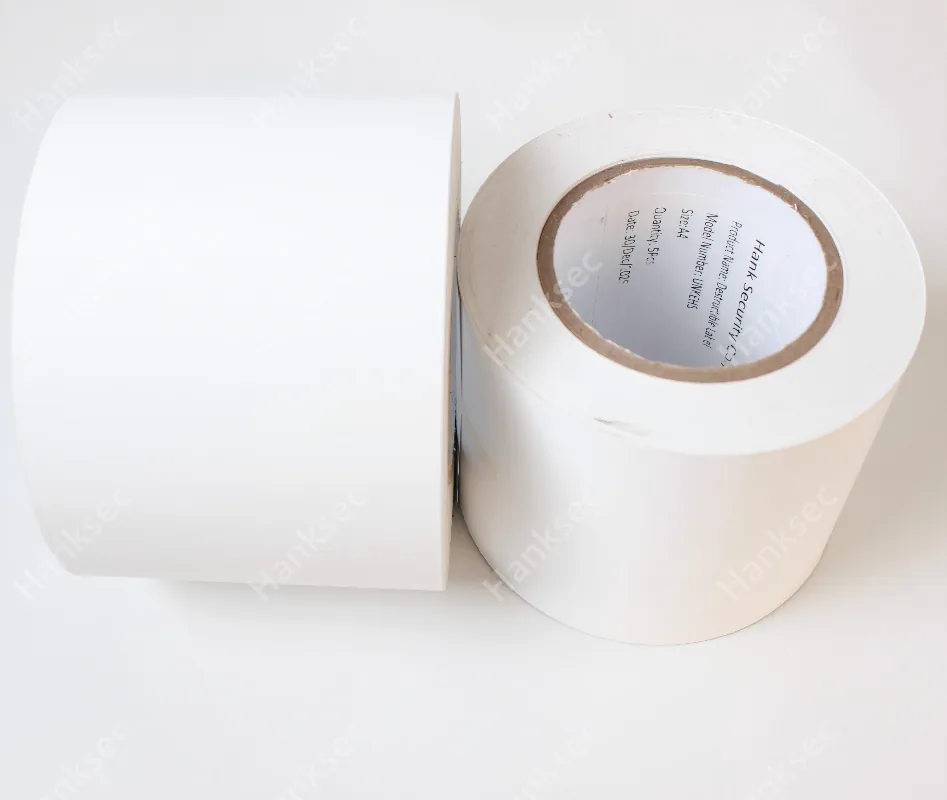
Resposta rápida:
Um sistema de etiquetas de segurança é uma construção multicamadas na qual o material frontal, o revestimento de segurança ou antiaderente, o sistema adesivo e o liner são projetados para funcionar em conjunto e criar evidências de violação controladas. Materiais de alta qualidade com evidência de violação apresentam desempenho consistente porque essas camadas funcionais são compatíveis com o substrato, o processo de impressão, o método de conversão e as condições reais de aplicação.
Por que os sistemas de materiais para etiquetas de segurança são mais complexos do que aparentam
At first glance, a security label material may look like a simple adhesive film. It may appear to be only a transparent label, a printed VOID pattern, a pressure-sensitive adhesive, and a release liner. From the outside, many products in the market look similar. They may even be described with similar words: tamper evident label, anti-counterfeit adhesive label, security barcode label, VOID label material, waterproof security sticker, or packaging security seal.
However, the real performance of a security label does not come from appearance alone. It comes from a controlled multi-layer material system.
A high-quality security label material must balance surface coating, face film, hidden message layer, color layer, carrier layer, adhesive behavior, release liner performance, printing compatibility, die-cutting stability, aging resistance, and final application performance. If one layer is unstable, the entire tamper-evident effect may fail.
This is why security label materials look easy, but are not easy to manufacture well.
A low-grade market sample may show a visible VOID effect in one picture, but fail when used on real packaging surfaces, during printing, after die-cutting, during storage, or after exposure to heat, humidity, friction, or transportation pressure. A premium security label material must perform consistently from sample testing to mass production, from roll to roll, and from one application surface to another.
For buyers, label converters, packaging companies, security printers, distributors, and brand protection projects, the real question is not only: “Can this label show a VOID message?” The more important question is: “Can this material deliver stable, repeatable, and controlled tamper evidence under real market conditions?”
That is the key difference between a low-cost appearance product and a high-quality engineered security label material system.
Global counterfeiting remains a serious supply-chain and consumer-safety problem. OECD reported in 2025 that counterfeit goods accounted for an estimated USD 467 billion in global trade in 2021, based on the latest available data in the OECD–EUIPO study. Esse contexto explica por que a segurança das embalagens, as tecnologias de autenticação e os materiais invioláveis estão se tornando cada vez mais importantes para os proprietários de marcas e para as indústrias regulamentadas.
What Is a Security Label Material System?
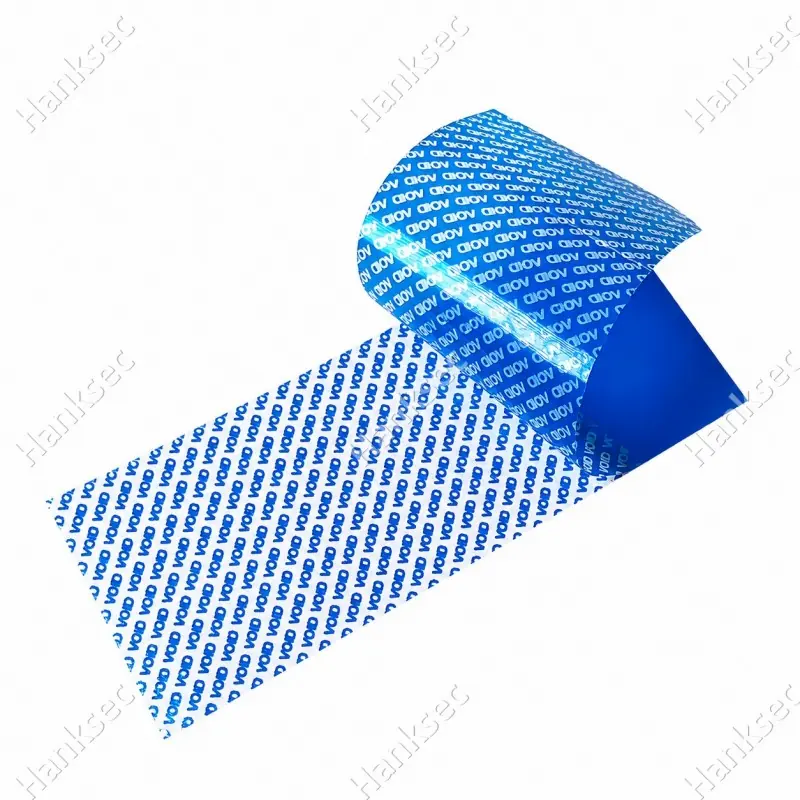
A security label material system is a multi-layer structure designed to reveal visible evidence when removal, opening, replacement, or tampering is attempted. Unlike ordinary pressure-sensitive labels, security label materials are not only used for decoration, identification, or barcode printing. They are designed to create a security response.
Estrutura central de um sistema de materiais para etiquetas de segurança
| Camada | Função |
|---|---|
| Material facial | Oferece superfície de impressão e proteção. |
| Revestimento de segurança | Controla mensagens ocultas ou efeitos de segurança |
| Camada de Liberação | Controla o comportamento de ativação por adulteração. |
| Camada adesiva | Cria ligação com o substrato |
| Revestimento de liberação | Protege o adesivo antes da aplicação. |
Para uma explicação mais detalhada da construção do material e do comportamento de transferência, consulte nosso VOID label material guia técnico.
This response may include:
- A VOID or OPEN VOID message after peeling
- A destroyed label surface
- Adhesive residue left on the applied surface
- A non-transfer effect with evidence remaining on the label
- A partial transfer effect between label and surface
- A full transfer message on the substrate
- A color-change or environmental indicator
- A customized hidden message, logo, pattern, serial number, QR code, or brand mark
A real security label material system must answer several technical questions at the same time:
Can the label bond properly to the target surface?
Can the hidden message remain invisible before use?
Can the message appear clearly after removal?
Can the adhesive behave in a controlled way?
Can the label be printed, slit, die-cut, rewound, and applied smoothly?
Can the material remain stable after storage, transportation, and climate changes?
Can the same effect be repeated in mass production?
This is why professional security label material manufacturing is not only a printing job. It is a material engineering process.
A OMPI explica As tecnologias de autenticação podem ajudar os peritos a distinguir produtos genuínos de falsificados, e os dispositivos de autenticação podem usar múltiplas camadas ou combinações de recursos visíveis, ocultos e forenses. Isso corrobora o princípio mais amplo de que a proteção eficaz contra falsificações geralmente depende de segurança em camadas, em vez de um único recurso visível.
Estrutura do material da etiqueta de segurança: como funciona cada camada funcional
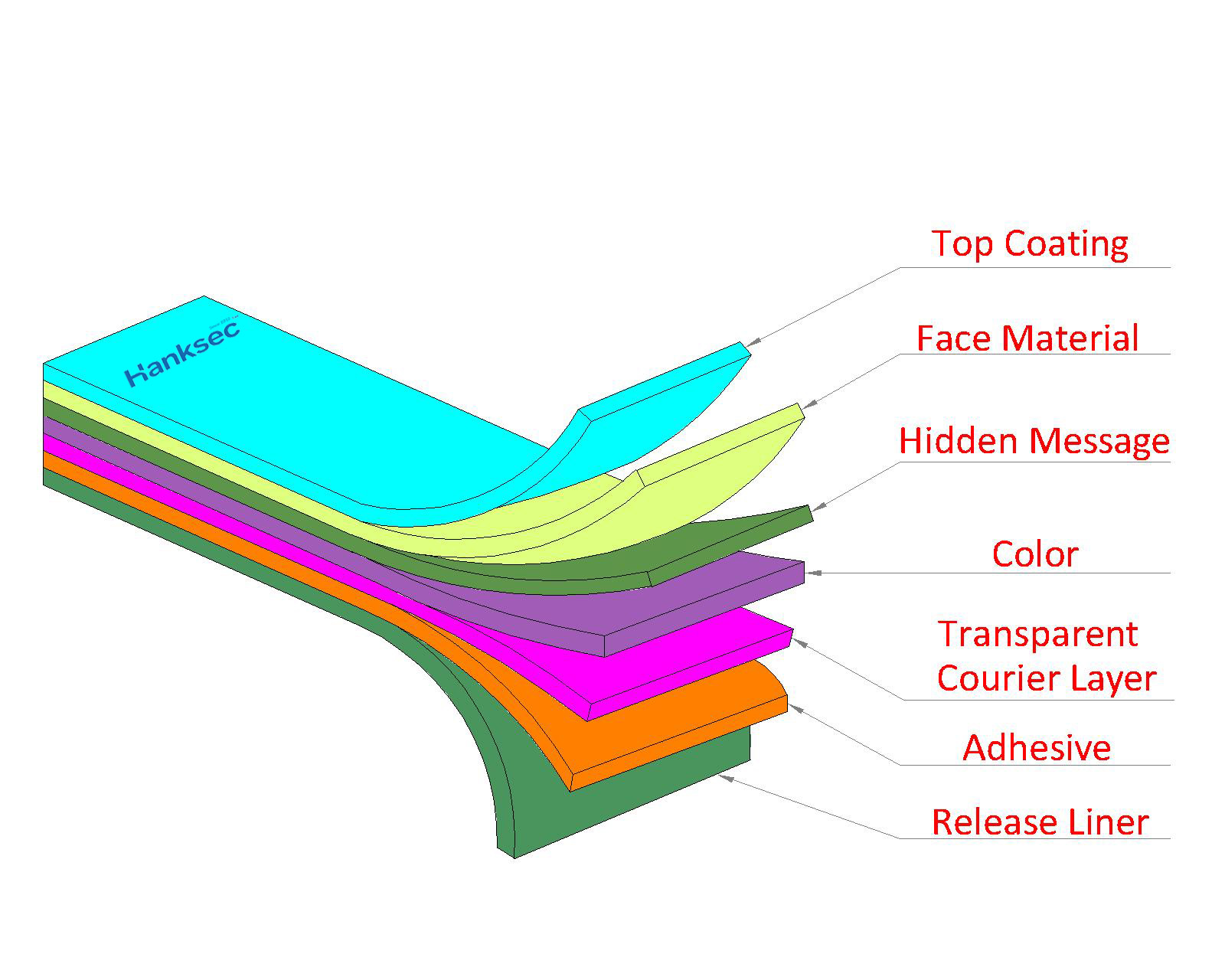
A typical tamper-evident security label material may include the following layers:
- Revestimento superior
- Material facial
- Hidden message layer
- Color layer
- Transparent carrier layer
- Adesivo
- Revestimento de liberação
Each layer may look thin and simple, but each one affects final performance. The challenge is not only to combine these layers. The challenge is to make them work together in a controlled way. Estruturas de mensagens ocultas controladas são amplamente utilizados em Etiquetas antifalsificação VOID Criar evidências visíveis e irreversíveis após a remoção.
Top Coating: More Than a Printable Surface
The top coating is the first surface that customers see, but its role is much deeper than appearance.
A stable top coating affects:
- Ink adhesion
- Printing compatibility
- Scratch resistance
- Barcode readability
- UV ink performance
- Digital printing performance
- Surface durability
- Resistance to handling friction
- Long-term visual stability
For label converters, top coating quality is extremely important. A material may look acceptable before printing, but if the top coating is unstable, it can cause ink peeling, poor barcode scanning, weak UV ink adhesion, color inconsistency, or surface scratches after handling.
For security label materials, poor top coating can create more serious problems. If the coating is too weak, the printed information may be damaged during application. If the coating is too strong or incompatible with the release system, the tamper-evident layer may not break correctly. If the coating is not suitable for the customer’s printing method, the converter may need repeated testing, additional primer, or extra production adjustments.
This is why high-quality security label materials must be developed with printing and converting in mind.
The label industry often uses standardized testing methods to evaluate self-adhesive materials. FINAT lists test methods covering peel adhesion, release force, accelerated ageing, UV resistance, shear resistance, loop tack, low-temperature adhesion, surface tension, ink adhesion, scratch resistance, and other performance areas. These categories show that label material quality depends on many factors, not only one visible effect.
Facestock: A Base Física do Sistema de Segurança
O material da face fornece a base física da etiqueta de segurança. Pode ser PET, PP, papel, filme destrutível, filme holográfico, filme transparente, filme prateado fosco ou outro substrato projetado. Para aplicações que exigem que o próprio material da face se rompa durante a remoção, materiais de etiquetas destrutíveis fornecer um mecanismo diferente à prova de adulteração.
- Thickness
- Flexibility
- Tear resistance
- Transparency
- Surface energy
- Dimensional stability
- Die-cutting behavior
- Label dispensing performance
- Peeling response
For example, a transparent VOID label material used on electronics packaging needs good clarity and clean visual appearance. A security label used on kraft paper packaging needs strong adhesion and a clear message contrast. A label used on cosmetics or premium retail packaging may require a cleaner appearance, better gloss control, or customized branding.
Low-grade materials often use face films that look similar at first, but they may not maintain stable dimensional performance. They can curl, shrink, deform, wrinkle, or create inconsistent tension during slitting and rewinding. These problems may not appear in a small sample, but they become costly during mass production.
Um material de alta qualidade para a face da etiqueta deve funcionar em conjunto com o revestimento superior, a camada de mensagem oculta, o adesivo e o liner de liberação. O objetivo não é apenas criar uma etiqueta, mas sim um resultado inviolável e controlado. Para aplicações que utilizam comportamento de transferência controlada, consulte nosso guia. Etiquetas antifalsificação VOID para soluções de segurança com transferência total, transferência parcial e sem transferência.
Hidden Message Layer: The Core of Tamper Evidence
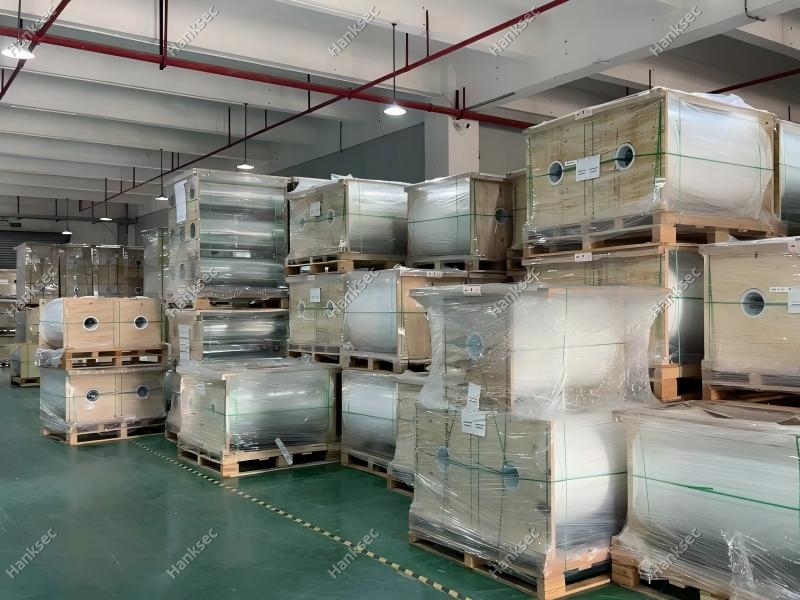
The hidden message layer is one of the most important parts of a VOID label material system.
Before application, the hidden message should remain controlled and should not create an obvious visual defect. After removal, the message should appear clearly, consistently, and permanently enough to show that the package or product has been opened or tampered with.
A good hidden message layer should achieve:
- Clear VOID or OPEN VOID display
- Stable pattern transfer
- Good contrast after peeling
- Controlled residue edge
- No premature message visibility before use
- No incomplete or blurred message after peeling
- Stable performance after storage
- Consistent effect across production batches
Low-grade market samples often fail in this layer. The hidden message may be too light, too thick, uneven, blurry, incomplete, or inconsistent. In some cases, the message appears only in part of the label. In other cases, the adhesive tears randomly, leaving an uncontrolled white patch instead of a clean security message.
This is one of the most important differences between a cheap security label and a high-quality tamper-evident material.
Security labels are not only about making a word appear. They are about controlling how, when, where, and how clearly that word appears.
Color Layer: Visual Contrast, Brand Identity, and Security Clarity
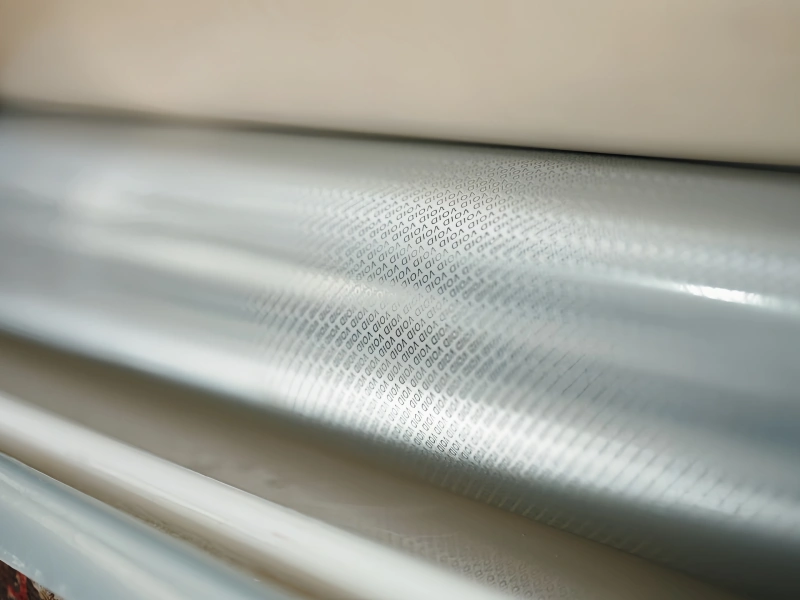
The color layer is often misunderstood as only a design or decoration layer. In reality, it plays an important role in security performance.
Color affects:
- VOID message visibility
- Contrast after peeling
- Brand recognition
- Product appearance
- Light blocking
- Transparency control
- Batch consistency
- Visual quality under different lighting conditions
A weak or unstable color layer can make the hidden message difficult to identify. It can also create inconsistent appearance between rolls, which is a major issue for B2B customers supplying brand owners.
In low-quality products, color difference may appear from batch to batch. The message may look strong in one sample but weak in another. Under light reflection, the label may show uneven coating marks, poor gloss control, or cloudy appearance. These defects reduce customer confidence.
A premium security label material uses controlled color and layer design to make the tamper evidence easy to read while maintaining a professional packaging appearance.
Transparent Carrier Layer: The Control Layer Behind the Effect
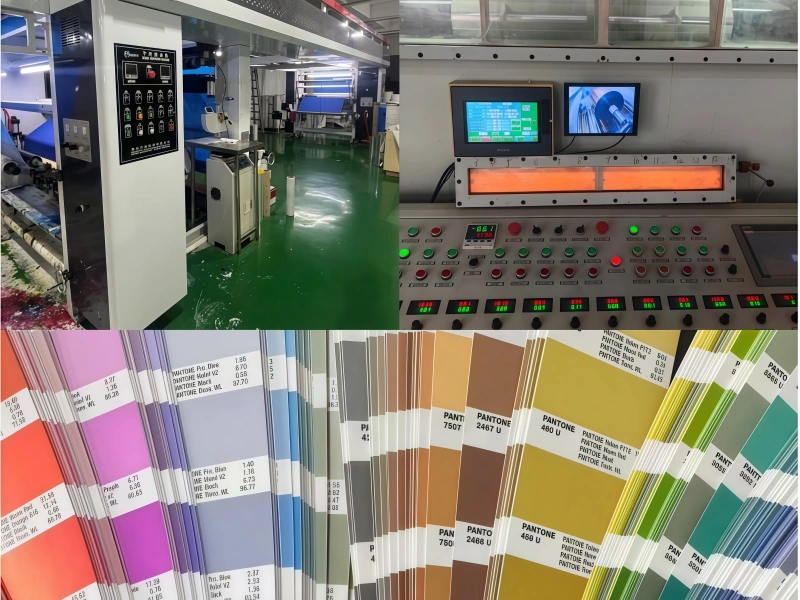
The transparent carrier layer is one of the hidden technical parts of the system. Customers may not see it directly, but it strongly affects the peeling result.
This layer helps control:
- Message transfer behavior
- Splitting position
- Residue boundary
- Full transfer effect
- Partial transfer effect
- Non-transfer effect
- Label transparency
- Final surface appearance
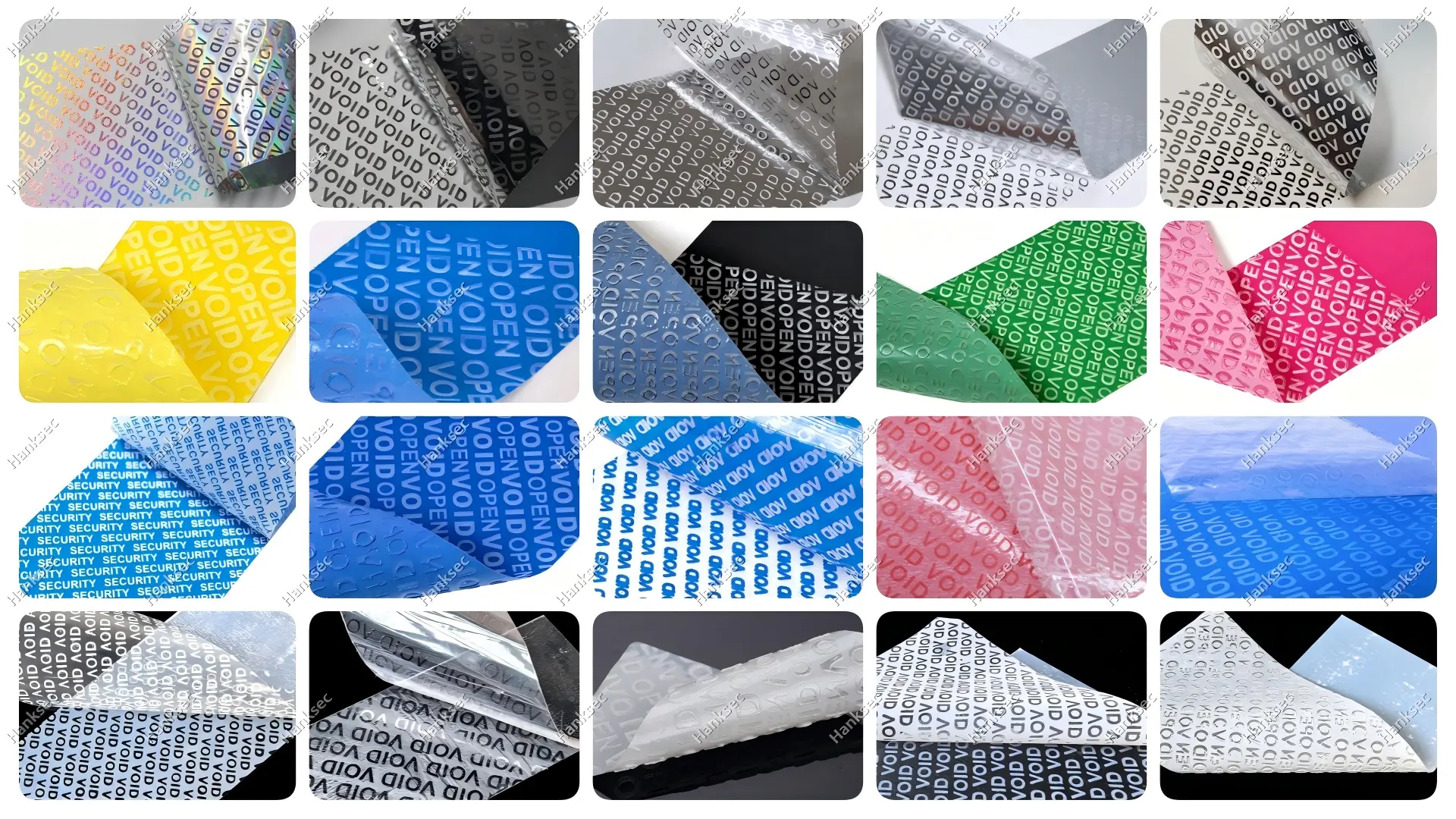
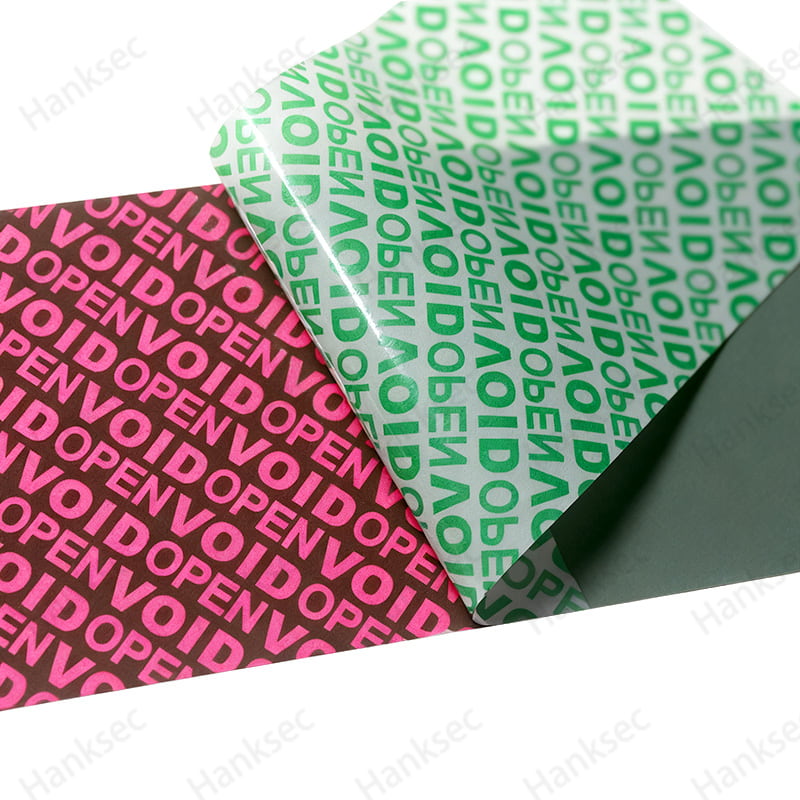
For full transfer VOID materials, the message transfers to the applied surface after peeling. For partial transfer materials, the residue splits between the label and surface. For non-transfer materials, the message appears on the label while the applied surface remains clean.
These effects depend on controlled layer separation. If the carrier layer is unstable, the material may peel randomly instead of revealing a designed message.
This is why the same product name does not mean the same quality. Two suppliers may both sell “VOID label material,” but the internal carrier design and layer control may be completely different.

Adesivo: a camada de ligação que ativa a resposta de segurança
O adesivo faz parte da estrutura de segurança multicamadas, pois controla a força de adesão da etiqueta ao substrato e se a resposta projetada de ausência de material, resíduo ou destruição será ativada durante a remoção. Portanto, a seleção do adesivo deve ser avaliada em conjunto com o material frontal, a estrutura de liberação e a superfície de aplicação real. Uma seção mais detalhada sobre adesivos encontra-se abaixo.
Release Liner: The Layer Many Buyers Ignore
The release liner is not the security function itself, but it strongly affects production performance.
A stable release liner supports:
- Smooth unwinding
- Stable die-cutting
- Easy waste removal
- Automatic labeling
- Roll flatness
- Rewinding quality
- Label dispensing
- Reduced production waste
Many low-cost materials use unstable release liners. The material may look fine in a photo, but during die-cutting the converter may face liner breakage, difficult waste removal, label lifting, adhesive bleeding, or inconsistent release force.
For B2B buyers, this creates hidden cost. A material with a cheaper unit price may cause slower production speed, more machine stoppage, higher waste rate, and more complaints from downstream customers.
This is why high-quality security label material must be evaluated as a complete roll material, not only as a small peeled sample.
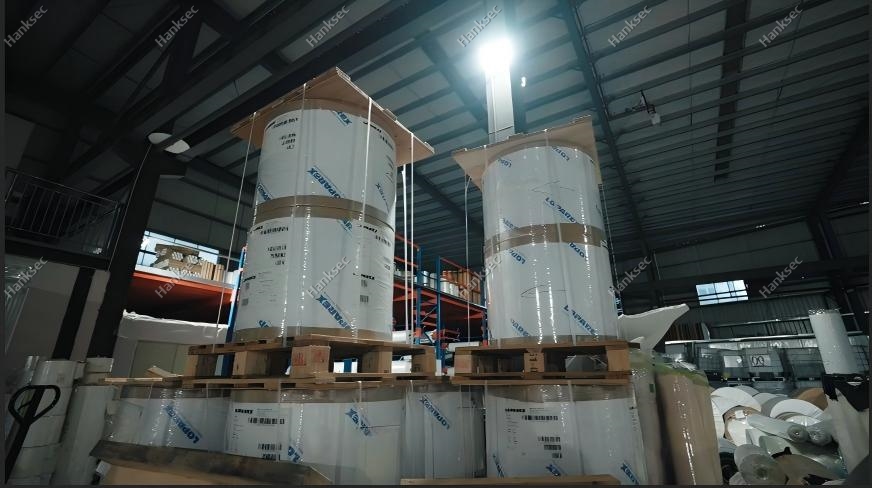
Materiais para a face da etiqueta de segurança: PET, papel, filmes holográficos e destrutíveis.
O material frontal determina grande parte do comportamento físico, do desempenho de impressão e da estabilidade de conversão de um sistema de etiquetas de segurança. A escolha correta depende da resistência à violação, da superfície de aplicação, do método de impressão, da durabilidade e do processo de conversão subsequente.
Materiais para etiquetas de segurança em PET
O PET é amplamente utilizado para Materiais de etiquetas de segurança VOID e invioláveis Isso ocorre porque proporciona estabilidade dimensional, resistência à tração e boa compatibilidade com revestimento, impressão, corte e conversão em bobina. O PET pode suportar construções de transferência total, parcial e sem transferência, mas a espessura e a rigidez do filme devem ser compatíveis com as dimensões do adesivo, do revestimento e do rótulo.
Materiais para etiquetas de segurança em papel
As estruturas de papel podem fornecer evidências de violação por meio de transferência de VOID (símbolo de produto inviolável), delaminação ou danos às fibras, sendo particularmente relevantes para caixas de papelão, documentos e embalagens à base de papel. O desempenho ainda depende do revestimento, do adesivo e da própria superfície da embalagem. Os compradores que avaliam essa opção podem consultar os relatórios da Hanksec. Guia de Etiquetas de Papel VOID.
Materiais de segurança holográficos
Os materiais holográficos adicionam uma camada de autenticação óptica. Quando também for necessária evidência de remoção, o recurso holográfico deve ser combinado com uma marcação VOID adequada, uma construção destrutiva ou outra à prova de adulteração, em vez de ser tratado como evidência de adulteração por si só. Veja Hanksec. Guia de Etiquetas Holográficas Para uma seleção detalhada.
Materiais de etiquetas destrutíveis
Os materiais destrutíveis são projetados de forma que a camada frontal se quebre, fragmente ou rasgue ao tentar removê-la. Seu desempenho depende do equilíbrio entre a fragilidade da camada frontal, a força adesiva e a estabilidade de conversão. Diferentes níveis de destruição podem ser necessários para impressão, corte e vinco, rotulagem automática e aplicação final. Consulte a Hanksec. Destructible Label Materials Guide.
Como funcionam os materiais de etiquetas de segurança invioláveis
Os materiais de etiquetas de segurança invioláveis funcionam através da interação controlada entre o material frontal, a camada de segurança ou de liberação, o adesivo e a superfície de aplicação.
Antes da remoção, as camadas funcionais permanecem unidas em uma estrutura projetada. Quando a remoção é tentada, o sistema se separa ou falha em uma interface controlada. Dependendo da construção, essa ação pode deixar uma mensagem de "VOID" ou "OPENED" no substrato, dividir o padrão de segurança entre duas superfícies, revelar evidências no rótulo removido ou destruir fisicamente a face do rótulo.
O ponto importante é que a evidência de violação não é criada por uma única camada. Um desempenho confiável resulta do equilíbrio entre a adesão da camada, a força de desprendimento, o comportamento do material de superfície e a ligação ao substrato. É por isso que dois materiais de segurança que parecem semelhantes antes da aplicação podem se comportar de maneira muito diferente após a remoção.
Tipos de sistemas de materiais para etiquetas de segurança
Os materiais para etiquetas de segurança podem ser projetados para diferentes níveis de resistência à remoção. A estrutura principal deve ser selecionada de acordo com o local onde o comprador deseja que a evidência de violação apareça e o nível de resíduo ou dano físico aceitável.
Materiais VOID de transferência total
Os materiais VOID de transferência total são projetados para deixar fortes evidências visíveis, principalmente na superfície de aplicação, após a remoção. São comumente considerados para caixas de papelão, embalagens e outras aplicações onde resíduos permanentes são aceitáveis.
Materiais VOID de transferência parcial
Os materiais VOID de transferência parcial dividem a evidência visível de violação entre o rótulo removido e o substrato. Isso cria evidências em ambos os lados e pode fornecer uma opção equilibrada quando a transferência completa não é necessária.
Materiais VOID sem transferência
Os materiais VOID sem transferência são projetados para revelar adulterações principalmente dentro do rótulo, mantendo a superfície de aplicação mais limpa. Eles podem ser úteis para eletrônicos, vidro e outras superfícies onde resíduos adesivos visíveis e fortes são indesejáveis.
Materiais de segurança destrutíveis
As construções destrutíveis utilizam falhas controladas na face do rótulo, em vez de dependerem apenas da transferência de uma mensagem VOID. Quando se tenta removê-lo, o rótulo fratura ou fragmenta-se, de modo que não pode ser removido intacto e reutilizado.
Materiais holográficos invioláveis
Os materiais holográficos à prova de adulteração combinam autenticação óptica com um mecanismo independente de evidência de remoção, como a transferência VOID ou comportamento destrutivo. O efeito holográfico aprimora a autenticação visual, enquanto a construção do material determina a resposta real à adulteração.
Para uma comparação mais abrangente dessas categorias de rótulos, consulte o artigo de Hanksec. Etiquetas de segurança: tipos, materiais e guia de seleção.
Materiais para etiquetas de segurança VOID com baixo e alto resíduo
O nível de resíduo descreve a quantidade de material visível ou vestígio de adesivo que permanece na superfície de aplicação após a remoção.
Construções com alto teor de resíduos São concebidos para deixar evidências visíveis mais fortes no substrato e são comumente usados onde é necessária uma indicação óbvia de violação. Construções com baixo resíduo Reduzir a quantidade de material deixado no substrato, proporcionando ainda uma resposta visível de remoção.
O nível de resíduo não deve ser tratado como o mesmo conceito que transferência total, transferência parcial ou ausência de transferência. O tipo de transferência descreve como o padrão de segurança se separa, enquanto o nível de resíduo descreve a quantidade e o tipo de evidência que permanece na superfície. A combinação necessária deve ser selecionada de acordo com o substrato e a aparência esperada após a remoção.
Sistemas de etiquetas adesivas de segurança: por que a adesão controla a evidência de violação
Adhesive is often the real key to success or failure.
A security label adhesive must do more than stick. It must stick in a controlled way, release in a controlled way, and interact with the hidden message layer in a predictable way.
A high-quality adhesive system should consider:
- Initial tack
- Final adhesion
- Surface compatibility
- Temperature resistance
- Humidity resistance
- Residue control
- Aging stability
- Peel force consistency
- Low-temperature performance
- High-temperature storage
- Compatibility with packaging materials
Low-grade security label materials often fail because the adhesive is not properly balanced. Common problems include:
- Weak bonding on cartons
- Poor adhesion on plastic
- Adhesive overflow
- Incomplete VOID transfer
- Random tearing
- Residue that looks dirty
- Edge lifting
- Performance change after storage
- Poor performance in cold or humid environments
- Unstable effect on coated packaging
For ordinary labels, adhesive failure may mean the label falls off. For security labels, adhesive failure means the security function fails.
ASTM D3330/D3330M-04(2025) Fornece métodos padronizados para avaliar a adesão por descascamento de fitas adesivas sensíveis à pressão e pode ser usado para comparações de garantia de qualidade dentro de um mesmo rolo, entre rolos diferentes ou entre lotes de produção. Para materiais de etiquetas de segurança, o comportamento de descascamento controlado é um aspecto útil na avaliação da consistência do adesivo e da compatibilidade com o substrato.
O Métodos de teste FINAT Forneça métodos de referência adicionais relevantes para materiais de etiquetas autoadesivas. Exemplos incluem FTM 2 para adesão por descascamento a 90 graus, FTM 4 para força de liberação em alta velocidade relevante para a remoção da matriz, FTM 5 para envelhecimento acelerado e FTM 9 para aderência da alça. O teste apropriado deve ser selecionado de acordo com a propriedade que está sendo avaliada, em vez de tratar um único valor de adesão como uma medida completa do desempenho da etiqueta.
Para a seleção de adesivos específicos para substratos em PP, PE, HDPE, PET, vidro e embalagens revestidas, consulte a Hanksec. Guia de Adesivos para Etiquetas de Segurança.
Opções de materiais para etiquetas de segurança personalizadas
Os materiais para etiquetas de segurança podem ser personalizados tanto no nível do sistema de materiais quanto no nível de conversão. Os compradores devem primeiro definir a resposta à violação necessária e, em seguida, confirmar as especificações visuais, de impressão e de fornecimento.
| Item de personalização | Opções típicas |
|---|---|
| Facestock | PET, papel, holográfico, destrutível ou outras construções especiais |
| Espessura do filme | Selecionados de acordo com os requisitos de durabilidade, impressão e conversão. |
| Cor e acabamento | Efeitos transparentes, brancos, prateados, personalizados, brilhantes, foscos ou holográficos. |
| Mensagem de segurança | VAZIO, ABERTO, logotipo ou texto/padrão oculto personalizado |
| Resposta de transferência | Transferência total, transferência parcial, ausência de transferência ou resposta destrutiva |
| Adesivo | Selecionado de acordo com os requisitos de substrato, temperatura, tempo de permanência e resíduo. |
| Revestimento de acabamento | Compatível com processos de impressão UV, flexográfica, por transferência térmica, digital ou outros. |
| Segurança adicional | Efeitos holográficos, características UV, números de série, códigos de barras, códigos QR ou características termocrômicas. |
| Revestimento de liberação | Papel glassine, PET ou outro revestimento, de acordo com os requisitos de conversão. |
| Especificação do rolo | Largura, comprimento, núcleo e direção de enrolamento personalizáveis. |
Especificações do material da etiqueta de segurança que os compradores devem confirmar.
Um pedido de amostra torna-se mais eficiente quando o comprador fornece as especificações técnicas que afetam tanto a resposta à adulteração quanto o desempenho da conversão.
| Especificação | O que os compradores devem confirmar |
|---|---|
| Facestock | Filmes de PET, papel, holográficos, destrutíveis ou especiais |
| Thickness | Espessura necessária do revestimento frontal e quaisquer restrições de construção total. |
| Adesivo | Substrato de aplicação, aderência inicial, adesão final e requisitos ambientais |
| Revestimento de liberação | Papel glassine, revestimento PET ou outro revestimento exigido pelo conversor. |
| Tipo de transferência | Transferência total, transferência parcial, ausência de transferência ou resposta destrutiva |
| Mensagem oculta | VAZIO, ABERTO, logotipo ou texto/padrão personalizado |
| Compatibilidade de impressão | Flexografia, UV, transferência térmica, digital, serigrafia ou outros processos |
| Formato de fornecimento | Rolo jumbo, rolo cortado, folha ou etiqueta acabada |
| Dimensões do rolo | Largura, comprimento, diâmetro do núcleo e direção de enrolamento. |
| Condições de candidatura | Superfície, temperatura, umidade, armazenamento e tempo de permanência |
Formatos de fornecimento de material para etiquetas de segurança: rolos jumbo, rolos cortados, folhas e etiquetas acabadas.
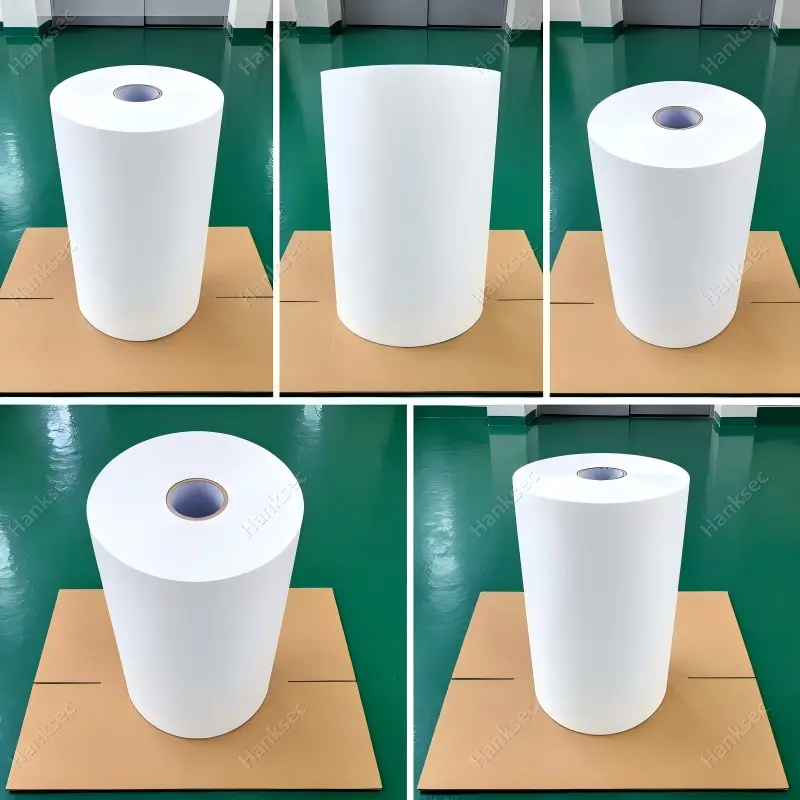
Os materiais para etiquetas de segurança podem ser fornecidos em diferentes formatos, dependendo do processo de produção do comprador. As empresas de conversão de etiquetas geralmente exigem Rolos jumbo ou rolos cortados de material para etiquetas VOID para impressão, corte e conversão posterior, enquanto outros clientes podem exigir folhas ou etiquetas acabadas prontas para aplicação direta.
| Formato de fornecimento | Comprador típico / Uso | Principais detalhes a confirmar |
|---|---|---|
| Rolos gigantes | Conversores de etiquetas e impressoras de segurança | Largura principal, comprimento do rolo, núcleo, consistência de enrolamento e revestimento |
| Rolos cortados | Conversores que exigem larguras de produção mais estreitas | Tolerância de largura final, comprimento do rolo, núcleo e direção de enrolamento |
| Folhas | Impressão em folhas soltas ou conversão especializada | Tamanho da folha, planicidade do revestimento e compatibilidade de impressão |
| Etiquetas finalizadas | Proprietários de marcas, operações de embalagem e usuários diretos | Tamanho, formato, espaçamento, sentido de enrolamento, método de impressão e aplicação da etiqueta. |
O formato de fornecimento deve ser confirmado em conjunto com o equipamento subsequente, pois a geometria do rolo, a escolha do revestimento e a direção do enrolamento podem afetar a impressão, o corte e vinco, a remoção da matriz e a dispensação automática.
Como os materiais para etiquetas de segurança são fabricados: do revestimento ao corte
Os materiais para etiquetas de segurança são fabricados como um sistema multicamadas coordenado, em vez de um filme adesivo padrão. O processo de fabricação deve controlar a interação entre o material da face, o revestimento de segurança, o comportamento de liberação, o sistema adesivo e o liner, de modo que a evidência de violação necessária permaneça consistente após a remoção.
1. Seleção do Material da Face
Os substratos PET, BOPP, papel, filme holográfico ou outros são selecionados de acordo com os requisitos de impressão, estabilidade dimensional, durabilidade e a superfície de aplicação final.
2. Tratamento de Superfície e Revestimento Funcional
O tratamento corona, a aplicação de primer ou de revestimentos superiores imprimíveis podem melhorar a fixação da tinta e a compatibilidade do revestimento antes da produção das camadas de segurança.
3. Formação de padrões de segurança e camadas de lançamento
O logotipo oculto VOID, OPENED ou o padrão de segurança personalizado é criado em conjunto com um sistema de liberação controlada. O equilíbrio do revestimento determina como o material se separa durante a remoção.
4. Seleção e Revestimento do Sistema Adesivo
A escolha do adesivo sensível à pressão leva em consideração o tipo de substrato, a energia superficial, a temperatura, o tempo de contato e o comportamento desejado dos resíduos. O adesivo deve funcionar em conjunto com o sistema de desmoldagem, e não apenas proporcionar a máxima resistência ao descascamento.
5. Laminação, estabilização e conversão
O material revestido é laminado com o revestimento protetor apropriado e estabilizado antes do corte, impressão ou posterior conversão em bobinas prontas para conversão ou etiquetas acabadas.
6. Inspeção de Qualidade e Testes em Aplicações Reais
Os materiais de segurança finalizados devem ser avaliados quanto à consistência do revestimento, desempenho do adesivo, comportamento de transferência, compatibilidade de impressão, liberação do liner e desempenho real do substrato antes da produção em massa.
Na Hanksec, o desenvolvimento de materiais de segurança é validado de acordo com o substrato real do cliente, o processo de impressão e o comportamento de violação exigido, pois um material que funciona corretamente em vidro pode se comportar de maneira diferente em caixas revestidas, ABS, PP, PE ou metal pintado. Saiba mais sobre a Hanksec capacidades de fabricação de material para etiquetas de segurança e processo de produção em fábrica.
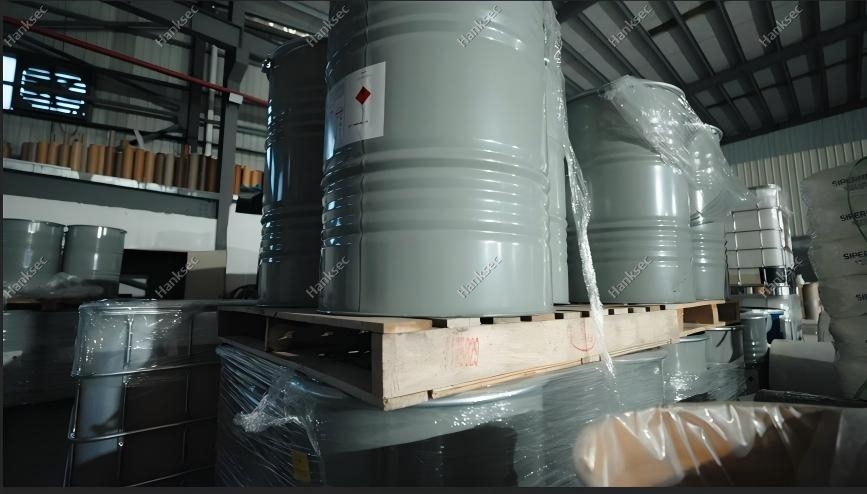
Conversão de etiquetas de segurança: impressão, corte longitudinal, corte e vinco e remoção de matrizes.
A fabricação do material de segurança é apenas a primeira etapa. O material também deve funcionar de forma confiável no equipamento real do cliente.
As etapas importantes de conversão incluem impressão, corte longitudinal, rebobinagem, corte e vinco, remoção da matriz e dispensação automática. Para convertedores que utilizam processos de impressão UV, flexográfica, por transferência térmica ou digital, compatibilidade de impressão do material da etiqueta de segurança deve ser avaliado em conjunto com o desempenho do revestimento superior. Mesmo um material corretamente projetado pode criar dificuldades de produção se o revestimento superior, o liner, o adesivo, a profundidade de corte, a geometria de remoção ou as configurações da máquina não forem adequados à aplicação.
Portanto, os convertedores devem qualificar os materiais de segurança como parte do fluxo de trabalho completo de produção, em vez de julgá-los apenas por uma amostra retirada manualmente. Para um exemplo real de como a construção do material e as condições de conversão interagem, veja o caso da Hanksec. Caso do cliente: Remoção de matriz de etiquetas em alta temperatura.
Requisitos de desempenho essenciais de um sistema de materiais para etiquetas de segurança confiável
Why Low-Grade Market Samples Can Look Similar Before Use
One of the biggest challenges in this industry is that low-grade products can look similar before application.
A buyer may compare product photos and think:
“The VOID pattern is visible.”
“The price is lower.”
“The supplier says it is waterproof.”
“The label can be customized.”
“The sample shows a peeling effect.”
But security label performance cannot be judged only by one photo.
The real test is:
What happens after printing?
What happens after die-cutting?
What happens on kraft paper?
What happens on coated boxes?
What happens on plastic?
What happens after 30 days of storage?
What happens in hot shipping containers?
What happens in winter transportation?
What happens when a customer tries to remove it slowly?
What happens when the label is applied by machine at high speed?
What happens across 10 rolls, 100 rolls, or repeat orders?
Low-grade products often pass a simple visual test but fail in real production.
This is the difference between a sample effect and a material system.
Materiais para etiquetas de segurança de alta e baixa qualidade
The following comparison helps buyers understand the real difference.
| Ponto de comparação | High-Quality Security Label Material | Low-Quality Market Material |
|---|---|---|
| Layer Design | Each layer is designed to work as a controlled system | Layers may be combined mainly for appearance and low cost |
| Mensagem oculta | Clear, consistent, and controlled after removal | Message may be blurred, incomplete, uneven, or too light |
| Adhesive Performance | Balanced adhesion for different surfaces and environments | Adhesion may fail, overflow, dry out, or leave uncontrolled residue |
| Peeling Effect | Stable tamper evidence after opening attempt | VOID effect may appear randomly or fail to transfer properly |
| Compatibilidade de superfície | Tested on plastic, metal, glass, cartons, coated boxes, and other surfaces | May work only on limited surfaces or only under ideal conditions |
| Printing Performance | Stable top coating for ink adhesion and barcode readability | Ink may scratch, peel, fade, or fail after printing |
| Die-Cutting Performance | Smooth die-cutting, stable liner release, easy waste removal | Edge lifting, liner breakage, difficult waste removal |
| Aging Resistance | Stable after storage, shipping, heat, and humidity changes | Performance may change after storage or transportation |
| Batch Consistency | Consistent effect from roll to roll and batch to batch | Color, adhesive, and VOID effect may vary |
| Real Cost | Reduces waste, complaints, and repeated testing | Low price may cause production loss and customer claims |
Image Comparison: Budget Market Samples vs Premium Controlled Samples
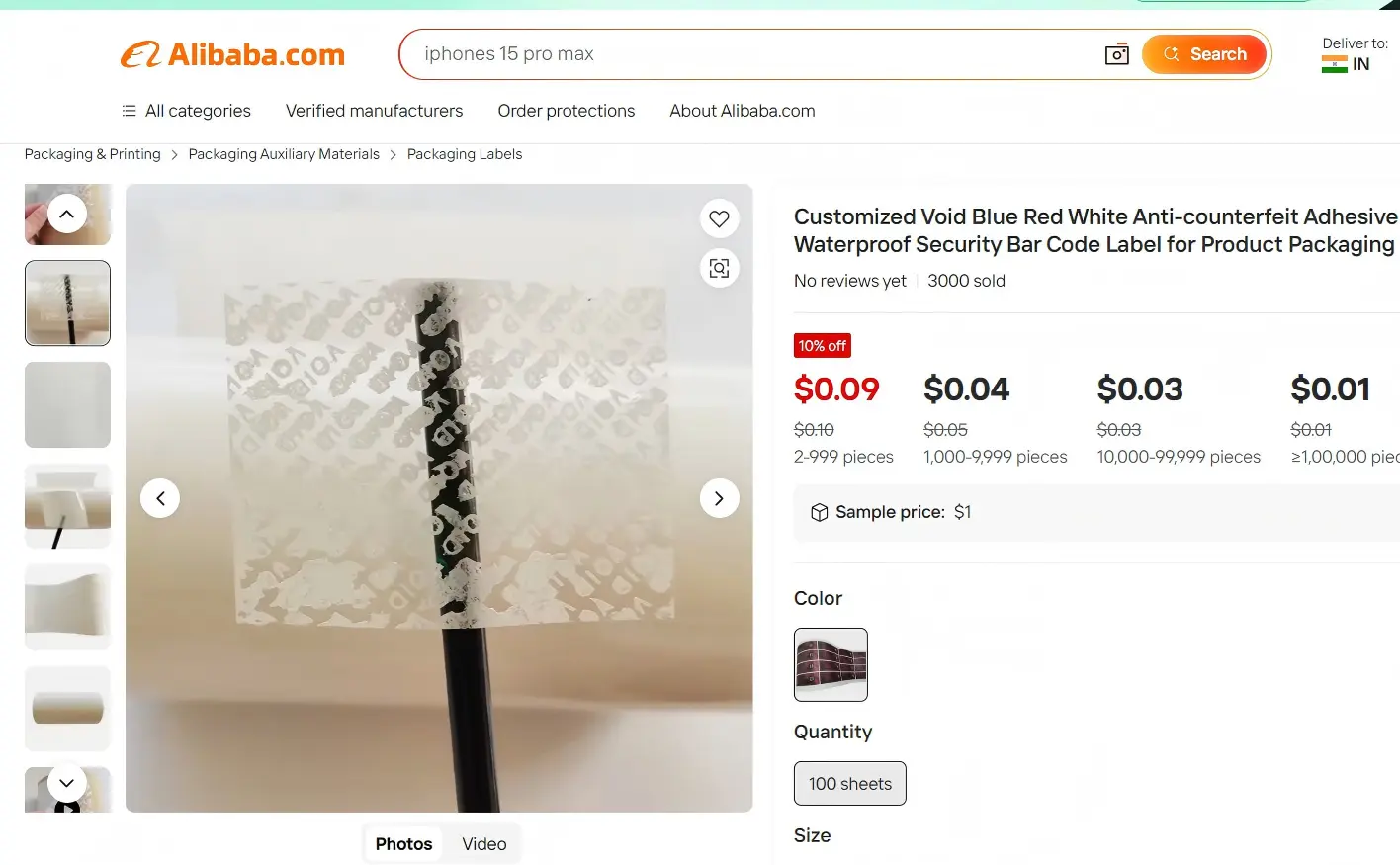
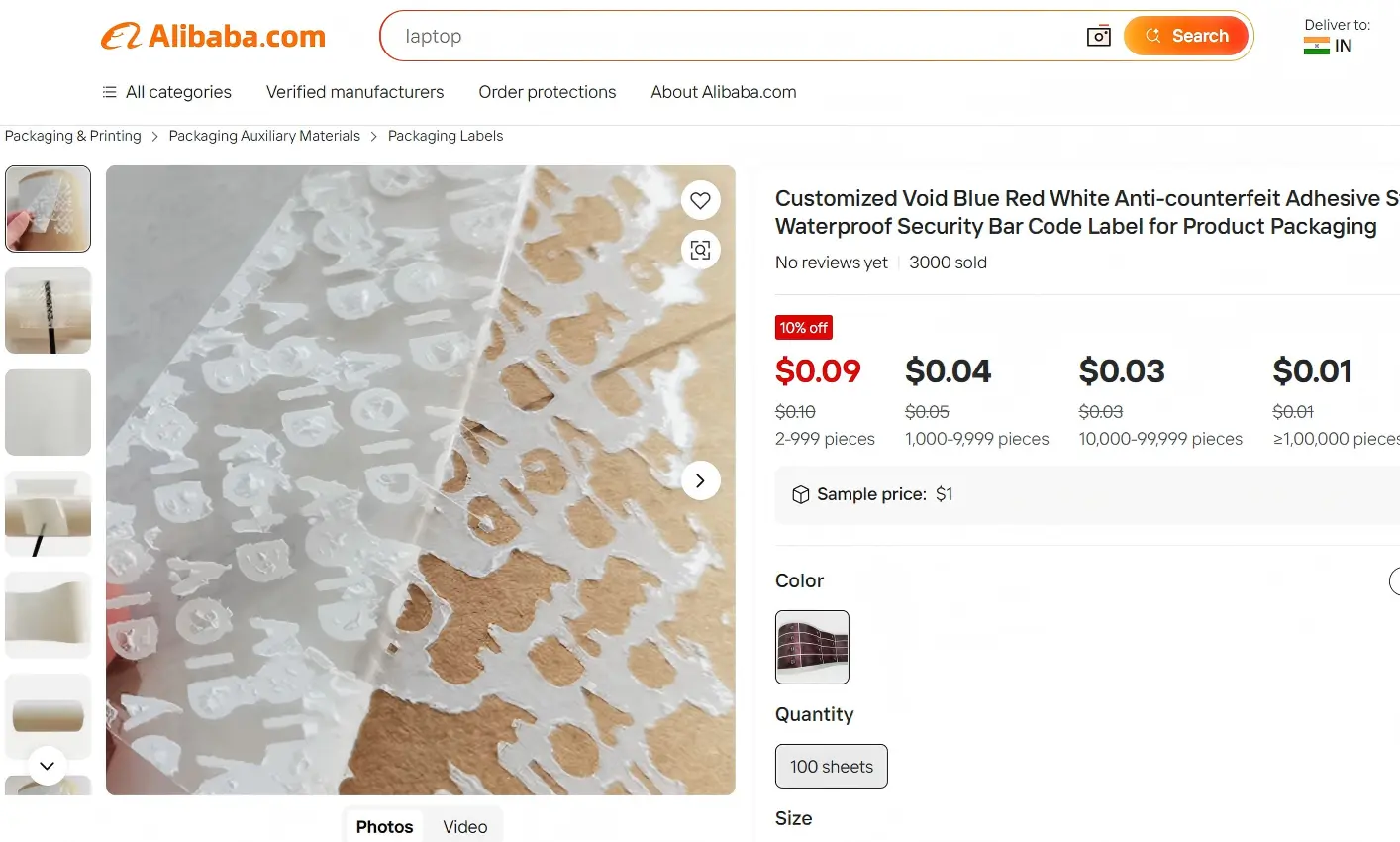
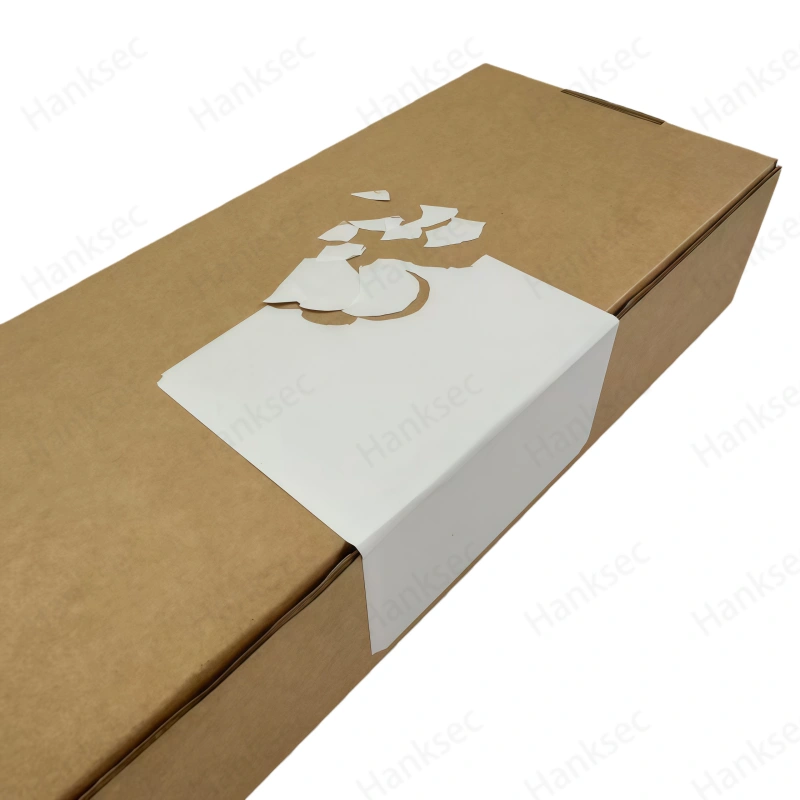
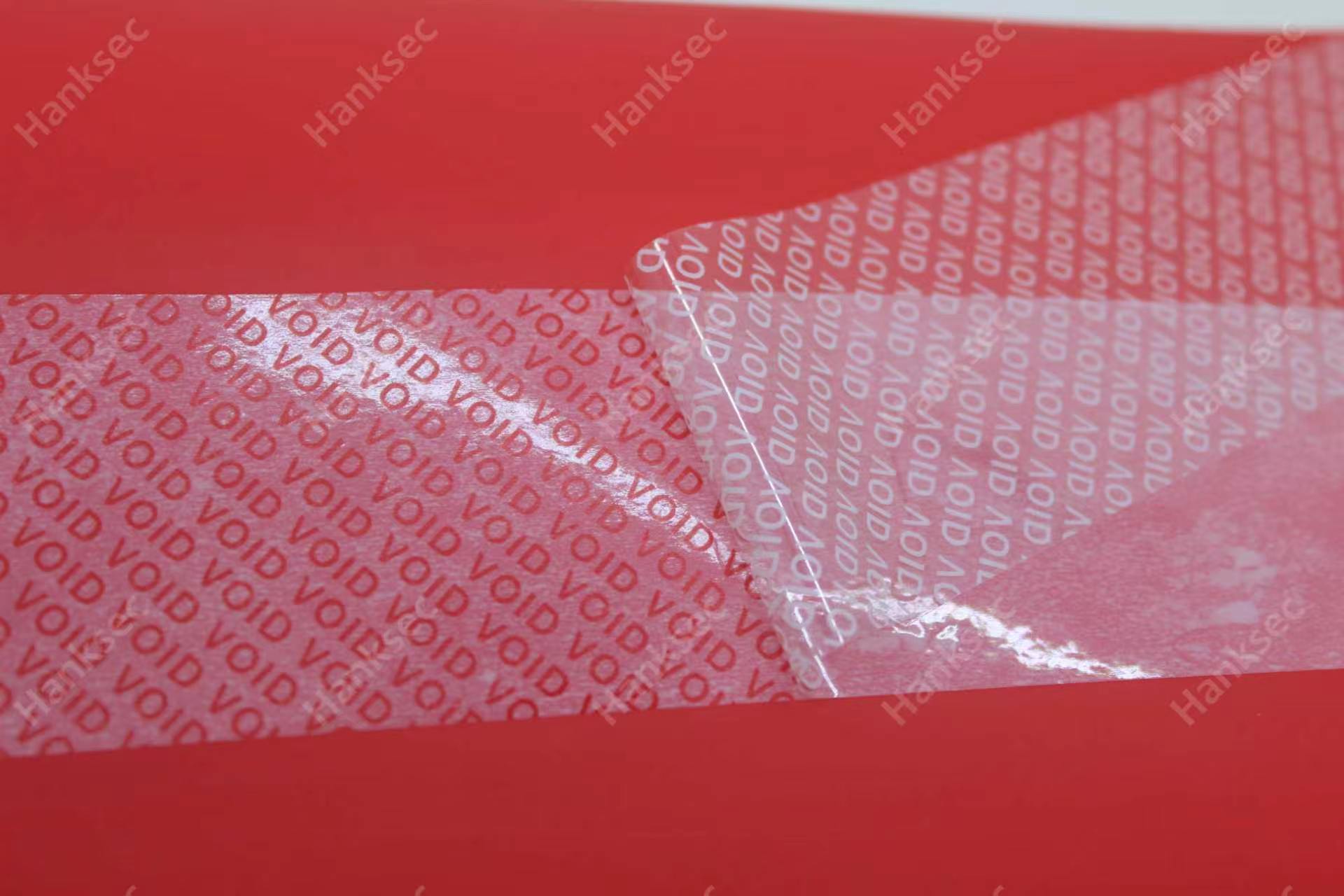
budget void label material with uneven peeling effect on packaging surface
Algumas amostras de mercado de baixa qualidade podem apresentar um efeito VOID visível, mas a borda residual, a clareza da mensagem, o comportamento adesivo e a aparência da superfície podem não permanecer estáveis o suficiente para aplicações profissionais de proteção de marca.
Common Problems Found in Low-Quality Security Label Materials
Low-grade security label materials often fail in ways that are not obvious before purchase.
1. Unclear VOID Message
The VOID message may appear too light, too heavy, blurry, incomplete, or uneven. This reduces the ability to show clear tamper evidence.
2. Random Adhesive Residue
Instead of a controlled message, the adhesive may tear randomly and leave messy patches. This looks unprofessional and may not meet brand protection requirements.
3. Weak Adhesion
The label may not bond strongly enough to cartons, plastics, coated boxes, or other packaging surfaces. If the label can be removed without clear evidence, the security function is weakened.
4. Edge Lifting
Poor adhesive or poor material tension may cause edges to lift after application. This affects both appearance and security.
5. Poor Printing Performance
Ink may scratch, peel, fade, or fail to bond properly with the top coating. This is especially problematic for barcode labels, QR codes, brand logos, and variable data printing.
6. Die-Cutting Waste
Unstable liners and face materials can cause difficult waste removal, liner tearing, or label lifting during converting.
7. Poor Aging Resistance
Some materials look acceptable at first but fail after storage, shipping, heat, humidity, or UV exposure. FINAT includes test categories such as accelerated ageing and UV resistance, showing that long-term stability is an important part of self-adhesive material evaluation.
8. Inconsistent Batch Quality
One roll may work, while the next roll performs differently. For B2B production, this is a serious risk.
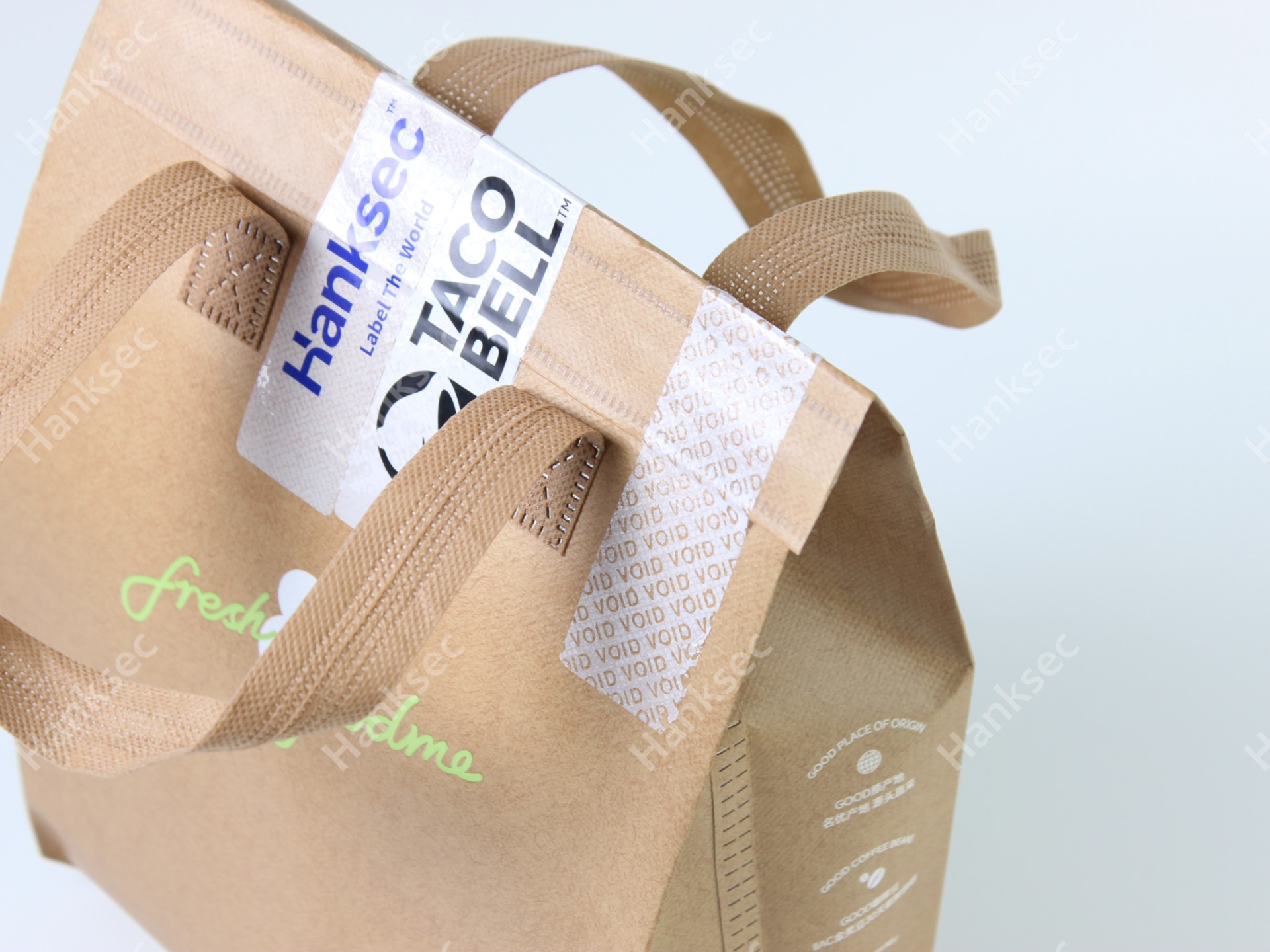
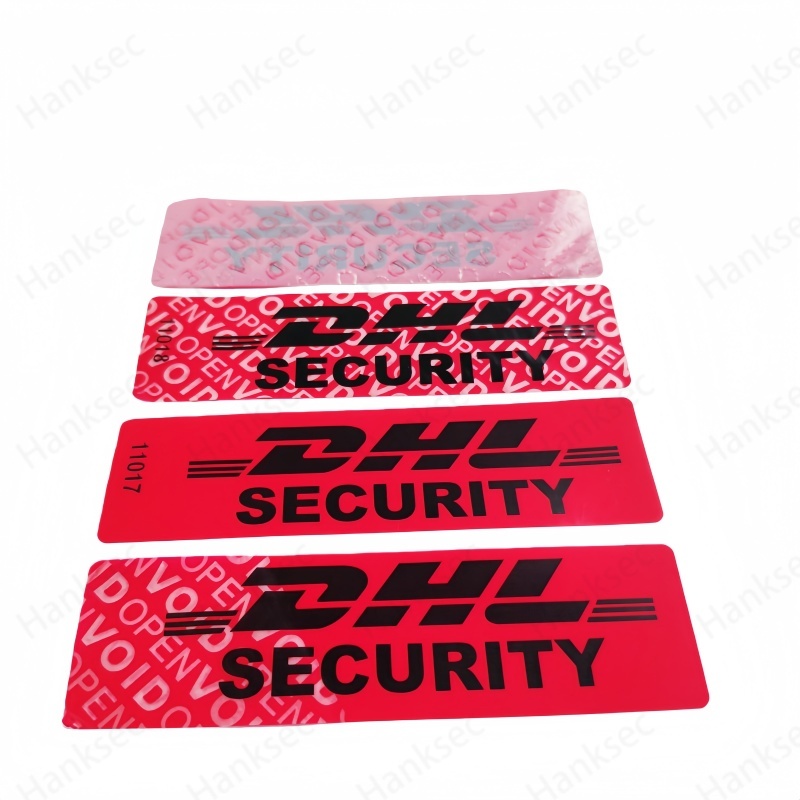
Etiqueta VOID inviolável aplicada em embalagens de varejo para fins de proteção da marca.
Why Market Requirements Keep Changing
Os materiais para etiquetas de segurança não podem permanecer os mesmos para sempre. As exigências do mercado continuam a mudar porque as embalagens, a logística, a impressão, os métodos de falsificação e as regulamentações de embalagens estão em constante evolução. Na Europa, Regulamento da UE sobre Embalagens e Resíduos de Embalagens (PPWR), Regulamento (UE) 2025/40, está a dar cada vez mais atenção ao design de embalagens, à compatibilidade de materiais e às considerações de reciclabilidade. Estes desenvolvimentos também estão a aumentar o interesse em Etiquetas de papel VOID e outras estruturas de segurança projetadas para caixas de papelão e sistemas de embalagem. Aplicações de maior risco também pode exigir adesivo inviolável anti-calor Materiais projetados para preservar evidências visíveis de adulteração durante ataques térmicos.
Today’s customers may require:
- Cleaner non-residue labels for electronics
- Stronger transfer labels for carton security
- Partial transfer labels for balanced visual appearance
- Custom logo VOID messages
- QR code or barcode integration
- Digital printing compatibility
- Better performance on coated boxes
- Better adhesion on low-energy plastic
- More stable performance in hot and humid climates
- Security tapes for e-commerce packaging
- Destructible labels for warranty protection
- Paper-based security materials for sustainable packaging
This is why a strong supplier cannot only sell one fixed formula. A professional factory must continuously adjust material systems according to market feedback.
Por exemplo, uma empresa de conversão de etiquetas pode precisar de um revestimento superior melhor para impressão digital. Uma empresa de embalagens pode precisar de uma adesão mais forte em caixas de papelão reciclado. O proprietário de uma marca pode precisar de um efeito antitransferência mais limpo em eletrônicos premium. Um distribuidor pode precisar de um estoque estável de material para entrega rápida. Cada exigência do mercado altera o design do material.
This is the real value of a technical security label material manufacturer.
Why High-Quality Materials Reduce Total Cost
Low-grade materials may look cheaper per piece, but the real cost for B2B customers includes more than the unit price.
O custo total inclui:
- Tempo de teste da amostra
- Failed printing trials
- Die-cutting waste
- Machine downtime
- Rework cost
- Customer complaints
- Delayed delivery
- Repeat testing
- Lost trust from brand owners
- Lost market opportunities
A security label material that fails during production can cost much more than the price difference between a low-grade product and a premium product.
For label converters, production efficiency is critical. If a material causes unstable release, difficult waste removal, or poor printing adhesion, the converter loses time and money. For distributors, inconsistent quality can damage customer relationships. For brand owners, unclear tamper evidence can weaken the protection value of the packaging.
High-quality materials help reduce these hidden costs.
This is why professional buyers should evaluate security label materials by system performance, not only by price.
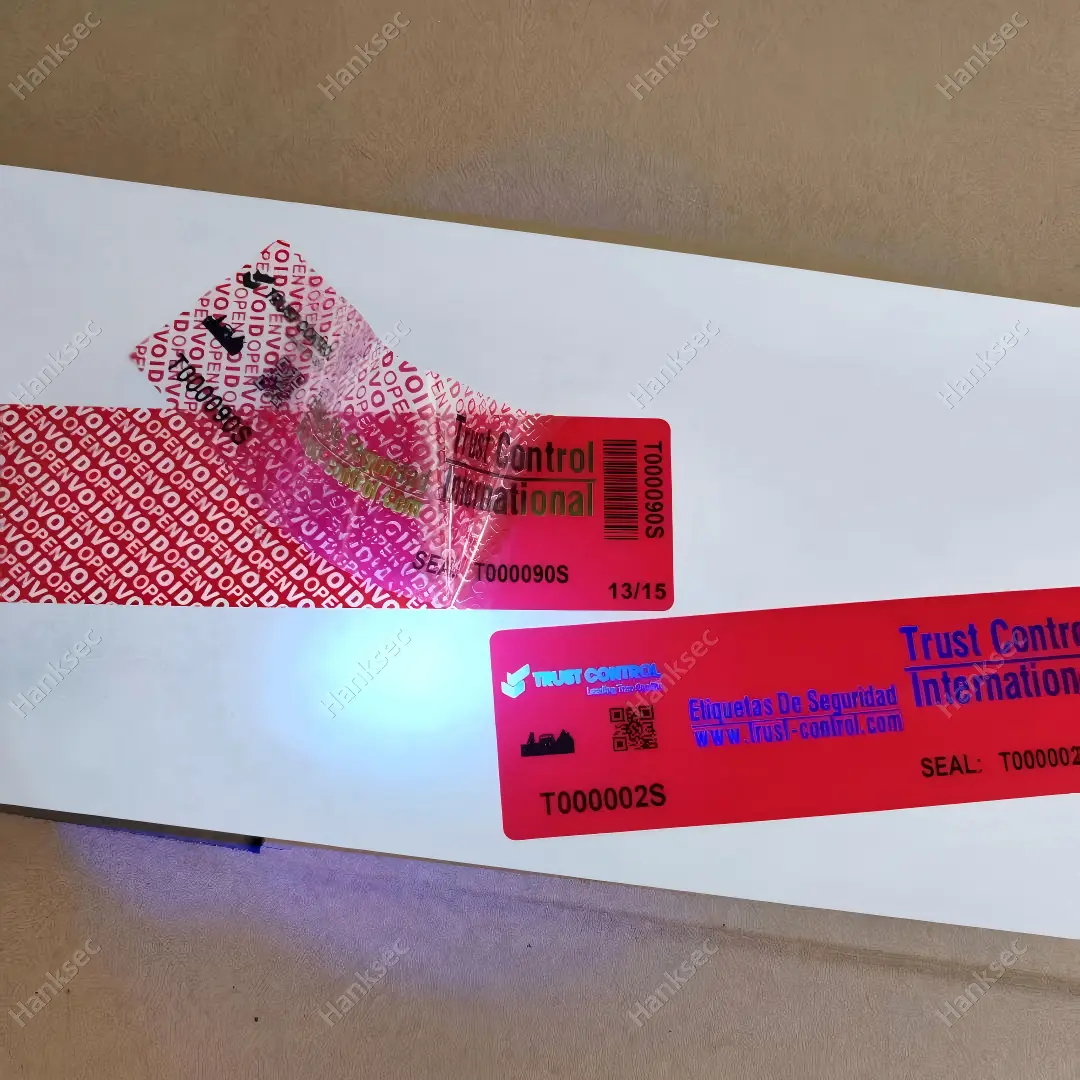
Testes e controle de qualidade de materiais para etiquetas de segurança
Os materiais de etiquetas de segurança devem ser avaliados como um sistema completo, em vez de verificar apenas se a mensagem "VOID" aparece durante uma demonstração de remoção.
Antes da produção em massa, os compradores devem avaliar:
Compatibilidade com o substrato — teste o material na própria embalagem de papelão, plástico, metal, vidro ou superfície revestida.
adesão por descascamento — confirmar se o adesivo proporciona uma ligação adequada sem interferir na resposta inviolável exigida.
Clareza na mensagem de segurança — verifique se o padrão oculto VOID, OPENED ou personalizado aparece de forma clara e consistente.
Desempenho do revestimento de liberação — Avaliar a liberação do revestimento durante o corte com matriz, a remoção da mesma e a dispensação automática.
Compatibilidade de impressão e conversão — Verificar a adesão da tinta, a resistência a riscos, a estabilidade do corte e o desempenho do rebobinamento.
Estabilidade ambiental — Avaliar temperatura, umidade, armazenamento e envelhecimento quando essas condições forem relevantes.
Batch consistency — comparar amostras de diferentes rolos ou lotes de produção para confirmar o desempenho repetível.
Por que "à prova d'água" por si só não define o desempenho de um rótulo de segurança?
Many low-cost listings use broad claims such as “waterproof,” “anti-counterfeit,” “barcode security label,” or “customized VOID label.” These terms may attract attention, but they do not explain real performance.
For professional buyers, the important questions are more specific:
Is the material suitable for my packaging surface?
Can it be printed by my equipment?
Can it be die-cut without edge lifting?
Does it work after aging?
Does the VOID effect remain stable after storage?
Can the adhesive handle shipping and temperature changes?
Can the message be customized without sacrificing stability?
Can the supplier repeat the same quality in bulk orders?
A high-quality manufacturer should be able to discuss these questions with technical logic, not only with low price.
Security label material is a solution product, not a commodity sticker.
Como a Hanksec controla o desempenho do material das etiquetas de segurança
Hanksec focuses on security label materials, VOID label materials, materiais de etiquetas destrutíveis, fitas de segurança, security bag tapes, and anti-counterfeit packaging solutions. With long-term factory experience, Hanksec understands that stable tamper-evident performance depends on controlled material engineering.
The key control areas include:
1. Layer Structure Control
Each layer must be designed according to the final tamper-evident effect. Full transfer, partial transfer, and non-transfer materials require different system balance. The hidden message layer, carrier layer, adhesive, and release liner must work together.
2. Adhesive Matching
Different application surfaces require different adhesive behavior. Cartons, coated paper boxes, plastic, metal, glass, electronics housings, and fabric-like surfaces may all require different bonding strategies.
3. Message Clarity Control
The hidden VOID message must remain controlled before use and become clear after peeling. High-quality materials avoid random tearing, weak transfer, blurry residue, or uncontrolled adhesive patches.
4. Printing and Converting Compatibility
B2B customers often need printing, slitting, die-cutting, rewinding, and automatic labeling. Therefore, material quality must be suitable for real converting processes.
5. Batch Consistency
A small sample is not enough. The material must remain stable in bulk production. Consistency from roll to roll is one of the most important signs of a professional supplier.
6. Application Testing
Security label materials should be tested on real application surfaces whenever possible. The same material may behave differently on kraft paper, coated boxes, plastic film, painted metal, glass, or textured surfaces.
7. Market-Based Adjustment
Hanksec continuously adjusts security label material systems according to customer applications, market requirements, printing methods, and packaging changes.
This is where real anti-counterfeit technology begins.
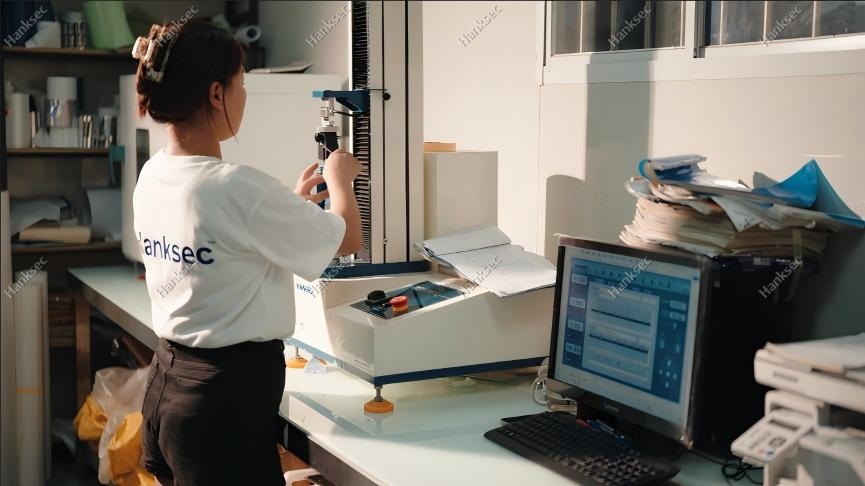
Aplicações de materiais para etiquetas de segurança por indústria e superfície.
A seleção do material para etiquetas de segurança deve levar em consideração tanto as exigências do setor quanto a superfície em si. A mesma estrutura inviolável pode apresentar comportamentos diferentes em vidro, PET, PP, PE, metal pintado e caixas revestidas, pois a energia superficial, a rugosidade e os revestimentos afetam a aderência do adesivo e o comportamento de remoção.
| Indústria/Aplicação | Requisito de segurança típico | Direção comum do material |
|---|---|---|
| Eletrônicos e Garantia | Evidências de abertura ou acesso não autorizado a componentes | Construções de garantia não transferíveis, destrutíveis ou especiais |
| Embalagem e logística | Sinais visíveis de abertura em caixas, sacos ou embalagens. | Materiais VOID de transferência total ou parcial |
| Embalagem secundária farmacêutica | Evidências de abertura de embalagens e identificação controlada | Materiais invioláveis específicos para cada aplicação, validados em embalagens reais. |
| Cosméticos e artigos de luxo | Evidências de adulteração e autenticação visível | VOID, construções de segurança holográficas ou combinadas |
| Proteção de ativos e equipamentos | Controle de acesso para manutenção, garantia e prevenção de remoção | Etiquetas de segurança destrutíveis, VOID ou serializadas |
Para embalagens de medicamentos, a seleção do rótulo de segurança também pode precisar levar em consideração os requisitos de verificação de violação específicos de cada mercado. ISO 21976:2018 Este documento fornece requisitos e orientações para a aplicação, utilização e verificação de dispositivos de segurança contra violação em embalagens de medicamentos. A seleção final dos materiais deve, portanto, ser validada em relação à construção real da embalagem e aos requisitos regulamentares aplicáveis.
| Superfície de aplicação | Consideração típica |
|---|---|
| Vidro | Grau de impregnação do adesivo, tempo de contato e comportamento desejado do resíduo. |
| PET / PC / ABS | Revestimento da superfície, limpeza e resposta necessária em caso de adulteração. |
| PP / PE | Uma menor energia superficial geralmente exige uma qualificação mais rigorosa do adesivo. |
| Metal pintado ou revestido | Compatibilidade do revestimento, temperatura e aparência de remoção |
| Cartão revestido / Papelão | A estrutura da fibra, o verniz ou o revestimento podem influenciar a adesão e a transferência. |
Para obter informações detalhadas sobre a qualificação do substrato e do adesivo, consulte o manual da Hanksec. Guia de Adesivos para Etiquetas de Segurança.
Como escolher o sistema de etiquetas de segurança adequado
There is no single security label material that is perfect for every application.
A good supplier should help customers choose the right material according to:
- Tipo de superfície
- Requisito de resíduo
- Security level
- Printing method
- Tamanho da etiqueta
- Packaging material
- Application temperature
- Storage environment
- Required visual effect
- Brand customization needs
- Automatic or manual labeling process
For example:
Full transfer VOID materials are suitable when strong visible residue is required on the applied surface.
Partial transfer VOID materials are suitable when customers need both tamper evidence and a more balanced appearance.
Non-transfer VOID materials are suitable when the applied surface needs to remain cleaner, such as electronics, camera lens protection, premium packaging, or reusable equipment control.
Destructible materials are suitable when physical destruction is required after removal.
Security tapes are suitable for cartons, envelopes, logistics boxes, and e-commerce packaging.
Etiquetas sensíveis à água são adequadas para proteção da garantia de eletrônicos e indicação de umidade.
High-temperature materials are suitable for industrial and electronics manufacturing environments.
Application-based selection is one of the most important ways to reduce testing cost and improve customer success.
How to Evaluate a Security Label Material Supplier
Compradores profissionais não devem avaliar fornecedores apenas pelo preço ou fotos do produto. Um fornecedor confiável deve ser avaliado por sua capacidade técnica, consistência na produção e suporte à aplicação.
Here are important questions to ask:
Can the supplier explain the material structure?
Can they provide full transfer, partial transfer, and non-transfer options?
Can they support custom hidden messages?
Can they recommend materials according to surface type?
Can they provide roll materials for label converters?
Can they support printing and die-cutting requirements?
Can they explain adhesive behavior?
Can they provide stable batch quality?
Can they help with OEM and ODM customization?
Eles podem fornecer amostras para testes?
Can they adjust materials according to market feedback?
A supplier who only sells a cheap sample may not be able to solve real production problems. A professional manufacturer should understand how the material works inside the customer’s actual production and application environment.
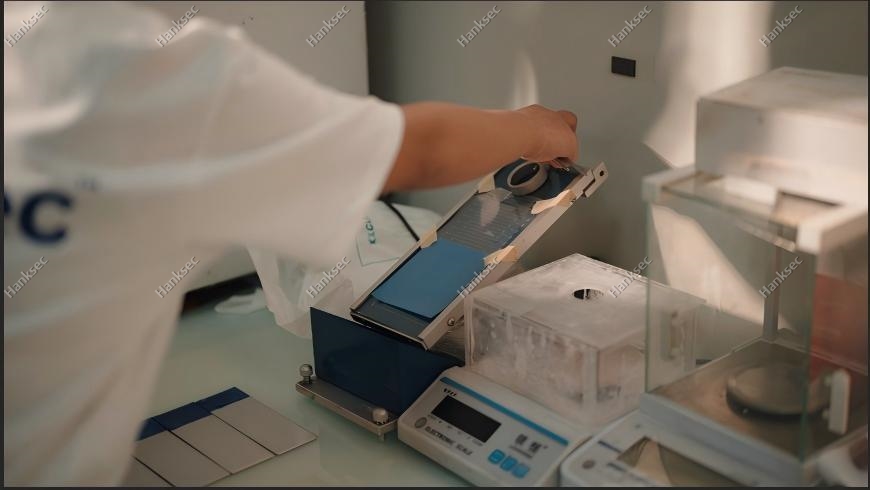
Como os materiais para etiquetas de segurança agregam valor para diferentes compradores B2B
For B2B customers, high-quality security label materials create value in several ways.
For Label Converters
They reduce trial waste, improve printing performance, support stable die-cutting, and help converters supply higher-value security labels to their customers.
For Packaging Companies
They improve packaging security, reduce unauthorized opening risks, and provide visible evidence for cartons, bags, boxes, and envelopes.
For Distributors
They provide more stable product quality, fewer after-sales problems, and stronger market positioning compared with low-cost commodity materials.
For Brand Owners
They support brand protection, product authentication, warranty control, and customer trust.
For Security Solution Providers
They provide a material foundation for customized anti-counterfeit systems, including VOID messages, serial numbers, barcodes, QR codes, holographic effects, and special security features.
This is why the value of a security label material should not be measured only by sticker price. It should be measured by its ability to reduce risk and create reliable security performance.
O que as empresas de conversão de rótulos e os compradores devem enviar antes de solicitar amostras?
Para recomendar um sistema de materiais para etiquetas de segurança mais adequado, o fornecedor deve compreender a aplicação real do comprador e os requisitos de conversão antes de preparar a amostra.
- Superfície de aplicação ou amostra real do substrato
- Resposta necessária em caso de adulteração
- Preferência por transferência total, transferência parcial, não transferência ou destruição.
- Printing method
- Dimensões da etiqueta finalizada
- Largura do rolo, comprimento do rolo, núcleo e direção de enrolamento necessários.
- Requisito de revestimento antiaderente
- Informações da máquina de conversão ou etiquetagem
- Temperatura de aplicação e serviço
- Requisitos de armazenamento, umidade ou ambientais especiais
- Quantidade estimada de teste e pedido
Fornecer essas informações antes da amostragem pode reduzir testes desnecessários e ajudar o fornecedor a avaliar os requisitos de material, adesivo, revestimento e conversão como um sistema único.
Solicite testes de materiais e recomendações técnicas da Hanksec.
Perguntas frequentes sobre sistemas de materiais para etiquetas de segurança
1. What is a security label material system?
A security label material system is a multi-layer label material designed to show visible tamper evidence when removal or unauthorized opening is attempted. It usually includes a face material, hidden message layer, adhesive, carrier layer, and release liner.
2. Como um(a) VOID label material trabalhar?
A VOID label material works by using controlled layer separation. When the label is removed, the hidden message layer breaks or transfers in a designed way, revealing a VOID, OPEN VOID, or customized security message.
3. Why do security labels need multiple layers?
Security labels need multiple layers because each layer controls a different function, including printing, appearance, message reveal, adhesive bonding, residue transfer, die-cutting, and release performance.
4. Why do low-quality security label materials fail?
Low-quality materials often fail because the hidden message layer, adhesive, carrier layer, and release liner are not properly balanced. This can cause blurry messages, weak adhesion, random residue, poor printing, or unstable performance after storage.
5. What is the difference between full transfer, partial transfer, and non-transfer VOID materials?
Full transfer materials leave the security message mainly on the applied surface. Partial transfer materials split the message between the label and the surface. Non-transfer materials reveal evidence on the label while keeping the applied surface cleaner.
6. Why is adhesive important in tamper-evident labels?
O adesivo controla a adesão, a força de descolamento, o comportamento do resíduo, a compatibilidade com a superfície e a estabilidade a longo prazo. Se o adesivo for instável, a função de segurança contra violação pode falhar.
7. Can security label materials be customized?
Yes. Security label materials can be customized with different hidden messages, colors, face materials, adhesives, transfer effects, roll sizes, and printing requirements.
8. How should buyers choose a security label material supplier?
Os compradores devem escolher um fornecedor com experiência em engenharia de materiais, capacidade de produção estável, suporte para testes de aplicação, serviços de OEM e ODM e capacidade de fornecer qualidade consistente em cada lote.
9. Os materiais para etiquetas de segurança podem ser fornecidos em rolos jumbo?
Sim. Os materiais para etiquetas de segurança podem ser fornecidos em bobinas jumbo ou bobinas cortadas para convertedores de etiquetas e impressoras de segurança, bem como em folhas ou etiquetas acabadas, dependendo do projeto. A largura, o comprimento, o núcleo, o sentido de enrolamento e o revestimento da bobina devem ser confirmados de acordo com o equipamento do convertedor.
10. Quais especificações os convertedores devem fornecer antes de encomendar materiais para etiquetas de segurança?
Os convertedores devem fornecer as informações necessárias sobre resistência à violação, material frontal, espessura, superfície de aplicação, método de impressão, tamanho do rótulo, dimensões do rolo, revestimento, adesivo ou requisitos de temperatura, além de informações relevantes sobre a máquina. Recomenda-se testar o material nas condições reais de conversão e aplicação antes da produção em massa.
Conclusão: O desempenho das etiquetas de segurança depende de todo o sistema de materiais.
Security label materials are not ordinary adhesive stickers. They are engineered systems designed to create controlled tamper evidence under real market conditions.
A label may look simple from the outside, but behind the surface are multiple layers that must work together. The top coating affects printing. The face material affects stability. The hidden message layer controls security evidence. The color layer affects contrast. The carrier layer controls transfer behavior. The adhesive determines bonding and residue performance. The release liner affects die-cutting and production efficiency.
When these layers are not controlled properly, the material may still look acceptable in a product photo, but it can fail during printing, die-cutting, application, storage, transportation, or end use.
This is the key difference between low-grade market materials and high-quality security label material systems.
For customers, the right security label material does more than show a VOID message. It reduces trial cost, improves production efficiency, strengthens brand protection, reduces customer complaints, and supports long-term market growth.
Hanksec continues to develop and adjust security label material systems according to changing market requirements, helping label converters, packaging companies, distributors, and brand owners build more reliable tamper-evident and anti-counterfeit packaging solutions.
Security label materials look easy.
Making them stable, repeatable, and reliable is where the real technology begins. Compradores que precisam Bobinas prontas para conversão ou estruturas personalizadas podem ser encontradas na Hanksec. materiais de etiqueta VOID invioláveis Para aplicações de transferência total, transferência parcial e sem transferência.