Kurzantwort
Originalitätsverschlüsse aus PPWR gewinnen für Marken, Verarbeiter und Käufer von Sicherheitsetiketten, die Produkte in die Europäische Union exportieren, zunehmend an Bedeutung im Verpackungsdesign. Gemäß der Verordnung (EU) 2025/40 müssen Verpackungen verstärkt auf Recyclingfähigkeit, Materialeffizienz und Kreislaufwirtschaft ausgelegt sein, während die Originalitätsverschlüsse weiterhin einen unwiderruflichen Nachweis über das Öffnen oder die Manipulation erbringen müssen.
For security-label buyers, the real challenge is not simply replacing PET with paper. Facestock, adhesive, VOID transfer structure, label coverage, packaging substrate and the intended recycling stream must be evaluated as one packaging system.
Der official text of Regulation (EU) 2025/40 replaces the previous Packaging and Packaging Waste Directive with a directly applicable EU regulation. The Regulation entered into force on 11 February 2025 and, according to the European Commission’s 2026 guidance, generally applies from 12 August 2026.
Packaging companies should not assume that every detailed PPWR technical requirement is already fixed.
Der European Commission’s 2026 PPWR guidance explains that Article 6(1) requires packaging placed on the market to be recyclable from the date the Regulation applies, while the fully harmonised Design for Recycling criteria and assessment methodology will be developed through delegated acts. The Commission is tasked with adopting the key delegated acts by 1 January 2028. The more specific market-access requirement based on recyclability grades A, B or C applies from 2030 or 24 months after the relevant delegated acts enter into force, whichever is later.
That creates a transition period in which packaging engineers should act now, but should avoid pretending that every future technical criterion is already known.
The Regulation ultimately introduces a recyclability performance framework. Under Annex II, Grade A represents recyclability of at least 95%, Grade B at least 80%, and Grade C at least 70% under the relevant methodology. Packaging below 70% is treated as technically non-recyclable under that framework. From 2038, Grade C is scheduled to fall out of the permitted range, leaving A and B as the acceptable grades, subject to the Regulation’s detailed conditions and later acts.
For a brand owner, this changes recyclability from a broad environmental aspiration into a design parameter that increasingly affects market access, technical documentation and extended producer responsibility economics.
Für Hersteller von Sicherheitsetiketten verändert PPWR die technische Fragestellung. Anstatt zu fragen: „Welches ist das stärkste Material für Hohlräume?“, müssen Verpackungsteams zunehmend folgende Fragen stellen:
„Welche manipulationssichere Konstruktion bietet das erforderliche Sicherheitsniveau und minimiert gleichzeitig unnötige Auswirkungen auf das vorgesehene Recycling- oder Wiederverwendungssystem der Verpackung?“
“What tamper-evident construction protects this package without unnecessarily degrading the recycling or reuse system the package is designed for?”
2. PPWR erkennt ausdrücklich an, dass Etiketten die Recyclingfähigkeit beeinträchtigen können.
Security-label suppliers should pay particular attention to Annex II of the Regulation because PPWR does not treat a label as an invisible accessory.
The Regulation states that the coverage rate of labels can affect sorting efficiency, and that the material used for the label and the type of glue or adhesive can affect the quality of the secondary raw material. In other words, a label can influence both whether a package is correctly identified by sorting equipment and what happens to the recycled material after the package enters a recycling process.
The Regulation also gives useful classification examples. Sticky labels attached to another packaging item are listed as packaging, while RFID tags are listed separately as items that are not packaging. This distinction will become increasingly relevant as packaging combines pressure-sensitive labels, QR codes, NFC or RFID, Digital Product Passports and tamper-evident features.
The most important practical lesson is simple:
The label should be evaluated as part of the package.
Even a small security label can influence sorting or recycled-material quality depending on its area, density, adhesive and recycling process. Paper facestock alone does not solve recyclability if the adhesive or coatings create contamination; likewise, a PP security label on a PP container can still be affected by ink, metallisation or adhesive behaviour.
This system-level view is consistent with the RecyClass Design for Recycling Guidelines, which assess packaging features according to their compatibility with specific plastic recycling streams rather than relying on a simple “recyclable material” claim.
3. Warum die Bezeichnung „PPWR-konform“ irreführend sein kann
Buyers increasingly ask for “PPWR-compliant labels,” but that phrase can oversimplify the law. PPWR obligations apply to packaging placed on the EU market, and recyclability is assessed by packaging category, Design for Recycling criteria and the performance of the packaging unit. A raw facestock cannot prove that every package using it will comply.
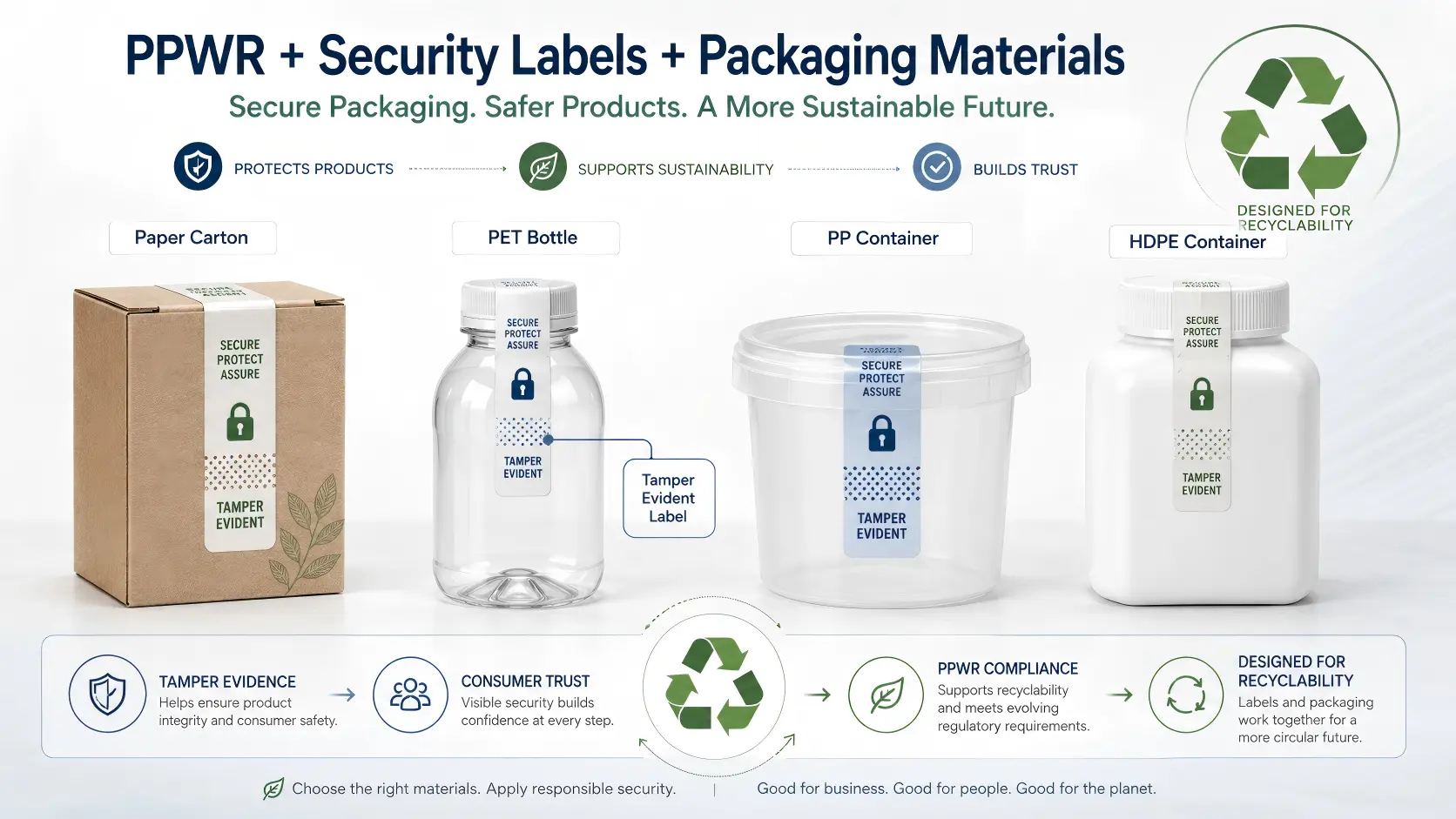
The same security label may be applied to a kraft carton, a varnished folding box, a clear PET bottle or a PP cosmetic jar; its effect on each recycling stream can differ. A more credible supplier statement is that a material is designed and tested to support PPWR-oriented packaging goals for specified substrates and recovery routes, while final compliance is assessed for the complete package under the applicable rules.
This also avoids vague environmental claims such as “green” or “100% recyclable” when the actual test conditions have not been defined.
4. Sicherheit und Recyclingfähigkeit: Klebstoff in entgegengesetzte Richtungen ziehen.
Pressure-sensitive security labels create an unusual technical conflict.
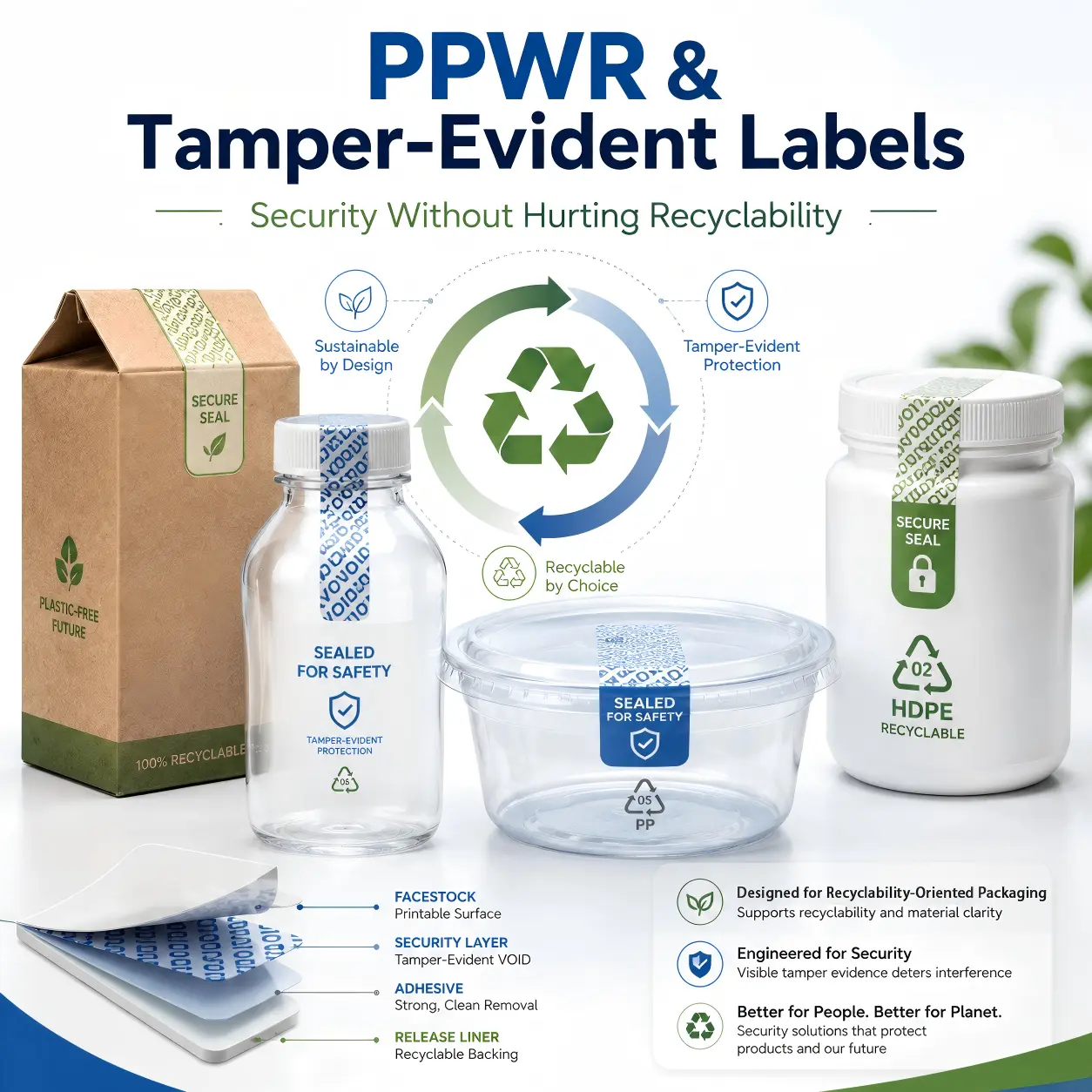
A tamper-evident label is not a single material. It is a multilayer construction in which the facestock, security or release layer, carrier coating and pressure-sensitive adhesive are engineered to work together. The facestock provides the printable and structural surface, while the internal VOID or release layer determines how the label responds when removal is attempted. The adhesive controls how strongly the complete construction anchors to the carton, bottle or container. Changing only one of these components can alter not only tamper performance, but also converting behaviour, residue level and the way the label interacts with the packaging during recycling.
From a PPWR and Design-for-Recycling perspective, this means security-label recyclability cannot be judged by facestock alone. A paper facestock does not automatically make the complete security label suitable for a paper recycling stream, just as a PET or PP facestock does not by itself determine compatibility with a plastic recycling process. Adhesive chemistry, label coverage, security coatings, transfer residue and the behaviour of the complete label-package combination all need to be considered. For this reason, PPWR tamper evident labels should be evaluated as part of the finished packaging system rather than as an isolated sticker.
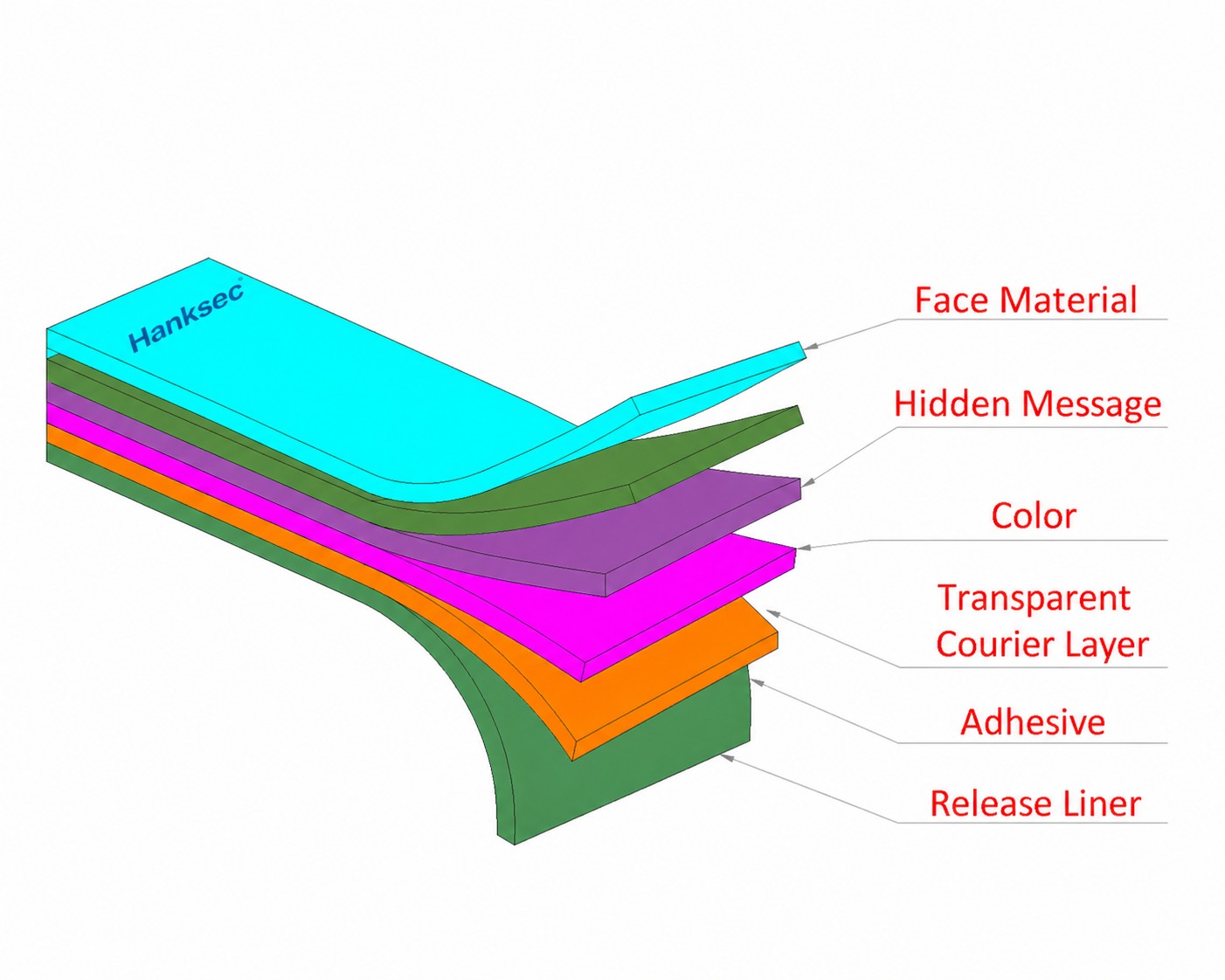
Among these layers, the adhesive is particularly important because it sits directly at the interface between the security label and the packaging substrate.
A normal removable label often succeeds when it releases cleanly.
A tamper-evident label often succeeds when it does not.
Full-transfer VOID labels are deliberately engineered so that an attempted removal causes an internal split and leaves a permanent message or pattern on the package. Destructible labels are engineered to fracture. Fiber-tear paper seals are designed to fail structurally. High-bond security tapes may use aggressive adhesives specifically to discourage clean removal.
Recycling, however, may favour separation.
For clear PET bottles, current RecyClass guidance for clear PET containers favours label constructions and adhesives that can separate appropriately during the PET recycling process. RecyClass identifies alkali/water-releasable adhesive behaviour at typical hot-wash conditions as important for label separation in the PET stream. It also evaluates label material density, coverage and whether decoration can interfere with recognition of the underlying PET container.
This creates a design problem that cannot be solved by asking only for “strong glue.”
A security label may need two different behaviours at two different stages:
During product use: resist peeling and reveal tampering.
During industrial recycling: separate or behave in a way that does not compromise the target recycling stream.
Those goals are not automatically incompatible. But they require purposeful adhesive chemistry and package-specific testing.
Avery Dennison’s current PPWR guidance makes the same broader point: Design for Recycling requirements will influence label facestocks and adhesives, and label choice can enable or hinder recycling depending on the packaging material. Its work with wash-off adhesive technologies demonstrates how an adhesive can remain functional through a product lifecycle while being designed to release under controlled recycling conditions. Avery Dennison’s PPWR resource is a useful industry reference for this packaging-system approach.
For tamper-evident labels, the next step is to combine that recycling logic with irreversible security response.
Haben Sie eine schwierige Verpackungsoberfläche?
Bitte teilen Sie uns die Art des Untergrunds und die erforderliche Manipulationswirkung für eine erste Materialbewertung mit. Sprechen Sie mit einem Materialspezialisten →
5. Papierbasierte Verpackungen: Paper VOID ist vielversprechend, aber der Klebstoff spielt weiterhin eine wichtige Rolle.
Paper and cardboard are obvious growth areas for sustainable tamper-evident packaging.
A paper-based security label can provide better material alignment with a fibre-based carton than a conventional plastic film, especially for pharmaceutical cartons, cosmetics boxes, document packaging, electronics boxes and e-commerce packaging.
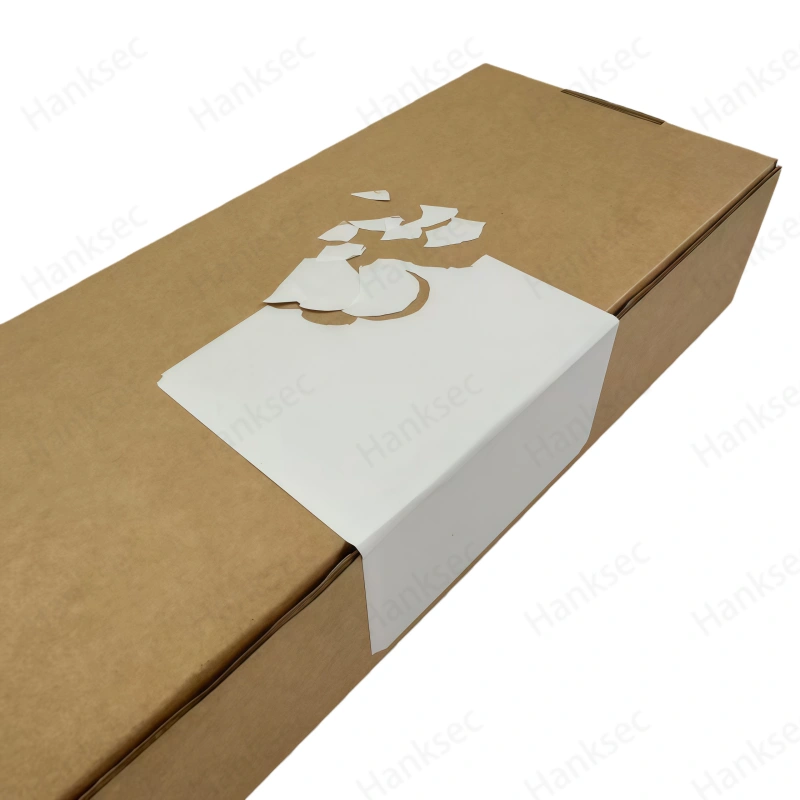
Hanksec already develops paper VOID label materials for tamper-evident applications, including constructions intended to reveal VOID or OPENED evidence after removal.
However, changing the facestock from PET to paper is only the first step.
Der CEPI Paper and Board Recyclability Laboratory Test Method evaluates how fibre-based packaging behaves in processes that simulate conventional paper recycling. The method considers not only fibre yield but also rejects, dissolved and colloidal substances, stickies and visual impurities. This is especially relevant for pressure-sensitive security labels because adhesive contamination can affect recycled pulp even when the visible label surface is paper.
From a security-material engineering perspective, paper-based systems should therefore be evaluated in at least four layers:
Facestock
Is the paper strong enough for printing, converting and application, yet capable of producing the intended security failure?
Sicherheitsebene
Does the VOID or OPENED mechanism introduce coatings, inks or transfer layers that affect fibre recycling?
Klebstoff
Does the adhesive provide enough wet-out and peel resistance during use without creating avoidable recycling contamination?
Trennpapier
What happens to the liner during label converting? Even though the liner usually does not remain with the final package, large-volume label programs generate substantial liner waste that converters may need to manage separately.
An industry example comes from Securikett. At Interpack 2026, the company highlighted its PaperVOID security-label range for paper and cardboard packaging and also promoted PP-based security labels containing PP recyclate for plastic packaging. The significance is not one specific product. It is the direction of travel: match security materials more closely to the host packaging material and its recovery system.
6. PET-Verpackungen: Die Regel „Gleiches Material“ ist nicht immer die richtige Regel
A common sustainability shortcut says: “Use the same material for the label and the container.”
That can be useful in some streams, but clear PET recycling illustrates why it is not a universal rule.
For clear PET bottles, separation by density is an important part of the recycling process. RecyClass currently identifies certain lower-density PE, PP and OPP label constructions as favourable because they can separate from PET flakes, while PET-family label materials with similar density can create different challenges if they do not detach. Adhesive release behaviour and label coverage also matter.
This is why a security label manufacturer should not automatically recommend PET VOID simply because the bottle is PET.
The correct decision may depend on:
- bottle geometry;
- label coverage percentage;
- whether the bottle must remain detectable by sorting equipment;
- the density of the facestock;
- adhesive release in the washing process;
- printing and metallisation;
- whether tamper evidence must remain on the bottle after opening.
A small neck seal may have a different recyclability impact from a near-full-wrap security label even if both use the same adhesive.
This is an important commercial point for buyers: label size is a material decision. Reducing unnecessary security-label coverage can sometimes improve recyclability without reducing security because tamper evidence only needs to protect the actual opening path.
7. PP- und HDPE-Verpackungen: Sicherheitsdesign, das mit Polyolefinen kompatibel ist
PP and HDPE packaging is common in cosmetics, personal care, chemicals, healthcare, industrial products and reusable containers.
For coloured PP packaging, RecyClass PP Design for Recycling guidance treats PP labels as fully compatible in the appropriate conditions and also evaluates PE/polyolefin labels, paper labels, PET-family labels and adhesive release differently. The guidance again reinforces that label material and adhesive should be selected according to the recycling stream rather than by a generic sustainability hierarchy.
For HDPE and PP containers, RecyClass has also published guidance stressing that label-and-adhesive combinations may need to release appropriately in the washing process, depending on the specific construction and stream.
For tamper-evident packaging, this opens several design strategies:
Strategie A: Sicherheitsfolie auf PP-Basis auf PP-Verpackung
Useful when material-family alignment, durability and film performance are priorities.
Strategie B: Manipulationssicherung mit geringer Abdeckung
Protect only the closure interface instead of covering a large percentage of the container.
Strategie C: Zerstörbare oder VOID-Funktion mit recyclingfähigem Klebstoffverhalten
Maintain irreversible opening evidence during use but design controlled release for the intended recycling process.
Strategie D: Trennung von Identitäts- und Manipulationsfunktionen
Keep a durable identification label on the package while using a smaller sacrificial tamper seal across the closure.
The last option is particularly useful when a product also carries a QR code, serialized UID or Digital Product Passport. One label does not always need to perform every security and information function.
8. Wiederverwendbare Verpackungen schaffen ein anderes Sicherheitsproblem
PPWR is not only about recycling. Reuse is another central policy direction.
Article 29 establishes reuse targets for several transport and sales-packaging categories beginning in 2030, including certain packaging used in e-commerce and business-to-business transport, subject to the Regulation’s scope, exemptions and detailed conditions.
Reusable packaging changes the security brief completely.
Consider a reusable plastic crate or returnable container.
A traditional high-residue full-transfer VOID label may show tampering very effectively on the first journey, but permanent residue could create cleaning problems when the crate enters its next cycle.
The better design may be a tamper-evident label that is irreversible under normal removal but can be removed under a controlled industrial washing process.
This is not contradictory.
It is a two-stage performance requirement:
- Security stage: unauthorized peeling must create obvious evidence and prevent label reuse.
- Recovery stage: authorised washing or processing should remove the label or adhesive cleanly enough for the packaging reuse system.
This is where non-transfer VOID structures, controlled-release adhesives, removable security seals or replaceable serialized closure labels may become more relevant than traditional permanent-residue constructions.
For reusable packaging, “strongest adhesion” is often the wrong specification. The better specification is controlled security during the use cycle plus controlled removal during the recovery cycle.
9. Vollständiger Transfer, teilweiser Transfer oder kein Transfer: Welche Richtung passt zu runden Verpackungen?
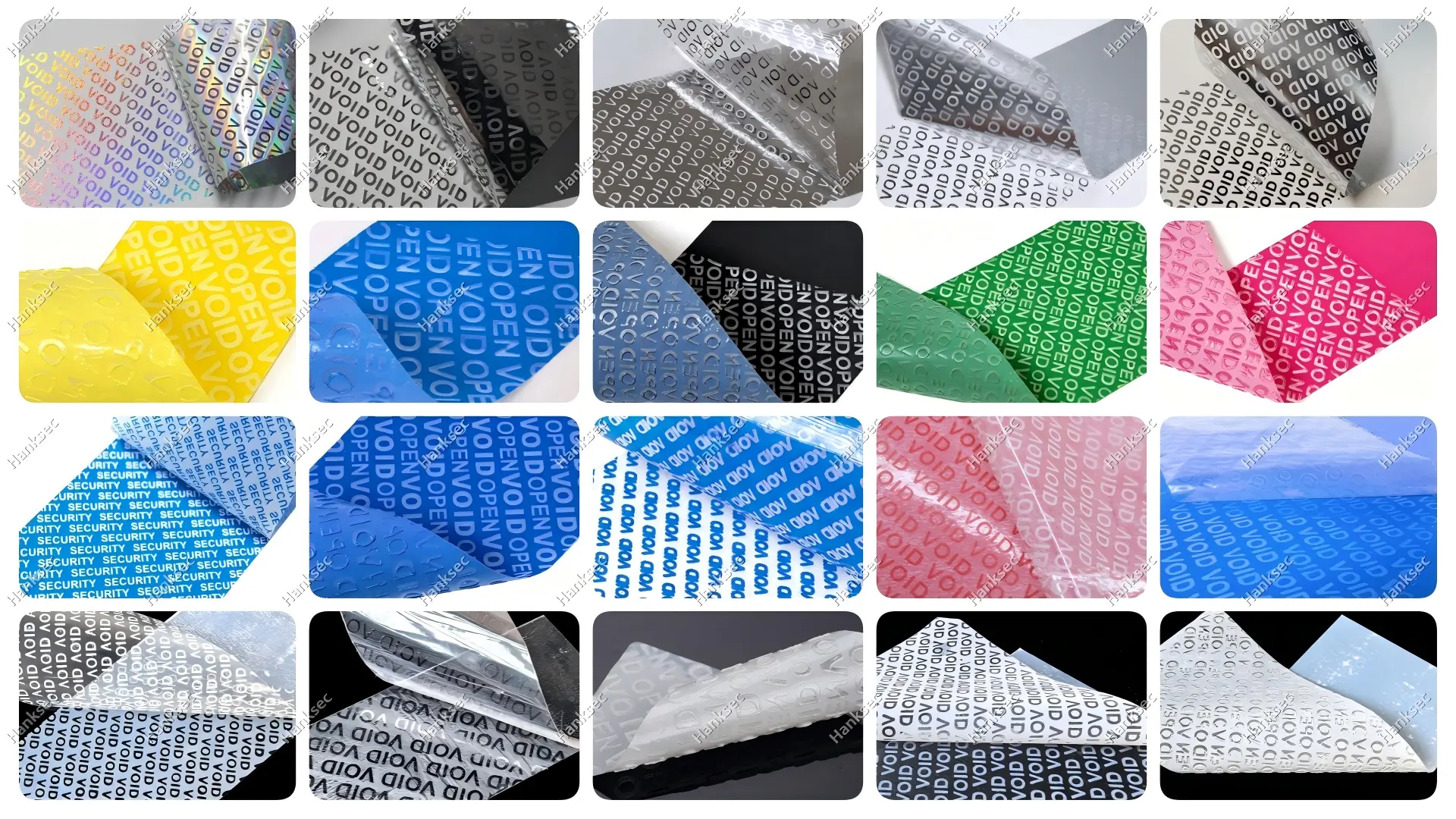
Tamper-evident VOID materials are commonly divided into full-transfer, partial-transfer and non-transfer constructions. Hanksec’s VOID label material guide explains these basic mechanisms, but PPWR introduces a new reason to distinguish them: residue behaviour can affect both cleaning and material recovery.
| VOID Type | Manipulationsnachweis | Typical Surface Residue | Circular-Packaging Consideration |
| Vollständige Übertragung | Hidden message transfers strongly to substrate | Hoch | Strong evidence, but residue may be undesirable on reusable packaging |
| Teilübertragung | Evidence splits between label and surface | Medium | Balance between visible residue and cleaner removal |
| Nichtübertragung | Evidence mainly remains in label structure | Low / controlled | Useful where clean substrate or reuse is important, but transfer resistance still needs validation |
| Destructible Paper | Fiber/structure tears | Hängt vom Klebstoff ab | Strong fit with some paper-packaging concepts when fibre/adhesive recycling is validated |
This table should not be read as a recyclability ranking.
A non-transfer label is not automatically more recyclable than a full-transfer label. A paper label is not automatically better than a plastic film. The package, recycling stream, adhesive and total construction determine the result.
But residue behaviour is now a design variable that security teams should discuss with packaging sustainability teams much earlier in development.
Sie sind sich nicht sicher, welches Sicherheitsetikett zu Ihrer Verpackung passt?
Papierkartons, PET-Flaschen, PP-Behälter, HDPE-Oberflächen und Mehrwegverpackungen können sehr unterschiedliche manipulationssichere Konstruktionen erfordern.
Senden Sie uns Ihr Verpackungsmaterial, die Anwendungsfläche und die gewünschte Manipulationssicherheit. Hanksec unterstützt Sie bei der Vorauswahl geeigneter Sicherheitsmaterialien (Volltransfer, Teiltransfer, Nicht-Transfer, papierbasiert oder selbstzerstörbar), bevor Sie mit der Musterprüfung beginnen.
Lassen Sie sich eine Materialempfehlung geben
Die Materialempfehlungen können auf dem Verpackungssubstrat, dem Oberflächenzustand, dem erforderlichen Hohlraumeffekt, den bevorzugten Rückständen, der Anwendungstemperatur und dem zu erwartenden Entsorgungsweg basieren.
10. Fünf technische Variablen, die Käufer in ihre Spezifikation für Sicherheitsetiketten aufnehmen sollten.
A PPWR-oriented security-label brief should specify five things before material selection: the exact host packaging material; surface treatment and geometry; desired tamper failure mode; intended end-of-life route; and service environment.
For example, “plastic box” is not enough. A supplier needs to know whether the substrate is PP, HDPE, PET or another polymer, whether the surface is textured or coated, whether the seal should leave full residue or remain non-transfer, whether the package is recycled or reused, and what heat, cold, humidity or chemical exposure it will face. Those variables determine the security construction far more reliably than colour or label size alone.
Umwandlung von Verpackungsanforderungen in eine Auswahlliste für Sicherheitsmaterialien
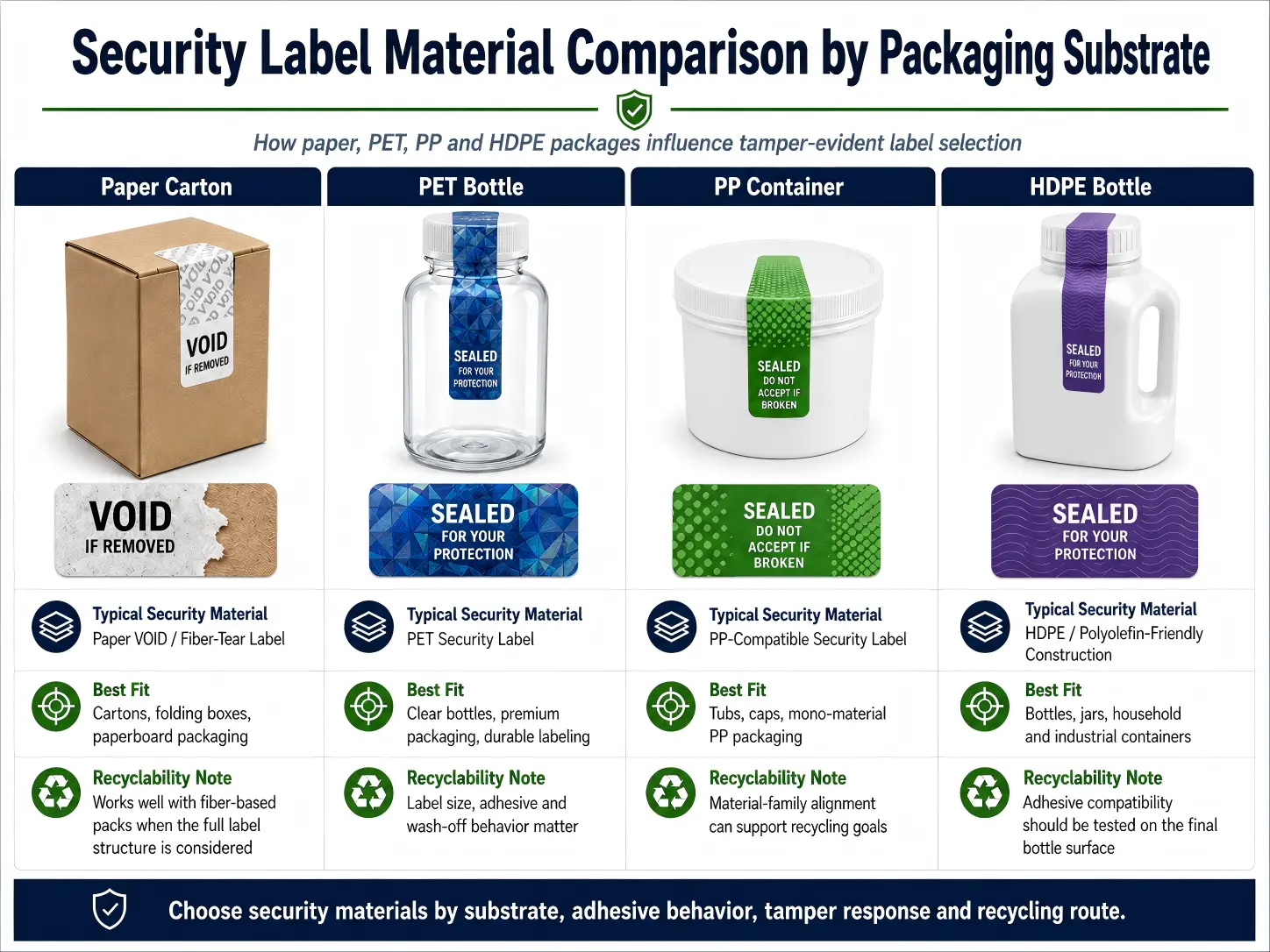
Once these five variables are defined, material selection becomes much more practical. The goal is not to identify one universal “sustainable security label,” but to narrow the choice to constructions that fit the host packaging and its intended recovery route. Paper cartons may favour paper-based VOID or fibre-tear concepts, while PET, PP and HDPE packaging can require very different combinations of facestock density, adhesive behaviour, label coverage and tamper response.
The following selection guide should therefore be used as a screening tool rather than a compliance certificate. It helps packaging engineers and label converters identify a sensible starting construction, but the final choice should still be validated through substrate testing, attack simulation, environmental conditioning and, where applicable, recycling or reuse evaluation.
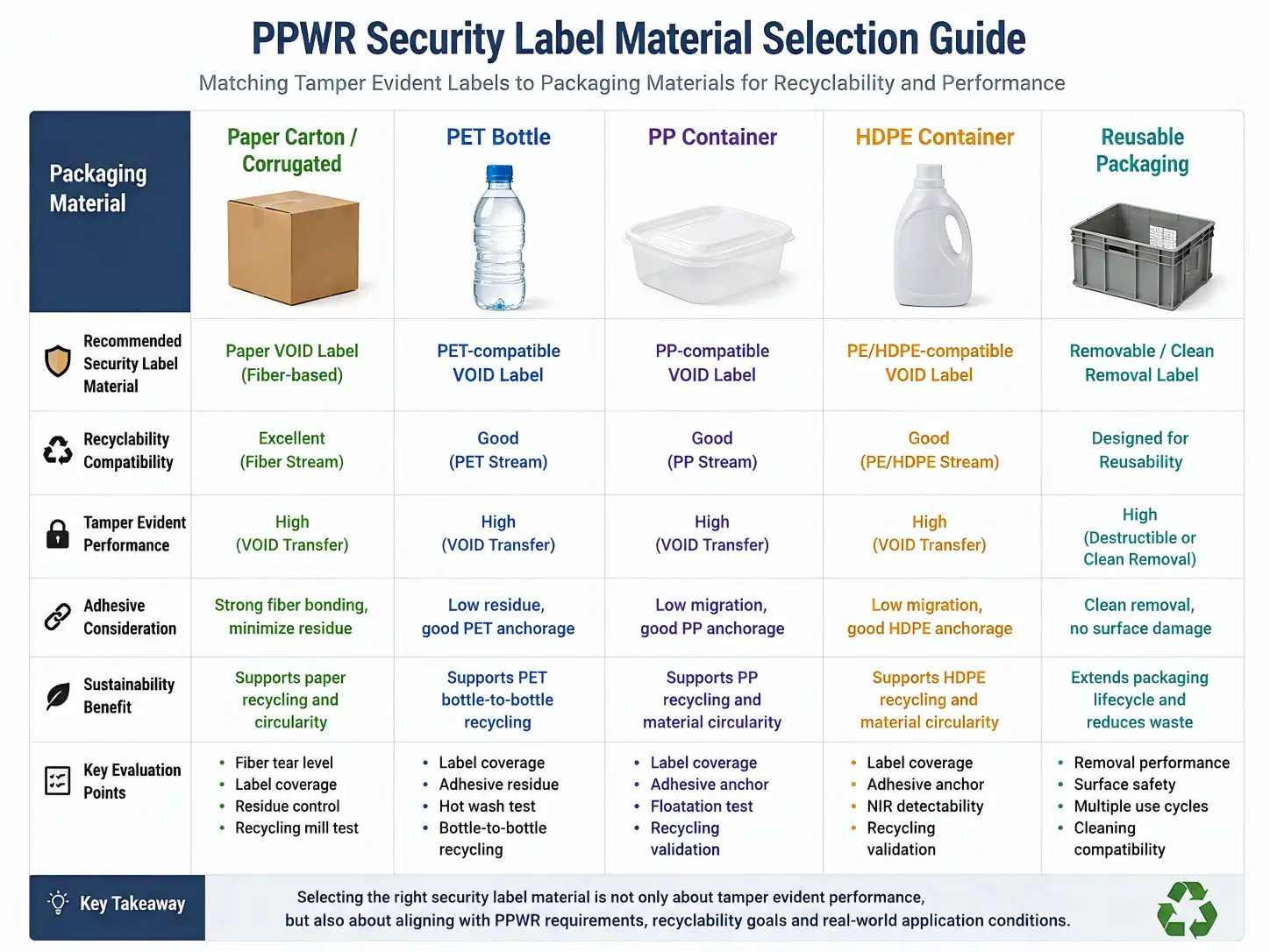
11. Wie sollte ein PPWR-orientiertes Testprogramm für Sicherheitsetiketten aussehen?
A credible development project should test the label twice: once as a security component and once as part of a packaging recovery system.
Phase 1: Substratqualifizierung
Use the actual commercial package, not a generic laboratory panel.
Record:
- substrate type;
- surface treatment;
- roughness;
- curvature;
- application temperature.
Phase 2: Klebstoffbenetzung
Test immediately after application, then after defined dwell periods such as 24 and 72 hours.
Pressure-sensitive adhesives develop bond over time. A label that peels cleanly after five minutes may produce strong tamper evidence after full wet-out.
Phase 3: Eröffnungs- und Angriffssimulation
Confirm that normal opening produces clear, irreversible evidence, then test realistic attack methods such as slow peeling, heat, cold, moisture and edge lifting. Record VOID clarity, residue, fibre tear or label fracture, and whether the removed label can be reapplied convincingly. The objective is not to claim that tampering is impossible; it is to make intervention detectable.
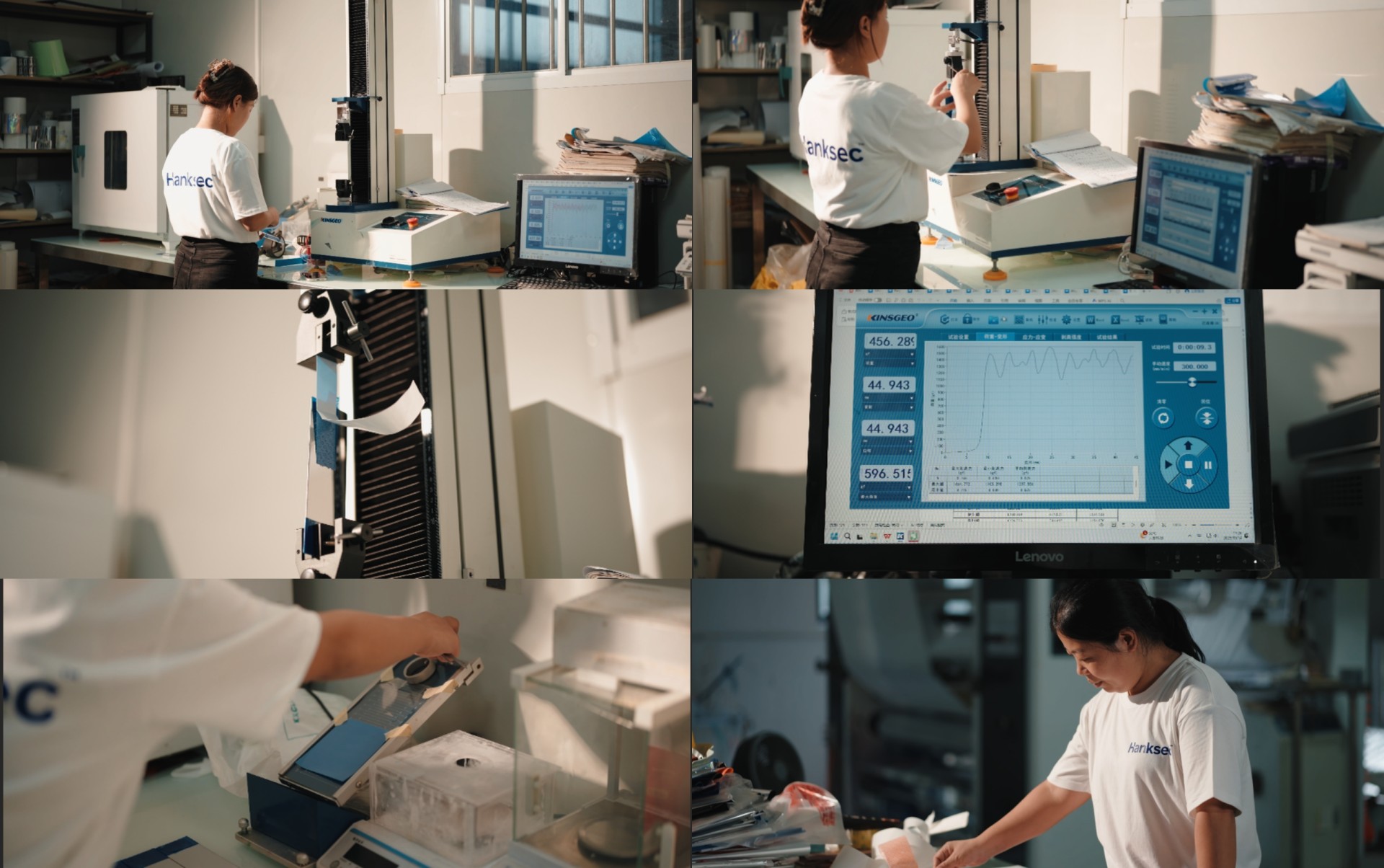
Real substrate testing is especially important for tamper-evident materials because the same VOID construction can behave very differently on different packaging surfaces. A material that produces a sharp and irreversible VOID message on coated PET may show weak transfer on PP, excessive residue on a varnished carton or insufficient anchorage on a textured HDPE surface. Surface energy, coating chemistry, roughness, curvature and adhesive wet-out can all change the failure mode.
For this reason, Hanksec evaluates candidate security constructions on the customer’s actual or representative substrate wherever possible. The objective is not simply to confirm that the label “sticks.” Testing should verify whether the intended tamper response appears consistently, whether residue is appropriate for the application, whether the removed label can be reapplied, and whether performance remains stable after the defined dwell time and environmental exposure.
Phase 4: Umweltkonditionierung
Condition samples for the actual product lifecycle, including relevant heat, cold, humidity and condensation, before repeating the security tests.
Phase 5: Recycling- oder Wiederverwendungskompatibilität
This stage should follow the target recovery route.
For fibre-based packaging, CEPI-style laboratory evaluation can help determine how adhesives, coatings and other components influence pulping and recycled-paper quality.
For plastic packaging, RecyClass protocols can be used as an industry reference for evaluating specific label-and-adhesive combinations in PET, HDPE, PP and film recycling streams.
Phase 6: Validierung konvertieren
The security material also has to run through real production equipment.
Check:
- printing primer compatibility;
- ink adhesion;
- die-cut pressure;
- matrix stripping;
- Liner-Freigabe;
- roll tension;
- automatic dispensing;
- QR/barcode readability if variable data are used.
This is especially important for label converters purchasing jumbo or slit-roll material rather than finished labels.
12. Eine praktische Materialauswahlmatrix
| Packaging Application | Security Priority | PPWR-Oriented Design Direction | Main Risk to Test |
| Folding carton | Visible first-opening evidence | Paper VOID or fibre-destructible seal where appropriate | Adhesive stickies, carton coating, fibre tear |
| Corrugated e-commerce box | Anti-opening / resealing | Paper security tape or low-coverage closure seal | Dust, recycled fibre surface, humidity |
| Clear PET bottle | Tamper + sorting/recycling compatibility | Low-coverage security seal with compatible facestock/adhesive design | Density separation, wash-off, label coverage |
| PP cosmetic jar | Premium tamper evidence | PP/polyolefin-compatible security construction | Adhesive release, decoration, low surface energy |
| HDPE chemical container | Durable security | Polyolefin-compatible label or approved construction | Surface texture, chemical resistance |
| Reusable crate | Chain-of-custody evidence | Controlled-removal or non-transfer security seal | Cleaning process, residue, repeated cycles |
| Pharmaceutical carton | First-opening evidence + traceability | Paper-based or thin-film tamper seal selected to package requirements | Regulatory requirements, print/serial integrity |
| Elektronikverpackung | Anti-switching + premium appearance | Non-transfer VOID or destructible seal | Residue, heat, textured surfaces |
This matrix is a starting point, not a compliance certificate. The correct material must be validated on the final package.
13. Welche Fragen Etikettenhersteller ihren Materiallieferanten stellen sollten
Label converters need evidence, not only a sustainability claim. Before approval, ask for the facestock composition and thickness, adhesive type, intended VOID transfer behaviour, printing/primer compatibility, liner options, converting limits and the test evidence behind any recyclability statement. Most importantly, ask whether the claim applies to the label alone or to the label used on a defined packaging system.
For security materials, also confirm whether adhesive coat weight, residue level, hidden message and full-, partial- or non-transfer behaviour can be adjusted for the customer’s real substrate.
14. Ein Aktionsplan für Marken, die manipulationssichere Verpackungen verwenden (2026–2030).
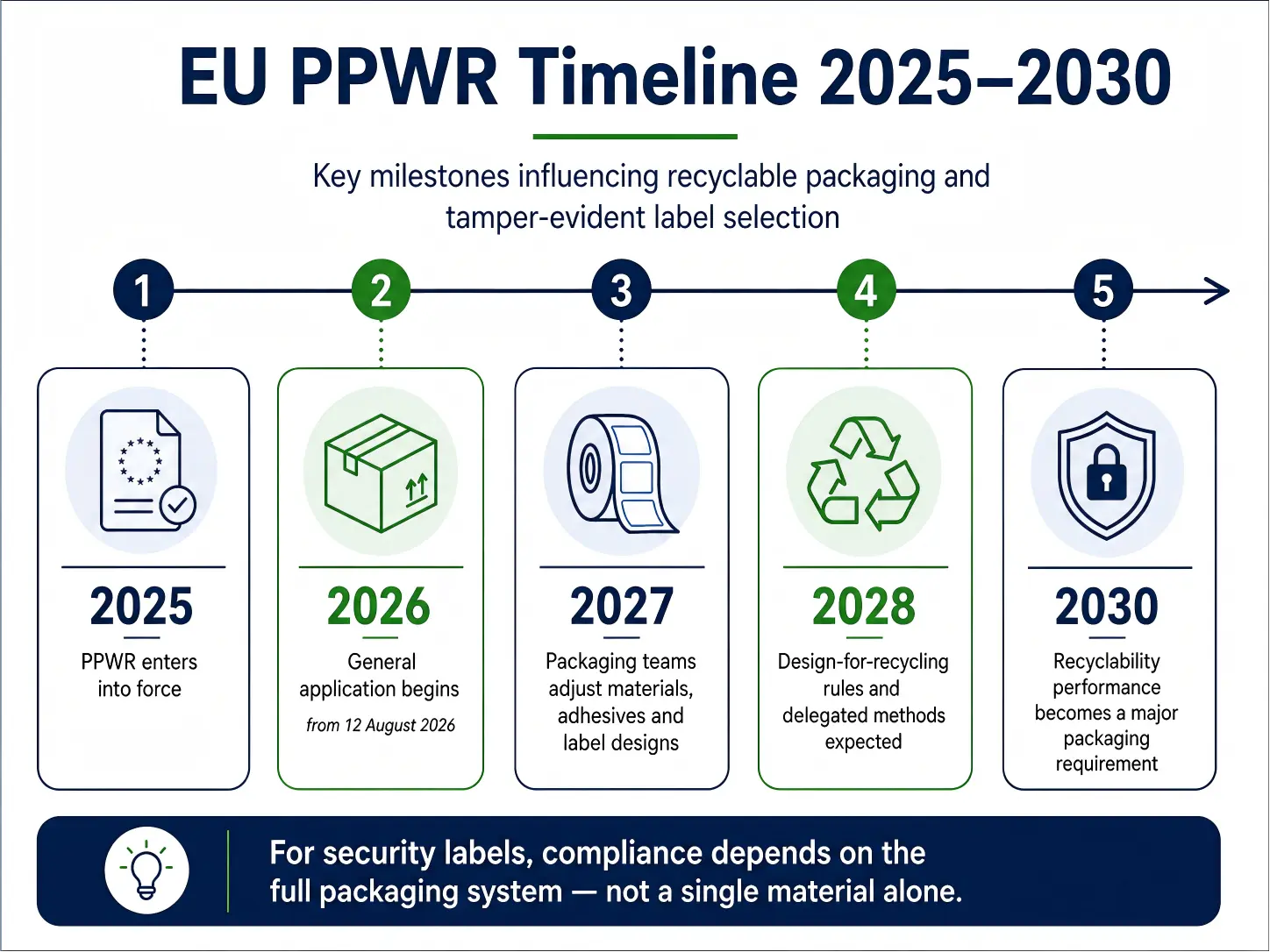
2026: Die Verpackungskarte erstellen
Identify every security label, tape and closure used on EU-bound packaging.
For each one, record:
- package material;
- label facestock;
- adhesive;
- coverage;
- residue type;
- security function;
- expected end-of-life route.
Der European Commission’s August 2026 PPWR FAQ should be treated as a live implementation reference alongside the Regulation and formal guidance because practical questions continue to be clarified.
2027: Hochrisikobauwerke testen
Prioritise packages where the security component is:
- large relative to the package;
- made from a different material family;
- heavily metallised;
- permanently bonded;
- difficult to remove in recycling;
- used on reusable packaging.
Begin testing alternatives before mass conversion is required.
2028: Erneute Prüfung anhand der endgültigen DfR-Kriterien
The Commission is expected to establish the detailed Design for Recycling criteria through delegated acts by 1 January 2028. Once those rules are available, previous assumptions should be revalidated against the final methodology.
2029: Schlossspezifikationen und Lieferantennachweise
Qualify final materials, converters and documented test methods for packaging that will need to meet the 2030 recyclability-grade rules.
2030: Betrieb anhand messbarer Recyclingleistung
By this stage, packaging recyclability is expected to be assessed using harmonised performance grades under the PPWR timetable. Security labels will therefore need to be treated as functional packaging components within that assessment, not as last-minute decoration.
15. Wo ein Hersteller von Sicherheitsmaterialien Mehrwert schafft
For a label converter or brand owner, the most valuable security-material supplier is not necessarily the one with the longest catalogue.
It is the supplier that can change the material structure when the application demands it.
Hanksec manufactures tamper-evident VOID label materials and can support development around variables such as facestock, transfer behaviour, adhesive strength, hidden message, liner and converting format for specified applications.
For PPWR-oriented projects, the engineering discussion should start with the package sample rather than the label drawing.
A useful development workflow is:
Step 1: Customer sends the actual package or representative substrate.
Step 2: Define the security threat: opening, transfer, resealing, counterfeiting or return fraud.
Step 3: Define end-of-life route: paper recycling, PET recycling, PP/HDPE recycling or reuse.
Step 4: Select candidate security constructions.
Step 5: Test adhesion and tamper response.
Step 6: Evaluate recycling/reuse compatibility using the appropriate methodology or external testing partner where required.
Step 7: Validate printing, die cutting and automatic application before bulk production.
For projects where the substrate should remain cleaner after inspection or authorised opening, non-transfer VOID security material may also be considered as one engineering option, subject to the package and recovery requirements.
Müssen Sie ein Sicherheitsetikett für Ihre Verpackung validieren?
Entwicklung eines manipulationssicheren Etiketts für einen Papierkarton, eine PET-Flasche, einen PP- oder HDPE-Behälter oder eine Mehrwegverpackung?
Senden Sie Hanksec Ihr tatsächliches Verpackungsmuster oder Details zum Substrat. Unser Team kann vor der Serienproduktion die Klebeverbindung, das Übertragungsverhalten von Hohlräumen, den Rückstandsgrad, die Kompatibilität mit Druck- und Verarbeitungsprozessen sowie die zu erwartenden Anwendungsbedingungen beurteilen.
Materialbewertungen sind für Papierkartons, PET, PP, HDPE, Glas, beschichtete Oberflächen und Mehrwegverpackungen verfügbar. OEM/ODM-Sicherheitskonstruktionen werden unterstützt.
Wie dieser Leitfaden erstellt wurde
Dieser Leitfaden vereint Hanksecs praktische Erfahrung mit manipulationssicheren Sicherheitsmaterialien mit öffentlich zugänglichen regulatorischen und Recycling-Referenzen, darunter die Verordnung (EU) 2025/40, die PPWR-Leitlinie der Europäischen Kommission, die RecyClass-Leitlinie „Design for Recycling“ und das CEPI-Prüfverfahren zur Papierrecyclingfähigkeit. Die Materialempfehlungen in diesem Artikel dienen als Ausgangspunkt für die Entwicklung und stellen keine Zertifizierungsansprüche dar. Die endgültige Leistungsfähigkeit der Verpackung sollte anhand des tatsächlichen Substrats und der geltenden regulatorischen und Recycling-Anforderungen validiert werden.
Häufig gestellte Fragen: PPWR- und manipulationssichere Sicherheitsetiketten
Gilt PPWR auch für Etiketten, die an Verpackungen angebracht sind?
Yes. PPWR recognises sticky labels attached to packaging as packaging and notes that label coverage, material and adhesive can affect sorting and recycled-material quality. The effect of a specific label depends on the package and applicable Design for Recycling criteria.
Verbietet PPWR PET VOID-Etiketten?
No. PPWR does not impose a blanket ban on PET security labels. PET may still be appropriate where durability, transparency, dimensional stability or temperature resistance is needed; the complete packaging unit must be assessed.
Sind Papieretiketten mit der Aufschrift „VOID“ automatisch recycelbar?
No. Adhesive, coatings, inks, transfer layers and the final packaging configuration still matter. “Paper” is a material description, not proof of recyclability.
Kann ein manipulationssicheres Etikett sowohl dauerhaft verwendet als auch beim Recycling entfernbar sein?
Potentially. A label can maintain security during normal use yet release under defined industrial washing or recycling conditions, provided both behaviours are validated.
Verlangt PPWR, dass jede Verpackung im Jahr 2030 die Klasse A erreicht?
No. The Regulation’s 2030 framework allows packaging meeting Grades A, B or C, subject to the timing rules and delegated acts. Grade C corresponds to at least 70% recyclability performance under the defined methodology. From 2038, packaging is scheduled to need Grade A or B, subject to the Regulation’s final implementation framework.
Kann ein Lieferant von Sicherheitsetiketten die gesamte Verpackung als PPWR-konform zertifizieren?
A supplier can provide material data and test support, but final compliance depends on the full packaging configuration, the economic operator’s responsibilities and applicable PPWR rules.
Fazit: PPWR wird die Sicherheitsmerkmale nicht entfernen – es wird sie technisch ausgereifter gestalten.
PPWR does not create a choice between packaging security and sustainability. It requires the two to be designed together.
Tamper-evident labels still need to reveal opening, resist transfer and protect product integrity. What changes is how those functions interact with the package. Paper packaging needs more than a paper-looking seal. PET packaging needs more than a generic plastic label. Reusable packaging needs security that does not make recovery impractical. Adhesive, label coverage and residue all become part of packaging engineering.
For packaging engineers, converters and brand-protection teams, the strongest response is to map security components now, test them on real packaging, understand the intended recycling stream and build alternative constructions before the 2030 recyclability-grade requirements become commercial deadlines.
For label converters and brand owners developing paper, PP, PET or custom tamper-evident structures, Hanksec can evaluate actual application surfaces and support material selection, adhesive adjustment, VOID transfer design and converting trials before mass production. Contact Hanksec for a sample or application test.
Technical note: This article is an industry and materials-engineering interpretation of publicly available PPWR information and is not legal advice. Packaging compliance should be assessed against Regulation (EU) 2025/40, applicable delegated and implementing acts, harmonised standards and the specific product/packaging configuration.
Verfasst von Hank Security Co., LTD | Spezialist für Sicherheitsmaterialien, Hanksec
Technische Überprüfung: Hanksec-Materialtechnikteam
Veröffentlicht: 9. August 2026 | Letzte Aktualisierung: 9. August 2026