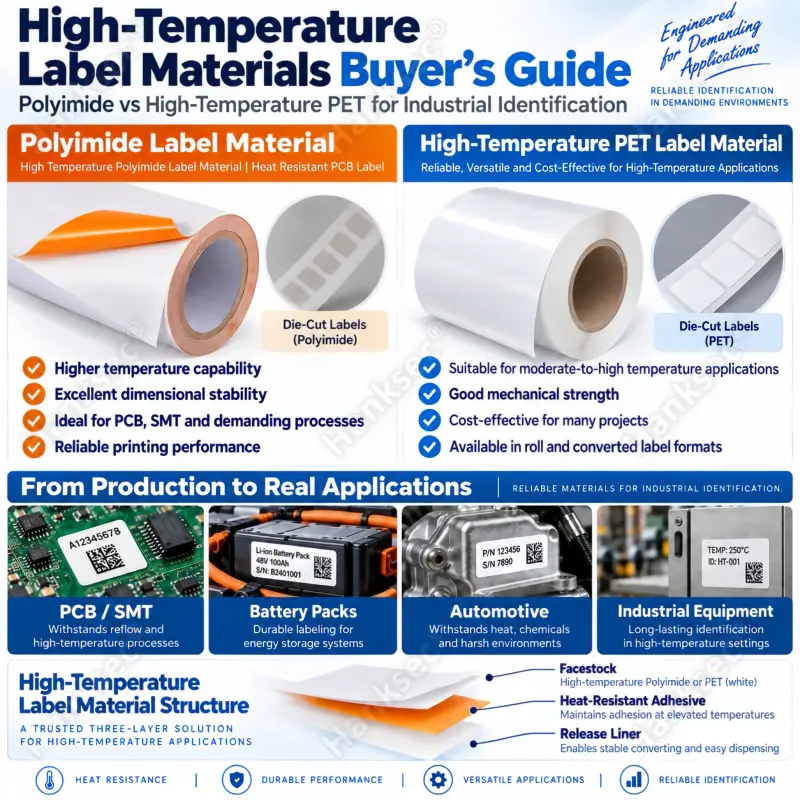
Risposta rapida: Materiali per etichette resistenti alle alte temperature Le etichette autoadesive sono progettate per rimanere aderenti, dimensionalmente stabili e leggibili anche in condizioni di produzione, lavorazione o utilizzo ad alte temperature. La scelta del materiale corretto non deve basarsi unicamente sul tipo di supporto. Gli acquirenti devono valutare l'intero sistema di etichettatura: Materiale di superficie + adesivo + rivestimento stampabile + metodo di stampa + superficie di applicazione + temperatura di esposizione + tempo di esposizione.
Il poliimmide viene comunemente scelto per processi di produzione di PCB, SMT ed elettronica particolarmente esigenti, dove è richiesta una maggiore stabilità termica. Il PET termoresistente può essere adatto a numerose applicazioni industriali ed elettroniche in cui i requisiti di temperatura sono meno stringenti e contano anche il costo, l'aspetto estetico o l'efficienza di conversione. La scelta corretta dipende dal processo produttivo specifico, piuttosto che dal solo nome del materiale.
Hanksec fornisce Materiale per etichette in poliimmide ad alta temperatura Per produttori di PCB, fabbriche di elettronica, aziende di trasformazione di etichette industriali e progetti OEM, con adesivo, liner, spessore del film, larghezza del rotolo, superficie stampabile e formati di etichetta finita personalizzabili.
Che cosa sono i materiali per etichette resistenti alle alte temperature?
Materiali per etichette resistenti alle alte temperature Si tratta di speciali supporti per etichette autoadesive sviluppati per applicazioni in cui la carta convenzionale, il poliestere standard o gli adesivi generici potrebbero restringersi, ammorbidirsi, sollevarsi, scolorirsi, deformarsi o perdere la leggibilità dopo l'esposizione al calore.
Una struttura completa di etichetta per alte temperature può contenere diversi strati funzionali:
- a heat-resistant facestock such as polyimide or application-specific PET;
- a pressure-sensitive adhesive selected for both the substrate and thermal environment;
- an optional top coating or primer for printing;
- printed information such as barcodes, QR codes, serial numbers or warning text;
- a release liner selected for converting, dispensing and automatic labeling.
The most important purchasing principle is that high-temperature performance belongs to the complete label construction, not to the facestock alone.
High-Temperature Label Performance = Facestock + Adhesive + Print System + Surface + Temperature + Exposure Time
A film can remain physically stable at elevated temperature while the adhesive softens, the label edge lifts or the printed barcode becomes unreadable. In that case, the facestock may have survived, but the complete label system has failed.
This is why asking only “What temperature can this film withstand?” is usually not enough. A better purchasing question is:
Can this complete label construction survive my actual process and remain attached and readable afterward?
Exposure duration also matters. A label exposed briefly to a high process temperature is experiencing a different condition from a label that must remain continuously attached to warm industrial equipment for months or years.
For buyers who need a deeper understanding of how facestock, coating, adhesive and liner work together, see Hanksec’s Guida tecnica ai sistemi di materiali per etichette di sicurezza.
Materiali per etichette ad alta temperatura: poliimmide vs. PET
Polyimide and PET are both durable film materials used for industrial labels, but they should not automatically be treated as equivalent high-temperature solutions.
Polyimide is generally selected when the process involves more demanding thermal exposure, especially in PCB and electronics manufacturing. PET is widely used for durable industrial labeling and may be appropriate when the thermal requirement is lower or when appearance, cost and converting efficiency have greater priority.
| Confronto | Materiale per etichette in apimmide | Heat-Resistant PET Label Material |
|---|---|---|
| Temperature Capability | Generally preferred for more demanding high-temperature processes | Suitable for moderate-to-high temperature applications depending on the exact PET and label construction |
| Applicazioni tipiche | PCB, SMT, reflow, wave soldering, electronics process tracking | Industrial equipment, electronics, automotive components and durable identification |
| Dimensional Stability | Strong choice for demanding thermal processes | Depends on PET grade, film thickness and process conditions |
| Stampa | Thermal transfer and other methods depending on the top coating | Thermal transfer, UV, flexo, screen or digital depending on surface treatment |
| Appearance | Amber, white or project-specific constructions | White, clear, silver or project-specific constructions |
| Cost Position | Normally selected when demanding process performance justifies the material | Can be more economical where extreme thermal performance is unnecessary |
| Selection Priority | High process heat, PCB processing and dimensional stability | Balance of heat resistance, cost, appearance and converting requirements |
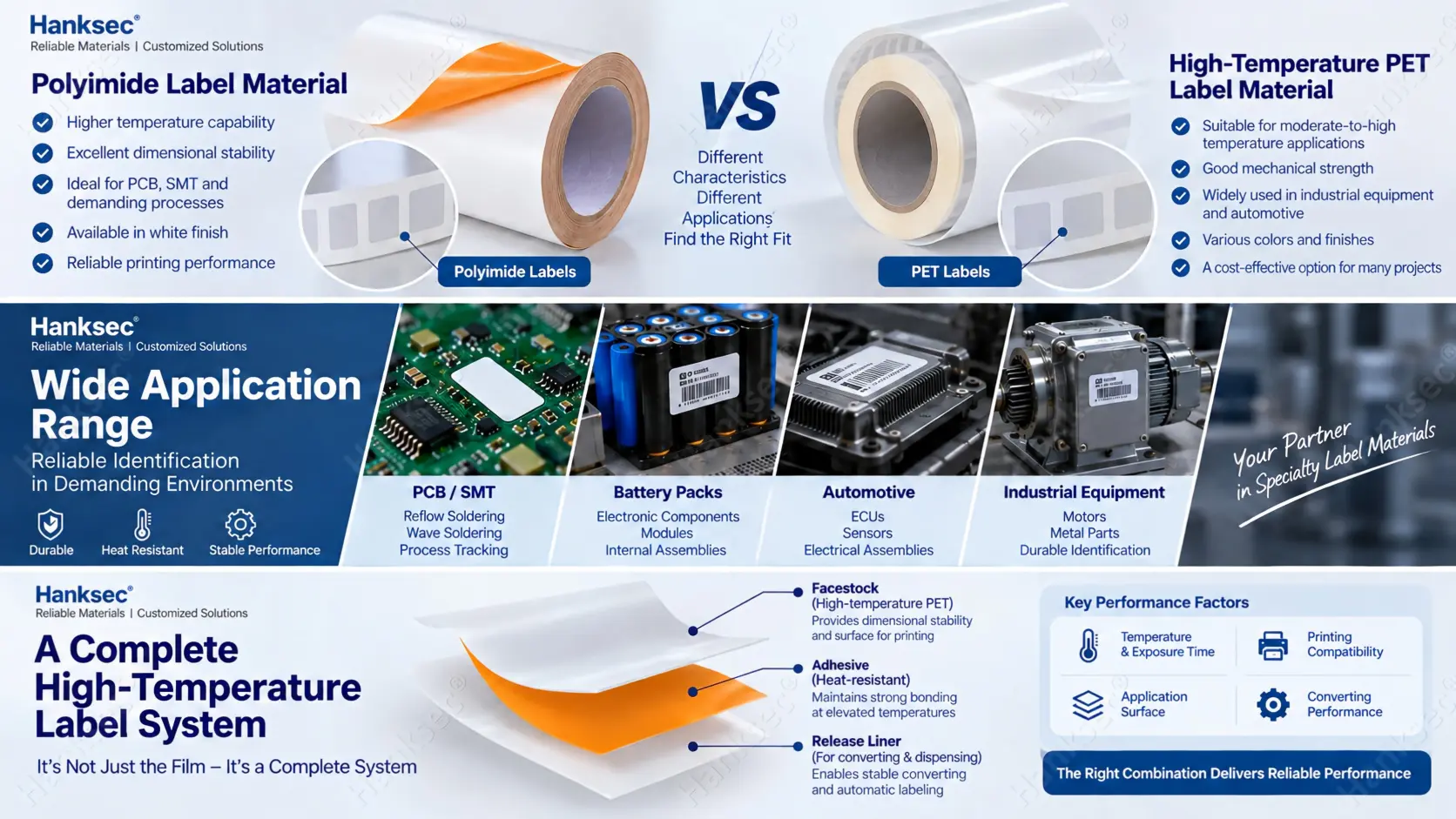
DuPont’s technical information for Kapton® polyimide film illustrates why polyimide is widely used where thermal, electrical, mechanical and dimensional performance must be maintained under demanding conditions.
However, the temperature capability of a raw polyimide film should non automatically be copied and presented as the temperature rating of a pressure-sensitive label. A finished label also contains adhesive, coating, ink or ribbon and may be attached to a substrate that behaves differently during heating.
This complete-system concept is also visible in commercial constructions such as 3M Thermal Transfer Label Material 7812, which combines a polyimide facestock, adhesive and thermal-transfer-printable topcoat for high-temperature labeling.
The correct purchasing conclusion is not that polyimide is universally better than PET. Buyers should select the minimum label construction that can reliably survive the actual thermal, printing, adhesive and converting requirements. Using an unnecessarily demanding material may increase cost, while choosing a standard PET construction for a severe soldering process may create production risk.
Applicazioni di materiali per etichette ad alta temperatura
High-temperature label materials are particularly valuable when identification must remain attached and readable before, during and after a demanding manufacturing or operating process.
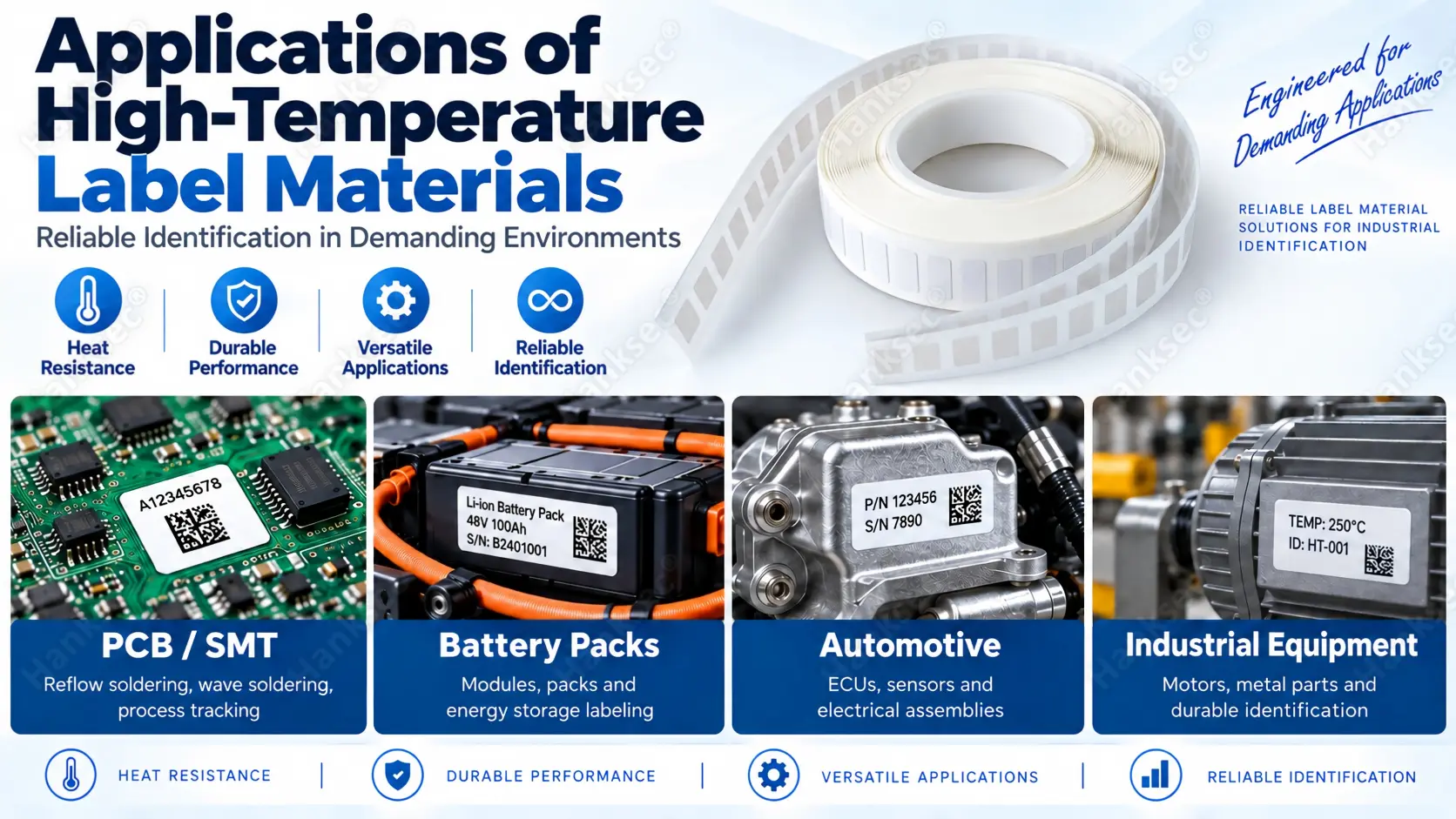
Produzione di PCB, SMT e componenti elettronici
PCB manufacturing is one of the most established applications for polyimide high-temperature labels. A single tracking label may need to remain attached while a board moves through multiple production stages.
Typical stages can include:
- PCB identification;
- SMT placement;
- reflow soldering;
- wave soldering;
- cleaning;
- inspection;
- electrical testing;
- assembly;
- final traceability.
In these applications, the label is not merely decorative. It may carry production information that connects one board or component to a manufacturing record.
Hanksec’s Materiale per etichette in poliimmide ad alta temperatura is designed around applications including PCB manufacturing, SMT processing, reflow soldering, wave soldering, barcode identification and electronic-component tracking.
Electronics manufacturers should qualify the label under the actual soldering profile rather than relying only on a generic material description. IPC maintains widely used electronics manufacturing standards, including standards and guidance relevant to printed boards, soldering and manufacturing processes.
Componenti elettronici e sistemi di batterie
High-temperature materials are also used for battery packs, electronic modules, chargers, internal components and other assemblies where labels may experience elevated process or operating temperatures.
For these projects, the buyer should first determine whether the requirement is caused by:
- manufacturing-process heat;
- a short-duration temperature peak;
- continuous service temperature;
- heat generated by the component itself;
- hot storage or transportation conditions.
These conditions should not be treated as equivalent.
A label that survives one short thermal cycle does not automatically prove that the same construction is suitable for long-term exposure at an elevated service temperature.
Identificazione automobilistica e industriale
Automotive electronics, electrical assemblies, motors, metal parts, industrial machinery and production equipment can also require durable heat-resistant labels.
In these environments, temperature is often only one of several stresses. Buyers may also need to evaluate:
- oil and chemical exposure;
- abrasion;
- vibration;
- curved or textured surfaces;
- low- or high-surface-energy plastics;
- long-term adhesive bonding;
- outdoor exposure;
- barcode and QR code readability.
For this reason, industrial label selection should be based on the complete operating environment rather than one temperature number.
Codici a barre, codici QR ed etichette di tracciabilità
A high-temperature label used for traceability is only successful if its printed information remains usable after the process.
Barcode bars, QR modules, serial numbers and human-readable text should therefore be checked after thermal exposure, not only immediately after printing.
Standard dei codici a barre GS1 describe barcode identification and scanning systems used across supply chains. For industrial manufacturing, the practical objective is to ensure that the selected label and print system remain readable throughout the intended production workflow.
Resistenza alla temperatura: materiale di rivestimento, adesivo e sistema di stampa
One of the most common mistakes when specifying Materiali per etichette resistenti alle alte temperature is assigning a single temperature number to the complete label without defining what that number actually represents.
A better qualification separates:
continuous service temperature + short-term peak temperature + exposure duration + complete material construction
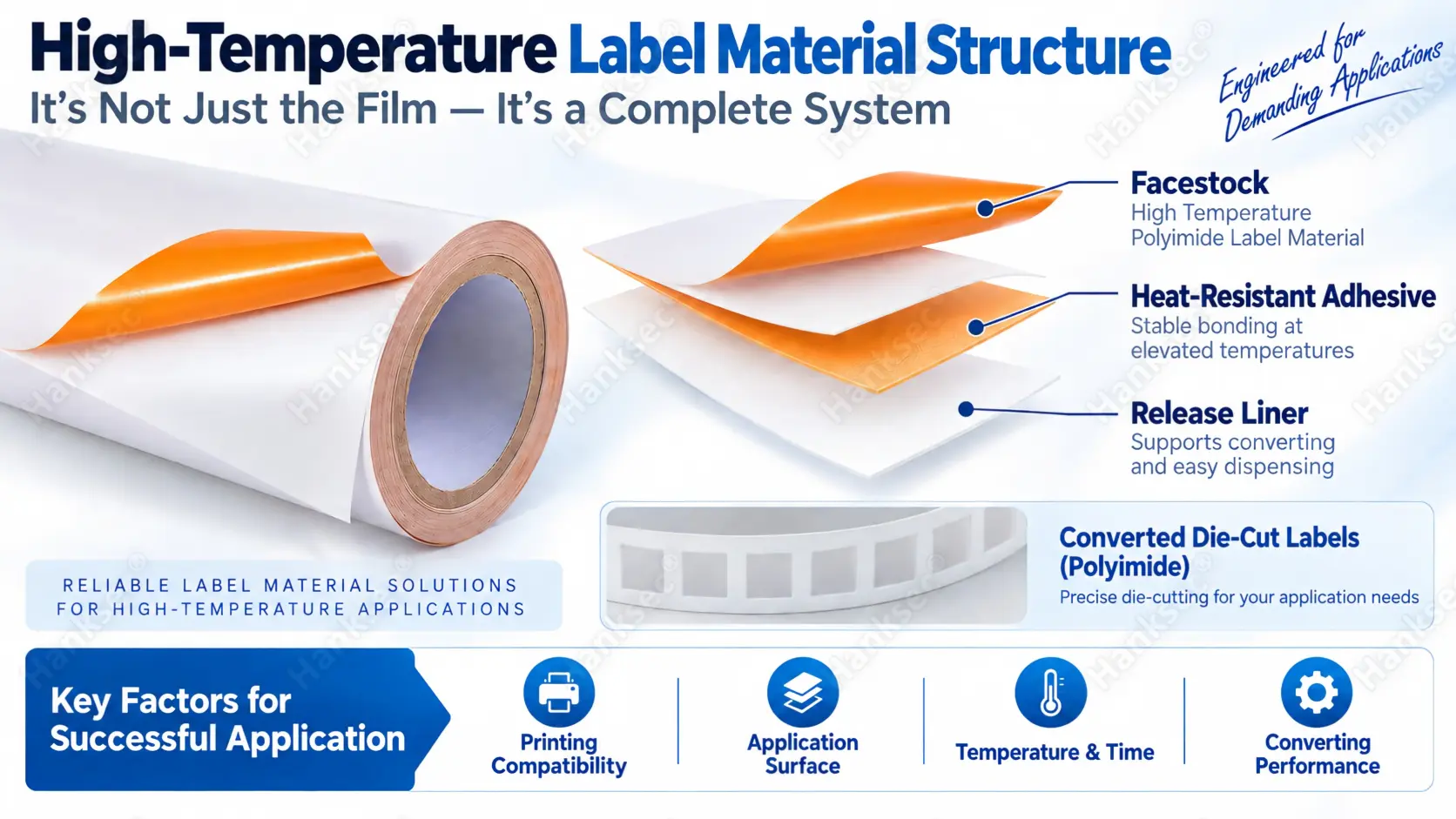
Facestock Temperature Resistance
The facestock provides mechanical and dimensional stability. Polyimide is widely used where conventional polymer films may not provide sufficient performance under demanding thermal conditions.
However, buyers should avoid approving a label based only on the theoretical performance of the raw facestock.
The relevant question is how the finished pressure-sensitive construction behaves after coating, adhesive lamination, printing, die cutting and final application.
Resistenza al calore dell'adesivo
The adhesive is equally important.
Possible adhesive-related failures during heat exposure include:
- sollevamento dei bordi;
- label movement;
- adhesive softening;
- adhesive ooze;
- loss of bond strength;
- excessive residue after removal;
- poor bonding caused by contaminated or low-energy surfaces.
A strong room-temperature adhesive does not automatically guarantee good high-temperature performance.
The adhesive must be matched to both the application surface and the thermal profile. PCB, coated metal, aluminum, PET, PC, ABS and other substrates may require different adhesive behavior.
Buyers who need deeper guidance on matching adhesive and application surface can review Hanksec’s Label Adhesive Selection Guide.
Stabilità di stampa e di rivestimento superiore
High-temperature labels frequently carry variable information, making print compatibility part of the material specification.
Depending on the selected surface treatment, Hanksec polyimide materials can be developed for processes including:
- thermal transfer printing;
- Stampa UV;
- Stampa flessografica;
- serigrafia;
- digital printing.
For thermal transfer applications, the material and ribbon need to be tested together. A good facestock combined with an unsuitable ribbon can still result in image loss, smearing or reduced scan quality after heat exposure.
Important print-validation points include:
- ink or ribbon adhesion;
- black density;
- barcode edge definition;
- QR code scanning;
- print discoloration;
- abrasion resistance;
- resistenza chimica;
- readability after thermal processing.
Converters working with different printing technologies can also review Hanksec’s Guida ai materiali per etichette di sicurezza stampabili.
Il tempo di esposizione è importante
“Heat resistant” is incomplete without time.
Consider two applications:
- a PCB label exposed to a short high-temperature production cycle;
- an industrial equipment label exposed continuously to elevated operating temperature.
Even when the peak temperature of the first application is higher, the long-duration thermal stress in the second application can create a different adhesive and material challenge.
When requesting a recommendation, buyers should therefore provide both:
maximum expected temperature + duration of exposure
If the application includes multiple thermal cycles, that should also be included in sample testing.
Specifiche dei materiali per etichette ad alta temperatura
For procurement, a high-temperature label material should be described as a complete construction rather than simply requesting “high-temperature PI” or “heat-resistant PET.”
| Specifiche | Direzione tipica | L'acquirente deve confermare |
|---|---|---|
| Facestock | Polyimide / application-specific PET | Required thermal and mechanical performance |
| Spessore della superficie | Specifico del progetto | Process, rigidity and converting requirements |
| Adesivo | Heat-resistant pressure-sensitive adhesive | Substrate, temperature and required bond |
| Continuous Temperature | Dipende dalla costruzione | Actual operating temperature and duration |
| Short-Term Peak Temperature | Dipende dalla costruzione | Maximum process temperature and exposure time |
| Thermal Cycles | Specifico del progetto | Single or repeated heat exposure |
| Colore | Amber / white / project-specific | Appearance and scanning requirements |
| Rivestimento superiore | Printing-method dependent | Ink or ribbon compatibility |
| Stampa | Thermal transfer / UV / flexo / screen / digital where compatible | Actual printing equipment and consumables |
| Codice a barre / QR | Available where required | Readability after heat exposure |
| Superficie di applicazione | PCB / metal / plastic / coated surface / project-specific | Surface material and cleanliness |
| Linea di rilascio | Specifico del progetto | Die cutting, dispensing and automatic labeling |
| Formato di fornitura | Rotolo jumbo / rotolo tagliato / foglio / etichette finite | Converter or OEM production process |
| Larghezza L | Costume | Machine and production requirement |
| Core & Winding | Costume | Converter or printer requirement |
| Fustellatura | Custom label dimensions | Label size, liner and stripping conditions |
Hanksec does not recommend copying a temperature number from another supplier’s film or label and assuming it applies to every construction. Exact thermal capability should be confirmed using the selected facestock, adhesive, printing system, application substrate and real heat-exposure profile.
This is particularly important for PCB and SMT projects, where production conditions may vary between customers, soldering equipment, process profiles and downstream cleaning or inspection steps.
Materiale in poliimmide ad alta temperatura Hanksec - Specifiche di fornitura tipiche
For buyers who need a more practical reference, the table below summarizes the typical supply specification of Hanksec’s current 50 μm high-temperature polyimide label material construction.
These values should be used as a material-selection reference rather than as a universal performance guarantee. Final performance depends on the complete label construction, application surface, printing system, thermal profile, exposure time and converting conditions. Sample validation under the customer’s actual process is recommended before bulk production.
| Specifiche | Hanksec Typical Supply |
|---|---|
| Product Code | 50MAPI |
| Facestock Material | Polyimide (PI) |
| Spessore della superficie | 50 ± 4 μm |
| Facestock Basis Weight | 68 ± 3 g/m² |
| Facestock Color | Bianco |
| Tipo di adesivo | Solvent-based pressure-sensitive adhesive |
| Dry Adhesive Thickness | 25 ± 2 μm |
| 180° Peel Adhesion | 6 N / 2.5 cm (GB/T 2792-98) |
| Adesione iniziale | 4# (GB/T 4852-94) |
| Holding Force | 24 h (GB/T 4851-98) |
| Temperature Range — Current TDS | -30°C to 300°C** |
| Recommended Label Application Temperature | 10°C to 40°C |
| Linea di rilascio | White liner |
| Release Liner Thickness | 80 ± 3 μm |
| Release Liner Basis Weight | 90 g (as specified in current TDS) |
| Stampa | Suitable for label printing; thermal transfer printing (TTP) available |
| Fustellatura | Good die-cutting performance |
| Standard Roll Size | 510 mm × 400 m |
| Custom Roll Length | Available according to converting requirements |
| Sheet Supply | Not recommended |
| Durata di conservazione | 12 months under recommended storage conditions |
| Magazzinaggio | -10°C to 30°C; 50%–90% RH; store ventilated and away from direct sunlight |
| Environmental Information | Halogen-free / SVHC / RoHS information stated in current TDS*** |
| Applicazioni tipiche | High-temperature identification labels, PCB and electronics applications, thermal-transfer-printed industrial labels |
| Formato di fornitura | Roll material; custom slitting and converted label formats available according to project requirements |
* The current TDS provided for this product identifies it as “50 microns High Temperature Resistant Material” but does not explicitly state the facestock chemistry. “Polyimide (PI)” should only be published after confirming that 50MAPI is the Polyimide construction.
** The current TDS lists -30°C to 300°C under “Apply Temperature.” This value should not automatically be interpreted as a universal continuous-service temperature or finished-label rating. Thermal performance should be validated using the complete construction, actual substrate, exposure time and customer process.
*** Environmental information is based on the current product TDS. Supporting documentation can be reviewed according to project and customer requirements.
For label converters and industrial printers, selecting the correct high-temperature construction is only the first step. Roll width, liner release, printing compatibility, die-cutting behavior, matrix stripping, core size and winding direction should also match the customer’s converting equipment and production process.
Materiali per etichette resistenti alle alte temperature per convertitori e produttori OEM
Many customers purchasing Materiali per etichette resistenti alle alte temperature are not looking only for finished stickers. Label converters, industrial printers and electronics OEMs may need a material construction that fits their own printing, slitting, die-cutting, dispensing and assembly equipment.
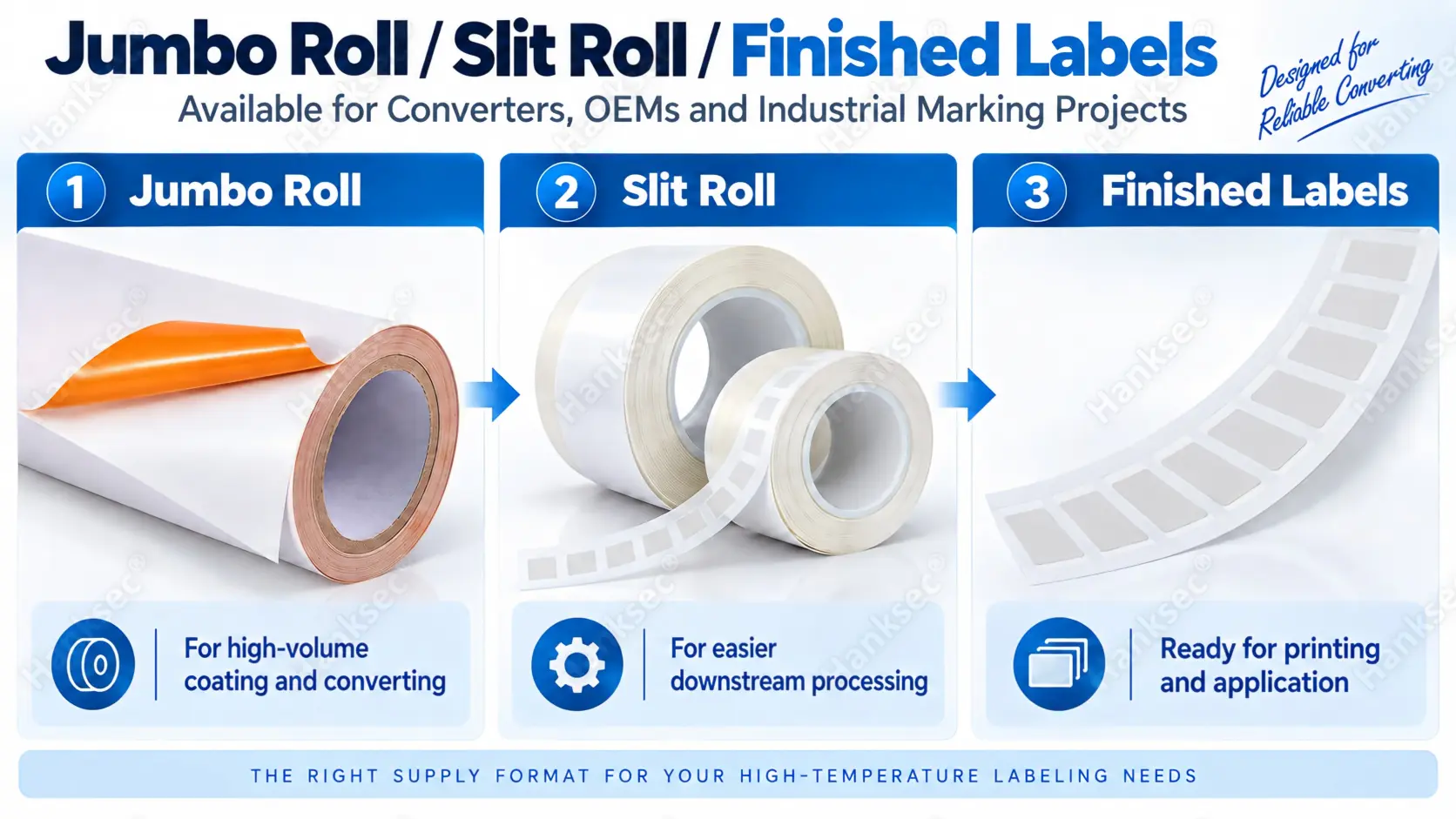
Hanksec can support project requirements including:
- jumbo rolls;
- slit rolls;
- sheets;
- finished die-cut labels;
- custom film thickness;
- adesivo personalizzato;
- custom release liner;
- thermal-transfer-printable coating;
- other printable surface treatments;
- custom roll width;
- custom roll length;
- core size;
- direzione di avvolgimento;
- barcode or QR printing;
- serial-number printing;
- OEM / ODM material production.
For converters, material qualification should include more than heat resistance. The roll still needs to run reliably through printing and converting equipment.
Important converting factors include:
- web stability;
- surface printability;
- Rilascio del rivestimento;
- precisione di fustellatura;
- rimozione della matrice;
- small-label stability;
- erogazione automatica;
- finished-roll consistency.
This is especially important for small PCB and electronic-component labels. Smaller labels provide less area for adhesive bonding and can also create a narrower converting window during die cutting and matrix removal.
Hanksec recently documented a real customer converting project in which a relatively thick high-temperature construction and small label dimensions created matrix-removal difficulties. The final solution required understanding both adhesive behavior and the customer’s converting process. Buyers and converters facing similar problems can review the High-Temperature Label Matrix Stripping real customer case.
The broader lesson is that material quality and converting performance are related, but they are not identical. A specialty high-temperature material should be validated on the actual printing and converting line whenever possible.
Come scegliere e testare i materiali per etichette resistenti alle alte temperature
Before requesting a quotation or approving bulk production, buyers should define the actual thermal and production conditions.
- Identify the application. PCB, SMT, battery, automotive, machinery and industrial identification can require very different constructions.
- Define the maximum temperature. Provide the highest expected process or operating temperature rather than simply requesting a “high-temperature label.”
- Define the exposure time. Separate a short temperature peak from continuous elevated-temperature service.
- Identify repeated thermal cycles. Tell the supplier if the label will experience several heating and cooling cycles.
- Choose the facestock. Evaluate whether polyimide is required or whether an application-specific PET construction can meet the real requirement.
- Verificare la superficie di applicazione. PCB, metal, PET, PC, ABS, coated surfaces and other substrates can require different adhesive systems.
- Conferma il metodo di stampa. Thermal transfer, UV, flexo, screen and digital printing require suitable surface treatment and consumables.
- Define the information that must survive. Barcode, QR code, serial number or warning text should remain readable after the complete process.
- Verificare le dimensioni dell'etichetta. Le etichette di dimensioni molto ridotte potrebbero richiedere maggiore attenzione per quanto riguarda l'adesivo, il supporto, la fustellatura e l'erogazione.
- Confermare il formato di fornitura. Specificare se si desidera un rotolo jumbo, un rotolo tagliato, un foglio o un'etichetta fustellata finita, indicando anche la larghezza del rotolo, il tipo di anima e la direzione di avvolgimento, ove applicabile.
- Testa l'intero processo. Prima della produzione in serie, sottoporre il campione approvato a processi di stampa, etichettatura, esposizione al calore, pulizia, ispezione e alle condizioni di produzione successive.
Una utile lista di controllo per la convalida dei campioni include:
- adesione iniziale;
- sollevamento del bordo dopo il riscaldamento;
- cambiamento dimensionale;
- scolorimento della parte frontale;
- adhesive ooze;
- leggibilità del codice a barre;
- QR code scanning;
- resistenza di stampa;
- esposizione a sostanze chimiche o detergenti, ove applicabile;
- comportamento di fustellatura;
- rimozione della matrice;
- Rilascio del rivestimento;
- erogazione automatica;
- ultima apparizione.
Il materiale migliore non è necessariamente quello con la più alta capacità termica teorica. È la costruzione che soddisfa i requisiti reali di produzione e di utilizzo finale del cliente, con un intervallo di conversione pratico.
Domande frequenti sui materiali per etichette resistenti alle alte temperature
Qual è il materiale migliore per le etichette resistenti alle alte temperature?
Non esiste un materiale universalmente migliore. Il poliimmide viene comunemente scelto per applicazioni esigenti come PCB, SMT e saldatura, mentre il PET resistente al calore può essere adatto a condizioni di temperatura industriali meno severe. La scelta deve tenere conto del materiale di rivestimento, dell'adesivo, del sistema di stampa, del substrato, della temperatura e del tempo di esposizione.
Le etichette in poliimmide sono adatte alla produzione di PCB e SMT?
I materiali per etichette in poliimmide sono ampiamente utilizzati per applicazioni su PCB, SMT, saldatura a rifusione, saldatura a onda e tracciamento di componenti elettronici grazie alla loro stabilità termica e dimensionale. La struttura finale dell'etichetta autoadesiva deve comunque essere validata nelle effettive condizioni di processo del cliente.
Il PET può essere utilizzato come materiale per etichette resistenti alle alte temperature?
Sì, a seconda della composizione del PET e della temperatura richiesta. Il PET resistente al calore può essere adatto a molte applicazioni elettroniche e industriali, ma non si deve automaticamente dare per scontato che il PET standard sia adatto a processi di saldatura di PCB particolarmente aggressivi. Sono necessari dei test.
La temperatura nominale del materiale di rivestimento corrisponde alla temperatura nominale dell'etichetta finita?
No. L'etichetta finita comprende anche adesivo, rivestimento, stampa e un substrato di applicazione. Una pellicola grezza può resistere a temperature elevate, mentre un altro componente del sistema di etichettatura si deteriora prima.
Perché il tempo di esposizione è importante per le etichette resistenti alle alte temperature?
Un breve picco di temperatura di processo e un'esposizione continua ad alte temperature creano sollecitazioni diverse. Gli acquirenti devono indicare sia la temperatura massima che la durata dell'esposizione quando richiedono una raccomandazione sui materiali.
È possibile stampare con la tecnica del trasferimento termico materiali per etichette resistenti alle alte temperature?
Sì, se il materiale selezionato presenta una superficie adatta alla stampa. Il nastro per trasferimento termico e il rivestimento del supporto devono essere testati insieme, verificando la leggibilità del codice a barre o QR dopo il processo termico richiesto.
Hanksec è in grado di fornire materiale per etichette ad alta temperatura in rotoli jumbo?
Sì. A seconda del progetto, Hanksec può fornire rotoli jumbo, rotoli tagliati, fogli ed etichette personalizzate fustellate per aziende di trasformazione, produttori di elettronica e progetti OEM.
È opportuno effettuare dei test sui campioni prima della produzione in serie?
Sì. I test sui campioni dovrebbero riprodurre l'applicazione reale nel modo più fedele possibile, inclusi il substrato effettivo, il metodo di stampa, l'incollaggio, le dimensioni dell'etichetta, il profilo termico, il tempo di esposizione, il processo di conversione e le condizioni di produzione a valle.
Hai bisogno di materiale per etichette resistenti alle alte temperature per il tuo progetto?
Hanksec fornisce etichette in poliimmide resistenti alle alte temperature e etichette termoresistenti specifiche per progetti, destinate a produttori di PCB, fabbriche di elettronica, aziende di trasformazione di etichette industriali e applicazioni OEM. Comunicaci la superficie di applicazione, la temperatura massima, il tempo di esposizione, il metodo di stampa, le dimensioni dell'etichetta, l'adesivo richiesto, il formato di fornitura e la quantità stimata.
RICHIEDI CAMPIONI DI MATERIALI PER ALTE TEMPERATURE E UN PREVENTIVO