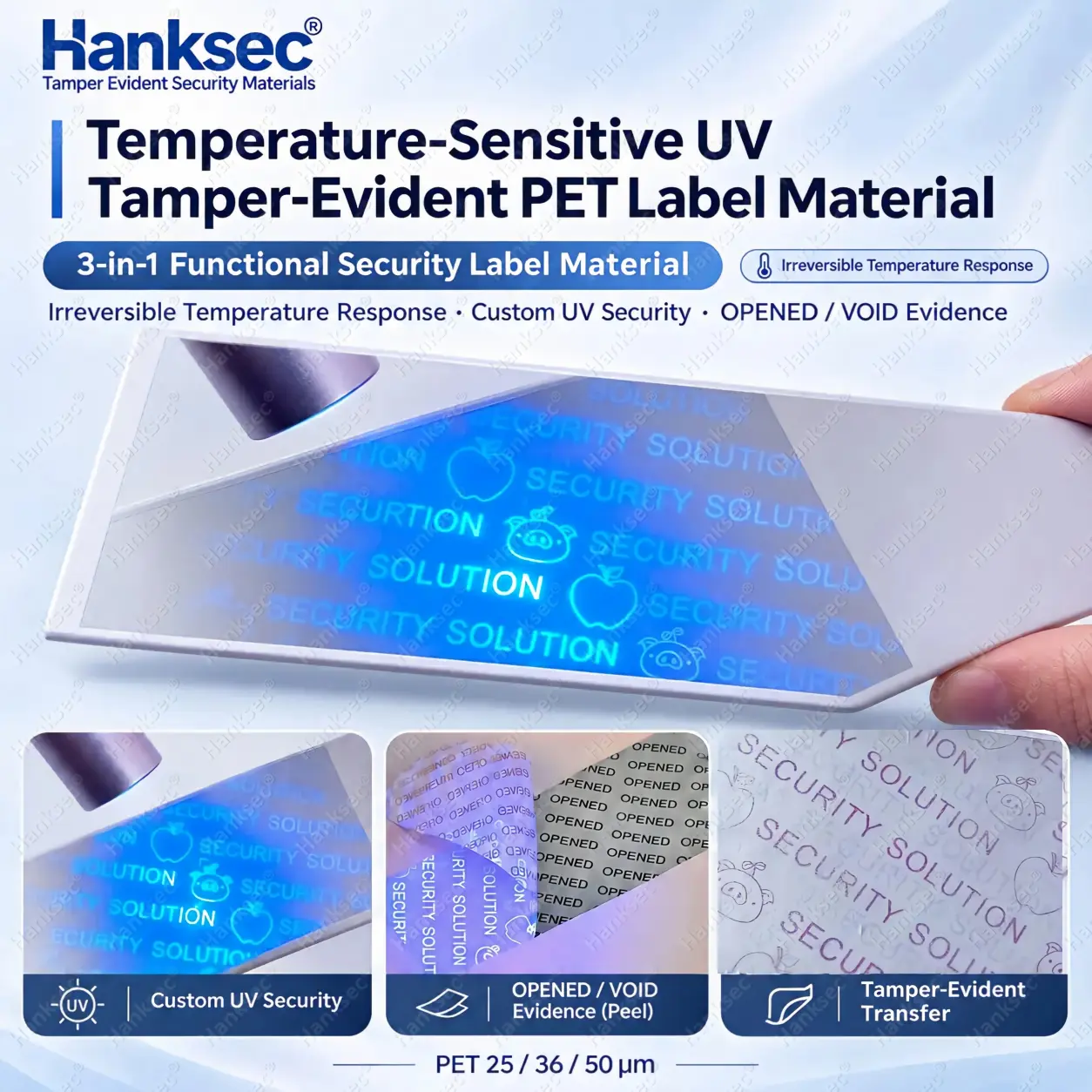
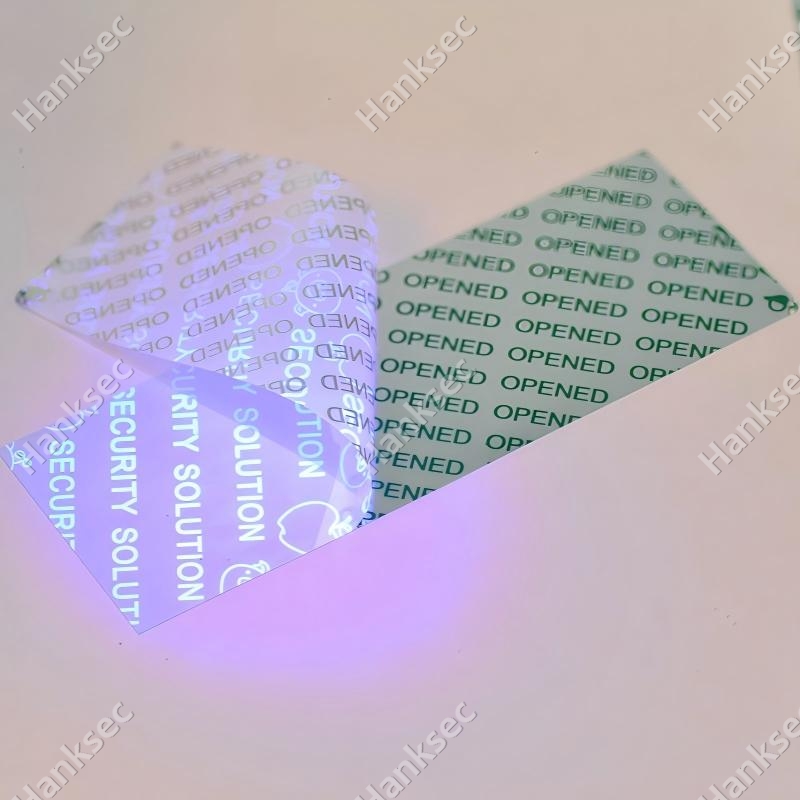
Quick Answer: Hanksec Temperature-Sensitive UV Tamper-Evident PET Label Material combines three security functions in one integrated label construction: irreversible temperature-responsive indication, customizable UV fluorescent identification, and OPENED / VOID tamper-evident protection. Available with 25 μm, 36 μm and 50 μm PET facestock options, this multifunctional security material supports Full-Transfer, Partial-Transfer and Non-Transfer constructions, subject to the selected design and technical qualification. Hanksec primarily supplies jumbo rolls and slit rolls to label converters, security printers and packaging manufacturers, with custom die-cut finished labels available for OEM and ODM projects.
Why Do Buyers Need a Multi-Functional Security Label Material?
Different security labels address different protection requirements. A VOID label reveals evidence of removal, a UV fluorescent marking provides an additional authentication feature, and a temperature-sensitive indicator shows whether a specified temperature activation condition has occurred.
For applications requiring all three functions, purchasing separate labels can increase material sourcing, inventory management, printing operations and application steps. Different label constructions may also create challenges in maintaining consistent positioning, functional performance and inspection procedures.
Hanksec’s multifunctional PET security label material integrates temperature response, UV identification and tamper-evident protection into one pressure-sensitive label construction. It is developed for B2B buyers who need multiple security features within a coordinated material solution.
Problem 1: Conventional VOID Labels Cannot Indicate Temperature Exposure
A conventional tamper-evident label helps identify unauthorized opening, lifting or removal. However, its tamper-evident function does not independently indicate whether a specified temperature activation condition has occurred. Likewise, a standard VOID construction does not automatically provide UV fluorescent authentication.
Practical solution: Integrate an irreversible temperature-responsive feature and customizable UV fluorescent identification with the required OPENED / VOID tamper-evident function. This allows the three inspection requirements to be addressed within one coordinated label construction.
Problem 2: Separate Security Labels Can Complicate Production
When temperature indicators, UV security labels and tamper-evident seals are purchased separately, converters and packaging manufacturers may need to manage different material specifications, printing processes, die-cutting requirements and application positions.
This can increase production coordination and introduce additional opportunities for inconsistent positioning, material incompatibility and incomplete application.
Practical solution: Evaluate an integrated multifunctional material construction. Confirm that the temperature response, UV fluorescence and tamper-evident function remain effective after printing, converting, application and relevant environmental exposure.
Problem 3: Three Security Functions Must Work Together
Combining multiple security features does not automatically guarantee that every function will perform correctly. The PET facestock, temperature-responsive component, UV fluorescent feature, tamper-evident layer, adhesive, coatings and release liner must be considered as parts of the complete pressure-sensitive construction.
For example, a protective coating or overlaminate may affect UV visibility. Changes to the adhesive or tamper-evident construction may also influence the intended removal response. Processing conditions can further affect the performance of the finished label.
Practical solution: Qualify the complete label construction rather than approving each function independently. Test representative printed and converted samples under the customer’s actual application, storage and inspection conditions.
How Does Temperature-Sensitive UV Label Material Work?
The material integrates three different inspection mechanisms. Each function addresses a specific security requirement and should be evaluated independently as well as within the completed label construction.
1. Irreversible Temperature-Sensitive Indication
The temperature-sensitive feature is designed to produce a visible change when its specified activation temperature is reached. The response is irreversible, meaning the indication is designed to remain visible after the surrounding temperature returns to a lower level.
This provides a visible indication that a defined temperature activation condition has occurred. It can support inspection procedures where buyers need to identify whether a specified temperature threshold has been reached.
The activation temperature is project-dependent and must be confirmed before ordering. Buyers should specify:
- Required activation temperature in °C.
- Initial appearance and activated appearance.
- Required visibility and readability of the indication after activation.
- Expected exposure conditions and inspection requirements.
- Storage conditions before application and during use.
- Required response consistency across samples and production batches.
Important limitation: An irreversible temperature indicator does not automatically provide continuous temperature monitoring, exposure duration or a complete temperature history. Its actual indication depends on the selected activation mechanism and the agreed qualification criteria. Buyers should confirm the intended temperature threshold and inspection requirements before approving production.
2. Custom UV Fluorescent Security Identification
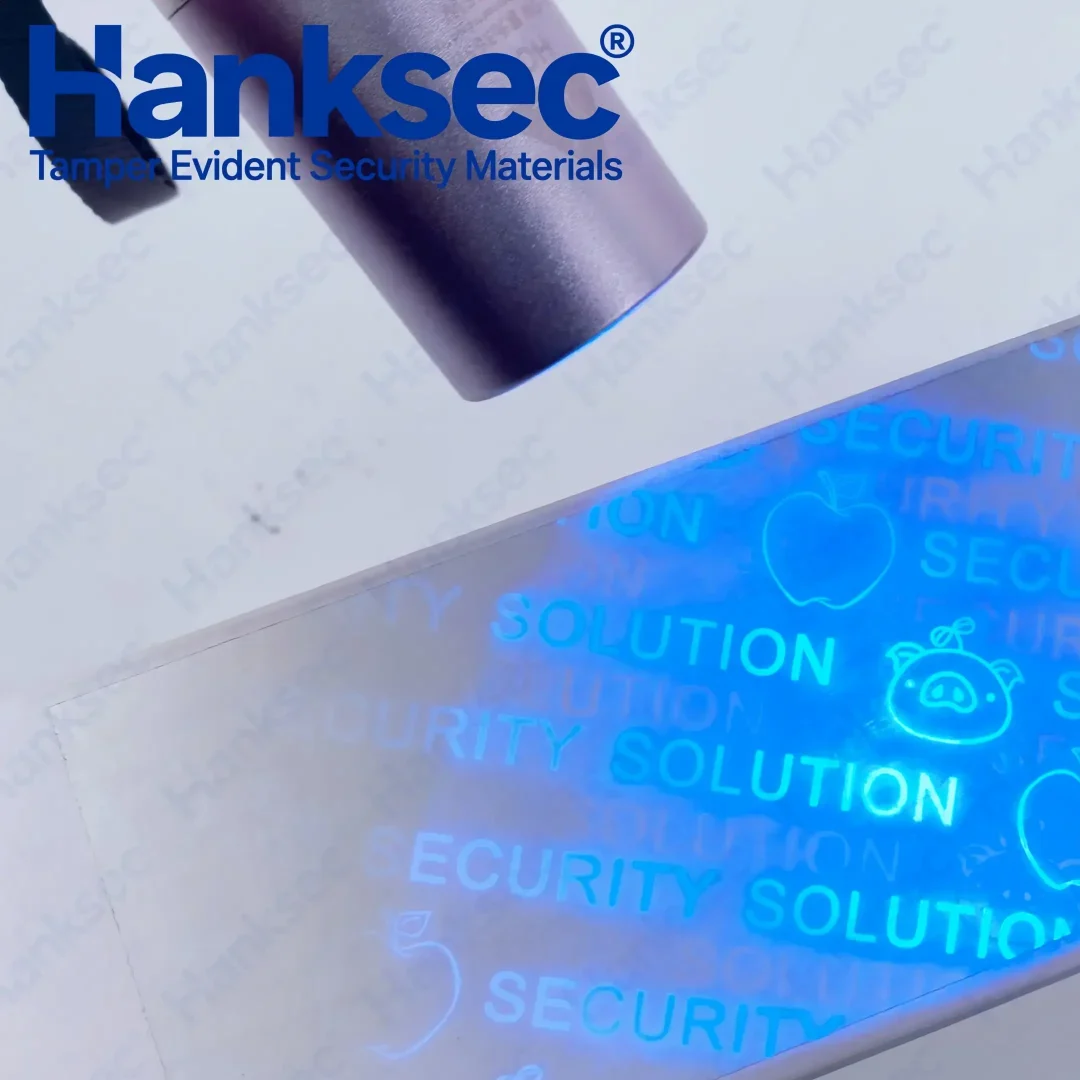
The UV security function provides an additional authentication feature through customizable fluorescent graphics, text, logos or security patterns. These markings are inspected using an appropriate ultraviolet light source.
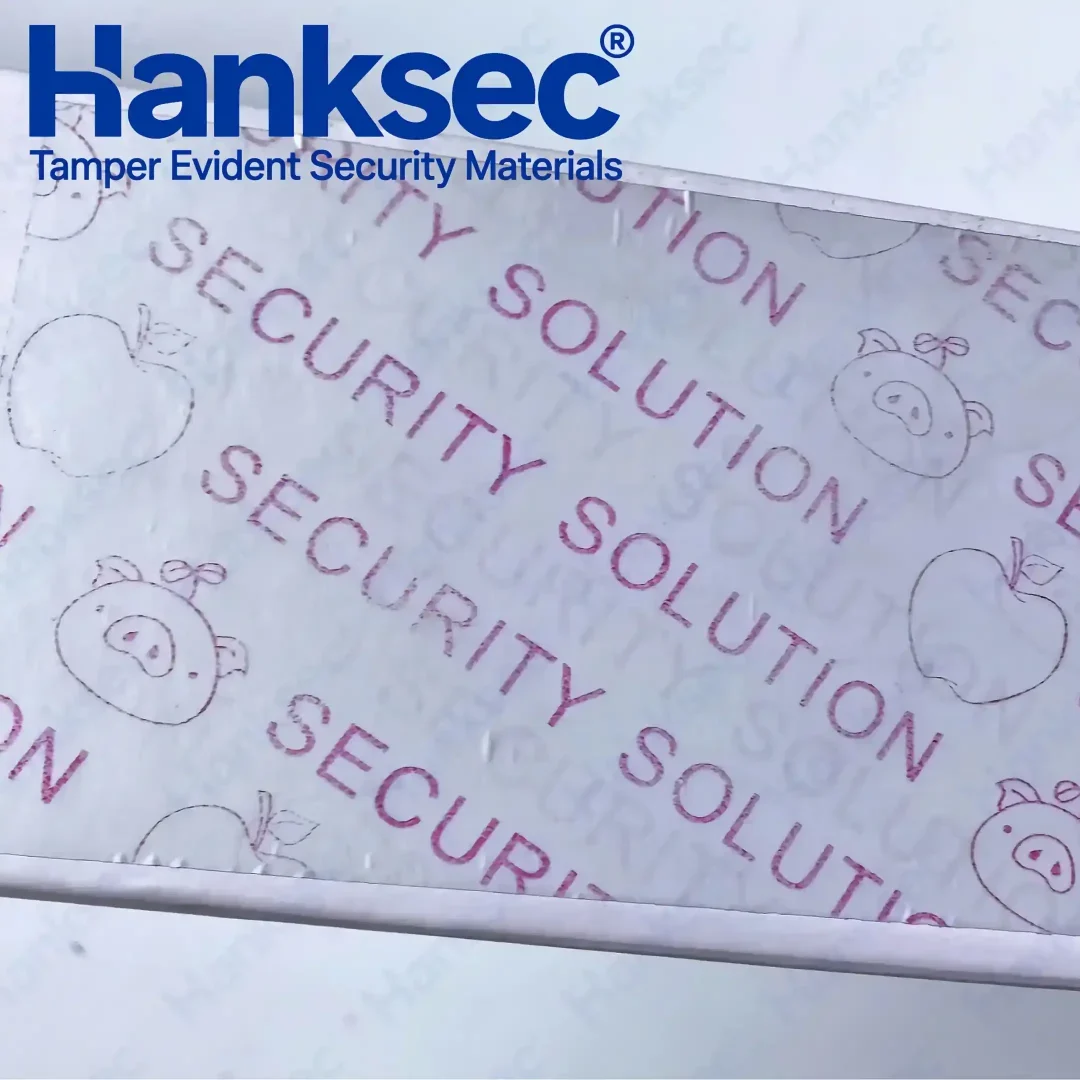
Depending on the selected fluorescent system, the security marking may have a different appearance under normal lighting and UV illumination. This provides an additional inspection feature alongside the visible temperature response and tamper-evident mechanism.
UV customization can be discussed according to:
- UV fluorescent logo or brand identification.
- Hidden text, security patterns or customized graphics.
- Required fluorescent color and visual appearance.
- Normal-light appearance and UV inspection conditions.
- UV light source and verification requirements.
- Compatibility with printing, coating and finishing processes.
Important limitation: UV visibility depends on the selected fluorescent material, excitation conditions, artwork and completed label construction. Printing inks, protective coatings, overlaminates and other surface treatments may affect the final inspection result. The finished construction should therefore be evaluated using the intended UV inspection equipment.
3. OPENED / VOID Tamper-Evident Protection
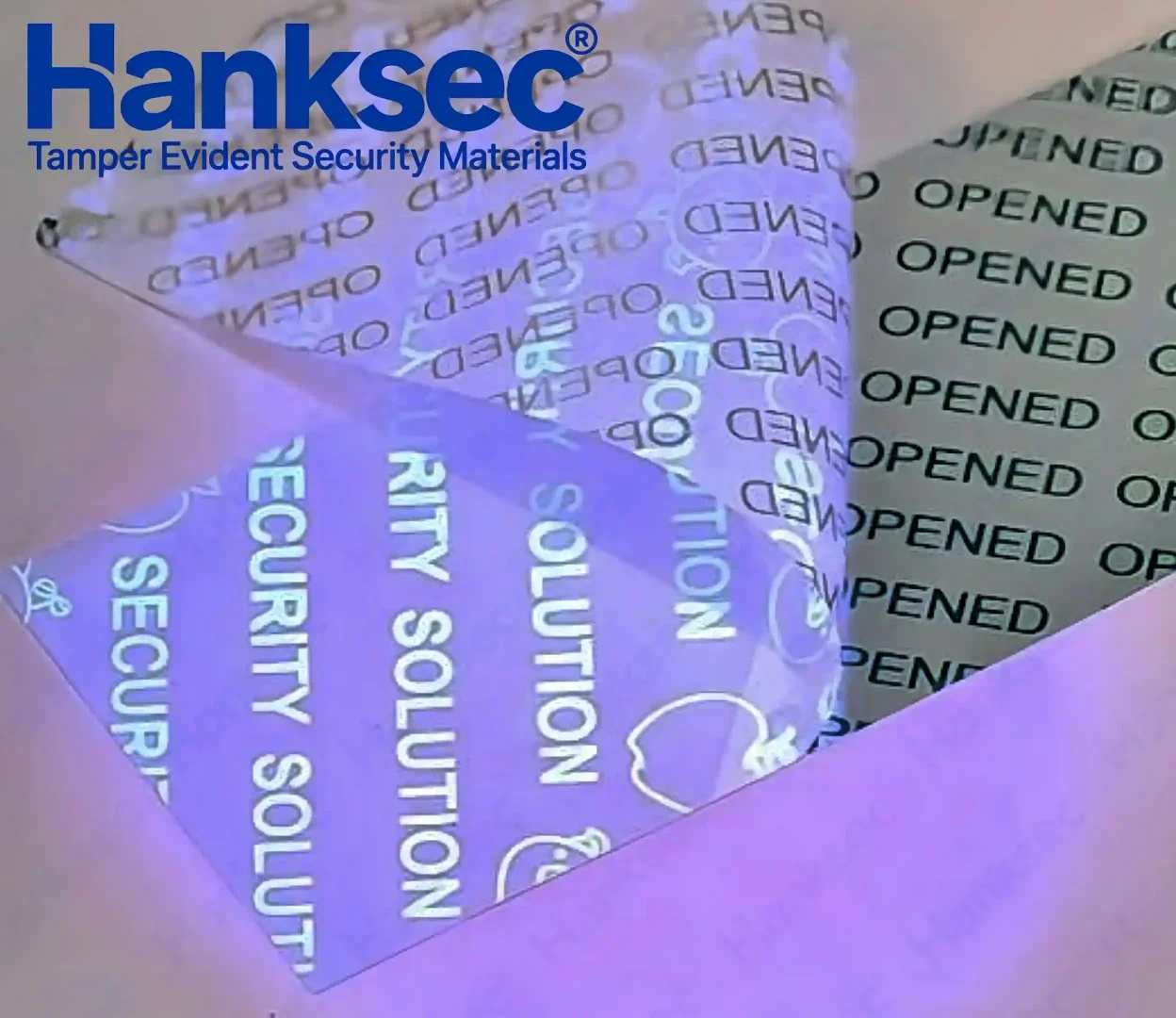
The tamper-evident function provides visible evidence when an applied label is lifted, removed or manipulated. Depending on the selected construction and approved artwork, the security message can be customized as OPENED, VOID or another agreed design.
Hanksec can develop the multifunctional material with different tamper-evident transfer constructions. Buyers can select the required transfer behavior according to the application substrate, removal evidence requirements and intended inspection method.
- Full Transfer: The designated tamper-evident functional layer is designed to transfer to the applied substrate when the label is removed, leaving a visible transfer pattern or security message.
- Partial Transfer: A controlled portion of the designated functional layer transfers to the substrate, while the remaining portion stays with the removed label.
- Non-Transfer: The construction is designed to provide the specified tamper-evident response without transferring the main functional label layer to the substrate.
These three transfer configurations can be evaluated with the temperature-responsive and UV fluorescent functions, subject to the selected material construction, functional compatibility and technical qualification.
Important: The product photographs currently displayed on this page show Full-Transfer samples. They illustrate one available tamper-evident construction and do not indicate that the product is limited to Full Transfer. Partial-Transfer and Non-Transfer versions can also be discussed for project evaluation.
Buyers should not select a tamper-evident material based only on the printed security message. The actual removal response, message clarity, adhesive residue, substrate compatibility and consistency of the security effect should also be evaluated.
For additional technical guidance on security label material qualification and tamper-response evaluation, see our Security Label Material Quality Control Guide.
What PET Thickness Should Buyers Choose: 25, 36 or 50 μm?
Hanksec offers 25 μm, 36 μm and 50 μm PET facestock options for this product range. The appropriate thickness should be selected according to label dimensions, application geometry, printing requirements and downstream converting conditions.
| PET Thickness |
Buyer Evaluation |
What to Verify |
| 25 μm |
For applications where a thinner PET facestock is preferred. |
Handling, dimensional stability, printing and converting performance. |
| 36 μm |
An intermediate facestock thickness for project evaluation. |
Printing, die-cutting, dispensing and construction compatibility. |
| 50 μm |
For applications where a thicker PET facestock is preferred. |
Flexibility, label geometry, handling and final application behavior. |
These values refer to PET facestock thickness, not the total thickness of the complete label construction. Adhesive, functional layers, coatings and release liner must be considered separately.
A thicker facestock is not automatically a better security label. The correct choice depends on the complete construction and the customer’s printing, converting and application requirements. Sample evaluation is recommended before final material approval.
Temperature-Sensitive UV Tamper-Evident Label Material Specifications
The following table summarizes the currently specified material options and project-dependent features of Hanksec’s multifunctional PET security label material. Final specifications should be confirmed against the approved sample and project requirements.
| Specification |
Details |
| Product Type |
Multifunctional Security Label Material |
| Facestock |
PET |
| Facestock Thickness |
25 μm / 36 μm / 50 μm |
| Temperature Response |
Irreversible |
| Activation Temperature |
To be confirmed according to project requirements |
| UV Function |
Custom fluorescent graphics, text or patterns |
| Tamper-Evident Message |
OPENED / VOID / Custom, subject to selected construction |
| Transfer Configuration |
Full Transfer / Partial Transfer / Non-Transfer |
| Integrated Security Functions |
Irreversible Temperature Response + UV Fluorescent Identification + Tamper-Evident Protection |
| Material Supply |
Jumbo Rolls / Slit Rolls |
| Finished Label Supply |
Custom Die-Cut Labels |
| Artwork |
Customizable |
| Dimensions |
Customized according to project requirements |
| Adhesive / Release Liner |
To be confirmed according to the selected construction |
How to Avoid Problems During Printing and Label Converting
For material buyers and label converters, the finished security effect is only one part of product qualification. The material must also run through the intended production process without compromising its temperature response, UV fluorescent identification or tamper-evident performance.
UV Fluorescent Feature and Printing Compatibility
The UV security marking should be inspected after the complete printing and finishing process. Printing inks, protective coatings, laminating materials and overprinting may affect fluorescent visibility or the appearance of the finished security marking.
Recommended action: Prepare a representative finished-structure sample and compare its normal-light appearance and UV response before and after the intended printing and finishing processes. Confirm the inspection conditions before approving production.
Die-Cutting and Matrix Stripping
Incorrect die-cutting conditions may affect label edges, functional layers or the release liner. Matrix stripping and dispensing should also be evaluated using the intended converting equipment.
Recommended action: Confirm die-cutting depth, edge quality, matrix removal stability, release behavior and web handling using a representative roll sample. Check that converting does not damage or compromise the integrated security functions.
Adhesive and Substrate Compatibility
A material that performs well on one surface may behave differently on another. Glass, PET, ABS, PP, PE, coated paperboard and painted metal can have different surface energies, textures and surface treatments. Adhesion and tamper-evident behavior should therefore be evaluated on the actual application substrate.
Recommended action: Test the complete label construction on the customer’s actual substrate. Evaluate adhesion development, edge lifting, tamper activation and residue behavior after the specified dwell period and under the intended application conditions.
How Should Buyers Qualify the Three Security Functions?
A reliable purchasing decision should be based on defined test requirements rather than visual appearance alone. Hanksec recommends evaluating each function separately and then checking the complete printed and converted construction under representative application conditions.
| Qualification Item |
What to Check |
Acceptance Basis |
| Temperature Activation |
Activation threshold, visual response and irreversibility. |
Agreed activation temperature and approved reference sample. |
| UV Identification |
Fluorescent color, pattern clarity and inspection visibility. |
Approved UV artwork and defined inspection conditions. |
| Tamper Response |
OPENED / VOID message appearance, selected transfer configuration and residue behavior. |
Specified Full-Transfer, Partial-Transfer or Non-Transfer response on the actual substrate. |
| Peel Adhesion |
Bond performance under defined application conditions. |
Project-specific adhesive requirement and agreed test method. |
| Die-Cutting and Release |
Cutting quality, matrix stripping and liner release. |
Stable performance on the intended converting equipment. |
| Construction Consistency |
Consistency of temperature response, UV fluorescence and selected tamper-evident transfer behavior across samples and production batches. |
Conformity to approved specifications and reference samples across tested samples and production batches. |
The qualification criteria should be agreed before production approval. If the activation temperature, UV inspection conditions or tamper-response requirements have not been defined, these items should remain under technical review rather than being assigned an assumed PASS result.
For pharmaceutical packaging projects, buyers may also consult ISO 21976:2018 – Packaging: Tamper Verification Features for Medicinal Product Packaging as a reference for the application, use and checking of tamper-verification features. Its scope is specific to medicinal product packaging and does not constitute a certification claim for this Hanksec material.
Jumbo Roll Supply or Custom Finished Security Labels?
Hanksec primarily supplies multifunctional security label material to B2B customers. The main supply model is roll material for industrial printing and converting, with custom finished labels also available for projects requiring ready-to-apply products.
Jumbo Rolls for Industrial Material Buyers
Jumbo roll supply is suitable for label converters and security printing manufacturers with their own printing, slitting and die-cutting facilities.
Before requesting a quotation, specify:
- PET facestock thickness: 25 μm, 36 μm or 50 μm.
- Required irreversible temperature activation threshold.
- UV fluorescent artwork and inspection requirements.
- OPENED, VOID or customized tamper-evident message.
- Required transfer construction: Full Transfer, Partial Transfer or Non-Transfer.
- Required web width, roll length and core size.
- Printing, die-cutting and downstream converting process.
Slit Rolls for Converters and Printing Factories
Slit roll supply can be discussed according to the customer’s equipment, web width, winding direction, core dimensions and production requirements.
Converting trials should confirm web handling, edge quality, release behavior and the stability of all three functional features after processing.
Custom Die-Cut Finished Labels
For buyers without their own label converting facilities, Hanksec can also discuss custom finished security labels. Options may include customized label dimensions, die-cutting, UV artwork, temperature activation requirements, tamper-evident transfer construction and OPENED / VOID security messages.
Finished-label specifications should be approved against the intended application surface and inspection process before bulk production.
What Information Should Buyers Include in an RFQ?
Incomplete purchasing specifications can lead to samples that do not match the actual application. A useful RFQ should describe the intended security functions, material construction, converting process and end-use conditions.
| RFQ Parameter |
Information to Provide |
| PET Thickness |
25 μm / 36 μm / 50 μm. |
| Temperature Requirement |
Required irreversible activation temperature and expected exposure conditions. |
| UV Requirement |
Fluorescent color, artwork, inspection light and visibility requirements. |
| Tamper-Evident Function |
OPENED / VOID / Custom message and required Full-Transfer, Partial-Transfer or Non-Transfer behavior. |
| Application Surface |
Glass, PET, PP, PE, metal, coated carton or another substrate. |
| Printing Process |
Flexographic, screen, digital or another intended process. |
| Supply Format |
Jumbo roll, slit roll or finished die-cut labels. |
| Quantity |
Estimated material area, roll quantity or finished-label quantity. |
Providing these details allows the material supplier to evaluate the construction, confirm technical requirements and prepare representative samples before quotation and production approval.
Frequently Asked Questions About Temperature-Sensitive UV Label Material
1. Can temperature-sensitive, UV fluorescent and tamper-evident functions be combined in one label?
Yes. Hanksec’s multifunctional PET security label material is designed to integrate irreversible temperature response, customizable UV fluorescent identification and OPENED / VOID tamper-evident protection within one label construction. The final combination should be confirmed through technical evaluation of the selected material structure.
2. Is this material available in Full-Transfer, Partial-Transfer and Non-Transfer versions?
Yes. All three tamper-evident transfer configurations can be evaluated for this product. The photographs currently displayed show Full-Transfer samples. Partial-Transfer and Non-Transfer constructions are also available for project evaluation, subject to material design and technical qualification.
3. Can I specify the temperature activation threshold?
Yes. The activation temperature is project-dependent and should be specified before sampling. Please provide your required activation temperature in °C, initial and activated appearance, exposure conditions and inspection requirements so the appropriate construction can be evaluated.
4. Does the irreversible temperature indicator record exposure duration or a complete temperature history?
No. The irreversible indicator provides a visible response when its specified activation condition is reached. It does not independently provide continuous temperature monitoring, exposure duration or a complete temperature history.
5. Can the UV fluorescent security feature be customized with our company logo or security pattern?
Yes. Custom UV fluorescent logos, text, graphics and security patterns can be discussed. The fluorescent appearance, inspection light source and visibility requirements should be confirmed during artwork and sample evaluation. Printing and coating compatibility should also be checked on the finished construction.
6. What PET thickness options are available?
Hanksec offers 25 μm, 36 μm and 50 μm PET facestock options. These values refer to the PET facestock thickness, not the total thickness of the complete label construction. The appropriate option depends on label dimensions, application geometry and converting requirements.
7. Can Hanksec supply jumbo rolls, slit rolls and finished labels?
Yes. Hanksec primarily supplies jumbo rolls and slit rolls for label converters and security printing manufacturers. Custom die-cut finished labels are also available for OEM and ODM projects. Supply dimensions and specifications can be discussed according to your production requirements.
Why Work with Hanksec for Multifunctional Security Label Materials?
Hanksec is a direct manufacturer of temperature-sensitive, UV fluorescent and tamper-evident security label materials, with more than 15 years of industry experience. We focus on material solutions for label converters, security printers, packaging manufacturers, distributors and OEM/ODM customers.
Our product approach prioritizes the complete material construction rather than the appearance of an individual security feature. PET thickness, temperature response, UV identification, tamper-evident behavior, adhesive compatibility, release liner and roll specifications should all be considered together.
Whether you require jumbo rolls for industrial converting, slit rolls for your production line or custom die-cut finished labels, the material specification should start with your application, processing conditions and inspection requirements.
For technical consultation, sample evaluation or a project quotation, contact the Hanksec team through our security label material inquiry page.
Looking for a Multifunctional Temperature-Sensitive UV Tamper-Evident Material?
Hanksec supplies multifunctional PET security label materials combining irreversible temperature response, customizable UV fluorescent identification and OPENED / VOID tamper-evident protection. Full-Transfer, Partial-Transfer and Non-Transfer constructions can be evaluated according to your application requirements.
Tell us your required PET thickness, activation temperature, UV artwork, tamper-evident transfer type, application substrate, printing process and roll specifications. Our team can discuss suitable material constructions, sample evaluation and jumbo roll, slit roll or custom finished-label options for your project.
REQUEST SAMPLES & QUOTE →
Hanksec® – Multifunctional PET Security Label Materials for Temperature-Sensitive, UV and Tamper-Evident Applications.