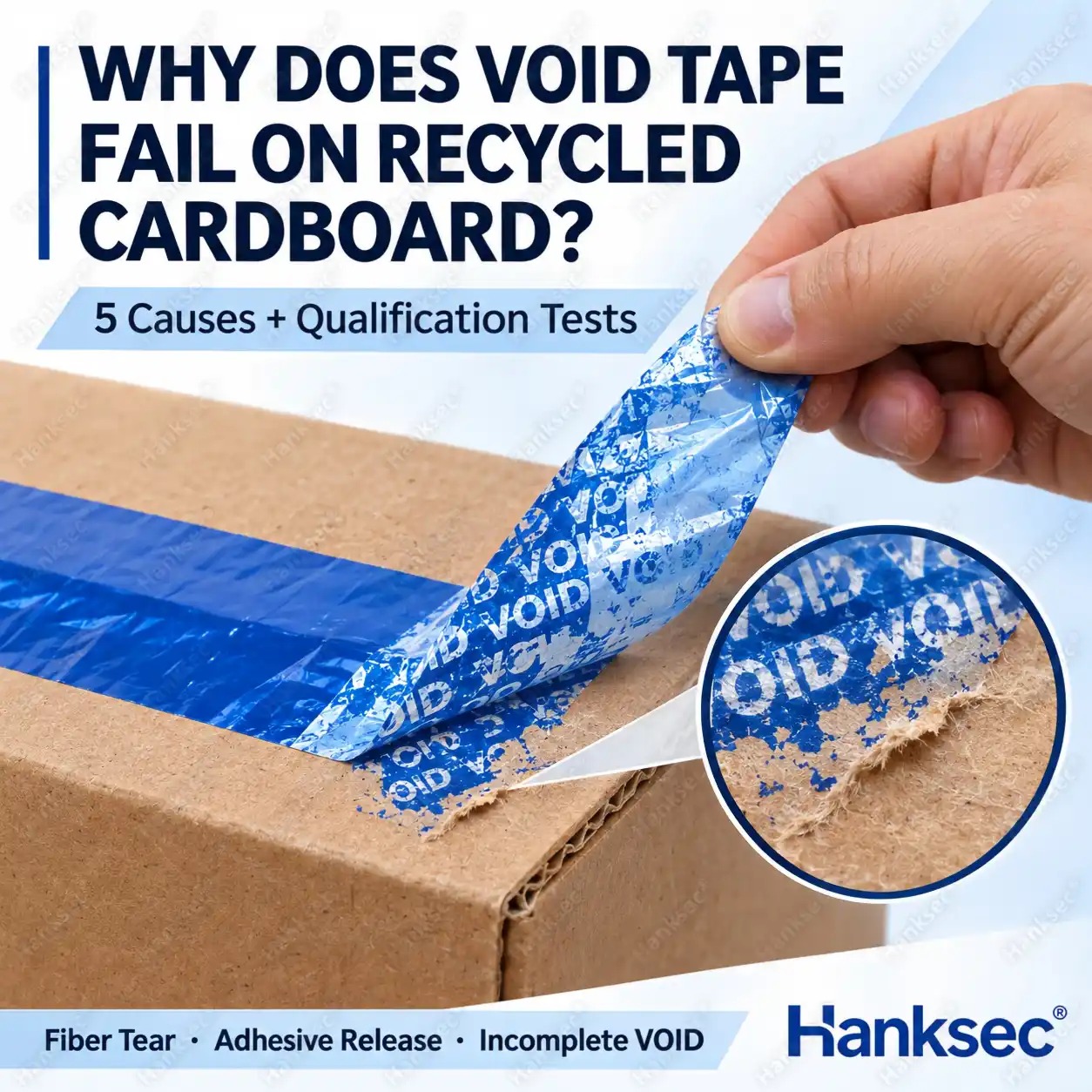
Quick Answer: VOID tape fails on recycled cardboard when the carton surface releases fibers, contains loose dust, develops uneven adhesive contact or changes with moisture before the designed tamper-evident layer activates. The result may be fiber tear without a readable VOID message, incomplete transfer, adhesive release or premature edge lifting. The correct solution depends on identifying which interface fails first, not simply choosing a stronger adhesive.
A VOID tape that produces a clear OPENED message on a smooth reference carton may behave differently on recycled corrugated board. The adhesive, security release layer and carton fibers interact as one system during peeling.
For security tape converters, packaging manufacturers and logistics buyers, the critical question is whether the finished tape produces the specified visible tamper evidence on the actual production carton. Laboratory adhesion alone does not confirm this result.
Why VOID Tape Fails on Recycled Cardboard
Recycled corrugated board can vary in surface strength, fiber composition, porosity, dust, sizing and moisture content. These properties influence the pressure-sensitive adhesive’s contact with the outer liner and the location where separation occurs during removal.
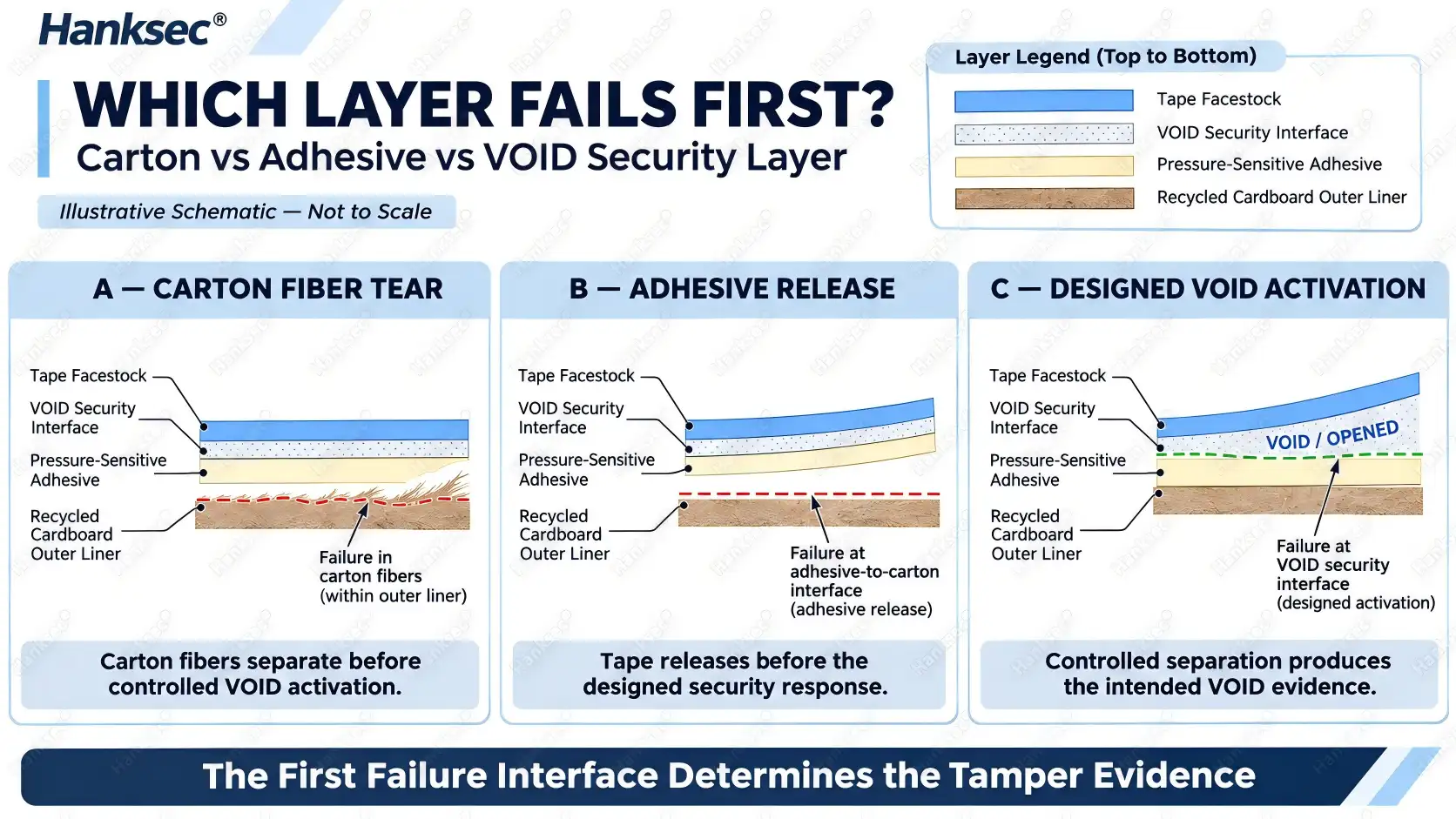
The relationship between the carton surface and VOID security construction is especially important. When tape is peeled, the applied force may separate the adhesive from the carton, activate the intended VOID layer or tear fibers from the paperboard.
Only one of these outcomes may match the approved security specification.
Importantly, recycled content does not automatically mean poor performance. Different board grades, fiber treatments, coatings and manufacturing conditions can produce substantially different results. The actual outer liner should be tested rather than judging compatibility only by the recycled-content percentage.
For the general selection of tamper-evident tapes for shipping cartons, see Hanksec’s Security Tape for Boxes Selection Guide. This article focuses specifically on failure diagnosis on recycled cardboard.
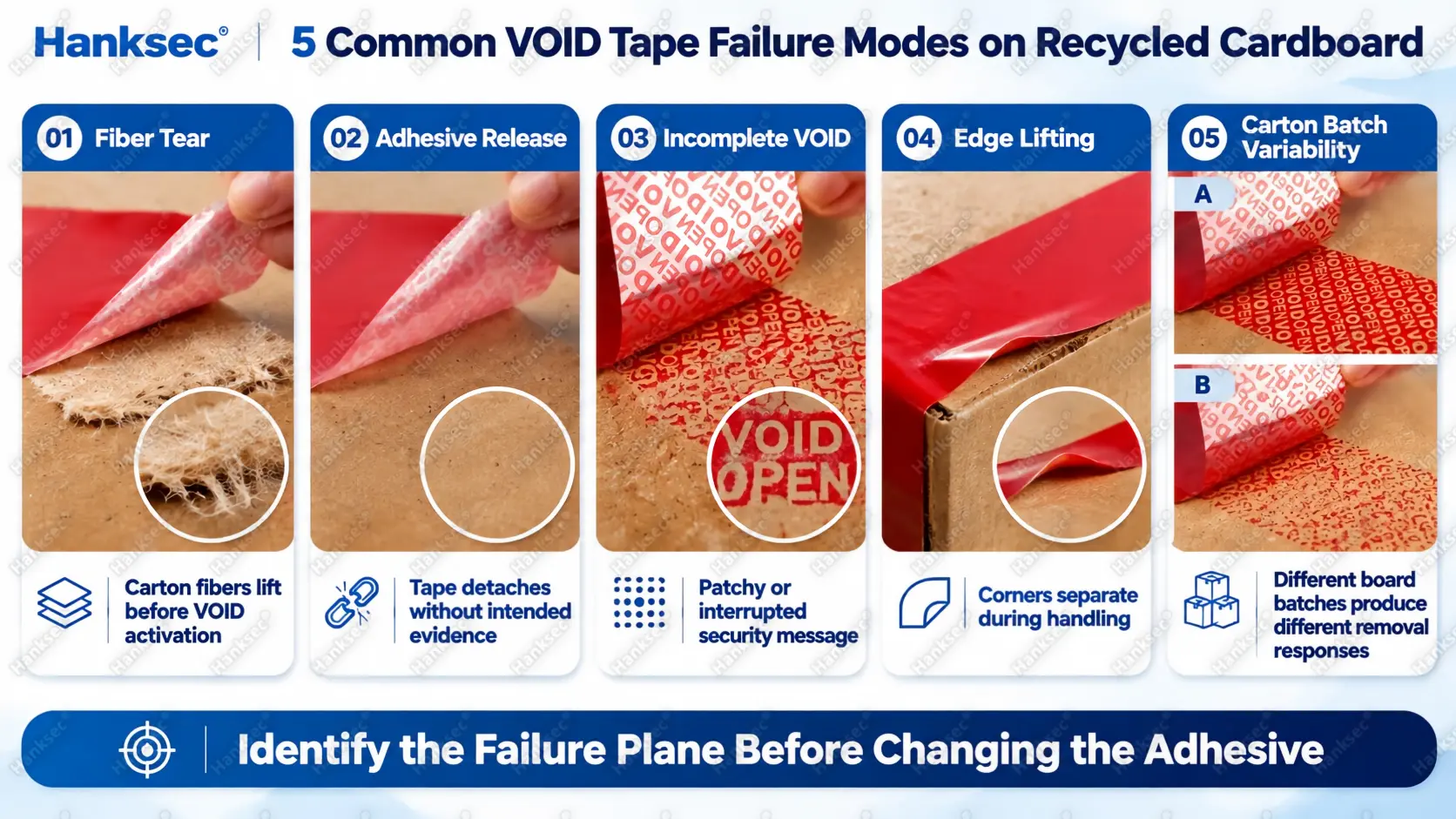
What Are the 5 Common VOID Tape Failure Modes on Recycled Cardboard?
The most useful troubleshooting method is to compare the expected VOID effect with the actual appearance of the tape and carton after a controlled removal attempt.
| Failure | Visible Symptom | Likely Failure Location |
|---|---|---|
| 1. Fiber Tear | Paper fibers lift with the tape; VOID message may be missing. | Within the outer carton liner |
| 2. Adhesive Release | Tape peels away with little resistance or evidence. | Adhesive-to-carton interface |
| 3. Incomplete VOID | Patchy, faint or broken hidden message. | Uneven contact or functional separation |
| 4. Edge Lifting | Tape corners or edges release during storage or handling. | Local adhesive contact or sustained closure stress |
| 5. Variable Results | Identical tape works on some boxes but fails on others. | Carton or application variability |
1. Carton Fibers Tear Before the VOID Message Activates
This is a distinctive problem on paperboard with limited surface strength.
During peeling, the adhesive may bond strongly enough to pull fibers from the carton surface. However, the outer paper liner may split before the engineered VOID security interface separates.
The result can be a visibly damaged carton without the intended readable VOID or OPENED pattern.
This does not necessarily mean that the adhesive is weak. It can mean that the carton-fiber bond is weaker than the force required to activate the specified security construction.
Fiber damage may be acceptable in applications where the approved security requirement is simply irreversible, visible carton damage. But if the buyer requires a clear VOID message on the carton, fiber tearing alone may be a qualification failure.
The important task is to identify whether the desired result is controlled message transfer, visible paper destruction or a combination of both.
2. Adhesive Releases Before the Security Layer Activates
The opposite failure occurs when the adhesive does not develop sufficient contact with the recycled board.
Loose dust, poor surface contact, uneven texture, an unsuitable adhesive or inadequate application pressure may allow the tape to detach from the carton before the internal security system separates.
In this case, the removed tape may appear almost unchanged, with little visible opening evidence.
A high peel-adhesion value measured on stainless steel does not establish that the same adhesive will behave correctly on a porous recycled carton.
Before changing the adhesive formulation, inspect the real carton surface, application pressure, dwell time and removal conditions.
3. VOID Message Appears Uneven or Incomplete
Recycled board surfaces may contain uneven fibers, pores, raised areas and locally variable coatings. The adhesive may contact some regions more effectively than others.
During peeling, the resulting separation can vary across the tape width, producing a faint or discontinuous VOID pattern.
However, incomplete activation is not always caused by the carton. Security-layer coating consistency, material aging, adhesive formulation and converting damage may also affect the result.
Compare the failed sample with an approved reference produced from the same material batch. This helps determine whether the variation originates in the substrate or the tape construction.
4. Tape Edges Lift During Storage or Transportation
Security tape may initially appear well bonded but develop raised edges after the box is closed, stacked or transported.
Possible contributors include carton roughness, insufficient pressure, dust, application temperature, box-flap spring-back and tension introduced during sealing.
A carton with overfilled flaps can place continuous stress on the sealing tape. In that situation, increasing adhesive strength alone may not solve the underlying mechanical problem.
Inspect whether the tape is applied directly to the intended carton surface, whether the flaps remain under tension and whether the material has developed adequate contact before handling.
5. The Same VOID Tape Produces Different Results Across Carton Batches
Inconsistent performance can occur when carton grades, recycled-fiber blends, outer-liner treatments or storage conditions vary between suppliers or production batches.
Even when a customer specifies the same nominal corrugated grade, the surface properties relevant to pressure-sensitive security tape may not remain identical.
For repeat production, qualify representative carton batches and retain approved opening-response samples. When the carton supplier or outer-liner construction changes, the tape-and-carton combination may require additional validation.
Which Layer Fails First: Carton, Adhesive or VOID Security Layer?
Understanding the failure location is more useful than describing every poor result as an adhesive problem.
A simplified VOID tape system involves three interacting regions:
- Carton surface: The outer liner, surface fibers and any treatment or coating.
- Adhesive bond: The contact between the pressure-sensitive adhesive and the carton.
- VOID functional construction: The internal security layers designed to separate and reveal a hidden message.
During removal, the first region to fail largely determines the visible outcome.
If the adhesive releases first, the security pattern may not activate. If the carton fibers split first, the board may tear before controlled transfer occurs. If the intended VOID interface separates as designed, the specified message or pattern should become visible.
This is why the strongest possible adhesive is not necessarily the best solution for recycled cardboard. The adhesive and functional security construction must be balanced against the actual strength of the carton surface.
For a related but different mechanism involving varnish or printed coatings, read Why Security Tape Fails on Coated Cartons.
How Should VOID Tape Be Tested on Recycled Corrugated Boxes?
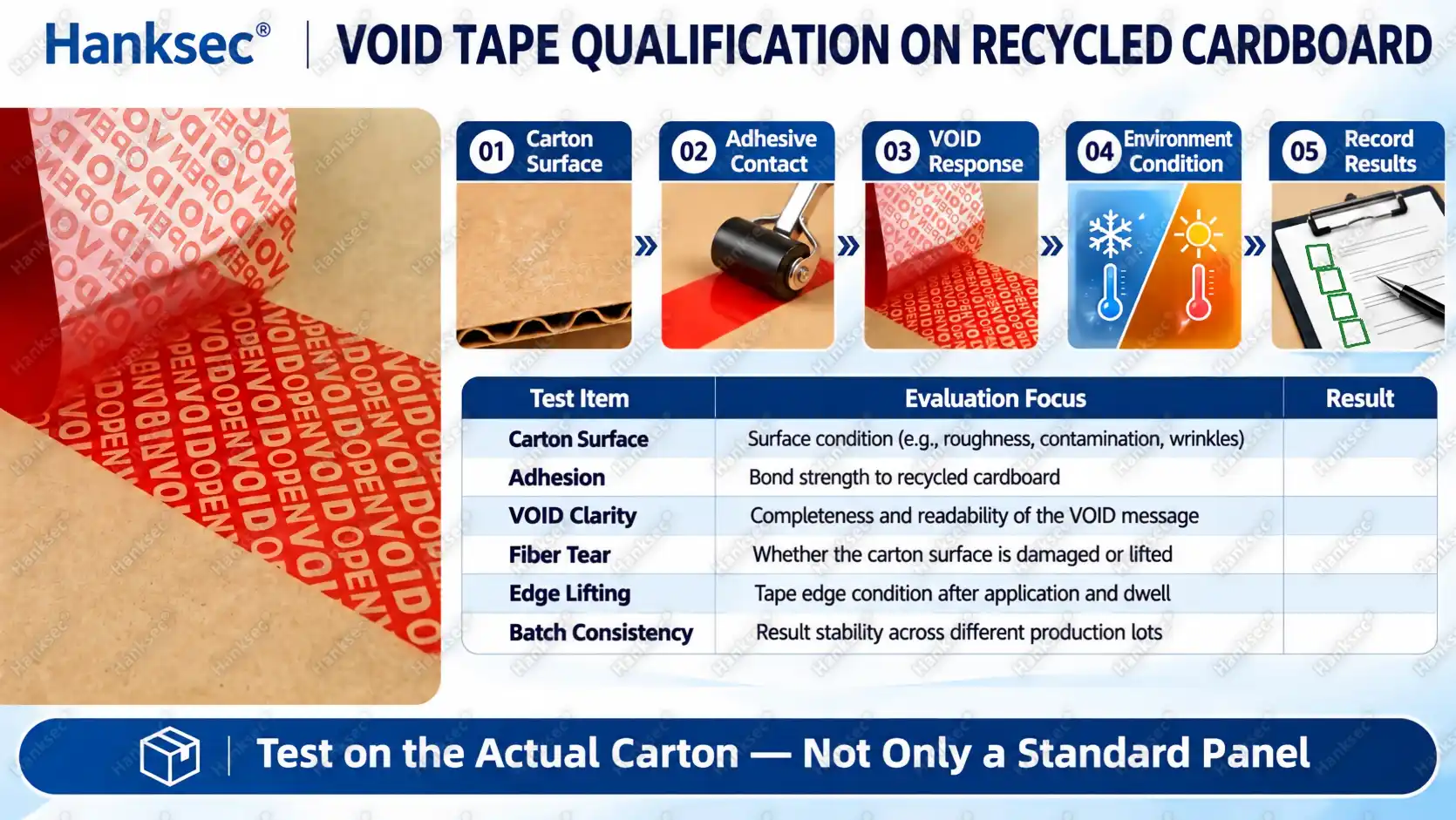
A practical qualification program should combine controlled testing with representative production cartons. Testing only on a smooth reference panel can miss the fiber-strength and surface-variability issues that influence security performance.
Step 1: Identify the Actual Carton Construction
Record the carton supplier, outer-liner type, surface treatment, recycled-content information if available and the relevant storage conditions.
Do not assume that a printed ECT or burst-strength rating directly identifies the outer liner’s resistance to surface picking or delamination. Those are different material properties.
Step 2: Evaluate the Carton Surface
Inspect the intended sealing area for loose dust, weak fibers, uneven texture, moisture and coatings.
If the tape will be applied using a case-sealing machine, evaluate cartons under realistic machine conditions rather than only with carefully prepared hand-applied samples.
Step 3: Apply Samples Under Controlled Conditions
Use consistent application pressure, tape dimensions and placement. Record the application temperature and intended dwell period.
Do not assume a universal dwell time for every adhesive construction. The necessary bond-development period depends on the selected material and application conditions.
Step 4: Inspect Adhesion and VOID Activation Separately
Conduct the agreed peel or removal assessment and record:
- Initial adhesion and any premature edge lifting.
- Whether carton fibers tear or delaminate.
- Whether the tape releases from the carton.
- Clarity and completeness of the VOID or OPENED message.
- Location and amount of transferred security material.
- Consistency across representative cartons and material samples.
When appropriate, ASTM D3330/D3330M provides recognized methods for evaluating pressure-sensitive tape peel adhesion. However, measured adhesion alone does not establish whether a functional security message has activated correctly.
Step 5: Repeat After Environmental Conditioning
Paper-based packaging can change with temperature and relative humidity. These changes may influence surface strength, adhesive contact and the eventual removal response.
Condition representative carton-and-tape samples according to the project’s expected environment and agreed test plan.
ASTM D4332 provides an established framework for conditioning containers, packages and packaging components before testing.
The final acceptance criteria should still be defined by the customer’s intended application and security requirements.
What Should Buyers Change When VOID Tape Fails?
The correction should follow the observed failure mode. Replacing every failing tape with a higher-tack version may solve one problem while creating another.
| Observed Problem | What to Investigate | Possible Correction |
|---|---|---|
| Fiber tear before VOID activation | Outer-liner strength and functional release balance | Evaluate another VOID transfer construction or stronger carton liner |
| Tape peels cleanly without VOID | Dust, wet-out, pressure and adhesive compatibility | Improve application conditions or assess a carton-compatible adhesive |
| Patchy VOID message | Contact uniformity and security-layer consistency | Compare reference samples and adjust the appropriate interface |
| Edges lift after sealing | Application pressure, flap tension and tape positioning | Correct sealing conditions before changing material |
| Results vary between carton batches | Outer-liner grade, moisture, fibers and coatings | Qualify representative batches and establish an approved specification |
For example, a full-transfer construction may be worth evaluating if the required result is a readable message on the carton. However, suitability must still be confirmed on the actual recycled board; full transfer is not a universal remedy for weak paper fibers.
Hanksec supplies different functional constructions for these applications. Buyers can review Tamper Evident VOIDOPEN Sealing Tape for material and customization options.
What Should a Security Tape Converter or Packaging Buyer Specify?
For B2B material sourcing, a request for “strong VOID tape for cardboard” is not sufficient to determine the correct security construction.
Before requesting samples or production quotation, provide the following:
- Actual carton samples: Preferably including representative recycled-board grades and different production lots.
- Expected tamper evidence: VOID on the carton, on the removed tape, on both sides or approved visible fiber damage.
- Application method: Manual dispenser, automatic case sealer or another process.
- Adhesive requirement: Initial contact, intended dwell, transport conditions and residue preference.
- Tape specification: Width, roll length, core, printing, security message and converting requirements.
- Storage and transport: Humidity, temperature changes, condensation and carton-handling conditions.
- Acceptance criteria: Required VOID clarity, permissible fiber tear, edge stability and production consistency.
Hanksec’s role as a security printing material manufacturer is to help match the adhesive and functional VOID construction to the actual carton surface, while supporting converter-ready rolls and customized tape specifications.
For general product-type comparisons, see the Tamper Evident Security Packaging Tapes Guide.
Frequently Asked Questions
Why does VOID tape tear recycled cardboard instead of showing VOID?
The carton outer liner may split before the designed VOID release interface activates. This can happen when the paper surface has limited fiber strength relative to the force required for the specified security response.
Does stronger adhesive always improve VOID performance on recycled boxes?
No. Stronger bonding may reduce adhesive release, but it can also increase fiber tearing. The correct solution depends on the weakest interface and the required final tamper evidence.
Is fiber tear an acceptable tamper-evident result?
It can be acceptable if visible, irreversible fiber damage is part of the approved security specification. If the customer requires a readable VOID or OPENED pattern, fiber tear without that message may not meet the requirement.
Can full-transfer VOID tape solve this problem?
A different full-transfer construction may improve the probability of a clear message in some applications. However, it must be qualified on the actual recycled carton. No transfer type can be assumed suitable for every paperboard grade.
Why does the same VOID tape work on some recycled cartons but not others?
Outer-liner composition, recycled-fiber blends, dust, sizing, coating, moisture and application conditions can differ. These variations can change adhesive contact and the layer that fails first during peeling.
Should peel adhesion and VOID activation be tested separately?
Yes. Peel adhesion measures a bonding characteristic under defined conditions, while VOID activation confirms the designed security response. Both are relevant, but neither result can replace the other.
Can Hanksec supply customized VOID tape materials for carton converters?
Yes. Hanksec supports security tape material supply and OEM/ODM customization, including selected transfer constructions, adhesives, hidden messages, printing and roll specifications. The final configuration should be based on application testing and approved requirements.
When a recycled carton tears before VOID activation, or when the tape lifts without visible evidence, the correct solution starts by identifying the failure location.
Send Hanksec your carton surface details, current tape construction, expected VOID effect, application conditions and photos of the failed peel samples. Representative carton samples can help our technical team evaluate suitable security materials.
Hanksec supports adhesive and security-layer selection, custom VOID tape development, converter-ready roll supply and application-specific material testing before bulk production.
REQUEST VOID TAPE MATERIAL TESTING →
Hanksec® | VOID Security Tape Materials · Recycled Carton Compatibility · Adhesive & Transfer Testing · OEM/ODM