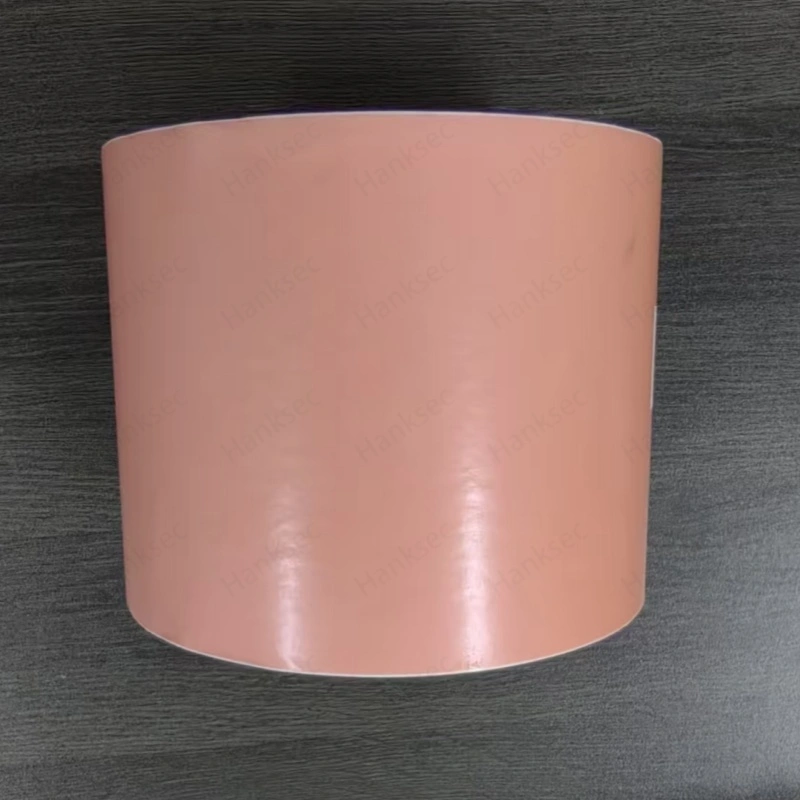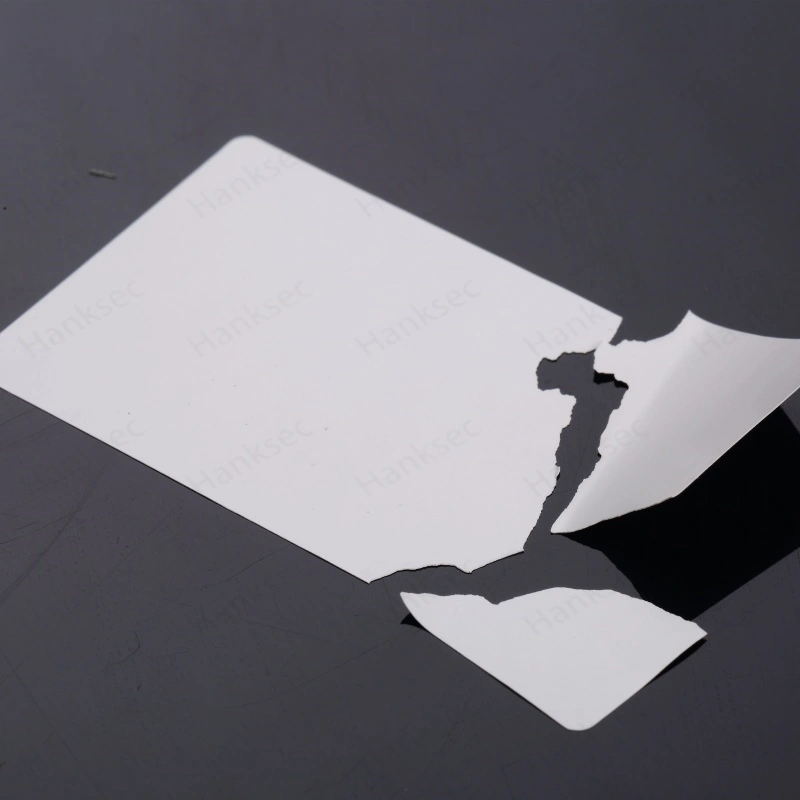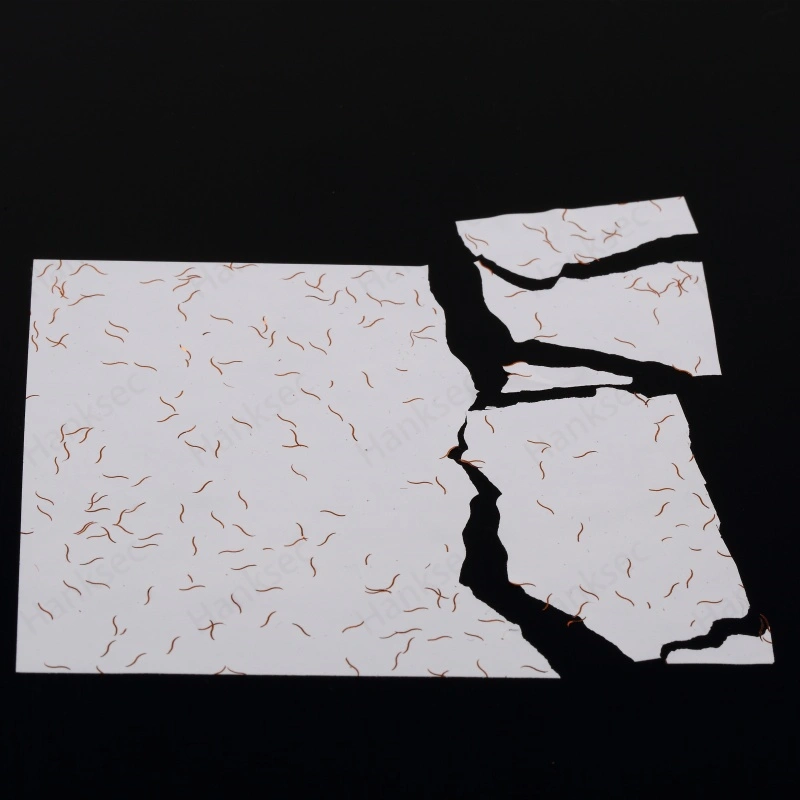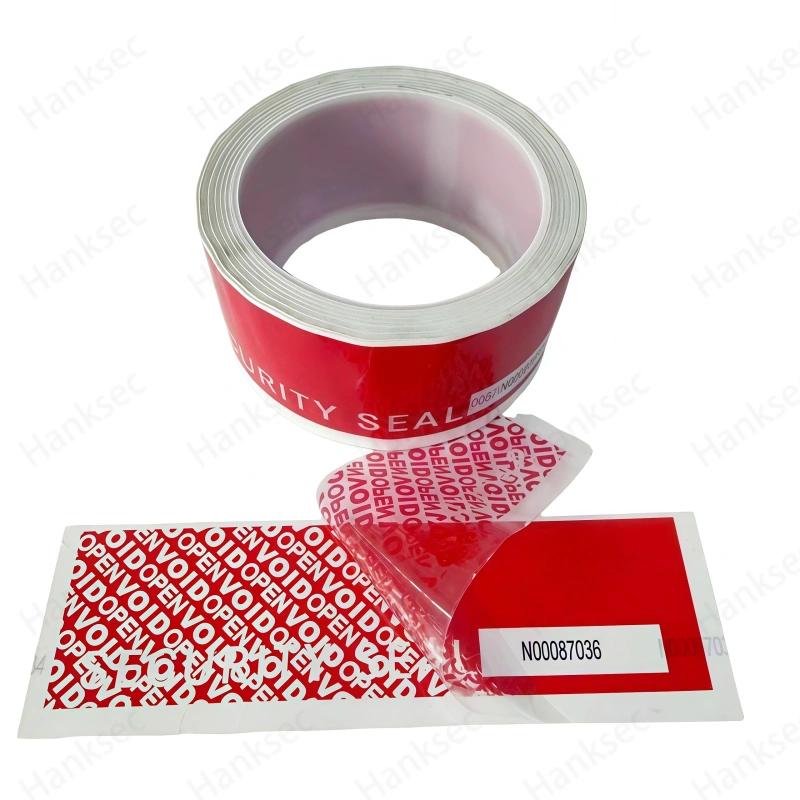
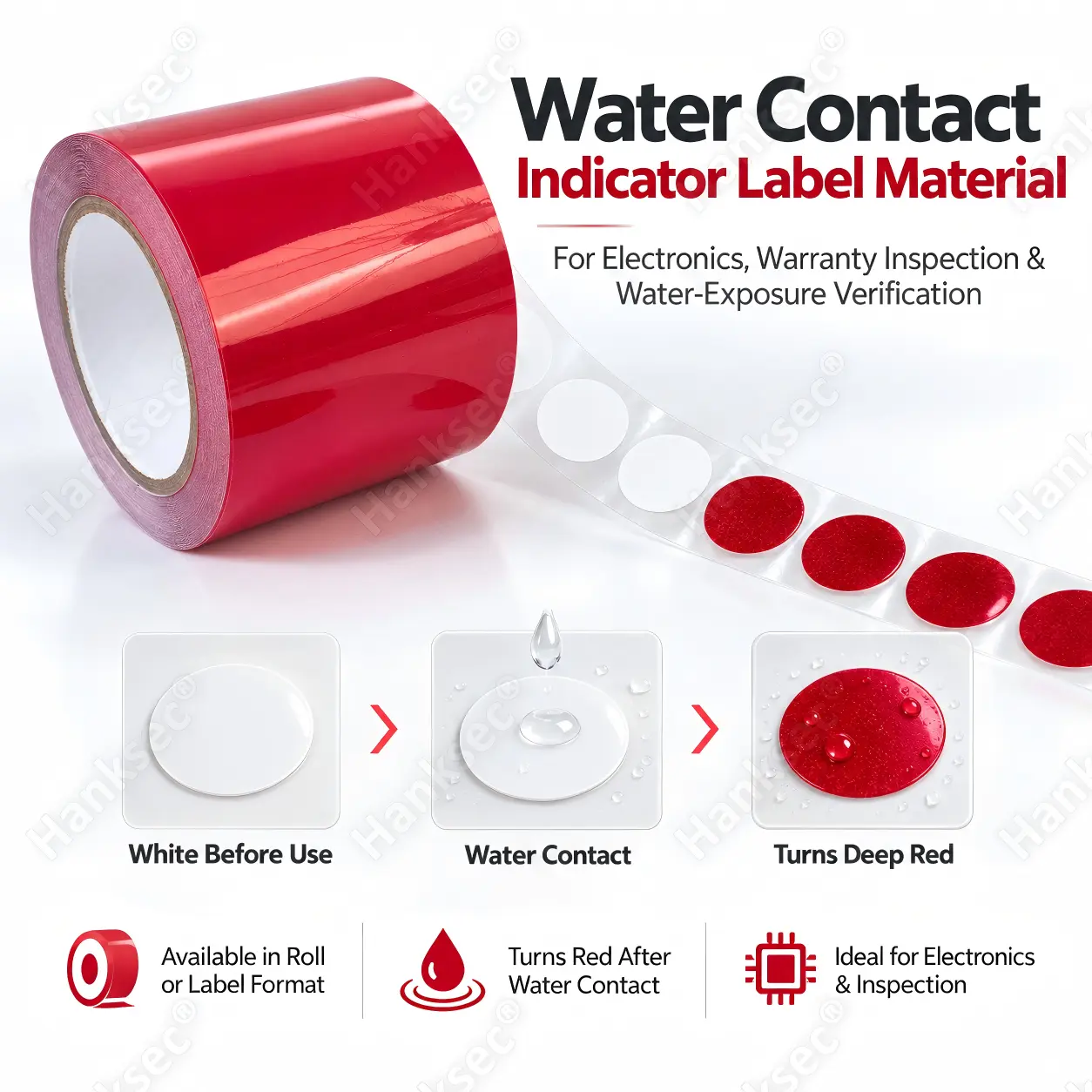
Quick Answer: Water Contact Indicator Label Material is a water-sensitive indicator material designed to create a clear visual change from white to red after direct contact with water or applicable liquids. Hanksec offers both unlaminated and laminated constructions. The unlaminated version provides higher environmental sensitivity and may also develop a red response under sustained high-humidity conditions, while the laminated version uses a protective film to improve resistance to ambient humidity and reduce unintended activation.
This construction choice is important for electronics manufacturers, warranty-service systems, label converters and OEM buyers. The right material depends not only on whether it turns red, but also on the target liquid, storage humidity, installation surface, label size, adhesive, response requirement and converting format.
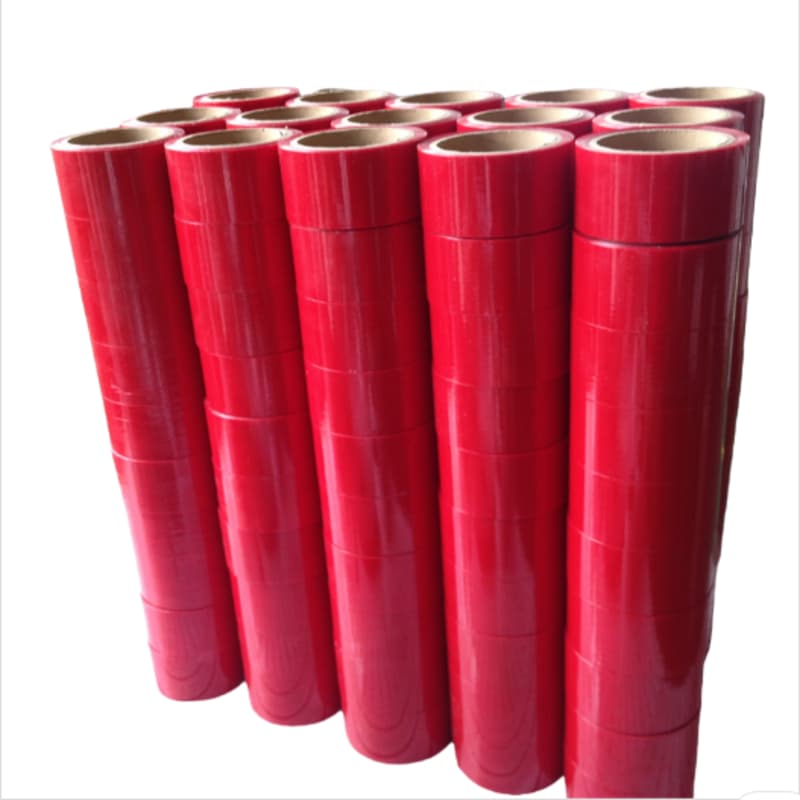
Hanksec supplies Water Sensitive Indicator Paper in roll, sheet and custom die-cut formats for electronics, PCB, battery, warranty-inspection and other liquid-exposure applications. Buyers who need deeper information about multilayer label construction can also review the Security Label Material Systems technical guide.
What Is Water Contact Indicator Label Material?
Water Contact Indicator Label Material is a visual indicator material used to show whether direct contact with water or another target liquid has occurred. In its normal dry condition, the indicator is white. After the target liquid reaches the active indicator area, the material changes visibly to red, allowing an inspector to identify liquid exposure without an electronic sensor or separate measuring instrument.
Typical buyers use this material when they need to determine whether:
- a smartphone, tablet or other electronic device has been exposed to liquid;
- water or another target liquid has reached a protected inspection area;
- a PCB, battery compartment, connector or internal component has experienced liquid exposure;
- a warranty inspection point has been activated;
- a product has entered an intended wet-use or liquid-contact environment;
- a compact product needs a visual liquid-contact indicator that can be inspected later.
The key point is that the indicator records liquid exposure at the label location. A red result does not automatically prove that the product has failed, that every internal component has been exposed, or that a particular warranty decision must be made. It is best used as one part of a defined inspection process.
Apple uses the term Liquid Contact Indicator (LCI) for indicators built into many iPhone and iPod devices. Apple explains that these indicators normally appear white or silver and turn red after contact with water or a liquid containing water. This illustrates the broader industry use of compact color-change indicators for electronics inspection.
Laminated vs Unlaminated Water Contact Indicator Material
One of the most important purchasing decisions is whether the indicator material should be supplied with a protective film or without lamination. Both Hanksec constructions are intended to provide a white-to-red indication after direct liquid contact, but their behavior under environmental humidity is different.
| Construction | Direct Liquid Contact | High-Humidity Behavior | Typical Selection Logic |
|---|---|---|---|
| Unlaminated Water Contact Indicator | White-to-red indication | Higher environmental sensitivity; may respond under sustained high-humidity conditions | Applications that prioritize sensitivity and operate in a controlled or relatively dry environment |
| Laminated Water Contact Indicator | White-to-red indication | Protective film improves resistance to ambient humidity and helps reduce unintended activation | Electronics, warranty inspection and applications exposed to storage or operating humidity before intended liquid contact |
| Dedicated Humidity Indicator | Not primarily designed as a liquid-contact indicator | Designed to respond at defined relative-humidity conditions | Dry packaging, desiccant monitoring and calibrated humidity-control applications |
This distinction is important because a Water Contact Indicator and a dedicated Humidity Indicator are not the same product category. Hanksec’s unlaminated material can be sensitive enough to respond under sustained high humidity, but that does not make it a calibrated relative-humidity indicator. The laminated version is selected when greater resistance to environmental humidity is required before the intended liquid-contact event.
For purchasing, the practical question is therefore not simply “Does humidity activate the label?” The better question is: What humidity environment will the product experience before use, and which construction gives the required balance between sensitivity and humidity resistance?
How Does a Water Contact Indicator Label Work?
From a buyer’s perspective, the operating principle is straightforward:
Dry condition → direct liquid contact → indicator activation → visible red result → visual inspection
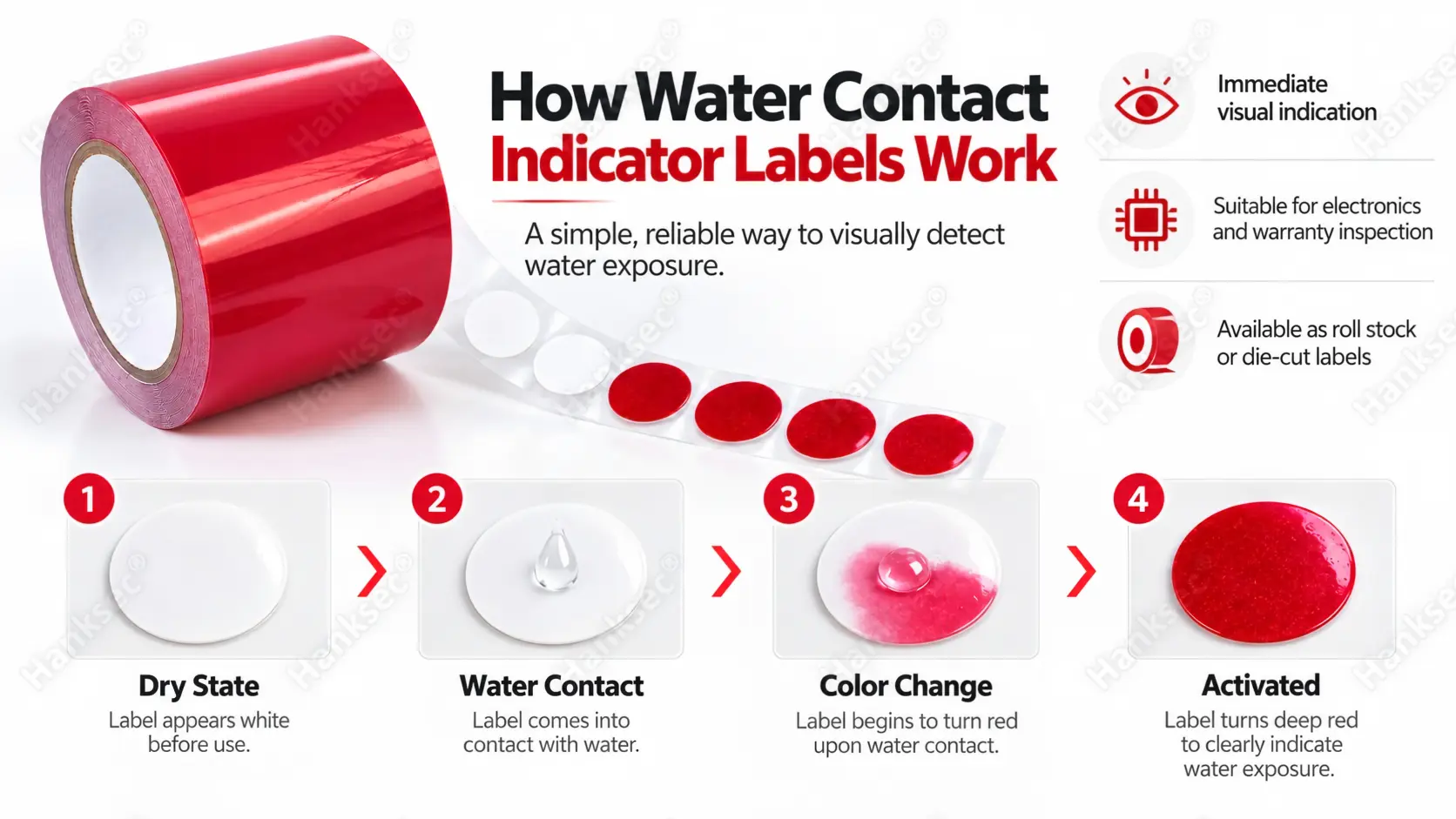
Depending on the project, the label construction can include:
- a water-sensitive indicator layer;
- an absorbent paper or carrier layer;
- an optional protective film;
- a pressure-sensitive adhesive;
- a release liner;
- optional printed text, identification information, barcode or QR code.
The protective film is not only a handling layer; it is also an important selection variable. An unlaminated construction exposes the sensitive material more directly and therefore provides higher environmental sensitivity. Under sustained high-humidity conditions, this version may also develop a red response. A laminated construction adds a protective film to improve resistance to ambient humidity and help reduce unintended activation during storage, handling or normal environmental exposure.
The preferred construction therefore depends on whether the buyer prioritizes higher sensitivity or greater resistance to environmental humidity.
Industry products also show why construction matters. 3M describes its Water Contact Indicator Tape 5557 as a white-to-red direct-water indicator using a printable film top layer, absorbent paper backing and acrylic adhesive. Its Ultra-Thin Water Contact Indicator Tape 5558 uses a thinner construction for space-restricted applications. These examples should be treated as industry references rather than specifications for Hanksec material.
For more detail about facestock, functional layers, adhesives and liners, see Hanksec’s Security Label Material Systems guide.
Water Contact Indicator Label Applications
Water-sensitive indicators are widely associated with consumer electronics, but the commercial use cases extend beyond smartphones. Construction selection should always reflect both the target liquid and the humidity environment before activation.
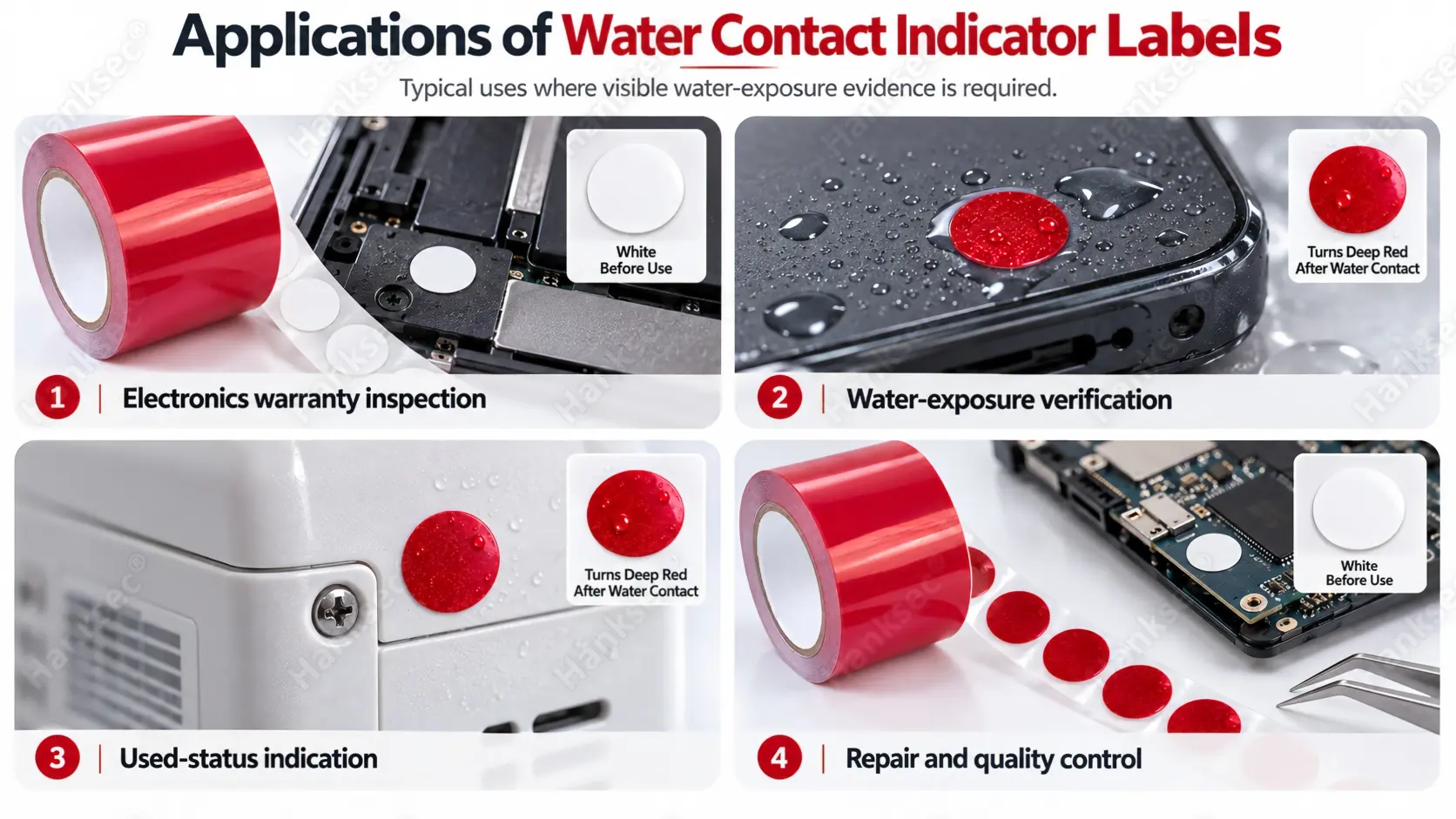
Electronics & Liquid Exposure Inspection
Electronics are one of the most established application categories. Typical uses include:
- smartphones and tablets;
- laptops and cameras;
- wearable electronics;
- PCB assemblies;
- battery packs;
- charging equipment;
- internal electronic components;
- service-access areas.
The indicator can be positioned where liquid exposure is meaningful to technicians or service personnel. When the product is inspected later, the color condition provides a simple visual reference showing whether the target liquid reached that location.
For electronics stored or operated in humid conditions, the choice between laminated and unlaminated material becomes especially important. A laminated construction may be preferred when the indicator must remain stable through normal environmental humidity before a direct liquid-contact event.
Warranty & After-Sales Inspection
Water Contact Indicator Labels can support warranty and service workflows where liquid exposure is relevant to diagnosis.
A typical process may be:
Product returned → indicator checked → liquid exposure identified → further inspection performed
This helps manufacturers, repair centers and service teams distinguish between products with no visible liquid-contact indication and products where direct exposure has occurred. The indicator should therefore be treated as a visual inspection reference, not as the sole basis for every warranty decision.
Liquid-Exposure Verification & Use Indication
Some products are designed so that normal operation, testing, rinsing, immersion or use inevitably involves direct contact with water or another target liquid. If the indicator remains protected from the target liquid during storage but becomes exposed during normal use, the white-to-red change can become part of a use-indication system.
A simplified workflow is:
Before use: white → product enters intended wet-use or liquid-contact environment → target liquid reaches indicator → indicator turns red → previous liquid exposure can be visually confirmed
This can be considered for selected water-related consumer products, wet-use accessories, industrial components, inspection systems and applications where liquid contact represents a meaningful status change.
Important: the label confirms that liquid exposure has occurred. Whether that exposure is treated as evidence of previous product use depends on the product design and the buyer’s inspection procedure.
Industrial Testing & Liquid-Exposure Monitoring
Water-sensitive indicator labels can also help engineers identify whether a target liquid reached a specific point during:
- leakage testing;
- water-ingress testing;
- assembly validation;
- transport inspection;
- quality-control checks;
- maintenance;
- wet-process evaluation.
For these applications, placement is as important as the material itself. A correctly selected indicator may remain white if it is installed where the target liquid cannot reach it. Environmental humidity should also be included in validation when an unlaminated construction is being considered.
Water Contact Indicator Label Material Specifications
For procurement, the material should be specified as a complete system rather than simply requesting “white-to-red paper.” The table below shows the main purchasing points to confirm for a Hanksec project.
| Specification | Hanksec / Project Direction | Buyer Should Confirm |
|---|---|---|
| Indicator Function | Direct liquid-contact indication | Required liquid-exposure condition |
| Dry Color | White | Required initial appearance |
| Activated Color | Red | Required inspection visibility |
| Activation Type | Direct contact with water or applicable liquid | Exact target liquid and required response |
| Construction | Laminated / unlaminated | Required sensitivity and environmental conditions |
| Humidity Behavior | Construction dependent | Unlaminated material may respond under sustained high humidity; laminated material provides improved humidity resistance |
| Indicator Material | Water-sensitive paper / project-specific construction | Final application and converting requirements |
| Protective Layer | With protective film / without protective film | Humidity resistance, handling and liquid-access requirements |
| Adhesive | Pressure-sensitive adhesive | PET, PC, ABS, metal, glass, PCB or other substrate |
| Label Shape | Round / square / rectangle / custom | Installation space |
| Label Size | Small electronics labels or custom | Inspection visibility and installation area |
| Printing | Logo / warning / serial / barcode / QR where applicable | Printing process and readability |
| Release Liner | Project-specific | Converting and automatic application |
| Supply Format | Roll / sheet / die-cut finished labels | Converter or OEM requirement |
| Sensitivity | Project-specific | Target liquid, humidity environment and required activation behavior |
| Response Time | Project-specific | Validate using approved samples and the actual target liquid |
Exact response time, humidity tolerance, storage life and temperature range should be confirmed using the selected Hanksec construction and an approved sample. These values should not be copied from another supplier because indicator chemistry, protective-film design, adhesive and test conditions may differ.
Buyers who need help matching adhesive performance to PET, PC, metal, glass or other surfaces can review Hanksec’s Tamper Evident Label Adhesive Guide.
Custom Water Sensitive Materials for Label Converters & OEMs
Many OEM buyers do not need only a standard finished sticker. They need indicator material that fits their printing, die-cutting, assembly, storage and inspection process.
Hanksec can develop projects around requirements such as:
- laminated or unlaminated indicator construction;
- custom label dimensions and shapes;
- roll or sheet supply;
- die-cut finished labels;
- different adhesive systems;
- liner selection;
- custom printing;
- logos and warning text;
- serial numbers;
- QR codes and barcodes;
- roll width and core size;
- winding direction;
- custom packaging;
- OEM / ODM production.
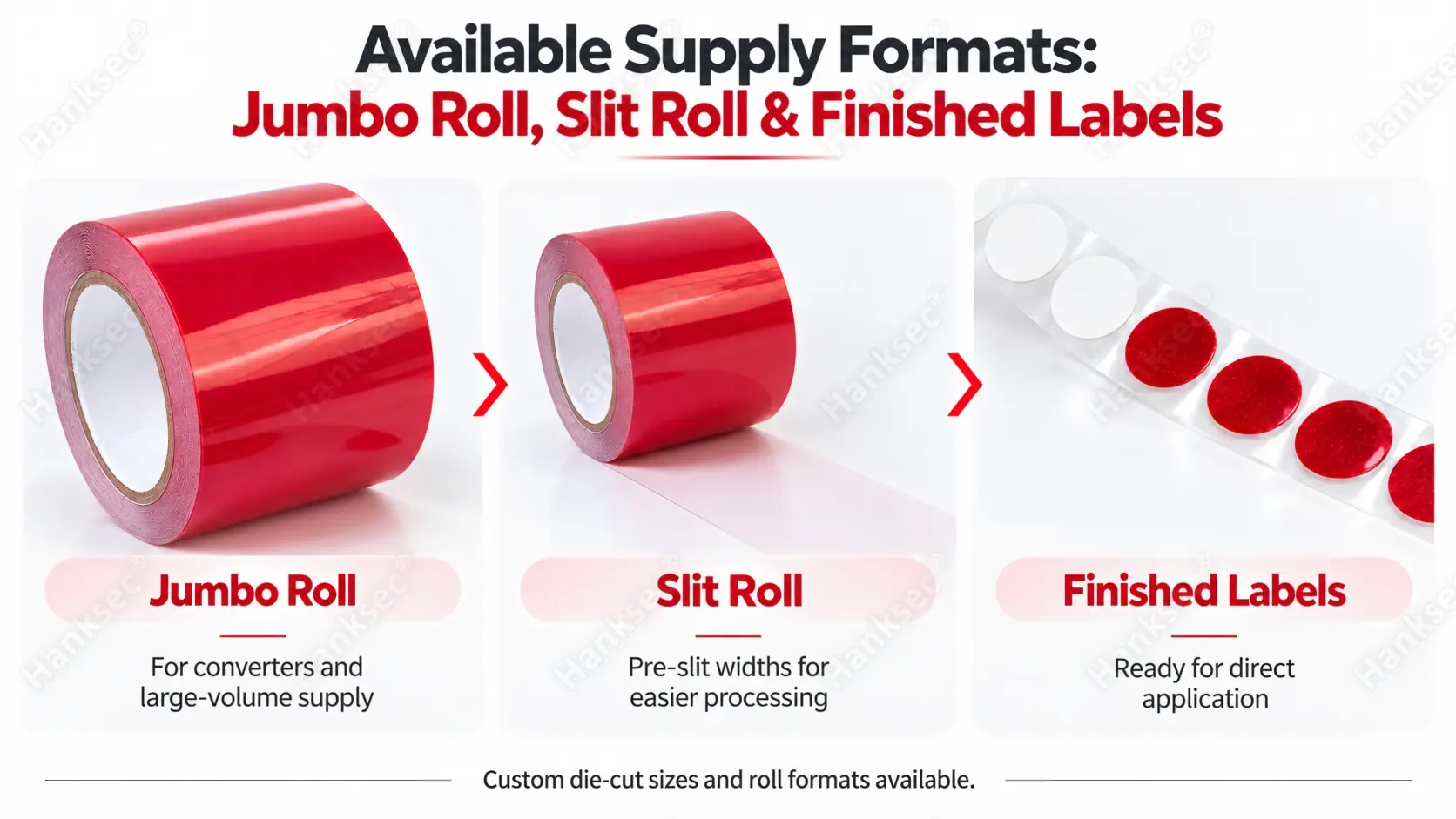
For electronics manufacturers, very small indicator labels may be required inside housings or near sensitive components. For label converters, roll stability, liner release, die-cutting behavior and the selected laminated or unlaminated construction can all affect production performance.
For OEM projects, Hanksec recommends confirming these items together:
target liquid + humidity environment + laminated/unlaminated construction + indicator response + adhesive + converting format + application location
This reduces the risk of approving a material that works in a simple liquid-drop test but later creates problems during humid storage, die cutting, assembly or final inspection.
Converters who need additional guidance on print surfaces can review Hanksec’s Printable Security Label Materials Guide.
How to Choose & Test Water Contact Indicator Material
Before ordering bulk material, buyers should define the actual use environment rather than selecting only by the white-to-red effect.
- Identify the target liquid. Water, beverages, process liquids, cleaning liquids and other application-specific liquids may produce different activation characteristics. Test the actual target liquid whenever possible.
- Define the humidity environment. Confirm whether the product will experience dry, normal-humidity or sustained high-humidity conditions during storage, transport and operation before the intended liquid-contact event.
- Choose laminated or unlaminated construction. If higher sensitivity is the priority and prolonged high humidity is not expected, an unlaminated construction may be suitable. If the indicator must tolerate environmental humidity with lower risk of unintended activation, evaluate the laminated construction.
- Confirm the application surface. PET, PC, ABS, PP, PE, metal, glass, PCB and coated surfaces can require different adhesive behavior.
- Define the required response. Buyers should specify how quickly the red indication should become visible and how the activated result will be inspected.
- Confirm label size and placement. Small electronics may have only a few millimeters of available space. The indicator must be positioned where the target liquid can reach it while remaining easy to inspect later.
- Confirm supply format and converting method. Choose roll, sheet, slit-roll or finished die-cut labels according to the production process, and confirm liner, winding and die-cutting requirements.
- Validate on the real product. Test dry-state color, target-liquid response, humidity exposure, adhesive bonding, label position, printing, die cutting and final readability before bulk production.
For projects where humidity behavior is critical, Hanksec recommends comparing laminated and unlaminated samples under the customer’s actual storage and operating conditions. This is more reliable than selecting a construction from a generic “water-sensitive” description alone.
For broader security-label selection beyond liquid exposure, see Hanksec’s Security Labels: Types, Materials, Applications & How to Choose.
Water Contact Indicator Label Material FAQs
Does a water contact indicator label change from white to red after liquid contact?
Yes. Hanksec Water Contact Indicator Material is designed to change from white to red after direct contact with water or applicable liquids. Because different liquids can produce different activation characteristics, testing with the actual target liquid is recommended before mass production.
Can high humidity turn a Water Contact Indicator Label red?
It depends on the construction. Hanksec’s unlaminated material has higher environmental sensitivity and may develop a red response under sustained high-humidity conditions. The laminated version uses a protective film to improve resistance to ambient humidity and reduce unintended activation.
What is the difference between laminated and unlaminated Water Contact Indicator Material?
The unlaminated version provides higher exposure sensitivity but can also be more sensitive to prolonged environmental humidity. The laminated version adds a protective film to improve humidity resistance. The correct option depends on the required sensitivity, storage environment and intended liquid-contact event.
Is a water contact indicator the same as a humidity indicator?
No. A dedicated humidity indicator is designed to respond at defined relative-humidity conditions. A Water Contact Indicator is primarily used to show direct liquid exposure. However, humidity sensitivity can vary by construction, so the unlaminated and laminated versions should not be treated as identical.
Can water-sensitive labels be used inside electronic devices?
Yes. Electronics are one of the most common application categories for liquid contact indicators. Final label size, construction, adhesive and placement should be validated on the actual device and under the expected humidity environment.
Can a water indicator label show whether a product has already been used?
It can confirm that liquid exposure has occurred. If contact with the target liquid is an unavoidable part of normal product use, that indication may form part of a use-verification process. The relationship between liquid exposure and previous use should be defined by the product manufacturer.
Can Water Contact Indicator Material be supplied in rolls or custom labels?
Yes. Hanksec supports roll, sheet and finished die-cut formats depending on converter and OEM requirements. Label dimensions, shape, adhesive, liner, printing and other production details can be customized according to the project.
Can logos, serial numbers, barcodes or QR codes be added?
Depending on the final construction and printing process, custom text, logos, identification numbers, barcodes or QR codes can be incorporated.
Should laminated and unlaminated materials be tested before bulk production?
Yes. Testing should use the real substrate, target liquid, label position and expected humidity conditions whenever possible. For humidity-sensitive projects, compare both constructions before final approval.
Need Water Contact Indicator Material for Your Project?
Hanksec supplies laminated and unlaminated water-sensitive indicator materials for electronics manufacturers, label converters, OEMs, distributors and custom inspection applications. Tell us your application surface, target liquid, expected humidity environment, indicator size, required white-to-red response, supply format, quantity and printing requirements.