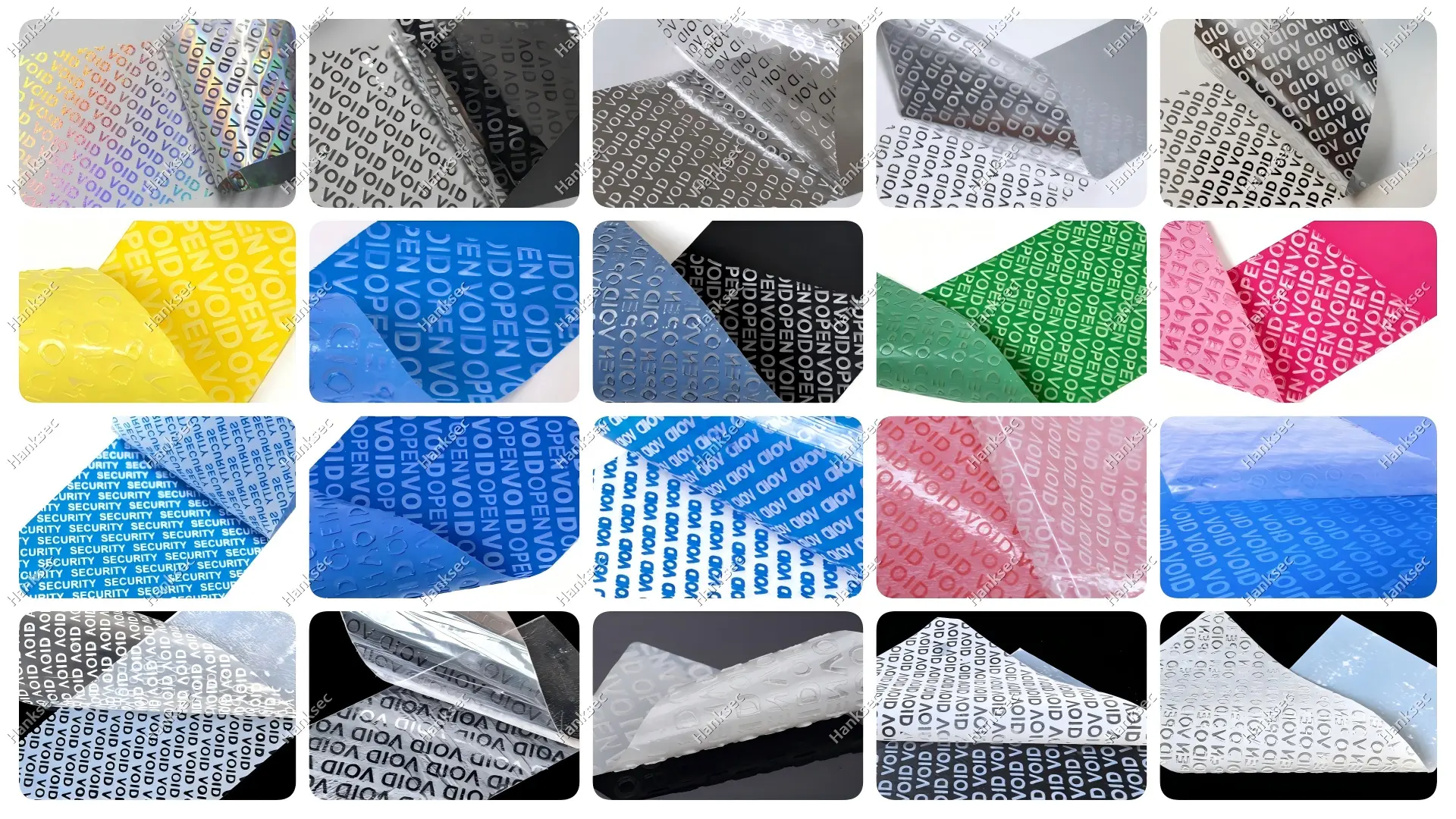
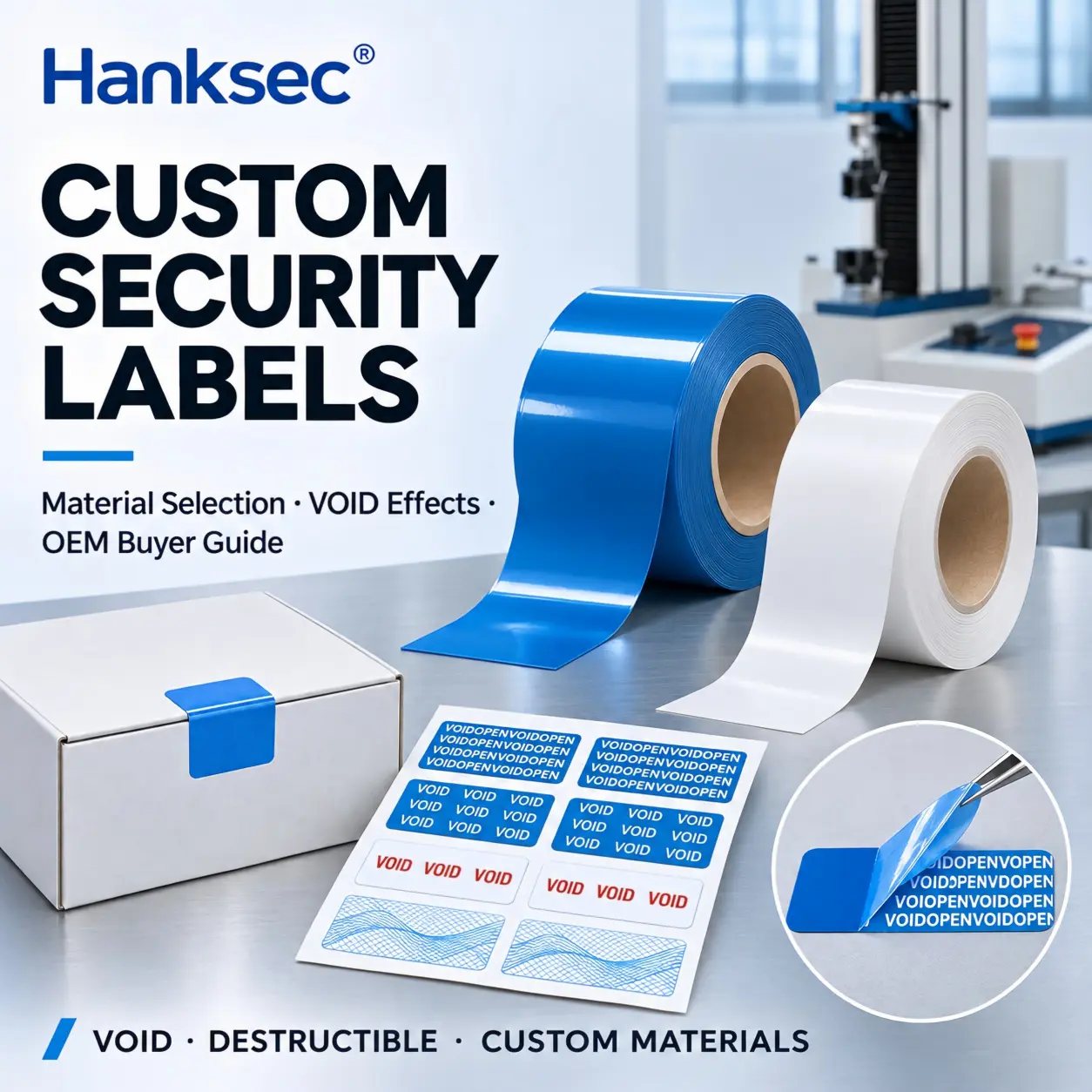
Quick Answer: Custom security labels should be engineered as a complete material system, not treated as ordinary stickers with a logo or serial number added. A reliable specification starts with the intended tamper-evident response, the actual application surface and the required inspection result. Buyers must then select the facestock, functional VOID or destructible construction, pressure-sensitive adhesive, printable coating, release liner and converting format. The best custom security label is the one that creates repeatable evidence on the real product or package without failing during printing, die cutting, application or normal service. Before bulk production, qualify the proposed construction on representative production substrates under defined application, dwell, removal and environmental conditions.
For security-label converters, packaging manufacturers, OEM engineers and industrial purchasing teams, the difficult part of ordering custom security labels is rarely the visible artwork. The real challenge is making sure the material behaves correctly after printing, converting, application and an attempted removal.
A hidden VOID message can be manufactured correctly but remain incomplete if the adhesive releases from the substrate first. An ultra-destructible facestock can provide clear removal evidence but crack during matrix stripping. A non-transfer construction can reduce designed message transfer while still leaving adhesive traces on a sensitive surface. These are engineering trade-offs, not simply design options.
This guide explains how to specify custom tamper-evident label materials, identify unsuitable constructions, compare application surfaces, evaluate printing and converting compatibility, and prepare a practical OEM purchasing specification. Hanksec focuses on manufacturing security label materials for converters and OEM projects, including converter-ready rolls and selected finished-label formats.
What Can Be Customized in Security Labels?
Custom security labels can be customized at two different levels: visible identification and functional material construction. Visible customization includes printed logos, colors, text, numbering and barcodes. Functional customization determines what happens when the label is peeled, transferred, fractured or exposed to the intended inspection process.
The distinction matters because adding a custom logo to a standard label does not automatically change its tamper-evident performance. Similarly, an attractive holographic image may provide an authentication feature without producing the required evidence of physical opening.
Visible Design and Identification
Depending on the selected material and converting process, visible customization may include brand artwork, colors, printed warning text, sequential numbering, barcodes, QR codes or other identification elements. The print system must be compatible with the face coating, and the final image must remain readable after intended handling and environmental exposure.
Variable data also needs its own acceptance criteria. A barcode that scans clearly immediately after printing may become unreadable after abrasion, cleaning or application to a curved surface. Buyers should define the expected print durability and scanning conditions rather than approving artwork alone.
Functional Security Construction
Functional customization may involve a hidden VOID pattern, transfer behavior, destructible facestock, adhesive selection, liner, printable topcoat, surface color and supplied roll configuration. Each modification may influence another part of the material system.
For example, changing the facestock thickness can alter stiffness, conformability and die-cutting behavior. Changing the adhesive can move the first failure plane from the security layer to the package coating. Changing the liner may alter matrix stripping or automatic dispensing even when the visible label design remains unchanged.
For a broader explanation of standard security material families, see Hanksec’s tamper-evident security label selection guide. This article concentrates on the engineering decisions needed when an existing construction must be adapted for a custom application.
Which Tamper-Evident Material Construction Should Buyers Choose?
The first material-selection question is not which label has the strongest adhesive. It is where the evidence must appear after an attempted removal, and what the inspector must be able to recognize.
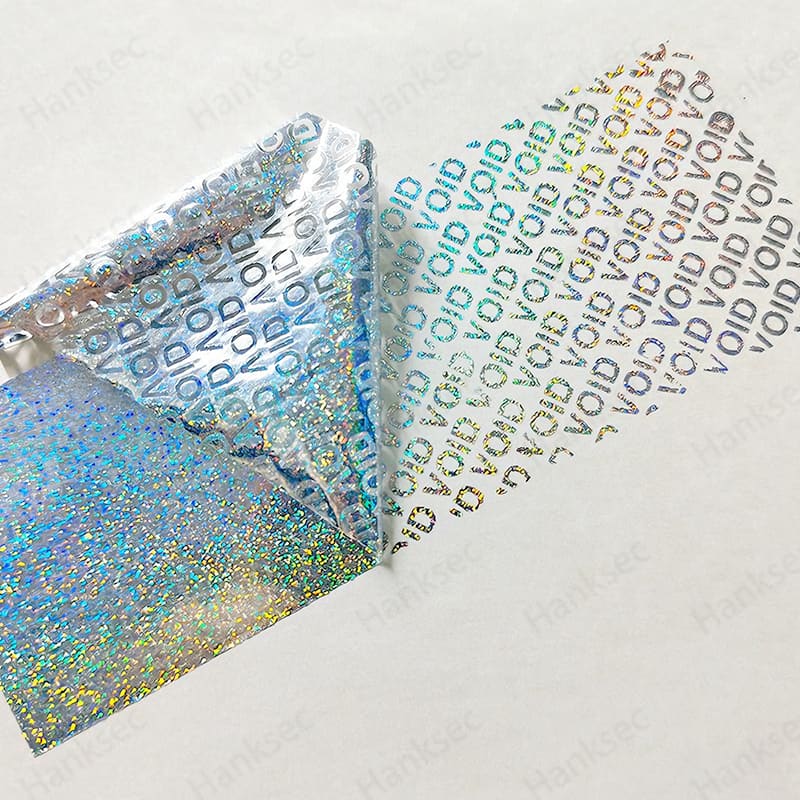
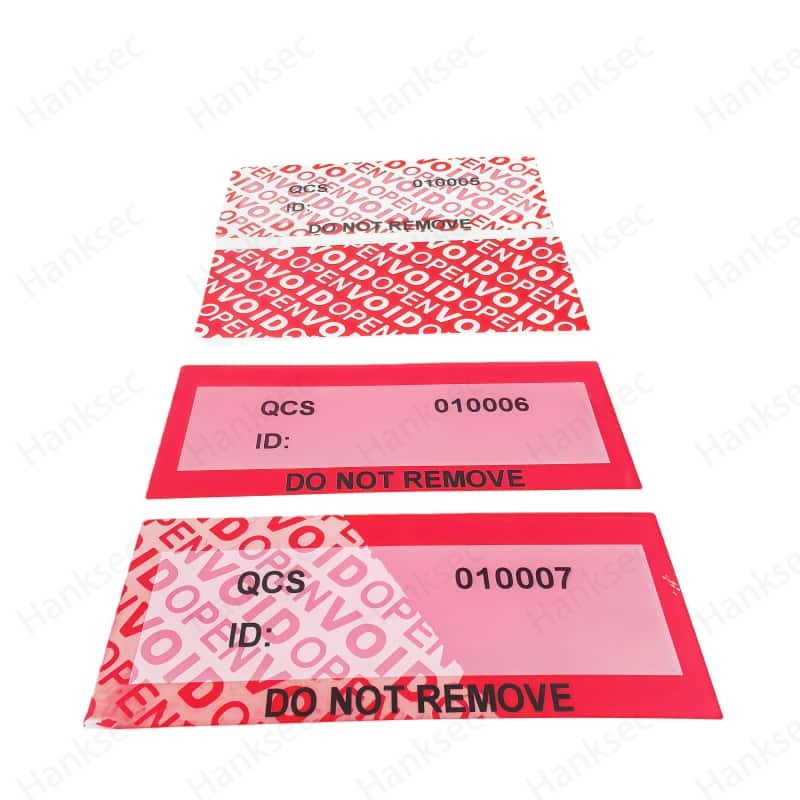
Full-transfer, partial-transfer and non-transfer VOID materials use controlled separation to reveal a security pattern. Destructible materials rely primarily on facestock fracture. Paper-based security materials may use different combinations of coating separation, fiber tear and VOID effects.
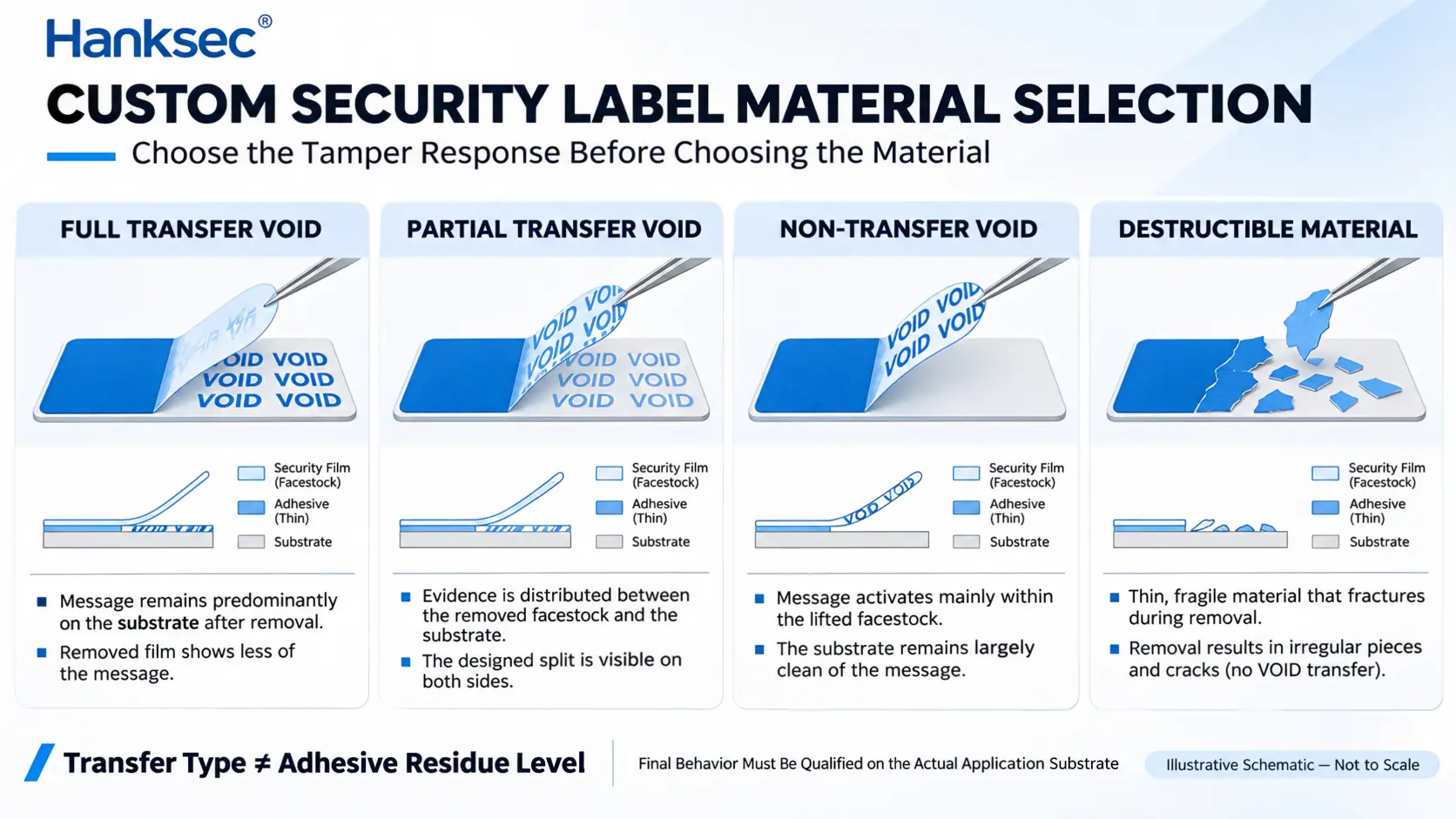
| Material Construction | Intended Evidence | Suitable Selection Reason | Critical Limitation |
|---|---|---|---|
| Full-transfer VOID | Designed security pattern transfers predominantly to the application surface. | A clearly visible package-side warning is required. | Surface residue, artwork damage and coating adhesion must be assessed. |
| Partial-transfer VOID | Designed evidence is divided between the lifted film and substrate. | Inspection may involve evidence on both sides of the separation. | Pattern clarity and repeatability depend on the actual construction and surface. |
| Non-transfer VOID | The hidden security response appears mainly within the lifted label. | Reduced designed message transfer is preferred. | Non-transfer does not guarantee zero adhesive residue. |
| Destructible material | The facestock tears or fragments during removal. | Physical destruction is preferred over message transfer. | Fragile material may break prematurely during converting. |
| Paper-based security material | Depending on construction: VOID activation, delamination or fiber tear. | Paper facestock or package compatibility is a design priority. | Humidity, coating adhesion and end-of-life claims require separate evaluation. |
Transfer Type and Residue Level Are Different Specifications
One purchasing mistake is treating full-transfer, partial-transfer, non-transfer, high residue and low residue as interchangeable descriptions. They are not.
Transfer type describes the intended location and distribution of the security message after separation. Residue behavior describes what adhesive or other material remains on the substrate or lifted facestock after the defined removal procedure.
Actual residue behavior depends on the design of the material, adhesive chemistry, substrate and test conditions. Buyers should therefore request photographs of both sides of an approved peeled sample, identify the expected message location and separately define the allowable surface residue.
For example, a non-transfer VOID construction may be chosen for an electronic-device housing where visible security-message transfer is undesirable. It should not be approved merely because the supplier calls it non-transfer. The buyer must also assess adhesive traces, housing finish and the visibility of the security response on the removed film.
When Is a Destructible Material the Wrong Choice?
An extremely fragile material is not automatically more suitable for every project. If the material breaks during matrix stripping, rewinding, dispensing or normal application, production waste and false tamper indications may increase.
Where the application requires automatic labeling at a defined line speed, the facestock must be sufficiently stable for the conversion and dispensing process while remaining fragile enough to create the specified evidence during removal. This balance can only be judged with the actual label geometry, adhesive, liner and equipment.
Buyers comparing material categories can also review Hanksec’s VOID Label Materials and Destructible Label Materials ranges.
Why Do Custom Security Labels Fail on Different Substrates?
The same security label can produce different results on two packages because the weakest separation interface may change. A VOID film that activates clearly on a laboratory test panel may release cleanly from a PP housing, lift varnish from a carton or show incomplete activation on a contaminated metal surface.
The substrate must be treated as part of the security system, not as a neutral background.
| Application Surface | Potential Failure | Buyer Qualification Priority |
|---|---|---|
| PP / PE plastic | Insufficient adhesive wet-out on low-surface-energy materials. | Actual resin, additives, surface condition and adhesive compatibility. |
| ABS / PC housing | Variable adhesion, surface damage or cosmetic changes. | Actual molded finish, cleaning process and acceptable removal appearance. |
| Varnished paperboard | Coating lift before the designed VOID layer separates. | Final printed carton, varnish attachment and seal location. |
| Powder-coated metal | Uneven contact on textured or contaminated coatings. | Surface texture, coating integrity, oil and service environment. |
| Glass / smooth PET | Unexpected adhesive traces or moisture-related failure. | Surface preparation, residue target and condensation exposure. |
| Corrugated carton | Fiber tear, dust, irregular contact or weak surface layers. | Actual carton grade, recycled content, coating and closure design. |
Surface Energy Is Only One Part of Adhesion
PP and PE generally present more difficult bonding conditions for many conventional pressure-sensitive adhesives than clean, high-surface-energy reference panels. However, surface energy alone does not determine the final result. Mold-release agents, pigments, additives, roughness, cleaning residues and the selected adhesive all affect contact and bond development.
A buyer should not approve a custom tamper-evident label solely because its adhesive performs well on steel. The actual plastic housing or packaging component should be used during qualification.
Application Pressure and Dwell Change the Result
Pressure-sensitive adhesives need adequate contact with the substrate. Insufficient pressure, trapped air, curvature and uneven contact can reduce the effective bonded area. The bond may also develop after application, depending on the adhesive and surface.
For this reason, a peel demonstration immediately after hand application is not equivalent to an approved production test after the required dwell. Record the application pressure or equipment settings, dwell intervals, peel direction and environmental conditions for meaningful comparison.
Application Temperature Is Not Service Temperature
A label that tolerates cold storage after bonding is not necessarily suitable for application to a cold or condensation-covered surface. Conversely, a label applied at normal room conditions may behave differently after extended heat, humidity or thermal cycling.
Custom security labels for cold-chain cartons, laboratory products or industrial equipment should therefore be specified using an application timeline rather than a single maximum or minimum temperature claim.
For adhesive and substrate selection in greater depth, refer to Hanksec’s Tamper Evident Label Adhesive Guide.
How Should Facestock, VOID Layers and Adhesives Be Specified?
Once the required tamper evidence and substrate are defined, the material construction can be specified. A custom security label may contain a printable surface, facestock, functional security layers, pressure-sensitive adhesive and release liner. The exact layer sequence depends on the selected construction.
Facestock Thickness and Material Choice
Hanksec supplies applicable PET and BOPP VOID constructions with confirmed film options including 25, 36 and 50 μm. These are available material options, not interchangeable thickness specifications for every security construction.
Film thickness influences more than handling strength. A stiffer film may be easier to process in some converting operations but may not conform to a sharp package edge as readily as a thinner construction. A thinner facestock may follow a curved surface more easily but could require tighter control of web tension, printing pressure and die-cut depth.
Engineering selection rule: Do not choose the thinnest film simply because it conforms well, or the thickest film because it appears stronger. Qualify the film against the package geometry, application method, print process and expected removal response.
Hidden Message Design and Functional Separation
The hidden message may use VOID, OPENED, VOIDOPEN, a custom warning pattern or a brand-specific security design. However, the visible shape of the message is only one part of the specification. Functional separation must occur at the intended location when the approved opening test is performed.
For a custom logo or hidden pattern, the buyer should confirm artwork orientation, repeat layout, required message size, acceptable edge margins and the intended appearance on both the lifted facestock and application substrate.
Hanksec offers application-specific custom VOID constructions, including Custom Logo Partial Transfer VOID Label Material. The approved sample should demonstrate the actual hidden-message response, not merely the printed logo.
Adhesive Selection and Failure-Plane Balance
Pressure-sensitive adhesive must provide sufficient bond to the actual application surface while allowing the designed security mechanism to activate. The strongest possible peel value is not automatically the best outcome.
If the adhesive releases from the substrate before the functional layer separates, the security warning may remain incomplete. If the adhesive bond exceeds the attachment strength of a varnish or printed coating, part of the package surface may detach instead. If the facestock is destructible, the adhesive-to-substrate bond must also be considered relative to the facestock’s fracture behavior.
When choosing between two adhesive constructions, document the first failure plane and the intended inspection result. Avoid changing adhesive coat weight or formulation without checking whether the security layer, facestock or packaging surface has become the limiting factor.
Release Liner Is a Functional Production Component
The release liner must protect the adhesive and support stable converting and dispensing. Excessive or inconsistent release force can interfere with matrix stripping, cause fragile labels to break prematurely or prevent clean transfer from the liner to the application surface.
Buyers should specify liner material, release behavior, winding direction and converting method together with the label construction. A change in liner can require a new production trial even when the facestock and adhesive remain unchanged.
What Should Converters Check Before Printing Custom Security Labels?
Custom security label materials may be supplied for UV flexographic, screen, thermal-transfer, digital or other printing processes, but compatibility depends on the actual printable topcoat, ink or ribbon and operating conditions. No one security film should be assumed to support every printing system without qualification.
Print Anchorage and Image Durability
Ink adhesion should be evaluated after the intended printing and curing process. Buyers should also check image rub resistance, scratching, handling and any relevant environmental exposure. A visually acceptable image immediately after printing may fail later during packaging operations or product service.
For serialized security labels, barcode readability and number clarity need to be checked separately from the VOID mechanism. A successful tamper response does not compensate for an unreadable code.
Die Cutting and Matrix Stripping
A die-cutting process must separate the label shape without unacceptable damage to the liner. Excessive die penetration may score the liner and affect dispensing. Insufficient die penetration may cause labels to remain connected to the waste matrix.
For destructible constructions, the facestock may fracture during stripping if the label shape, matrix width, web tension or release behavior is unsuitable. Small labels with sharp internal corners can be particularly demanding and should be assessed on actual equipment rather than approved only from a hand-cut sample.
Roll Geometry and Automatic Dispensing
Converters should define web width, label pitch, winding direction, core, maximum roll diameter, splice requirements and other machine constraints. The final trial should include the intended dispenser or applicator, not only the printing press.
The following information should be agreed before production approval:
| Specification | What the Buyer Must Confirm | Why It Matters |
|---|---|---|
| Facestock and coating | Material grade, thickness, printable surface and required security response. | Controls printing, converting and the final tamper evidence. |
| Printing system | Press type, ink or ribbon, curing conditions and variable data needs. | Determines image anchorage and legibility. |
| Die-cut design | Label dimensions, corner geometry, waste-matrix layout and cutting method. | Affects matrix removal and facestock integrity. |
| Liner and release | Liner grade, release behavior and dispenser requirements. | Controls stripping and automatic application. |
| Roll supply | Web width, roll length, core, winding and maximum roll diameter. | Reduces mismatch with existing converting equipment. |
For more detailed print-system selection, see Hanksec’s printable security label material guide.
Why Do Custom Tamper-Evident Labels Fail After Conversion or Application?
Many security-label defects are incorrectly described as adhesive problems. In practice, the first failure plane may be the substrate interface, package coating, functional VOID layer, facestock or liner. Changing the adhesive without locating the failure can introduce another defect.
| Observed Problem | Possible Failure Plane | Verification Method | Corrective Direction |
|---|---|---|---|
| Label peels cleanly with little VOID evidence. | Adhesive / substrate interface. | Compare actual substrate, pressure and dwell conditions. | Review surface preparation and adhesive suitability. |
| Carton coating transfers with the label. | Coating / board interface. | Inspect coating attachment and peeled surfaces. | Review coating compatibility and seal position. |
| VOID pattern appears only partially. | Functional separation construction. | Record peel method and compare approved samples. | Review layer balance and application conditions. |
| Destructible label lifts in one piece. | Bond releases before facestock fracture. | Compare substrate adhesion and actual removal behavior. | Reassess adhesive, facestock and label geometry. |
| Label breaks during matrix stripping. | Facestock / liner / converting process. | Check die depth, web tension and liner release. | Adjust converting conditions or material grade. |
| Label edges lift during service. | Contact area, geometry or service stress. | Review application pressure, corners, temperature and curvature. | Requalify geometry and environmental conditions. |
These are diagnostic starting points, not guaranteed root causes. More than one failure mechanism may occur in a single sample. An effective investigation records the untouched condition, initiation point, peeled facestock, remaining surface, environmental history and material lot.
Factory-side qualification principle: Identify the failure plane before requesting a stronger adhesive, thinner film or different security coating. Each change should address a documented cause and should be verified against the complete approved material system.
How Should Buyers Qualify Custom Security Labels Before Bulk Production?
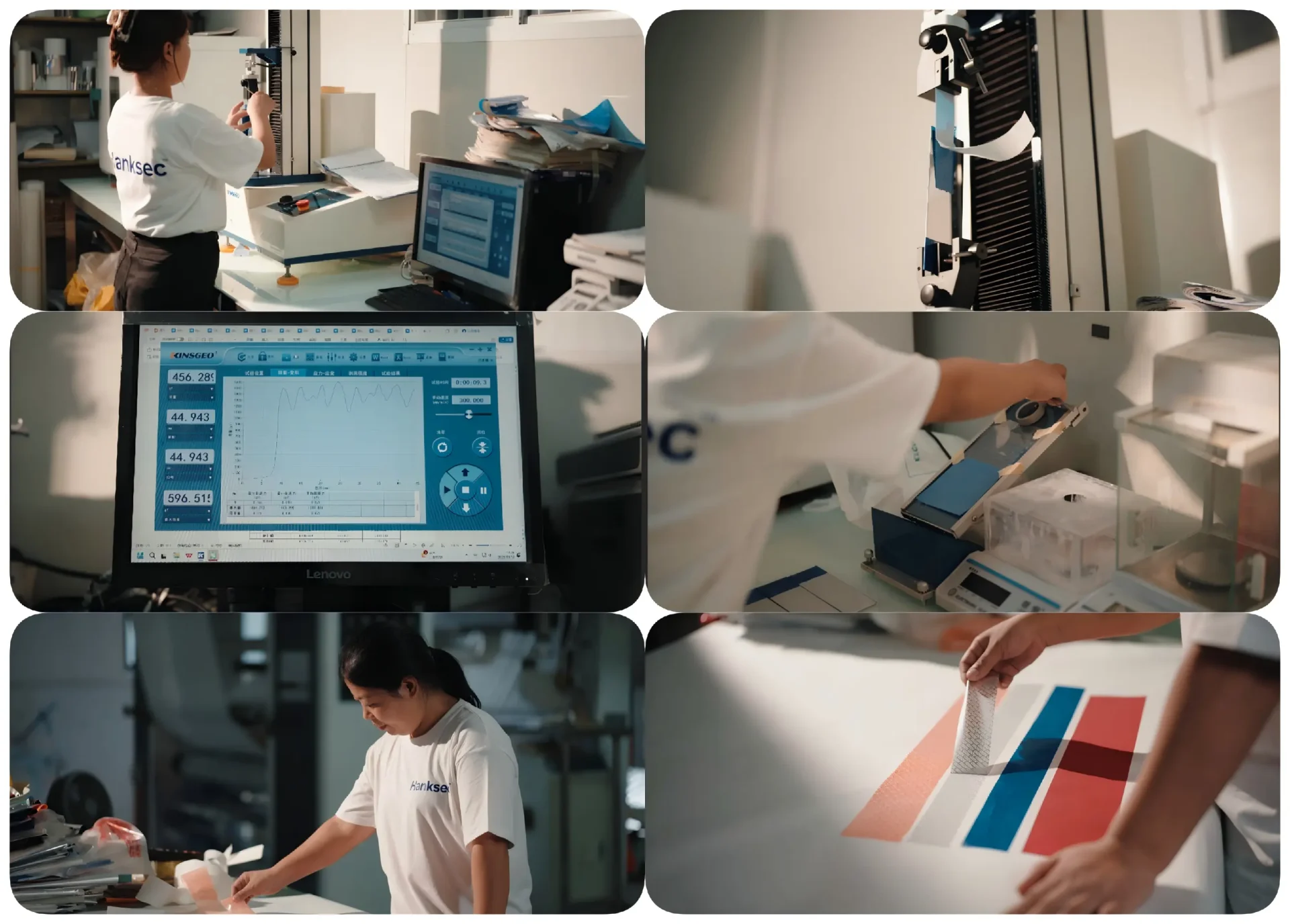
Material qualification should demonstrate both normal-use stability and the intended tamper response. A supplier’s short demonstration on a clean reference panel is useful for initial screening, but it does not replace trials on the actual product or package.
Define the Test Substrate and Application Conditions
Use representative production substrates, including relevant coating batches, textures and cleaning conditions. Record label dimensions, pressure, dwell, application temperature, humidity and any relevant surface treatment. If the production part is curved or textured, test the actual geometry instead of relying only on a flat laboratory coupon.
Separate Adhesion Results from Security-Response Results
Peel adhesion provides information about bonding under controlled conditions, but it does not by itself establish that the security message or destructible response works as intended.
ASTM D6252/D6252M-98(2025) describes a standardized method for measuring 90-degree peel adhesion of pressure-sensitive label stocks. It can support controlled comparisons when appropriate to the construction and test purpose.
Buyers should document peel conditions separately from the required VOID activation, facestock fracture, residue, coating damage and evidence readability. A peel-force value alone cannot establish the security performance of a finished custom label.
Verify Printing, Die Cutting and Dispensing
Run representative trials using the intended printing and converting process. Evaluate print anchorage, barcode readability, die-cut stability, matrix stripping, liner release, rewinding and dispensing behavior where applicable.
A construction that passes hand application but breaks or releases improperly during machine processing should not be approved for production until the issue is resolved.
Check Environmental and Service Conditions
Where relevant, expose unopened labels to the expected storage and use conditions before performing the defined removal test. These may include temperature changes, humidity, abrasion, handling, cleaning exposure and extended dwell.
The qualification should distinguish premature damage during normal use from the evidence created by a deliberate removal attempt. It should also confirm that the expected tamper response remains inspectable after relevant service exposure.
Define Acceptance Criteria Before Testing
Do not decide that a sample has passed only after seeing the result. Agree on the intended evidence beforehand. Record acceptable and unacceptable examples, including message readability, facestock breakage, edge lifting, surface damage and any residue limitations.
Where risk warrants, include more than one relevant material or substrate lot and retain sample identification for later comparison. The correct sample plan and numerical pass limits depend on the application and its quality requirements; no universal threshold should be invented.
Hanksec’s security label material systems guide explains how the facestock, functional layers, adhesive and liner interact. Buyers can also consult the Security Label Material Quality Control Guide for relevant production checks.
Which Applications Need Different Custom Security Label Specifications?
Application requirements vary considerably. A material developed for a coated retail carton should not be approved automatically for an electronic device, industrial machine, medical package or logistics container.
Electronics Warranty and Device Access Seals
Electronics applications may involve ABS, PC, PP, painted housings, metal panels or surfaces with sensitive finishes. Buyers often need evidence of unauthorized access while also controlling residue, cosmetic impact and label dimensions.
Where a label bridges a removable housing seam or fastener, the geometry and bonded area are just as important as the VOID construction. The engineering team should confirm whether inspection occurs on the product after peeling, on the removed label, or on both surfaces.
Automotive Parts and Aftermarket Packaging
Automotive replacement-part packaging may require tamper evidence across a carton opening, alongside authentication or serial-number features. The final printed and varnished box should be used for qualification because the coating can affect adhesive anchorage and VOID response.
Security labels should be positioned on appropriate packaging surfaces rather than on functional bearing tracks, electrical contacts or other sensitive working surfaces unless the application has been specifically engineered and approved.
Industrial Equipment and Asset Protection
Industrial equipment may be exposed to textured coatings, oil, cleaning agents, vibration and extended service periods. A warranty or inspection seal must remain stable during approved use while responding correctly to the specified removal attempt.
Purchasers should document the surface finish, expected exposure and whether the security function or long-term printed identification is the primary requirement. In some cases, one material cannot satisfy every durability and tamper-evidence condition without trade-offs.
Pharmaceutical and Medical Secondary Packaging
Medicine cartons and specified external medical-packaging closures may require a clearly recognizable opening indication while preserving essential artwork and product information. The final packaging system, not just the adhesive film, must be qualified against the applicable requirements.
For medicinal-product packaging, ISO 21976:2018 provides requirements and guidance related to tamper-verification features. Referencing this standard does not mean that a particular material or finished package is automatically certified or compliant.
Retail, E-Commerce and Logistics Cartons
Shipping and retail cartons may use uncoated, coated, laminated or recycled boards. Fiber strength, coating attachment, dust and surface texture can change both adhesion and the appearance of tamper evidence.
The buyer should establish whether carton damage is acceptable, whether the hidden warning must remain on the package and whether the closure must withstand expected handling before any opening attempt. A successful application on a smooth reference surface does not eliminate the need to test production cartons.
How Does Hanksec Support Custom Security Label Material Manufacturing?
From a material-manufacturing perspective, custom label development involves more than printing a private logo. The design must be translated into a repeatable material construction that can be coated, handled, converted and inspected.
Depending on the project, manufacturing stages may involve security-pattern preparation, film treatment, functional coating, printing-compatible surface treatment, adhesive application, liner combination, slitting, rewinding and quality checks.
Hanksec’s security label material manufacturing capabilities provide a closer look at its material-production processes.
Manufacturing Insight: Artwork Is Not the Security Mechanism
One important specification risk is approving the visible artwork before the functional construction and adhesive interface have been qualified. A custom VOID message may be printed or coated correctly, yet the expected evidence may remain incomplete if the adhesive releases from the package first.
Conversely, modifying the adhesive without considering the substrate coating may increase damage to the package while leaving the intended security response unresolved.
For this reason, artwork approval, material approval and final application qualification should be treated as connected but distinct production decisions.
Material Supply Formats and MOQ
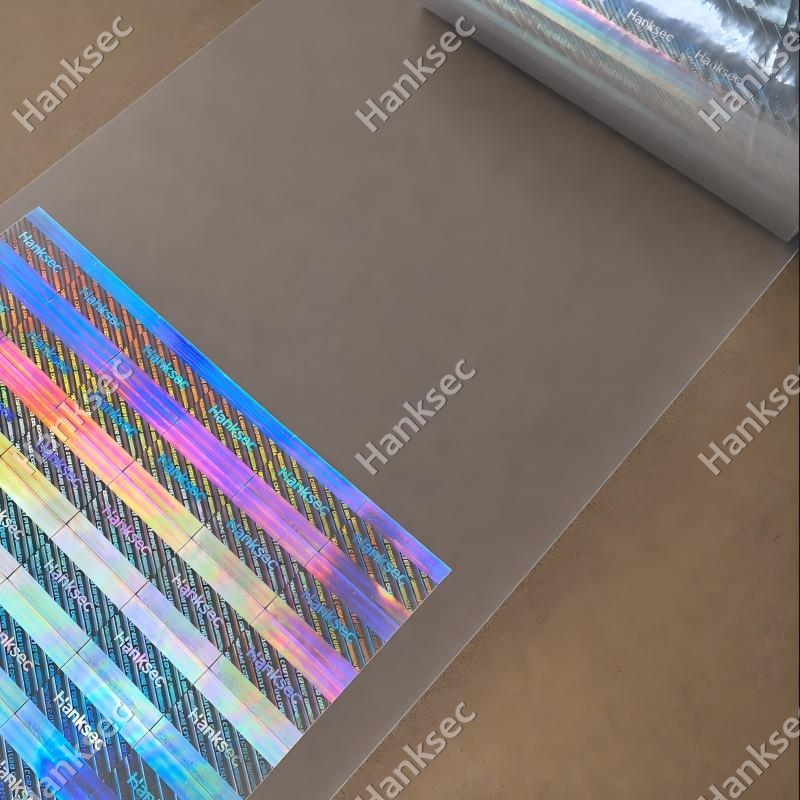
Hanksec can support jumbo rolls, slit rolls, sheets and selected converted formats according to the material construction and project requirements. A typical jumbo-roll specification for some products is 1070 mm × 1000 m, but dimensions and availability must be confirmed for the requested material.
Some stocked materials may support smaller purchasing quantities. A custom hidden message, adhesive system, coating or production format may require a different MOQ because of setup, tooling and manufacturing feasibility. Buyers should confirm the actual specification and quotation rather than assume that one MOQ applies to all custom security labels.
For standard inventory options, review Hanksec’s Stock Materials for Security Labels.
What Should Buyers Include in a Custom Security Label RFQ?
A useful RFQ should allow the material manufacturer to understand the required security result and the buyer’s production conditions. Artwork and dimensions alone are not sufficient for an engineering quotation.
Provide the following information wherever available:
- Application: Product, package or closure being secured, including the attempted action the seal should reveal.
- Substrate: Material, coating, finish, texture, curvature and surface-cleaning conditions.
- Required evidence: Full-transfer, partial-transfer, non-transfer VOID, destructible fracture or another defined response.
- Residue and cosmetic limits: Acceptable adhesive traces, coating damage, fiber tear and surface appearance after removal.
- Visible customization: Logo, colors, hidden warning, serial numbering, barcode or QR-code requirements.
- Print method: Press, ink or ribbon, curing conditions and print-durability requirements.
- Converting: Label dimensions, die-cut geometry, liner, matrix design and automatic application equipment.
- Supply format: Jumbo roll, slit roll, sheet or converted format, including width, length, core and winding.
- Environment: Application and service temperatures, humidity, exposure duration and handling.
- Qualification: Sample substrate, test method, dwell, removal procedure and acceptance criteria.
- Commercial requirements: Estimated demand, required delivery format, sample quantity and project timeline.
Procurement tip: If the substrate or opening-evidence requirement is uncertain, provide representative packaging samples or clear photographs before selecting a final material. Early substrate evaluation can reduce repeated sampling caused by choosing a material solely from an image or product name.
Frequently Asked Questions About Custom Security Labels
Can custom security labels include logos, barcodes and serial numbers?
Yes, subject to the printable surface and production-process compatibility. The buyer should qualify print adhesion, readability, variable-data consistency and the final tamper-evident response together. A printed QR code provides identification or a link to data; it does not automatically provide physical tamper evidence.
Are custom tamper-evident labels completely tamper proof?
No pressure-sensitive label should be described as impossible to defeat under every condition. A reliable specification defines the removal or interference event to be detected and the visible evidence expected after that event. Tamper-evident performance should be evaluated against those defined conditions.
Can non-transfer VOID labels be removed without adhesive residue?
Non-transfer refers to the intended security-message behavior, not a universal guarantee of residue-free removal. Actual adhesive traces depend on the construction, substrate, dwell and environmental conditions. Test the approved material on the final surface.
Which is better for warranty seals: VOID or destructible material?
Neither is universally better. VOID constructions provide a designed hidden-message response. Destructible materials provide evidence through physical facestock fracture. The choice depends on the application surface, required inspection method, cosmetic limits and printing or converting process.
What thickness is available for custom VOID security materials?
Hanksec offers applicable PET and BOPP constructions with film options including 25, 36 and 50 μm. Availability, complete construction thickness and suitability depend on the selected product. Buyers should not substitute one thickness for another without checking converting and tamper-response performance.
Can Hanksec supply jumbo rolls instead of finished security labels?
Yes. Hanksec’s primary focus includes converter-ready security label materials in jumbo rolls and slit rolls. Sheets and selected converted formats may also be available depending on the construction and project. Roll specifications should match the buyer’s printing and converting equipment.
What is the minimum order quantity for custom security label materials?
MOQ depends on whether the requested construction is stocked or requires custom coating, hidden-message preparation, adhesive selection or other manufacturing changes. Buyers should provide the intended material, supply format and quantity to obtain a project-specific quotation.
How should custom VOID labels be tested before production?
Use representative production substrates and record application conditions, dwell, peel procedure and expected message location. Evaluate adhesion, VOID readability, surface residue and any package damage. Where applicable, add print anchorage, barcode readability, die cutting, matrix stripping, liner release and automatic dispensing tests.
Can one custom label material work on plastic, glass, metal and paperboard?
Not automatically. These surfaces differ in chemistry, texture, coatings and mechanical behavior. A material may perform well on one surface and fail on another. Separate substrate qualification is necessary before claiming compatibility across multiple product or packaging types.
Conclusion: Specify the Security Evidence Before Ordering the Label
The right custom security label is not the construction with the most visible features or the highest possible adhesive strength. It is the material system that creates the specified tamper evidence on the real application surface while remaining practical to print, convert, apply and inspect.
For purchasing and engineering teams, the most effective sequence is to define the required evidence, confirm the substrate, select the material construction, qualify printing and converting, test the finished application and document production acceptance criteria.
When these decisions are made before bulk ordering, manufacturers and converters can compare security material options against the actual project requirements instead of relying on generic product claims.
Share your application substrate, required VOID or destructible response, printing process and roll specification. Hanksec can discuss suitable material constructions, customization options and representative samples for your qualification process.
Custom VOID Patterns · PET/BOPP Security Films · Adhesive & Liner Options · Jumbo Rolls · Slit Rolls · OEM/ODM
REQUEST CUSTOM MATERIAL SAMPLES →
Hanksec® | Tamper-Evident Security Label Materials · Custom Constructions · Technical Support