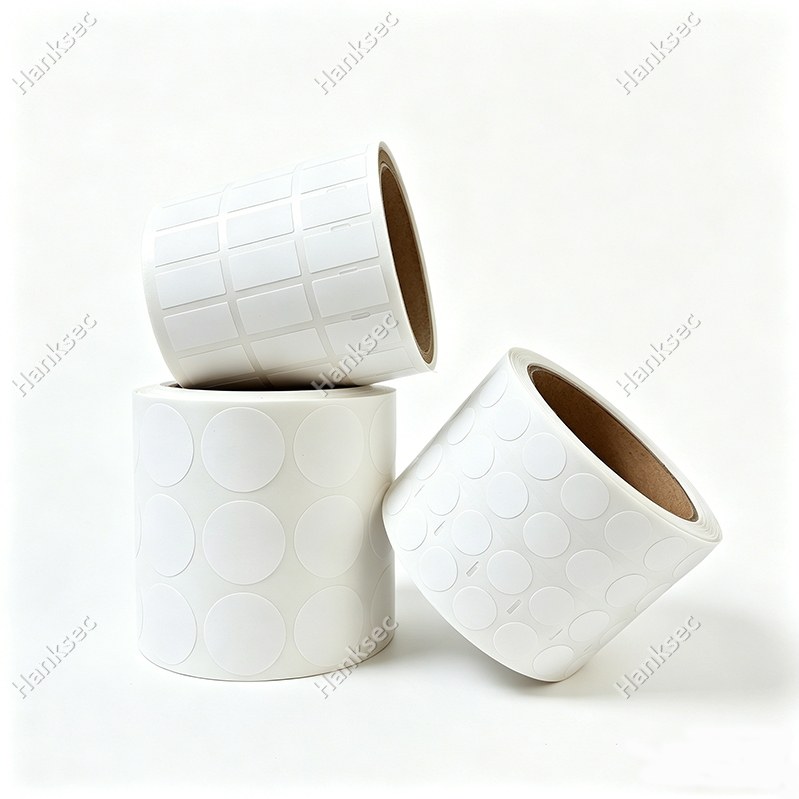
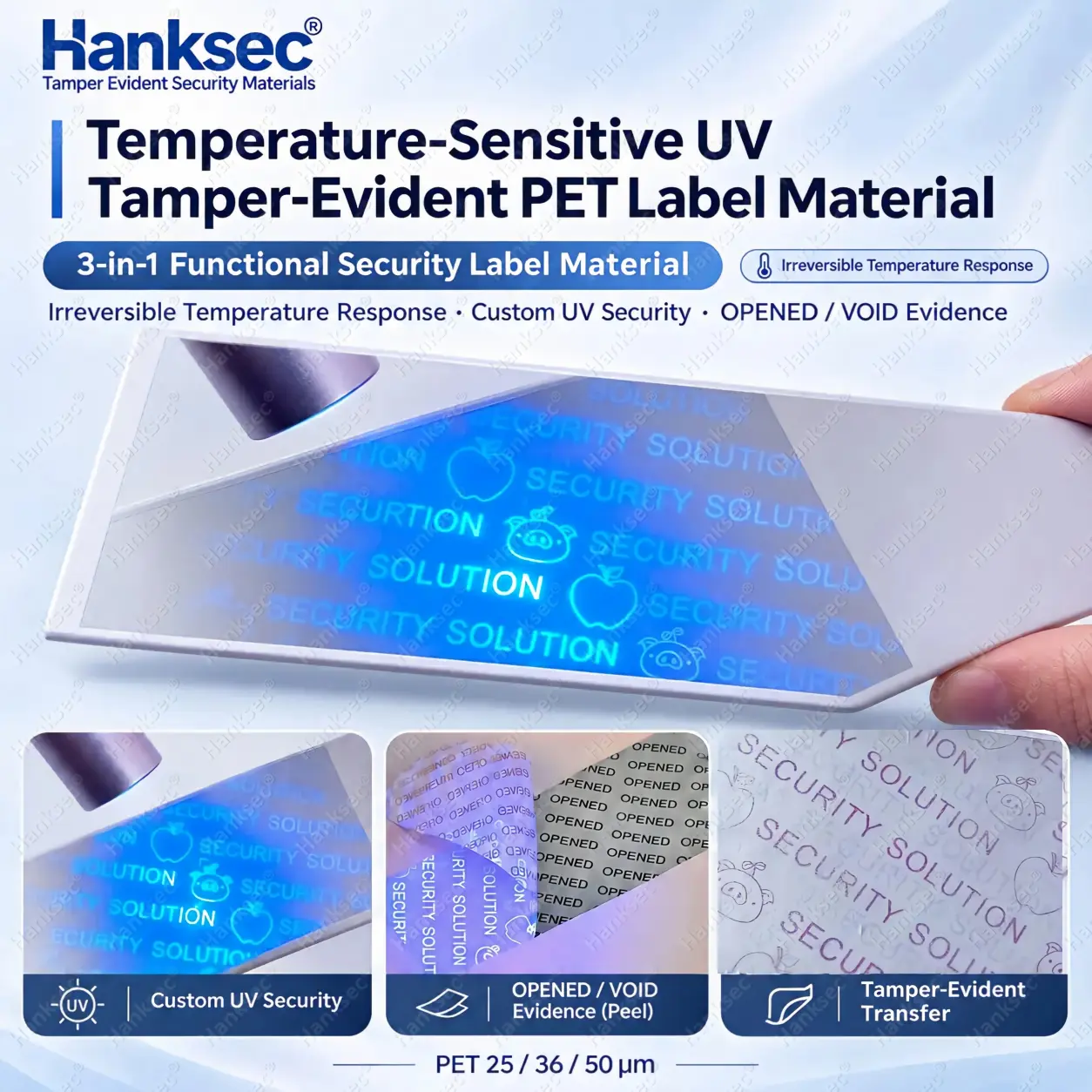
Quick Answer: Temperature-Sensitive UV Label Material combines three distinct security functions in one coordinated label construction: irreversible temperature response, UV fluorescent identification and VOID tamper-evident protection. Each function provides different evidence. The temperature-sensitive feature indicates exposure to a defined temperature condition, the UV-responsive marking can support covert visual identification under a specified UV light source, and the VOID structure is designed to reveal evidence when removal is attempted. For converters and procurement teams, the main challenge is ensuring that all three functions remain effective after printing, coating, die cutting, application and environmental exposure. A complete qualification process must therefore test each function separately and then verify the finished label as an integrated security system.
What Is Temperature-Sensitive UV Label Material?
Temperature-Sensitive UV Label Material is a multifunctional security label material that brings together three different security features in one coordinated construction. It is designed to provide a visible temperature-response indicator, a UV-checkable identification feature and tamper-evident evidence if someone attempts to remove the applied label.
The three functions serve different purposes:
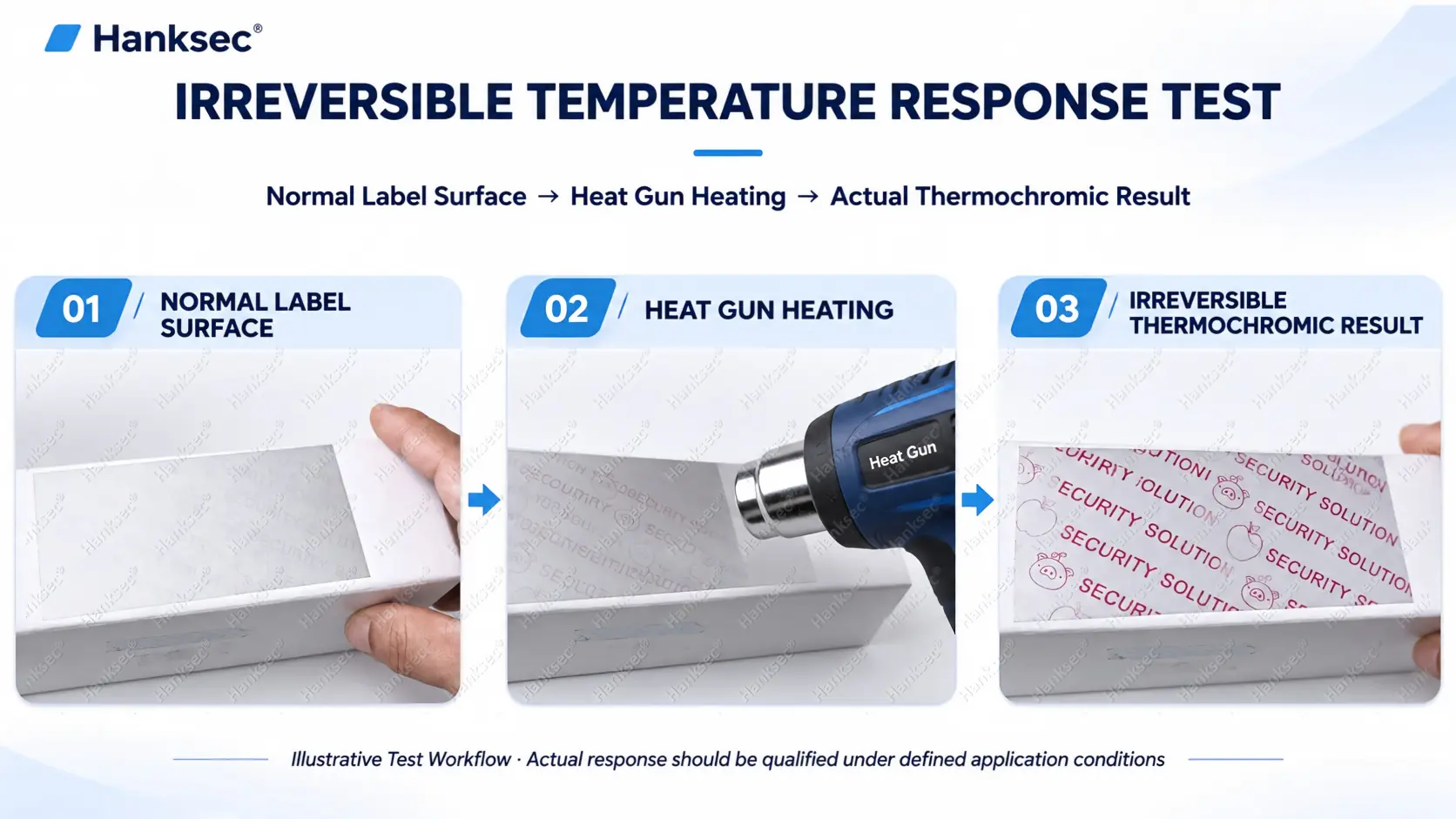
- Irreversible temperature response: Indicates that a specified temperature condition has been reached. The visual change is intended to remain after the material returns to normal conditions, according to the approved indicator design.
- UV fluorescent identification: Provides a customized marking or pattern that can be inspected under the specified UV light source. Depending on the design, the marking may remain inconspicuous under normal lighting.
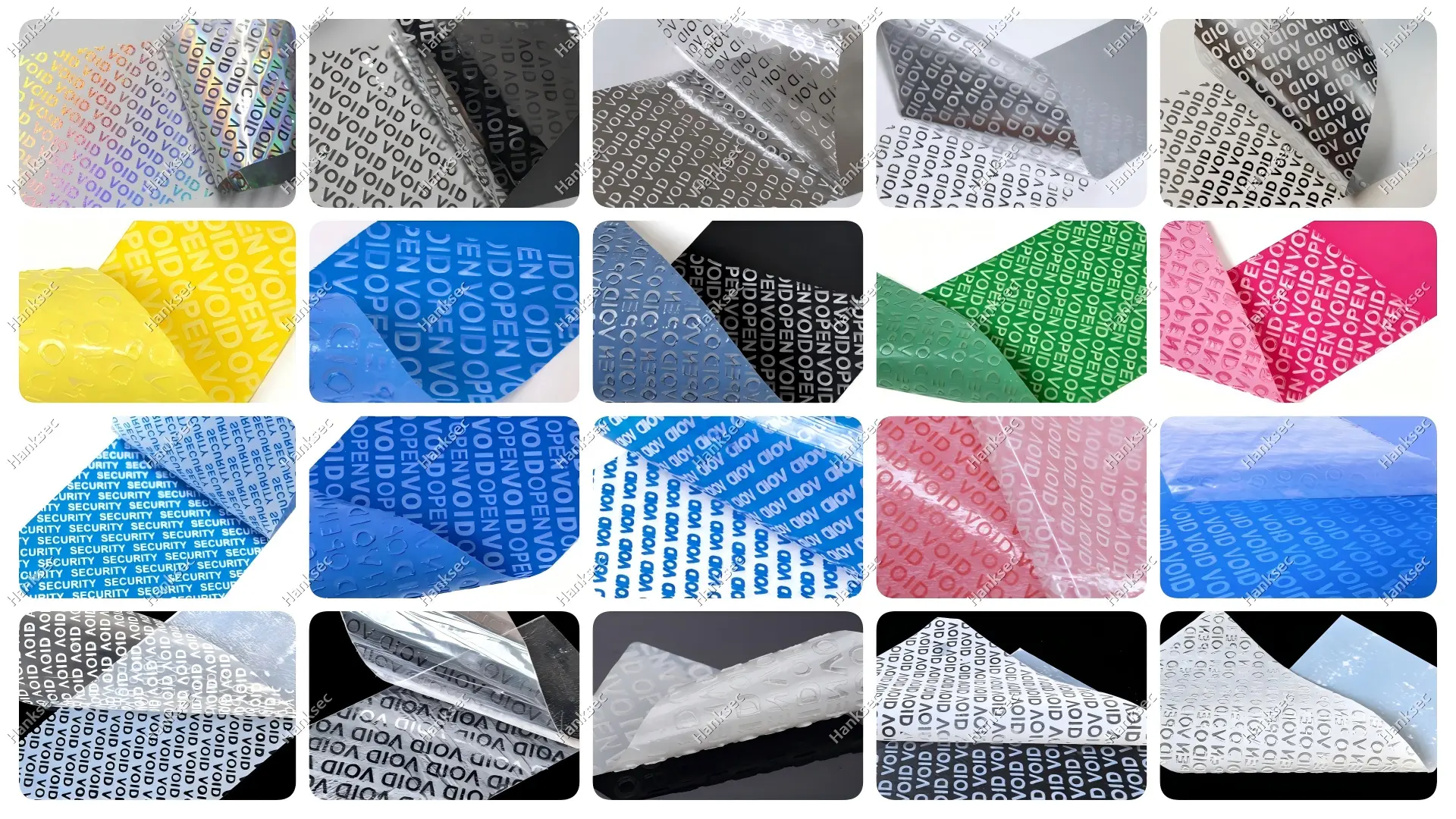
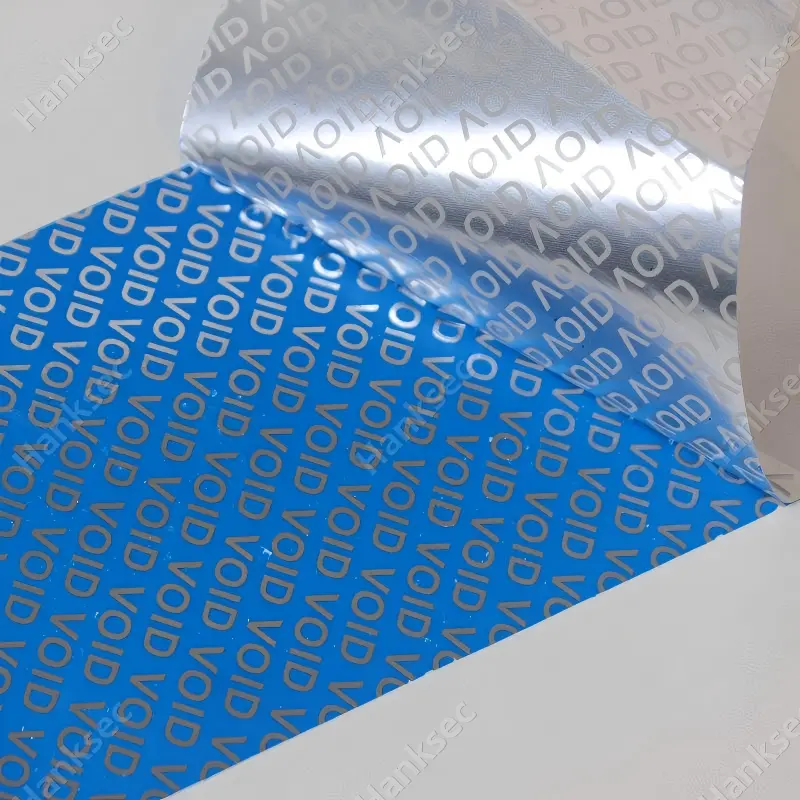
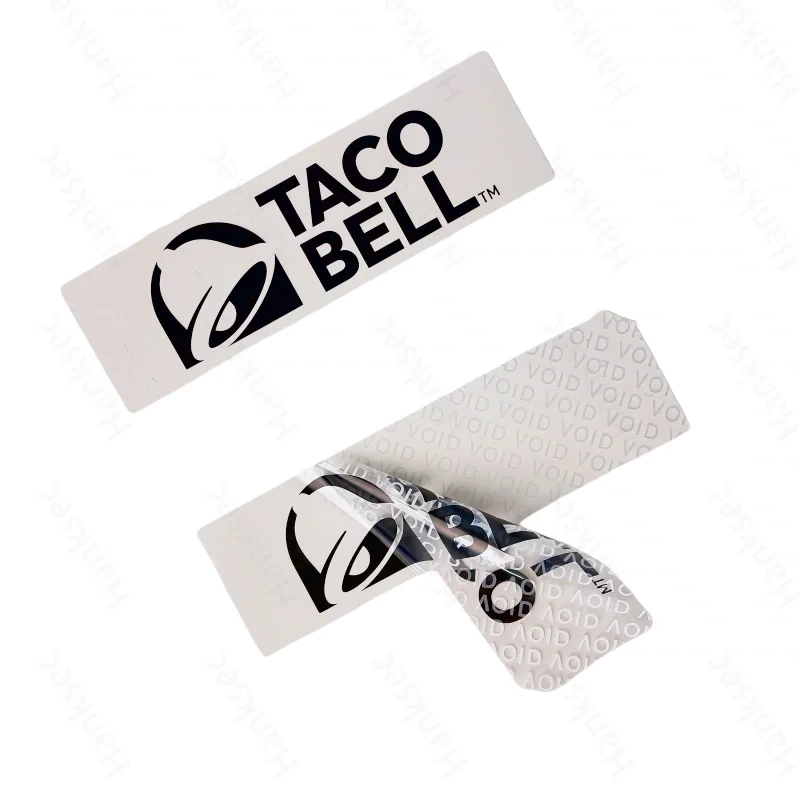
- VOID tamper-evident protection: Reveals a designed message or transfer pattern when removal is attempted, providing visible evidence associated with interference.
These features are combined in one label material, but they do not perform the same job. The temperature response indicates a defined thermal event; the UV feature supports visual identification; and the VOID function indicates attempted removal. None should be treated as a substitute for the others.
The exact specification must be defined for each project. Buyers should confirm the temperature trigger and response requirements, the UV marking and inspection conditions, and the required VOID transfer construction. The term temperature-sensitive alone does not define a trigger threshold or mean that the label records a complete temperature history.
Why Does a 3-in-1 Security Label Need More Than a Single Performance Test?
A label may show the expected temperature response in a laboratory sample, produce a clear fluorescent marking under UV illumination and reveal a VOID message during a hand-peel demonstration. However, these individual results do not automatically prove that the finished label will perform consistently in production.
For example, a printing or drying process may expose the temperature-sensitive feature to unintended heat. A protective coating may change the visibility of the UV fluorescent marking. An unsuitable adhesive or application surface may prevent the intended VOID response from developing correctly.
The challenge is not simply whether each feature works in isolation. The three functions can interact with the label construction, printing and finishing operations, adhesive, application surface and environmental conditions. A complete qualification process must therefore test each function separately and then evaluate the finished label as one integrated security system.
This guide explains how to qualify Temperature-Sensitive UV Label Material, identify possible failure mechanisms, select tests before bulk production and prepare the information buyers should provide when requesting customized security label materials.
For security label converters, packaging manufacturers and brand owners, four purchasing problems deserve particular attention.
Problem 1: The Temperature Indicator Activates During Processing
Temperature-sensitive materials can be exposed to heat during printing, ink drying, coating, curing, lamination, packaging and transportation.
If the actual process temperature exceeds the defined activation condition, the indicator may change before the label reaches its intended application. The material could therefore arrive at the customer in an already activated or unusable state.
The solution is to compare the indicator’s specified activation conditions with the complete manufacturing and logistics temperature profile, rather than checking only the nominal temperature setting of one machine.
Problem 2: UV Fluorescence Becomes Difficult to Verify
A UV security marking may be designed to remain inconspicuous under normal lighting and produce a recognizable fluorescent response under a specified UV light source.
However, the final appearance can be affected by the printing surface, ink compatibility, protective coatings, overprinting and inspection conditions.
The solution is to approve the UV response under a defined inspection method and repeat the verification after all relevant printing and finishing operations.
Problem 3: The VOID Message Does Not Activate as Expected
A tamper-evident label depends on controlled interaction between the adhesive, security layers and application surface. If the adhesive bond is insufficient or the substrate surface is unsuitable, the intended security message may not appear clearly during removal.
The solution is to qualify the VOID construction on the actual customer substrate, with agreed application pressure, dwell time and removal conditions.
Problem 4: The Three Functions Work Individually but Not Together
This is the most important issue in a multifunctional construction.
Changing one layer may affect another function. A new topcoat may alter UV inspection visibility. A different adhesive may change the tamper-evident separation behavior. A higher-temperature printing process may affect the temperature-sensitive feature.
The solution is a staged qualification process: verify each function independently, evaluate the interactions between layers, and finally test the complete label after representative converting and application.
For the product construction and available customization options, see Hanksec’s Temperature-Sensitive UV Label Material.
What Does Each of the Three Security Functions Actually Detect?
Before selecting a multifunctional label, buyers should understand what each feature is designed to indicate. The three functions should not be treated as interchangeable security mechanisms.
| Security Function | What It Indicates | Main Verification Method |
|---|---|---|
| Temperature Response | Exposure to a defined temperature trigger, producing an irreversible visual change. | Controlled temperature exposure and visual comparison with an approved reference. |
| UV Fluorescent Identification | Presence of a specified hidden or UV-responsive marking. | Inspection under the specified UV light source. |
| VOID Tamper Evidence | Attempted removal or interference with the protected label or closure. | Controlled application, dwell and removal on the actual substrate. |
The functions provide complementary information:
- Temperature response indicates that a defined thermal condition has occurred.
- UV fluorescence provides an additional authentication feature that authorized personnel can inspect.
- VOID activation provides visible evidence associated with an attempted removal of the label.
None of these features should be interpreted beyond its defined function. A UV fluorescent mark alone does not prove that a product is genuine. A temperature response does not establish the complete temperature history of a product. A VOID label does not make a package physically tamper-proof.
The value of the combined construction comes from using different verification methods to provide different types of security evidence.
How Should Buyers Qualify Temperature-Sensitive UV Label Material?
The first step is to define exactly what temperature condition the indicator is intended to detect.
The term temperature-sensitive does not by itself specify the activation direction, trigger threshold, response time or permitted tolerance. These requirements must be confirmed for the selected construction before testing begins.
1. Define the Temperature Trigger
Buyers should establish whether the intended indicator responds to an increase in temperature, a decrease in temperature or another specifically defined thermal condition.
For a heat-triggered design, the specification should identify the intended upper activation threshold. If a cold-triggered design is required, the lower trigger condition must be defined and separately qualified.
The following information should be confirmed:
- Specified activation temperature or temperature threshold.
- Whether the response is triggered by rising or falling temperature.
- Required response time under the defined test conditions.
- Permitted activation tolerance.
- Expected visual state before and after activation.
- Whether the visual change must remain irreversible after returning to normal conditions.
Without these details, the phrase temperature-sensitive cannot serve as a complete purchasing specification.
2. Distinguish a Threshold Indicator from a Time-Temperature Indicator
One common technical misunderstanding is treating every irreversible temperature indicator as a time-temperature monitoring device.
A threshold indicator is designed to show that a specified temperature condition has been reached or exceeded. A time-temperature indicator, by contrast, is designed to reflect accumulated exposure over time according to its specific response mechanism.
These technologies answer different questions.
| Indicator Type | Information Provided |
|---|---|
| Temperature Threshold Indicator | Visual evidence that a specified temperature trigger has occurred. |
| Time-Temperature Indicator | A response related to accumulated time and temperature exposure. |
| Electronic Temperature Logger | Recorded temperature measurements over a defined monitoring period. |
An irreversible visual response should not automatically be described as continuous temperature monitoring. Unless the selected indicator has been specifically designed and validated as a time-temperature integrator, it should not be used to infer exposure duration or reconstruct a complete temperature history.
The World Health Organization’s PQS E006/IN04.1 Threshold Indicator Specification provides a useful example of how a threshold indicator can be specified. It addresses activation, irreversible visual change, threshold temperature, tolerance, quality control, storage and durability.
This WHO specification applies to its defined vaccine-related threshold indicator scope. It should be used as a technical reference for specification thinking, not as evidence that a Hanksec label complies with that specification.
3. Check the Risk of Premature Activation During Converting
For label converters, one of the most important qualification questions is whether the temperature-sensitive feature remains in its intended unactivated state throughout manufacturing.
Potential heat exposure can occur during:
- Printing and ink drying.
- UV or other curing processes.
- Protective coating application.
- Hot lamination or thermal bonding.
- Roll storage near heat sources.
- Transportation and warehouse handling.
The actual temperature experienced by the label material may differ from the machine’s displayed setting. Web speed, exposure duration, material contact, heat transfer and process configuration can all affect the thermal profile.
For this reason, buyers should measure or otherwise establish the actual material exposure conditions during representative production trials.
If the production process approaches the indicator’s specified activation conditions, the construction and process sequence should be reviewed before bulk production.
4. Establish a Controlled Temperature Qualification Test
A practical temperature test should use samples from the selected construction and a controlled temperature environment.
- Prepare the samples: Identify the material version, batch, initial visual state and relevant storage history.
- Establish a control group: Keep representative samples under the agreed non-trigger condition.
- Condition the test samples: Apply the specified temperature profile using calibrated equipment and an independently verified temperature measurement.
- Record the response: Document the onset of the visual change, the response time and the final appearance.
- Check irreversibility: Return activated samples to the defined normal condition and observe whether the visual change remains.
- Compare repeatability: Evaluate multiple samples and, where required, samples from different production lots.
The acceptance criteria must be established according to the selected indicator design and customer requirement. A generic temperature test without a defined trigger condition is not sufficient for product approval.
5. Separate Activation Temperature, Application Temperature and Service Temperature
These three terms describe different conditions and should not be used interchangeably.
| Term | Meaning |
|---|---|
| Activation Temperature | The defined temperature condition that triggers the indicator’s response. |
| Application Temperature | The temperature of the label and substrate when the label is applied. |
| Service Temperature | The environmental temperature conditions expected during actual use and storage. |
A label may have a defined thermal activation threshold while also having separate storage, application and service requirements. All these conditions should be evaluated together.
Hanksec technical recommendation: Do not approve a temperature-sensitive label based only on a single activation demonstration. Confirm the trigger definition, response time, pre-activation storage conditions and complete converting temperature profile.
How Do You Verify the UV Fluorescent Security Function?
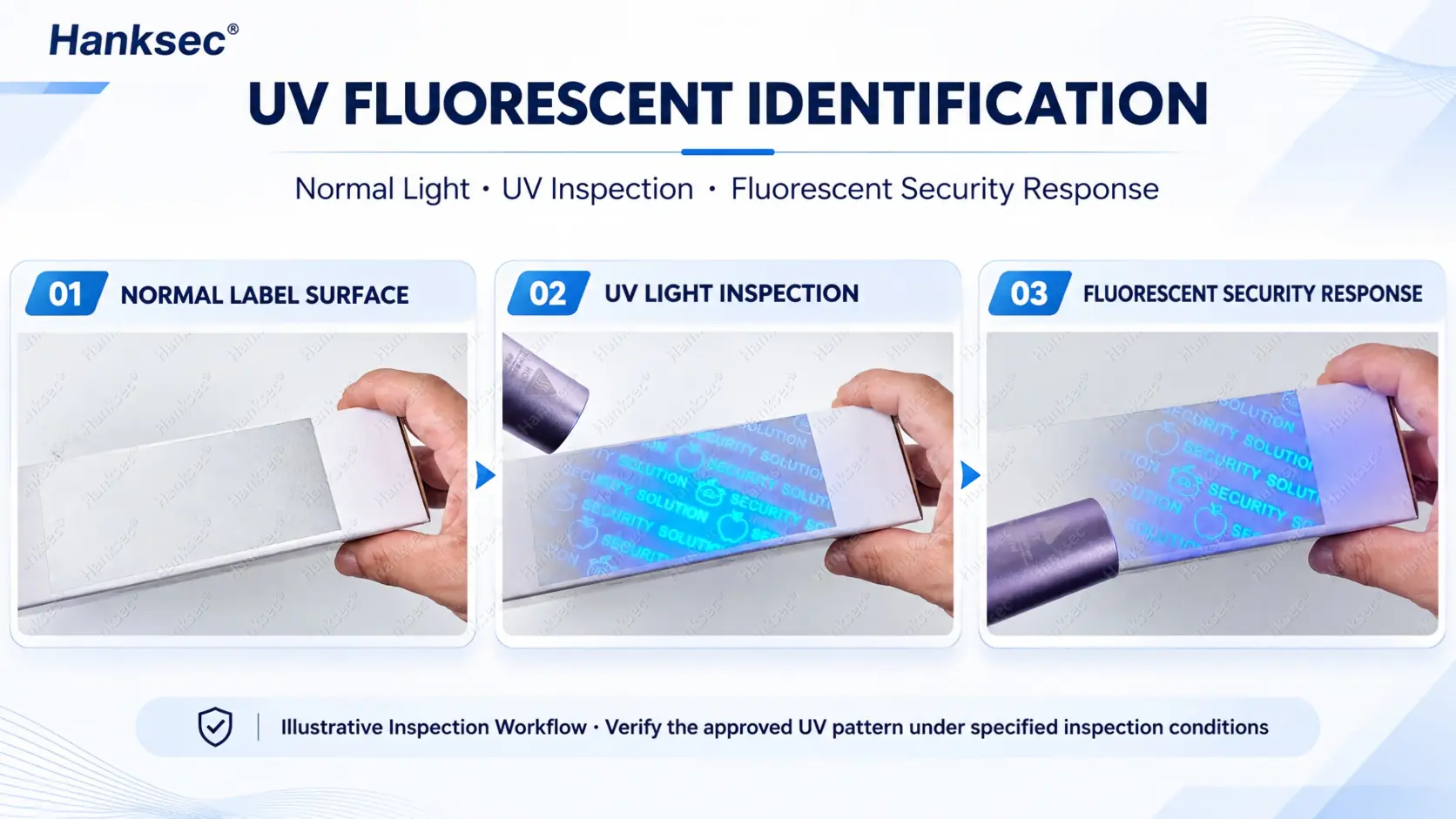
The UV feature provides an additional identification method. A customized marking can be difficult to distinguish under ordinary lighting and become visibly fluorescent when exposed to the specified ultraviolet light source.
For buyers, the main issue is not simply whether the marking fluoresces. It is whether the expected marking can be identified consistently under a defined inspection procedure after the label has been printed and converted.
1. Define the Expected UV Response
Before approving the UV function, the buyer and material supplier should agree on the appearance of the marking.
Important details include:
- Hidden logo, text, symbol or customized security pattern.
- Expected appearance under normal lighting.
- Expected fluorescent color or visual response under UV illumination.
- Position and dimensions of the security marking.
- Required contrast against the surrounding label design.
- Whether the marking must remain identifiable after protective finishing.
Not all UV-responsive inks behave identically. The actual response depends on the selected formulation, printing method and complete label construction.
The European Union Intellectual Property Office explains the use of UV-sensitive inks for authentication and anti-tampering applications in its Anti-Counterfeiting and Anti-Piracy Technology Guide.
2. Specify the UV Inspection Equipment
A UV marking should be inspected under the light source for which it has been designed and approved.
Buyers should not assume that a general-purpose UV flashlight will produce the same result as the intended inspection equipment.
The inspection specification should identify:
- UV wavelength or approved light-source type.
- Light intensity or the relevant equipment setting.
- Distance between the light source and label.
- Illumination angle.
- Ambient lighting conditions.
- Viewing position and expected response.
For example, a security mark designed for one specified UV source may appear weaker or different under another source. This does not necessarily indicate that the label is defective; the inspection conditions may simply be unsuitable.
For this reason, the approved UV reference sample and the inspection equipment should be treated as part of the same qualification system.
3. Test UV Visibility Before and After Finishing
A UV fluorescent mark may be visible on an unfinished sample but become less recognizable after additional processing.
Potential causes include:
- Opaque printing covering the designated security area.
- Protective coatings that alter light transmission.
- Overlamination that changes the inspection response.
- Incompatible inks or varnishes.
- Surface damage caused by handling or converting.
- Changes in the marking’s contrast under the final label design.
The appropriate solution is to inspect the marking at several stages: after printing, after any coating or lamination, after die cutting and on the final applied label.
If the marking is intended to remain concealed during normal viewing, the normal-light appearance should also be checked at every relevant stage.
4. Do Not Confuse UV Security Ink with UV-Curable Printing
These two terms describe different functions.
UV-responsive security ink is used to provide a visual response under specified UV inspection conditions. UV-curable printing uses ultraviolet energy to cure or harden ink during production.
A label converter may use UV-curable printing equipment and also require a UV fluorescent security marking. However, compatibility between the two must be confirmed through the actual printing sequence and finishing conditions.
Where UV exposure forms part of the production process, the security marking should be checked after the relevant curing stages rather than assuming that its original appearance will remain unchanged.
For more detailed information about UV security ink, normal-light appearance and inspection requirements, see Hanksec’s UV Security Label Material: Hidden UV Authentication Guide.
5. Establish an Approved UV Reference Sample
Visual inspection can become inconsistent when different operators use different lamps, distances or ambient lighting.
To improve repeatability, retain an approved reference sample showing:
- The expected normal-light appearance.
- The expected UV fluorescent response.
- The exact marking position.
- The approved inspection light source.
- Any acceptable visual variation defined by the project.
Production samples should be compared with this reference under the same inspection conditions.
A UV fluorescent mark is an authentication aid, not independent proof of product origin. Its value depends on the control of the marking design, access to the inspection method and the wider product verification procedure.
Hanksec technical recommendation: Approve the UV marking on the complete finished label, not only on an isolated ink sample or uncoated material.
How Should the VOID Tamper-Evident Function Be Qualified?
The VOID function has a different purpose from the temperature and UV features. It is designed to reveal visible evidence when removal of the applied label is attempted.
Its performance depends on the interaction between the security layer, adhesive, facestock, application surface and application conditions.
1. Select the Correct Transfer Construction
Full-transfer, partial-transfer and non-transfer VOID materials create different evidence patterns after removal.
| Construction | Expected Tamper Evidence | Typical Selection Consideration |
|---|---|---|
| Full Transfer | The intended security message or transfer pattern appears predominantly on the application surface. | Visible evidence directly on the protected substrate. |
| Partial Transfer | Security evidence is divided between the removed material and the application surface. | A combined visual response on both sides. |
| Non-Transfer | The intended security message appears mainly within the removed facestock, while the substrate remains relatively cleaner. | Applications where surface cleanliness is an important consideration. |
The appropriate transfer type depends on the application surface, expected evidence location, residue preference and complete adhesive construction.
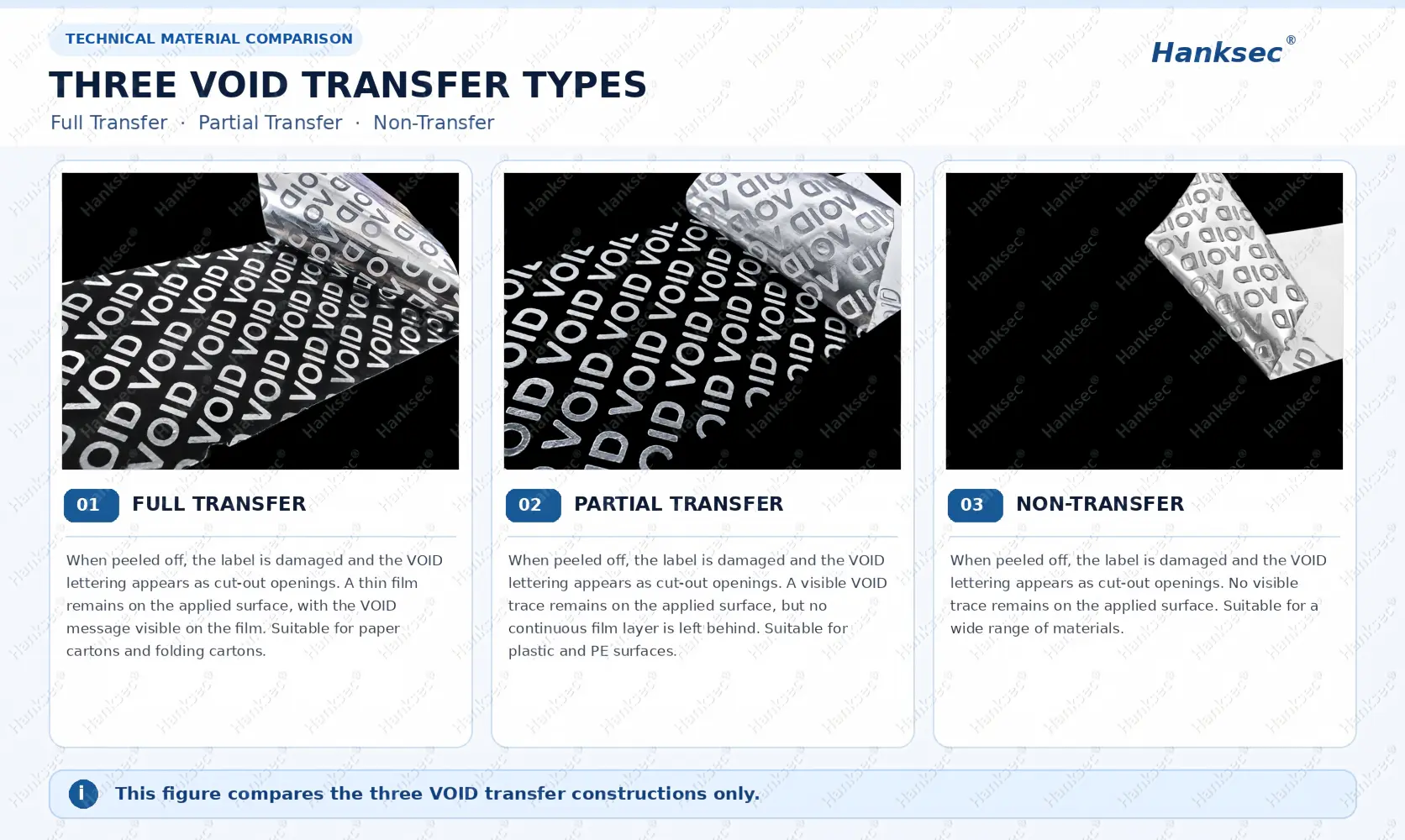
One important distinction: transfer type is not the same as adhesive residue level. A non-transfer construction does not automatically guarantee zero adhesive residue on every substrate.
Likewise, a full-transfer construction should not automatically be interpreted as leaving all adhesive on the substrate. The security message transfer and adhesive residue are different aspects of material behavior.
For multifunctional security labels, the three functional features can be developed with different transfer constructions according to the project requirements. A full-transfer sample should be treated as one specific construction, not as proof that every available version has the same transfer behavior.
See Hanksec’s VOID Label Material Types: Full, Partial and Non-Transfer for further material selection information.
2. Test on the Actual Application Substrate
A VOID label may behave differently on different surfaces even when the same material sample is used.
Potential application surfaces include:
- Coated and uncoated paperboard.
- Plastic housings and electronic enclosures.
- Glass surfaces.
- Metal surfaces and painted metal.
- Coated cartons and laminated packaging.
- Other application-specific substrates.
Surface energy, coating composition, surface texture, contamination and substrate strength can influence the final response.
For example, a security label that performs correctly on clean glass may not develop the same adhesive bond on a textured plastic housing. A coated paperboard surface may also fail differently from the underlying paper fibers.
Testing on a generic stainless steel panel can help evaluate adhesive characteristics, but it cannot replace testing on the customer’s actual packaging surface.
The ASTM D3330/D3330M peel adhesion test method provides a standardized approach for evaluating pressure-sensitive tape adhesion. ASTM also explains that peel adhesion results do not by themselves establish a specific functional performance requirement. For a multifunctional security label, peel testing must therefore be accompanied by direct verification of the intended VOID response.
3. Control Application Pressure and Dwell Time
A common mistake is testing a security label immediately after lightly placing it on a surface and treating the result as its final performance.
Pressure-sensitive adhesive systems require appropriate contact with the substrate. Application pressure, surface cleanliness, temperature and dwell time can influence the development of the adhesive bond.
For a controlled VOID test, record:
- Surface preparation and cleaning method.
- Application temperature.
- Application pressure or application method.
- Time between application and removal.
- Peel direction and removal angle.
- Removal speed or test procedure.
Where relevant, compare an initial inspection with a sample conditioned for the agreed dwell period. The exact timing should be based on the material specification and application requirements rather than an assumed universal waiting period.
Substrate condition, application pressure and dwell time must be controlled during qualification. A quick peel test on an unspecified surface is not a reliable basis for approving a tamper-evident construction.
4. Identify the Actual Failure Plane
If the VOID response is incomplete, the first corrective action should not automatically be changing the adhesive.
Instead, determine where the material has separated.
| Observed Failure | Possible Cause | What to Check |
|---|---|---|
| Adhesive Release | Insufficient bonding or unsuitable surface condition. | Adhesive-to-substrate interface and application conditions. |
| Incomplete VOID Activation | Unstable or incomplete separation within the functional security construction. | Message clarity, layer separation and sample consistency. |
| Substrate Coating Lift | The surface coating separates from the underlying substrate. | Coating-to-substrate bond and paperboard or coating integrity. |
| Edge Lifting | Poor contact, surface contamination, geometry or adhesive mismatch. | Label edges, pressure, surface condition and application geometry. |
This distinction is important because each failure plane requires a different corrective action.
Increasing adhesive strength may not solve a problem caused by a weak carton coating. Changing the VOID layer may not solve poor bonding on a contaminated plastic surface.
Hanksec technical recommendation: Identify the failure interface first, then adjust the material construction or application process according to the actual cause.
Where Can the Three Security Functions Interfere with Each Other?
Testing the temperature, UV and VOID functions separately is necessary, but it is not enough. A multifunctional label must also be evaluated for compatibility between its functional layers and manufacturing processes.
The following problems should be considered during material development and customer qualification.
1. Process Heat Can Affect the Temperature Indicator
A printing or finishing process may expose the label to heat before it is applied to the protected product.
If the actual exposure approaches the defined activation conditions, the temperature indicator may change prematurely.
Possible corrective actions:
- Review the actual thermal profile experienced by the material.
- Evaluate the order of printing, coating and finishing operations.
- Confirm whether a lower-temperature or shorter-duration process is practical.
- Recheck the temperature response after the complete converting sequence.
Any process adjustment must preserve the quality of the printed label and the other two security functions.
2. Protective Coatings Can Change UV Inspection Visibility
A protective topcoat or overlaminate may affect the amount of UV light reaching the marking or the visibility of its fluorescent response.
The effect depends on the optical properties and compatibility of the complete construction.
Possible corrective actions:
- Confirm the intended location of the UV marking.
- Evaluate coating and overlamination compatibility.
- Compare UV response before and after finishing.
- Consider a different marking position or finishing sequence if necessary.
Do not approve the UV feature based only on an uncoated ink sample when the finished label will contain additional layers.
3. Adhesive and Security Layer Changes Can Affect VOID Performance
The adhesive is part of the tamper-evident mechanism. Changing its properties or the surrounding functional layers may alter the separation behavior.
For example, a construction that performs correctly with one application surface may require further evaluation when the substrate changes from coated paperboard to a plastic enclosure.
Possible corrective actions:
- Reconfirm the required transfer construction.
- Evaluate the adhesive on the actual substrate.
- Inspect the security message after removal.
- Check whether additional protective layers influence the intended separation.
4. Printing and Die Cutting Can Affect the Final Security Area
Printing, overprinting and die cutting may influence the appearance or position of functional features.
Opaque graphics could cover an inspection area. Incorrect registration could move the UV marking away from its intended location. Die-cutting damage could affect the edge integrity of the label.
For this reason, the converter should inspect the complete security area after production rather than checking only the original unconverted roll.
5. Different Functional Requirements May Need Different Design Priorities
A label intended for a highly visible temperature warning may require a different graphic layout from a label designed primarily for covert UV authentication.
Likewise, a full-transfer VOID construction may be appropriate when visible evidence on the substrate is required, while a non-transfer construction may be preferred when keeping the protected surface relatively clean is important.
The best design is not necessarily the one with the greatest number of visual effects. It is the one in which every function remains recognizable and performs its intended role without interfering with the others.
How Should Buyers Build a 3-in-1 Security Label Qualification Plan?
A structured 3-in-1 Security Label Qualification plan helps prevent one successful demonstration from being mistaken for complete product approval.
For a multifunctional security label, the qualification process should include seven stages.
Stage 1: Define the Application and Required Evidence
Start with the actual application rather than the product name.
Identify the protected product, package construction, substrate, expected environmental exposure and the purpose of each security feature.
Questions to answer include:
- What temperature condition must be indicated?
- Is the UV feature intended for hidden identification or another defined verification purpose?
- Where should the VOID message or transfer evidence appear?
- Does the protected surface need to remain relatively clean?
- Will the label be applied manually or by an automatic labeling system?
Stage 2: Confirm the Complete Material Construction
Identify the relevant components of the selected construction.
These may include the face material, temperature-responsive feature, UV fluorescent marking, security layer, adhesive, printable surface, protective coating and release liner.
Not every project uses the same layer arrangement. The construction should be confirmed through the supplier’s technical description and approved reference sample.
Stage 3: Approve the Individual Function References
Prepare separate approved references for:
- Unactivated and activated temperature-response states.
- Normal-light and UV-light inspection states.
- Unpeeled and peeled VOID tamper-response states.
Each reference should identify the expected visual result and the conditions under which it was produced.
Stage 4: Perform Individual Functional Tests
Test the three functions independently before conducting a combined test.
This makes it easier to identify the source of a problem. If all functions are tested together from the beginning, a failure in one area may be difficult to distinguish from an interaction caused by another layer.
Stage 5: Evaluate Printing and Converting Compatibility
Run representative samples through the intended printing and converting process.
Evaluate:
- Printing and marking quality.
- Temperature-response stability after processing.
- UV visibility after coating or finishing.
- Die-cutting and matrix stripping.
- Release-liner performance.
- Rewinding and dispensing behavior.
Record relevant process settings and inspect the material after each critical stage.
Stage 6: Test the Finished Label on the Actual Substrate
Apply the converted label to the actual product or packaging surface.
Use the agreed application method, pressure and dwell conditions. Then verify the temperature feature, UV marking and VOID response on the finished applied sample.
Where the label will experience environmental exposure, include the relevant conditioning requirements in the test plan.
Stage 7: Record the Approved Construction and Acceptance Criteria
Before bulk production, document the approved sample, material construction, functional reference states, inspection conditions, substrate and converting process.
Production acceptance should be based on predefined project criteria rather than a general statement that the label looks acceptable.
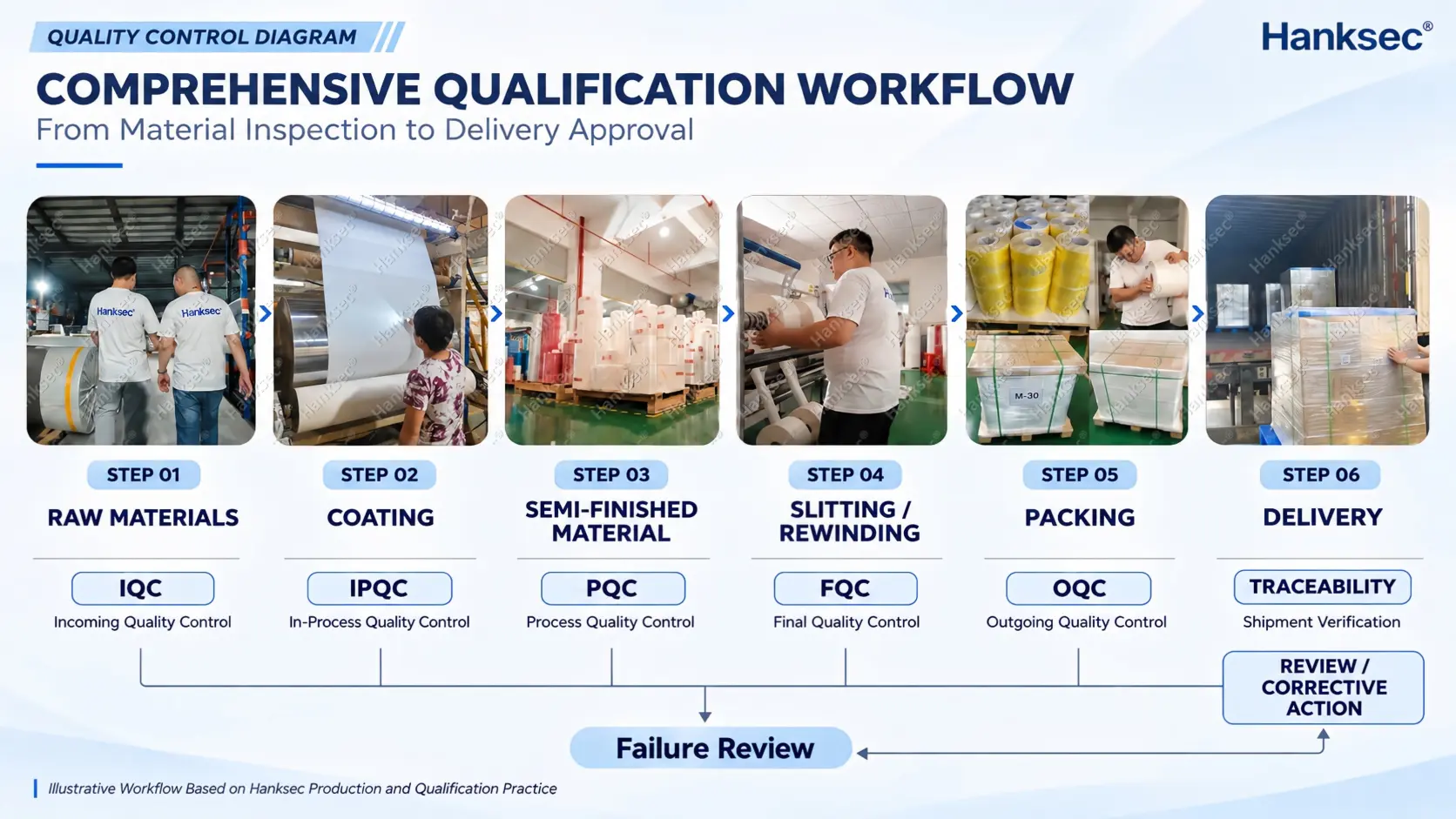
| Qualification Area | Evidence to Record | Approval Basis |
|---|---|---|
| Temperature | Trigger condition, response time, visual state and irreversibility. | Agreed temperature specification. |
| UV Identification | Light source, inspection conditions, marking position and visual response. | Approved UV reference. |
| VOID Response | Transfer type, message clarity, substrate and removal conditions. | Approved tamper-response sample. |
| Converting | Printing, coating, die cutting, matrix stripping and roll handling. | Agreed production-line requirements. |
| Final Application | Combined functional response on the actual product surface. | Approved finished-label sample. |
| Batch Control | Material identification, lot reference and inspection records. | Agreed production acceptance plan. |
For broader testing of peel adhesion, release force, die cutting, matrix stripping, printing and VOID response, review Hanksec’s Security Label Material Quality Control Guide.
What Should Buyers Include in an RFQ for Temperature-Sensitive UV Label Material?
A well-prepared RFQ helps the manufacturer understand the required functions and determine whether a standard construction or a customized material system should be evaluated.
Instead of asking only for a price per roll, procurement teams should provide the following information.
| RFQ Item | Information to Confirm |
|---|---|
| Application | Product, package type, protected surface and intended use. |
| Temperature Function | Trigger direction, threshold, response time, visual state and required irreversibility. |
| UV Function | Hidden marking, normal-light appearance, UV source and expected fluorescent response. |
| VOID Function | Full, partial or non-transfer requirement, message design and residue preference. |
| Substrate | Glass, metal, plastic, coated paperboard or the actual packaging material. |
| Printing | Printing method, variable data, artwork and protective finishing. |
| Converting | Die cutting, matrix stripping, slitting, rewinding and application method. |
| Roll Specifications | Required width, length, core size, winding direction and supply format. |
| Environmental Conditions | Application, storage, processing and service conditions. |
| Qualification | Sample quantity, test requirements, acceptance criteria and estimated production demand. |
Where available, buyers should attach reference photographs, existing label samples, packaging drawings and information about the production equipment.
This is particularly important when a project requires all three security functions to remain visible and functional after printing and converting.
A supplier cannot reliably recommend a complete construction from the words temperature-sensitive, UV and VOID alone. The actual requirements must be defined first.
Frequently Asked Questions About Temperature-Sensitive UV Label Material
What is Temperature-Sensitive UV Label Material?
It is a multifunctional security label material that combines an irreversible temperature-responsive feature, UV fluorescent identification and a VOID tamper-evident function. Each feature provides a different type of visual security evidence.
Does an irreversible temperature indicator record the complete temperature history?
Not necessarily. A threshold indicator generally shows that a defined temperature condition has occurred. It does not automatically record exposure duration or the complete temperature history. A time-temperature integrator requires a specifically designed and validated cumulative response mechanism.
Can the UV fluorescent marking be seen under normal lighting?
That depends on the selected marking design. Some UV security markings are intended to remain inconspicuous under normal lighting and become visible under the specified UV source. The normal-light appearance should be confirmed using an approved sample.
Does the UV feature require a 365 nm UV light?
Not necessarily. The required wavelength depends on the selected UV-responsive marking. Buyers should confirm the approved light source and inspection conditions rather than assuming that one wavelength works for every formulation.
Can the three security functions be combined with full-transfer, partial-transfer and non-transfer VOID constructions?
These transfer constructions can be considered for the multifunctional material according to the project design. The expected message location, substrate appearance and adhesive behavior must be confirmed using the corresponding approved sample. A full-transfer sample should not be assumed to represent the partial-transfer or non-transfer versions.
Does non-transfer VOID mean that no adhesive residue will remain?
No. Non-transfer describes the intended security-message transfer behavior. Adhesive residue depends on the adhesive construction, substrate, surface condition, application pressure and removal conditions. Zero residue should not be guaranteed without application-specific testing.
Can printing or lamination affect the temperature-sensitive feature?
Potentially. Heat exposure during drying, curing or lamination may affect a temperature-responsive construction if the actual process conditions approach its activation requirements. The finished label should be tested after representative processing.
Can a UV security feature and a VOID feature replace other authentication controls?
No. They provide complementary security functions, but they do not independently establish product origin or guarantee that unauthorized access is impossible. Depending on the application, serialization, controlled artwork, digital verification and other security measures may also be needed.
Should the finished label be tested on the actual packaging surface?
Yes. Adhesion and VOID response can change with substrate material, coating, texture, contamination and dwell time. Qualification should include the actual application surface and representative production conditions.
Qualify Your 3-in-1 Security Label Construction with Hanksec
A multifunctional security label should be selected according to the evidence it needs to provide, the surface it will protect and the production process it must pass through. A documented 3-in-1 Security Label Qualification process helps confirm that the temperature, UV and VOID functions remain suitable in the finished application.
Hanksec® develops tamper-evident and functional security label materials for label converters, packaging manufacturers, distributors and OEM/ODM customers. Temperature-sensitive response, UV fluorescent identification and VOID tamper evidence can be evaluated as coordinated security functions according to the project requirements.
Before requesting samples, prepare your target temperature condition, UV inspection method, required VOID transfer type, application substrate and converting process. These details help establish a more useful technical evaluation instead of relying on a visual sample demonstration alone.
Material Qualification · OEM / ODM Support
Need a 3-in-1 Security Label for Your Application?
Share your temperature trigger requirements, UV verification conditions, VOID transfer preference, application substrate and converting process. Hanksec can help evaluate suitable material constructions and arrange samples for application-based qualification.
REQUEST SAMPLES & TECHNICAL CONSULTATION →
Hanksec® | Temperature-Sensitive Security Materials · UV Function Security Materials · VOID Label Materials · OEM/ODM