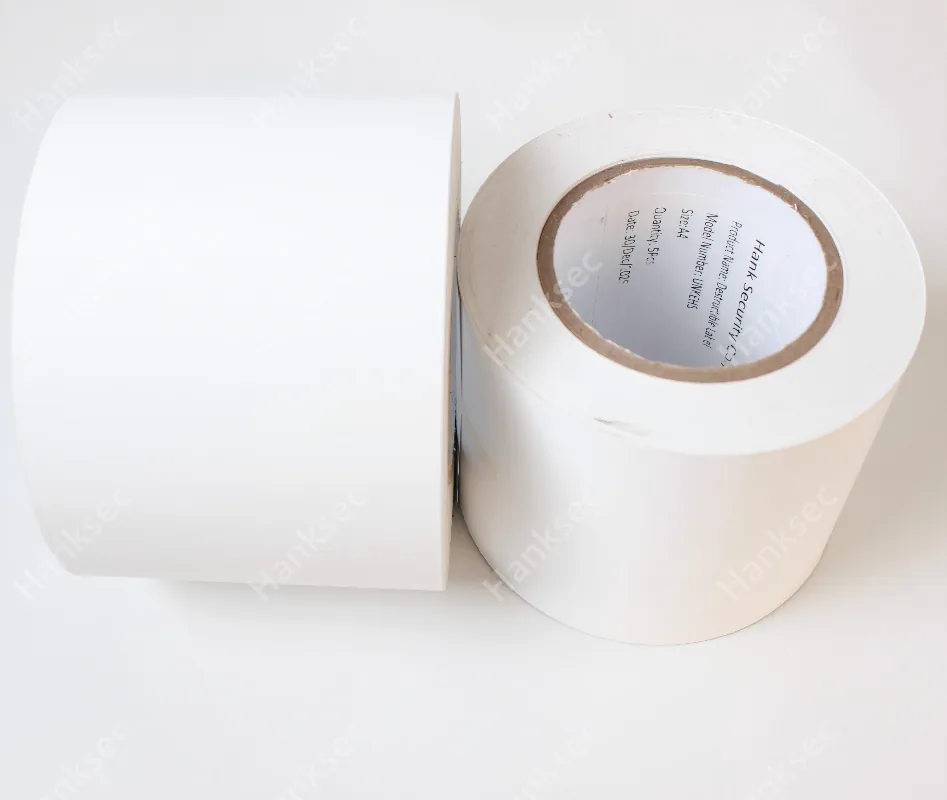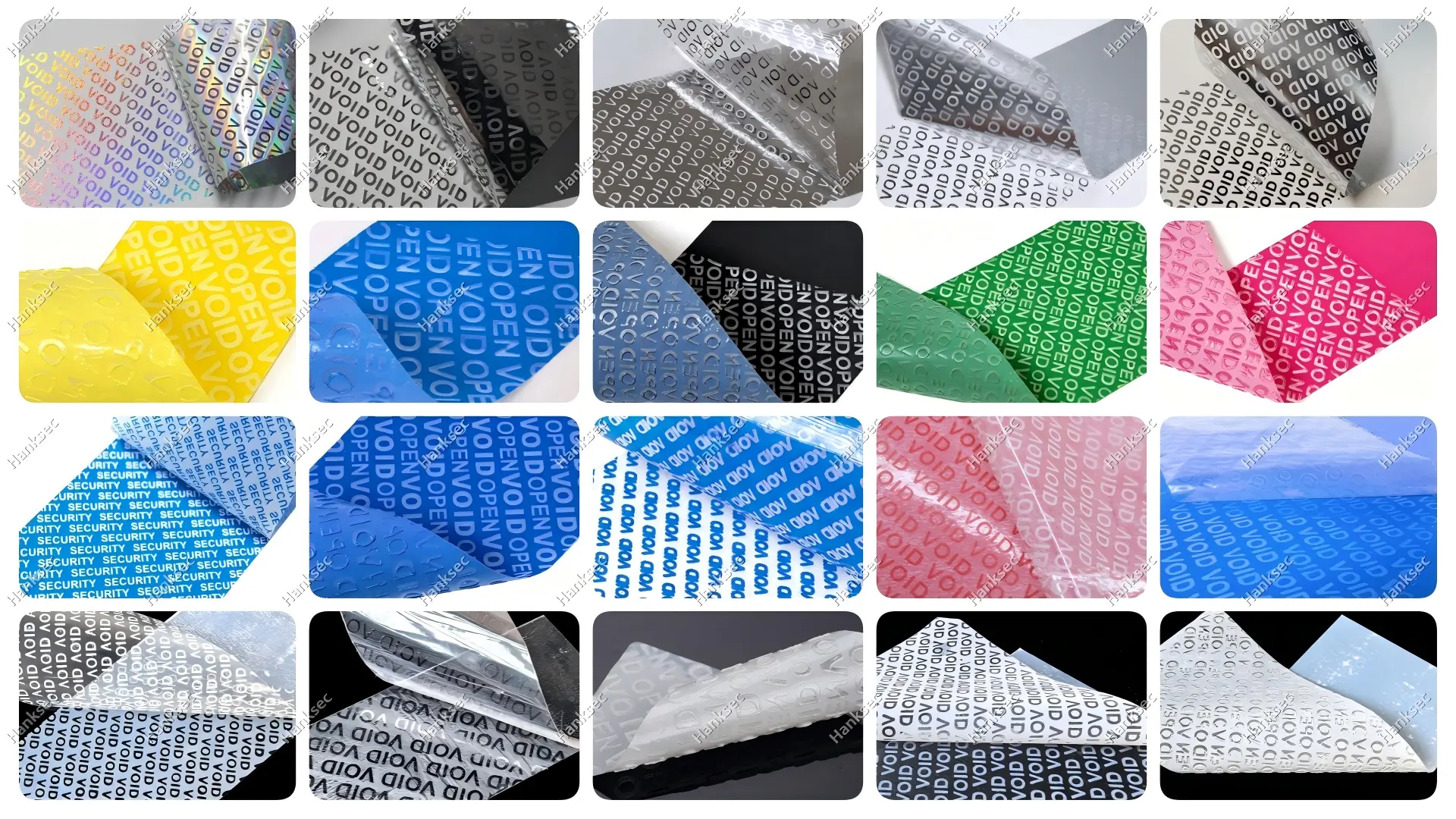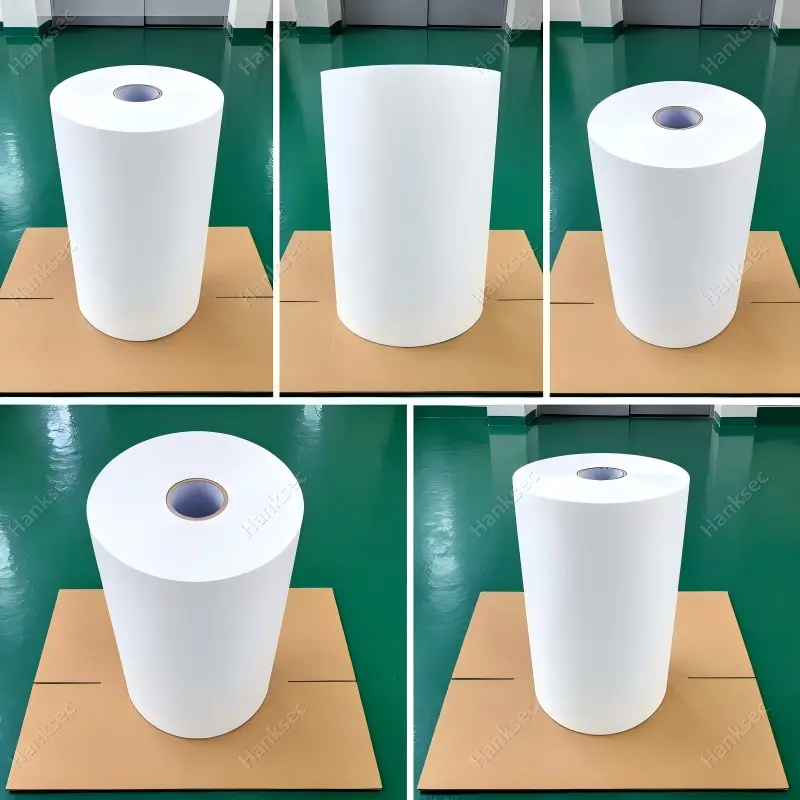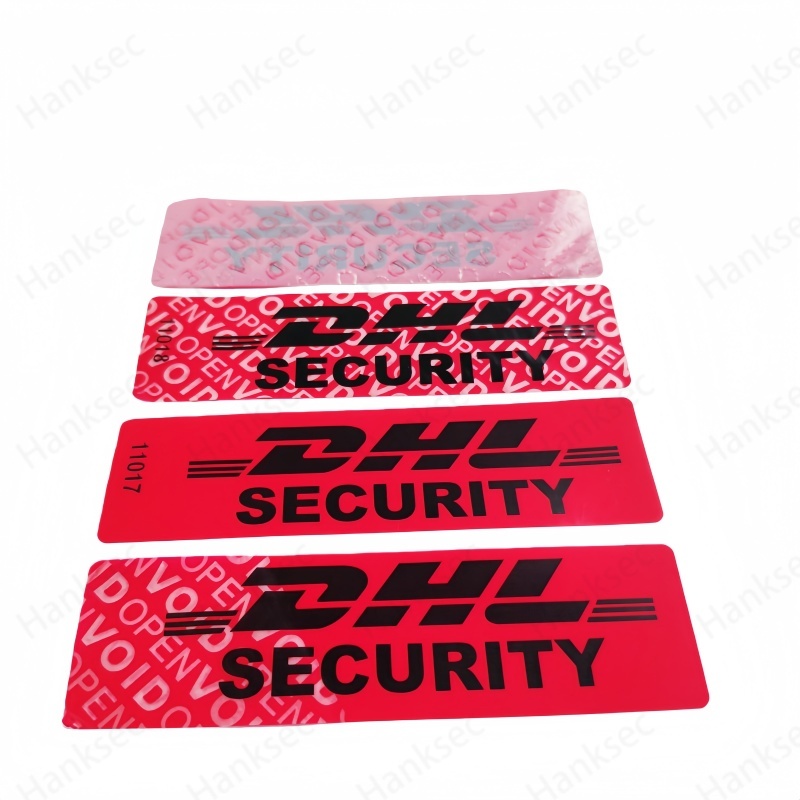
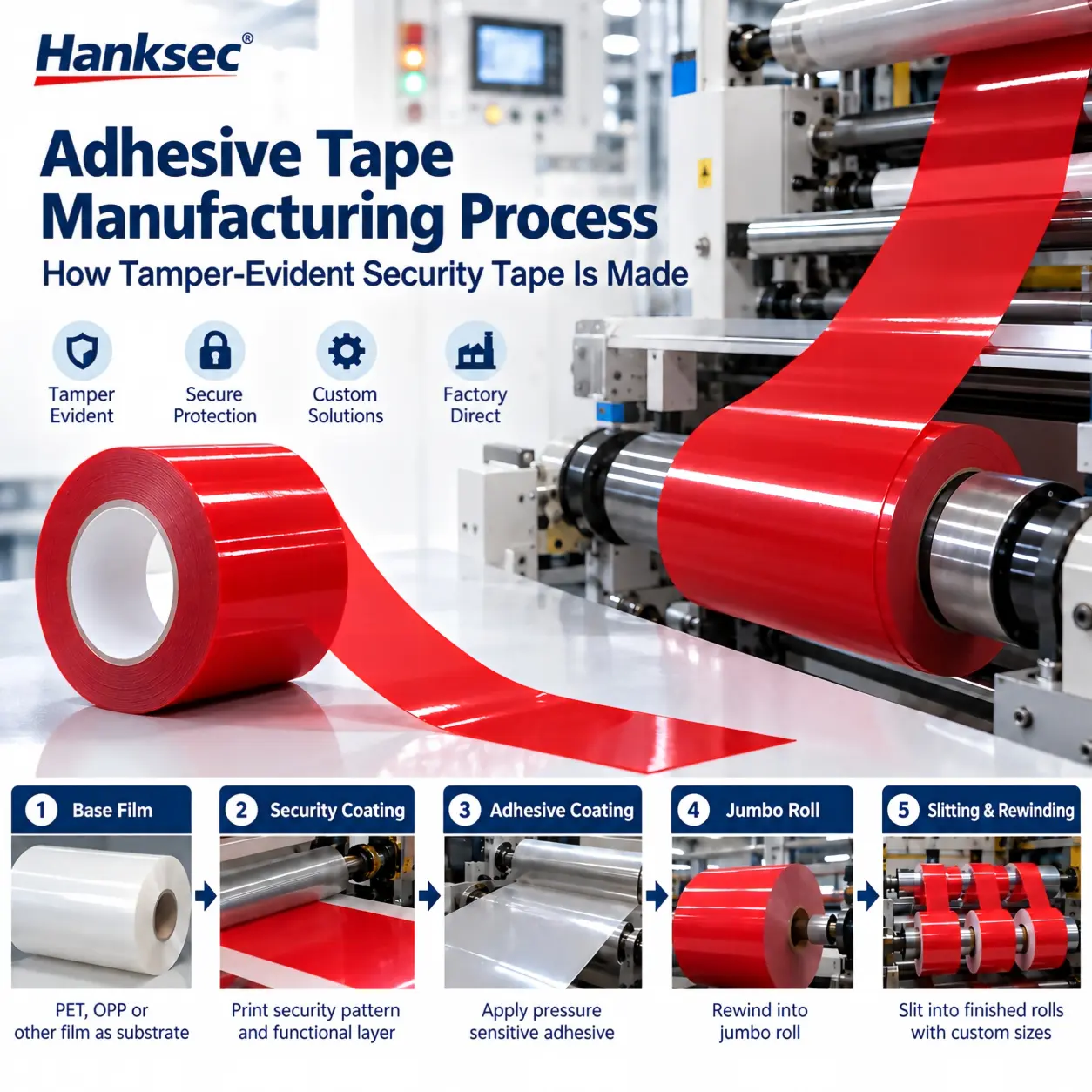
Adhesive tape manufacturing is usually described as a sequence of coating, drying, rewinding and slitting. That description is correct for many conventional pressure-sensitive tapes, but it is incomplete for tamper-evident security tape.
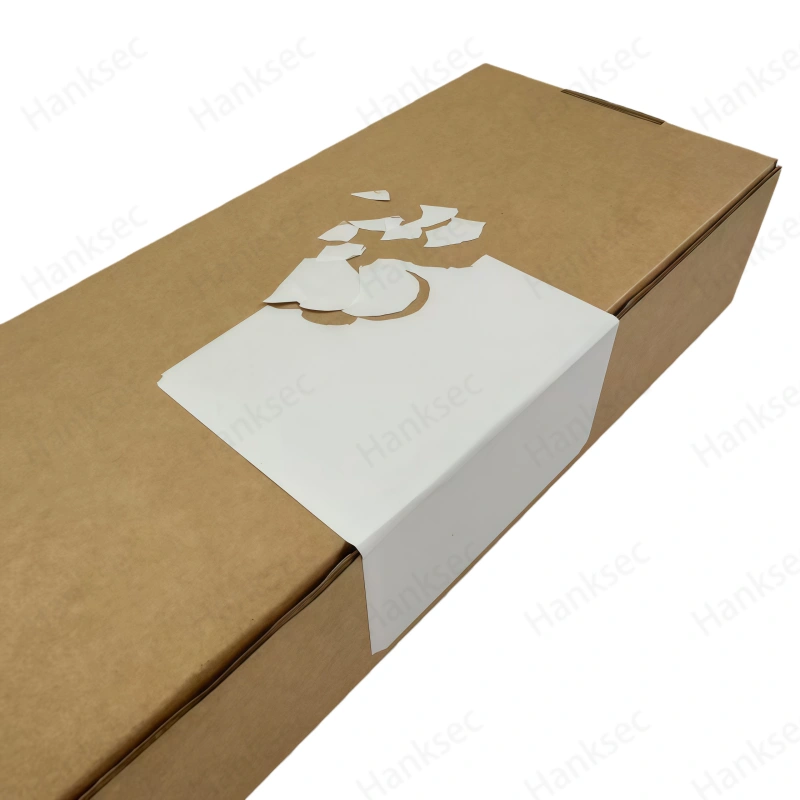
A security tape must do more than bond to a carton, bag, plastic surface or metal panel. Its internal construction must also respond in a controlled way when removal is attempted. Depending on the approved design, the tape may reveal VOID, OPENED or a custom message, transfer part or all of a security layer, leave the application surface relatively clean, fracture, or create another irreversible opening indication.
For packaging manufacturers, security-tape converters, distributors and technical buyers, the important question is therefore not only “How is tape made?” It is:
How is a pressure-sensitive tape manufactured so that adhesion, unwind, roll quality and the final tamper response remain repeatable in production?
This guide explains the manufacturing route from security specification and film preparation through functional coating, adhesive coating, jumbo-roll production, slitting, rewinding and final quality control. It focuses on tamper-evident security tape manufacturing rather than repeating Hanksec’s existing Tamper Evident Security Packaging Tapes Selection Guide, which covers tape types and application selection, or the Security Tape Converting Troubleshooting Guide, which focuses on slitting, rewinding, web tension and liner-release problems after the material enters a converter’s production line.
Quick Answer: How Is Adhesive Tape Made?
Most pressure-sensitive adhesive tapes are made by preparing a backing material, applying one or more surface treatments or functional coatings, coating the pressure-sensitive adhesive, drying or stabilizing the coated web where required, rewinding it into a master or jumbo roll, and then slitting and rewinding the material into the required finished roll format.
Tamper-evident security tape adds another requirement: the functional security layers must separate or transfer in a predefined way, while the adhesive-to-substrate interaction supports the intended tamper response.
A representative security-tape manufacturing route is:
Security Requirement → Artwork / Tooling → Backing Film → Surface Preparation → Security Pattern & Functional Layer → Color / Optical Layer → Adhesive Coating → Jumbo Roll → Slitting / Rewinding → Functional QC
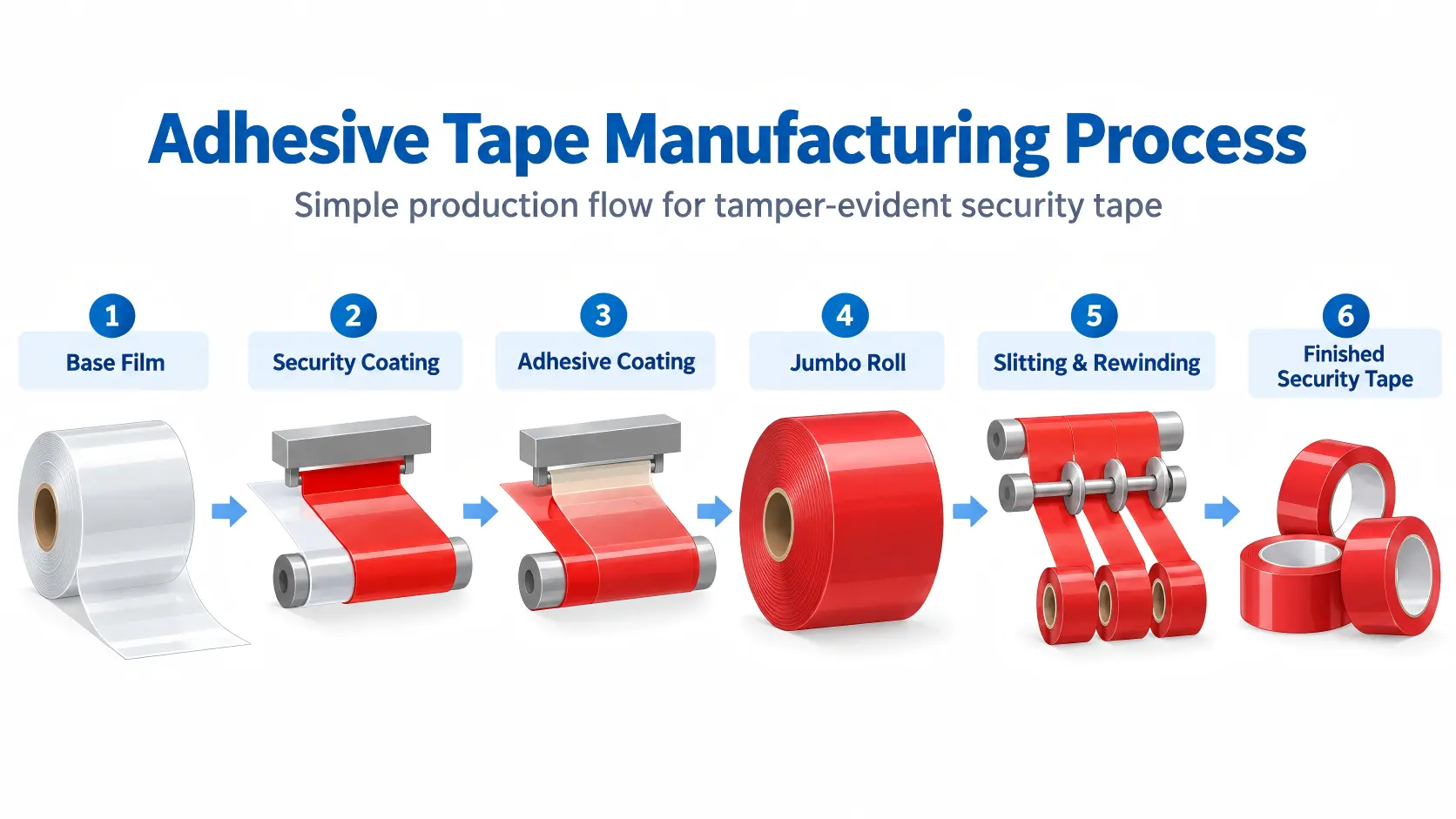
The exact route varies with the tape construction. Linerless carton-sealing tape, liner-backed security-bag tape, double-sided security tape, holographic tape and functional heat- or liquid-sensitive constructions do not necessarily use the same sequence or equipment.
How Adhesive Tape Manufacturing Changes for Tamper-Evident Security Tape
Ordinary packaging tape is primarily expected to provide closure, adhesion, unwind performance and mechanical integrity. Tamper-evident security tape must provide those basic tape functions while also creating an intentional, irreversible security response.
| Manufacturing Requirement | Ordinary Packing Tape | Tamper-Evident Security Tape |
|---|---|---|
| Backing film | Supports coating and mechanical handling | Must also support the required security-layer construction and controlled separation behavior |
| Adhesive | Primarily optimized for closure and bonding | Must bond to the substrate while remaining compatible with the designed tamper response |
| Release / unwind behavior | Controls roll handling | Must support stable unwinding without prematurely activating or disturbing the security construction |
| Printing | Often branding or warning text | May include hidden VOID / OPENED patterns, visible warnings, logos, serial data or security graphics |
| Quality control | Adhesion, unwind, dimensions, appearance | Must also verify security-pattern activation, transfer clarity and repeatability on the intended surface |
This difference is fundamental. A tape can have acceptable peel adhesion and still be a poor security tape if its hidden message activates inconsistently, its transfer is patchy, its film lifts before the designed layer separates, or the finished roll becomes unstable during unwinding.
What Materials Are Used in Adhesive Tape Manufacturing?
Adhesive tape performance is created by a material system rather than by the adhesive alone. The exact components depend on the tape family and end use.
Backing Films
Common industrial tape backings include BOPP, PET, PVC, paper, cloth, foil, foam and specialty films. For tamper-evident security tapes, PET and selected OPP-based films are commonly used because the film can support printing, coating and controlled security-layer construction.
The backing influences:
- dimensional stability;
- tensile behavior;
- print and coating anchorage;
- web handling;
- roll build;
- temperature performance;
- the way the tape separates during removal.
Pressure-Sensitive Adhesive Systems
Pressure-sensitive adhesives remain tacky under normal use conditions and bond when pressure is applied. In the wider adhesive-tape industry, acrylic, rubber-based and silicone adhesive systems are common, but they are not interchangeable.
| Adhesive Family | General Industry Characteristics | Security-Tape Consideration |
|---|---|---|
| Acrylic PSA | Widely used for durable pressure-sensitive bonding and can be formulated for different substrates and service conditions | Common direction for tamper-evident constructions where controlled bonding and ageing stability are required |
| Rubber-Based PSA | Often selected for high initial tack and fast wet-out in general packaging applications; formulations may be hot-melt or solvent-based. | High initial tack alone does not guarantee a controlled VOID or transfer response. |
| Silicone PSA | Used for specialized surfaces or demanding temperature conditions | Normally application-specific rather than a default choice for standard tamper-evident packaging tape |
The correct adhesive should be evaluated on the real application surface. Corrugated carton, coated paperboard, PET, PP, PE, glass, painted metal and other substrates can create different bonding and tamper-response conditions.
ASTM D3330/D3330M provides standardized methods for evaluating peel adhesion of pressure-sensitive tape and can be used as a quality-assurance tool when an acceptance criterion has been defined. See ASTM D3330/D3330M-04(2025).
Security and Release Layers
This is where tamper-evident security tape departs most clearly from ordinary tape.
The construction may contain:
- a hidden VOID, OPENED, SECURITY or custom message;
- a functional release / separation layer;
- a transfer layer designed to remain on the protected surface;
- a color or opacity layer that improves message contrast;
- a holographic or metallized feature where required;
- a backside release treatment for linerless roll constructions;
- a release liner for selected liner-backed or double-sided constructions.
The purpose is not simply to add more layers. Each layer must support the required activation sequence when removal is attempted.
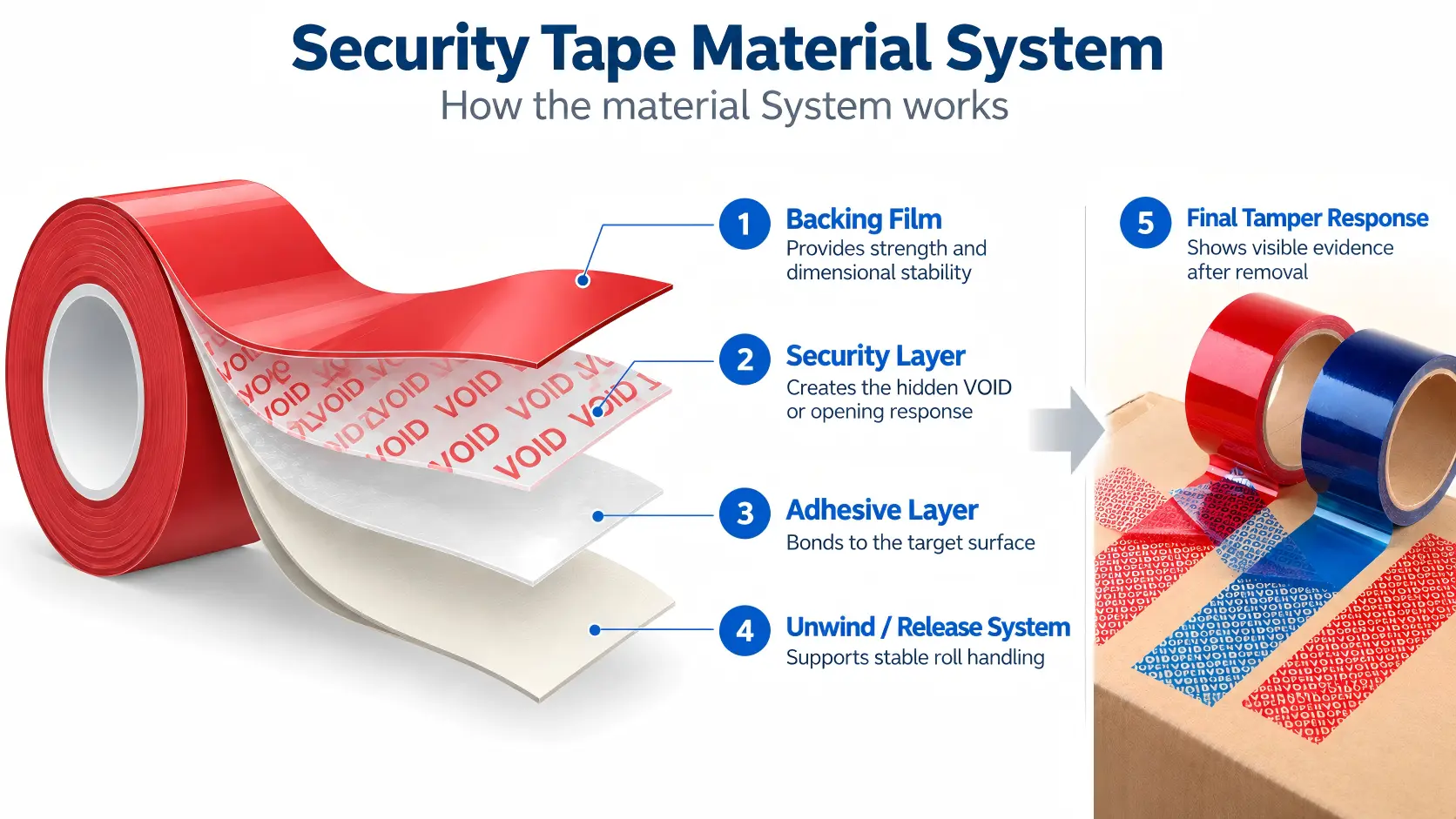
Note: The release construction is architecture-dependent. It may be a backside release treatment on a self-wound tape or a separate release liner in liner-backed constructions.
The Adhesive Tape Manufacturing Process for Tamper-Evident Security Tape
The following ten steps represent a practical manufacturing route for many pressure-sensitive tamper-evident security-tape constructions. They should not be treated as a universal formula for every tape. Functional security-bag tapes, double-sided products, linerless carton tapes and specialized high- or low-temperature constructions may use different combinations of these steps.
Step 1: Define the Security Response and Finished-Roll Specification
Professional security tape manufacturing begins before coating.
The manufacturer should first define:
- application substrate;
- required full-transfer, partial-transfer, non-transfer or other security response;
- visible VOID / OPENED / custom message;
- surface-residue requirement;
- finished tape width and length;
- core size and winding direction;
- linerless or liner-backed construction;
- printing, perforation, serial-number or barcode requirement;
- application temperature and storage conditions.
This step prevents a common procurement error: approving a visually attractive tape before confirming whether its material architecture matches the actual package and production process.
Step 2: Prepare Artwork, Pattern Tooling and Production Parameters
When the tape contains a hidden message, custom logo or repeated security pattern, the repeat length, registration, pattern orientation and artwork have to be converted into production-ready tooling.
For gravure-based security pattern production, the engraving or cylinder setup controls how consistently the hidden pattern is transferred across the web and across repeat production orders.
The manufacturer should confirm:
- message orientation;
- pattern repeat;
- print direction;
- relationship between visible artwork and hidden security pattern;
- finished slit width;
- customer winding direction.
A security message that is technically correct but oriented incorrectly after slitting can still create an unusable finished roll.
Step 3: Inspect and Unwind the Backing Film
The selected PET, OPP or other backing enters production as a wide web or master roll.
Before functional coating, the film should be checked for the parameters relevant to the approved construction, such as:
- thickness consistency;
- surface condition;
- roll damage;
- web flatness;
- contamination;
- edge condition;
- correct material identity.
During unwinding, web guiding and tension control keep the film stable through printing and coating stations. Wrinkles, lateral wandering or unstable tension at this stage can affect coating uniformity and registration later in the line.
Step 4: Treat the Surface and Prepare the Release Side
Plastic films may require surface treatment to improve wetting and anchorage of ink, coatings or adhesive. Corona treatment is one common method used where required to raise surface energy and improve coating receptivity.
For linerless constructions, the reverse side may also require a controlled release treatment so the adhesive-coated tape can unwind without blocking.
This stage must be engineered for the specific construction. Too little anchorage can cause coating or printing failure. Excessively difficult unwind can create web instability or interfere with downstream dispensing.
ASTM D3811/D3811M covers the force required to unwind a roll of pressure-sensitive tape and notes that unwind force is rate-dependent. See ASTM D3811/D3811M-21a.
Step 5: Print the Hidden Security Pattern and Apply the Functional Separation Layer
This is the core security-building stage.
The hidden message and functional coating are engineered so that the tape separates in a controlled way when removal is attempted. Depending on the approved design, the opening event may cause:
- most of the security image or adhesive layer to transfer to the substrate;
- the image to divide between the removed tape and substrate;
- the message to appear mainly within the removed tape while heavy surface residue is reduced;
- another defined irreversible change.
For this reason, the process needs control of pattern registration, coating uniformity and interlayer adhesion—not simply attractive printing.
The goal is repeatability:
the same security construction should activate in the same intended manner across the roll and between approved production lots.
Step 6: Apply Color, Opacity, Metallization or Visible Printing Where Required
Security tape can include a color layer, metallized appearance, holographic effect, surface warning text, logo or other visible printing.
These features serve different purposes:
- color and opacity improve contrast between the normal and activated state;
- surface printing communicates warnings or branding;
- holographic or optical features can add an overt authentication layer;
These visible features should not be confused with the physical tamper mechanism itself. A printed warning or decorative effect can be copied; the security value of the tape still depends on the controlled material response and, where authentication features are used, on a clearly defined verification method.
Step 7: Coat the Pressure-Sensitive Adhesive and Dry or Laminate the Construction
The adhesive layer must be applied uniformly across the moving web and matched to the approved substrate and tamper-response target.
Depending on the adhesive technology, the manufacturing route may involve coating followed by controlled drying, cooling, curing, lamination or stabilization.
For tamper-evident tape, adhesive coating quality affects more than peel strength. It can influence:
- initial wet-out;
- final bond development;
- edge lifting;
- adhesive squeeze-out;
- security-layer activation;
- residue appearance;
- roll blocking;
- performance after storage.
A stronger adhesive is therefore not automatically a better security-tape adhesive. The adhesive has to work with the backing film, functional layer and target substrate as one system.
Step 8: Rewind the Coated Web Into a Master or Jumbo Roll
After the functional and adhesive layers are complete, the wide web is rewound into a master or jumbo roll for inspection, conditioning and later converting.
Rewinding quality influences:
- roll hardness;
- sidewall condition;
- telescoping risk;
- edge pressure;
- future slitting stability;
- unwind consistency.
A roll that appears visually acceptable but is wound too tight, too loose or unevenly can create problems later during slitting, dispensing or automatic application.
This is where manufacturing and converting become directly connected.
Step 9: Slit, Rewind, Perforate and Add Variable Data as Required
Master rolls are converted into the final customer format.
Depending on the order, converting may include:
- precision slitting;
- rewinding to a defined roll length;
- custom core size;
- specified winding direction;
- perforation for easy tear;
- surface printing;
- sequential numbering;
- barcode or QR printing;
- customer-specific roll packing.
Slitting should preserve the security construction and produce stable edges without liner damage, excessive adhesive contamination, curl or poor roll build.
Converters who receive jumbo or slit rolls for further processing can use Hanksec’s Security Tape Converting Troubleshooting Guide for deeper guidance on slitting, rewinding, web tension and unwind behavior.
Step 10: Verify Adhesion, Unwind, Tamper Response and Roll Quality
Final inspection should confirm the complete tape function, not only appearance.
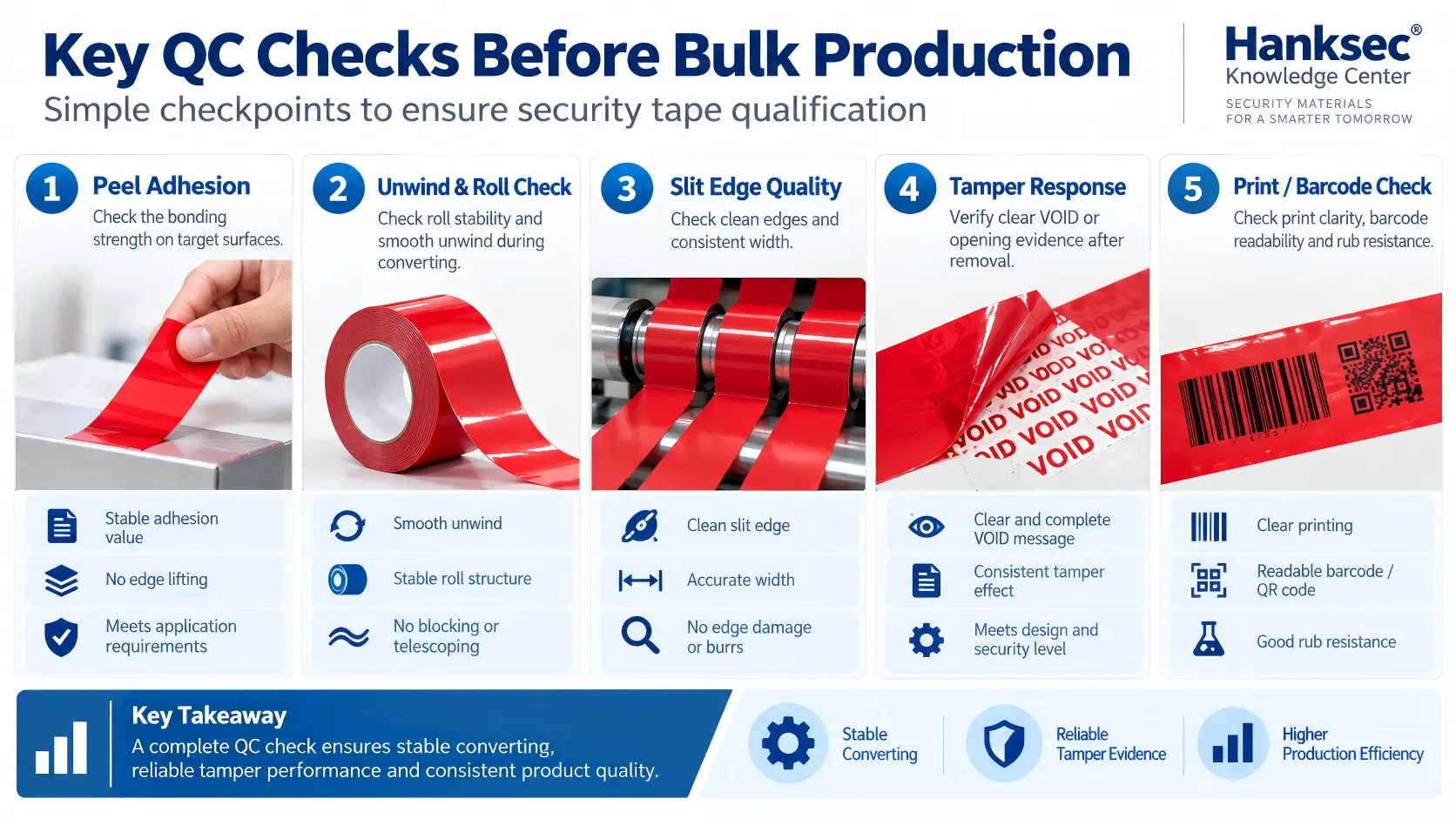
Relevant checks can include:
| QC Item | Why It Matters |
|---|---|
| Visual / registration inspection | Confirms hidden and visible patterns are positioned correctly and consistently |
| Peel adhesion | Checks bonding performance against the defined test condition |
| Unwind behavior | Confirms the roll can release and feed without abnormal force or instability |
| Tamper activation | Confirms the intended VOID, OPENED, transfer or other irreversible response |
| Real-substrate application | Checks that the approved security effect occurs on the actual carton, film, plastic, glass or metal surface |
| Slit width and edge quality | Supports downstream dispensing and roll handling |
| Roll build | Checks telescoping, looseness, excessive hardness and sidewall consistency |
| Print / barcode durability | Verifies surface printing and machine-readable identification where applicable |
The Pressure Sensitive Tape Council (PSTC) maintains laboratory test methods for pressure-sensitive adhesive tapes covering performance characteristics such as peel, shear, unwind, tensile and related properties. See the PSTC Test Methods.
Where Adhesive Tape Manufacturing for Security Tape Commonly Goes Wrong
A poorly controlled manufacturing step often appears later as a packaging or converting problem.
| Observed Problem | Possible Manufacturing Cause | What Should Be Checked |
|---|---|---|
| Patchy VOID / OPENED message | Functional coating or pattern inconsistency | Coating uniformity, pattern registration, substrate bond and test conditions |
| Tape lifts before the security layer activates | Insufficient bond to the application surface | Adhesive / substrate compatibility, contamination, dwell and application pressure |
| Too much uncontrolled residue | Adhesive / security-layer balance does not match the target response | Approved transfer mode, adhesive system and real substrate |
| Roll is difficult to unwind | Release-side or rewind condition is unsuitable | Release treatment, roll hardness, storage and unwind force |
| Adhesive squeezes from the edges | Adhesive construction, winding pressure or storage condition | Coating, roll build, temperature and slit condition |
| Finished roll telescopes | Web alignment or rewind instability | Tension, roll build, core and finished OD |
| Printed warning or barcode rubs off | Poor print-surface compatibility or curing | Top surface, ink system, curing and abrasion resistance |
| Bench test passes but production line fails | Process window is too narrow | Actual line speed, roll diameter, unwind path, winding direction and dispensing conditions |
The key point is that the visible failure may not begin where it is first noticed. A dispensing problem can originate in rewinding. A poor tamper response can originate in adhesive / substrate mismatch. An edge problem can originate in slitting or adhesive squeeze-out.
High-Quality vs Poorly Controlled Adhesive Tape Manufacturing
Buyers should evaluate the manufacturing system rather than judging only the unused tape sample.
| Evaluation Area | Controlled Manufacturing | Poorly Controlled Manufacturing |
|---|---|---|
| Security pattern | Defined repeat, orientation and registration | Pattern varies or shifts across the web |
| Functional coating | Specified tamper response is repeatable | VOID effect is patchy or inconsistent |
| Adhesive | Matched to the substrate and required transfer mode | Selected mainly by generic tack or price |
| Release / unwind | Designed for stable roll handling | Roll blocks, jerks or releases inconsistently |
| Slitting | Clean edges, correct width and stable roll build | Edge contamination, curl, uneven sidewalls or width variation |
| Quality control | Adhesion + unwind + tamper response + real-substrate test | Visual inspection only |
| Repeat production | Approved construction and process parameters are controlled | Lot-to-lot behavior changes without explanation |
How Should B2B Buyers Specify Tamper Evident Security Tape?
A buyer does not need to send a complete chemical formulation. The supplier does need enough information to define the material and production route.
Before requesting a quotation or sample, provide:
- Application: carton, parcel, evidence package, courier bag, security bag, electronics box or another closure?
- Surface: kraft carton, coated carton, PET, PP, PE, glass, metal, wood or another substrate?
- Tamper response: full transfer, partial transfer, non-transfer, destructible or another required effect?
- Residue target: strong visible residue, balanced residue or relatively clean surface?
- Tape construction: linerless, liner-backed, double-sided or bag-closure tape?
- Finished roll: width, length, core ID, roll OD and winding direction?
- Printing: stock VOID message, custom logo, warning text, serial number, barcode or QR?
- Converting: manual use, dispenser, automatic application, bag-making integration or further slitting?
- Environment: storage temperature, application temperature, humidity, chemicals or special exposure?
- Qualification: what test will be used to approve the final tape on the real package?
For buyers comparing security effects and packaging surfaces, the next resource is Hanksec’s Tamper Evident Security Packaging Tapes: Materials, Types & Selection Guide.
Jumbo Rolls, Slit Rolls and Finished Security Tape
The same coated material may be supplied at different stages depending on the customer’s role.
| Supply Format | Typical Buyer | What Must Be Specified |
|---|---|---|
| Master / Jumbo Roll | Tape converter, security printer, packaging manufacturer | Master width, length, core, construction, surface print requirement and converting route |
| Slit Production Roll | Packaging line, distributor, OEM converter | Finished width, length, core, winding direction and roll OD |
| Finished Security Tape | Brand owner, logistics user, packaging operation | Application surface, tamper response, roll size, printing and dispenser / application method |
This distinction is important because a converter-ready jumbo roll and a finished carton-sealing roll are not the same purchasing specification.
How Hanksec Approaches Security Tape Manufacturing
Hanksec is positioned as a B2B manufacturer of tamper-evident security materials and a security anti-tampering solution provider. For security-tape projects, the technical route is built around the interaction of the film, functional security layer, pressure-sensitive adhesive, release / unwind system, roll conversion and final substrate.
The manufacturing approach is therefore application-led:
required tamper response → film / security construction → adhesive / surface match → roll format → converting requirement → functional qualification.
Hanksec’s broader production framework can be reviewed at Manufacturing Capabilities, while the testing framework is covered in Quality Assurance.
For security bag factories using HDPE, LDPE, co-extruded or laminated bag film, the manufacturing and integration requirements can differ from ordinary carton tape. See the Tamper Evident Security Bag Tape Guide.
FAQ: Adhesive Tape Manufacturing and Security Tape Production
How is adhesive tape made?
Adhesive tape is generally made by preparing a backing web, applying the required surface treatment and coatings, coating a pressure-sensitive adhesive, drying or stabilizing the web where required, rewinding it into a master roll, and then slitting and rewinding it into finished rolls. Tamper-evident security tape adds functional layers that create a controlled change after removal.
What makes tamper evident security tape different from normal packing tape?
Normal packing tape is primarily designed for closure and bonding. Tamper-evident security tape contains an engineered security construction that creates visible, irreversible evidence when removal is attempted. The adhesive, film and security layer therefore have to work as one system.
Is the adhesive the most important part of security tape?
The adhesive is critical, but it is not the only critical component. Security performance depends on the interaction between the adhesive, backing film, functional separation layer, release system, substrate and application conditions. A very strong adhesive can still produce a poor security result if the complete construction is not balanced.
Why is corona treatment used in tape manufacturing?
Corona treatment may be used on plastic film where additional surface energy is needed to improve wetting and anchorage of coatings, inks or adhesive. The requirement depends on the material and approved production route.
Why is tape manufactured first as a wide jumbo roll?
Coating and printing are more efficiently controlled on a wide continuous web. After the functional construction is complete, the master or jumbo roll can be slit and rewound into different customer widths, lengths and core specifications.
How is the VOID or OPENED message created?
The message is created through a controlled security-pattern and functional separation construction. When the tape is removed, the internal layers separate in the designed way so the message or transfer effect becomes visible. The exact construction differs between full-transfer, partial-transfer and non-transfer systems.
What tests are important after security tape manufacturing?
Relevant checks can include peel adhesion, unwind behavior, slit width, edge quality, roll build, printing durability, barcode readability where applicable, and—most importantly—the actual tamper response on the intended package or substrate.
Can security tape be supplied as jumbo rolls for further converting?
Yes. Depending on the project, security tape materials can be supplied as master / jumbo rolls or slit production rolls for further printing, slitting, perforation or packaging conversion. Roll width, core, winding direction, liner construction where applicable and downstream equipment should be defined before production.
Why can a tape pass a hand test but fail on an automatic line?
A hand test does not reproduce continuous web tension, changing roll diameter, production speed, unwind geometry or automatic dispensing. If the problem appears only after slitting, rewinding or machine application, use the Security Tape Converting Troubleshooting Guide to isolate the process stage where the behavior changes.
Conclusion: Security Tape Manufacturing Is a System, Not a Single Coating Step
Adhesive tape manufacturing may look simple from the outside: coat a film, rewind it and cut it into rolls. For tamper-evident security tape, that description misses the most important part.
The final product has to combine:
film stability + controlled security-layer separation + adhesive / substrate compatibility + unwind behavior + roll conversion + repeatable tamper evidence.
That is why a reliable security tape should be qualified as a complete material-and-process system rather than judged only by color, tack or the appearance of a VOID message on an unused roll.
For a new project, send Hanksec the application surface, required tamper response, residue target, finished roll dimensions, printing requirement and production method. The Hanksec Technical Team can use those inputs to recommend a representative construction and sample-testing route before bulk production.