Double-Sided Tamper-Evident Material for Security Bag Manufacturing
Hanksec® Double-Sided VOID Security Tape Material is developed for security bag manufacturers, plastic bag factories, packaging converters and OEM security-packaging projects where the tamper-evident material becomes part of the finished bag closure.
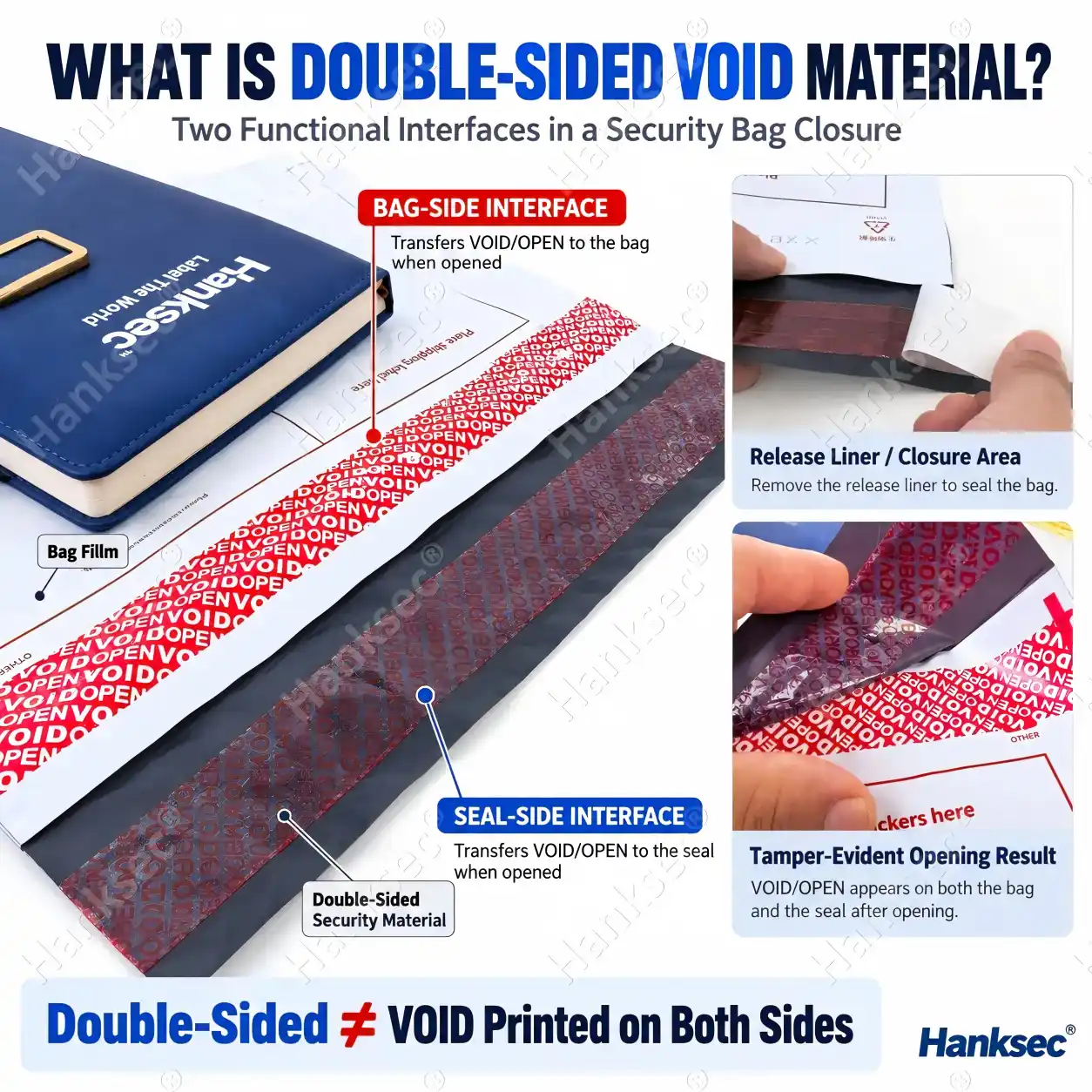
Unlike conventional VOID label material that is normally converted into a label and applied to one finished surface, a double-sided construction works through two functional interfaces within the sealing system.
One interface is used for integration or bonding with the bag structure. The other participates in the final closure after the release liner is removed.
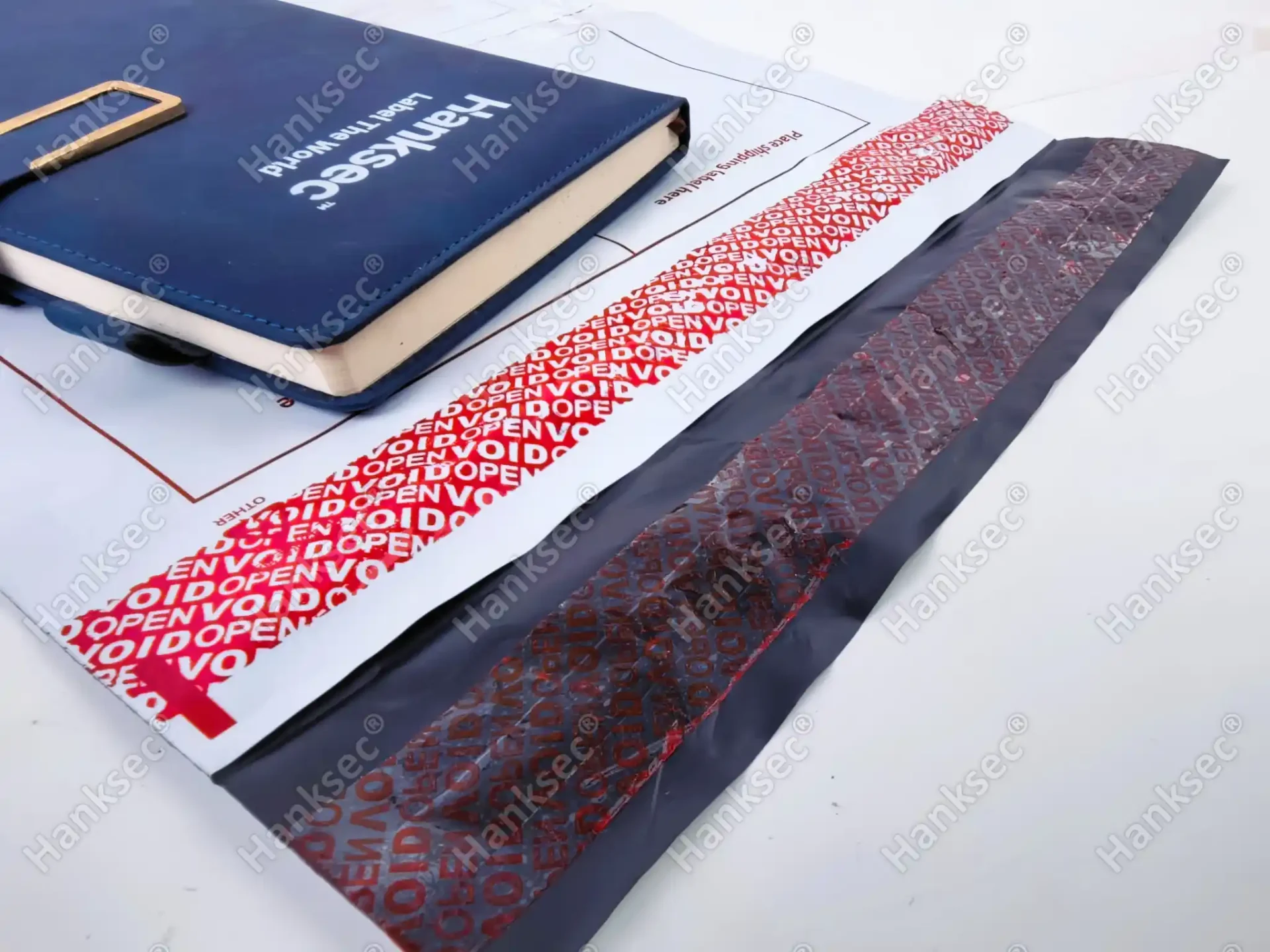
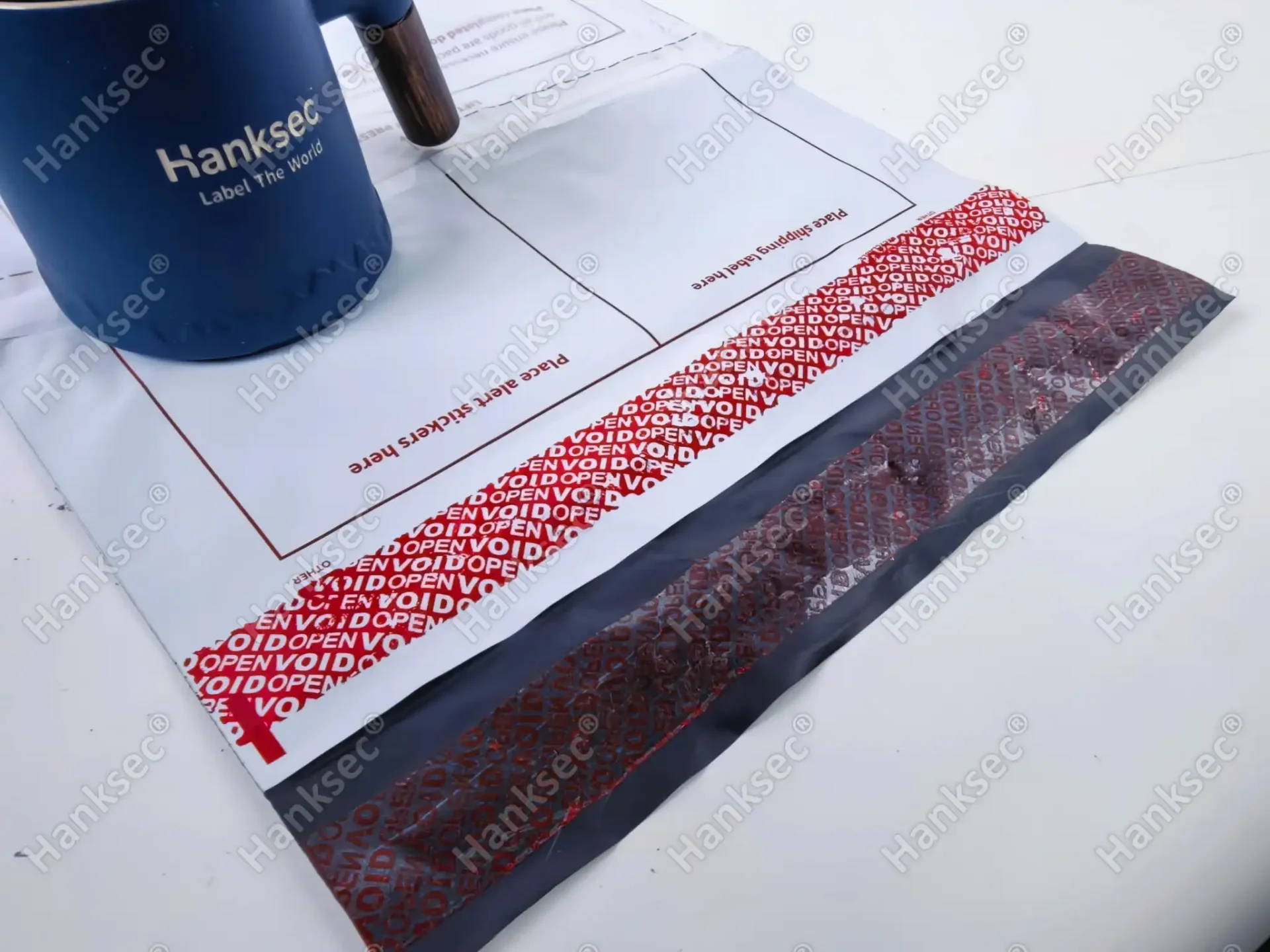
When the sealed bag is opened or peeled, the approved security construction is designed to reveal a visible VOID, OPENED, VOIDOPEN or customized tamper indication.
The exact transfer effect, residue position, adhesive balance and functional construction depend on the selected material and actual bag application. Final approval should therefore be based on sample testing with the real production film and finished security-bag closure.
What Makes This Double-Sided VOID Material Different?
“Double-sided” does not simply mean that VOID lettering is printed on two sides.
The important difference is the functional construction of the sealing system.
A simplified security-bag application can be described as:
Bag Film → Bag-Side Integration → Tamper-Evident Security Construction → Seal-Side Closure Interface → Release Liner
During bag production, the security material is integrated with the required bag-film area. The release liner protects the final sealing interface until the finished bag is ready to be closed.
When the user removes the liner, the seal-side adhesive contacts the corresponding closure surface. If someone later attempts to reopen the bag, the designed security interface activates and creates visible evidence.
This means that Double-Sided VOID Security Tape Material must be evaluated for both manufacturing compatibility and final tamper response.
For a broader explanation of complete security-bag closure design, bag-film selection and converting requirements, see the Hanksec Security Bag Tape for Bag Manufacturers Guide.
For a detailed explanation of what “double-sided” means, how the two functional interfaces work and how this construction differs from standard VOID label material, read our guide: What Is Double-Sided VOID Material? How It Works in Security Bags.
Key Product Advantages
| Feature |
What It Means for the Customer |
| Two Functional Interfaces |
Designed for bag-side integration plus final seal-side closure. |
| Tamper-Evident Response |
VOID, OPENED, VOIDOPEN or customized messages can be developed according to the approved construction. |
| Security-Bag Integration |
Designed to become part of the bag closure instead of simply being applied as an external packaging tape. |
| Release Liner |
Protects the final sealing adhesive before the security bag is closed. |
| PE / PP Application Development |
Adhesive and construction should be matched to the actual production film. |
| Converter-Oriented Supply |
Suitable for slitting, laminating, integration and security-bag manufacturing workflows. |
| Custom Development |
Width, color, liner, hidden message, roll format and other construction details can be developed according to the project. |
| Finished-Bag Validation |
Final approval should be based on the completed bag rather than only the unused roll. |
Typical Applications
Double-Sided VOID Security Tape Material can be evaluated for security packaging applications such as:
- courier security bags;
- cash and bank deposit bags;
- evidence and forensic bags;
- confidential document envelopes;
- e-commerce security bags;
- high-value transport bags;
- and other tamper-evident PE / PP bag closure systems.
The application name alone should not be treated as a material specification. Two security bags used for the same purpose may use different film formulations, surface treatments, coatings, printing systems or closure designs.
Customers comparing other tamper-evident tape constructions can also review the broader Hanksec Security Packing Tapes range.
How Does the Tamper-Evident Effect Work?
The unused material roll is only one part of the final security system.
A typical application sequence is:
Material Roll → Bag-Film Integration → Finished Security Bag → Remove Release Liner → Close Bag → Adhesive Dwell → Opening Attempt → Tamper Evidence Appears
After opening, the approved security construction may reveal a VOID, OPENED, VOIDOPEN or customized hidden message, together with a defined residue or transfer response.
The exact result depends on the selected construction.
For this reason, buyers should not evaluate Double-Sided VOID Security Tape Material only by looking at the appearance of the unused roll.
The more important question is:
What happens after the material has been integrated into the actual security bag, sealed under representative conditions and then opened?
The finished-bag result is the functional security test.
Bag Film and Adhesive Compatibility
Security bags are commonly produced from PE-family, PP and other flexible packaging films, but apparently similar films should not automatically be assumed to provide the same adhesive performance.
One important reason is surface energy. 3M’s surface-energy guidance classifies polypropylene and polyethylene as low-surface-energy materials, which can be more difficult for adhesives to wet out and bond to than higher-surface-energy surfaces.
The final result can also be affected by:
- HDPE, LDPE, PP or other film formulation;
- co-extruded or laminated film construction;
- corona or other surface treatment;
- surface printing or coating;
- film additives;
- contamination;
- application pressure;
- dwell time;
- and the final opening condition.
This is why a description such as “our bag is PE” may not provide enough information for final material approval.
Whenever practical, Hanksec recommends evaluating the material on the actual production film or finished bag.
For a deeper explanation of surface energy, adhesive wet-out and tamper activation on PE, PP, HDPE and other substrates, see the Hanksec Tamper Evident Label Adhesive Guide.
Release Liner and Converting Requirements
The release liner is an important functional part of a double-sided security-bag construction.
It protects the seal-side adhesive before final closure, but it must also remain compatible with the customer’s converting and bag-making process.
Depending on the project, customers should confirm:
- liner material and construction;
- liner release behavior;
- tape width;
- roll direction;
- slitting requirements;
- material flatness and curl;
- alignment during bag production;
- bag-making speed;
- and final liner-removal method.
A liner that performs normally during a manual sample test may still need further evaluation during continuous production.
This is why converter qualification should include both material performance and production compatibility.
Customization Options
Double-Sided VOID Security Tape Material can be developed according to the actual security-bag project rather than being limited to one universal construction.
Possible customization directions include:
- VOID, VOIDOPEN, OPENED or customized hidden message;
- surface color;
- tape width;
- release liner;
- roll length;
- winding direction;
- slit-roll format;
- jumbo-roll format;
- printing or identification requirements;
- and other OEM / ODM construction requirements.
Customization should be confirmed through approved samples because changes to the bag film, adhesive system, liner or security construction can change the final opening response.
What Information Should You Provide Before Ordering?
For faster material evaluation, provide Hanksec with as much of the following information as possible:
- actual bag-film type or sample;
- film thickness or construction if known;
- surface treatment or coating;
- required tape width;
- required VOID / OPENED / custom response;
- release-liner requirement;
- roll specification;
- bag-making process;
- final sealing method;
- and intended security-bag application.
If the bag film is difficult to describe, sending the actual production film or finished bag usually provides more useful information than a general description such as “plastic” or “PE.”
How Should Double-Sided VOID Security Tape Material Be Tested Before Bulk Production?
A practical qualification process should reproduce the customer’s real bag-making and sealing conditions.
Recommended checks include:
- Prepare the actual production film or representative bag material.
- Convert or slit the material in the intended production format.
- Integrate the security material with the bag film.
- Check liner handling and release behavior.
- Produce the finished closure.
- Allow representative adhesive dwell.
- Perform an actual opening attempt.
- Inspect the VOID / OPENED / custom security response.
- Check residue and bag-surface behavior.
- Repeat the test across multiple samples for consistency.
Standardized peel testing can also support quality control. ASTM D3330/D3330M includes test methods for pressure-sensitive tape peel adhesion, including double-coated tape and release-liner removal force.
However, ASTM also explains that peel measurements do not automatically define final functional performance. For a tamper-evident security bag, laboratory peel values should therefore be combined with testing on the actual film and finished closure.
For broader material-quality checks covering peel adhesion, release force, converting and tamper response, see the Hanksec Security Label Material Quality Control Guide.
Why Work With Hanksec?
Hanksec® supplies tamper-evident security materials for security-bag manufacturers, label converters, security printers, packaging manufacturers and OEM projects.
For Double-Sided VOID Security Tape Material projects, development can focus on the complete combination of:
Security Function + Bag Film + Adhesive + Release Liner + Converting Process + Finished-Bag Performance
Rather than selecting a security material only from appearance, Hanksec can support material comparison, sample testing and project-specific development based on the actual production film and closure requirement.
Customers who are still comparing general security-bag tape constructions can first review the Security Bag Tape for Bag Manufacturers Selection Guide.
Need a Double-Sided VOID Material Sample?
Send Hanksec your actual bag film, required tamper effect, tape width, liner requirement and production information. We can evaluate the material against the real bag-making and final closure process before bulk production.
REQUEST DOUBLE-SIDED VOID MATERIAL TESTING →
Hanksec® | Double-Sided VOID Security Tape Material · Security Bag Materials · Slit Rolls · Custom Constructions · OEM/ODM