Author: Hanksec Technical Team
Tamper Evident VOID Materials | Cold-Chain Packaging | Adhesive Performance | Failure Diagnosis & Application Validation
Quick Answer: A cold chain VOID label can lift, lose adhesion, show an incomplete VOID message or become difficult to scan after refrigeration or freezing even when the PET facestock itself survives the temperature. Failures are often related to application temperature, condensation, adhesive wet-out, substrate compatibility, insufficient dwell before cooling, thermal cycling or print-system durability. The correct test is not simply “Does the label survive -20°C?” but whether the complete VOID construction performs through the real sequence of application → dwell → cooling/freezing → storage → temperature cycling → tamper inspection.
For general VOID label failure modes unrelated specifically to cold environments, see Why VOID Labels Fail: 8 Common Causes and How to Fix Them. This guide focuses specifically on failures created or exposed by refrigerated, frozen and other low-temperature packaging conditions.
What Failure Pattern Do You See in Cold-Chain Packaging?
Before changing the material, identify when the failure appears. A label that will not stick to a cold bottle has a different problem from a label that applies normally at room temperature and begins lifting after several hours in frozen storage.
| What You See | Possible Failure Area | Check First |
|---|---|---|
| Label will not bond to an already-cold package | Initial adhesive tack | Actual application temperature, adhesive minimum application temperature and surface moisture |
| Edges lift soon after refrigeration | Adhesive / substrate interface | Application pressure, dwell time, surface energy, contamination and condensation |
| Label passes refrigeration but fails after freezing | Complete adhesive construction | Lowest service temperature, thermal cycle and substrate dimensional behavior |
| VOID pattern appears weak or incomplete | Adhesive bond / VOID separation balance | Dwell, substrate bond, temperature during removal and security-layer construction |
| Label surface becomes cloudy, distorted or damaged | Facestock / topcoat / moisture exposure | Condensation, coating durability and repeated temperature changes |
| Barcode remains attached but becomes difficult to scan | Printable surface / ink / ribbon | Moisture, abrasion, print system and temperature cycling |
The important distinction is that “the label failed in the freezer” is not a complete diagnosis. The failure may have started before the package ever entered cold storage.
Application Temperature Is Not the Same as Service Temperature
This is one of the most common sources of confusion in cold-chain label selection.
Minimum application temperature describes how cold the package or surface can be when the pressure-sensitive label is applied. Service temperature describes the temperature range the already-applied label is expected to experience after sufficient adhesive contact has been established.
These two values should not be treated as interchangeable.
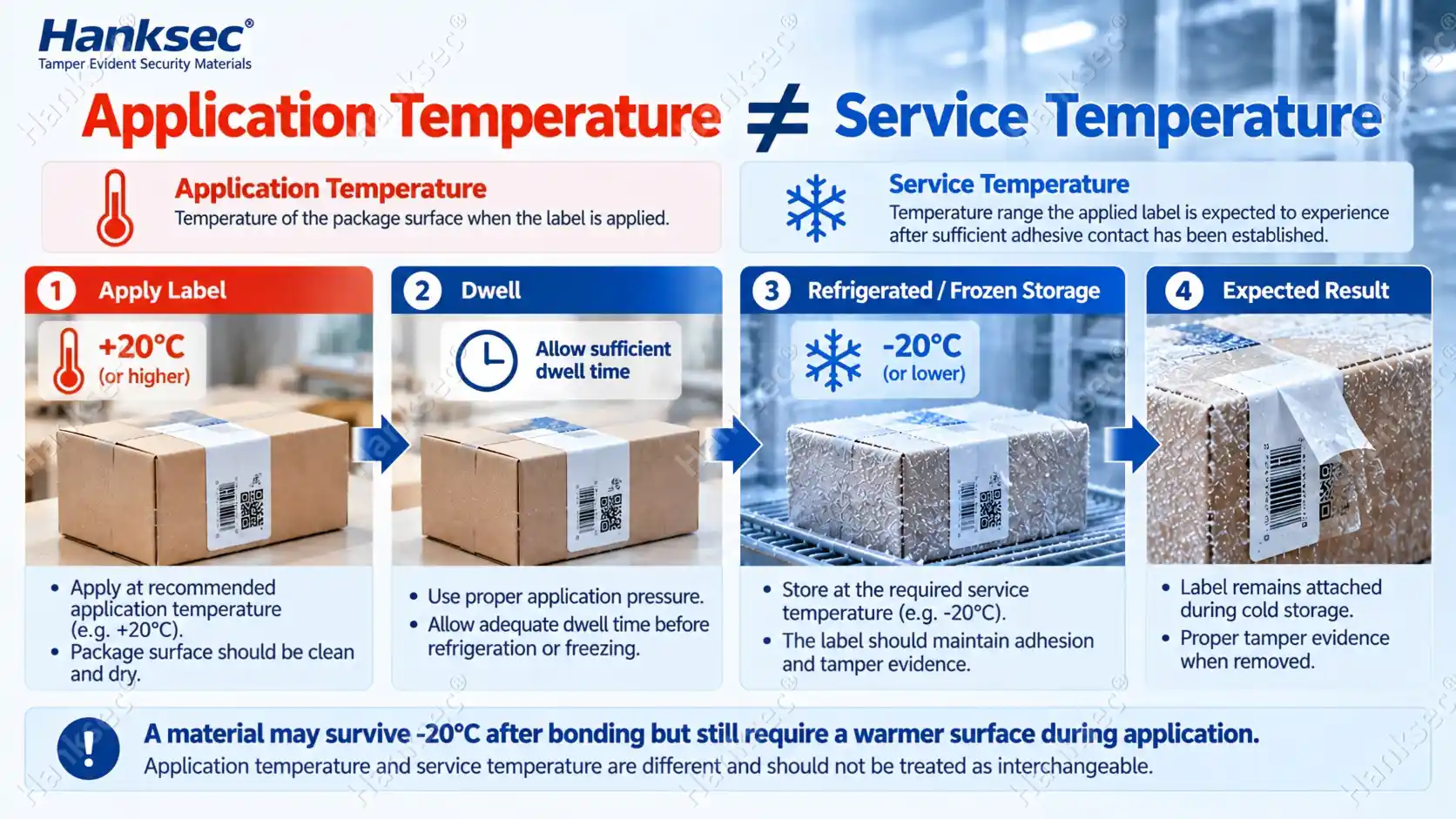
For example, a construction may be designed to remain functional during frozen storage but still require application at a substantially warmer temperature. If the same material is applied directly to an already-frozen or condensation-covered package, the initial adhesive bond can be very different.
Avery Dennison’s cold-temperature labeling guidance specifically distinguishes minimum application temperature from service temperature and recommends considering the actual surface, application condition and complete product lifecycle when choosing an adhesive.
This means that a specification such as:
“Our package is stored at -20°C.”
is not enough for material selection.
The supplier also needs to know:
- whether the label is applied at +20°C, +5°C, 0°C or below freezing;
- whether the package surface is dry when labeling occurs;
- how long the label remains at application temperature before cooling;
- the lowest storage or transport temperature;
- and whether the package later returns to warmer conditions.
What Usually Causes Cold Chain VOID Label Failures?
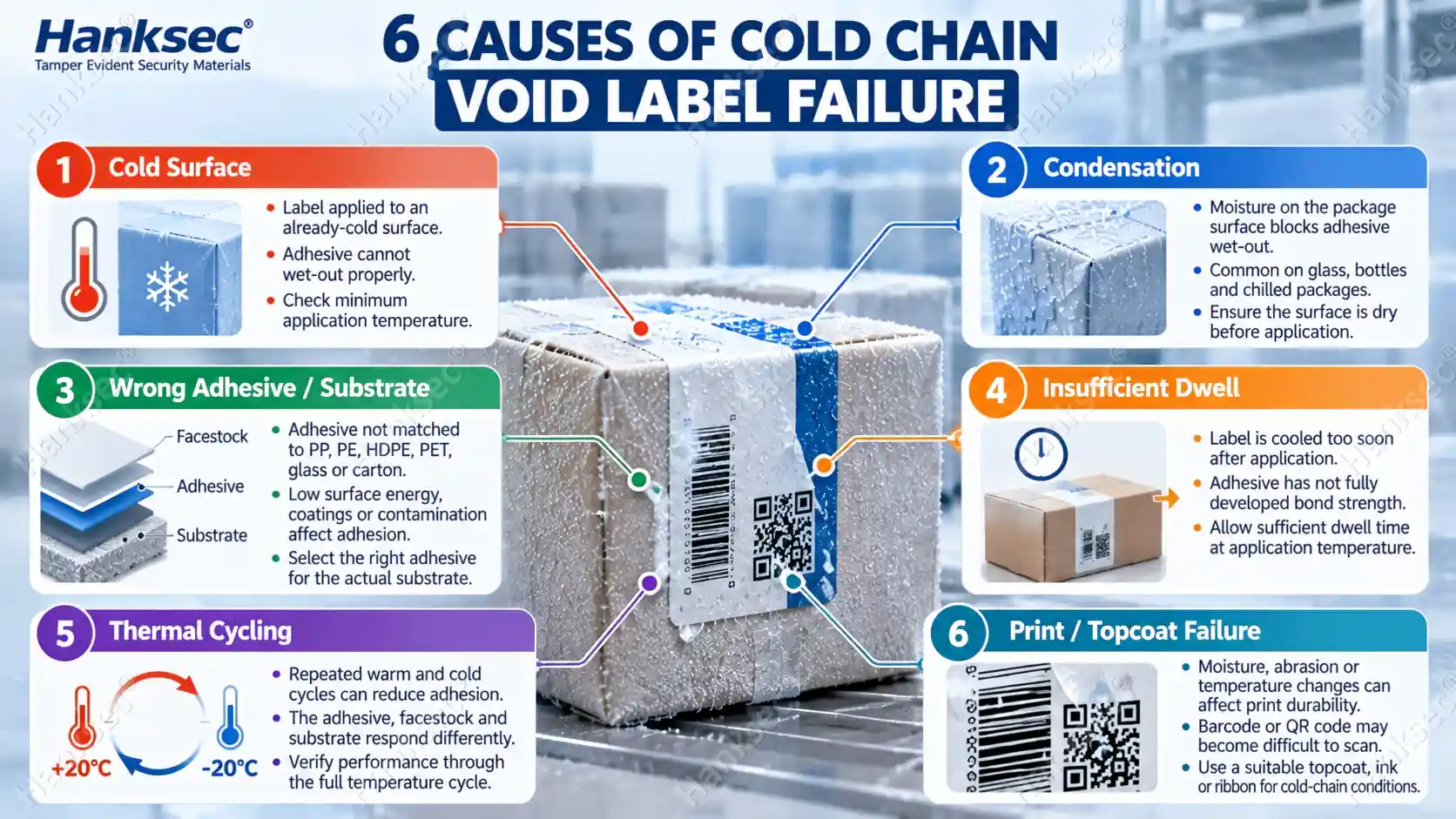
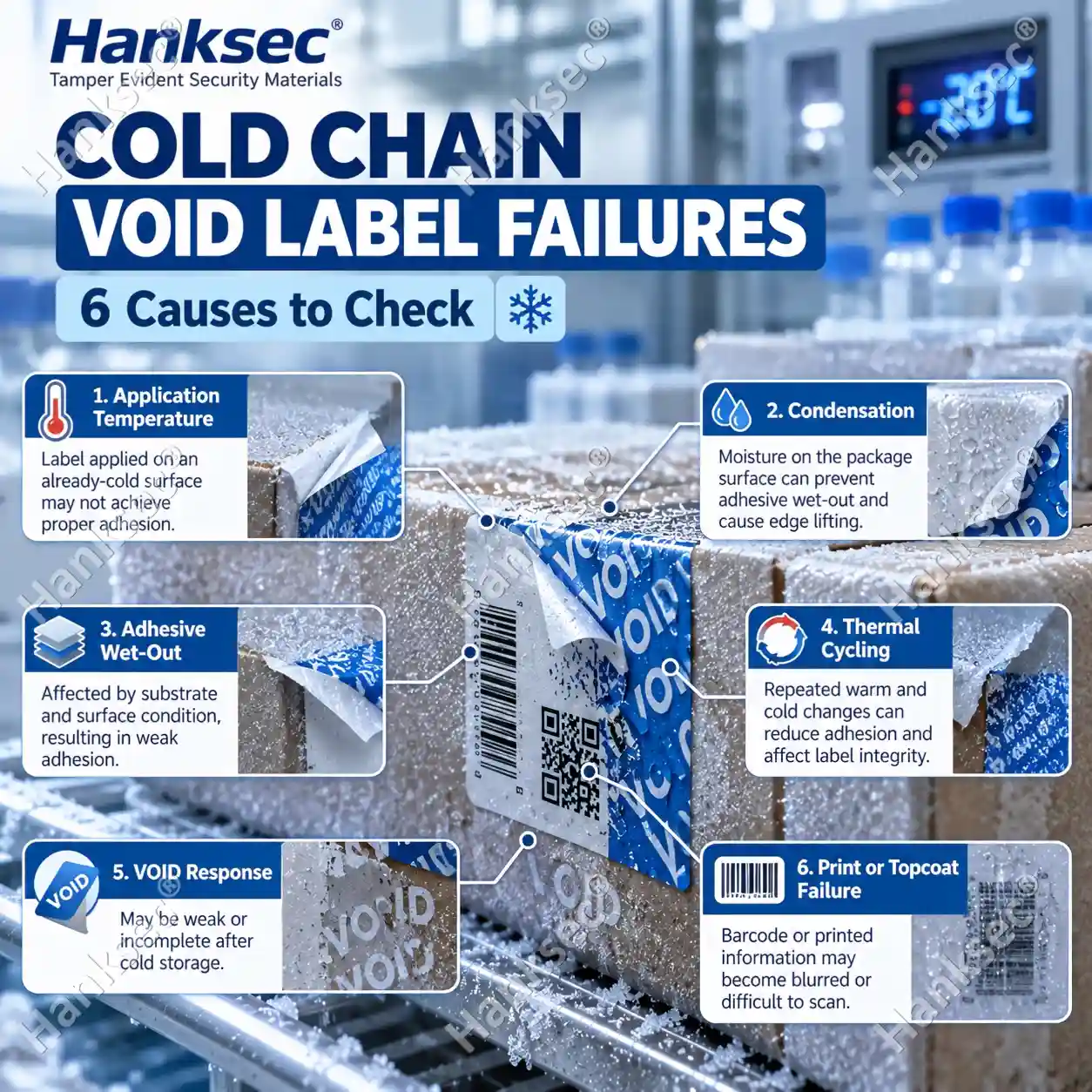
1. The Label Is Applied to an Already-Cold Surface
Pressure-sensitive adhesives depend on sufficient contact between the adhesive and the substrate. At lower temperature, many adhesives become less able to flow across the microscopic surface profile of the package.
A material that bonds well to a room-temperature PET bottle, glass vial or carton may therefore behave differently when the same package is already chilled.
The first questions should be:
- What is the actual package-surface temperature during labeling?
- Is the adhesive designed for that application temperature?
- Is sufficient application pressure being used?
- Does the label have enough time to establish adhesion before entering refrigeration or freezing?
Do not select a cold-chain VOID material only from its lowest published service temperature.
2. Condensation Prevents Proper Adhesive Wet-Out
A cold package moved into warmer, humid air can quickly develop condensation. That moisture can sit between the pressure-sensitive adhesive and the intended bonding surface.
This is especially important for glass bottles, pharmaceutical containers, beverage packaging and other smooth surfaces where even a thin water layer can interfere with initial contact.
Avery Dennison’s technical guidance for cold and wet labeling identifies both low temperature and condensation as important challenges for pressure-sensitive adhesion.
The troubleshooting question should therefore not be only:
“Is the adhesive cold resistant?”
It should also be:
“Was the actual package surface dry enough for the adhesive to establish contact?”
3. The Adhesive Is Not Matched to the Actual Packaging Surface
Cold temperature does not eliminate the normal differences between substrates.
PP, PE and HDPE can present different bonding challenges from PET, glass, coated paperboard or painted metal. Surface energy, texture, coatings, mold-release residues, printing inks and other surface treatments can all change the effective adhesive contact.
For example, a low-temperature adhesive that works well on glass may not provide the same bond on a low-surface-energy plastic.
3M’s adhesion guidance emphasizes that a bonding surface should be dry and free of contaminants and that pressure, time and temperature help increase adhesive contact with the substrate.
For a deeper comparison of PP, PE, HDPE, PET, glass and coated cartons, see the Hanksec Tamper Evident Label Adhesive Guide.
4. The Label Is Cooled Before Sufficient Bond Has Developed
Even if the label is applied at an acceptable temperature, immediate transfer into a refrigerator or freezer can create another variable: dwell time before cooling.
Pressure-sensitive adhesive performance develops through contact with the substrate. The actual time required depends on the adhesive construction, surface and application conditions.
If one production line applies the label and waits several hours before freezing while another sends the package into cold storage immediately, the final adhesion result may not be equivalent.
When investigating inconsistent failures, document:
- application temperature;
- application pressure;
- time between labeling and cooling;
- temperature during that dwell period;
- and whether the package surface changes during the waiting period.
A material comparison is much more useful when these variables are controlled.
5. Thermal Cycling Changes the Adhesive / VOID Response Balance
A tamper-evident VOID label has two jobs that must work together:
bond sufficiently to the package and separate through the intended security layer when removal is attempted.
Cold-chain applications can expose the construction to repeated changes such as:
Room Temperature → Refrigeration → Freezing → Transport → Thawing → Inspection
During these cycles, the adhesive, PET facestock, printed coating, substrate and internal security layers may respond differently.
A label can therefore remain physically attached but produce weaker-than-expected transfer evidence when peeled. Conversely, a security layer can activate correctly while edge adhesion remains inadequate.
This is why adhesion and tamper response should be evaluated separately and then together.
If the failure is primarily related to weak, missing or inconsistent VOID activation rather than cold exposure itself, compare the diagnostic approach in Why VOID Labels Fail.
6. The Print or Topcoat Fails Even When the Label Remains Attached
Cold-chain label qualification should not end with an adhesion test.
A label may stay attached while its printed barcode, QR code, variable data or warning text becomes harder to read because of moisture, abrasion, condensation or repeated environmental cycling.
Depending on the printing system, verify:
- printable topcoat compatibility;
- thermal-transfer ribbon or ink selection;
- barcode contrast after cold storage;
- surface resistance to condensation;
- rub resistance after thawing;
- and whether printed information remains scannable through the complete process.
For traceability applications, a label that remains attached but can no longer be reliably read should still be treated as a failed identification system.
Can Low Temperature Change the VOID Tamper Effect?
Yes. The visible VOID result depends on more than adhesive strength alone.
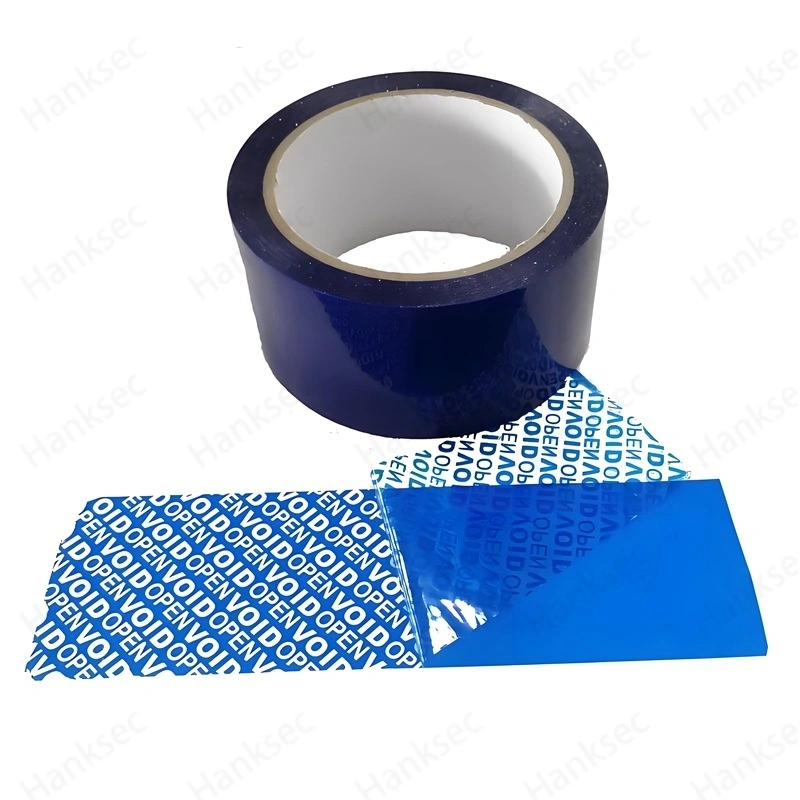
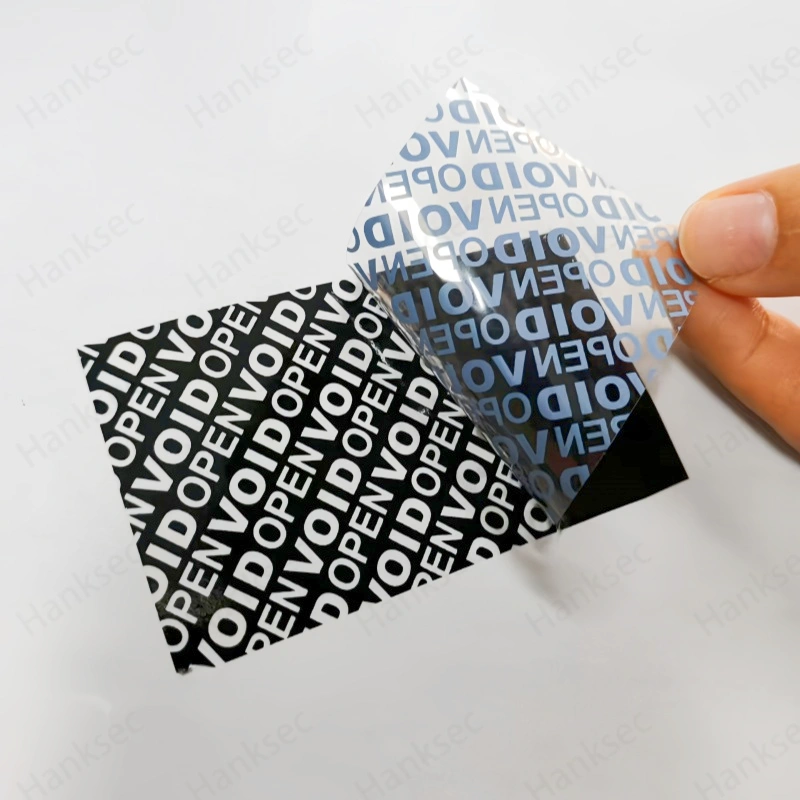
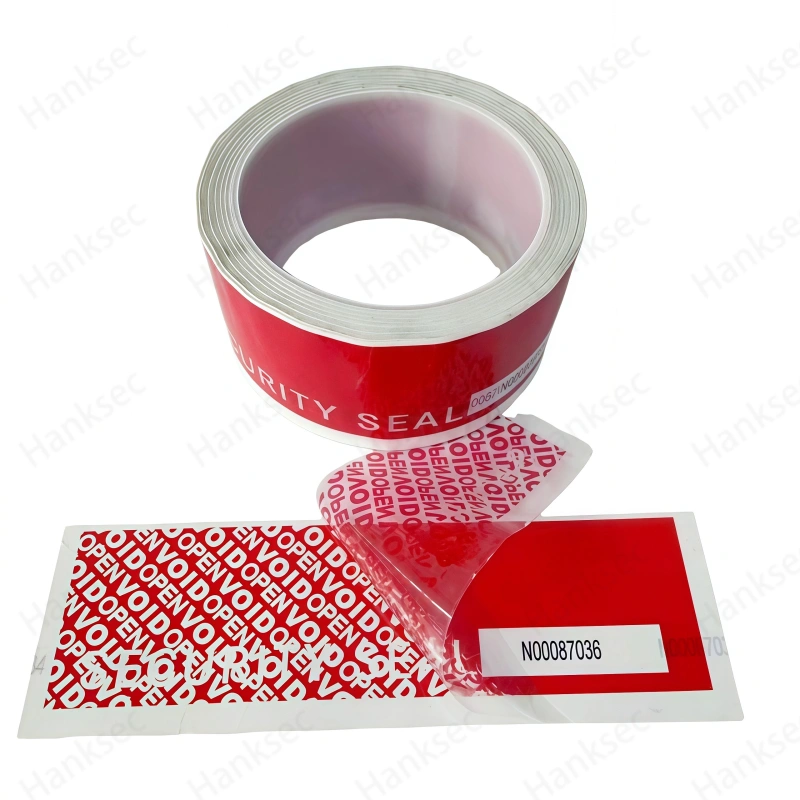
A tamper-evident construction contains an engineered balance between the facestock, functional security layers and the bond to the application surface. When the label is removed, separation must occur at the intended interface to reveal the hidden VOID, OPENED or custom security message.
If substrate adhesion is too weak, the complete label may release before the security mechanism activates properly.
If the construction is not matched to the service environment, removal at low temperature may also produce a different response from removal after the package returns to room temperature.
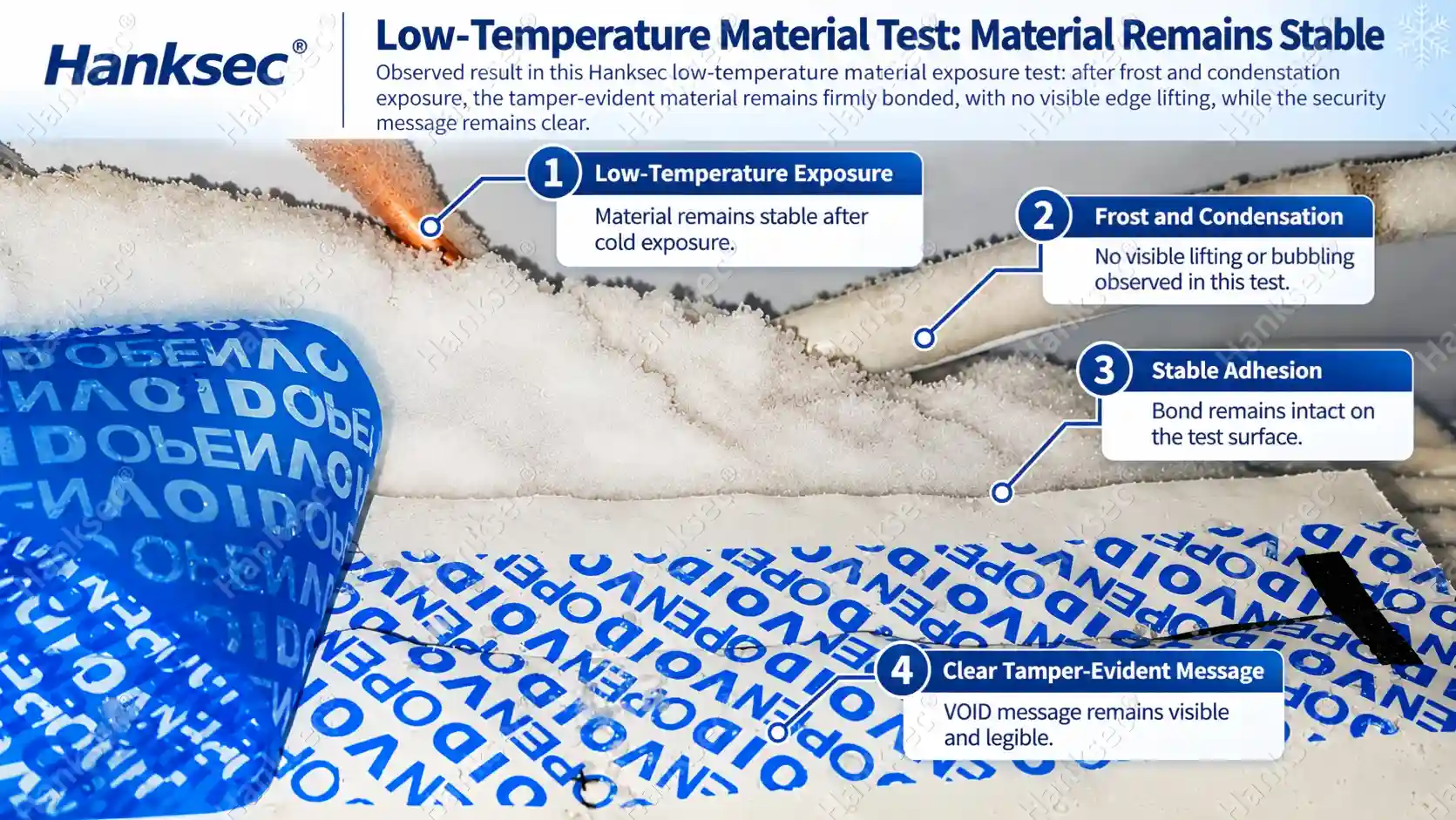
This real Hanksec low-temperature test shows a successful result under cold, frost and condensation exposure: the material remains securely bonded while the tamper-evident message remains clearly visible after removal.
This is particularly important when a security program specifies exactly where the tamper evidence should remain:
| VOID Construction | Expected Security Response | Cold-Chain Qualification Focus |
|---|---|---|
| Full Transfer | Security message transfers primarily to the package surface. | Sufficient substrate bond and clear transfer after temperature exposure. |
| Partial Transfer | Evidence appears on both the removed label and package. | Balanced separation and visible evidence under the intended removal condition. |
| Non-Transfer | Security message appears mainly within the removed label. | Label adhesion, internal VOID activation and acceptable surface cleanliness. |
Buyers can compare these constructions in the Hanksec Tamper Evident VOID Label Materials range.
Refrigerated, Frozen, Ultra-Low and Cryogenic Are Not the Same Requirement
The term “cold chain” covers very different environments. A material validated for ordinary refrigerated storage should not automatically be described as suitable for freezer, ultra-low-temperature or cryogenic applications.
| Environment | Illustrative Temperature Condition | Main Qualification Question |
|---|---|---|
| Refrigerated / Chilled | For example, approximately +2°C to +8°C | Will the label be applied before or after the package is chilled, and will condensation be present? |
| Frozen | For example, around -20°C | Can the applied construction maintain adhesion and tamper response during the required frozen-storage period? |
| Ultra-Low Temperature | For example, around -80°C | Is the complete label construction specifically supported and validated for this environment? |
| Cryogenic | Conditions may extend toward liquid-nitrogen temperatures | Does supplier technical data and package-specific testing support the exact application? |
The temperatures above are application examples, not universal material ratings.
Standard PET VOID material should therefore not automatically be assumed to work at -80°C or cryogenic temperatures simply because it performs well in an ordinary freezer.
Where ultra-low or cryogenic storage is required, use a construction supported by appropriate supplier technical data and validate it on the actual container and process.
The Hanksec Tamper Evident VOID Materials guide for pharmaceutical applications also discusses the need to separate application, storage, service and transportation temperatures when evaluating low-temperature security materials.
What Should You Tell the Supplier Before Selecting a Cold Chain VOID Material?
A request such as:
“We need a VOID label that works at -20°C.”
still leaves several important engineering questions unanswered.
For faster material selection, provide:
- Application temperature: actual package temperature when the label is applied;
- Service temperature: expected normal temperature after application;
- Lowest temperature: minimum temperature during storage or transportation;
- Application surface: glass, PET, PP, PE, HDPE, carton, metal or another substrate;
- Surface condition: dry, humid, condensation-prone or already wet;
- Dwell before cooling: time between label application and refrigeration/freezing;
- Thermal cycles: whether the package moves repeatedly between warm and cold environments;
- Required tamper response: full-transfer, partial-transfer or non-transfer VOID;
- Removal condition: whether tamper inspection occurs while cold or after warming;
- Printing method: UV flexo, thermal transfer, digital or another process;
- Barcode / QR requirement: whether machine readability must remain stable after the full cold-chain process;
- Finished label size: especially when small labels or tight-radius containers are involved;
- Supply format: jumbo roll, slit roll or finished converted label.
Providing these conditions is much more useful than selecting a material only from a single temperature number.
How Should You Test a Cold Chain VOID Label Before Bulk Production?
The best qualification test should reproduce the real packaging sequence as closely as practical.
- Use the actual package. Test on the real glass, plastic, metal or coated carton rather than relying only on a generic laboratory panel.
- Condition the package correctly. If production labels an already-chilled package, reproduce that condition. If production labels at room temperature, test that sequence instead.
- Record surface moisture. Determine whether the package is dry, condensation-prone or visibly wet at the moment of application.
- Apply the label consistently. Control application pressure and avoid comparing samples that were applied differently.
- Use the real dwell period. Reproduce the actual time between labeling and refrigerated or frozen storage.
- Run the required cold-storage cycle. Include the intended duration, lowest temperature and repeated temperature cycles where relevant.
- Inspect adhesion before tampering. Check for edge lift, bubbling, curling, movement or other physical changes.
- Perform the tamper test. Remove the label under the required inspection condition and verify that the intended VOID or OPENED response appears correctly.
- Inspect the package surface. Confirm whether residue behavior matches the approved full-, partial- or non-transfer specification.
- Check the printed information. Scan barcodes or QR codes and inspect printed text after the complete environmental sequence.
A useful qualification sequence can therefore be summarized as:
Condition Package → Apply → Dwell → Refrigerate / Freeze → Cycle if Required → Inspect Adhesion → Peel → Check VOID Response → Scan
When sourcing converter-ready roll material, printing, die cutting, liner release and matrix stripping should also be evaluated before mass production. The Hanksec Security Label Material Quality Control Guide covers these broader material-control checks.
Should You Test the Label Cold or After It Returns to Room Temperature?
In many applications, the answer is both.
The real tampering scenario determines which condition matters most.
If unauthorized opening could occur inside a refrigerated warehouse, the label should be evaluated while cold. If inspection normally takes place after the package has returned to room temperature, that condition should also be reproduced.
Comparing both states can reveal whether the security response changes after warming.
For example:
- adhesion may appear acceptable while frozen but weaken after condensation forms during warming;
- a VOID pattern may activate differently when the adhesive is cold;
- surface moisture may affect residue appearance after thawing;
- or printed information may become vulnerable to abrasion while wet.
Testing only one temperature state may therefore miss the actual field failure.
Frequently Asked Questions
Can a VOID label be applied below 0°C?
Some pressure-sensitive adhesive constructions are designed for low application temperatures, but this cannot be assumed for every VOID material. Check the material’s minimum application temperature and test it on the actual substrate. Service temperature alone does not prove that the label can be successfully applied below 0°C.
Why does a VOID label stick at room temperature but fail after freezing?
The initial bond may be sufficient at room temperature while the complete adhesive and substrate system responds differently during frozen storage or temperature cycling. Check the adhesive construction, substrate, dwell before cooling, lowest temperature and number of thermal cycles.
Does a -20°C service temperature mean the label can be applied at -20°C?
No. Application temperature and service temperature describe different conditions. A label may tolerate -20°C after bonding but still require a warmer surface when initially applied.
Why does condensation cause edge lifting?
Condensation can interfere with direct adhesive-to-substrate contact. If moisture is present during application, the adhesive may not develop sufficient wet-out even if the label material is otherwise suitable for cold storage.
Can the same VOID label be used at -20°C and -80°C?
Not automatically. Frozen, ultra-low and cryogenic environments impose different requirements. A construction that performs well at approximately -20°C should not be assumed to work at -80°C without supporting technical data and application-specific testing.
Does stronger adhesive always produce a clearer VOID message?
No. VOID performance depends on the balance between substrate adhesion and the internal security-layer separation. Strong adhesion alone does not guarantee that the required full-transfer, partial-transfer or non-transfer security pattern will appear correctly.
Should cold-chain VOID labels be tested on laboratory glass?
Laboratory panels can be useful for controlled comparison, but final qualification should use the actual package surface. Glass, PET, PP, PE, HDPE, coated cartons and other substrates can produce significantly different adhesion and tamper responses.
Need to Test a VOID Material for Cold-Chain Packaging?
Hanksec® supplies tamper-evident VOID label materials in jumbo rolls, slit rolls and custom constructions for converters, security printers and packaging projects. Share the application surface, application temperature, lowest service temperature, condensation condition, required VOID response, print process, label size and supply format. Sample evaluation can then focus on the complete application rather than a single temperature number.
REQUEST COLD-CHAIN VOID MATERIAL TESTING →
Hanksec® | Tamper Evident VOID Materials · Cold-Chain Evaluation · Jumbo Rolls · Slit Rolls · Custom Material Solutions