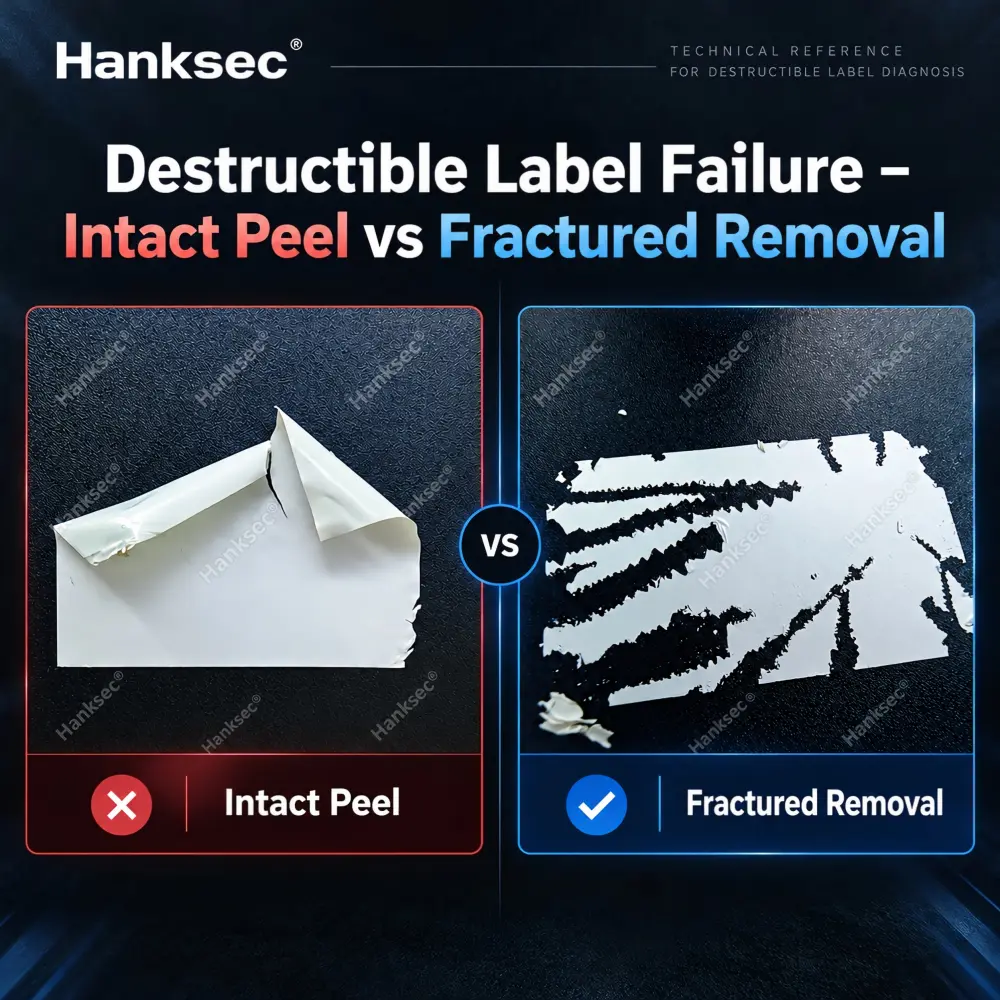
Quick Answer: Destructible labels peel off intact when the adhesive-to-substrate bond is too weak to trigger fracture, the face material is too resistant to breaking, or application conditions prevent proper contact. Low-surface-energy plastics, contamination, insufficient pressure and short dwell time are common contributors. The first step is to identify where separation occurs, not automatically replace the label with a stronger adhesive.
Destructible Label Not Breaking? Diagnose the Removal Pattern First
| What You See | Possible Failure Point | First Check |
|---|---|---|
| Whole label lifts with adhesive still on its back | Adhesive-to-substrate bond | Surface, contamination, dwell time |
| Film lifts while adhesive remains on the object | Facestock-to-adhesive interface or internal construction | Inspect both separated surfaces |
| Only corners crack; most of the label comes away | Uneven contact, label geometry or unsuitable breakage grade | Edge pressure, size and surface shape |
| Labels tear before application, but peel cleanly later | Converting and end-use requirements are not balanced | Compare roll, converted and applied samples |
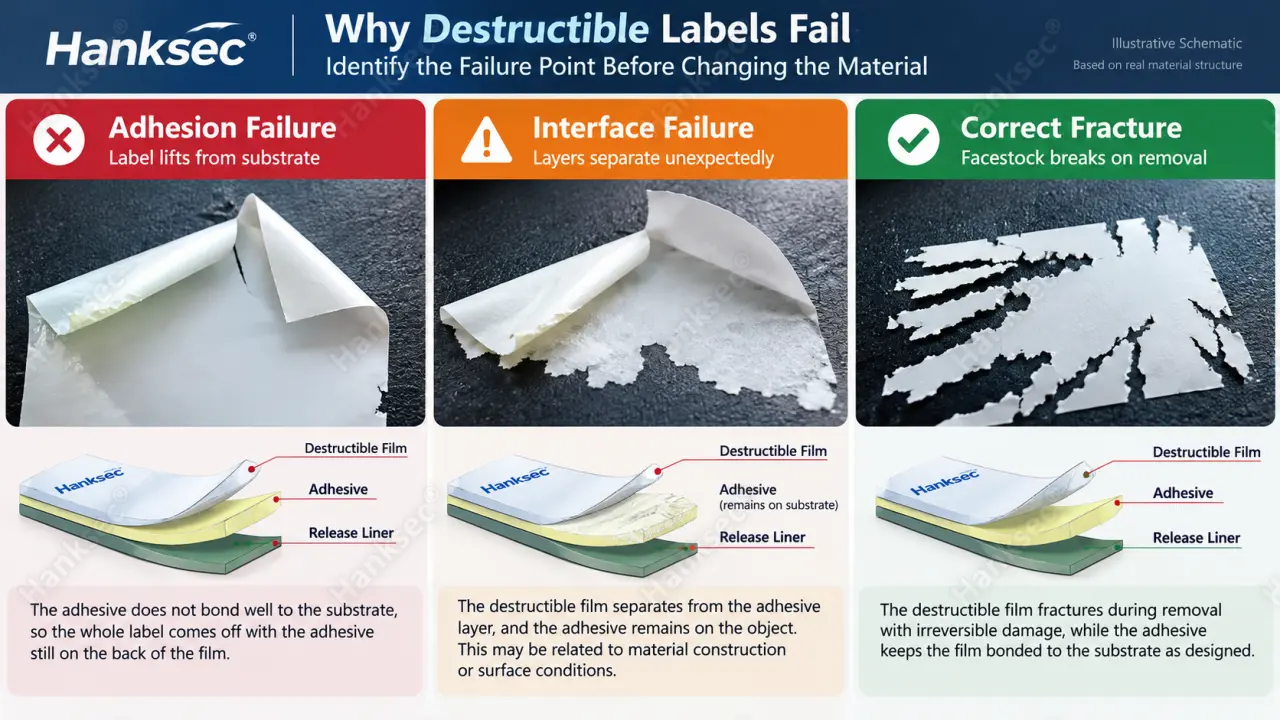
Three removal patterns used to distinguish adhesion failure, internal separation and correct facestock fracture.
A destructible label should show the specified irreversible damage after an attempted removal. An intact peel is a warning sign, but a single hand test does not identify the cause.
Why Destructible Labels Peel Off Intact: 6 Common Causes
1. The Adhesive Does Not Bond to the Actual Surface
PP, PE and some powder-coated or treated plastics may be difficult for a conventional pressure-sensitive adhesive. If the entire adhesive layer separates from the object, peeling stress may never fracture the face material.
Fix: Evaluate the adhesive on the customer’s real substrate, not only on glass or stainless steel. The Hanksec adhesive selection guide covers important substrate differences.
2. Oil, Dust or Mold-Release Residue Blocks Contact
An adhesive cannot develop a reliable bond where silicone, lubricant, dust or other residue prevents surface contact. This problem often appears on molded components and production-line equipment.
Fix: Compare a representative production surface with a properly prepared reference sample, following a surface-cleaning method compatible with the component. If only the reference sample fractures, investigate contamination or surface preparation.
3. Application Pressure or Dwell Time Is Insufficient
Pressure-sensitive adhesive performance depends partly on intimate contact. The bond may also develop over time. Testing immediately after a light finger press can give a different result from testing after controlled application and an agreed dwell period.
Fix: Record pressure, temperature and elapsed time before removal. Compare samples under repeatable conditions. Do not apply one manufacturer’s dwell-time specification to every Hanksec material.
4. The Facestock Is Too Tough for the Required Breakage
A medium or hard destructible grade may lift in larger sections when the application requires very fine fragmentation, particularly if adhesive bonding is marginal. Conversely, an ultra-fragile grade can be difficult to print, die-cut or dispense.
Fix: Specify the required fracture pattern and label dimensions. Compare easy, medium and hard grades before changing the complete construction. See the Destructible Label Material Rolls Guide.
5. Texture, Curvature or Label Size Creates Uneven Stress
A stiff face material may bridge over textured plastic, while a large or curved label can develop edge-lifting stress. When only part of the adhesive makes good contact, the label may release unevenly instead of fracturing as designed.
Fix: Inspect contact at edges and corners. Consider a more conformable construction where appropriate, and test the final label shape—not just a small flat sample.
6. Temperature, Storage or Converting Changes the Result
Cold application, condensation, heat exposure or unsuitable storage can change adhesive behavior. Excessive die pressure, liner damage or premature cracking during converting can also make the final label inconsistent.
Fix: Compare original roll stock with printed and die-cut labels. Repeat application testing after relevant environmental conditioning and check for roll-to-roll variation.
How to Test a Destructible Label That Peels Off Cleanly
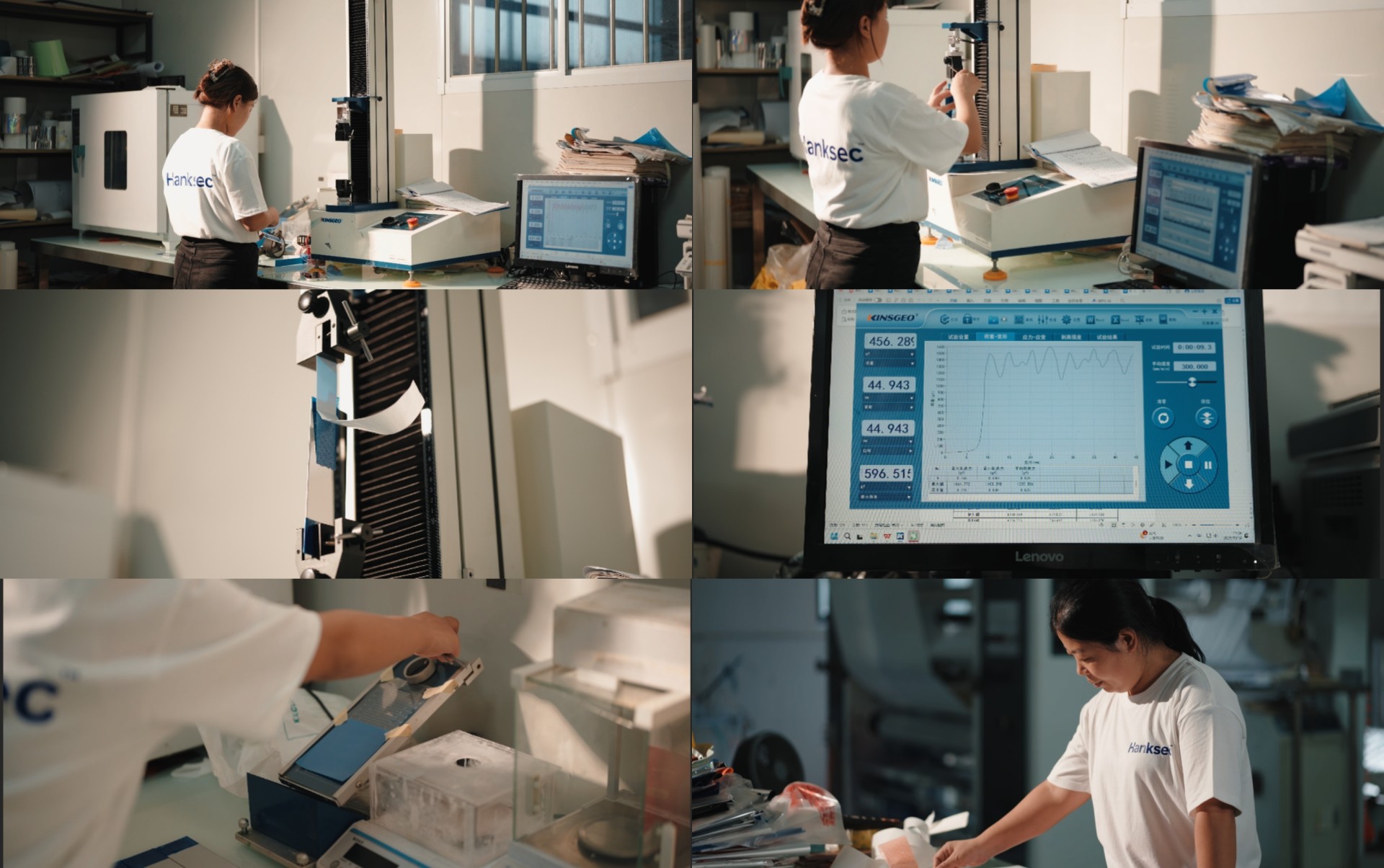
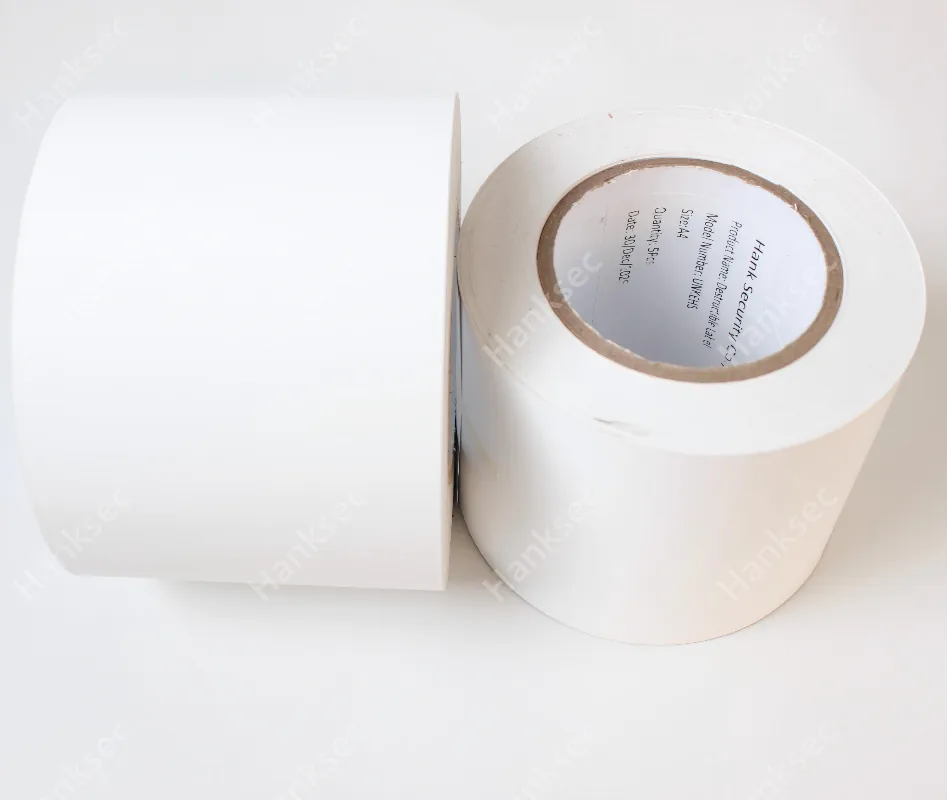
Destructible label material samples used to evaluate substrate adhesion and facestock fracture behavior.
Use a short controlled trial instead of judging one peeled sticker:
- Identify the surface: Record whether it is ABS, PP, PE, painted metal, coated carton, glass or another substrate.
- Apply consistently: Keep sample dimensions, surface preparation, pressure, application temperature and dwell period comparable.
- Inspect the failure point: Record whether the adhesive stays on the label, remains on the product, or the fragile face actually fractures.
- Repeat after converting: Test finished printed and die-cut labels, not just hand-cut raw film.
- Document the result: Photograph the removed label and substrate; record batch, peel angle, removal speed and environmental conditions.
A useful external reference is the 3M Destructible Vinyl Label Material 7613T technical data sheet, which explains that facestock destruction depends on adequate adhesion to the intended substrate. Its product-specific application figures should not be treated as universal specifications for other constructions.
For broader methods covering adhesion, liner release and converting, see Hanksec’s Security Label Material Quality Control Guide.
Which Destructible Material Should You Try Next?
The answer depends on the failure observed—not simply which film breaks into the smallest pieces. For a construction-level comparison, see Foamtack vs Co-Extruded Destructible Labels.
- Small, flat warranty seals requiring high fragmentation: Consider Ultra Destructible Vinyl Material after confirming adhesive bonding.
- Rough or textured surfaces: Trial a more conformable Foamtack destructible construction, while still checking adhesive compatibility.
- Larger labels or automatic application: Evaluate Co-Extruded Destructible Label Material for a suitable balance between fracture behavior and converting stability.
No single material is guaranteed to fracture correctly on every surface. The approved construction must work with the actual substrate and production process.
What Should Buyers Send for Troubleshooting?
Send Hanksec the substrate and coating, clear photos or a short peeling video, label size, required fragment size, application conditions, printing method, converting process and roll or batch identification. Include both an intact-peel sample and a sample that performs correctly, if available.
This allows the technical team to distinguish an application problem from a material-construction or converting problem before recommending samples for qualification.
Frequently Asked Questions
Does an intact peel always mean the adhesive is defective?
No. It may indicate contamination, unsuitable dwell time, low surface energy, excessive facestock strength or another interface problem. Check where separation occurred first.
Why does destructible vinyl break on glass but not on PP plastic?
The two substrates can develop very different adhesive bonds. Many PP surfaces have lower surface energy, which may prevent sufficient contact without a suitable adhesive construction.
Will a stronger adhesive always fix a destructible label that does not break?
No. Stronger adhesion may help in some cases, but face-material grade, surface preparation, label geometry and converting stability must also match the application.
Can Hanksec supply trial rolls for printing and die-cutting?
Hanksec supplies destructible material options in jumbo-roll and slit-roll formats. Trial specifications should be agreed according to the required substrate, printing method, label size and fracture behavior.
Destructible Label Peeling Off Intact? Request Material Testing
Hanksec® develops destructible label materials for label converters, security printers and industrial packaging manufacturers. Share your actual surface, peeling results and converting requirements. The technical team can recommend suitable sample constructions for adhesion and tamper-response trials before bulk production.
REQUEST DESTRUCTIBLE MATERIAL TESTING →
Hanksec® | Tamper Evident Security Label Materials Manufacturer · Jumbo Rolls · Slit Rolls · Custom Material Solutions