
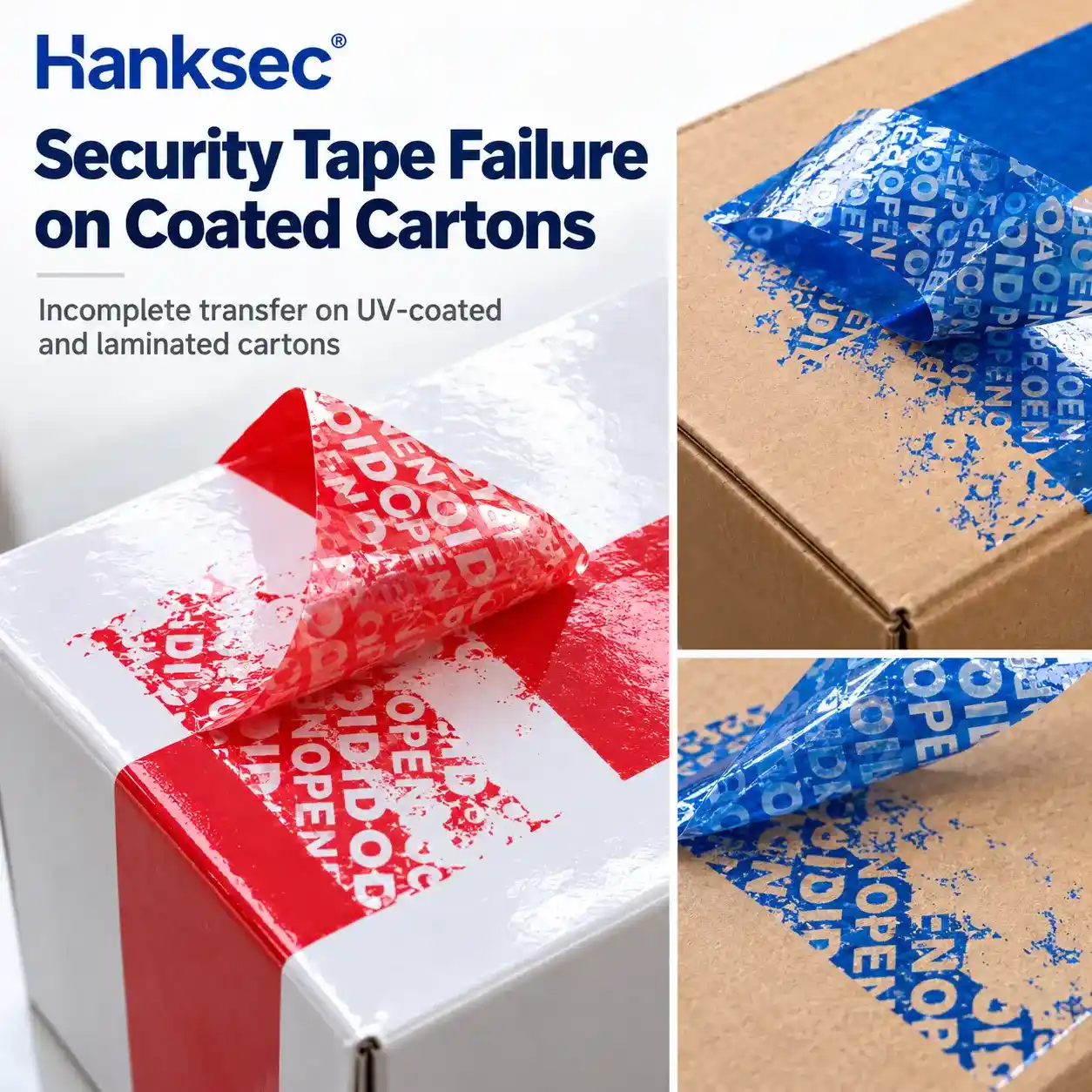
Quick Answer: Security tape fails on coated cartons when the adhesive cannot bond reliably to the surface, the carton coating separates from the paperboard, or the tape’s security layer does not activate as specified. Glossy varnish, lamination, contamination and application conditions can change the result. Instead of immediately choosing a stronger tape, inspect what remains on the carton and on the removed tape.
Security Tape Fails on Coated Cartons: What Does the Failure Look Like?
Before changing materials, document the actual removal pattern.
| Observed Result | Possible Failure Point | What to Inspect |
|---|---|---|
| Tape lifts cleanly and the required VOID evidence is absent | Weak tape-to-coating adhesion or incomplete security activation | Tape adhesive, carton finish and both peeled surfaces |
| Printed coating or board fibers come away with the tape | Coating-to-board bond or paper surface strength | Whether the carton finish is being stripped or torn |
| Tape stays bonded, but the VOID message is faint or patchy | Security-layer response, local contact or removal conditions | Message clarity and intended transfer location |
| Edges lift before the carton is opened | Insufficient contact, carton-flap stress or environmental exposure | Sealing pressure, folds, dwell time and storage |
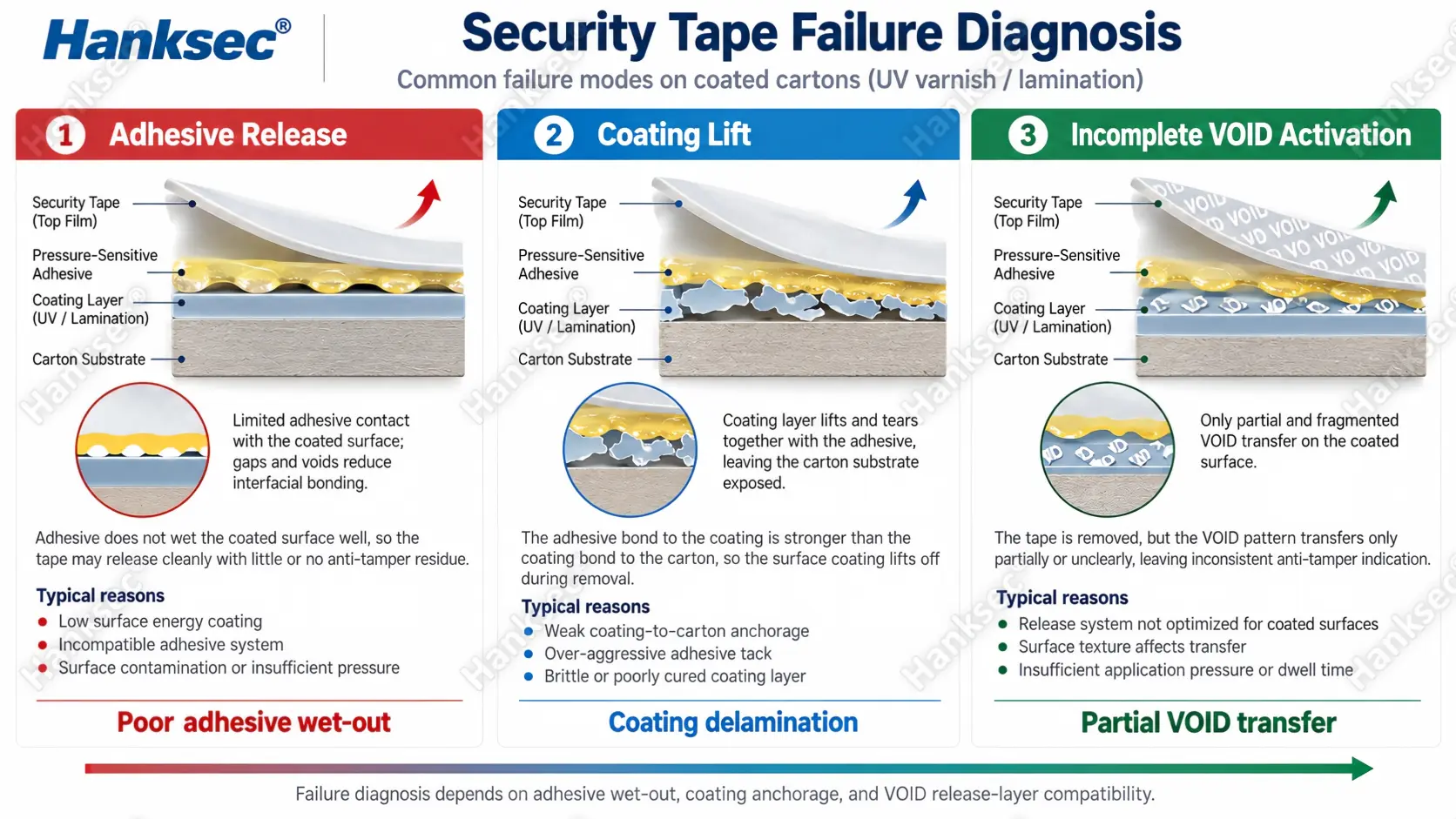
Coating removal or fiber tear may provide visible evidence of opening, but it is not automatically the specified VOID transfer effect. The result must match the customer’s approved security requirement.
5 Common Causes of Security Tape Failure on Coated Cartons
1. Varnish or Lamination Changes Adhesive Contact
UV varnish, aqueous coatings and plastic lamination present different surfaces to a pressure-sensitive adhesive. A glossy appearance alone does not prove poor adhesion, but a coating can change surface energy, chemistry and wet-out.
Fix: Test against the exact varnish or laminated film used in production. Ask the packaging supplier for the coating type and check a substrate-matched adhesive rather than assuming one carton-grade tape fits every finish.
2. The Coating Separates Before the VOID Layer Activates
Sometimes the tape bonds well to the coating, but the coating is less securely attached to the printed board beneath it. During removal, the finish comes away with the tape before the security construction separates as intended.
Fix: Compare the peeled tape, exposed board and any transferred coating. Discuss coating adhesion with the carton supplier and qualify the security effect on the complete printed package.
3. Dust, Slip Additives or Moisture Interfere with Bonding
Paper dust, handling oils, surface additives, condensation and other residues can reduce effective adhesive contact.
Fix: Compare an as-received carton with a suitable, carefully prepared reference surface. Do not use solvents or cleaning methods that could damage printed coatings without approval from the packaging supplier.
4. Sealing Pressure, Dwell Time or Flap Stress Is Inconsistent
Pressure-sensitive tape needs sufficient contact with the surface. Applying it lightly, testing immediately or running a carton sealer with uneven pressure can produce misleading results. Fold lines, spring-back and overfilled boxes may also lift tape edges before the adhesive bond develops.
Fix: Standardize application pressure, tape placement and the agreed dwell period. Repeat the test on cartons sealed by the actual production equipment, not only by hand.
5. The Security Construction Does Not Match the Carton
Full-transfer, partial-transfer and non-transfer security tapes create evidence in different locations. Their behavior also depends on adhesive bonding and the internal security-layer design. A tape can stick to a carton but still fail to display the required message clearly after removal.
Fix: Confirm where the VOID or OPENED message must appear, whether residue is acceptable and how the coated surface responds. Review available Hanksec tamper-evident security tape constructions before requesting an application-specific trial.
How Can You Identify the Actual Failure Point?
Use the carton and tape together as one test specimen. After a controlled removal, inspect three locations:
- The removed tape: Is its adhesive still present? Did the intended VOID pattern appear? Is printed coating attached to it?
- The carton surface: Is the varnish intact, is bare paper visible, or is the approved transfer message present?
- The bond line: Did separation occur at the tape adhesive, within the carton finish or within the intended security layer?
Photograph both surfaces under consistent lighting. A blank carton does not necessarily mean no tamper evidence if a non-transfer construction was specified; inspect the tape as well.
How Should Security Tape Be Tested on Coated Cartons?
- Confirm the package: Identify the paperboard, printed finish, varnish or lamination, and collect samples from representative production batches.
- Compare surfaces: Where useful, test the same construction on uncoated kraft and the actual coated carton to isolate surface effects.
- Control application: Record tape width, pressure, carton condition, temperature, humidity where relevant and dwell period.
- Check removal evidence: Use a consistent peel direction and speed. Photograph any coating lift, edge failure or incomplete VOID message.
- Repeat after production sealing: Test cartons made using the real sealing line and representative storage or shipping conditions before bulk approval.
What Does a Successful Security Tape Test Look Like?
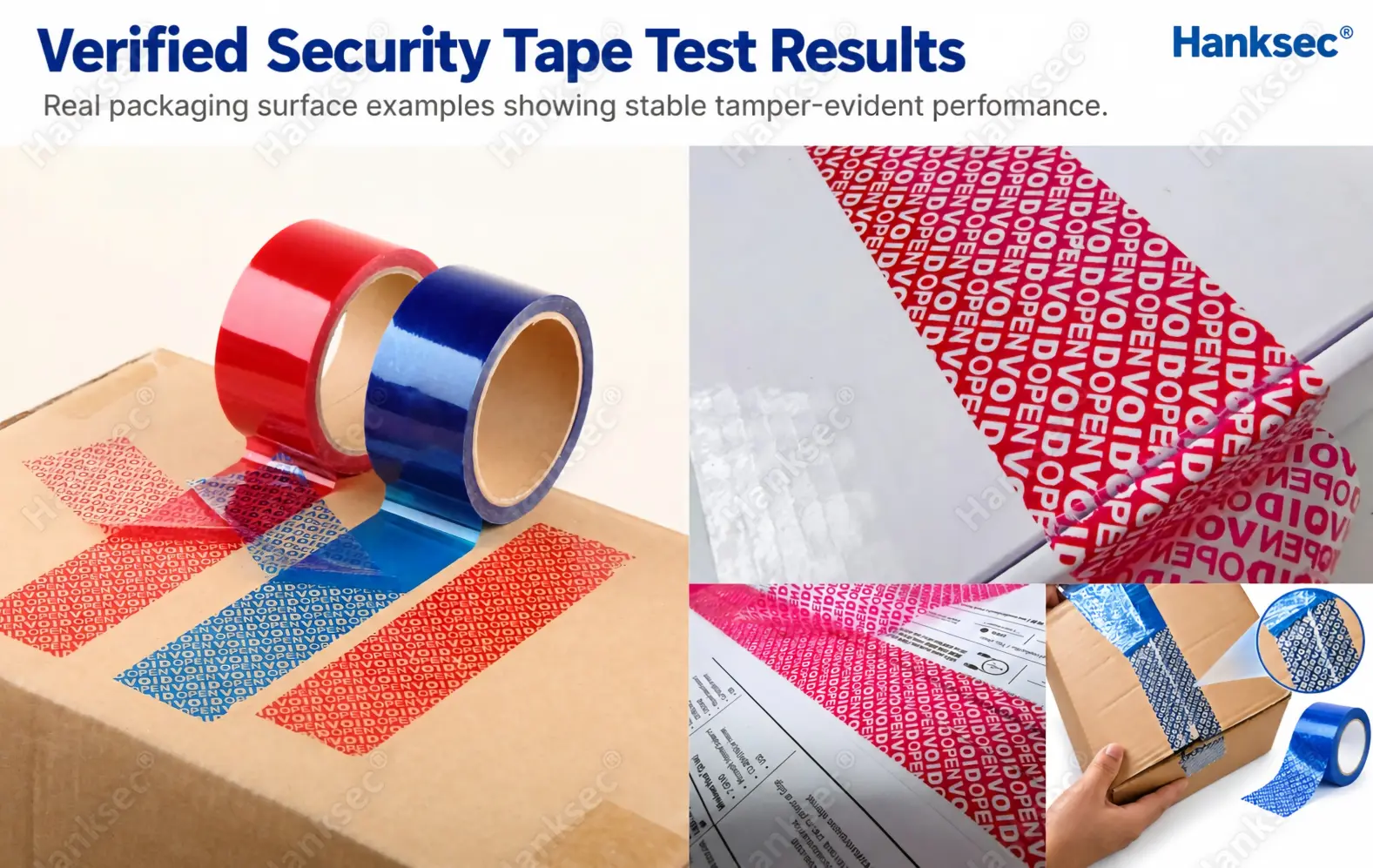
The following Hanksec material samples demonstrate the intended tamper-evident response under the tested application conditions. After removal, the security tape produces a visible VOID or OPENED message according to the selected material construction.
Successful performance should be evaluated by checking adhesion to the actual substrate, message clarity, transfer location and consistency across repeated samples. Results on one carton finish do not automatically guarantee the same performance on other varnished or laminated surfaces.
For the underlying adhesive science, 3M’s Substrates and Adhesion resource explains why coatings, cleanliness, porosity and surface energy matter. It is a general reference, not a specification for Hanksec security tape.
Hanksec’s Security Label Material Quality Control Guide explains related adhesion and tamper-response checks.
Which Security Tape Should You Try on a Coated Box?
There is no universal winner. The choice depends on where evidence is required and whether the carton coating tolerates removal.
- Full-transfer: Consider when the specification calls for prominent evidence on the carton; confirm that the coating and adhesive can support the intended transfer.
- Partial-transfer: Consider when evidence is required across the separated surfaces; verify message clarity and residue behavior.
- Non-transfer: Consider when less visible surface residue is preferred, but confirm that evidence on the removed tape meets the security requirement.
For an overview rather than troubleshooting, see Security Tape for Boxes and the broader Tamper-Evident Packaging Tape Selection Guide.
Frequently Asked Questions
Why does VOID tape work on kraft cartons but not on glossy boxes?
The glossy box may have a different varnish, lamination or surface treatment. Compare actual bonding and the security-layer response before attributing the problem to the tape alone.
Will stronger adhesive fix security tape that lifts from coated cartons?
Not always. A stronger bond may pull off the coating without producing the intended VOID pattern. Substrate integrity and transfer construction must also be checked.
Can security tape be applied over UV-coated printing?
It can be considered, but approval should be based on the real UV-coated box and its production conditions. Ink and varnish formulations vary, so one successful sample does not qualify every finish.
Does carton fiber tear mean the security tape passed?
Only if that response meets the agreed acceptance criteria. Fiber tear may show removal but cannot automatically substitute for a specified VOID message or residue pattern.
Security Tape Failing on Coated Cartons? Request Material Testing
Hanksec® supplies tamper-evident security tape materials and custom constructions for packaging converters, printers and industrial buyers. Share your coated carton type, required VOID effect, tape dimensions, sealing process and clear photographs of both peeled surfaces. The technical team can recommend a suitable material trial before bulk production.
REQUEST SECURITY TAPE MATERIAL TESTING →
Hanksec® | Tamper Evident Security Materials Manufacturer | OEM/ODM | Custom Tape Solutions


