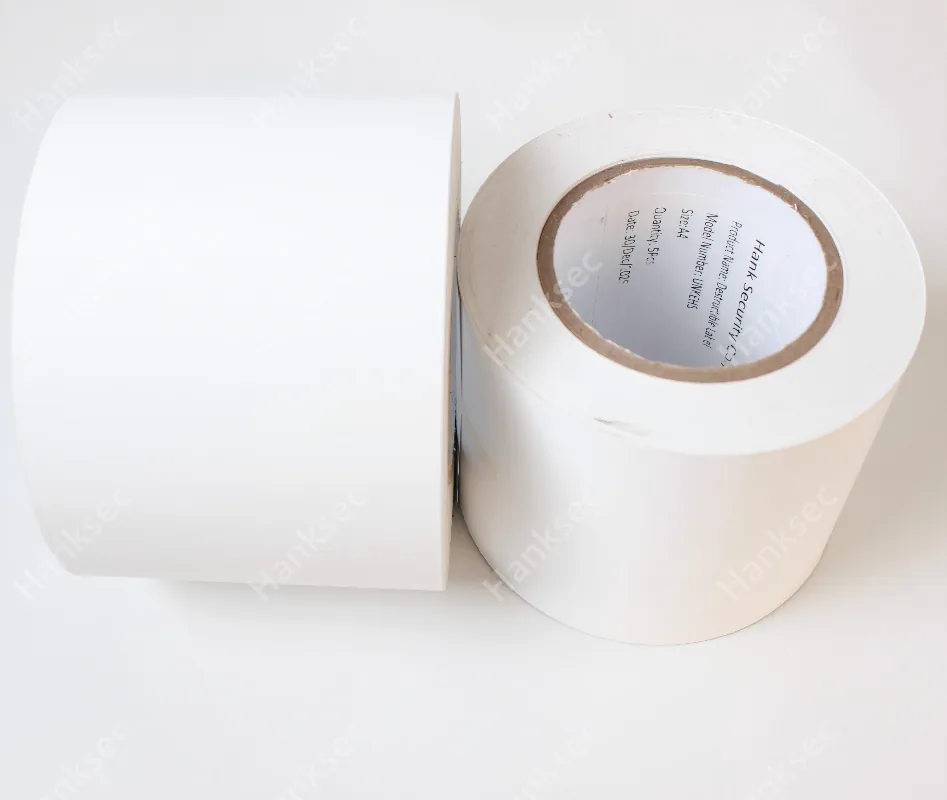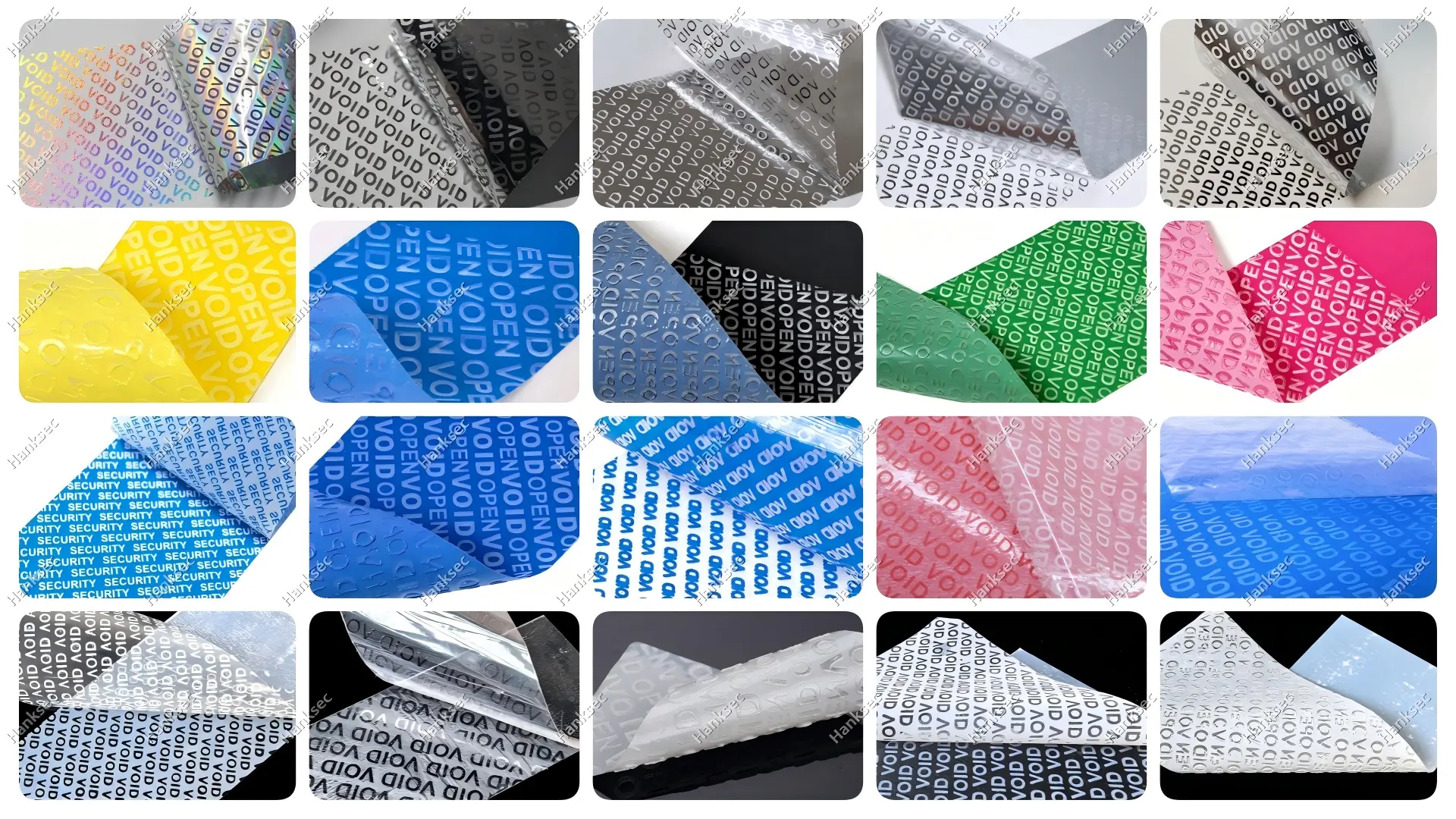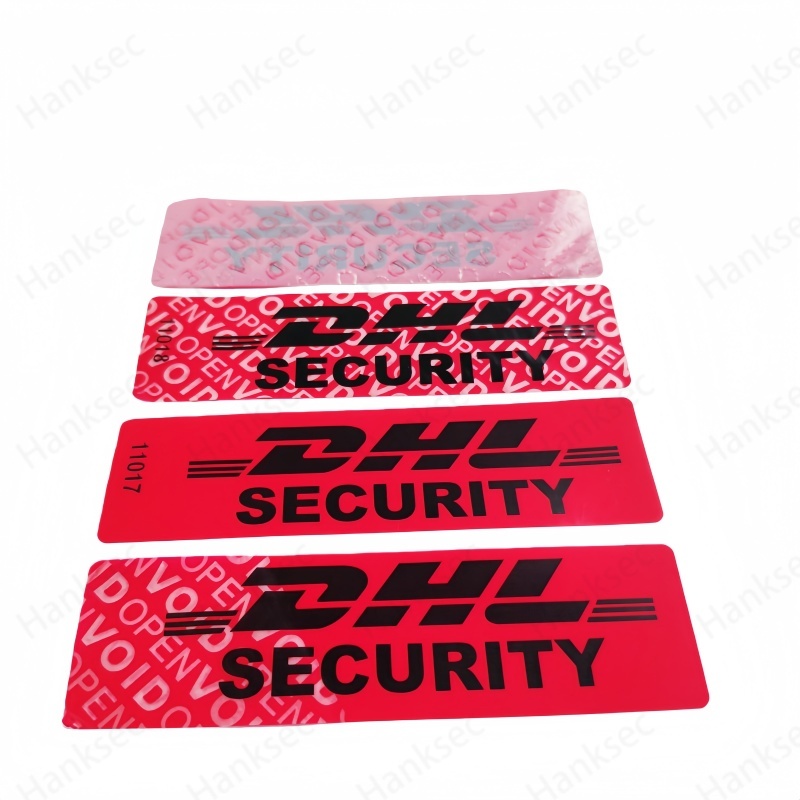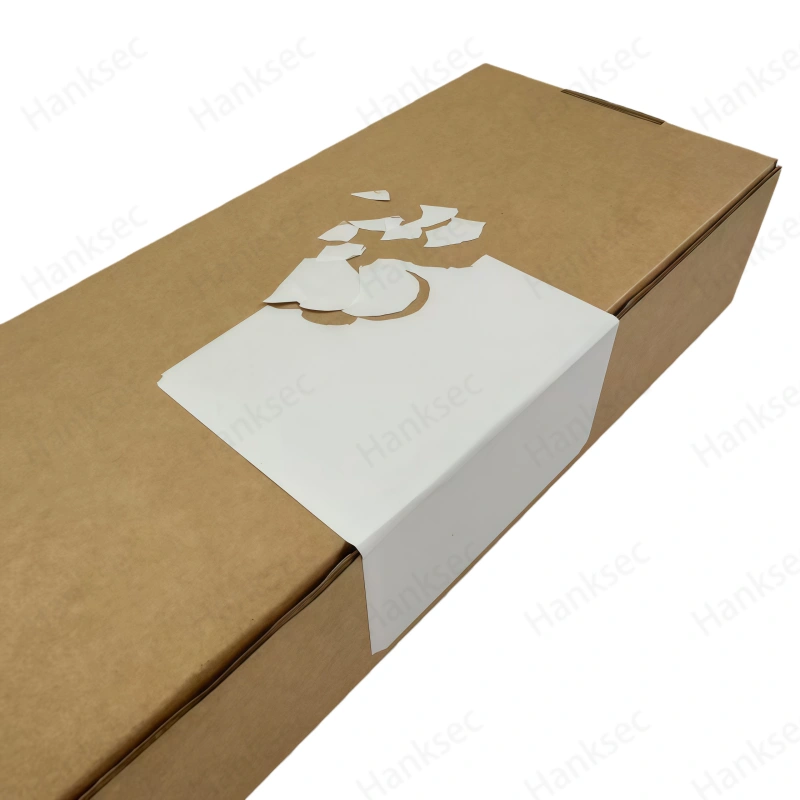
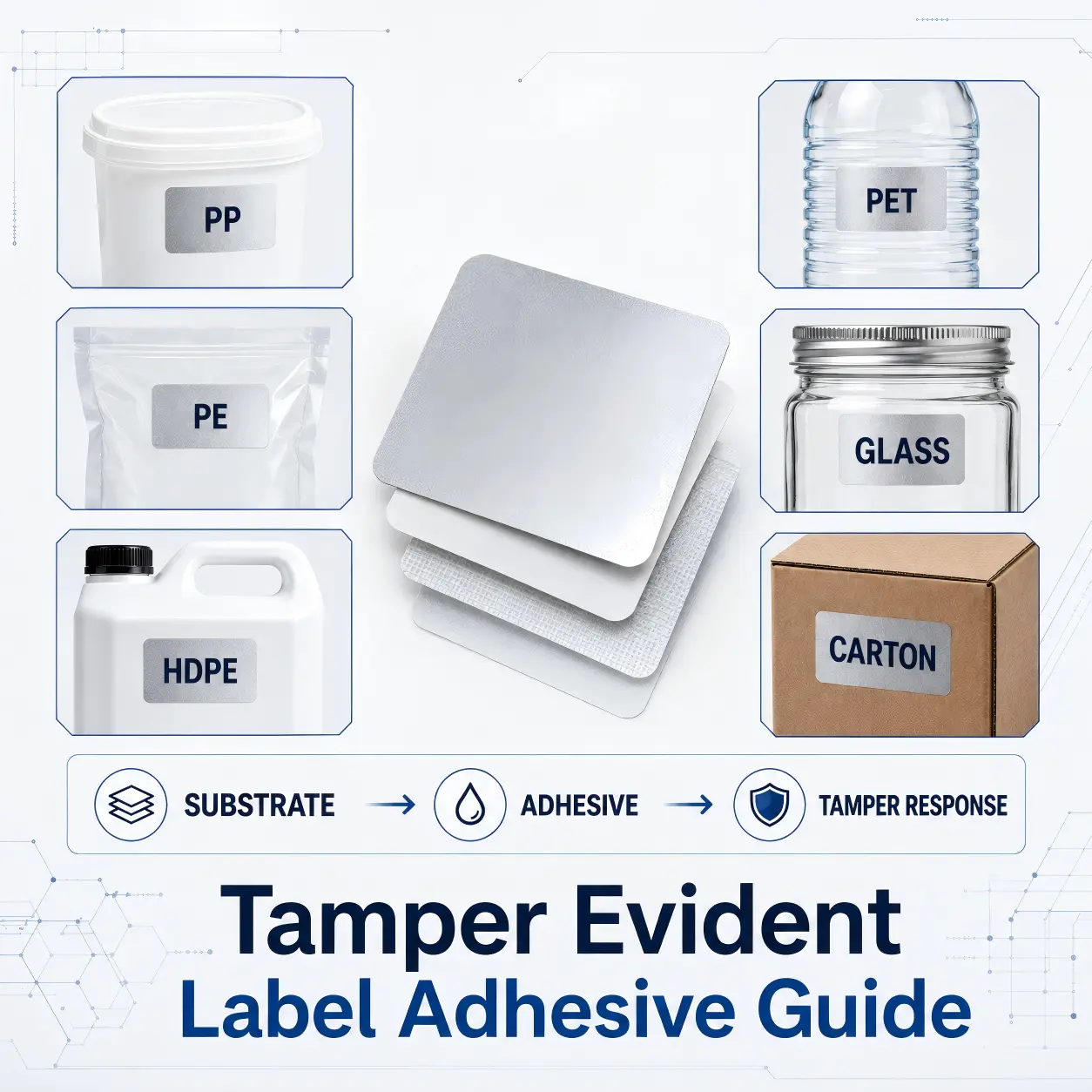
Tamper evident label adhesive should not be selected only by asking which adhesive is the “strongest.” For security labels, the adhesive must work together with the facestock, hidden security layer, release construction and actual application surface.
A VOID label may need enough bonding force to trigger a clear security message during removal. A destructible label may need the adhesive bond to become stronger than the fragile facestock so that the material fractures instead of peeling away intact. A clean-surface security label may require a different balance between adhesion, tamper activation and residue.
For a broader explanation of how facestock, security layers, adhesive and liner work together, see Hanksec’s Security Label Material Systems guide.
This is why the same security label material can perform differently on PP, PE, HDPE, PET, glass, coated cartons, painted metal and textured surfaces.
For procurement teams and label converters, the correct question is therefore not “Which adhesive is strongest?” but “Which adhesive construction produces the required tamper response on our actual substrate and production process?”
Tamper Evident Label Adhesive Selection Matrix by Application Surface
| Application Surface | Main Adhesion Challenge | Main Security Risk | What Buyers Should Test |
|---|---|---|---|
| PP | Low surface energy | Weak wet-out, edge lifting or incomplete VOID activation | Initial tack, dwell adhesion, edge lifting and tamper response |
| PE / HDPE | Low surface energy and variable molded surfaces | Insufficient bonding or unstable long-term adhesion | Wet-out, dwell, peel and environmental performance |
| PET | Surface coating, treatment or contamination | Unexpected peel behavior despite a smooth surface | Peel adhesion, VOID activation and residue behavior |
| Glass | Cleaning residue, moisture and condensation | Edge lifting or residue variation | Initial bonding, dwell, moisture exposure and removal behavior |
| Coated Carton | Varnish, lamination, recycled fiber or roughness | Incomplete bonding or uncontrolled surface damage | Wet-out, edge anchorage, VOID transfer and fiber interaction |
| Painted / Powder-Coated Metal | Paint chemistry and surface texture | Reduced contact area or coating lift | Bond strength, edge lifting, residue and coating inspection |
Fast selection rule: identify the real substrate first, then select and test the adhesive. Do not approve a security material only because it performs well on a standard test panel.
Why Surface Energy Matters for Security Label Adhesion
Pressure-sensitive adhesives need sufficient contact with the substrate to develop an effective bond. One important factor controlling that contact is surface energy.
Materials such as PP, PE and HDPE are commonly treated as low-surface-energy substrates. Compared with higher-surface-energy materials such as PET and glass, they can be more difficult for an adhesive to wet out effectively.
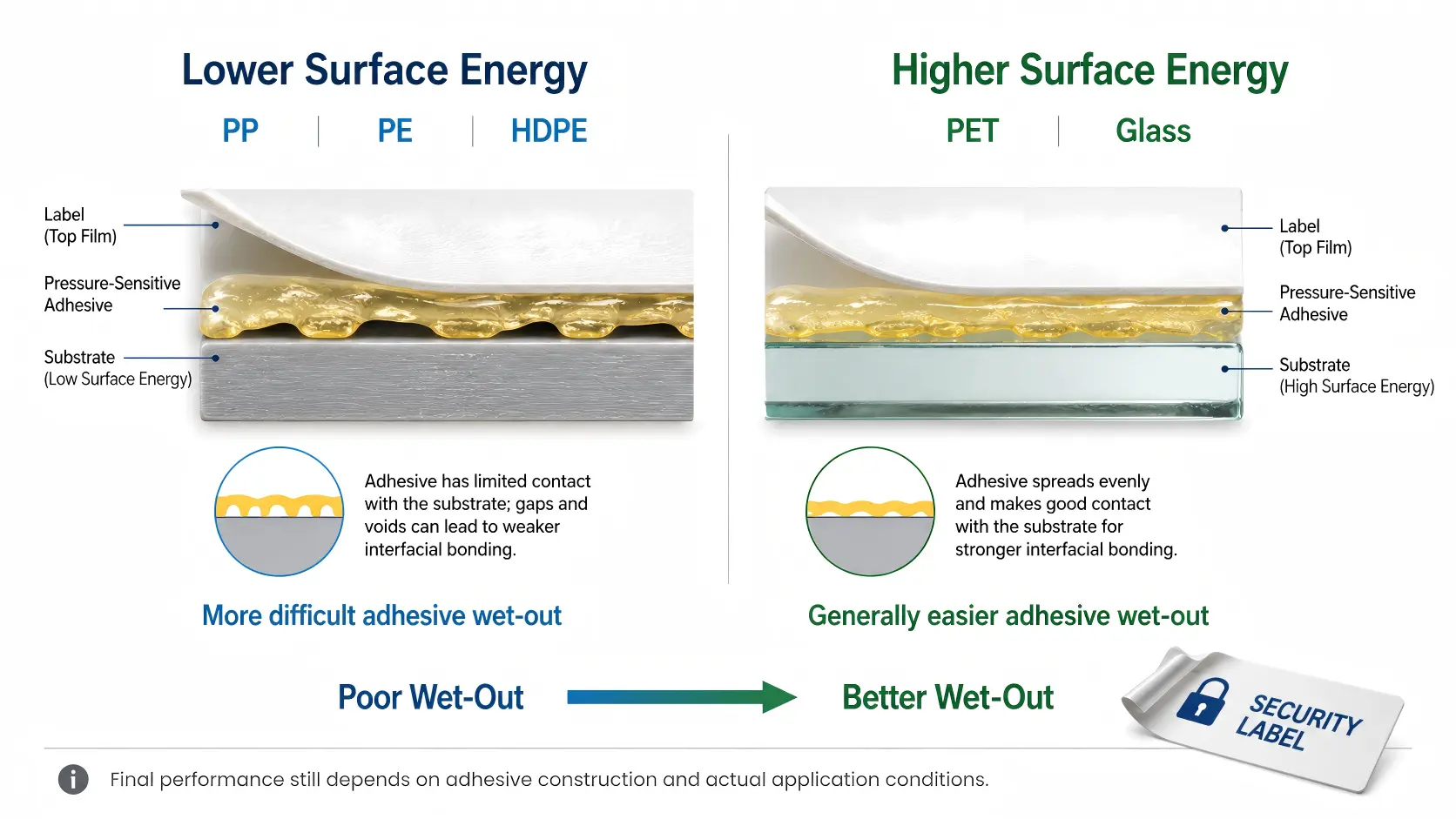
Avery Dennison’s adhesive technical guidance similarly identifies PET and glass as higher-surface-energy substrates, while HDPE and other polyolefin surfaces can present greater adhesive wet-out challenges.
This does not mean that security labels cannot be used on PP or HDPE. It means that the adhesive system should be selected specifically for the real substrate rather than assuming that one standard construction will behave equally on every plastic.
For buyers, the difference may appear as:
| Adhesive Behavior | Possible Result |
|---|---|
| Insufficient wet-out | Weak initial bonding or edge lifting |
| Insufficient dwell adhesion | Label removes before the security mechanism activates correctly |
| Excessive bonding for the application | Unwanted residue, coating damage or difficult removal |
| Correctly balanced bonding | Stable adhesion and intended VOID or destructible response |
Surface energy is therefore not only an adhesive issue. In a tamper-evident construction, it can determine whether the intended security mechanism actually works.
PP, PE and HDPE: Why Low-Surface-Energy Plastics Need Extra Attention
PP, PE and HDPE are widely used in packaging, molded containers, electronics housings, cosmetic bottles, logistics containers and industrial components.
They can also create one of the most common security-label failures: a label appears acceptable immediately after application but can later be lifted from the edge or removed without producing the intended tamper evidence.
The problem is not necessarily that the adhesive is defective. The adhesive may simply be poorly matched to the surface.
For low-surface-energy plastics, qualification should consider the complete combination of adhesive wet-out, application pressure, dwell time, surface texture, contamination and final tamper response.
PP Substrates
PP packaging and molded parts can vary significantly according to resin formulation, surface texture, additives and processing conditions.
A label tested on one PP sample should therefore not automatically be assumed to perform identically on another PP product.
For VOID materials, buyers should confirm that sufficient bonding develops to activate the hidden security message. For destructible materials, the adhesive should create enough anchorage for the fragile facestock to break instead of being removed intact.
PE and HDPE Substrates
PE and HDPE surfaces may require additional adhesive attention because standard pressure-sensitive constructions do not always wet out these surfaces efficiently.
Testing should include not only immediate adhesion but also representative dwell time, edge behavior and final removal response.
This is particularly important for containers, bottles and molded parts where curvature, texture or manufacturing additives may further influence the bond.
PET and Glass: Easier to Bond Does Not Mean Automatic Approval
PET and glass generally provide more favorable bonding surfaces than low-surface-energy polyolefins, but security-label performance should still be tested.
PET Surfaces
PET may appear smooth and consistent, but coatings, printing layers, contamination and surface treatments can change adhesive behavior.
A security label applied to untreated PET can behave differently from the same label applied to a coated or printed PET package.
Buyers should evaluate:
| Test Area | Reason |
|---|---|
| Initial tack | Confirm immediate anchorage |
| Dwell adhesion | Determine how bonding develops after application |
| Peel behavior | Evaluate the adhesive/substrate interaction |
| Tamper activation | Confirm the VOID or destructible mechanism activates correctly |
| Residue | Confirm full, partial or clean-surface requirement |
Glass Surfaces
Glass can provide strong adhesive contact, but the final result may still be affected by condensation, cleaning agents, dust, fingerprints or other contamination.
For cold-chain, beverage, medical or reusable-container applications, the buyer should reproduce the real cleaning and environmental conditions during testing rather than using only dry laboratory glass.
Coated Cartons and Paper Packaging Need a Different Evaluation
Cartons should not be treated as one uniform substrate.
A security label may be applied to coated paperboard, recycled carton, kraft board, varnished boxes, laminated packaging or printed cartons. Each surface can interact differently with the adhesive.
On a smooth varnished carton, the adhesive primarily interacts with the coating. On rough or recycled board, effective contact area may be lower. On paper-based surfaces, aggressive adhesive can also pull fibers from the package during removal.
For a full-transfer VOID construction, fiber damage may combine with the transferred security message and create stronger visible evidence. For applications where packaging appearance matters, excessive surface damage may instead be undesirable.
The required adhesive therefore depends on the security objective rather than on carton material name alone.
Surface Roughness Can Be as Important as Surface Energy
A rough surface reduces the real contact area available to the adhesive.
The top of the label may look fully applied while the adhesive underneath is only contacting the highest points of the surface texture.
This is common with:
| Surface | Typical Risk |
|---|---|
| Corrugated or rough carton | Limited contact area |
| Textured plastic housing | Edge lifting or incomplete adhesion |
| Powder-coated metal | Reduced wet-out across the texture |
| Embossed packaging | Uneven bonding across the label |
In these applications, simply choosing a material with a higher laboratory peel value does not automatically solve the problem. Adhesive flow, coat weight, facestock conformability and surface geometry must work together.
Why “Strongest Adhesive” Is the Wrong Purchasing Specification
A tamper-evident label is a controlled failure system.
Something must happen when removal is attempted.
With a full-transfer VOID construction, the system should separate in a way that transfers the security evidence to the substrate.
With a partial-transfer VOID material, the structure should produce evidence on both the film and application surface.
With a non-transfer construction, the security message should activate mainly within the label while meeting the required surface-residue target.
Converters comparing full-transfer, partial-transfer and non-transfer constructions can also review Hanksec’s VOID Label Material Rolls Selection Guide for roll format, substrate and converting requirements.
With a destructible material, the adhesive bond should work together with the fragile facestock so that removal causes tearing or fragmentation.
For converters selecting fragile facestock by breakage level and converting stability, see the Destructible Label Material Rolls Selection Guide.
If buyers specify only “use the strongest adhesive,” they may change the balance of this engineered failure mechanism.
The correct goal is therefore controlled tamper performance, not maximum adhesive strength in isolation.
Acrylic, Rubber-Based and Other Adhesive Directions
Security label constructions may use different pressure-sensitive adhesive technologies depending on substrate, environment, converting process and security requirement.
| Adhesive Direction | Why It May Be Considered | What Still Needs Testing |
|---|---|---|
| Acrylic PSA | Common direction for security label materials and durable applications | Substrate compatibility, dwell, temperature and residue |
| Rubber-Based / Hot-Melt Direction | May be considered when high initial tack or difficult substrates are involved | Ageing, heat, residue and final tamper behavior |
| Project-Specific Adhesive | Used when standard constructions do not meet the substrate or security requirement | Complete qualification on the real application |
The adhesive family name alone is not enough information for final approval. Formulation, coat weight, substrate, facestock and environmental conditions can all affect performance.
Initial Tack, Dwell Adhesion and Peel Adhesion Are Different
Buyers sometimes use the word “adhesion” as if it were one single value. In practice, different tests describe different parts of adhesive behavior.
| Property | What It Helps Evaluate |
|---|---|
| Initial Tack | How the adhesive begins to grab the substrate during application |
| Wet-Out | How effectively the adhesive establishes contact with the surface |
| Dwell Adhesion | How the bond develops after the label remains applied for a defined period |
| Peel Adhesion | Force measured while removing the adhesive construction under defined conditions |
| Edge Lifting | Whether edges remain anchored during real use |
| Tamper Response | Whether the complete security mechanism activates as intended |
This distinction is particularly important for tamper-evident materials. A high peel value does not by itself prove that the VOID message, residue pattern or destructible response will work correctly.
How Should Peel Adhesion Standards Be Used?
Standardized peel testing is useful for quality assurance and comparing the behavior of a pressure-sensitive construction under controlled conditions.
ASTM D3330/D3330M provides standardized methods for measuring the peel adhesion of pressure-sensitive tapes under defined test conditions.
However, a peel test should not be treated as a complete security-label approval.
The final tamper result also depends on the facestock, security layer, adhesive, liner, substrate, dwell condition and removal behavior.
For label converters, FINAT Technical Handbook also provide useful references for peel adhesion, tack, release force, ageing and adhesive coat-weight evaluation.
Recommended Qualification Workflow Before Bulk Production
| Step | Qualification Action | What to Record |
|---|---|---|
| 1 | Identify the exact application substrate | Material, coating, texture and supplier |
| 2 | Prepare representative production surfaces | Cleaning method and contamination condition |
| 3 | Apply the sample consistently | Application pressure and temperature |
| 4 | Allow representative dwell | Project-defined dwell condition |
| 5 | Check edge and surface bonding | Lifting, bubbles and incomplete contact |
| 6 | Perform peel evaluation | Bonding and residue behavior |
| 7 | Perform final tamper test | VOID clarity, transfer or fragmentation |
| 8 | Check surface condition | Residue, fiber tear, coating lift or staining |
| 9 | Repeat after relevant environmental exposure | Temperature, humidity or ageing effects |
| 10 | Approve the complete material construction | Facestock + adhesive + liner + substrate |
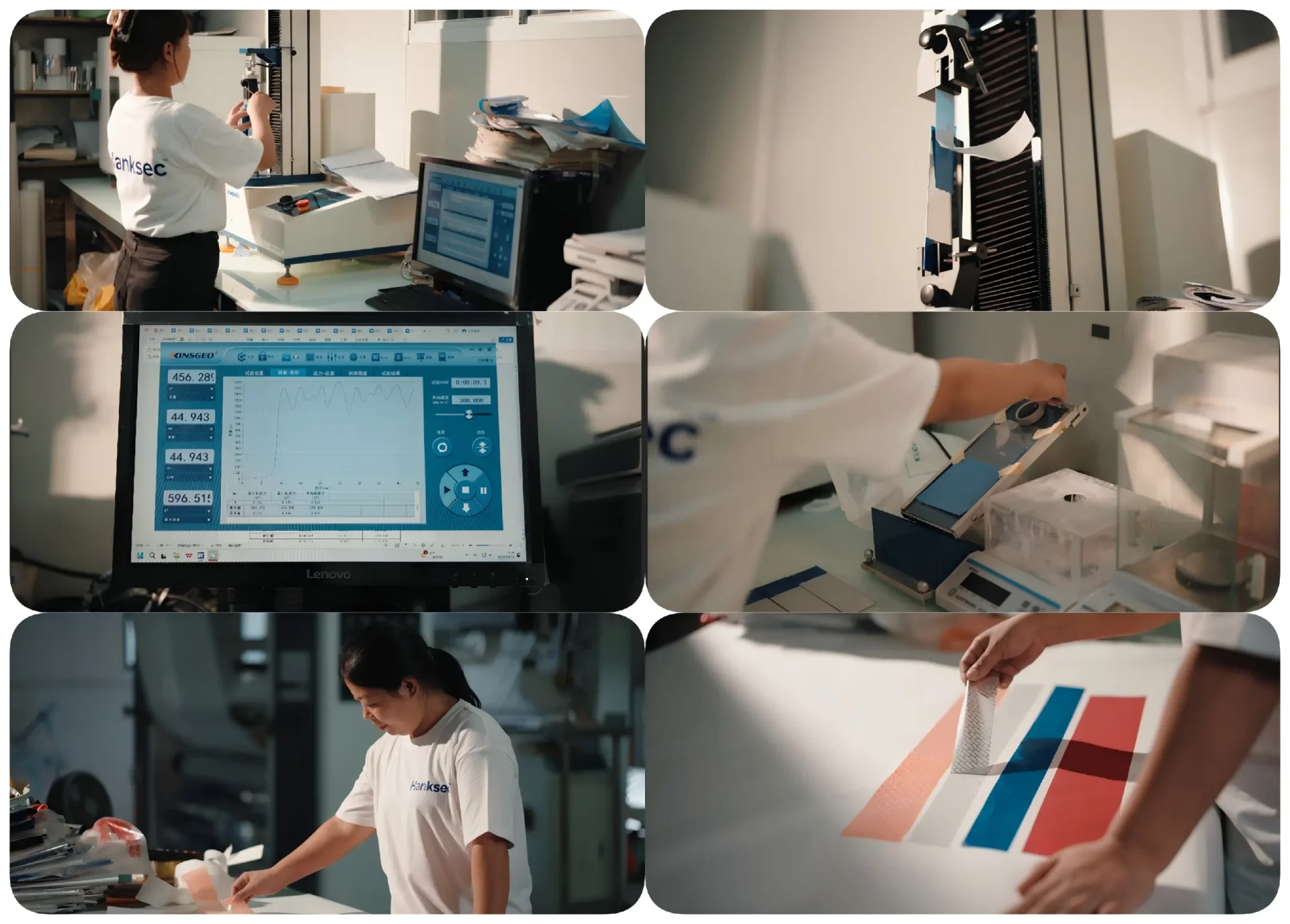
Hanksec Test Note: For adhesive compatibility projects, candidate security materials are evaluated on the actual customer substrate whenever possible. The qualification focuses on wet-out, edge lifting, dwell behavior, peel response, VOID or destructible activation, adhesive residue and visible surface damage before bulk production.
What Should Buyers Provide Before Requesting an Adhesive Recommendation?
| Information Required | Example |
|---|---|
| Application substrate | PP / HDPE / PET / glass / coated carton |
| Surface finish | Smooth / textured / varnished / painted |
| Security construction | Full / Partial / Non-Transfer / Destructible |
| Residue requirement | High residue / partial / relatively clean |
| Label size | Final converted dimensions |
| Application method | Manual / automatic |
| Operating environment | Indoor / humid / cold / elevated temperature |
| Printing and converting | Flexo / UV / Inkjet / Thermal Transfer / Die Cutting |
| Estimated quantity | Sample / trial / bulk production |
Buyers still selecting the required VOID construction can first compare Hanksec’s Tamper Evident VOID Label Materials before requesting adhesive compatibility testing.
The most useful additional item is an actual production substrate sample. A real bottle, carton, molded plastic part, metal panel or glass component can provide more reliable selection information than a generic description such as “plastic surface.”
For projects where the required tamper response is facestock fragmentation rather than VOID transfer, buyers can also review Hanksec’s Destructible Label Materials range.
Technical FAQ
What adhesive is best for tamper evident labels?
There is no single best adhesive for every application. The adhesive should be selected according to the substrate, surface energy, texture, security construction, residue requirement, environmental conditions and required tamper response.
Why do security labels have difficulty sticking to PP, PE or HDPE?
PP, PE and HDPE are low-surface-energy materials that can be more difficult for pressure-sensitive adhesives to wet out effectively. The final adhesive construction should therefore be tested on the actual molded or packaging surface.
Does higher peel adhesion always mean better tamper evidence?
No. Peel adhesion measures one aspect of adhesive performance under defined conditions. Tamper evidence also depends on the security layer, facestock, transfer mechanism, substrate and removal behavior.
Can the same VOID label adhesive be used on PET, glass and coated cartons?
Not necessarily. PET, glass and coated cartons can have very different surface energy, coatings, roughness and contamination conditions. One adhesive construction should not be assumed to provide identical performance on all three surfaces without testing.
Should buyers test the actual substrate before bulk production?
Yes. Testing the actual production substrate is strongly recommended because surface material, coating, texture, contamination and environmental conditions can significantly change bonding and final tamper-evident performance.
Request Security Label Adhesive Compatibility Testing
Send Hanksec the application substrate, surface finish, required tamper effect, residue requirement, label size, printing method and operating environment.
Hanksec can evaluate a suitable security material and adhesive direction for sample testing before bulk production.