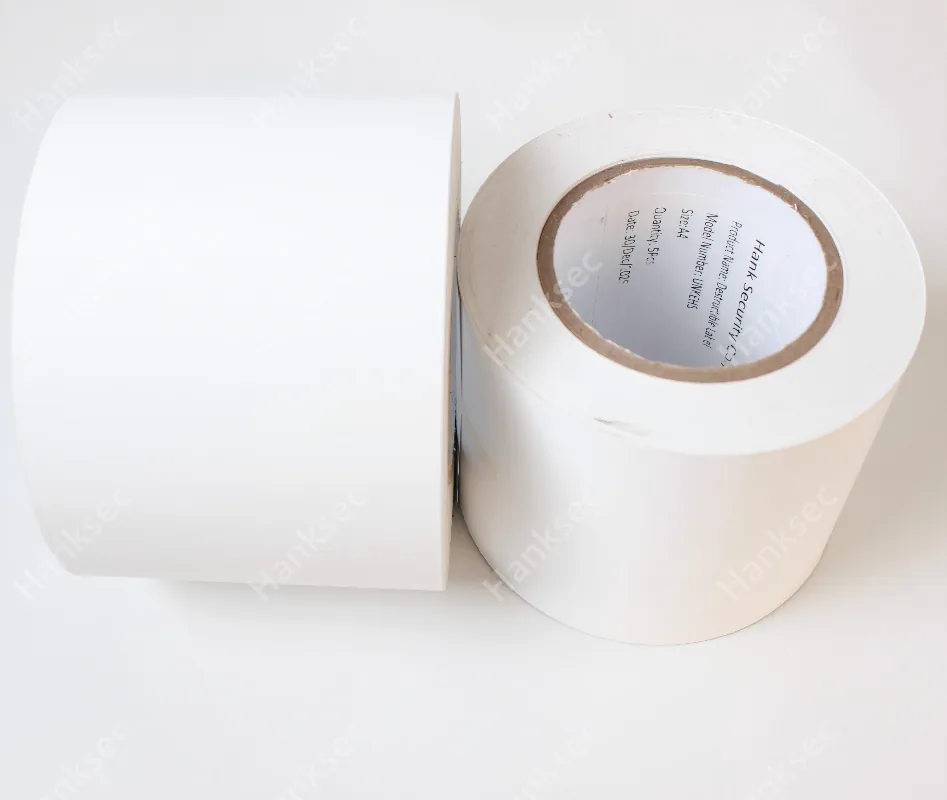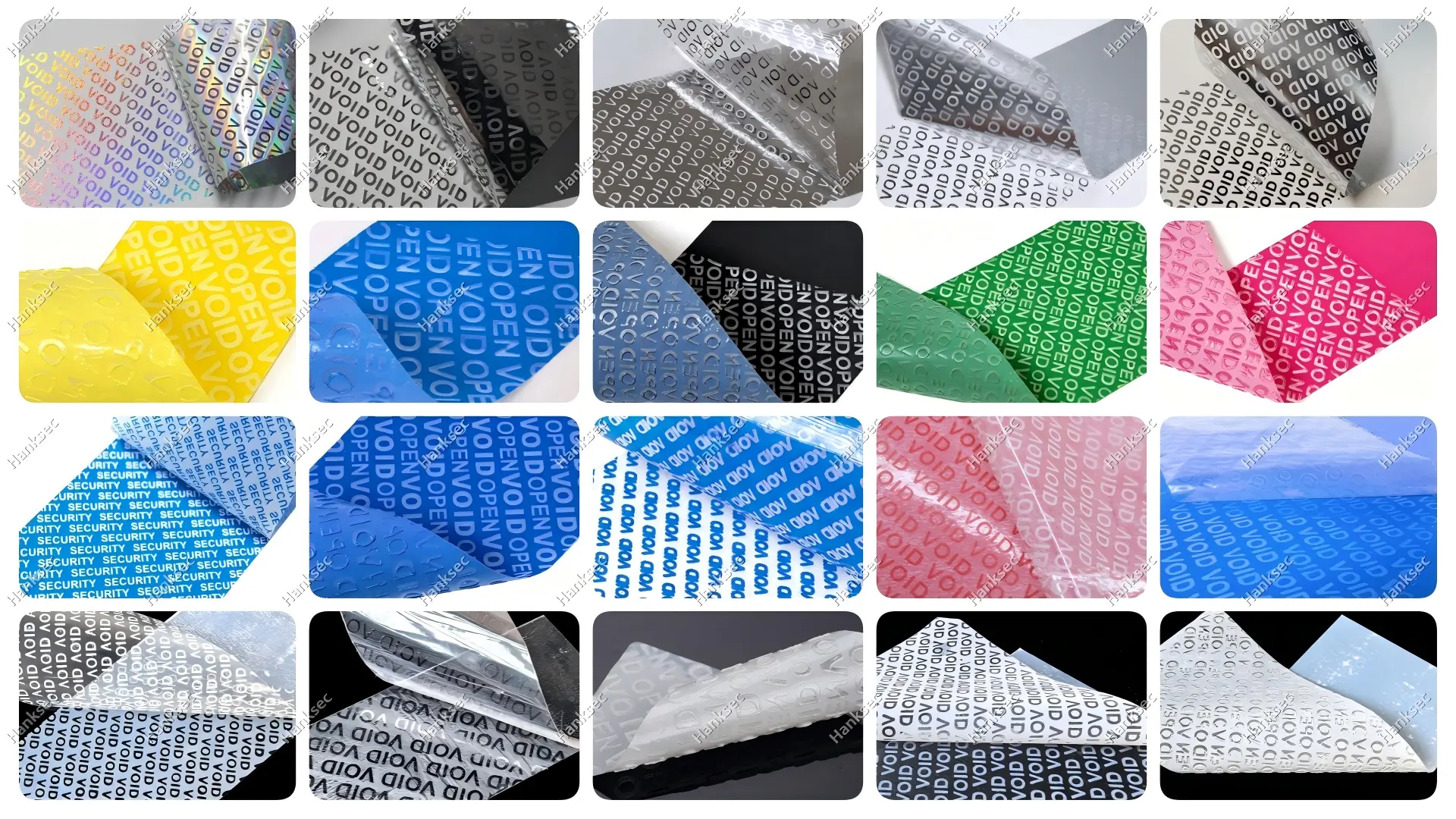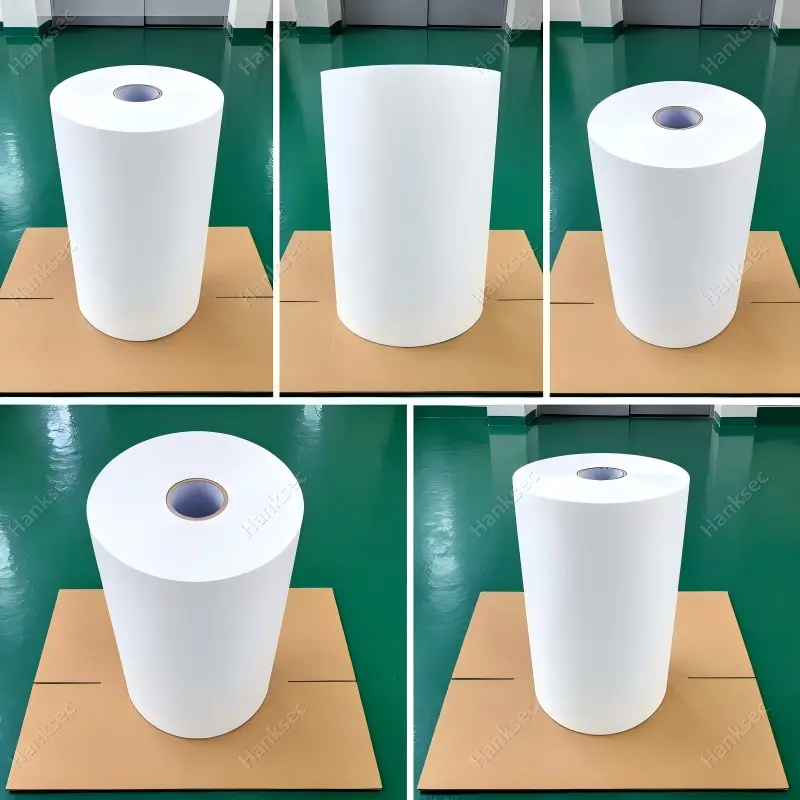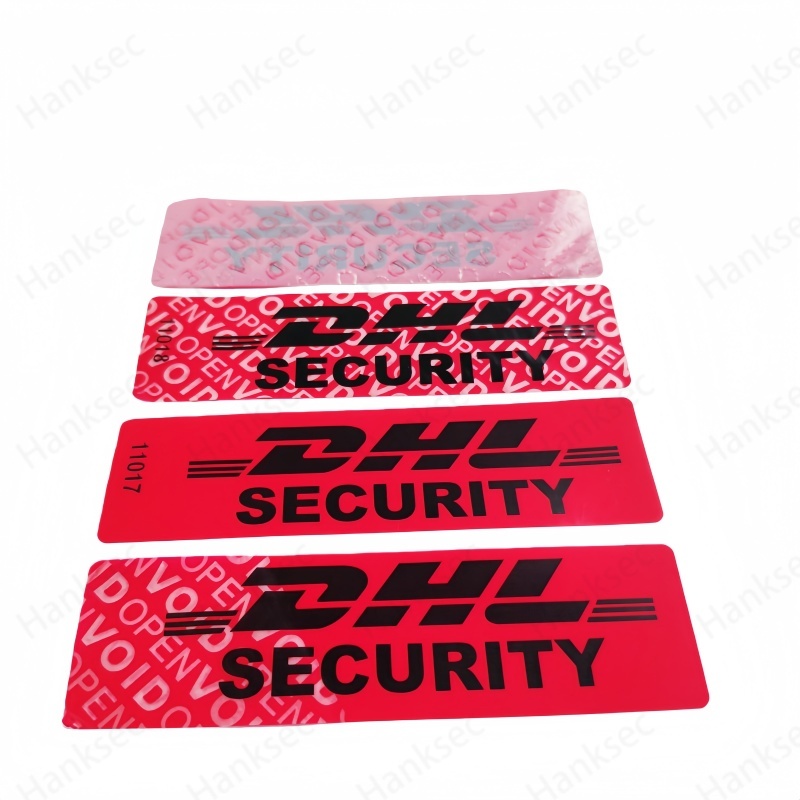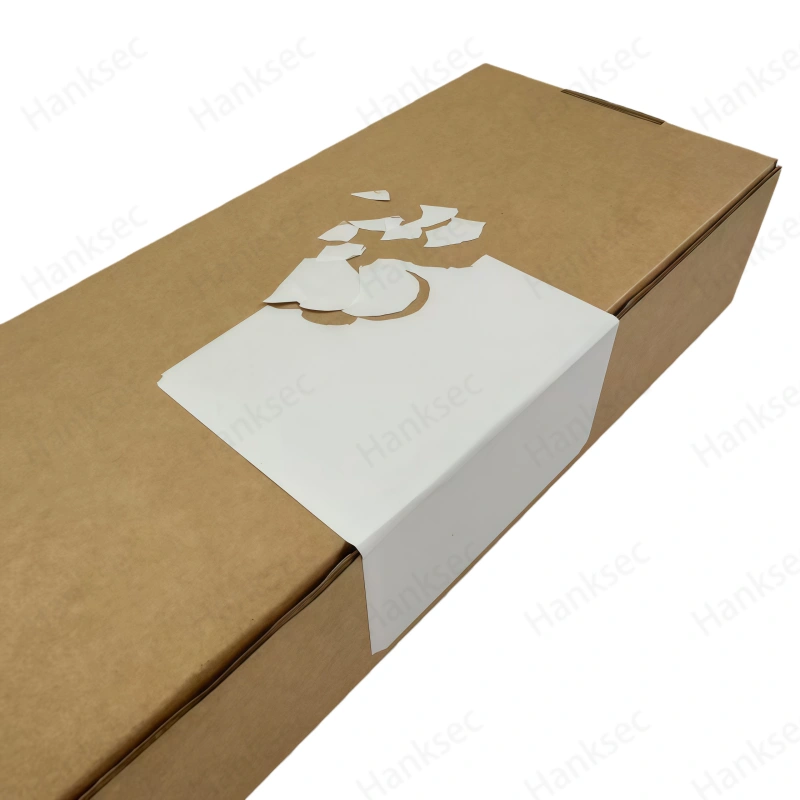
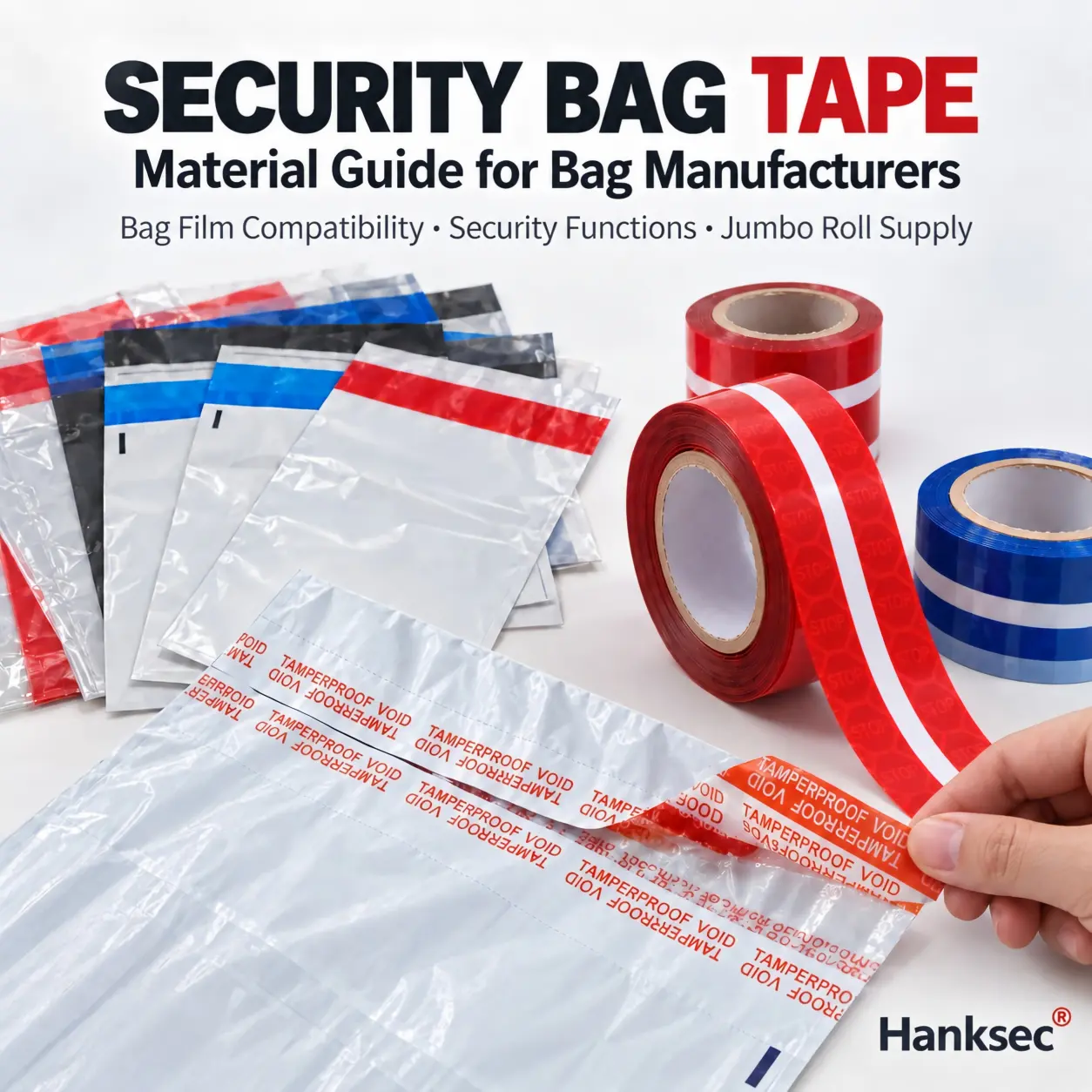
Tamper evident security bag tape is a functional sealing material designed to become part of the closure system of a security bag. When an unauthorized opening or manipulation attempt occurs, the tape is designed to create visible evidence such as a VOID or OPENED message, residue change, security-pattern change, material damage or another defined tamper indication.
For security bag manufacturers, plastic bag factories, packaging converters, security printers and material distributors, however, buying security bag tape is not simply a matter of choosing a roll with a VOID message.
Security bag tape for bag manufacturers should be selected according to the actual bag film, required tamper response and production process—not by tape appearance or security level alone.
The tape has to work together with:
- the bag film;
- adhesive system;
- security construction;
- release liner;
- printing or identification requirements;
- bag-making process;
- operating environment;
- required tamper response.
A security bag tape that performs correctly on one PE film may behave differently on another HDPE, LDPE, co-extruded, laminated, coated or recycled film.
For this reason, professional security bag tape selection starts with the finished bag construction and actual security requirement, not only tape color, VOID message or price.
Hanksec supplies Security Bag Tape Materials for security bag manufacturers, packaging converters and OEM security-packaging projects, including standard and customized security constructions for different bag applications.
Author
Hanksec specializes in tamper-evident security materials, VOID label materials, security tapes and converter-ready roll stock solutions. Our technical team supports material qualification, printing and converting evaluation, and application testing for label converters, packaging manufacturers and OEM customers.
Expertise:
Security Label Materials | VOID Materials | Security Tapes | Printing & Converting Evaluation
Quick Answer: How Do You Choose Tamper Evident Security Bag Tape?
A suitable security bag tape material should normally be selected according to five factors:
- Bag film — HDPE, LDPE, PE, co-extruded, laminated, coated or another film construction.
- Required tamper evidence — basic VOID indication, residue response, temperature-related evidence, liquid/solvent response or multiple security functions.
- Bag application — courier, evidence, cash deposit, confidential document, medical sample, duty-free or high-value transport.
- Bag-making process — the way the material will be slit, printed, integrated and processed during bag production.
- Supply format — slit roll, production roll or jumbo roll for further converting.
The correct tape is therefore not necessarily the tape with the largest number of security features.
It is the construction that creates clear, repeatable evidence on the actual bag film while remaining compatible with the customer’s production process.
Quick Security Bag Tape Selection Guide
| Bag Application | Typical Security Requirement | Material Direction to Evaluate |
|---|---|---|
| Standard Courier Bags | Visible opening evidence | Basic VOID security bag tape |
| E-commerce Security Bags | Opening evidence + production efficiency | VOID tape matched to PE bag film |
| Cash / Bank Deposit Bags | Strong, irreversible tamper evidence | Multi-function security construction |
| Evidence Bags | Clear opening evidence + identification | Higher-security construction with traceability options |
| Medical Sample Bags | Seal integrity + identification | Application-matched security tape |
| Confidential Document Bags | Opening evidence + serial identification | VOID tape with optional variable data |
| High-Value Transport Bags | Multiple tamper attack indicators | Multi-function security construction |
| Duty-Free / Controlled Bags | Visible opening evidence + traceability | Application-specific security construction |
The selection table is a starting point rather than a universal specification. The actual bag film and required tamper response still need to be confirmed before bulk production.
Security Bag Tape vs Ordinary Security Packaging Tape
Both products may use VOID technology, pressure-sensitive adhesives and hidden security messages, but their roles in production are different.
Tamper evident security packaging tape is commonly applied directly to:
- cartons;
- boxes;
- envelopes;
- finished parcels;
- other packaging surfaces.
By contrast, security bag tape is normally developed as part of the closure system of a security bag.
Depending on the bag-manufacturing process, the tape may need to be:
- slit to the required width;
- integrated with PE or another bag film;
- processed with a release liner;
- printed with identification information;
- aligned with bag-making equipment;
- used consistently during continuous production.
This means security bag tape must perform not only when someone later opens the finished bag, but also during the customer’s manufacturing and converting process.
Buyers looking for carton and parcel sealing rather than bag-manufacturing materials can refer to Hanksec’s Tamper Evident Security Packaging Tapes Guide.
How Security Bag Tape Works in a Tamper Evident Bag
A security bag closure is a system rather than a single adhesive layer.
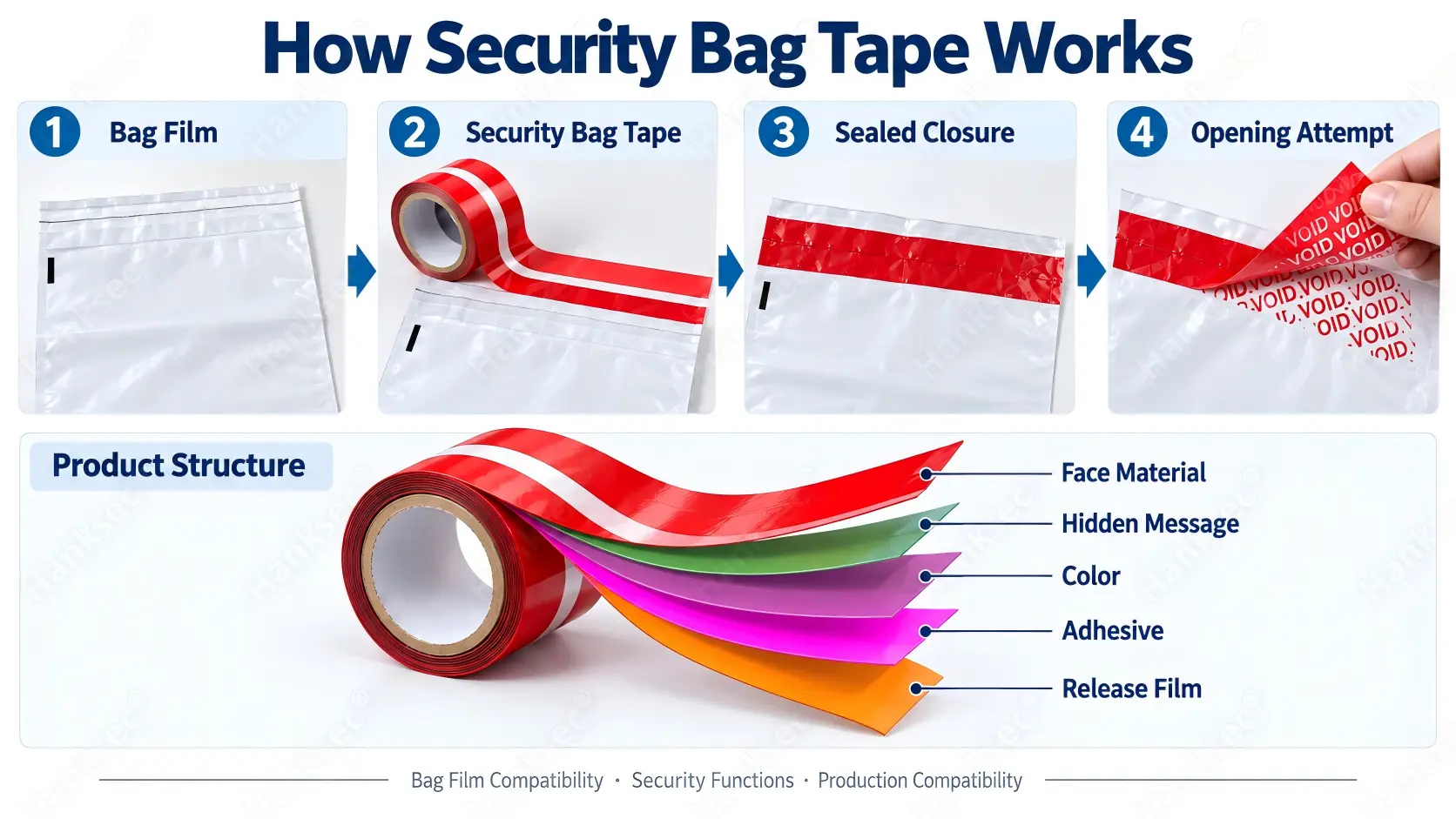
Depending on the construction, the system can involve:
- the bag film;
- the security tape carrier or functional film;
- hidden VOID or other tamper-evident layers;
- pressure-sensitive adhesive;
- release liner before application or integration;
- printed identification or security information.
When the bag is sealed, the adhesive establishes contact with the intended bag-film surface.
If someone later attempts to peel or otherwise manipulate the closure, the approved security construction is designed to produce defined evidence.
Depending on the selected design, this may include:
- VOID;
- VOIDOPEN;
- OPENED;
- transferred residue;
- changed security pattern;
- temperature-related indication;
- water- or solvent-related indication;
- visible damage or security cuts.
The exact response depends on the selected tape construction.
This is why a security bag tape cannot be evaluated simply by looking at the unused roll.
The more useful question is:
What happens after the tape has been converted into a finished security bag, bonded to the actual film and exposed to the relevant opening or tampering attempt?
Why Bag Film Compatibility Matters
The bag film is one of the most important variables affecting security bag tape performance.
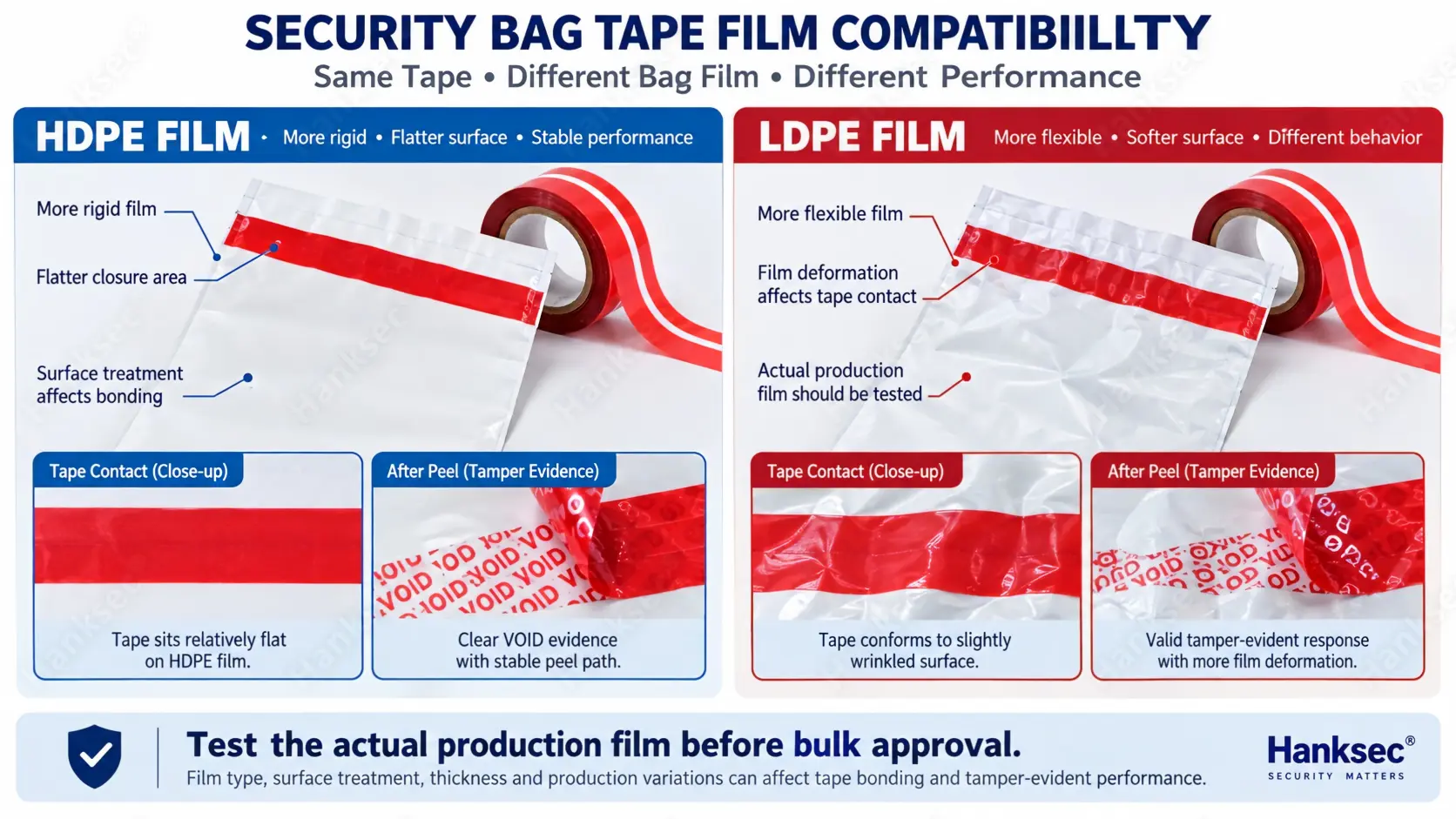
Security bags may use:
- HDPE;
- LDPE;
- other PE constructions;
- co-extruded films;
- laminated films;
- printed films;
- coated films;
- recycled-plastic constructions.
These surfaces should not automatically be assumed to provide identical adhesive behavior.
Hanksec’s existing security bag tape range also emphasizes testing against the actual film and production conditions rather than approving material only from a generic film description.
Security Bag Tape for HDPE Film
HDPE is commonly used in lightweight courier and security-bag constructions.
Polyethylene surfaces can present more demanding bonding conditions than some higher-surface-energy substrates. The result may also be affected by surface treatment, coating, printing and other film variables.
A suitable construction may therefore need to consider:
- actual HDPE surface condition;
- film treatment;
- printing or coating on the film;
- adhesive wet-out;
- application pressure;
- dwell time;
- production conditions.
A tape can appear to stick during initial assembly but still provide an unsatisfactory tamper response if the bond between the adhesive and bag surface does not develop as required.
For this reason, the actual HDPE film should be tested before mass production whenever practical.
For a deeper explanation of PE-family substrates, surface condition, adhesive wet-out and tamper response, see Hanksec’s Tamper Evident Label Adhesive Guide.
Security Bag Tape for LDPE Film
LDPE provides greater flexibility than many HDPE constructions and is widely used where the bag requires more softness or conformability.
The flexible film can influence:
- adhesive contact;
- tape flatness;
- peel behavior;
- closure deformation;
- final VOID response.
The tape should therefore be evaluated as part of the complete bag closure rather than only as a flat laboratory sample.
If the customer changes film suppliers, formulations or surface treatments, rechecking tape performance is advisable because apparently similar PE films may not behave identically.
Co-Extruded, Laminated and Coated Bag Films
More complex bag constructions introduce additional variables.
A co-extruded film can contain multiple polymer layers designed to provide functions such as:
- mechanical strength;
- sealability;
- appearance;
- barrier performance;
- printing performance.
Laminated or coated films can introduce different surface characteristics.
The security tape interacts with the actual outer surface it contacts, not simply the generic polymer family named in the specification.
For this reason, information such as:
“The bag is PE.”
may not always be sufficient for technical evaluation.
A more useful approach is to provide:
- the actual production film;
- a representative film sample;
- or a finished bag.
This allows the adhesive and tamper response to be evaluated against the real surface.
Adhesion and Tamper Response: Why Strong Bonding Alone Is Not Enough
Strong initial adhesion does not automatically mean a security bag tape is functioning correctly.
A tape can appear to bond strongly and still produce:
- weak VOID visibility;
- inconsistent residue;
- excessive film distortion;
- poor separation behavior;
- incomplete tamper activation.
Security performance depends on the balance between:
adhesive-to-bag-film bonding
and
controlled separation inside the security construction.
If the tape-to-bag bond is insufficient, the material may lift without generating the intended evidence.
If the construction is poorly balanced in the opposite direction, removal may create an inconsistent result that does not match the approved security effect.
This principle is particularly important for tamper-evident materials: a high peel value alone does not prove that the VOID message or other tamper mechanism will activate correctly. Hanksec’s adhesive guide makes the same distinction between adhesive strength and complete tamper response.
Security bag tape therefore needs to be evaluated as a complete functional construction, not by adhesive strength alone.
Security Functions Available in Security Bag Tape
Different applications face different tampering risks.
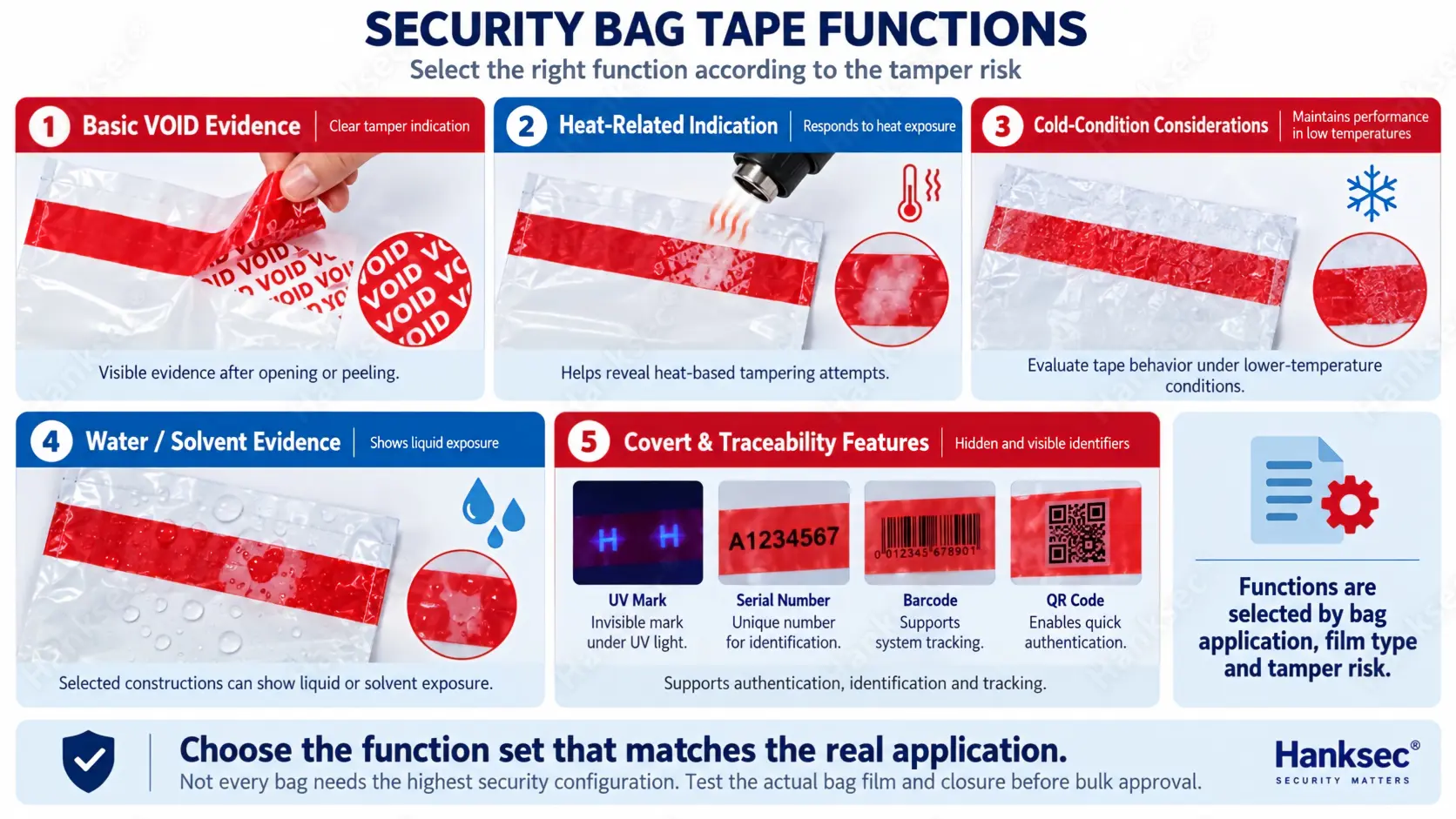
Security functions should therefore be selected according to the actual threat rather than simply adding every available feature.
Hanksec’s security bag tape products can combine basic VOID evidence with other project-specific functions such as temperature-related indication, liquid/solvent-sensitive features, UV elements and variable identification. The security-level terminology used on Hanksec product pages describes Hanksec product configurations for project selection; it should not be interpreted as a universal industry grading standard.
For specific Hanksec product configurations, buyers can refer to the Tamper Evident Bag Tape Types Guide.
Basic VOID Opening Evidence
The fundamental security function is visible evidence after the closure is peeled or opened.
Depending on the selected construction, a hidden message can include:
- VOID;
- VOIDOPEN;
- OPENED;
- STOP;
- custom text or pattern.
This type of construction is appropriate where the main threat is unauthorized opening or peeling and the primary requirement is clear visual evidence.
Heat-Related Tamper Indication
An attacker may attempt to use heat to influence adhesive or manipulate the closure.
Selected security bag tape constructions can incorporate temperature-responsive features intended to create additional visible evidence when exposed to defined conditions.
The objective is not to make the bag physically impossible to heat.
The objective is to make a relevant manipulation attempt more difficult to conceal.
Such functions may be considered for applications such as:
- evidence packaging;
- cash handling;
- controlled logistics;
- higher-risk security bags.
Cold-Condition and Cold-Tamper Considerations
Cold conditions can change adhesive behavior and may also form part of the tamper-risk assessment for certain projects.
Depending on the selected construction, evaluation may therefore involve:
- adhesive performance under the expected lower-temperature conditions;
- or a functional layer intended to create evidence after a defined cold-related manipulation.
The required behavior should be confirmed against the intended application and test conditions.
Water- and Solvent-Related Evidence
Liquid or solvent manipulation is another possible risk in some higher-security bag applications.
Certain functional constructions can incorporate layers intended to show visible change after defined liquid or solvent exposure.
These features are most relevant where basic peel-activated VOID evidence alone is considered insufficient.
The required response should always be confirmed through the selected sample or approved construction rather than assumed from the feature name.
Covert and Traceability Features
Higher-security projects may also use authentication or traceability features such as:
- hidden UV marks;
- customized security patterns;
- serial numbers;
- barcodes;
- QR codes;
- variable data.
These functions should be distinguished from tamper evidence itself.
For example, a serial number helps identify or track a bag, but the number alone does not prove that the closure has been opened.
A well-designed system gives different functions different roles:
tamper evidence + identification + traceability.
How to Choose the Right Security Configuration
More security functions are not automatically better.
Adding unnecessary functions can increase:
- material complexity;
- converting requirements;
- testing requirements;
- cost.
A standard courier bag may require only clear evidence of opening.
An evidence or high-value transport bag may require several independent indicators.
The better question is therefore:
What manipulation methods must the finished bag reveal?
Step 1 — Define the Bag Application
Start with the actual use:
- courier bag;
- cash or deposit bag;
- evidence bag;
- confidential-document bag;
- medical or sample-transport bag;
- high-value transport bag.
Step 2 — Identify the Main Tamper Risks
Possible concerns can include:
- peeling;
- attempted resealing;
- heating;
- cooling;
- liquid or solvent exposure;
- substitution or identification fraud.
Step 3 — Select Only the Functions Needed
The security configuration can then be built around the relevant risk instead of automatically choosing the construction with the largest number of functions.
A higher security-level configuration cannot compensate for poor bonding to the actual bag film.
The final selection still has to balance:
security function + bag film + production compatibility + repeatability.
Security Bag Tape by Application
The application helps define what must be tested, but the application name alone should not be used as a material specification.
Evidence Bags
Evidence bags require clear and irreversible evidence when the closure has been disturbed.
Depending on the chain-of-custody process, the finished bag may also include:
- sequential identification;
- barcodes;
- writable information areas;
- other traceability features.
The security tape is one component of the complete evidence-bag system and must remain compatible with the selected bag film and production method.
For a broader discussion of finished evidence bags, traceability and chain-of-custody applications, see Hanksec’s Evidence Bags & Tamper Evident Security Bags Guide.
Bank Deposit and Cash Bags
Bank deposit and cash-transport bags may require stronger and more easily inspected opening evidence than ordinary mailing bags.
Depending on the project, the finished bag can combine visible tamper evidence with identification or additional attack indicators.
The final tape construction should still be selected according to:
- actual bag film;
- closure design;
- production process;
- handling environment;
- required inspection method.
The complete finished closure—not only the unused tape—should be validated before bulk production.
Courier and E-Commerce Security Bags
Courier and e-commerce security bags often need to balance security with production efficiency.
Typical priorities include:
- reliable bonding to the selected PE film;
- stable long-roll production;
- visible opening evidence;
- consistent liner behavior;
- production efficiency;
- appropriate cost.
For these applications, adding every advanced security feature may not be necessary.
A properly matched VOID construction can be more appropriate if it provides repeatable evidence at the required production volume.
Medical and Sample Transport Bags
Medical and sample-transport bags may require clear opening evidence together with identification and traceability.
The security tape should therefore be evaluated as one component of the complete packaging system.
Requirements related to medical transport, specimen handling or regulatory compliance must be assessed for the finished package and its intended use, rather than inferred from the security tape alone.
Jumbo Roll Security Bag Tape for Bag Manufacturers
For a security bag factory, the purchasing requirement is very different from that of a buyer purchasing a few finished tape rolls.
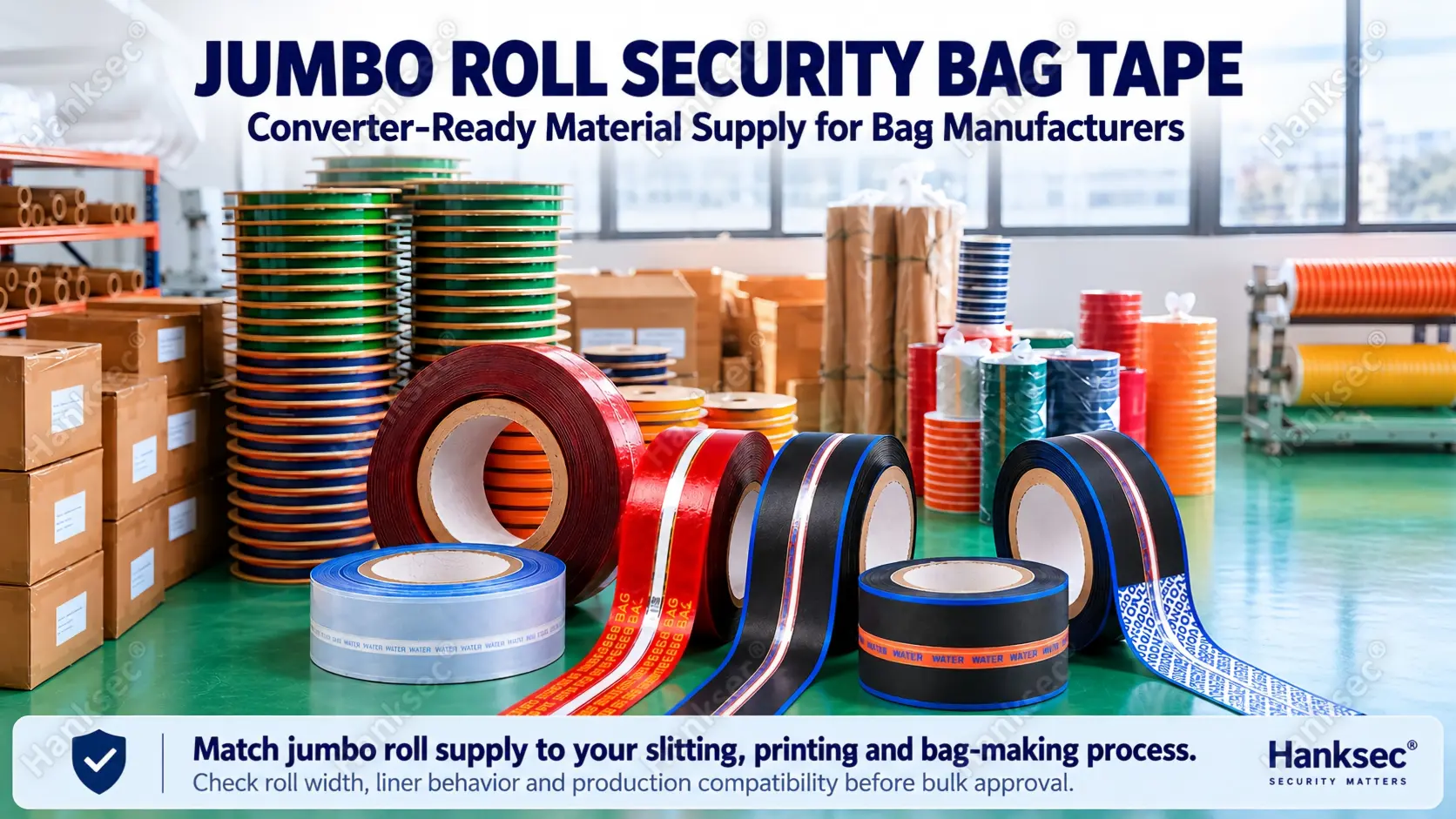
A bag manufacturer may require material for:
- continuous production;
- slitting;
- printing;
- integration into the bag-making process;
- customer-specific dimensions.
For these customers, Jumbo Roll Security Bag Tape provides a material format intended for further converting and bag production.
Hanksec’s current jumbo-roll product positioning is specifically aimed at security bag factories, packaging converters, printing companies and OEM security-packaging manufacturers.
What Should Be Evaluated in Jumbo Roll Material?
The important requirements are not limited to roll width and price.
Roll Stability
The roll should run consistently through the intended production process.
Slitting Performance
The material should remain stable when converted to the required narrower widths.
Release Liner Behavior
The liner should separate consistently during the customer’s actual process.
Printing Registration
Where logos, warning text, serial numbers, barcodes or other information are printed, registration needs to remain stable.
Tape Flatness
Excessive curl or distortion can create production difficulties.
Security Response
The converted tape must still create the approved tamper evidence after it is integrated into the finished bag.
This is why a jumbo-roll project should be evaluated through the complete converting process rather than by visually inspecting the incoming roll alone.
Printing and Identification Options
Security bag tape may need to carry both security information and production identification.
Depending on the project, this can include:
- brand logo;
- warning text;
- custom VOID message;
- sequential number;
- barcode;
- QR code;
- batch information;
- UV marking.
Visual readability is not the same as formal barcode verification.
Where formal barcode quality verification is required, GS1 guidance on printed barcode quality recommends using appropriate barcode-verification equipment compliant with the relevant ISO/IEC requirements.
For more detailed information about UV flexo, thermal-transfer, inkjet and digital-printing compatibility, see Hanksec’s Printable Security Label Materials Guide.
Release Liner Performance
Release liner behavior is particularly important when security bag tape is processed in an automatic or semi-automatic production environment.
If the release is too tight for the process, possible problems can include:
- difficult liner separation;
- unstable feeding;
- production slowdown;
- inconsistent processing.
If the release is too light, premature separation or handling instability may occur.
The liner therefore needs to be evaluated together with:
- the adhesive;
- tape construction;
- production speed;
- actual converting process.
This is why release liner selection should not be treated only as a low-cost backing component.
How to Test Security Bag Tape Before Bulk Production
Before mass production, testing should focus on the actual use condition.
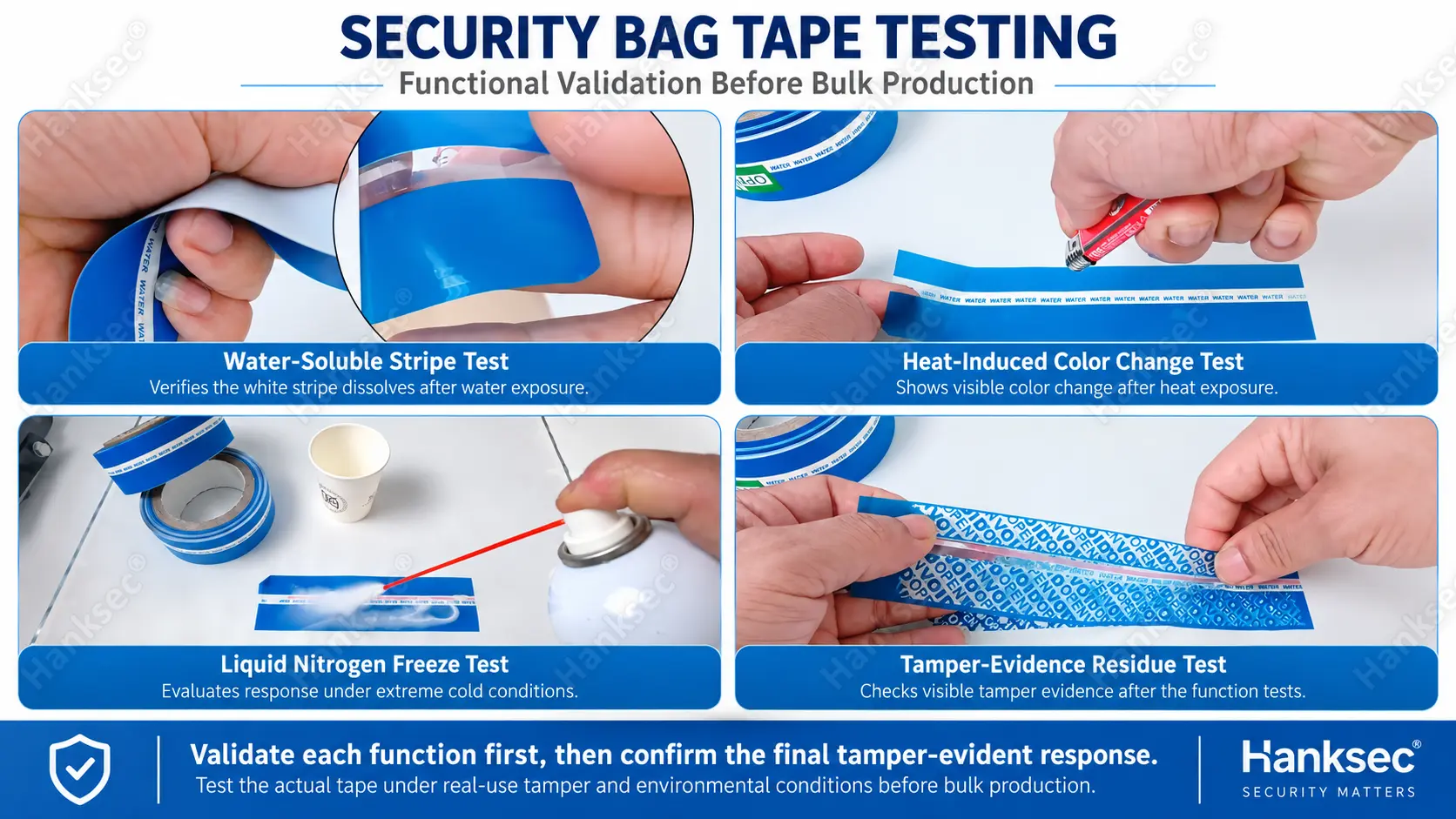
For the higher-security construction shown above, function-specific validation can be performed in sequence: water-soluble stripe response → heat-induced color change → liquid nitrogen freeze response → final peel testing to confirm that visible tamper evidence remains after the functional tests. This sequence supplements the broader qualification checks below and should not be treated as a universal test procedure for every security bag tape construction.
A practical qualification process can include the following.
1. Test the Actual Bag Film
Apply or integrate the candidate tape with the real HDPE, LDPE, PE, laminated, coated or co-extruded film whenever possible.
2. Check Initial and Developed Adhesion
Do not evaluate only the first few seconds after application.
Pressure-sensitive adhesive behavior can develop after application and dwell time.
3. Evaluate the Tamper Response
Check whether the approved VOID, residue or other security effect appears clearly and consistently.
4. Check Residue and Surface Behavior
Confirm that the result matches the intended security construction.
5. Evaluate Production Compatibility
Where possible, run the material through the customer’s actual:
- slitting;
- printing;
- bag-making;
- dispensing or integration process.
6. Evaluate Relevant Environmental Conditions
If the finished bag is expected to encounter heat, cold, moisture or another defined condition, evaluate the selected construction under representative conditions.
ASTM D3330/D3330M-04(2025) provides standardized test methods for measuring peel adhesion of pressure-sensitive tapes. ASTM explains that these methods can be used to compare a tape’s bond to specified surfaces, but peel values are quality-assurance data rather than a complete definition of finished functional performance.
For security bag tape, laboratory peel testing should therefore be combined with testing on the actual bag film and finished closure.
For a broader converter-level qualification workflow covering adhesion, release force, printing, die cutting and tamper-response testing, see Hanksec’s Security Label Material Quality Control Guide.
Why Sample Testing Matters More Than Security Level Alone
A higher security-level configuration cannot compensate for:
- poor bonding to the actual bag film;
- unstable liner behavior;
- poor print durability;
- production incompatibility;
- inconsistent tamper activation.
Security level is only one selection dimension.
The final approval should consider:
security function + actual bag film + production compatibility + repeatability.
For OEM and high-volume projects, this is especially important because the tape becomes one part of the finished bag-manufacturing system.
Quality, Troubleshooting & Production Consistency
Two security bag tapes can look very similar before conversion.
Both may have:
- similar color;
- similar VOID text;
- similar width;
- similar thickness.
The real difference often becomes visible during production and final use.
Common Security Bag Tape Problems
| Problem | Main Areas to Check |
|---|---|
| Tape lifts from bag film | Adhesive / surface condition / film treatment |
| VOID message is weak | Security construction / adhesive-to-film interaction |
| Tape peels away too cleanly | Bonding / wrong security construction |
| Residue does not match requirement | Transfer type / approved security effect |
| Liner is difficult to separate | Release level / liner / production process |
| Tape curls during production | Material construction / handling / processing conditions |
| Printed information rubs off | Printable surface / ink compatibility |
| Barcode is difficult to scan | Print quality / contrast / registration |
| Security response varies between rolls | Material or coating consistency |
| Sample works but production line does not | Converting conditions / speed / process |
| Performance changes after changing bag film | Surface compatibility requires revalidation |
The purpose of troubleshooting is not to ask the buyer to become an adhesive or coating engineer.
The buyer mainly needs to explain:
what is happening + what bag film is being used + what result is expected.
The material supplier can then determine which part of the construction should be investigated.
High-Quality vs Poorly Controlled Security Bag Tape
| Evaluation Area | Better-Controlled Material | Poorly Controlled Material |
|---|---|---|
| Adhesive Bonding | Repeatable on approved film | Variable bonding or edge lifting |
| VOID Response | Clear and consistent | Weak, incomplete or patchy |
| Functional Layers | Predictable approved response | Inconsistent indication |
| Release Liner | Stable separation in approved process | Too tight or premature release |
| Slitting | Stable roll conversion | Curl, edge or handling problems |
| Printing | Reliable on approved print system | Ink-adhesion or durability problems |
| Roll Consistency | Repeatable between approved batches | Significant variation |
| Bag-Line Performance | Stable after qualification | Frequent process adjustment |
| Final Tamper Evidence | Matches approved sample | Changes after conversion or use |
A security bag tape should not be judged only by whether one sample can display a VOID message.
The real manufacturing challenge is achieving the intended response consistently across:
- production rolls;
- finished bags;
- repeat orders.
How Hanksec Approaches Security Bag Tape Projects
Hanksec develops tamper-evident security materials for B2B customers including security bag factories, packaging converters, security printers, distributors and OEM manufacturers.
The technical process normally starts with the customer’s actual application rather than simply recommending the highest security configuration.
Understand the Bag and Application
Useful information can include:
- HDPE, LDPE or another film;
- surface printing or coating;
- representative film sample;
- finished bag sample;
- final bag application.
Understand the Problem or Required Security Effect
The buyer does not need to know the adhesive formulation or security-layer chemistry.
Typical information from a customer can be as simple as:
- “We need visible evidence after opening.”
- “Our current tape can be peeled away too cleanly.”
- “We need heat-related manipulation to be visible.”
- “The tape does not bond properly to our bag.”
- “The liner is difficult to process on our equipment.”
This type of application information is often more useful than asking an inexperienced buyer to specify technical parameters they do not know.
Select and Test a Candidate Construction
Based on the application, Hanksec can evaluate relevant factors such as:
- security mechanism;
- adhesive requirement;
- functional security layers;
- tape width;
- liner;
- supply format.
A sample or trial roll can then be evaluated on the customer’s actual film and production process before scale-up.
Security Bag Tape Customization Options
Depending on the selected construction and project requirements, customization can involve:
Security Message
- VOID;
- VOIDOPEN;
- OPENED;
- STOP;
- custom text;
- custom logo or security pattern.
Color
Standard or customized colors can be evaluated according to the selected construction.
Residue Behavior
Different transfer or residue effects can be selected according to the approved security requirement.
Functional Security Features
Depending on the project, options can include:
- temperature-related security features;
- water- or solvent-sensitive elements;
- UV or covert marking;
- security cuts.
Identification
Projects can include:
- serial numbers;
- barcodes;
- QR codes;
- batch information;
- warning text.
Supply Format
Depending on the production requirement, material can be supplied in formats such as:
- slit rolls;
- production rolls;
- jumbo rolls.
Specific options should always be confirmed against the selected construction and actual production requirement rather than assumed to apply identically to every tape.
What Should a Security Bag Manufacturer Send Hanksec?
Customers do not need to prepare a complicated technical specification before discussing a project.
A useful starting point is:
- What type of security bag are you producing?
- What bag film are you using?
- What tamper problem or risk are you trying to solve?
- What should happen when someone opens or manipulates the closure?
- Do you require any additional heat, cold, liquid or covert indication?
- Will the tape carry serial numbers, barcodes or other identification?
- Do you require slit roll, production roll or jumbo-roll material?
- What is the approximate trial or production volume?
If the bag film is difficult to describe, the customer can provide:
- a film sample;
- a finished bag;
- or relevant material information from the bag-film supplier.
Hanksec’s technical team can then evaluate a suitable security material construction rather than expecting the buyer to specify every adhesive, liner or coating parameter in advance.
Frequently Asked Questions
What is tamper evident security bag tape?
Tamper evident security bag tape is a functional sealing material designed to create visible evidence when a security-bag closure is opened or manipulated. Depending on the selected construction, the result can include a VOID or OPENED message, residue change, security-pattern change or another defined tamper response.
Is security bag tape the same as ordinary tamper evident packaging tape?
No. Ordinary tamper evident packaging tape is commonly applied directly to cartons, boxes, envelopes or other finished packages. Security bag tape is normally integrated into the closure structure of a security bag and therefore must also be compatible with the bag film and manufacturing process.
Can security bag tape be used on both HDPE and LDPE bags?
Security bag tape can be developed for PE-family bag films, but HDPE, LDPE and other film constructions should not automatically be assumed to behave identically. Testing on the actual production film is recommended before bulk approval.
What is the best security bag tape for evidence bags?
There is no universal best construction. The correct material depends on the required opening evidence, identification requirements, actual bag film, production process and any additional tamper indicators required by the project.
Do I always need the highest security level?
No. The most suitable construction is the one that addresses the actual tamper risks while remaining compatible with the bag material and production process. Additional security functions can increase complexity and cost without necessarily improving practical performance.
Can security bag tape show heat-related tampering?
Selected security bag tape constructions can include temperature-responsive features intended to make defined heat-related manipulation visible. The required response and test conditions should be confirmed for the specific project.
Can security bag tape show evidence of water or solvent exposure?
Certain higher-security constructions can include water- or solvent-sensitive elements. Their response should be confirmed through sample testing according to the relevant project requirement.
Can Hanksec supply jumbo roll security bag tape?
Yes. Hanksec supplies Jumbo Roll Security Bag Tape for security bag factories, packaging converters and OEM production where further slitting, printing or integration into bag production is required.
Can security bag tape include barcodes and serial numbers?
Depending on the selected construction, projects can incorporate serial numbers, barcodes, QR codes and other variable identification. Where formal barcode verification is required, the final printed symbol should be checked using the appropriate verification method for the intended barcode standard.
Should I send my actual bag film before ordering?
For critical, unfamiliar or high-volume applications, testing the actual production film or finished bag is strongly recommended. This allows the tape to be evaluated against the real bonding surface and production process before bulk approval.
Conclusion: Select Security Bag Tape as Part of the Finished Bag System
Tamper evident security bag tape should not be selected only by:
VOID message + color + tape width + price.
Its final performance depends on the interaction between:
bag film + security construction + adhesive + functional layers + liner + printing + converting + application conditions.
HDPE, LDPE, co-extruded, coated and laminated surfaces can behave differently.
Basic VOID opening evidence and multi-function higher-security constructions also solve different problems.
A jumbo roll that appears satisfactory during a simple bench test must still run reliably through the bag manufacturer’s actual converting and production process.
For this reason, professional security bag manufacturers should evaluate both:
tamper evidence
and
manufacturing compatibility.
Hanksec supplies security bag tape materials for security bag factories, packaging converters, distributors and OEM security-packaging manufacturers. Available solutions include standard and customized VOID constructions, selected functional security features, identification options and converter-ready roll formats.
When the correct construction is uncertain, the starting point does not need to be a complicated technical specification.
Send Hanksec:
your bag film + application + required tamper effect + current problem + production process.
The Hanksec Technical Team can then evaluate the material construction and recommend sample testing before bulk production.