Author: Hanksec Technical Team
High Temperature Label Materials | Polyimide | PCB & Electronics | Printing & Converting Evaluation
Quick Answer:
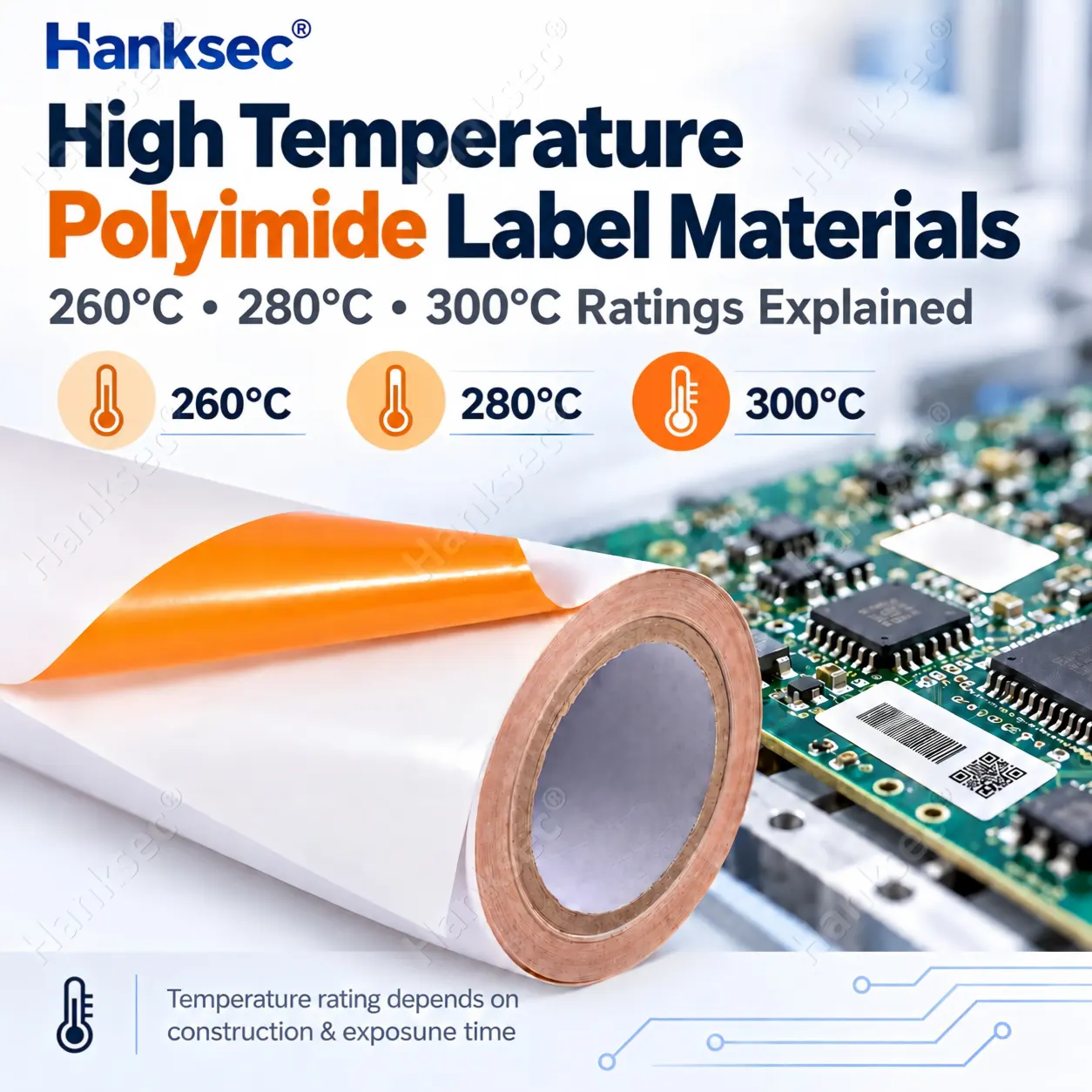
High temperature polyimide label materials are widely used for PCB, SMT, reflow, wave-solder and electronics traceability applications because polyimide provides strong thermal and dimensional stability.
However, a statement such as “300°C polyimide label” does not mean every polyimide pressure-sensitive label can continuously operate at 300°C.
The real temperature capability depends on the complete construction: facestock, printable topcoat, printing system, adhesive, substrate, exposure temperature and exposure time.
For a broader comparison between polyimide, heat-resistant PET, adhesives and general high-temperature material selection, see
Hanksec High Temperature Label Materials Buyer’s Guide.
Buyers already sourcing polyimide roll material can also review
Hanksec High Temperature Polyimide Label Material.
Why Do High Temperature Polyimide Label Materials Have Different Temperature Ratings?
A high-temperature label is often described by one number: 232°C, 260°C, 280°C or 300°C.
That number is incomplete unless the exposure duration and test condition are also known.
A polyimide label may experience:
- a short soldering-temperature peak;
- a several-minute high-temperature cycle;
- multiple reflow or wave-solder processes;
- continuous elevated-temperature service;
- heat combined with PCB cleaning chemicals.
These conditions create different stresses on the facestock, adhesive, printable coating and printed image.
For example, Brady’s published B-724 data shows substantially different results depending on whether the exposure lasts approximately 80 seconds, 5 minutes, 2 hours or 1000 hours.
The correct purchasing question is therefore:
“What temperature, for how long, and under what process conditions?”
—not simply:
“Is this a 300°C label?”
What Does “Up to 300°C” Actually Mean?
“Up to 300°C” should normally be treated as a construction-specific test result, not as a universal rating for every polyimide label material.
Published commercial materials demonstrate this clearly.
Avery Dennison’s
Polyimide Labels for Printed Circuit Board
states that its polyimide constructions are designed for demanding PCB processes and that selected materials can tolerate peak soldering temperatures up to 300°C.
Brady’s
B-724 Polyimide Label Stock Technical Data Sheet
provides an even clearer example: the published result changes as the exposure time increases.
Key point:
A label that survives a short 300°C process peak should not automatically be described as suitable for continuous 300°C service.
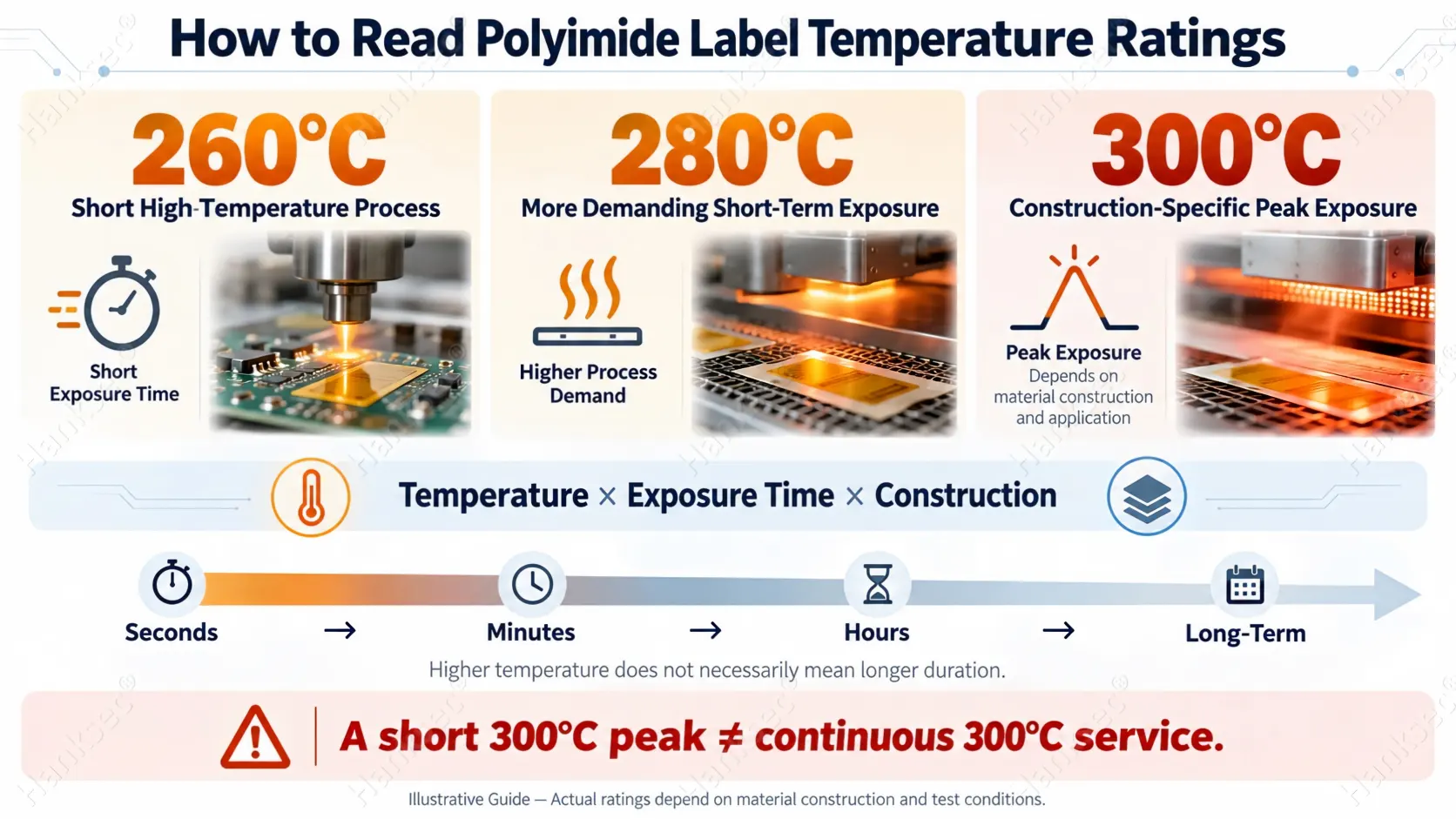
260°C vs 280°C vs 300°C: How Should Buyers Read These Numbers?
The important factor is not which number looks highest.
The important factor is how the temperature rating was established.
| Published Condition | Typical Interpretation | Buyer Should Confirm |
|---|---|---|
| Short peak around 230–260°C | Reflow, wave-solder or short manufacturing exposure | Exposure time and number of cycles |
| Around 280°C for several minutes | Demanding short-term thermal process | Label appearance, adhesive and print after exposure |
| Around 300°C short-term | Specialty high-temperature process capability | Exact duration and whether discoloration occurs |
| Long-duration elevated temperature | Continuous or long-term service condition | Long-term adhesive and topcoat stability |
Brady B-724, for example, reports no visible label effect after an 80-second exposure at 330°C under its laboratory test conditions, while its 1000-hour long-term test is performed at a much lower temperature.
This demonstrates why temperature and time must always be read together.
Why Polyimide Film Alone Does Not Determine Label Performance
Polyimide is only one part of the finished pressure-sensitive label.
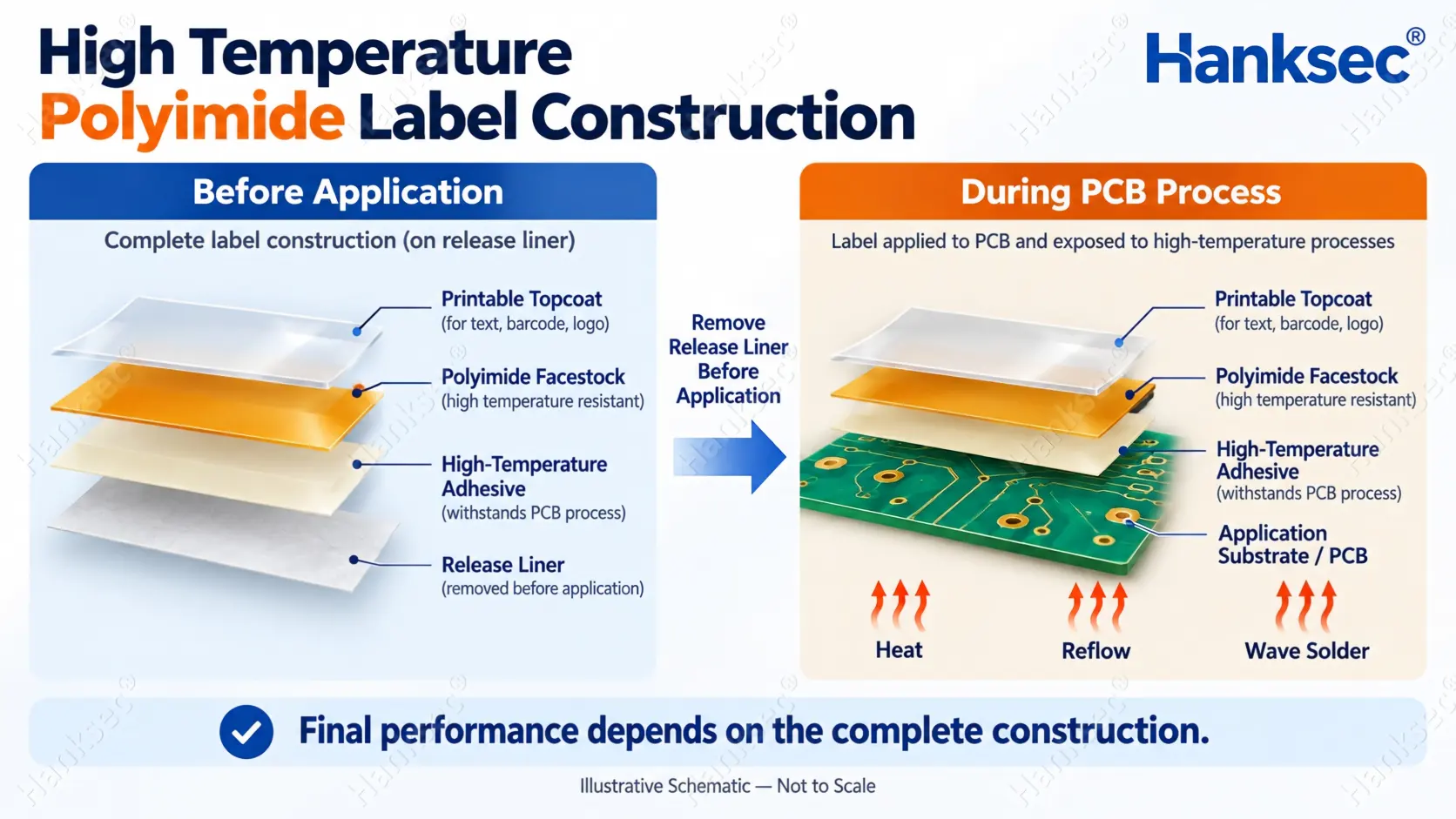
A complete high-temperature construction can include:
Polyimide Facestock
The facestock provides dimensional and thermal stability during demanding electronics processes.
Printable Topcoat
The coating must support the selected printing method and help printed information remain legible after heating and chemical exposure.
Printing System
Barcode, QR code and serial-number performance depends on the actual ribbon, ink, toner or printing process used.
Pressure-Sensitive Adhesive
The adhesive must maintain sufficient bond to the real application surface during and after thermal exposure.
Application Substrate
PCB laminate, metal, coated components and engineering plastics can create different adhesive and thermal conditions.
The release liner is important during die cutting, matrix stripping, dispensing and application, but it is normally removed before the finished label enters the customer’s thermal process.
Hanksec material-selection principle:
High-temperature label performance is a system property—not simply a polyimide-film property.
Can the Adhesive Fail Before the Polyimide Film?
Yes.
The polyimide facestock may remain dimensionally stable while the pressure-sensitive adhesive softens, discolors, loses bond or allows edge lifting.
This is why the adhesive specification should be reviewed together with the facestock.
The
3M™ Thermal Transfer Polyimide Label Material 7812 data sheet
is a useful example because it identifies the complete construction separately: polyimide film, thermal-transfer topcoat, #100 acrylic adhesive and densified kraft liner.
3M’s current product information also specifies short-term heat resistance for that adhesive system rather than claiming that the polyimide facestock alone determines finished-label temperature capability.
For procurement, this means:
Do not approve a high-temperature label only because the supplier says the facestock is polyimide.
Why Does the Printable Topcoat Matter?
A high-temperature label can remain physically attached and still fail its real function if the printed information becomes unreadable.
For PCB and electronics traceability, buyers may need to preserve:
- barcode readability;
- QR-code scanning;
- serial numbers;
- component identification;
- process-control information.
Avery Dennison specifically highlights heat-resistant topcoats in its PCB polyimide materials because physical film stability alone is not enough if printed information cannot remain legible after soldering and cleaning.
Brady B-724 testing is also conducted with a specified thermal-transfer ribbon, illustrating why facestock + coating + ribbon should be qualified together.
What Must a Polyimide Label Survive During PCB Manufacturing?
A PCB tracking label may experience several manufacturing steps before the board reaches final assembly.
Depending on the process, these can include:
- label printing and application;
- SMT placement;
- reflow soldering;
- wave soldering;
- PCB cleaning;
- inspection;
- barcode or QR scanning;
- electrical testing;
- final assembly.
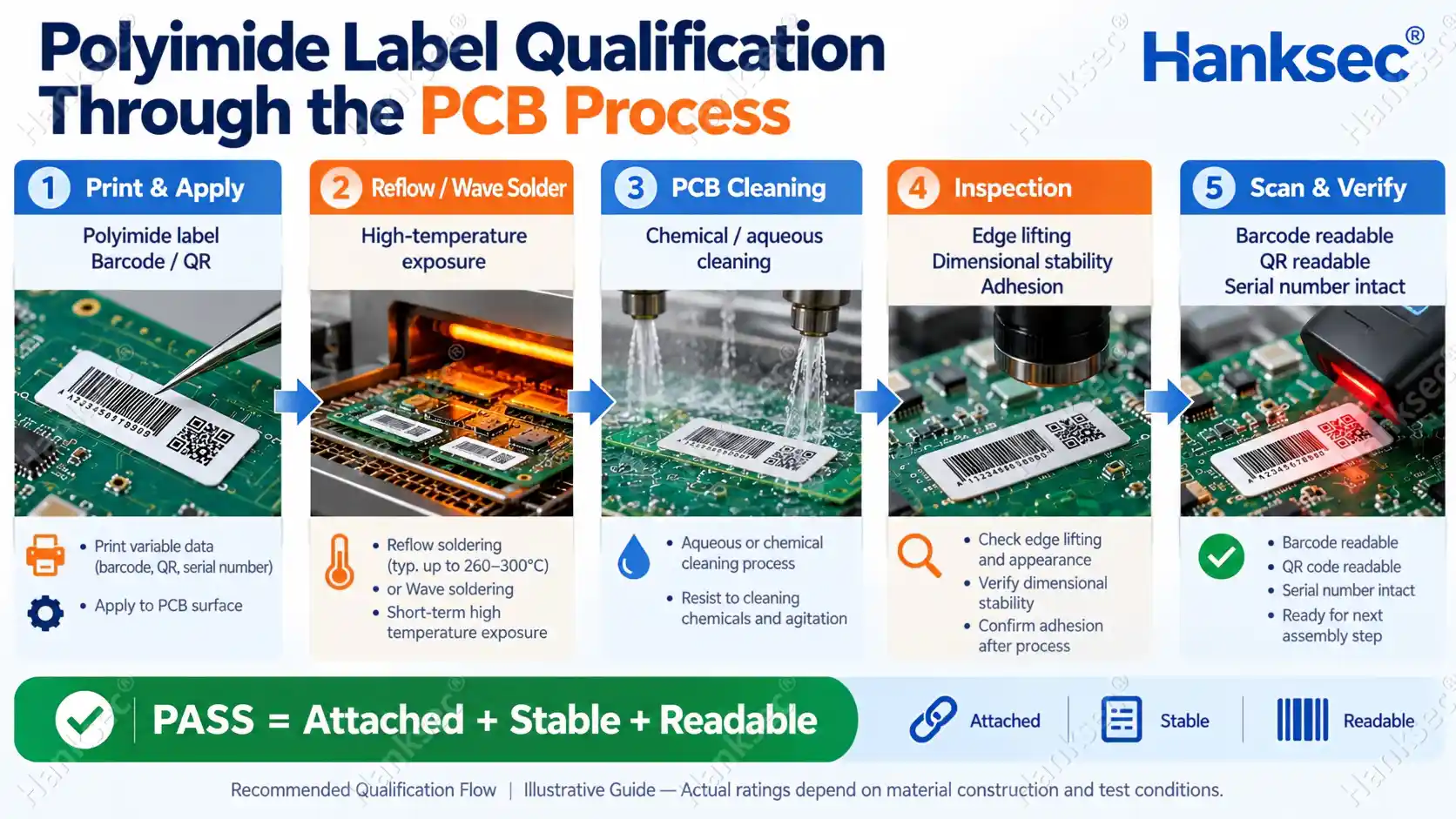
The highest temperature is therefore only one qualification factor.
The label may also need to resist cleaning chemicals, multiple thermal cycles, physical handling and scanning after thermal processing.
Is 300°C Necessary for Every PCB Label?
No.
A higher published temperature rating does not automatically make a material better for every application.
If the customer’s process reaches a lower peak temperature for a defined period, selecting an unnecessarily extreme construction may add cost without improving actual production performance.
The correct approach is:
Match the material to the real thermal profile instead of selecting the highest number on the data sheet.
Buyers comparing polyimide with lower-temperature heat-resistant PET can use
Hanksec High Temperature Label Materials Buyer’s Guide
for broader material selection.
Polyimide vs Heat-Resistant PET: When Does Polyimide Make More Sense?
Polyimide is normally the stronger starting direction when the label must pass through demanding PCB, SMT, reflow or wave-solder processes.
Heat-resistant PET may still be suitable for industrial applications with lower thermal requirements where appearance, converting efficiency or cost also matter.
| Selection Question | Polyimide Direction | Heat-Resistant PET Direction |
|---|---|---|
| PCB soldering process | Common starting point | Requires application-specific qualification |
| Very high short-term peak | Generally preferred | May be insufficient depending on construction |
| Moderate industrial heat | Possible | May provide a practical alternative |
Neither material should be selected from the polymer name alone.
The actual temperature, exposure time, adhesive and printing system remain important.
What Information Should Buyers Send a Polyimide Label Material Supplier?
A request such as:
“Please quote 300°C polyimide label material.”
does not provide enough information for a reliable material recommendation.
| Information | Example | Why It Matters |
|---|---|---|
| Maximum Temperature | 260°C | Defines thermal requirement |
| Exposure Time | 60–90 seconds | Separates short peak from continuous service |
| Thermal Cycles | 1 / multiple | Repeated heat can change performance |
| Application Surface | PCB / metal / component | Determines adhesive compatibility |
| Printing Method | Thermal transfer | Determines topcoat and ribbon compatibility |
| Cleaning Process | Aqueous / solvent | Chemical exposure can affect print and adhesive |
| Supply Format | Jumbo roll / slit roll / die-cut label | Defines converting requirements |
How Should High-Temperature Polyimide Label Material Be Tested?
Qualification should reproduce the customer’s actual production process as closely as practical.
Before bulk production, important checks can include:
- initial adhesion;
- thermal exposure;
- edge lifting;
- dimensional stability;
- adhesive discoloration or ooze;
- barcode readability;
- QR-code scanning;
- print durability;
- cleaning resistance;
- die-cutting performance;
- matrix stripping;
- liner release;
- dispensing stability.
Whenever possible, testing should use the actual application substrate, printing system and thermal profile.
For Hanksec’s broader material qualification method, see the
Security Label Material Quality Control Guide for Label Converters.
Hanksec Technical Recommendation:
Do not approve a polyimide label from a temperature number alone. Qualification should reproduce the actual substrate, printing method, thermal profile, exposure duration and downstream production conditions.
What Is the Correct Meaning of a 300°C Polyimide Label?
A technically accurate interpretation is:
A specific polyimide label construction has been qualified for a defined exposure at or near 300°C under stated test conditions.
It does not automatically mean:
- every polyimide label can continuously operate at 300°C;
- every adhesive will remain unchanged at 300°C;
- every barcode or printed image will remain readable;
- every PCB surface will produce the same adhesion result.
For technical purchasing, the specification should therefore include:
temperature + exposure time + cycles + substrate + adhesive + printing system + process environment.
Frequently Asked Questions About High-Temperature Polyimide Labels
Can all polyimide labels withstand 300°C?
No. Temperature capability depends on the complete construction and test conditions. Some qualified materials publish short-duration performance around 300°C, but this should not be treated as a universal polyimide-label rating.
Is 300°C a continuous service temperature?
Not necessarily. Short peak temperature and continuous service temperature are different specifications. Exposure duration must always be checked.
Why is polyimide used for PCB labels?
Polyimide provides strong thermal and dimensional stability for demanding PCB and electronics manufacturing processes such as reflow and wave soldering.
Does the adhesive also need to be heat resistant?
Yes. The adhesive must maintain sufficient bond during and after the required process. A thermally stable facestock cannot compensate for an unsuitable adhesive.
Can polyimide labels survive wave soldering?
Qualified polyimide constructions can be used for wave-solder applications. The actual temperature, duration, label position and process conditions should be confirmed by testing.
Can polyimide labels be thermal-transfer printed?
Yes, when the selected material has a suitable printable surface and the thermal-transfer ribbon is compatible with the application.
Should barcode readability be tested after heating?
Yes. A label that remains attached but produces an unreadable barcode or QR code has not passed the complete traceability requirement.
Should polyimide labels be tested before bulk production?
Yes. Sample qualification should reproduce the actual substrate, printing system, adhesive, thermal profile, cleaning process and converting conditions before final approval.
Need Polyimide Label Material for a High-Temperature Process?
Hanksec® supplies
high-temperature polyimide label materials
for PCB manufacturers, electronics factories, industrial label converters and OEM projects.
Available project directions include different polyimide facestocks, printable surfaces, adhesive systems, release liners, roll widths, slit rolls and finished-label formats.
For material selection, provide:
maximum temperature, exposure time, number of thermal cycles, application substrate, printing method, label size, cleaning process and supply format.
The objective is not simply to select the material with the highest temperature number.
The correct construction should remain attached, dimensionally stable and readable throughout the actual production process.
High Temperature Polyimide Label Material
|
High Temperature Label Materials Buyer’s Guide