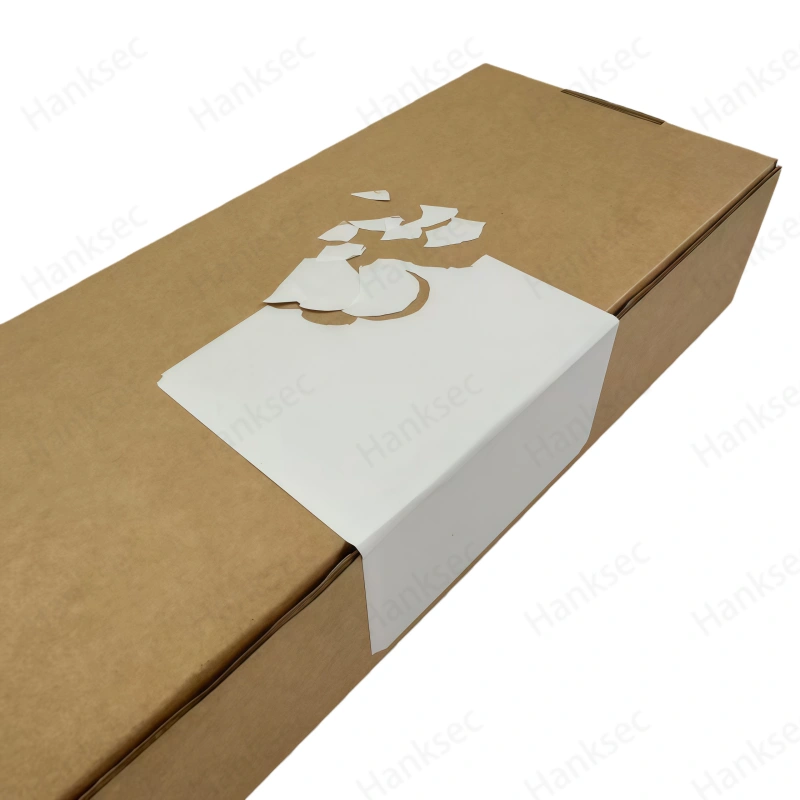
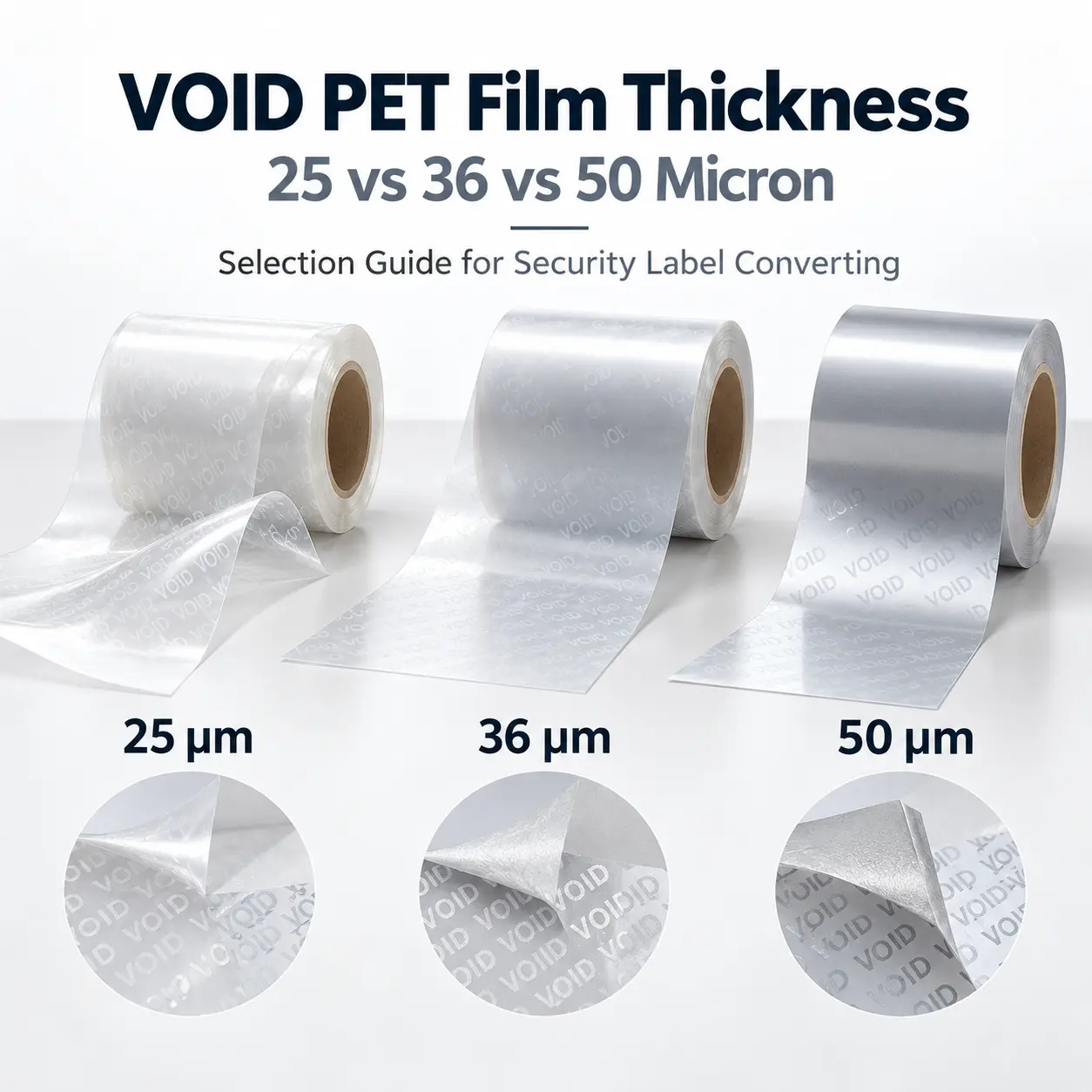
VOID PET film is commonly available in different thicknesses, but a thicker film does not automatically mean a better security material.
For label converters and security printers, VOID PET film thickness affects stiffness, flexibility, web handling, die cutting, matrix stripping and dispensing.
However, the final tamper-evident performance still depends on the complete material construction.
A 25 micron PET film may be suitable for one label size and substrate, while a 50 micron PET film may perform better in another converting process.
The correct choice should therefore consider PET thickness together with the security layer, adhesive, release liner, label geometry and final application surface.
This guide compares 25 micron, 36 micron and 50 micron VOID PET film and explains how each thickness can influence security label converting.
In this guide, 25, 36 and 50 micron refer to the nominal PET facestock thickness, not the total thickness of the adhesive-coated construction or release liner.
VOID PET Film Thickness Quick Comparison
The three thicknesses should not be treated as different security grades.
They mainly provide different mechanical behavior during converting and application.
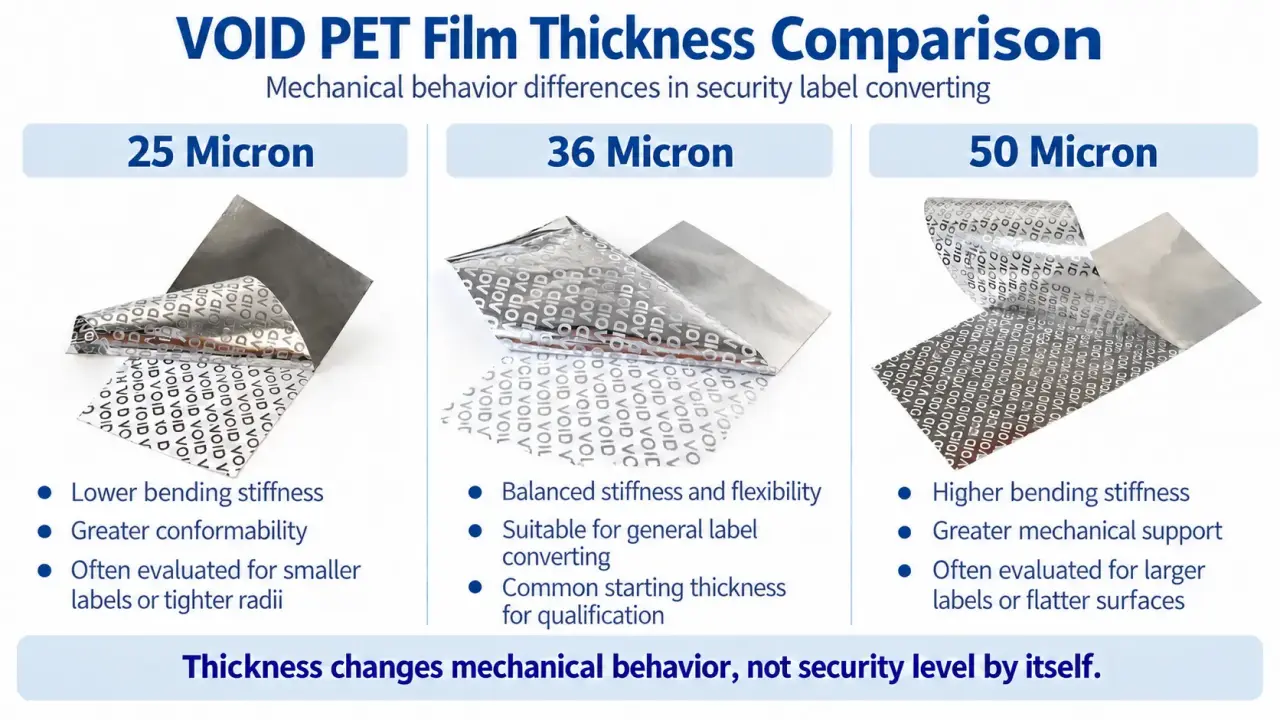
| PET Thickness | General Mechanical Behavior | Typical Selection Direction |
|---|---|---|
| 25 micron | Lower bending stiffness and greater conformability | Often evaluated for smaller labels, tighter radii or applications requiring more conformability |
| 36 micron | Balanced stiffness and flexibility | Common starting thickness for general security-label converting qualification |
| 50 micron | Higher bending stiffness and mechanical support | Often evaluated for larger labels, flatter surfaces or applications requiring greater handling stability |
These are general selection directions rather than universal performance guarantees.
Adhesive, coating, release construction, liner and label geometry can significantly change the final converting behavior.
The security response should therefore be evaluated on the complete VOID material rather than on PET thickness alone.
For a broader explanation of the complete construction, see the Tamper Evident PET Film Guide.
What PET Thickness Changes in a VOID Material
PET acts as the mechanical facestock in many VOID security materials.
Changing its thickness changes the physical behavior of the web and finished label.
It does not directly define the transfer type or security level.
Stiffness and Flexibility
Thinner PET normally provides greater flexibility.
This can help the finished label conform to smaller radii or less rigid application surfaces.
Thicker PET generally provides greater bending stiffness.
This can improve handling of larger labels and provide more mechanical support during converting and dispensing.
The correct balance depends on the complete laminate.
Web Handling
PET thickness can influence how the material behaves during printing, coating, slitting and rewinding.
A thinner web may require more careful tension control.
A thicker web can be easier to handle mechanically, but the increased stiffness may not suit every label geometry.
Machine settings should therefore be established using the actual material construction rather than a PET thickness value alone.
Label Conformability
Conformability becomes important when security labels are applied to curved plastic, small electronic components or surfaces with a tight radius.
A thinner construction generally bends more easily.
A thicker construction may resist bending and can generate more restoring force at the label edge.
On flat glass, metal or rigid plastic, this may not be a concern.
On curved surfaces, thickness should be evaluated together with adhesive strength and label size.
General PET film technical data also shows that thickness is one of several variables associated with mechanical properties and dimensional behavior. Toray Lumirror PET Technical Data
When 25 Micron VOID PET Film Makes Sense
25 micron VOID PET film is generally selected when a more flexible material construction is preferred.
It can be useful for smaller labels, tighter curves and applications where excessive stiffness could reduce surface conformity.
Potential advantages include:
- lower bending stiffness
- better conformity on curved surfaces
- lighter material construction
- good suitability for compact label geometry
- less resistance when the label must follow a small radius
However, thinner PET also requires a stable converting window.
Web tension, adhesive initial tack, die cutting and release force should all be controlled carefully.
A thin facestock does not automatically solve a small label converting problem.
If adhesive tack is too aggressive or the release balance is unsuitable, small finished labels may still lift together with the waste matrix.
This is why small label projects should be tested using the actual facestock, adhesive and liner combination.
When evaluating VOID PET film thickness for small labels, flexibility should be considered together with adhesive tack, release force and converting stability.
A practical example of this interaction is discussed in the High Temperature Label Matrix Stripping Case Study.
Why 36 Micron PET Is a Balanced Option
36 micron VOID PET film sits between thinner flexible constructions and thicker high-stiffness constructions.
For many security label projects, it can provide a useful balance between web stability and finished-label flexibility.
This makes 36 micron PET a practical starting point for general converting trials.
Typical considerations include:
- general roll-to-roll security label converting
- medium-sized label formats
- printing and variable data applications
- die cutting and matrix stripping
- automatic label dispensing
- applications requiring moderate stiffness
It should not be described as the best thickness for every project.
A 36 micron facestock can still perform poorly if the adhesive, liner or security separation layer is not matched to the intended application.
The value of 36 micron PET is mainly that it can provide a balanced mechanical starting point for material qualification.
When 50 Micron VOID PET Film Is Preferred
50 micron VOID PET film provides greater stiffness than thinner PET constructions.
This can be useful for larger security labels and applications where stronger mechanical support improves handling.
Potential advantages include:
- higher finished-label stiffness
- easier manual handling
- greater support for larger label areas
- more stable feeding in some dispensing systems
- reduced tendency for very large labels to feel too soft during application
Greater stiffness can also become a disadvantage.
A 50 micron PET construction may be less suitable for small-diameter curved surfaces or very small labels that need high conformability.
More stiffness can also increase edge stress when a label is forced around a tight radius.
The adhesive system must therefore be able to resist the mechanical forces created by the facestock.
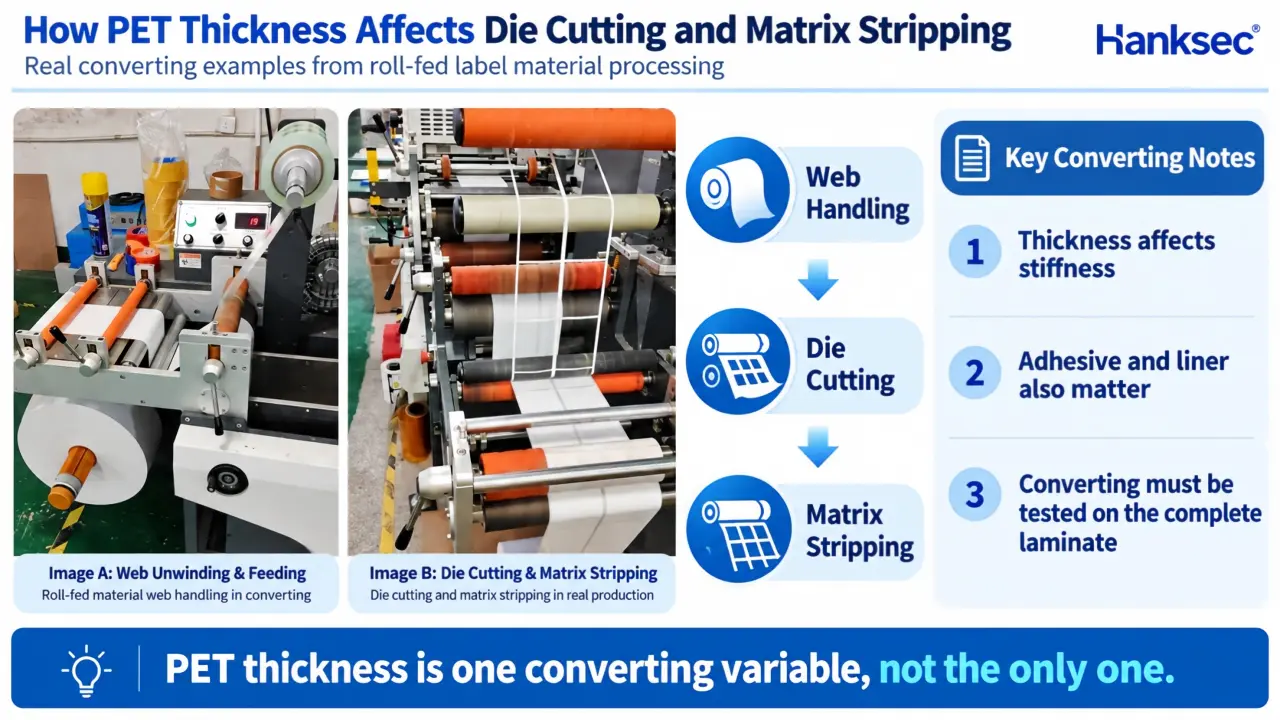
How PET Thickness Affects Die Cutting and Matrix Stripping
Die cutting performance depends on the complete laminate.
PET thickness is one important variable, but it is not the only variable.
Die Cutting Pressure
Changing PET thickness changes the thickness of the facestock layer that the cutting tool must penetrate.
The correct die setting also depends on coating thickness, adhesive behavior, liner construction, blade geometry and machine condition.
For this reason, die pressure should not be specified from PET thickness alone.
The complete material should be qualified on the actual converting equipment.
Changing VOID PET film thickness may require corresponding adjustments to die cutting and web handling conditions.
Matrix Stripping
Matrix stripping is influenced by several interacting factors.
- PET stiffness
- label size
- label shape
- adhesive initial tack
- release force
- matrix stripping angle
- stripping speed
A thicker facestock may provide greater mechanical support to the web.
However, that does not guarantee easier stripping.
If adhesive tack, release force or label geometry is unsuitable, finished labels can still travel with the waste matrix.
Likewise, a thinner PET construction can convert well when the adhesive and liner are correctly balanced.
The converting window should therefore be established by testing the complete construction.
Does PET Thickness Affect Printing
Yes, but PET thickness mainly affects printing through web handling and mechanical stability.
Print receptivity itself depends more directly on the surface treatment.
This may include:
- corona treatment
- primer
- print-receptive topcoat
- ink or ribbon compatibility
A thicker PET web may provide greater mechanical stability during feeding.
A thinner web may require more precise tension control.
However, neither thickness will provide good ink anchorage if the surface treatment is not compatible with the printing process.
Thickness and printability should therefore be qualified as separate but related material requirements.
Does Thicker PET Provide Better Tamper Evidence
No. A thicker PET film does not automatically create stronger tamper evidence.
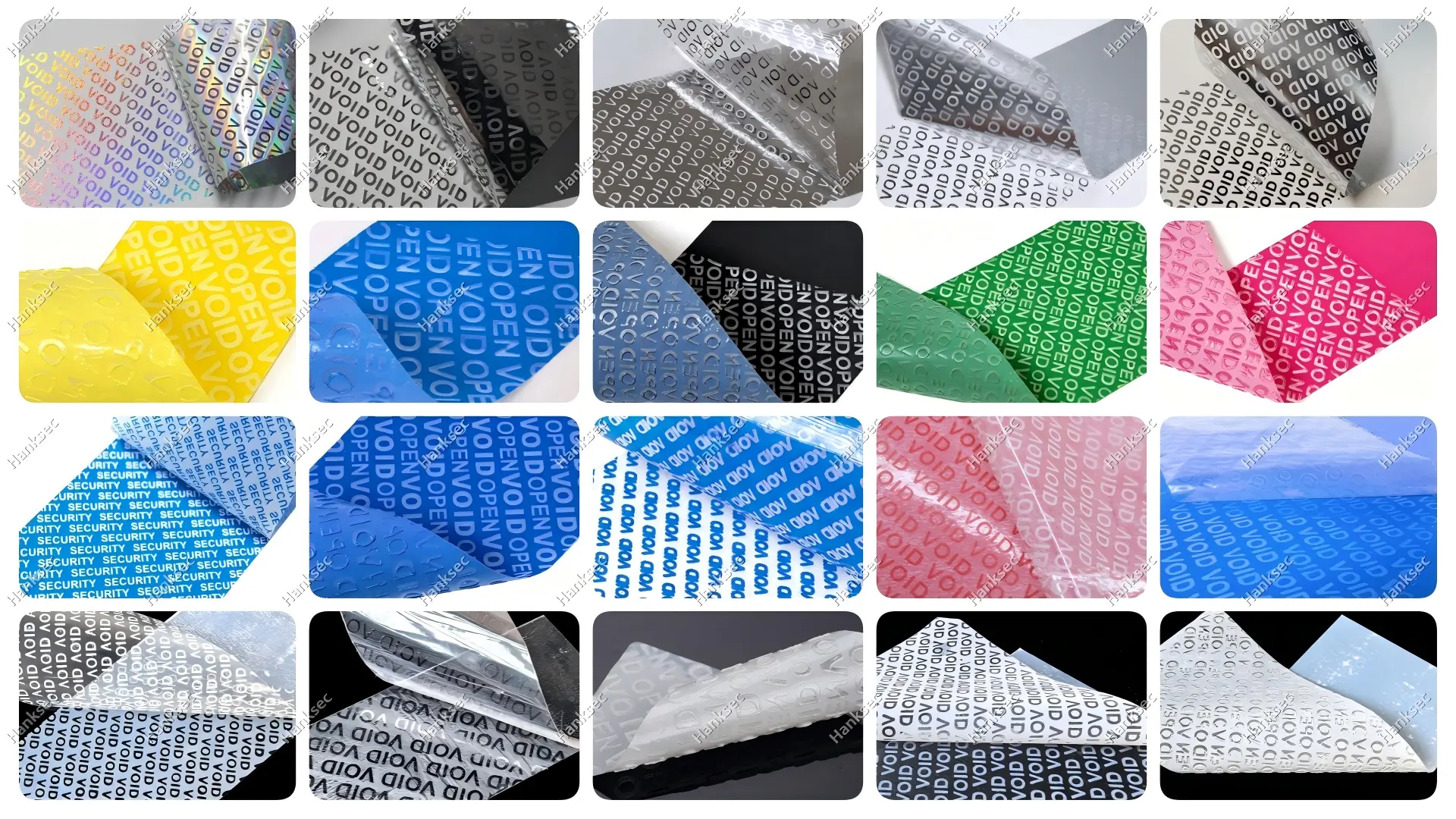
The VOID effect is created by the security release and separation system rather than by PET thickness alone.
Important factors include:
- security release layer
- full-transfer, partial-transfer or non-transfer design
- pressure-sensitive adhesive
- application substrate
- surface energy
- dwell time
- coating construction
- PET mechanical behavior
A 25 micron PET material can produce clear tamper evidence when the complete construction is properly designed.
A 50 micron PET material can still produce poor tamper evidence if the adhesive or separation system is unsuitable.
Thickness is therefore one component of the material construction, not a security level by itself.
For a detailed explanation of the three main transfer mechanisms, see What Is VOID Label Material.
How Label Size Changes Thickness Selection
Label geometry changes how facestock stiffness interacts with adhesive and release force.
Small Security Labels
Small labels can be sensitive to material stiffness, adhesive tack and die cutting geometry.
When the label is very small, the relationship between label area and edge length changes.
This can make edge lifting and matrix stripping behavior more noticeable.
A thinner PET may improve flexibility, but the complete construction still needs testing.
Small label size should not automatically be treated as a rule that requires 25 micron PET.
Large Security Labels
Larger labels can benefit from greater dimensional stability and easier handling.
In some applications, a thicker PET construction can help reduce excessive softness during dispensing and application.
However, larger labels applied to curved substrates may still require more flexibility.
Label dimensions and substrate geometry should therefore be evaluated together.
PET Thickness Must Match the Adhesive and Release Liner
A PET facestock does not work independently from the adhesive and liner.
Different combinations can produce very different converting and application behavior.
For example, a stiff PET film combined with a highly aggressive adhesive may require a different release balance from a thinner and more flexible construction.
The liner must also provide suitable support during printing, die cutting and matrix stripping.
When troubleshooting a VOID label material, changing only the PET thickness may not solve the actual problem.
The complete construction should be evaluated as one system.
For adhesive selection factors, see the Tamper Evident Label Adhesive Guide.
How Label Converters Should Choose PET Thickness
The best starting thickness depends on the application and converting process.
VOID PET film thickness should therefore be selected as part of the complete material construction rather than as an isolated specification.
| Project Requirement | Starting Selection Direction |
|---|---|
| Small label on a curved surface | Evaluate thinner PET and confirm adhesive holding force |
| General security label converting | Evaluate a medium thickness such as 36 micron |
| Large label requiring more stiffness | Evaluate thicker PET such as 50 micron |
| Tight radius application | Prioritize conformability and edge adhesion |
| High-speed dispensing | Evaluate PET stiffness together with liner and release force |
| Difficult matrix stripping | Evaluate the complete facestock, adhesive, liner and die cutting system |
| Strong VOID evidence required | Select the security transfer mechanism first and then optimize PET thickness |
A practical selection sequence is to define the required tamper response first, followed by the application substrate, label size, adhesive system, release construction, PET thickness and converting validation.
This sequence helps prevent a common sourcing mistake where thickness is selected before the security and converting requirements are understood.
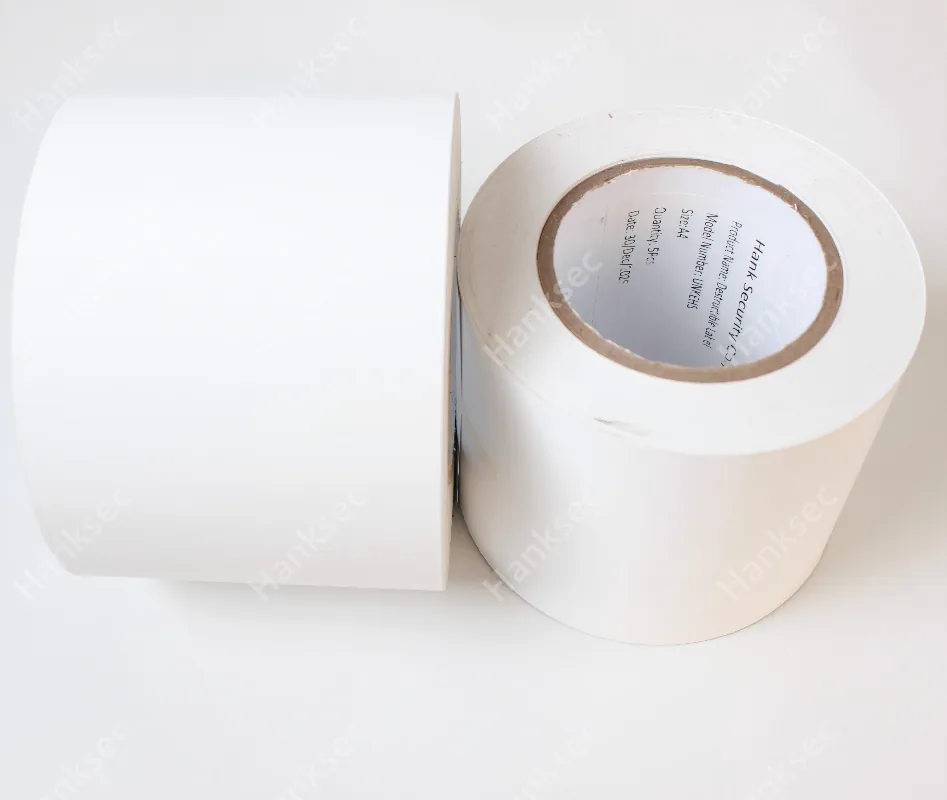
VOID PET Film Supply Formats
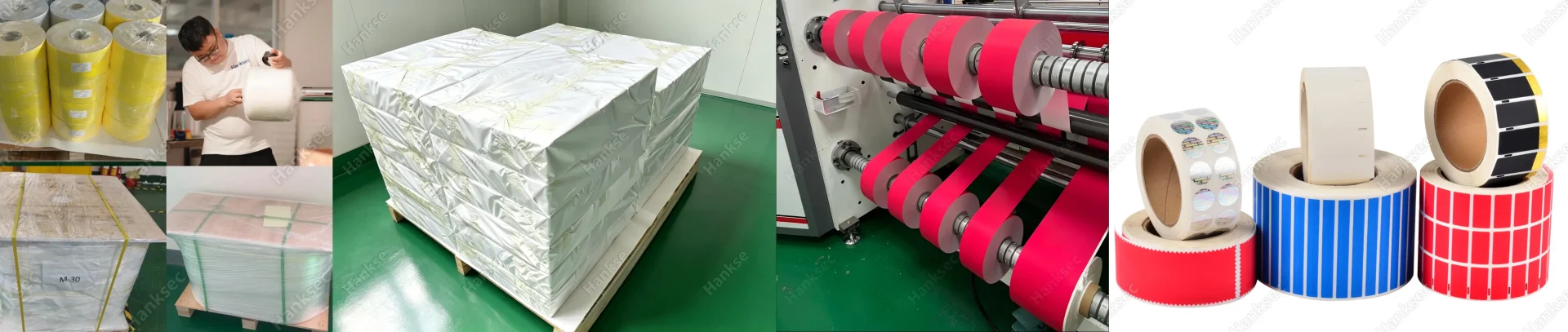
VOID PET materials can be supplied for different stages of converting.
Typical formats may include:
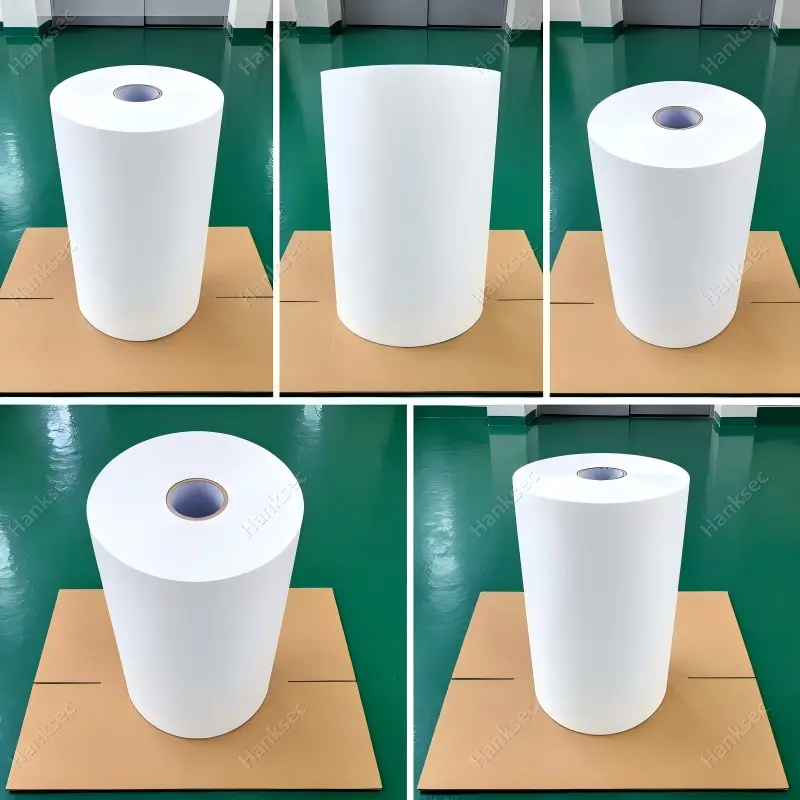
- jumbo rolls
- slit rolls
- custom roll widths
- sheets
- converted finished labels when required
Converters should confirm thickness together with roll width, roll length, core size, winding direction, adhesive system and release liner.
For roll supply considerations, see the VOID Label Material Rolls Guide.
What Should Be Tested Before Bulk Production
Thickness selection should be confirmed through actual material testing before bulk production.
Recommended checks include:
- adhesion on the actual substrate
- VOID activation after removal
- edge lifting
- printing compatibility
- die cutting
- matrix stripping
- release force
- slitting and rewinding
- automatic dispensing
- dwell time before tamper testing
The finished construction should be tested under conditions that represent the real converting and application process.
A sample that performs well on one substrate or label size should not automatically be assumed to perform the same way on another application.
For a complete testing workflow, see the Security Label Material Quality Control Guide.
Frequently Asked Questions About VOID PET Film Thickness
Is 50 Micron VOID PET More Secure Than 25 Micron PET
No.
50 micron PET is mechanically stiffer, but stronger tamper evidence depends on the security layer, adhesive, substrate and transfer mechanism.
Which VOID PET Thickness Is Best for Small Labels
There is no universal thickness for small labels.
Thinner PET may improve flexibility, but adhesive tack, release force, label geometry and matrix stripping conditions must also be evaluated.
Is 36 Micron PET Suitable for General Security Labels
36 micron PET is often a useful balanced starting point because it provides moderate stiffness and flexibility.
Final suitability should still be confirmed through actual converting and application testing.
Does PET Thickness Affect VOID Transfer
PET thickness can influence the mechanical behavior during removal.
However, the main VOID transfer mechanism is created by the functional security layer and adhesive system.
Does Thicker PET Improve Die Cutting
Not necessarily.
Die cutting depends on PET thickness together with adhesive, liner, blade geometry and machine settings.
Can Hanksec Supply Different VOID PET Thicknesses in Jumbo Rolls
Yes.
Hanksec can support different PET thicknesses and roll formats according to the required security construction, adhesive, release liner and converting process.
Select PET Thickness as Part of the Complete VOID Material System
VOID PET film thickness should not be selected as an isolated specification.
25 micron PET generally provides greater flexibility.
36 micron PET often provides a balance between flexibility and stiffness.
50 micron PET provides greater mechanical support and handling stiffness.
None of these thicknesses automatically provides a higher security level.
The correct material should be selected according to the required tamper response, application substrate, label size, adhesive system, release construction, PET thickness and converting process.
Hanksec supports VOID security materials for label converters, security printers, distributors and OEM projects.
Material evaluation can include PET thickness, full-transfer, partial-transfer or non-transfer construction, adhesive selection, release liner, printable surface and converter-ready roll specifications.