Author: Hanksec Technical Team
Security Label Materials | Destructible Materials | Printing & Converting Evaluation
Quick Answer:
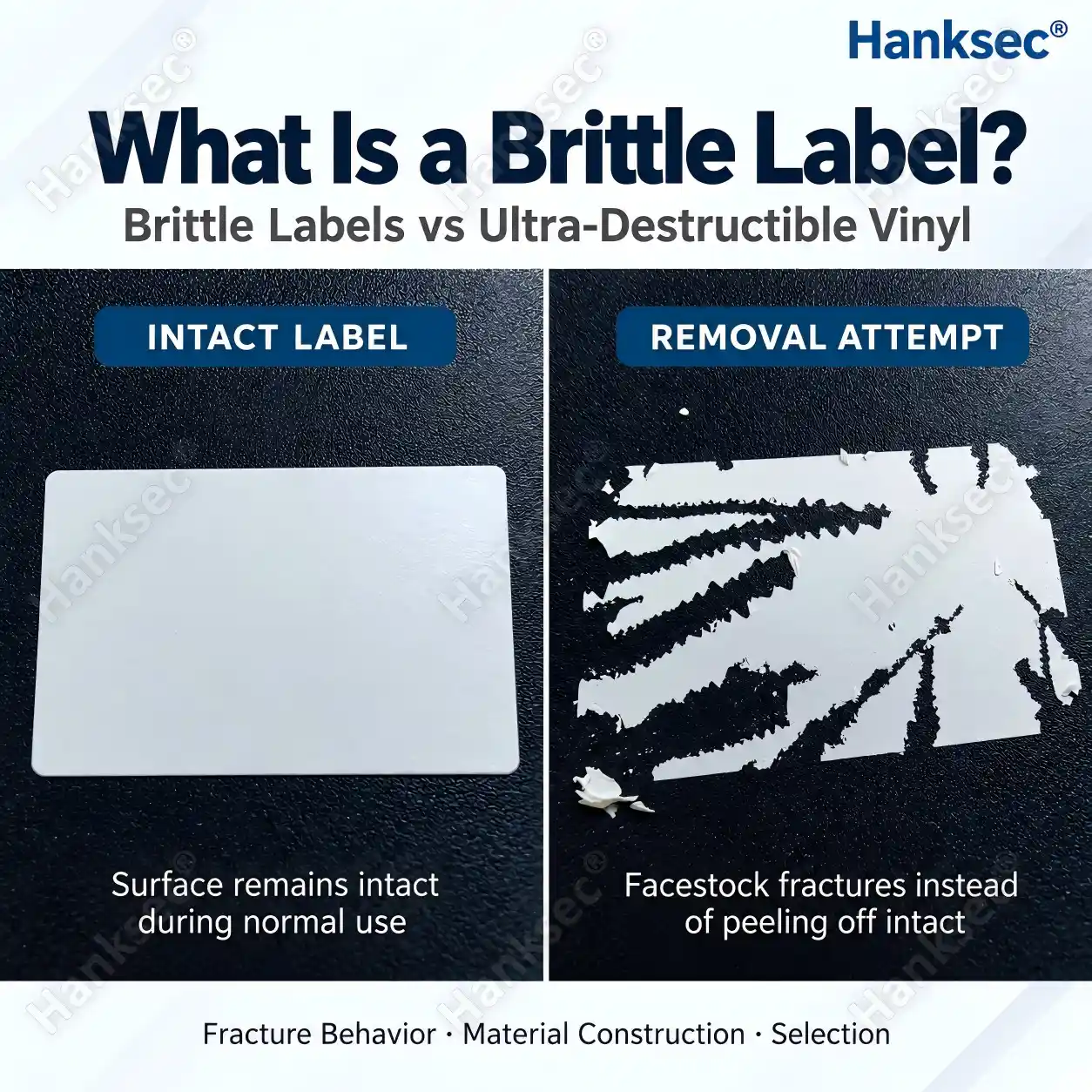
A brittle label is a security label designed so that its face material fractures, tears or breaks when removal is attempted.
Instead of peeling away intact like a conventional durable film label, the brittle facestock is intended to fail internally, making clean removal and reuse difficult.
However, brittle label, destructible vinyl and ultra-destructible vinyl are not always identical terms.
“Brittle” describes breakage behavior, while destructible security labels can be made from different facestock constructions.
If you first want the broader definition of destructibility in security materials, read
Meaning of Destructible Material: Definition, How It Works & Uses.
For buyers already sourcing converter-ready fragile materials, see
Hanksec Destructible Labels & Materials.
What Is a Brittle Label?
A brittle label is a pressure-sensitive security label whose facestock is intentionally designed to have limited resistance to removal stress.
When someone attempts to peel the label from the application surface, the material is intended to fracture before the complete label can be removed intact.
Depending on the material construction and application conditions, attempted removal may cause:
- cracks through the facestock;
- irregular tearing;
- small broken fragments;
- partial material remaining on the substrate;
- permanent physical damage that makes intact transfer difficult.
The purpose is not simply to manufacture a weak label.
A practical brittle security label must still have enough stability for printing, slitting, die cutting, matrix stripping, rewinding, dispensing and application before it reaches the final product.
The engineering challenge is therefore to balance converting stability before application with controlled fracture during an attempted removal.
Is a Brittle Label the Same as a Destructible Label?
The terms are often used for similar security-label concepts, but they are not necessarily precise synonyms.
A brittle label describes a label whose facestock shows fragile or fracture-prone behavior.
A destructible label is the broader security-label category in which physical material damage is used to make intact removal and reuse difficult.
Key point: A brittle vinyl label can be a destructible security label, but not every destructible label must use the same vinyl chemistry or facestock construction.
This distinction matters when a buyer is replacing an existing material or comparing specifications from different suppliers.
Why Does “Brittle” Not Mean One Specific Polymer?
One common purchasing assumption is:
brittle label = PVC or destructible vinyl.
That definition is too narrow.
Commercial destructible label portfolios show that controlled destruction can be created using different facestock technologies.
For example,
Zebra’s specialty synthetic label portfolio
currently identifies 8000D Destructible as polyethylene, while 8000T Z-Destruct™ is identified as vinyl.
Likewise,
Avery Dennison® 2920 QM Ultra Destructible
uses a brittle matt-white cast vinyl facestock.
The important purchasing question is therefore not simply:
“Is this vinyl?”
A better question is:
“What destruction behavior does the finished material produce on my actual application surface?”
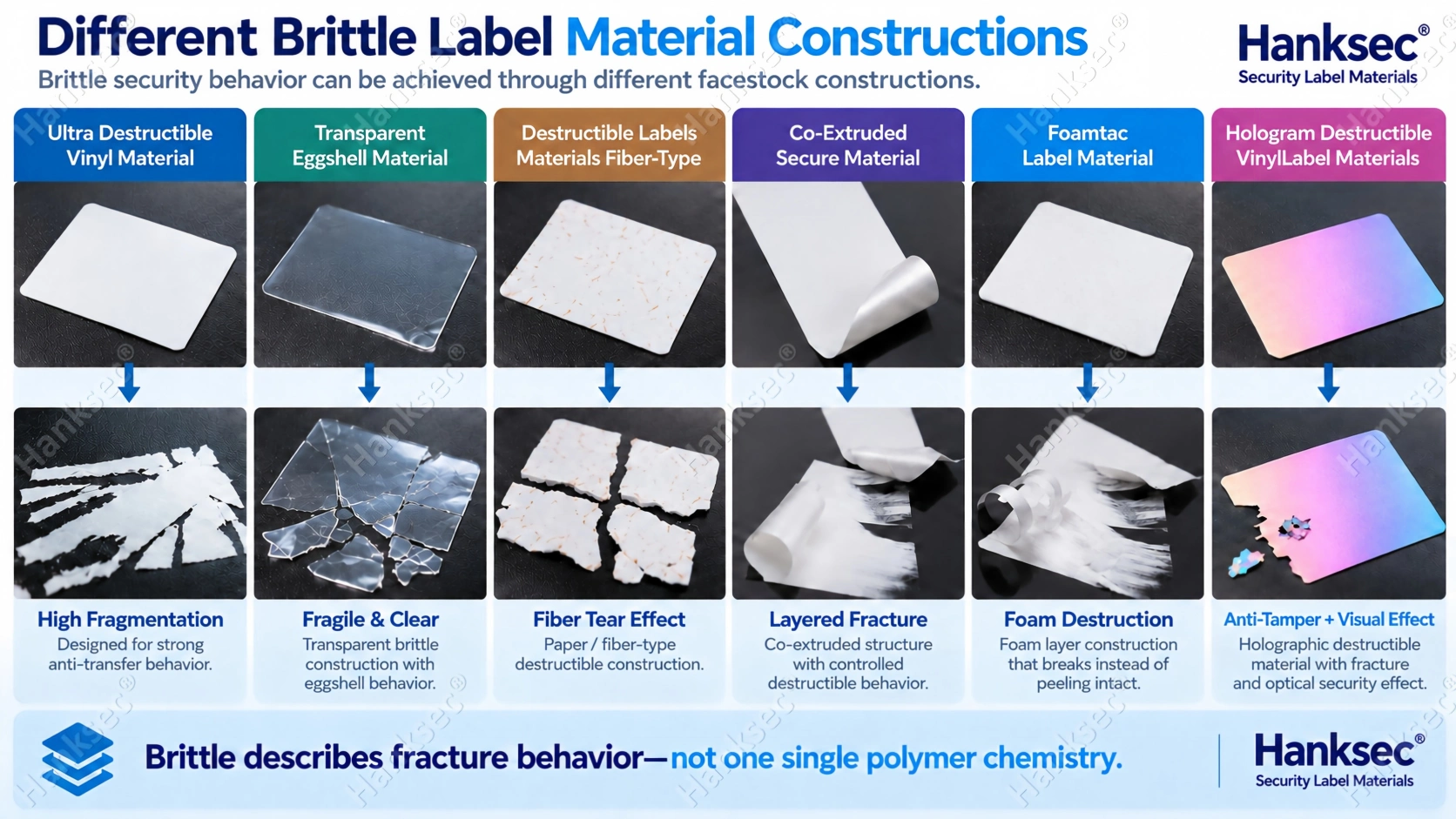
Brittle Label vs Destructible Vinyl vs Ultra-Destructible Vinyl
These terms are related, but they should not automatically be treated as standardized grades.
| Term | What It Usually Describes | Typical Removal Behavior | Main Selection Focus |
|---|---|---|---|
| Brittle Label | Label designed with fracture-prone facestock behavior | Cracks, tears or breaks | Anti-transfer and tamper evidence |
| Destructible Vinyl | A destructible construction using a vinyl-type fragile facestock | Breaks rather than peeling away intact | Security plus converting stability |
| Ultra-Destructible Vinyl | A highly fragile destructible vinyl direction | Higher fragmentation during removal | Strong resistance to intact removal |
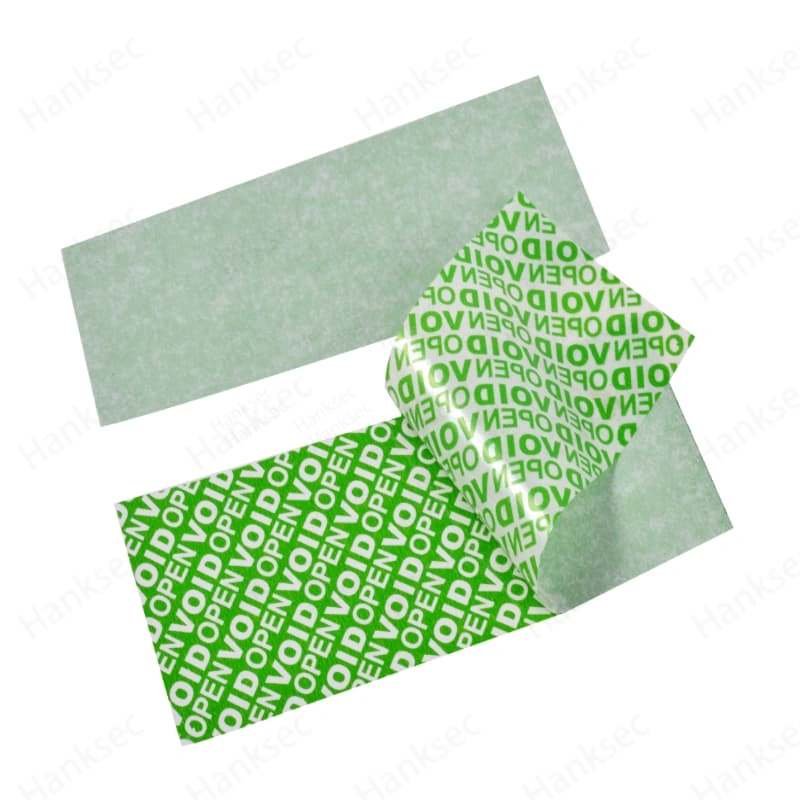
| VOID Material | Layered tamper-evident security construction | Reveals VOID, OPENED or another security pattern | Visible security message after removal |
Terms such as ultra, easy, medium and hard destructible can be useful for supplier-level material selection, but they should not automatically be treated as universal industry-standard grades.
For converter-oriented material selection, see
Destructible Label Material Rolls: Easy, Medium & Hard Selection Guide.
How Does a Brittle Security Label Work?
The final tamper response depends on the relationship between three main elements.
1. Facestock Strength
The face material must have controlled fracture behavior so that removal stress can initiate cracking, tearing or fragmentation.
2. Adhesive Bond
The pressure-sensitive adhesive must establish enough bond to the application surface to resist clean removal.
If the adhesive-to-substrate bond is too weak, the whole label may lift before the brittle facestock fractures.
3. Application Substrate
The same label construction can behave differently on glass, ABS, PP, PE, painted metal, coated surfaces or textured plastics because surface energy, texture and contamination affect adhesive contact.
Simplified mechanism:
Adhesive resistance + removal force → stress inside fragile facestock → controlled fracture
A successful brittle security construction therefore depends on the balance between adhesion, facestock strength and substrate conditions.
What Makes Ultra-Destructible Vinyl Different?
Ultra-destructible vinyl is generally positioned toward the more fragile end of destructible material selection.
When the construction is properly matched to the substrate, attempted removal can produce stronger fragmentation instead of allowing a large section of the label to lift intact.
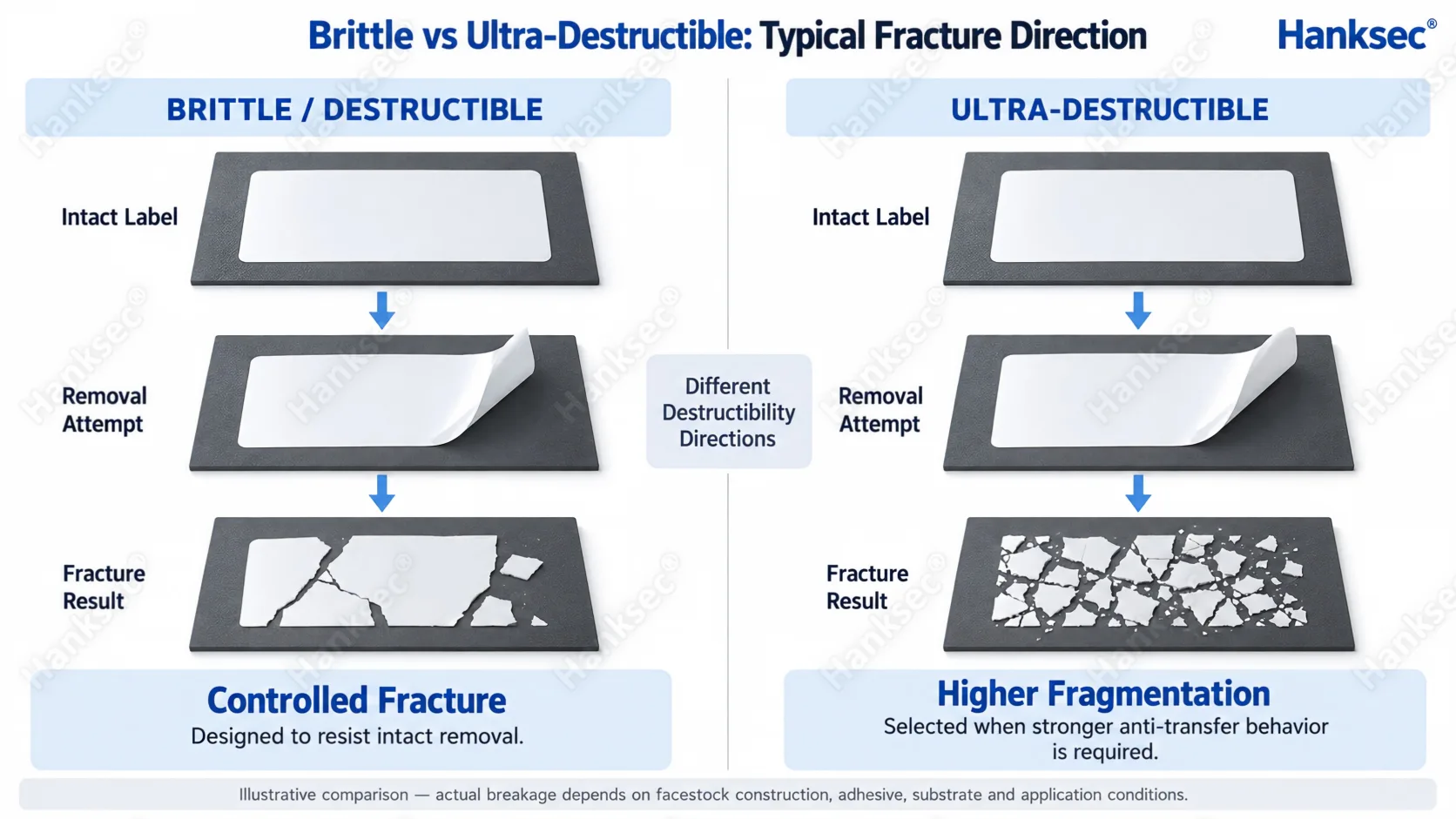
Illustrative Schematic — Not to Scale
This makes ultra-destructible materials useful for applications such as:
- electronics warranty seals;
- small device security labels;
- asset identification;
- inspection seals;
- service-control labels;
- serial-number security labels;
- product authentication labels.
Hanksec’s
Ultra Destructible Vinyl Material
is intended for projects where high fracture sensitivity is required, particularly when preventing intact label removal is the main security objective.
However, greater fragility can also create additional converting challenges.
Converters may need tighter control of:
- die-cutting pressure;
- matrix stripping tension;
- web tension;
- label geometry;
- release-liner behavior;
- automatic dispensing conditions.
For this reason, ultra-destructible is not automatically the best grade for every project.
Is 8000D Destructible the Same as Ultra-Destructible Vinyl?
Not necessarily.
This is a useful example of why buyers should check the actual facestock rather than relying only on a product name.
According to Zebra’s current published specialty synthetic label portfolio,
8000D Destructible
is listed as a polyethylene direct-thermal destructible material.
The same portfolio separately identifies 8000T Z-Destruct™ as a vinyl material with a permanent adhesive that destructs when the label is removed.
Therefore:
“Destructible” does not automatically mean “destructible vinyl.”
When replacing an existing branded material, buyers should compare the actual facestock, printing technology, adhesive, substrate compatibility, service environment and destruction behavior rather than selecting an alternative only because its product name sounds similar.
Brittle Label vs Ordinary Vinyl Label
An ordinary durable vinyl label and a brittle security label may look similar before application, but their mechanical objectives are very different.
| Property | Ordinary Durable Vinyl | Brittle / Destructible Label |
|---|---|---|
| Mechanical Behavior | Designed for durability and flexibility | Designed for controlled fracture |
| Removal Response | May remain intact | Intended to crack, tear or fragment |
| Main Function | Identification and durability | Tamper evidence and anti-transfer |
| Production Priority | Durability and flexibility | Balance of converting stability and destruction |
This is why ordinary vinyl should not automatically be substituted for a brittle security facestock even when both materials appear similar before removal testing.
Brittle Label vs VOID Label: Which Should You Choose?
Both technologies can provide visible evidence of tampering, but they operate through different mechanisms.
A brittle or destructible label relies mainly on physical destruction of the facestock.
A VOID label relies mainly on controlled separation of functional layers so that a hidden message or pattern becomes visible.
| Requirement | Better Starting Direction |
|---|---|
| Original label should not be removed intact | Brittle / destructible material |
| VOID or OPENED message should appear | VOID material |
| Both physical damage and additional security evidence are required | Evaluate a hybrid security construction |
Neither system is universally better.
The correct selection depends on what evidence the buyer needs after an attempted removal.
For a detailed explanation of transfer mechanisms, read
What Is VOID Label Material?.
Why Can a Brittle Label Still Peel Off Intact?
Seeing the word “destructible” on a product specification does not guarantee identical behavior on every application surface.
A brittle label may peel away too cleanly when:
- the adhesive is not suitable for the substrate;
- the substrate has low surface energy;
- oil, dust, silicone or release agents contaminate the surface;
- application pressure is insufficient;
- the label is tested before adequate dwell time;
- surface texture limits adhesive contact;
- the selected facestock is too resistant to fracture for the application.
This is why a destructible security material should be qualified on the actual application substrate whenever possible.
For detailed troubleshooting, see
Why Destructible Labels Peel Off Intact Instead of Breaking.
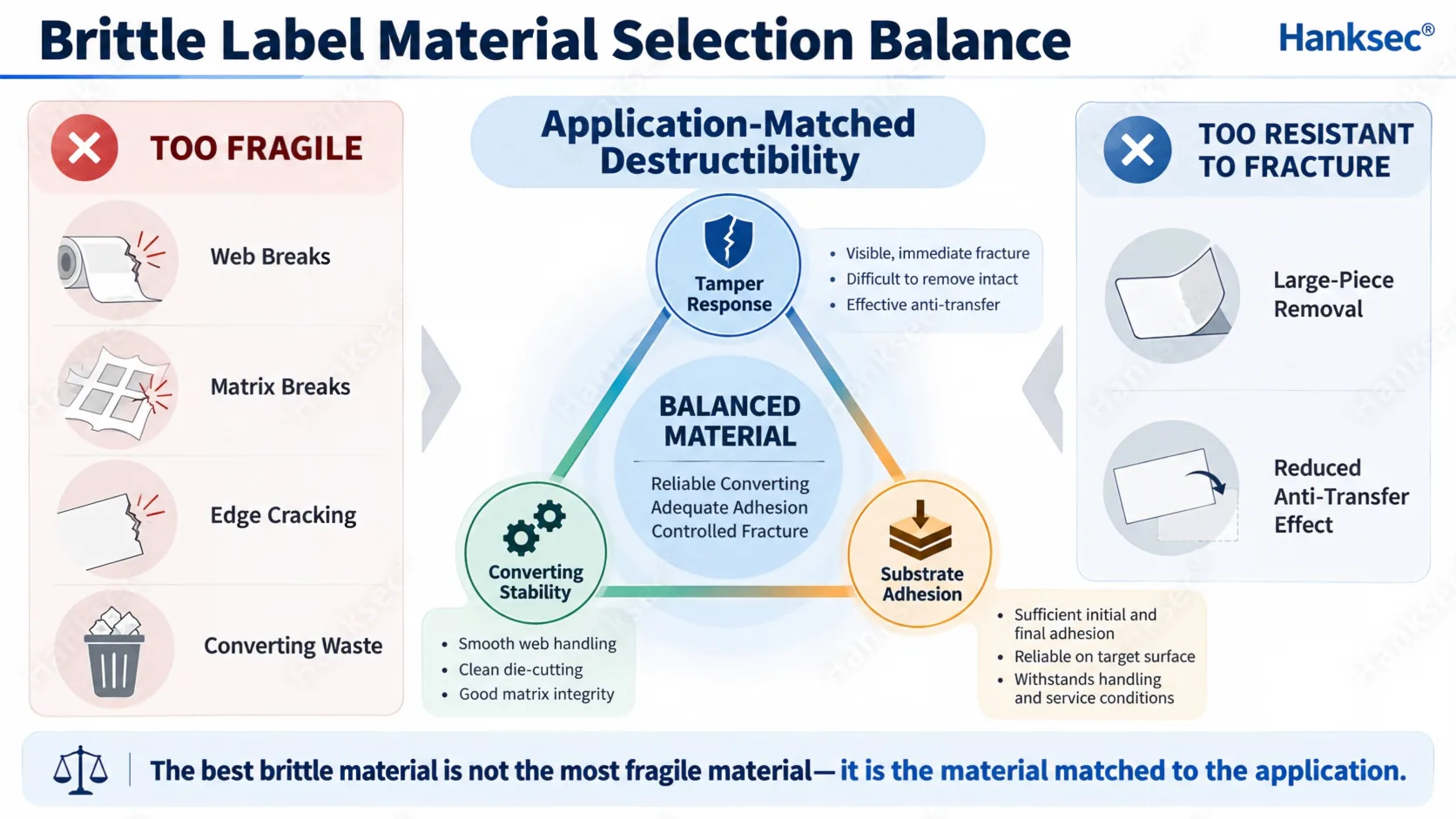
Is the Most Brittle Material Always the Best Choice?
No.
This is one of the most common material-selection mistakes.
A buyer may request:
“Give me the material that breaks into the smallest pieces.”
But maximum fragility can create unnecessary production difficulty.
For example, an extremely fragile material may increase the risk of:
- web breaks;
- matrix breaks;
- edge cracking;
- poor dispensing stability;
- production waste during high-speed converting.
A medium or harder destructible construction may sometimes provide a better balance between security performance and production stability.
The correct question is therefore:
“What level of fracture is required after application, and how much handling strength is required during converting?”
What Should Label Converters Check Before Ordering?
Before ordering brittle, destructible or ultra-destructible material, converters should provide enough information for the supplier to evaluate both production and end-use requirements.
| Parameter | What to Confirm | Why It Matters |
|---|---|---|
| Application Surface | ABS, PP, PE, PET, glass, painted metal, etc. | Determines adhesive compatibility |
| Label Size | Final width and length | Influences breakage and dispensing behavior |
| Printing Method | Flexo, screen, thermal transfer, digital, etc. | Determines surface-treatment requirements |
| Destruction Requirement | Ultra / easy / medium / harder fracture direction | Determines facestock direction |
| Die Cutting | Rotary / flatbed / production speed | Very brittle materials may need tighter process control |
| Roll Specification | Width, length, core, winding and liner | Affects downstream converting |
For converter-focused roll specifications, review
Destructible Label Material Rolls: Converter Selection Guide.
How Should Brittle Labels Be Tested?
Qualification should include both converting performance and final application performance.
Converting Test
Check whether the material can print, die cut, matrix strip, rewind and dispense without unacceptable breakage or waste.
Application Test
Apply the converted label to the actual substrate under controlled conditions and evaluate the removal response after an agreed dwell period.
The test should determine whether:
- the adhesive establishes sufficient contact;
- the facestock fractures as intended;
- edge lifting occurs;
- printing remains readable before tampering;
- the final destruction effect meets the project requirement.
A material that fragments strongly but cannot be converted reliably is not a practical solution.
Likewise, a material that converts perfectly but peels away intact may not provide the required tamper-evident function.
For broader qualification procedures, see the
Security Label Material Quality Control Guide for Label Converters.
What Is the Best Material for a Brittle Security Label?
There is no single best brittle material for every application.
The correct construction depends on the required balance between:
- fracture sensitivity;
- adhesive bonding;
- label size;
- substrate type;
- printing compatibility;
- die-cutting stability;
- automatic application requirements;
- service environment.
For a small electronics warranty seal, an ultra-destructible construction may be appropriate.
For a larger printed equipment label, a medium or harder destructible material may provide better converting and application stability while still producing irreversible damage.
For projects requiring a visible security message rather than mainly physical fragmentation, VOID material may be the better starting direction.
Frequently Asked Questions About Brittle Labels
What does brittle label mean?
A brittle label is a security label whose facestock is designed to fracture, tear or break when removal is attempted instead of peeling away intact.
Is a brittle label the same as destructible vinyl?
Not always. “Brittle” describes the material’s fracture behavior, while destructible vinyl refers more specifically to a destructible construction using a vinyl-type facestock.
What is ultra-destructible vinyl?
Ultra-destructible vinyl is a highly fragile vinyl-type security material designed for strong fragmentation during attempted removal. It is often selected where intact label transfer must be made particularly difficult.
Is Zebra 8000D Destructible vinyl?
No. Zebra’s current published product portfolio identifies 8000D Destructible as polyethylene. Zebra separately lists 8000T Z-Destruct™ as vinyl.
Does a brittle label leave a VOID message?
Normally, a standard brittle label relies primarily on physical fracture. VOID materials use a different mechanism that reveals a hidden message or transfer pattern during removal.
Can brittle labels be printed?
Yes, depending on the exact facestock and printable surface treatment. The actual ink, ribbon, toner or digital printing process should be qualified before bulk production.
Can ultra-destructible material be die-cut?
Yes, but highly fragile materials may require tighter control of die pressure, matrix design, stripping tension, label geometry and rewinding conditions.
Why does a brittle label sometimes peel off without breaking?
Common causes include insufficient adhesive bonding, substrate incompatibility, surface contamination, low surface energy, insufficient application pressure or dwell time, and selection of a facestock that is too resistant to fracture for the application.
Should brittle material be tested before bulk production?
Yes. The material should preferably be tested through the intended printing and converting process and on the actual final application substrate before full production approval.
Need Help Selecting a Brittle or Ultra-Destructible Material?
Hanksec® manufactures and supplies
destructible security label materials
for label converters, security printers, material distributors and OEM manufacturers.
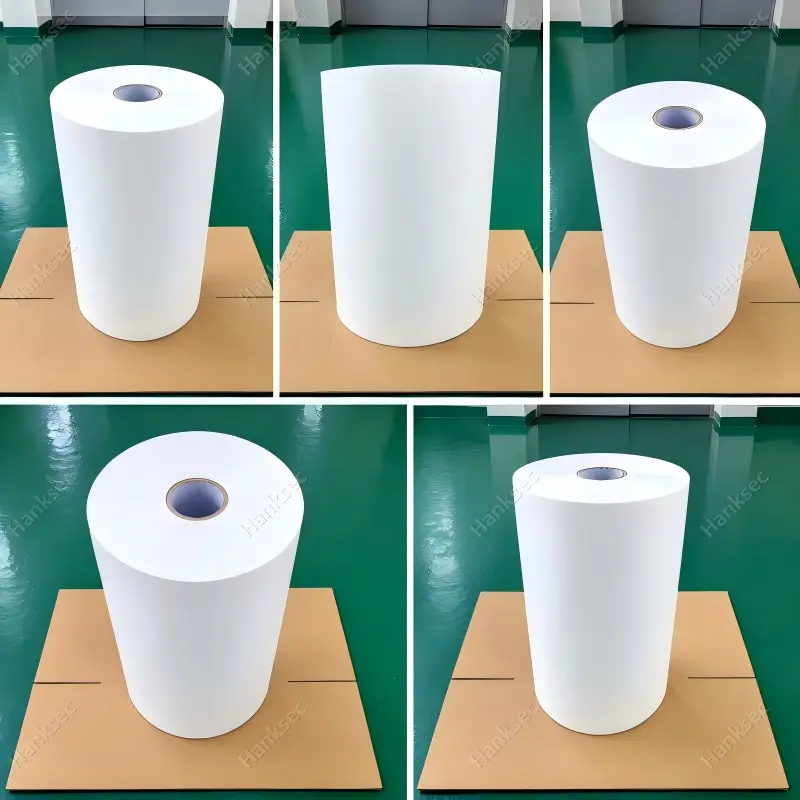
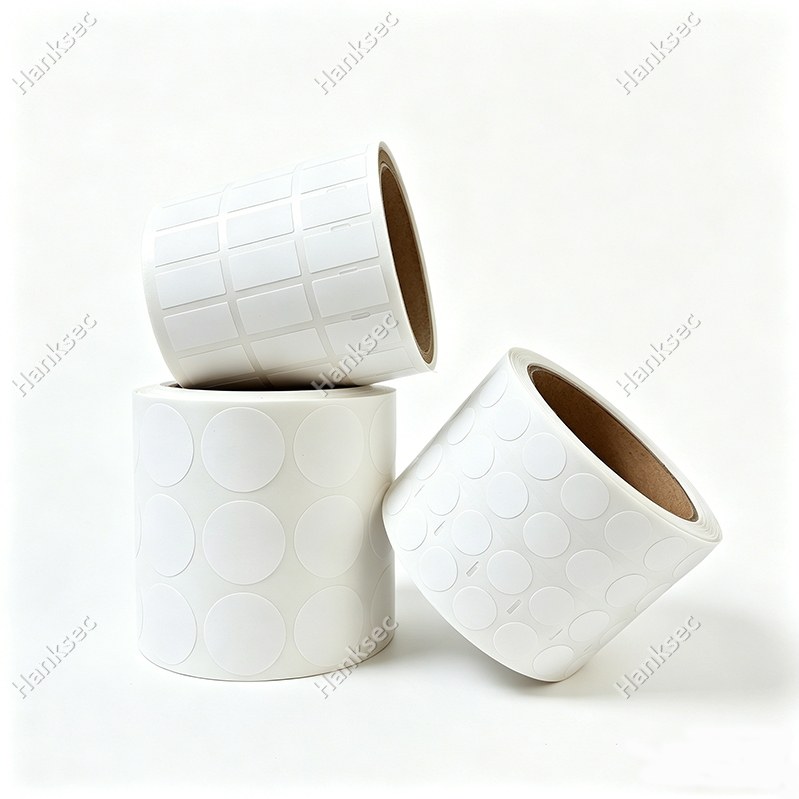
Available project directions include easy, medium and hard destructibility, ultra-destructible materials, different adhesive systems, printable surfaces, release liners and converter-ready roll formats.
For material selection, provide:
application substrate, label size, printing process, required destruction effect, die-cutting method, release-liner requirement and roll specification.
The objective is not simply to choose the most fragile material. The correct solution should both convert reliably and produce the required irreversible tamper response on the actual application surface.
Ultra Destructible Vinyl Material
|
Destructible Material Rolls Guide