Author: Hanksec Technical Team
Security Label Materials | Destructible Materials | Adhesive & Converting Evaluation
Quick Answer:
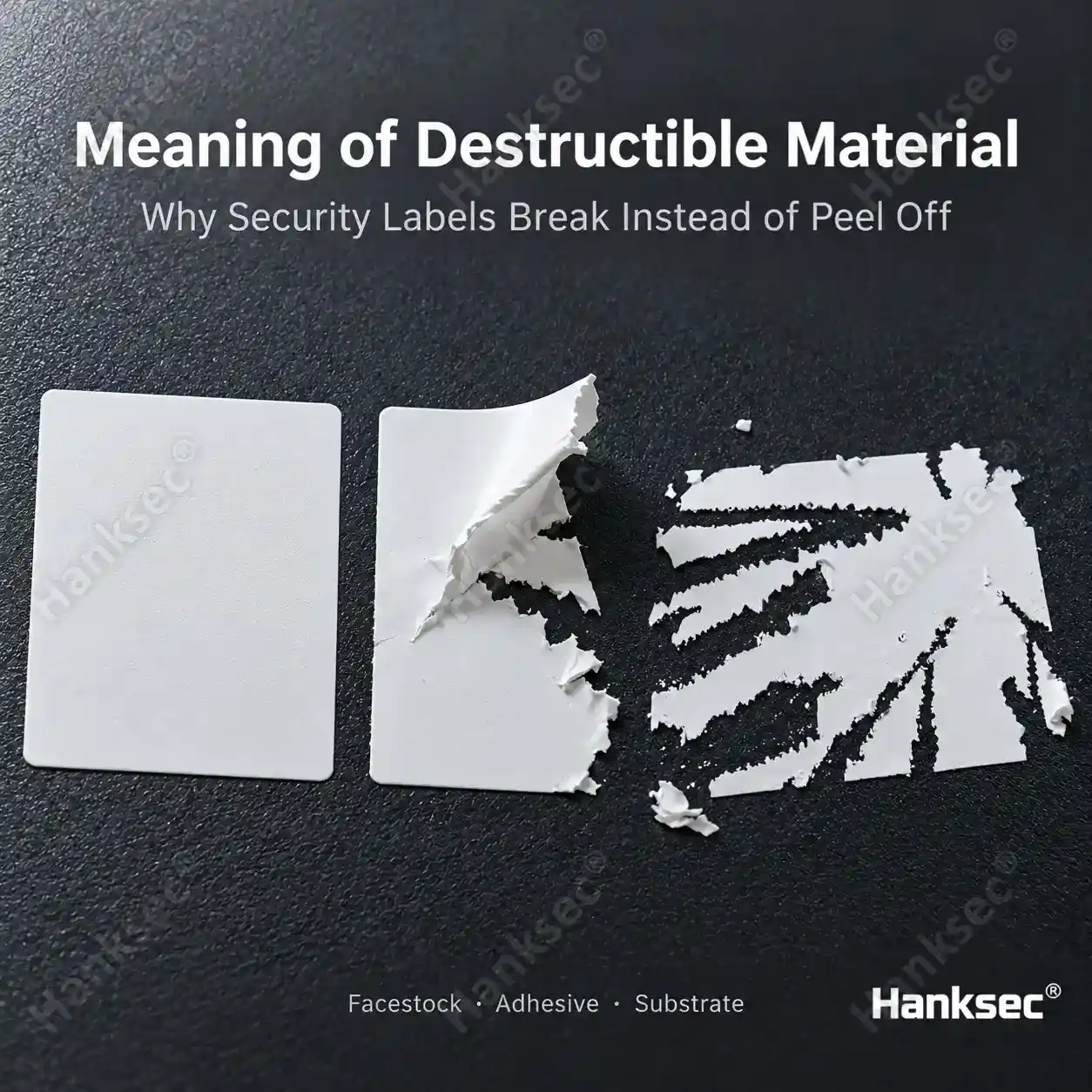
The meaning of destructible material is a material that is capable of being damaged, broken or destroyed.
In the security label industry, the term has a more specific meaning: a destructible label material is an engineered fragile facestock designed to fracture, tear or break into pieces when removal is attempted.
Instead of allowing the complete label to peel away intact, the material is intended to fail internally, making clean removal and reuse difficult and providing visible evidence of tampering.
For security labels, “destructible” should not be understood as simply “weak material.”
A professional destructible construction must balance controlled breakage, adhesive bonding, printing stability, die cutting and converting performance.
The final result depends on the complete material system and the surface to which the label is applied.
Buyers who already know they require fragile anti-removal material can also review
Hanksec Destructible Labels & Materials
or the
Destructible Label Material Rolls Selection Guide.
What Does Destructible Material Mean?
In its simplest sense, destructible means capable of being destroyed.
However, when the term is used in pressure-sensitive security labels, the definition becomes more specific.
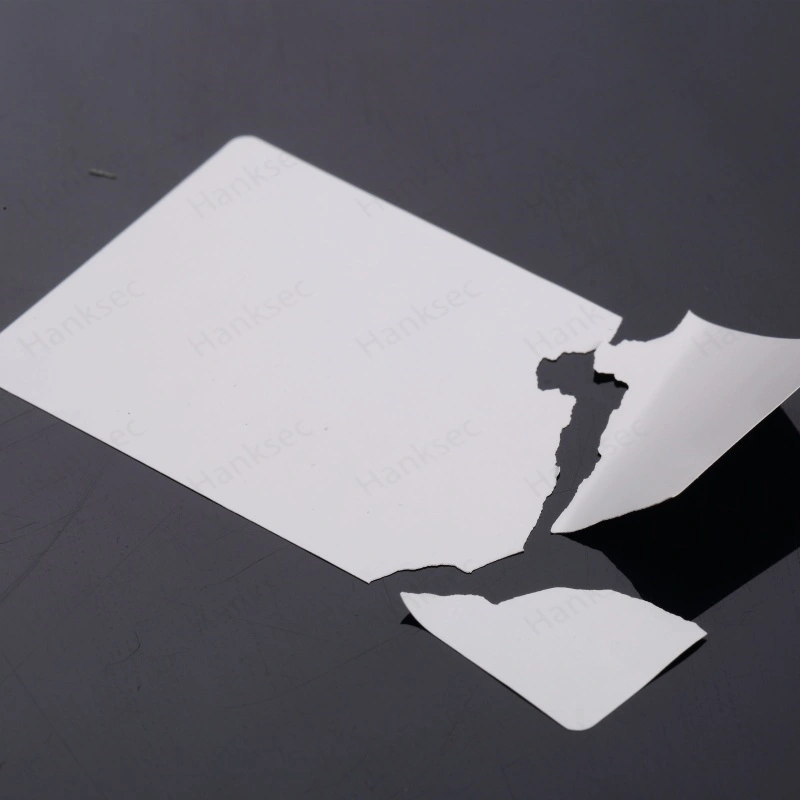
A destructible material is a fragile facestock intentionally engineered so that an attempted removal causes the material itself to fracture, tear, crack or fragment rather than allowing the complete label to be removed in one piece.
The security function therefore comes from controlled material failure.
The label may look like a normal printed identification or warranty label during use, but its mechanical behavior changes what happens when someone tries to peel it away.
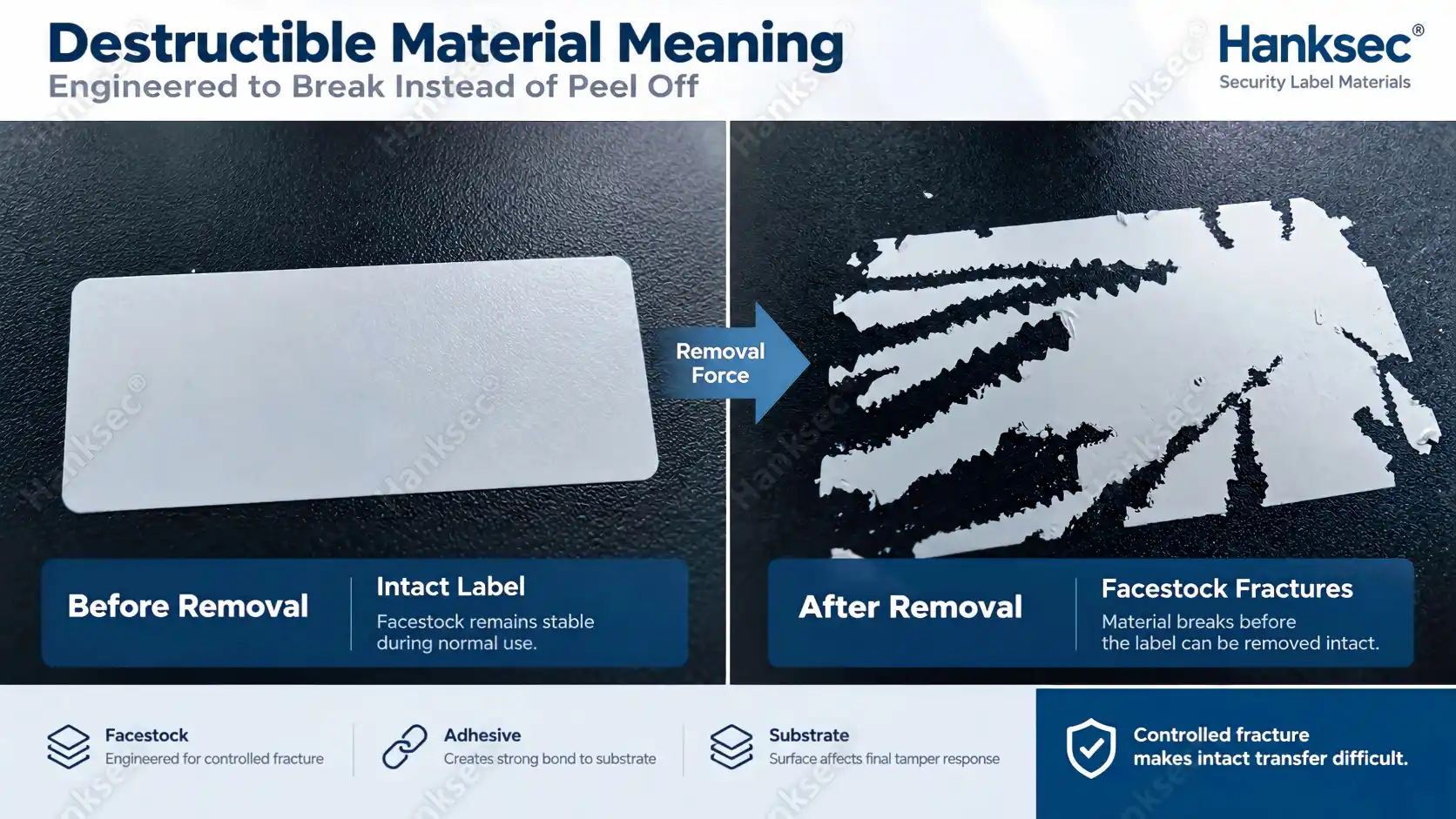
Depending on the construction, attempted removal may produce:
- small broken fragments;
- irregular tears;
- cracks across the facestock;
- partial pieces remaining on the application surface;
- layer separation or permanent physical damage to the original label.
This makes intact transfer from one product or surface to another significantly more difficult.
What Does Destructible Mean in Security Labels?
For a conventional pressure-sensitive label, the facestock is normally expected to remain mechanically stable during handling and use.
Depending on the adhesive and substrate, some conventional labels may also be removable in relatively large pieces.
A destructible security label is engineered differently.
Its facestock strength, adhesive system and application surface are selected so that the intended failure occurs inside the label construction when removal stress is applied.
Simple engineering principle:
The adhesive bond must develop enough resistance that, during an attempted peel, the fragile facestock breaks before the complete label can be removed intact.
This is why destructible label performance should not be judged only by touching a loose sample and asking whether it feels brittle.
The actual security effect is created by the interaction of the facestock + adhesive + substrate + dwell time + application conditions.
For a broader explanation of these interactions, see
How Security Label Material Systems Work.
How Does Destructible Label Material Work?
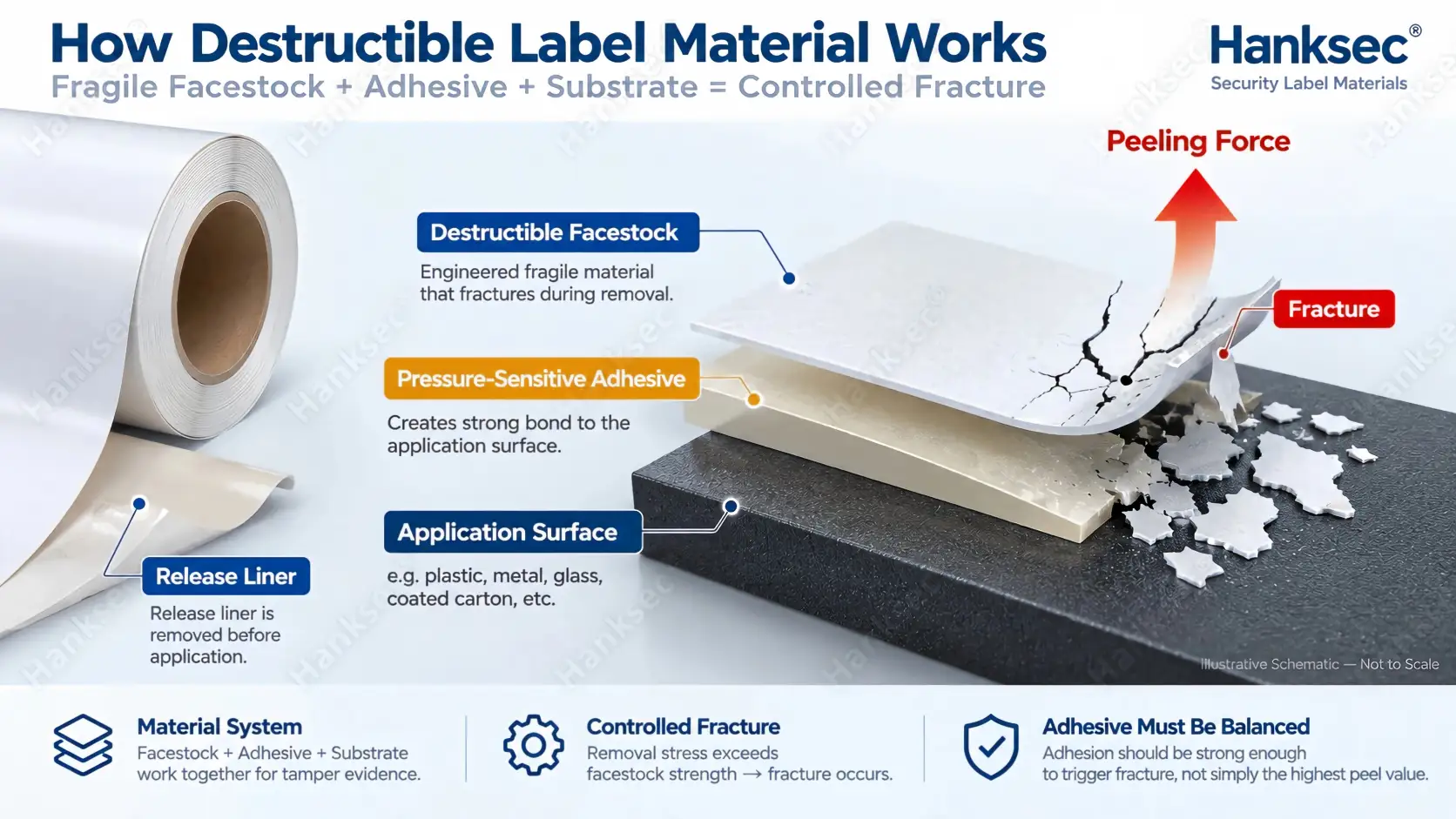
A typical destructible pressure-sensitive material contains three main functional components.
1. Destructible Facestock
The facestock is the fragile upper material carrying printed information such as logos, text, barcodes, serial numbers or authentication graphics.
Its mechanical properties are intentionally different from ordinary durable PET label film.
When sufficient peeling stress is applied, the material is designed to fracture rather than remain intact.
2. Pressure-Sensitive Adhesive
The adhesive anchors the fragile facestock to the application surface.
Its performance is critical.
If the adhesive bond is too weak for the substrate, the complete label may lift before the facestock produces the required destruction.
If the adhesive, facestock and substrate are properly matched, peeling transfers sufficient stress into the fragile material to initiate fracture.
This is also why the “strongest adhesive” is not automatically the correct adhesive.
The objective is a controlled tamper response, not simply the highest possible peel value.
For PP, PE, PET, glass, cartons and other surfaces, see the
Tamper Evident Label Adhesive Guide.
3. Release Liner
Before application, the adhesive is protected by a release liner such as glassine paper, kraft paper or PET liner depending on the construction.
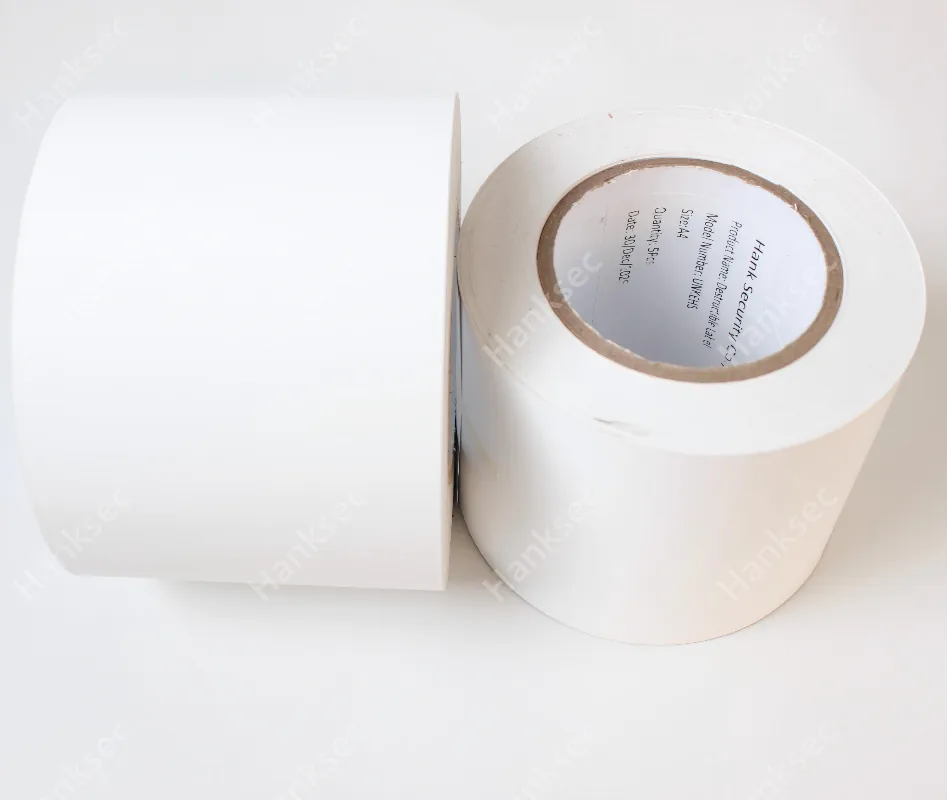
For label converters, liner behavior also affects die cutting, matrix stripping, rewinding, dispensing and automatic labeling.
A destructible material that works after application but constantly breaks during converting is not a practical production solution.
Destructible Does Not Mean Simply “As Fragile as Possible”
This is an important distinction for buyers and label converters.
A high-quality destructible label material should be fragile when unauthorized removal is attempted, but it must still have enough manufacturing and converting stability to survive the processes required before application.
These processes may include:
- printing;
- slitting;
- rewinding;
- die cutting;
- matrix stripping;
- label dispensing;
- manual or automatic application.
If a material is excessively fragile, a converter may experience web breaks, matrix breaks, edge cracking, label lifting or excessive production waste.
If the facestock is too strong for the application, however, removal may occur in large pieces and reduce the intended anti-transfer function.
The correct material therefore requires a balance between security after application and stability during production.
What Are Destructible Materials Made From?
There is no single universal raw material called “destructible material.”
Different manufacturers use different material systems to create the required breakage behavior.
Commercial examples demonstrate this clearly.
3M™ Destructible Polyurethane Label Material 3812
uses a destructible polyurethane facestock and is designed as a non-removable label material.
In comparison,
Avery Dennison® 2920 QM Ultra-Destructible
uses a brittle cast vinyl facestock designed for tamper-proof graphics and security-label applications.
This demonstrates an important technical point:
“destructible” describes the required mechanical behavior of the security material, not one single polymer chemistry.
Depending on the manufacturer and application, destructible security constructions may include:
- ultra-destructible vinyl-type films;
- fragile polymer films;
- polyurethane-based materials;
- specialty destructible paper;
- fiber-type destructible materials;
- transparent fragile films;
- multi-layer or co-extruded destructible constructions;
- holographic destructible constructions.
Therefore, buyers should not select a material based only on the words “destructible vinyl,” “eggshell,” or “fragile film.”
The actual removal behavior, adhesive compatibility and converting performance are more important.
Hanksec’s available constructions can be reviewed in the
Destructible Labels & Materials product range.
Destructible Material vs Ordinary Label Material
The main difference is not simply appearance.
It is what the material is engineered to do when removal is attempted.
| Material Type | Typical Removal Behavior | Primary Function | Intact Transfer Risk |
|---|---|---|---|
| Standard PET Label | Durable film may remain intact | Identification / information | Depends strongly on adhesive and substrate |
| Standard Paper Label | May tear during removal | General labeling | Variable |
| Destructible Material | Facestock intentionally fractures, tears or fragments | Anti-removal / tamper evidence | Designed to make intact transfer difficult |
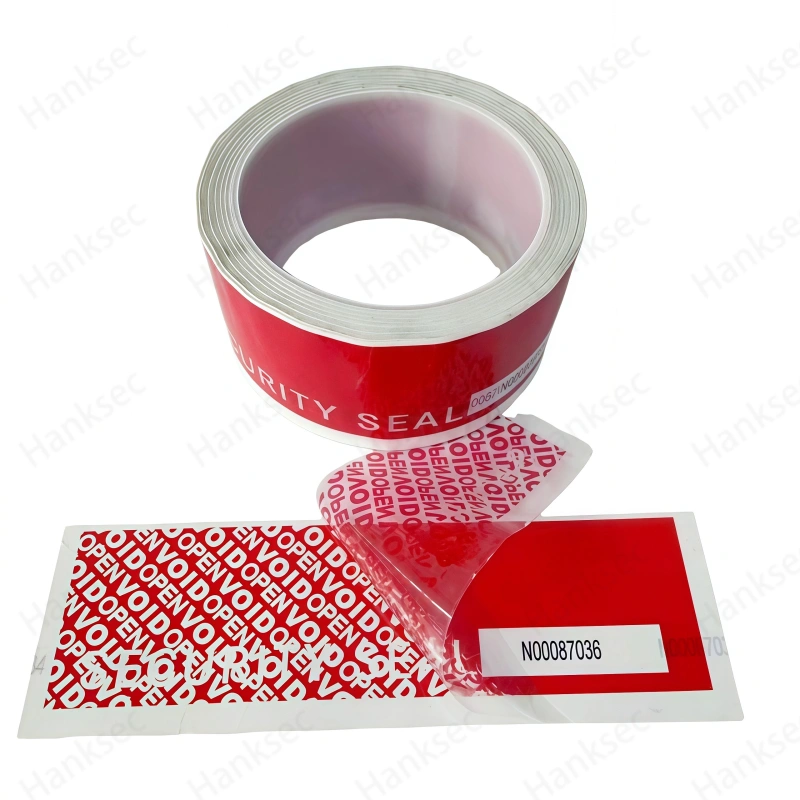
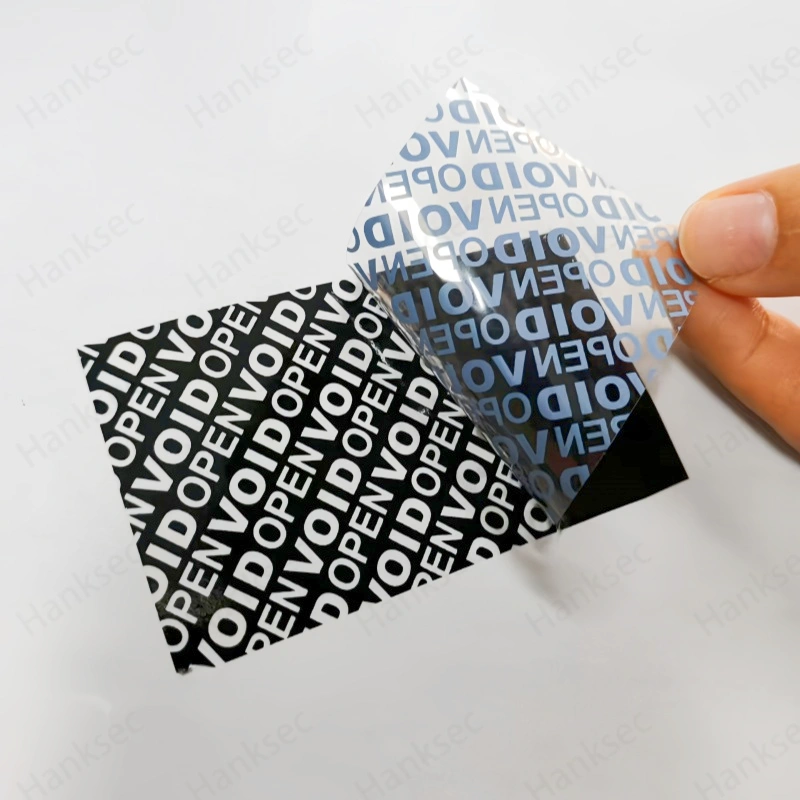
| VOID Security Material | Hidden message or transfer pattern becomes visible | Visual tamper evidence | Designed to reveal removal |
An ordinary label is primarily designed to remain attached and carry information.
A destructible label combines that identification function with a deliberately engineered anti-removal response.
Destructible Material vs VOID Material: What Is the Difference?
Destructible and VOID materials are both used for tamper-evident security labels, but they create evidence through different mechanisms.
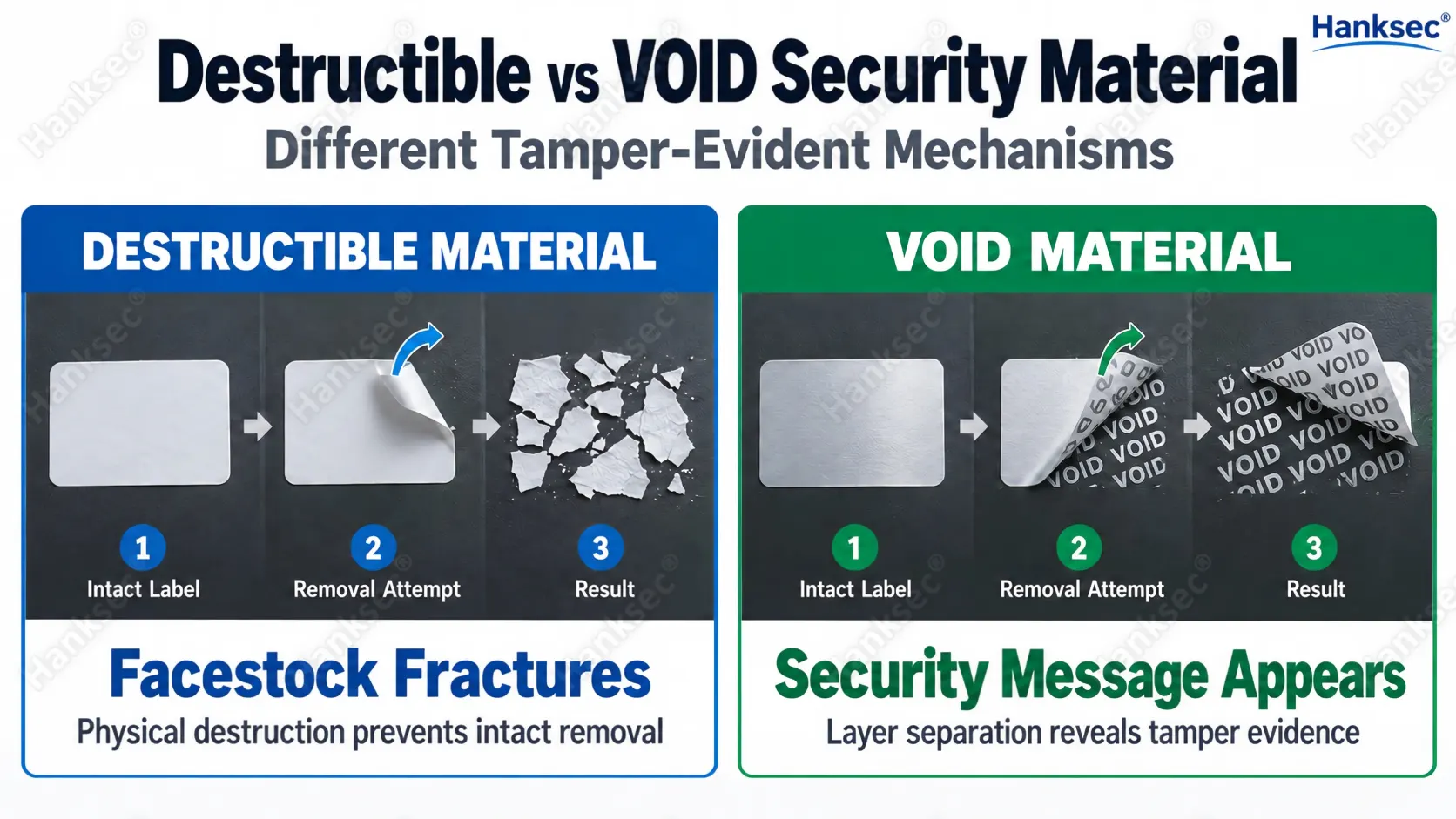
| Comparison | Destructible Material | VOID Material |
|---|---|---|
| Security Mechanism | Physical fracture of facestock | Controlled separation of functional security layers |
| Removal Evidence | Cracking, tearing or fragmentation | VOID, OPENED or custom security message |
| Main Selection Goal | Prevent intact removal or label transfer | Provide clearly visible opening evidence |
| Typical Applications | Warranty seals, electronics, assets, equipment | Packaging, warranty seals, electronics, logistics |
A destructible material mainly protects by physically destroying the label.
A VOID material mainly protects by revealing an irreversible security message or transfer pattern when its internal layers separate.
Neither technology is universally better.
The correct option depends on what the buyer needs to see after tampering.
If physical fragmentation is required, destructible material is normally the starting direction.
If the project requires a visible word such as VOID or OPENED, review
What Is VOID Label Material?
for full-transfer, partial-transfer and non-transfer constructions.
Is “Destructible” the Same as “Tamper-Evident”?
No. The two terms describe different things.
Tamper-evident describes the security function: the label or packaging system is designed to provide visible evidence that interference or removal has occurred.
Destructible describes one material mechanism that can create that evidence.
Destructible materials can be used to create tamper-evident labels, but not every tamper-evident label uses destructible material.
Other tamper-evident technologies include full-transfer VOID, partial-transfer VOID, non-transfer VOID, tamper-evident security tapes and hybrid security constructions.
Buyers comparing the broader range of security technologies can review
Types of Tamper-Evident Security Labels.
Where Are Destructible Materials Used?
Destructible materials are most useful when a label should not be removed intact and transferred to another product, component or surface.
| Application | Security Objective | What Should Be Evaluated? |
|---|---|---|
| Electronics Warranty Seals | Show attempted opening or unauthorized service | Small-label fracture, adhesive bond, housing surface |
| Asset Identification | Discourage label transfer or unauthorized replacement | Print durability, barcode readability, substrate adhesion |
| Equipment Security | Reveal access to screws, housings or service points | Surface texture, temperature and breakage pattern |
| Calibration / Inspection Labels | Make label substitution more difficult | Adhesion, printing and removal response |
| Product Authentication | Reduce intact transfer of authentication labels | Fragmentation plus optional serial, UV or holographic features |
For example, a small warranty seal applied over an electronics housing joint or screw can be designed to fracture when someone attempts to lift it.
The damage does not prove exactly who opened the equipment or why, but it can provide visible evidence that the original label has been disturbed.
Why Can the Same Destructible Material Behave Differently on Different Surfaces?
This is one of the most important practical issues in destructible label selection.
The label does not operate independently from the application surface.
Different substrates can create very different adhesive bonding conditions.
Examples include:
- PP and PE;
- ABS plastic;
- PET;
- glass;
- painted metal;
- powder-coated metal;
- coated cartons;
- textured housings.
PP and PE, for example, can create more difficult adhesive wet-out conditions than many higher-surface-energy materials.
Texture, coatings, contamination, oil, dust and molding additives may further change the result.
Two forces are especially important:
A — the internal strength of the destructible facestock
B — the adhesive bond between the label and the application surface
If the adhesive bond does not develop sufficiently, the label may lift before the required facestock fracture occurs.
If the adhesive bond and fragile facestock are correctly balanced, removal stress is transferred into the material and produces the intended destruction.
Dwell time can also matter.
A label tested immediately after application may behave differently after the adhesive has had additional time to establish contact with the surface.
This is consistent with published commercial material data.
For example, 3M’s destructible polyurethane material publishes different results according to substrate and dwell condition, reinforcing why buyers should not assume that one destructible material behaves identically on every surface.
For more detailed substrate selection guidance, read
Tamper Evident Label Adhesive Guide: PP, PE, HDPE, PET, Glass & Carton Selection.
Easy, Medium and Hard Destructibility: What Do These Terms Mean?
Security material suppliers may classify destructible products using terms such as ultra, easy, medium or hard destructible.
These descriptions are useful for material selection, but they should not automatically be treated as universal standardized industry grades.
A “medium destructible” grade from one supplier is not necessarily mechanically identical to a “medium” grade from another supplier.
| Destructibility Direction | Typical Behavior | Typical Selection Consideration |
|---|---|---|
| Ultra / Easy Destructible | High fragmentation, breaks quickly | Small warranty seals and strong anti-removal requirement |
| Medium Destructible | Balanced fracture and handling stability | General converting and security applications |
| Hard Destructible | Greater handling strength, larger fragments | Larger labels, printing or automatic labeling where more stability is required |
For label converters, the important question is not simply “Which material breaks into the smallest pieces?”
The correct question is:
Which material provides the required anti-removal response while still running reliably through our printing and converting process?
For a dedicated converter comparison, see
Destructible Label Material Rolls for Converters: Easy, Medium & Hard Selection Guide.
How Should Buyers Choose a Destructible Material?
The starting question should not be:
“Which destructible material is the strongest?”
A better purchasing question is:
“What type of destruction should occur on my actual application, and can the material also run reliably through our printing and converting process?”
Before selecting a construction, buyers should define:
- the exact application substrate;
- surface finish and texture;
- label dimensions;
- required fragmentation level;
- printing method;
- die-cutting and matrix-stripping requirements;
- manual or automatic labeling method;
- operating temperature and environment;
- adhesive requirements;
- release liner;
- roll width, roll length, core and winding direction.
A highly fragile construction may provide excellent anti-removal performance but create unnecessary converting difficulty for a large label or high-speed production line.
A harder destructible construction may be easier to print and convert but must still produce sufficient visible damage on the final substrate.
Material selection is therefore an engineering balance, not a simple ranking from “weak” to “strong.”
How Should Destructible Material Be Tested?
Destructible material should be evaluated as a complete pressure-sensitive system rather than by examining the facestock alone.
A practical qualification process should consider:
- peel adhesion;
- facestock fracture behavior;
- release force;
- die-cutting performance;
- matrix stripping;
- printing and rub resistance;
- barcode or variable-data readability where applicable;
- edge lifting;
- final tamper response on the actual substrate.
ASTM D3330/D3330M
provides standardized methods for measuring peel adhesion of pressure-sensitive tape and can be useful as a quality-assurance reference where the method is applicable.
However, a peel value alone should not be treated as proof that a destructible label is suitable for a specific security application.
For a destructible construction, the facestock may fracture before a conventional peel measurement can be obtained under some conditions.
The final qualification must therefore include the actual tamper response, not only a numeric adhesion value.
For Hanksec’s broader testing methodology, see the
Security Label Material Quality Control Guide for Label Converters.
Hanksec Technical Recommendation:
Whenever possible, test destructible material on the customer’s actual production substrate before bulk production.
A laboratory panel can provide useful comparative data, but it cannot reproduce every plastic formulation, coating, surface texture or environmental condition encountered in the final application.
Meaning of Destructible Material in One Sentence
In security labeling, destructible material means an engineered fragile label facestock designed to break, fracture, tear or fragment when removal is attempted so that the original label is difficult to remove intact and reuse without visible physical damage.
What Information Should You Send a Destructible Material Supplier?
For a useful technical recommendation, avoid sending only a request such as:
“Please quote destructible sticker material.”
A supplier can make a more accurate recommendation when the application conditions are clear.
| Information | Example | Why It Matters |
|---|---|---|
| Application Surface | ABS / PP / PET / Glass / Painted Metal | Determines adhesive compatibility |
| Label Size | 20 × 10 mm | Influences fracture and converting behavior |
| Printing Method | UV Flexo / Thermal Transfer / Digital | Determines printable-surface requirements |
| Required Breakage | Very small fragments / medium breakage | Helps select destructibility level |
| Supply Format | Jumbo Roll / Slit Roll / Finished Label | Determines converting specification |
| Operating Environment | Indoor / Humid / Elevated Temperature | Helps define qualification conditions |
Frequently Asked Questions About Destructible Material
What is the simple meaning of destructible material?
A destructible material is a material capable of being destroyed.
In security labeling, it usually refers to a fragile facestock intentionally engineered to break, tear or fragment when removal is attempted.
What does destructible mean on a label?
It means the label is designed so that attempted removal causes permanent physical damage to the facestock instead of allowing the complete label to peel away intact.
Is destructible material the same as destructible vinyl?
No. Destructible vinyl is one type of destructible construction.
Commercial destructible label materials can use different polymers and structures.
For example, published products include polyurethane-based destructible facestock as well as brittle vinyl constructions.
Is eggshell material the same as destructible material?
“Eggshell” is commonly used in the market to describe highly fragile label material that breaks into small pieces during removal.
However, destructible material is a broader category and can include different fragile film, paper, fiber, transparent and multi-layer constructions.
Does destructible material leave VOID text after removal?
Not necessarily.
A standard destructible material creates tamper evidence mainly through physical fracture of the facestock.
A VOID material uses a different security mechanism that reveals a hidden VOID, OPENED or custom message during removal.
Hybrid constructions can combine more than one security feature.
Which is better: destructible material or VOID material?
Neither is universally better.
Choose destructible material when physical fragmentation and prevention of intact label transfer are the main objectives.
Choose VOID material when the application requires a clearly visible transferred or revealed security message.
Can destructible material be removed without breaking?
A properly selected and applied destructible construction is intended to make intact removal difficult.
However, actual behavior depends on the adhesive, substrate, dwell time, temperature, surface contamination, label dimensions and destructibility level.
This is why testing on the final substrate is important.
Can destructible label material be printed?
Yes, but print compatibility depends on the exact facestock and surface treatment.
Different constructions may be prepared for UV, flexographic, screen, thermal-transfer, digital or other printing processes.
The actual ink, ribbon or toner system should be qualified before bulk production.
Can destructible material be die-cut?
Yes, but very fragile grades can require tighter control of die pressure, label spacing, matrix design, roll tension and stripping conditions.
Medium or harder destructible constructions may provide greater converting stability when the application does not require maximum fragmentation.
Why does a destructible label sometimes peel off without breaking?
One common reason is insufficient adhesive bonding to the actual application surface.
Surface energy, texture, contamination, application pressure, dwell time and adhesive selection can all affect whether removal stress causes facestock fracture or allows the label to lift.
Should destructible material be tested before bulk production?
Yes.
The material should preferably be tested on the real application substrate and, for label converters, through the intended printing, die-cutting, matrix-stripping and dispensing process before full production approval.
Need Destructible Material for Your Application?
Hanksec supplies destructible security label materials
for label converters, security printers, material distributors and OEM manufacturers.
Available project directions include different destructibility levels, fragile facestocks, adhesive systems, release liners, printable surfaces and converter-ready supply formats such as jumbo rolls, slit rolls, sheets and finished labels.
For material selection, send Hanksec your:
application surface, label size, printing method, required destruction effect, converting process, roll specification and operating environment.
The technical team can then recommend a suitable material direction and prepare samples for application and converting evaluation before bulk production.
Read the Complete Destructible Label Guide
|
Compare Easy, Medium & Hard Destructible Materials