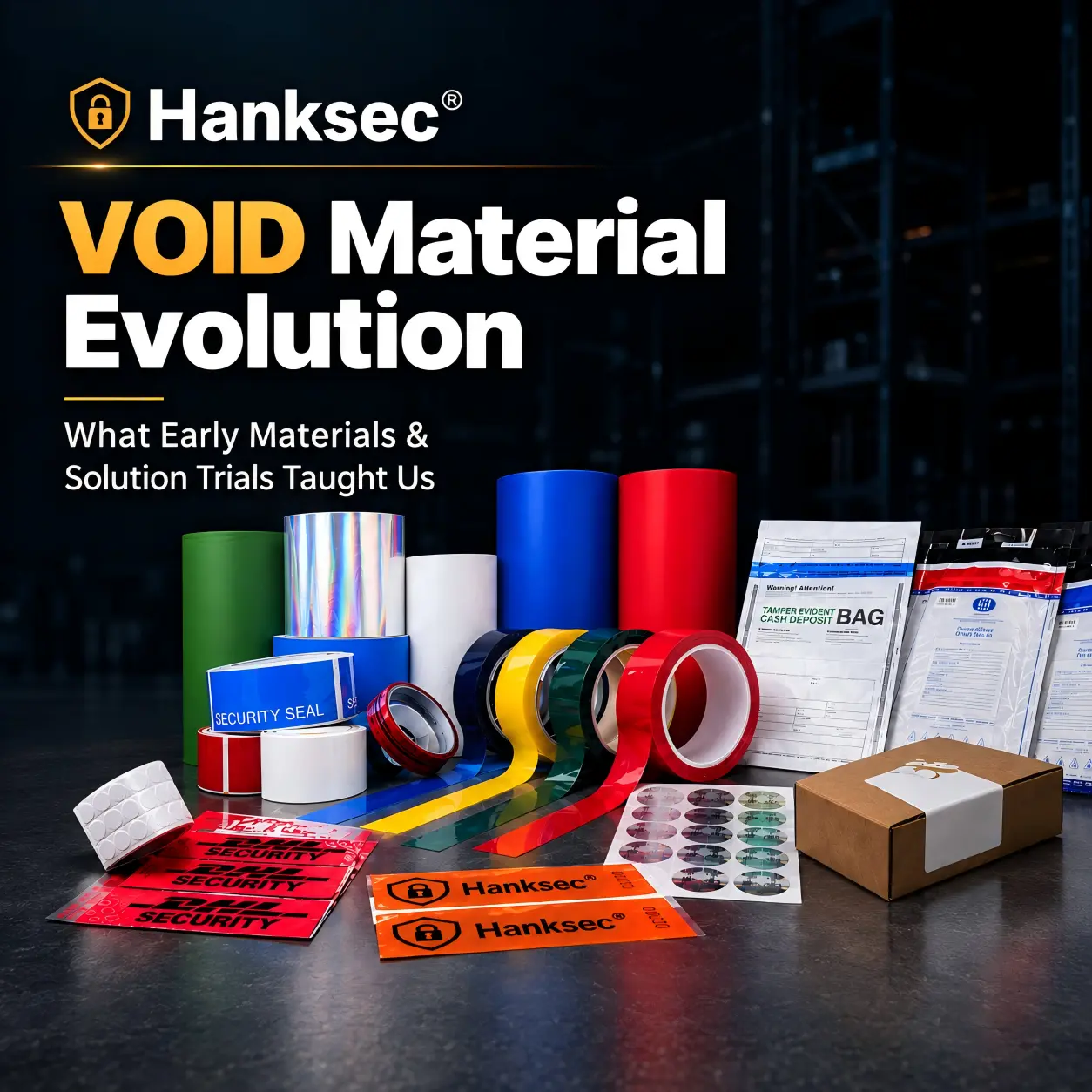
Tamper evident VOID material evolution is easier to understand when early materials and solution trials are placed next to what can be produced today.
Nearly twenty years ago, Hanksec was already working with matte silver checkerboard tamper-evident materials and comparing different PET films, surface appearances and security-layer constructions through practical material and solution trials.
The basic security principle has not changed:
Once the material is removed, it should create clear and irreversible evidence that the original sealed condition has been disturbed.
What has changed is the level of control available around that effect. The early materials showed that two constructions can look similar on a specification sheet and still behave differently in actual use. PET film characteristics, matte appearance, metallization, release behavior, adhesive interaction, coating uniformity and processing conditions can all influence the finished result.
This article uses Hanksec’s early matte silver checkerboard samples and solution trials as a technical reference. The purpose is not to claim that Hanksec conducted one continuous 20-year test program, nor to argue that “old material was bad and new material is good.” Instead, it looks back at what those early materials and trials revealed—and explains why the same engineering questions still matter when buyers and label converters evaluate tamper-evident materials today.
For readers who first need the basic structure and transfer types, see Hanksec’s What Is VOID Label Material? Structure, Types & Selection Guide.
Early Matte Silver Checkerboard Materials and Solution Trials
The historical photographs used in this article come from early Hanksec production and material-development work. One recurring format was a matte silver PET material with a checkerboard-style tamper indication.
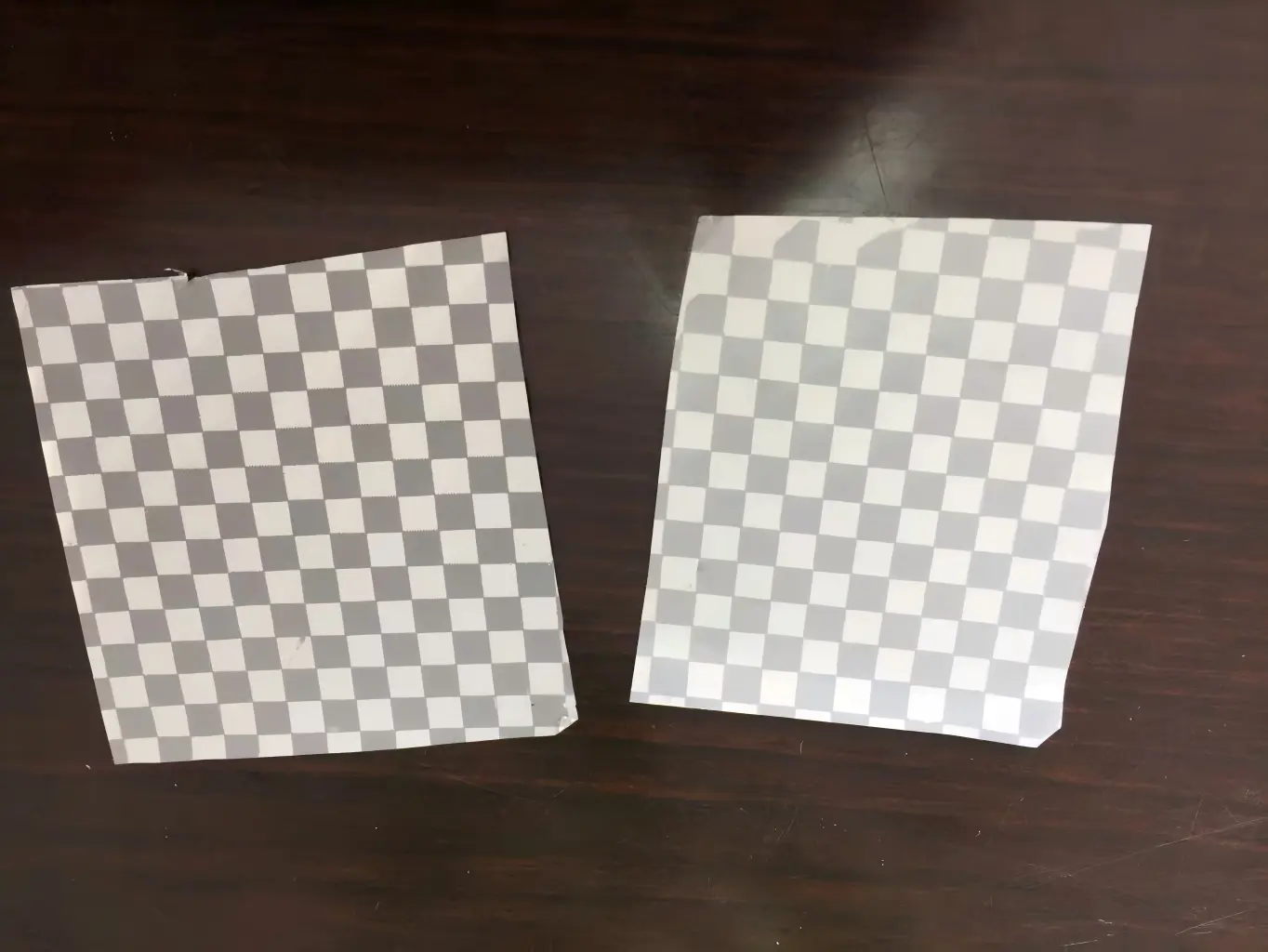
At first glance, the samples may appear to be the same type of material. They use a similar checkerboard security concept and a matte silver visual direction.
But when they are placed side by side, the differences become obvious. One sample can appear relatively pale, grey or whitish, while another can show a stronger metallic silver appearance. After peeling, the checkerboard definition may also vary in sharpness, contrast and uniformity.
Those early comparisons revealed one of the most important lessons in tamper-evident material development:
The finished appearance and tamper response are not determined by the checkerboard pattern alone.
The PET base film, surface texture, optical characteristics, metallized layer, release system, coating process and adhesive all contribute to the final result.
Why Can One Matte Silver VOID Material Look Whiter While Another Looks More Silver?
Buyers sometimes treat “matte silver PET” as if it were one standardized appearance. In practice, it is a broad description rather than a complete visual specification.
Several variables can change the finished appearance:
- PET base film grade;
- film haze and light-scattering characteristics;
- surface roughness or matte treatment;
- metallization characteristics;
- optical density;
- coating thickness and uniformity;
- release and transfer-layer construction;
- viewing angle;
- lighting conditions.
A PET base film with stronger light-scattering behavior can make a finished structure look softer and more diffused. Depending on the complete construction, that can move the visual impression toward a lighter grey or more whitish matte effect.
Another PET grade or surface treatment may allow the metallic layer to remain more visually dominant, producing a stronger silver appearance.
That is why a purchasing specification such as:
“50 μm matte silver PET”
is not enough by itself to define what the buyer will actually see.
For appearance-sensitive security-label projects, Hanksec recommends approving the physical finished-material sample, not only the nominal film color and thickness.
How PET Film Haze and Surface Characteristics Influence Matte Appearance
One of the clearest differences in Hanksec’s early comparisons came from the PET base film itself. Different matte PET films showed different optical behavior under the same or similar evaluation conditions.
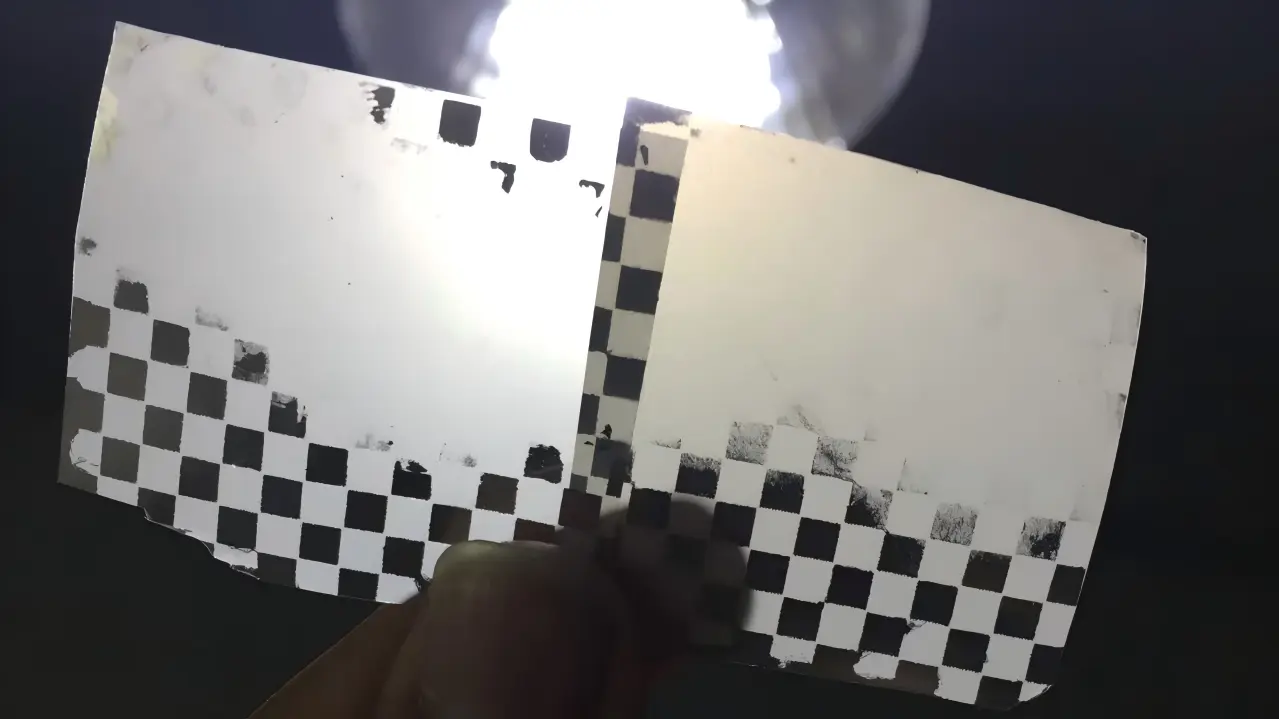
Haze is commonly used to describe wide-angle light scattering in transparent or essentially transparent plastic films. ASTM D1003-21 provides a standardized method for haze and luminous-transmittance measurement of transparent plastics and notes that haze data can be useful for specification and quality control. See ASTM D1003-21.
For a matte silver security material, however, the final visual appearance should not be reduced to one haze number. The finished structure may also include surface texture, metallization and functional coatings, so the appearance of the final material depends on the complete optical system.
In practical terms, PET base-film optical characteristics can influence how the finished material interacts visually with:
- metallization;
- transferred and non-transferred areas;
- printed graphics;
- ambient lighting;
- viewing angle;
- surface matte level.
This is a good example of why security material should be treated as a system, not simply as PET with a VOID pattern added afterward.
Different PET Film Sources: What the Early Trials Actually Showed
Another part of Hanksec’s early material and solution work involved comparing PET films from different sources. Some historical samples used DuPont-branded PET film, while others were produced with lower-cost domestic PET films available at the time.
But the facestock was only one part of the material system. Earlier Hanksec production references also show that release liner, adhesive formulation, metallizing and physical testing were evaluated together.
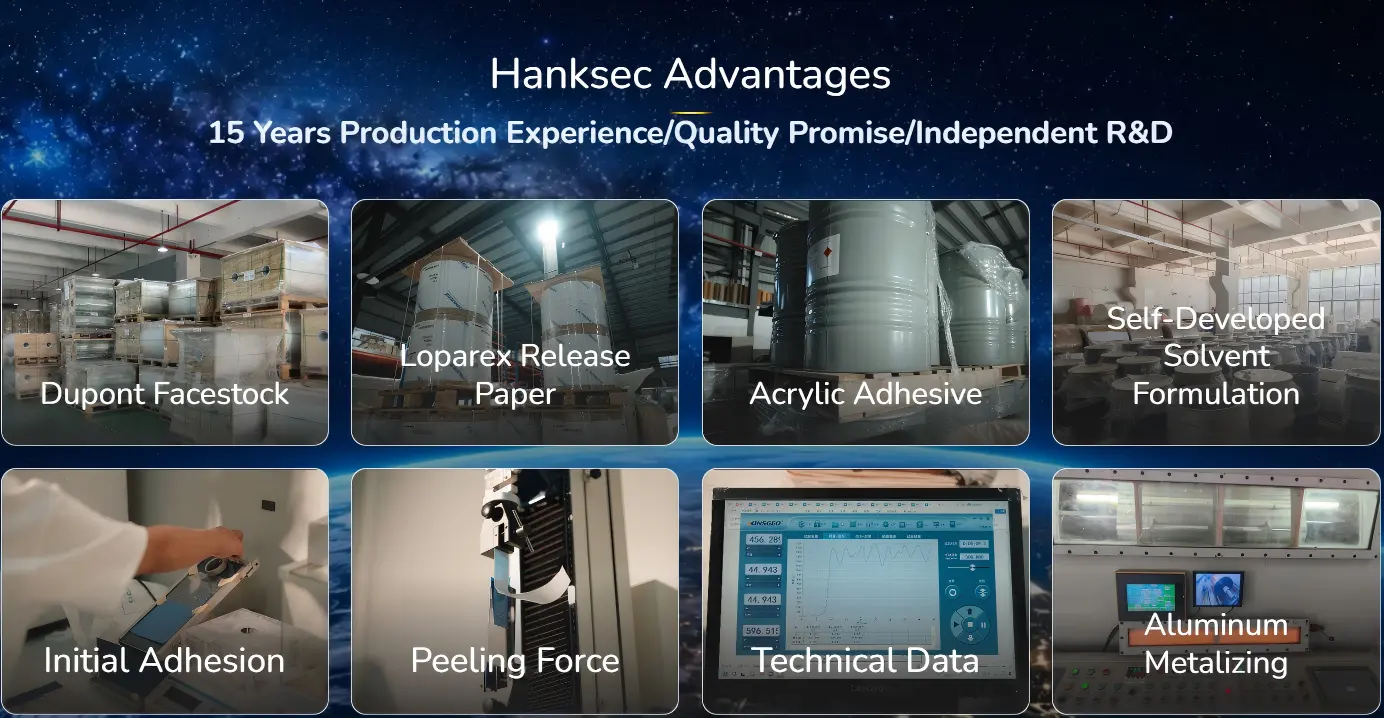
The comparison was useful because it showed that raw-film cost or supplier reputation alone did not determine the final security-material result.
Different PET films could influence:
- haze consistency;
- surface uniformity;
- dimensional stability;
- coating behavior;
- finished matte appearance;
- checkerboard definition;
- production repeatability.
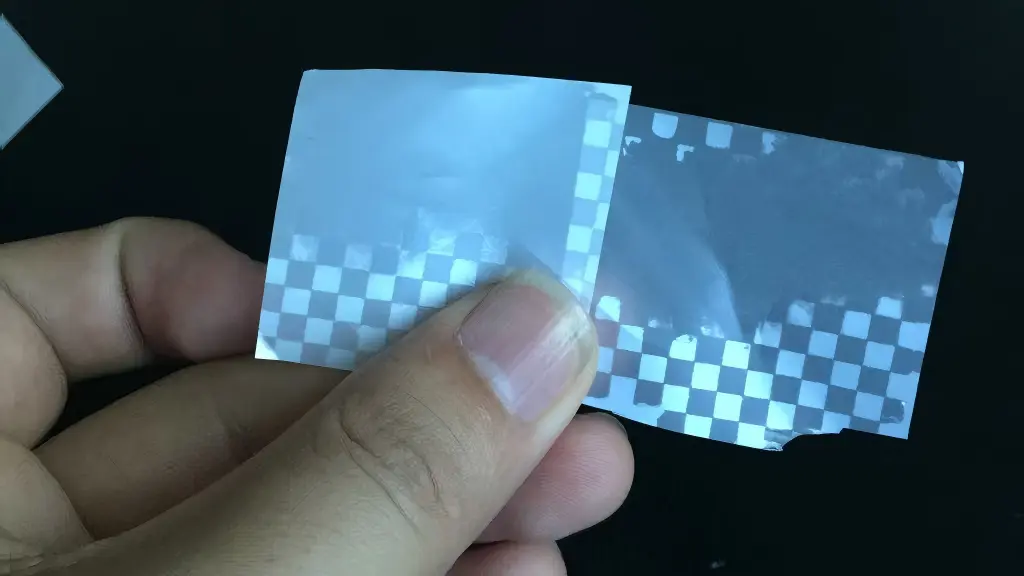
But the most important conclusion was not “expensive film is always better.”
A premium PET film does not automatically create a high-quality tamper-evident material.
The base film is only one part of the construction. The final result depends on how it works with the:
- release or separation system;
- tamper-indicating layer;
- metallized layer;
- adhesive system;
- surface treatment;
- printable topcoat;
- coating and drying process.
This is still how Hanksec approaches material qualification today: evaluate the complete construction rather than judging a security material by the PET supplier alone. Hanksec’s current Security Label Material Manufacturing Capabilities page describes this integrated material-system approach.
What Early Checkerboard Transfer Trials Were Actually Evaluating
The checkerboard pattern in the early samples was not only decorative. It created a simple visual way to compare how consistently a tamper-indicating structure separated or transferred during removal.
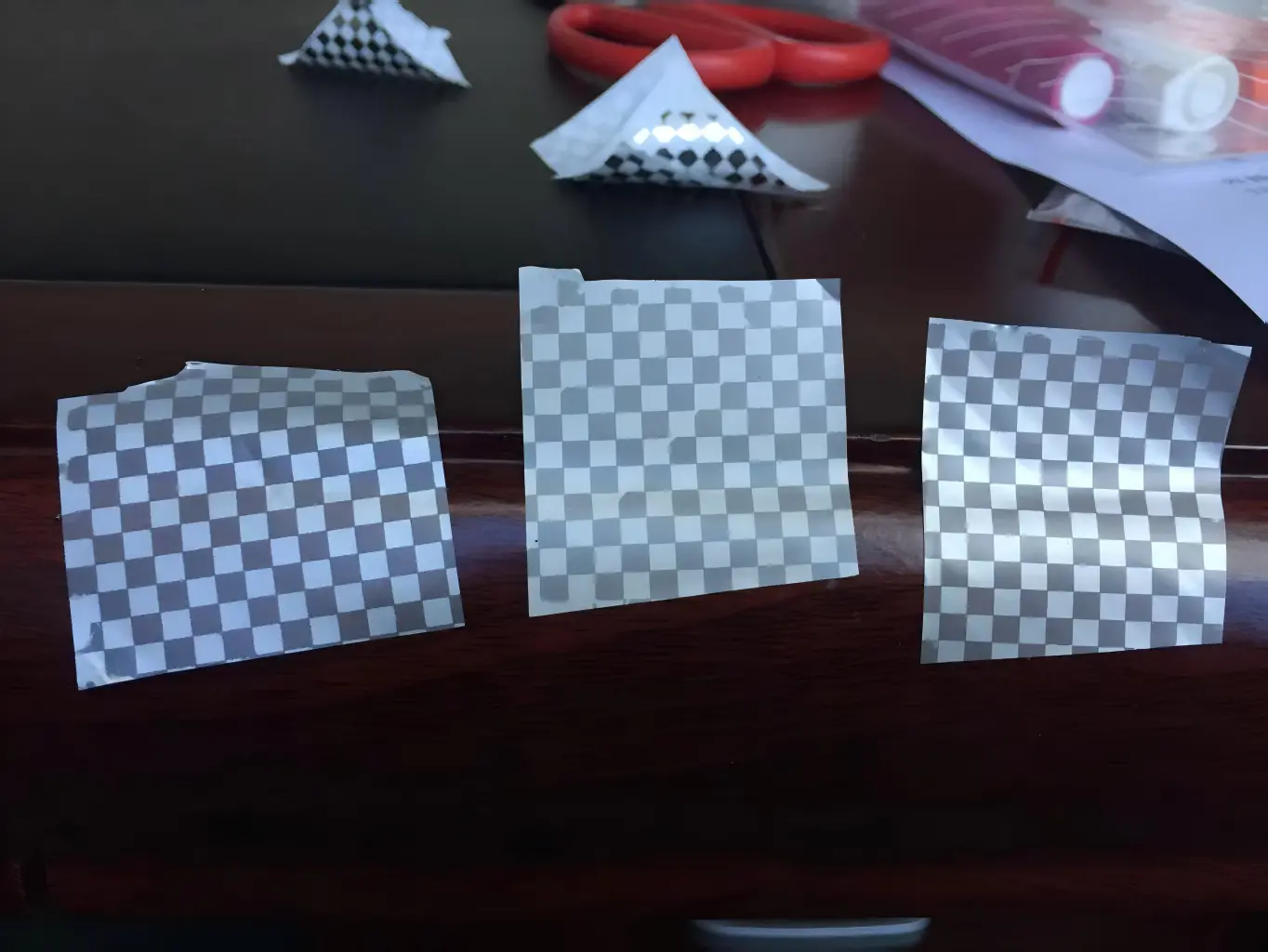
During those trials, engineers could compare:
- whether the checkerboard appeared clearly after peeling;
- whether individual squares remained well defined;
- whether some areas transferred incompletely;
- whether the remaining surface appeared uniform;
- whether the tamper pattern was repeatable across samples;
- whether the visual result stayed consistent across different areas of the material.
These trials helped separate two questions that are still important today:
Does the material look acceptable before application?
and
Does it create the intended tamper evidence after removal?
A tamper-evident material can look attractive on the roll and still fail the application if the security response is weak, inconsistent or incompatible with the target substrate.
Tamper Evident Material Quality Is a System, Not a Single Raw Material
These early material and solution trials reinforce one principle:
Tamper-evident performance should be evaluated as a complete material system.
A PET-based VOID construction can include several interacting elements.
| Material Factor | Possible Influence |
|---|---|
| PET film | Surface appearance, dimensional stability and converting behavior |
| Film haze / optical behavior | Matte level, visual diffusion and interaction with metallization |
| Metallized layer | Silver appearance, reflectivity and contrast |
| Release / separation coating | How and where the security structure separates during removal |
| Security pattern | Visibility and readability of the tamper indication |
| Pressure-sensitive adhesive | Bonding to the target substrate and support for intended activation |
| Coating uniformity | Repeatability across width and production lot |
| Surface treatment / topcoat | Printing, coating compatibility and downstream converting |
| Release liner | Release force, die cutting, matrix stripping and dispensing behavior |
Changing only one variable can alter the finished result.
That explains why two products described as:
“50 μm matte silver PET tamper-evident material”
can still differ in appearance, transfer definition, printability, die-cutting behavior and tamper response.
For a broader explanation of complete security-material architecture, Hanksec’s Security Label Materials FAQ and Security Label Material Quality Control Guide both use the same system-based selection logic.
From Early Samples to Current Tamper Evident PET Materials: What Has Changed?
Now compare those early samples with the current checkerboard tamper-evident materials used in Hanksec’s production and application testing.
The security principle remains familiar. The material is applied to a target surface. When removal is attempted, the functional security structure changes and the checkerboard indication becomes visible.
What has changed is the level of specification and process control expected around that result.
1. More Consistent Transfer Definition
The checkerboard pattern should appear clearly and predictably rather than showing uncontrolled transfer variation. This requires the separation layer, coating uniformity, adhesive interaction and substrate condition to work together.
2. Better Surface Uniformity
PET selection and coating control are used to target a more uniform matte appearance across the production roll instead of judging only one local sample.
3. More Controlled Matte-to-Metallic Balance
Rather than treating “matte silver” as one generic finish, the material can be developed toward a more specific visual target based on PET film, surface treatment and metallized appearance.
4. Improved Batch-to-Batch Repeatability
For label converters, repeatability is often more important than how impressive one sample looks. A material that performs well once but varies significantly between lots creates printing, converting and customer-approval risk.
That is why current qualification should compare recorded material data, physical samples and converting results rather than relying on a single hand-peel observation. Hanksec’s Quality Assurance process is structured around sample evaluation, actual-substrate testing, printing/converting checks and bulk approval.
5. More Tamper-Evident Construction Options
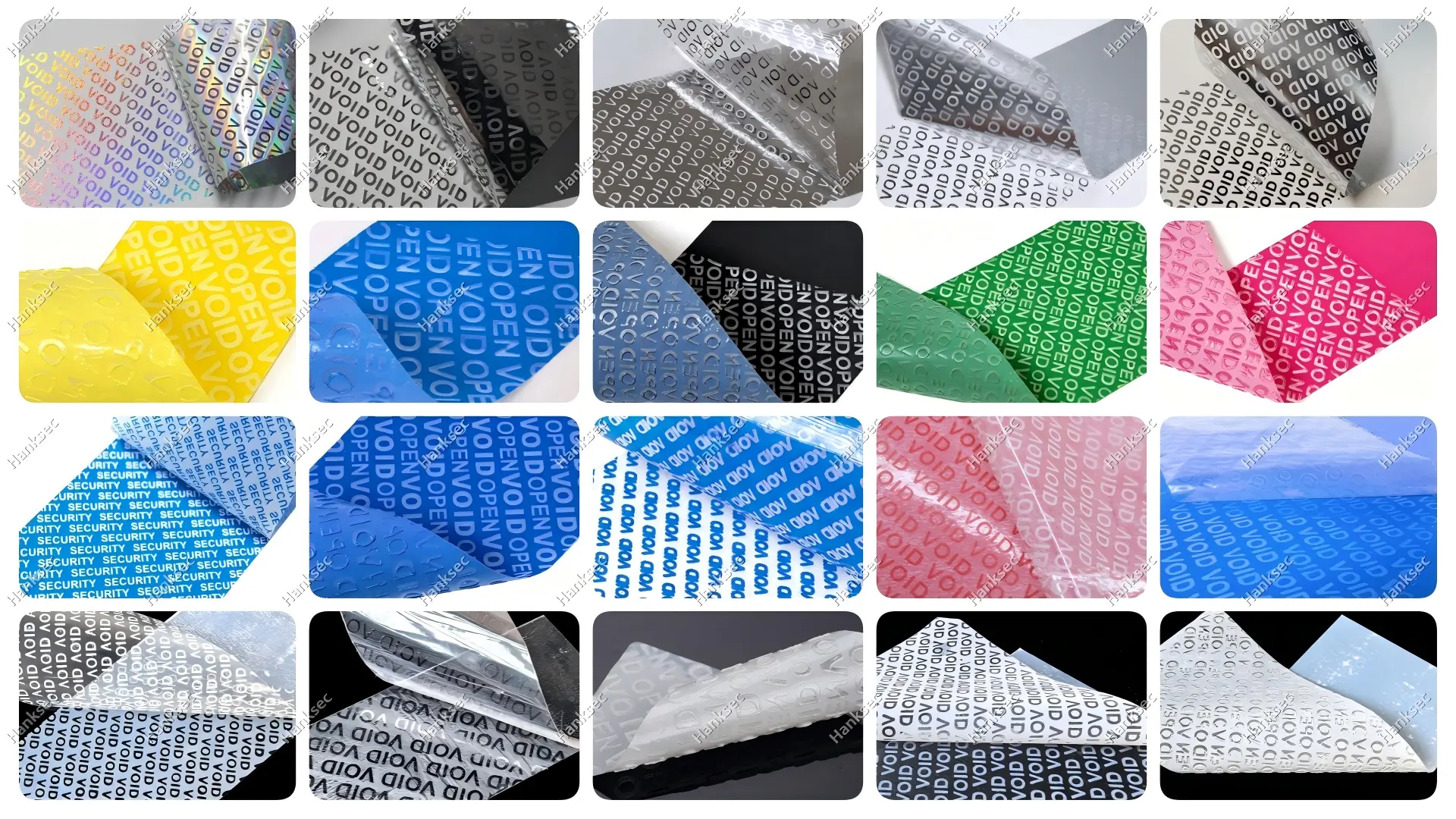
Current VOID materials are not limited to one transfer mode.
Full Transfer
The hidden message or security pattern transfers substantially to the applied surface after removal.
Partial Transfer
The security response is divided between the removed label and the applied surface, depending on the construction.
Non-Transfer
The construction is designed so that the hidden indication appears mainly on the removed label while transferred security graphics or residue on the application surface are minimized according to the approved material design and substrate.
The correct transfer mode depends on where the buyer wants the visible evidence to appear, how much residue is acceptable, and what substrate is being protected. For a detailed discussion of clean-surface applications, see Hanksec’s Non-Transfer VOID Label Material Buyer’s Guide.
Early Tamper Evident Materials vs Current PET VOID Materials
A useful comparison is not “old is bad, new is good.” The early samples successfully demonstrated the security concept and revealed material-development questions that still matter today.
The main difference is the amount of specification, process control and application qualification now expected around the result.
| Development Area | Early Material & Solution Trials | Current Material Development |
|---|---|---|
| PET selection | Compared through repeated physical trials | More controlled material specification and sample approval |
| Matte appearance | Noticeable variation between film sources | Targeted optical and surface selection |
| Metallic appearance | Could vary from pale to stronger silver | More deliberate visual target and repeatability control |
| Transfer pattern | Functional but sometimes variable between structures | Greater emphasis on definition and consistency |
| Raw-material evaluation | Strong dependence on side-by-side sample comparison | More systematic material qualification and recorded QC |
| Transfer options | More limited construction choices | Full / Partial / Non-Transfer options |
| Custom security pattern | More limited | Custom VOID, logo, text and pattern options |
| Printing compatibility | Evaluated case by case | Printable constructions developed around defined printing systems |
| Batch consistency | More dependent on repeated visual comparison | Greater process and material-control emphasis |
Why This Matters to Label Converters and Security Material Buyers
For a buyer, it is easy to compare tamper-evident materials only by:
- thickness;
- color;
- adhesive;
- film supplier;
- price per square meter.
These specifications matter, but they do not describe the whole material system.
A nominally similar material can still produce different:
- matte appearance;
- metallic tone;
- transfer definition;
- printability;
- die-cutting behavior;
- release-liner behavior;
- adhesive performance;
- tamper evidence.
This is why serious material approval should include physical testing.
Surface Appearance
Does the matte or metallic effect match the approved visual target under realistic lighting?
Transfer Effect
Is the checkerboard or VOID pattern clear, repeatable and located where the buyer expects the evidence to appear?
Target Substrate
Does the adhesive and security structure activate correctly on the actual carton, PET, glass, metal, PP, PE or other application surface?
Printing Compatibility
Can the material accept the intended ink, toner or ribbon system without losing print quality or damaging the functional surface?
Die Cutting and Matrix Stripping
Can the material convert reliably at the intended label geometry, speed and tooling condition?
Release-Liner Behavior
Is the release force compatible with die cutting, matrix removal, rewinding and dispensing?
Environmental Conditions
Will temperature, humidity, storage time or application environment change adhesion or tamper response?
A lower raw-material cost only creates value if the finished material remains stable through the customer’s printing, converting and end-use process.
Why Physical Sample Testing Still Matters
The early checkerboard comparisons were simple, but their logic remains valid: compare the material under controlled conditions and observe the result after removal.
Today, that hand-peel observation should be combined with more structured qualification.
ASTM D3330/D3330M-04(2025) provides standardized peel-adhesion test methods for pressure-sensitive tape and allows representative application surfaces to be compared with the standard steel panel for relative bond evaluation. It also cautions that peel data alone do not directly define functional end-use performance. See ASTM D3330/D3330M-04(2025).
That principle is highly relevant to security materials:
adhesion data, transfer behavior and real tamper response should be evaluated together.
For converters, Hanksec’s current QC workflow includes peel adhesion, release force, die cutting and matrix stripping, VOID tamper response and print/barcode/rub testing. See the Security Label Material Quality Control Guide.
What These Early Materials and Solution Trials Still Teach Us Today
When we look back at the early photographs and material samples, the products may appear simple. But the engineering questions behind them are almost identical to the questions our technical team still considers today:
- Why does one PET structure look more silver?
- Why does another look more pale or whitish?
- Why is one checkerboard pattern cleaner?
- Why does the matte appearance change?
- Why does one construction transfer more consistently?
- Why does one structure print or convert more reliably?
The tools, raw materials and process controls have improved.
The engineering mindset has not changed:
Test the material.
Compare the result.
Understand which variable changed.
Then optimize the construction.
That process is still fundamental to tamper-evident material development.
The Principle Stayed the Same. The Material Engineering Evolved.
In those early material and solution trials, the goal was already clear:
make unauthorized opening or removal visible.
That remains the purpose today.
What has evolved is the ability to define and control more parts of the material system:
- different PET film grades;
- different optical and matte characteristics;
- different metallic appearances;
- different transfer modes;
- custom security patterns;
- different pressure-sensitive adhesives;
- printable topcoats;
- release-liner options;
- jumbo-roll and slit-roll specifications;
- application-specific constructions.
The result is not simply a more attractive security material.
It is a more predictable and better-defined material system.
For Hanksec, the early checkerboard samples are therefore more than historical photographs. They preserve a record of the material and solution questions being explored at the time: how raw materials, coating structures and application conditions influence the final tamper-evident result.
Looking back at those trials does not prove a continuous 20-year test program. What it does show is that the core engineering questions behind tamper-evident materials were already being examined nearly twenty years ago—and those same questions remain relevant to material selection and qualification today.
FAQ: Tamper Evident VOID Material Evolution
Why can two matte silver VOID materials look different even if they have the same thickness?
Thickness alone does not define appearance. PET film characteristics, optical behavior, surface texture, metallization, coating uniformity and the functional security layers can all change the finished matte or metallic effect.
Does higher PET film cost always mean better VOID performance?
No. PET quality matters, but the final tamper-evident response depends on the complete construction, including the release system, security layer, metallization, adhesive, surface treatment and coating process.
Does PET haze determine the final matte silver appearance?
It can influence the optical behavior of the PET base film, but the finished matte silver appearance also depends on surface texture, metallization and functional coatings. A haze value should therefore not be used as the only visual specification for a metallized tamper-evident material.
Why is checkerboard transfer consistency important?
The checkerboard pattern provides a visible way to assess whether the tamper-indicating structure separates or transfers consistently. Poor definition or incomplete activation can indicate that the material system needs further qualification.
Should buyers approve a VOID material from a datasheet only?
No. A datasheet is useful for defining nominal specifications, but appearance, tamper response, adhesion, printing and converting should be confirmed with physical samples on the intended substrate and production process.
What do these early material and solution trials actually tell us?
They show that the final tamper-evident result depends on the interaction of the PET film, optical characteristics, metallization, release system, adhesive, coating process and target substrate. They should be treated as historical technical references, not as evidence of one continuous long-term test program.
What information should a buyer send before requesting a tamper-evident material sample?
Provide the application substrate, required Full / Partial / Non-Transfer response, target surface appearance, printing method, die-cutting or converting conditions, service environment, roll specification and estimated quantity.
Need to Compare Tamper Evident Materials for Your Application?
If you are choosing between different matte silver PET, Full Transfer, Partial Transfer or Non-Transfer VOID materials, physical testing is usually the most reliable way to determine the correct construction.
Hanksec can support material evaluation according to:
- application substrate;
- required tamper effect;
- surface appearance;
- adhesive requirement;
- printing process;
- die-cutting and matrix-stripping conditions;
- release-liner requirement;
- operating environment;
- jumbo-roll or slit-roll specification.
For unusual applications, Hanksec’s Application Engineering & Technical Support process can begin with the real substrate and required tamper response.
Request material samples or application testing before final production.