Author: Hanksec Technical Team
Security Bag Tape | Security Levels | Cold Tamper Detection | Heat Tamper Detection | Liquid Attack | Authentication
Quick Answer: Security Bag Tape Levels are not globally standardized. A Level 4 tape from one manufacturer may not contain the same security features as a Level 4 tape from another. Buyers should therefore compare the actual attack-detection functions rather than choosing only by the level number.
For practical selection, security bag tape can be evaluated by the risks it is designed to reveal: unauthorized opening, cold attack, heat attack, water or defined chemical interference, mechanical removal and covert authentication.
The correct question is not “What is the highest level?” It is “Which tampering methods are credible in our application, and which security features are required to reveal them?”
Are Security Bag Tape Levels Globally Standardized?
No. Security bag tape levels are normally manufacturer-defined product classifications rather than one universal international grading system.
For example, TamperTech publishes bag tape Levels 2–6, with different combinations of cold VOID, thermochromic indication, security cuts, hidden UV printing and water-fugitive ink.
Other manufacturers use Level 1–6 systems or different combinations of visible, temperature-sensitive, liquid-sensitive and authentication features.
This means two products carrying the same level number should not automatically be considered equivalent.
Buyers should request a feature specification that clearly identifies:
- what happens during normal opening;
- what happens during cold or freezing attack;
- what happens during heat attack;
- whether water or a specified liquid can trigger a visible response;
- whether mechanical removal creates additional evidence;
- and whether covert authentication is included.
For a broader explanation of bag-film compatibility, adhesive selection and production requirements, see the Security Bag Tape for Bag Manufacturers Selection Guide.
Security Bag Tape Level 1–6: A Practical Hanksec Selection Framework
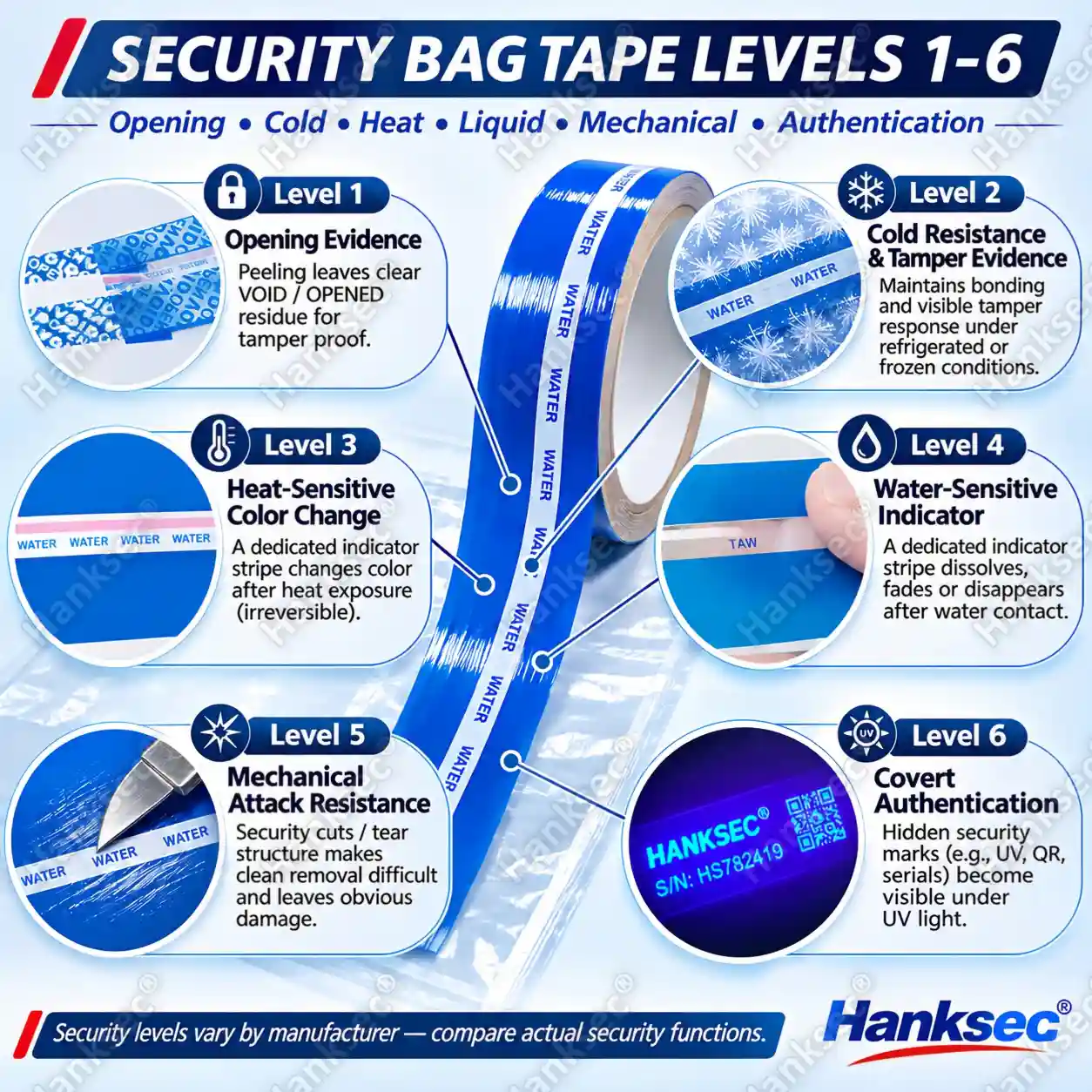
The following Level 1–6 matrix is a buyer-oriented framework for comparing different security functions. It illustrates one possible progression from basic opening evidence to additional attack detection and authentication. Final constructions must be confirmed according to the actual bag film, production process and required tamper response.
| Level | Main Security Function | Attack to Detect | Typical Evidence |
|---|---|---|---|
| Level 1 | Opening / Peel Evidence | Unauthorized opening or lifting | VOID / OPENED / custom message |
| Level 2 | Level 1 + Cold Tamper Detection | Freezing or low-temperature removal attempt | Intended tamper evidence after a defined cold attack |
| Level 3 | Level 2 + Heat Detection | Heat gun, hair dryer or adhesive-softening attempt | Thermochromic colour or security-pattern change |
| Level 4 | Level 3 + Liquid Tamper Indication | Water, moisture or a specified liquid exposure | Security ink changes, runs, fades or becomes visibly disturbed |
| Level 5 | Level 4 + Mechanical Tamper Evidence | Clean lifting, controlled removal or physical manipulation | Security cuts, tearing or irreversible material damage |
| Level 6 | Level 5 + Covert Authentication | Counterfeit or substituted security closure | UV or another approved covert verification feature |
Important: This matrix should be treated as a selection framework rather than a universal industry standard. The sequence illustrates one possible functional progression. It does not mean that every manufacturer’s Level 2–6 products necessarily contain all lower-level features. Project-specific constructions may combine the functions differently. Always confirm the actual included features against the supplier’s technical specifications.
Level 1: Does Opening Leave Clear Tamper Evidence?
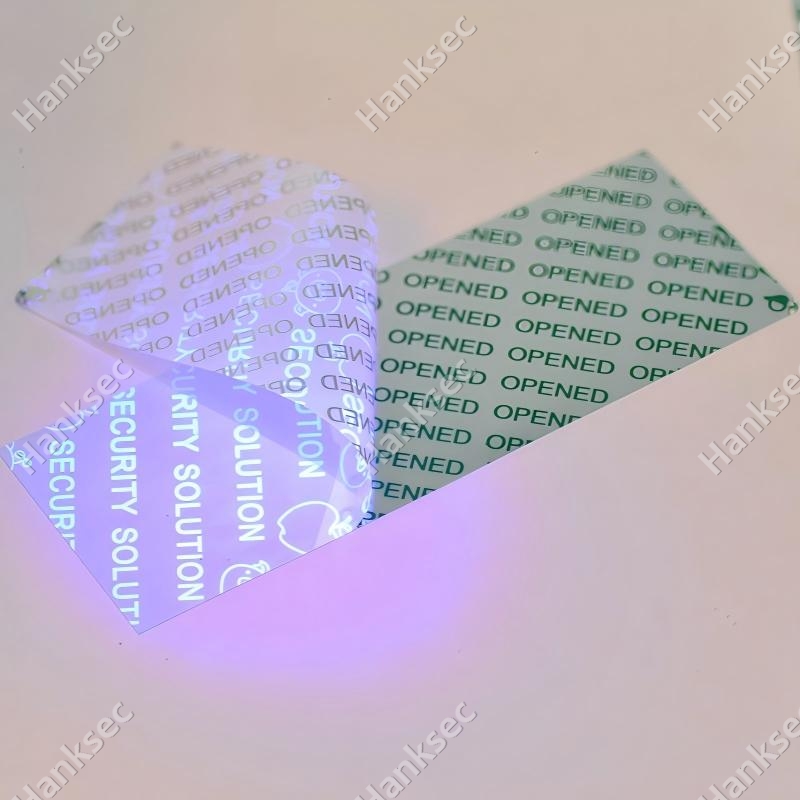
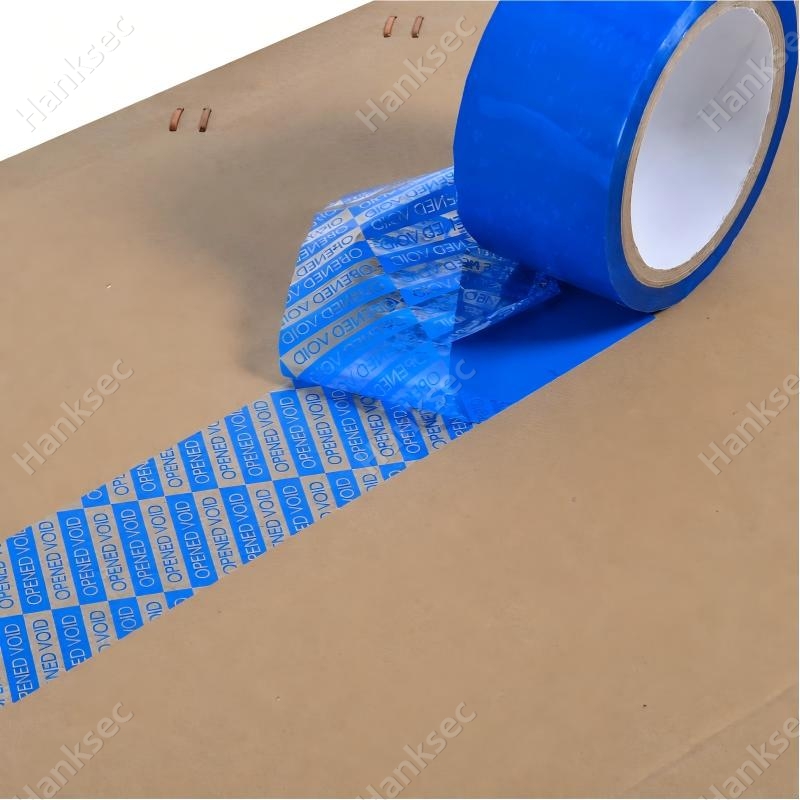
The foundation of a security bag closure is visible evidence that the seal has been opened.
Depending on the construction, an opening attempt may reveal:
- VOID;
- OPENED;
- VOIDOPEN;
- a customer-specific hidden message;
- or another controlled transfer pattern.
The objective is not simply strong adhesion. The objective is to make unauthorized opening difficult to hide.
Depending on the security bag tape construction, the tamper-evident message may transfer to the bag film, remain on the tape, or split across the two interfaces. The intended evidence pattern should be evaluated on the actual bag film and finished closure rather than assumed from an unused tape sample.
Level 2: Can the Seal Reveal a Cold or Freezing Attack?
Cold tampering is different from ordinary low-temperature storage.
An attacker may cool or freeze a closure in an attempt to change adhesive behaviour and make removal easier. A cold-tamper construction is selected so that the intended evidence appears when the seal is attacked under the specified low-temperature conditions.
Cold tamper detection should not be confused with cold-chain service temperature. One describes the ability to reveal an attempted opening involving cooling or freezing. The other describes whether a material can function during storage or transport at low temperature.
Buyers should also distinguish material-level cold resistance from finished-closure performance. Final qualification should use the actual bag film, adhesive construction, application conditions and defined cold-attack procedure.
Level 3: Can the Seal Show Evidence of Heat Attack?
Heat is another method that may be used to interfere with pressure-sensitive closures.
A hair dryer, heat gun or controlled heating may be used in an attempt to soften the adhesive before lifting the tape.
Thermochromic security features can add a visible response when a defined heat exposure occurs. Depending on the design, the ink may change colour or reveal a security pattern.
The important distinction is:
Heat resistance ≠ heat tamper indication.
A material may physically survive elevated temperatures without providing evidence that heat was intentionally applied. Conversely, a heat-sensitive indicator is designed to respond to a specified exposure condition and should be evaluated for its activation temperature, exposure time and visible response.
Level 4: What About Water, Moisture and Chemical Attack?
Liquid attack should also be treated separately from simple waterproof performance.
Security bag constructions may use water-sensitive or water-fugitive security-printing approaches so that water contact creates a visible indication. Depending on the ink formulation, the printed area may run, bleed, fade or disappear when exposed to water.
Water-sensitive and water-fugitive describe responses to water; they do not automatically mean that the same ink will react to every solvent or chemical.
Some applications may also need evaluation against alcohol, cleaning agents or other defined chemicals. Chemical tamper indication and chemical resistance are separate requirements. Their performance depends on the exact ink, adhesive, substrate and construction.
Buyers should therefore specify the actual liquid or chemical risk rather than simply requesting “solvent-proof” or “chemical-resistant” tape. Each required liquid should be evaluated separately under defined exposure conditions.
Shosky, for example, publicly lists temperature, water-contact, UV and other security options within its security-bag product range. See its published security-feature examples.
Level 5: Why Add Security Cuts or Mechanical Tamper Evidence?
Not every attack uses temperature or liquid.
An attacker may instead try to lift the tape slowly, peel it as one intact strip or physically manipulate the closure.
Security cuts, pre-scored areas or controlled tear patterns can make clean removal more difficult. When the tape is lifted or manipulated, the material may tear irregularly rather than being removed as one reusable piece.
This creates an additional type of evidence:
VOID response + physical damage.
The effectiveness of this feature depends on the cut pattern, material construction, adhesive behaviour and bag-film compatibility. Buyers should verify that the intended damage pattern is produced on the finished bag closure.
Level 6: Tamper Evidence Plus Authentication
The highest security requirement may involve more than detecting opening.
The receiving party may also need to verify that the security closure itself is genuine and belongs to the intended security system.
Covert features can include:
- hidden UV printing;
- fluorescent security marks;
- custom covert logos;
- project-specific verification patterns;
- or, where appropriate, optical or holographic authentication features.
These features perform a different job from VOID evidence.
Tamper evidence answers “Was it opened?” Authentication helps answer “Is this the correct security closure?”
A covert feature is useful only when the receiving party has an appropriate verification method and knows what result to look for. The feature design, inspection procedure and access to verification information should therefore be defined during project qualification.
Which Security Features Can Be Integrated Together?
Multiple functions can be combined in one security bag tape system.
Security bag constructions may combine VOID evidence with cold tamper detection, thermochromic indication, security cuts, UV authentication and water-sensitive printing. However, adding more features does not automatically create a better product.
Every additional functional layer or printing feature can affect cost, converting, printing compatibility, liner behaviour, adhesive balance and finished-bag performance.
For example, an indicator coating must remain compatible with the adhesive and the intended converting process. A security cut must create the required physical evidence without compromising normal bag production or closure integrity.
That is why buyers should specify the credible attack methods first, then build the appropriate combination.
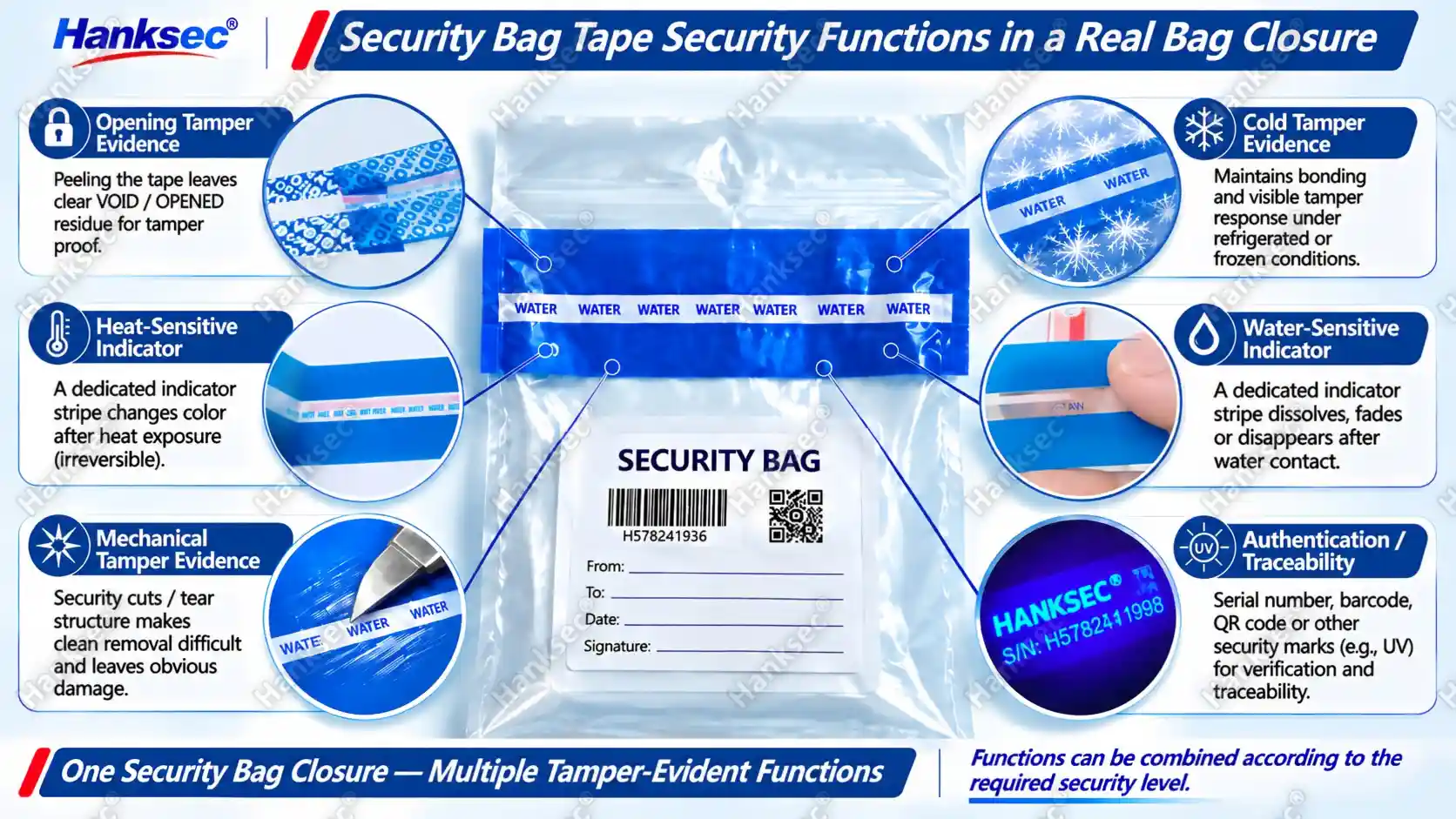
Illustration of multiple security functions integrated into one security bag closure. Not every configuration includes all six functions; the final construction depends on the required tamper-evident performance, material compatibility and application conditions.
For projects using two functional closure interfaces, also see Double-Sided vs Single-Sided Security Bag Tape.
Are Serial Numbers, Barcodes and QR Codes Security Levels?
They are important, but they perform a different function from physical tamper detection.
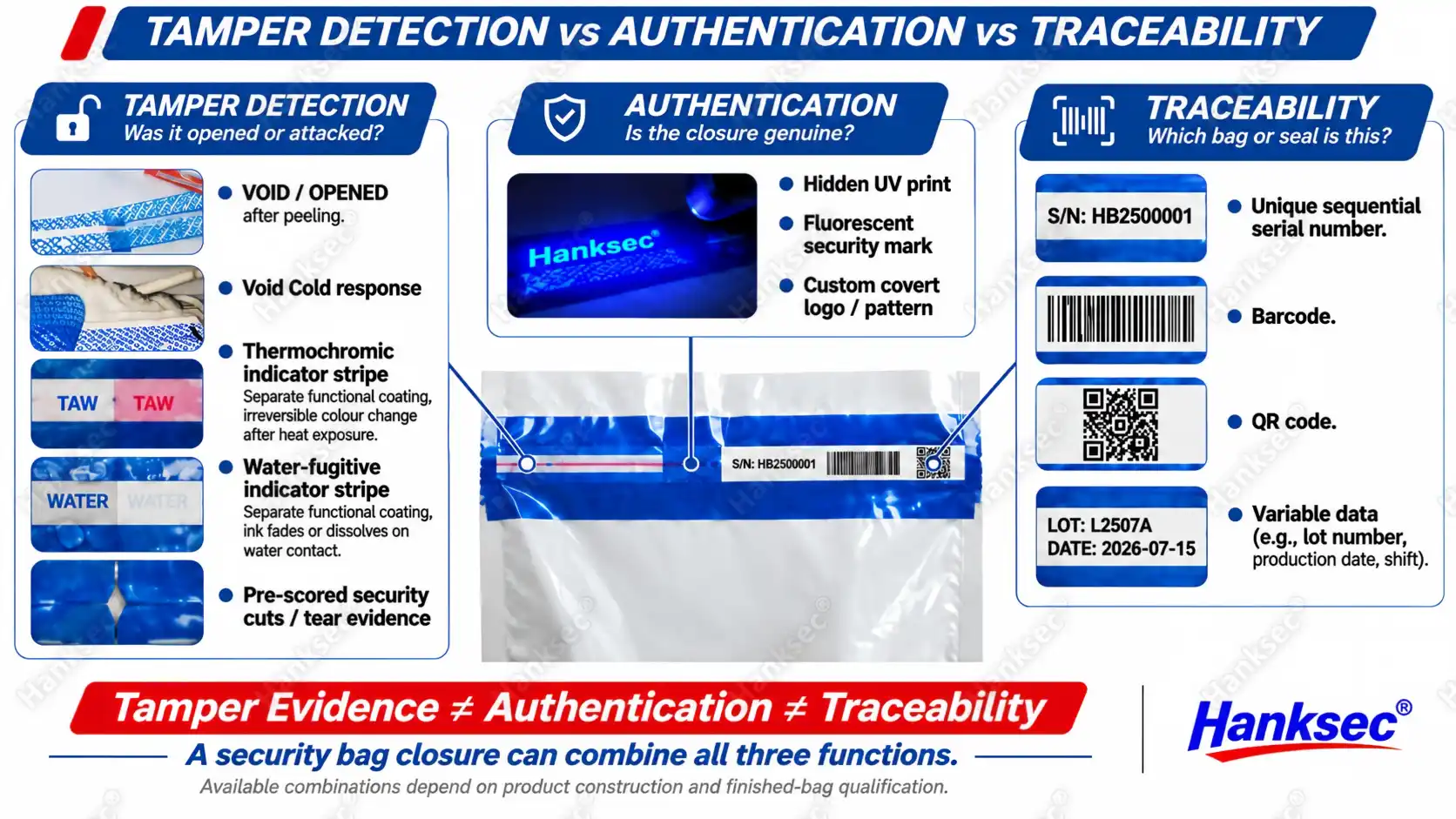
Serial numbers, barcodes, QR codes and variable data are primarily identification and traceability features.
They can help identify:
- which bag was issued;
- which seal belongs to which record;
- whether a bag or closure may have been substituted, when checked against controlled records;
- and where the item sits within a chain-of-custody process.
A printed serial number or QR code alone does not prevent tampering or guarantee authenticity. When linked to controlled records, scanning procedures or a verification system, these features can help detect mismatches and support traceability.
They should therefore be considered an additional traceability layer rather than automatically being counted as another tamper-detection level.
Which Security Bag Tape Level Should a Buyer Choose?
Start with the application risk rather than the number. The most appropriate construction is the one that addresses the credible attack methods and produces evidence that receiving staff can recognize and verify.
| Application | Main Question | Possible Security Direction |
|---|---|---|
| Courier / General Logistics | Was the bag opened? | Clear VOID / OPENED evidence |
| Cash / Valuable Transport | Could temperature or physical attack be used? | Opening + temperature + mechanical evidence |
| Evidence / Chain of Custody | Can opening and substitution both be detected? | Tamper evidence + authentication + traceability |
| Duty-Free / Secure Transfer | Does receiving staff need fast verification? | Visible tamper response + optional covert check |
A higher level should only be selected when the additional feature addresses a real risk or verification requirement. More features do not automatically mean better performance if they are not compatible with the actual bag film or manufacturing process.
What Should Buyers Confirm Before Requesting Samples?
Before sample approval, provide the supplier with:
- actual bag film: PE, PP, co-extruded or laminated;
- surface treatment and printing condition;
- expected opening attack;
- cold or heat attack risk, including the required exposure conditions;
- water or specifically identified chemical exposure;
- required VOID or OPENED response and where the evidence should remain;
- security cuts or controlled tear requirements;
- UV or other authentication requirements;
- serial number, barcode or QR requirements;
- roll width, winding direction and release liner requirements;
- and the final bag-making and sealing process.
Adhesive performance should also be qualified on the actual bag film. See the Tamper Evident Label Adhesive Guide for additional background on adhesive selection and low-surface-energy PE, PP and other substrates.
How Should a Security Bag Tape Level Be Validated?
Do not approve a security level only from a specification sheet or an unused roll. A tape sample alone cannot fully represent the performance of a finished security bag closure.
A practical qualification should reproduce the finished application:
Material → Converting → Actual Bag Film → Final Closure → Dwell → Defined Attack → Inspect Evidence → Repeat
If cold, heat, moisture or another attack method is part of the specification, test that defined condition separately and record the result. Relevant test details may include exposure temperature, duration, liquid type, application conditions, dwell time and the criteria used to judge the tamper response.
Check not only whether the indicator responds, but also whether the adhesive remains suitable for the intended bag film, whether the closure performs normally before an attack, and whether the resulting evidence can be clearly identified.
The final question is not whether every security feature activates dramatically. It is whether the complete bag closure produces clear, repeatable and difficult-to-hide evidence under the risks defined for the project.
For a broader material-testing workflow, see Hanksec’s Security Label Material Quality Control Guide. Material-level quality checks should complement, not replace, validation of the finished security bag closure.
Frequently Asked Questions
Is Level 6 security bag tape always better than Level 3?
No. Level 6 may include additional detection or authentication functions, but a lower-level construction can be the better choice when it correctly matches the actual attack risk, bag film and production process. The included functions matter more than the number alone.
Are Security Bag Tape Levels the same between manufacturers?
No. Level numbering and included features vary by manufacturer. Buyers should compare the actual security functions rather than assuming that equal level numbers mean equal constructions.
Is cold-resistant tape the same as cold-tamper tape?
No. Cold resistance describes service performance at low temperature. Cold tamper detection describes the ability to reveal an attempted opening involving cooling or freezing. These requirements should be tested separately.
Is thermochromic ink the same as heat resistance?
No. Thermochromic ink is used to create a visible heat-exposure indication. Heat resistance describes whether the material continues to function under elevated temperature. The indicator’s activation conditions must be specified and verified.
Do barcodes and serial numbers prevent tampering?
They primarily support identification and traceability. When connected to controlled records or a verification system, they can help identify mismatches or support the detection of substitution. They do not replace physical tamper evidence.
Should buyers test the tape or the finished security bag?
Both are useful, but final approval should include the finished bag because bag film, adhesive bonding, converting and closure geometry can all affect the actual tamper response.
Can all six security functions be integrated into one security bag tape?
Not necessarily. Multiple functions can be integrated into one security bag tape construction, but compatibility depends on the adhesive system, indicator coatings, printing process, release liner and finished-bag manufacturing conditions. The final combination should be qualified through application-specific testing.
Not Sure Which Security Bag Tape Level Fits Your Application?
Send Hanksec your bag film, expected tamper methods, production process and required security evidence. We can help compare opening, cold, heat, liquid, mechanical and authentication requirements before sample qualification.
COMPARE SECURITY BAG TAPE LEVELS →
Hanksec® | Security Bag Tape · VOID Materials · Temperature Tamper Detection · Security Printing · OEM/ODM