Author: Hanksec Technical Team
Security Bag Tape | Double-Sided Security Tape | Single-Sided Tape | Bag Film Compatibility | Buyer Selection
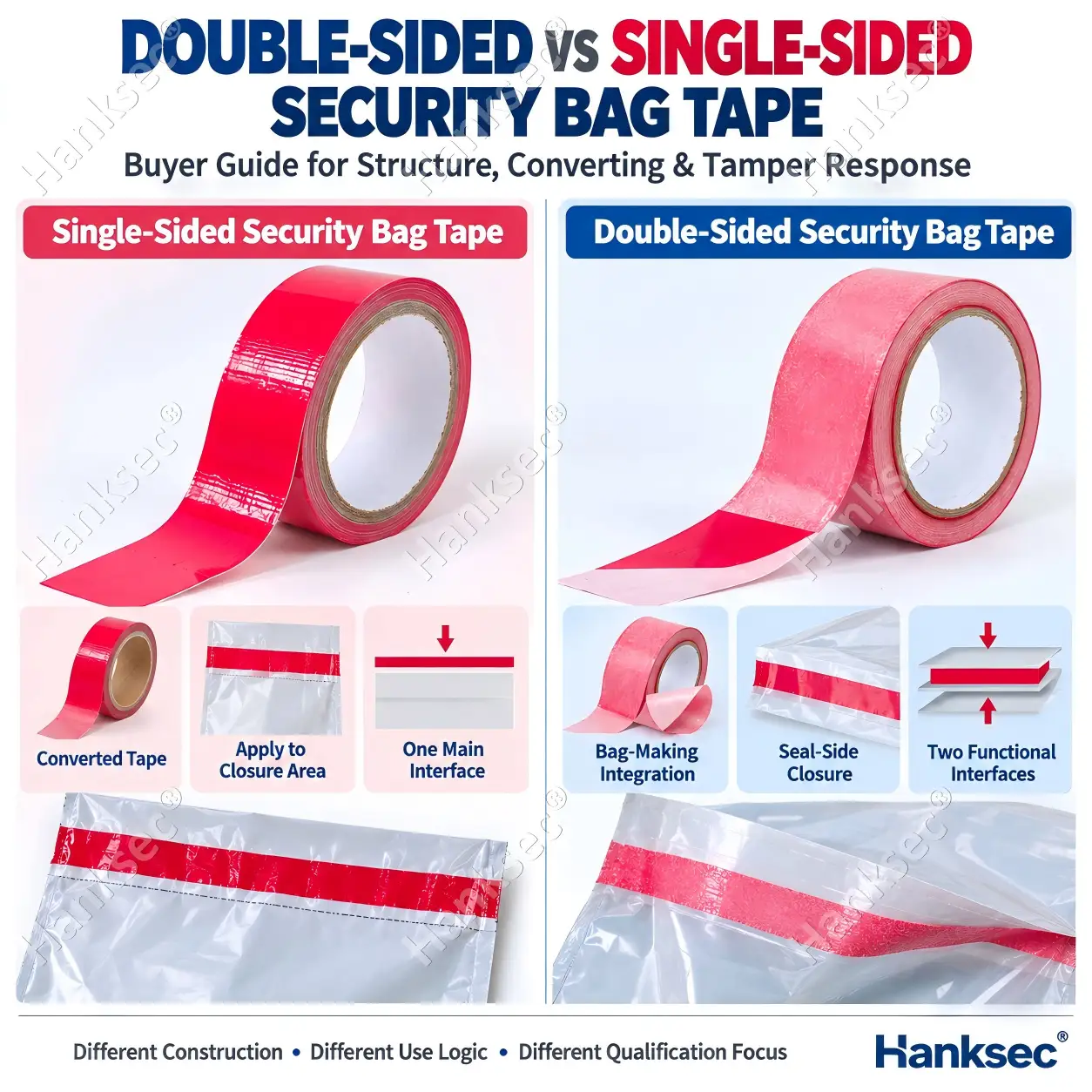
Quick Answer: When comparing Double-Sided vs Single-Sided Security Bag Tape, the decision is not simply which construction is more secure. The two designs solve different bag-closure problems. Single-sided tape normally uses one main adhesive interface and can be easier to integrate into simpler closure designs, while double-sided material uses two functional bonding or sealing interfaces.
For buyers, the important question is therefore not simply “single-sided or double-sided?” It is:
Which construction can be integrated consistently into your bag-making process and still produce the required tamper evidence after the finished bag is sealed and opened?
First Decide: Security Film, Single-Sided Tape or Double-Sided Tape?
Security-bag manufacturers do not always buy the same type of tamper-evident material.
Depending on the customer’s production process, the closure can begin with:
- tamper-evident security film;
- single-sided security bag tape;
- or double-sided security bag tape.
These are different supply concepts rather than simply different security grades.
| Construction | What the Buyer Receives | What the Converter Still Needs to Do | Typical Fit |
|---|---|---|---|
| Security Film | Tamper-evident functional film | Integrate adhesive, heat bonding, liner or other closure components according to the bag design | Converters with more control over bag-making construction |
| Single-Sided Tape | Security tape with one main adhesive application interface | Integrate or apply the tape in the intended closure position | Simpler security-bag closure designs |
| Double-Sided Tape | Security construction with two functional bonding or sealing interfaces | Control bag-side integration, liner handling and final seal-side closure | Integrated security-bag closure systems |
The correct starting material therefore depends on how much of the final closure construction is already built into the material and how much will be completed by the bag manufacturer.
What Is the Difference Between Double-Sided and Single-Sided Security Bag Tape?
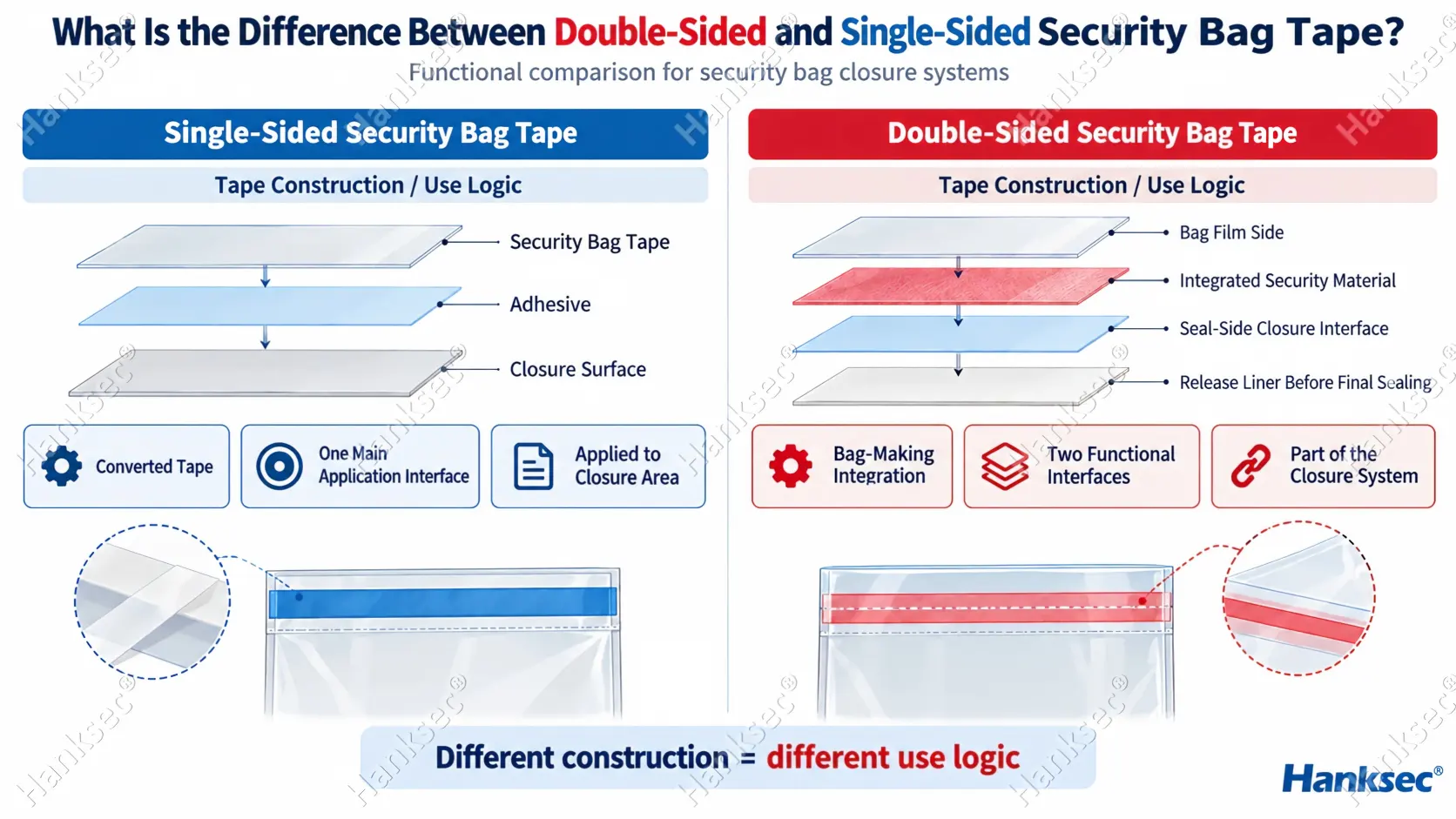
A simplified single-sided security tape can be considered as:
Security Material → Adhesive → Bag / Application Surface
The buyer mainly needs to control the bond between the tape and the intended surface together with the required VOID or OPENED response.
A double-sided construction is different:
Bag-Side Integration → Tamper-Evident Security Construction → Seal-Side Closure Interface → Release Liner
This introduces a second functional interface that must also behave correctly during converting and final use.
If you need a detailed explanation of what “double-sided” actually means, see What Is Double-Sided VOID Material? How It Works in Security Bags.
Buyers evaluating the actual material can also review the Hanksec Double-Sided VOID Security Tape Material developed for security-bag manufacturing and converting projects.
Which Construction Is Easier to Run on a Bag-Making Line?
Single-sided constructions are often easier to understand because there is one primary adhesive interface to control.
Double-sided material can provide greater flexibility in an integrated closure system, but it introduces more converting variables.
These can include:
- material feeding;
- slitting stability;
- liner release;
- roll winding direction;
- web tension;
- alignment with the bag film;
- lamination or integration pressure;
- bag-making speed;
- and final closure geometry.
The most complex construction is therefore not automatically the best construction.
The better material is the one the converter can integrate repeatably at production speed while maintaining the approved tamper response.
For broader bag-film, security-function and converting considerations, see the Security Bag Tape for Bag Manufacturers Selection Guide.
Does Double-Sided Tape Automatically Provide Better Security?
No.
“Double-sided” describes the closure construction. It does not define the total security level.
Tamper-detection capability can also depend on features such as:
- VOID or OPENED residue design;
- full, partial or non-transfer response;
- temperature-related indication;
- water- or solvent-sensitive elements;
- security cuts;
- UV or covert features;
- and customized security printing.
A poorly matched double-sided tape can perform worse than a properly selected single-sided tape if the adhesive does not bond correctly to the real bag film or the liner is unstable during production.
Double-sided describes construction. Security level describes tamper-detection capability. They are not the same specification.
Which Construction Is Better for PE and PP Security Bags?
Neither construction should be selected only because the bag is described as “PE” or “PP.”
Polyethylene and polypropylene are low-surface-energy plastics, and adhesive performance can vary according to the exact film formulation and surface condition. Bostik also identifies PE and PP compatibility, substrate bonding and manual or automated converting performance as important requirements for tamper-evident tape adhesive systems. See Bostik’s tamper-evident tape adhesive guidance.
For a security-bag project, useful film information includes:
- HDPE or LDPE;
- PP or another polymer;
- co-extruded construction;
- corona or other surface treatment;
- printing or coating;
- film additives;
- surface contamination;
- film thickness;
- and the actual area where the tape will bond.
A buyer who only tells the supplier “our bag is PE” may not provide enough information for reliable material selection.
For more detail on surface energy, adhesive wet-out and tamper response, see the Tamper Evident Label Adhesive Guide.
Why Does the Release Liner Matter So Much?
The release liner is sometimes treated as a low-cost backing component, but in security-bag production it can directly affect converting stability.
If release force is too high for the production process, possible problems include:
- difficult liner removal;
- unstable feeding;
- production slowdown;
- or excessive tension during stripping.
If release is too light, the liner may separate prematurely during handling or converting.
Other important variables include:
- liner material;
- liner width;
- curl;
- roll direction;
- release consistency;
- and compatibility with the bag-making equipment.
This becomes especially important with double-sided security bag tape because the liner protects the final seal-side adhesive until the bag is ready to be closed.
Where Should the VOID or OPENED Evidence Appear?
This should be defined before samples are approved.
Do not order only by saying:
“We need VOID tape.”
The supplier should know what the approved opening result is supposed to look like.
For example:
- Should the message remain on the bag?
- Should it remain on the peeled material?
- Should evidence appear on both sides?
- Is full transfer required?
- Is partial transfer required?
- Is a non-transfer construction required?
- Should the hidden message be VOID, OPENED, VOIDOPEN or customized?
This requirement can influence the security construction, adhesive balance and final qualification method.
Double-Sided vs Single-Sided Security Bag Tape: Buyer Comparison
| Buyer Question | Single-Sided Tape | Double-Sided Tape |
|---|---|---|
| Simpler integration? | Often | More process-dependent |
| Two functional bonding interfaces? | Usually no | Yes |
| Release liner importance | Important | Critical to final closure handling |
| Converting complexity | Generally lower | Generally higher |
| Integrated bag closure design | Application-dependent | Often well suited |
| Finished-bag validation | Required | Essential |
| Automatically higher security? | No | No |
Choose by closure architecture, not by the words “single-sided” or “double-sided.”
7 Questions to Send Your Supplier Before Requesting Samples
Before asking for a sample, provide the supplier with answers to these questions:
- What is the actual bag film? HDPE, LDPE, PP, co-extruded, laminated or another construction?
- How will the tape be integrated? Manual application, lamination or continuous bag-making line?
- Which side requires the permanent bag-side bond?
- Which liner will the final user remove before sealing?
- Where should the VOID or OPENED evidence remain after opening?
- What roll width, length and winding direction are required?
- Will final approval be performed on the finished security bag?
For double-sided projects, Hanksec supplies Double-Sided VOID Security Tape Material for Security Bags for converter and OEM applications.
How Should Security Bag Tape Be Tested Before Bulk Production?
Testing should reproduce the finished application rather than only measure an unused roll.
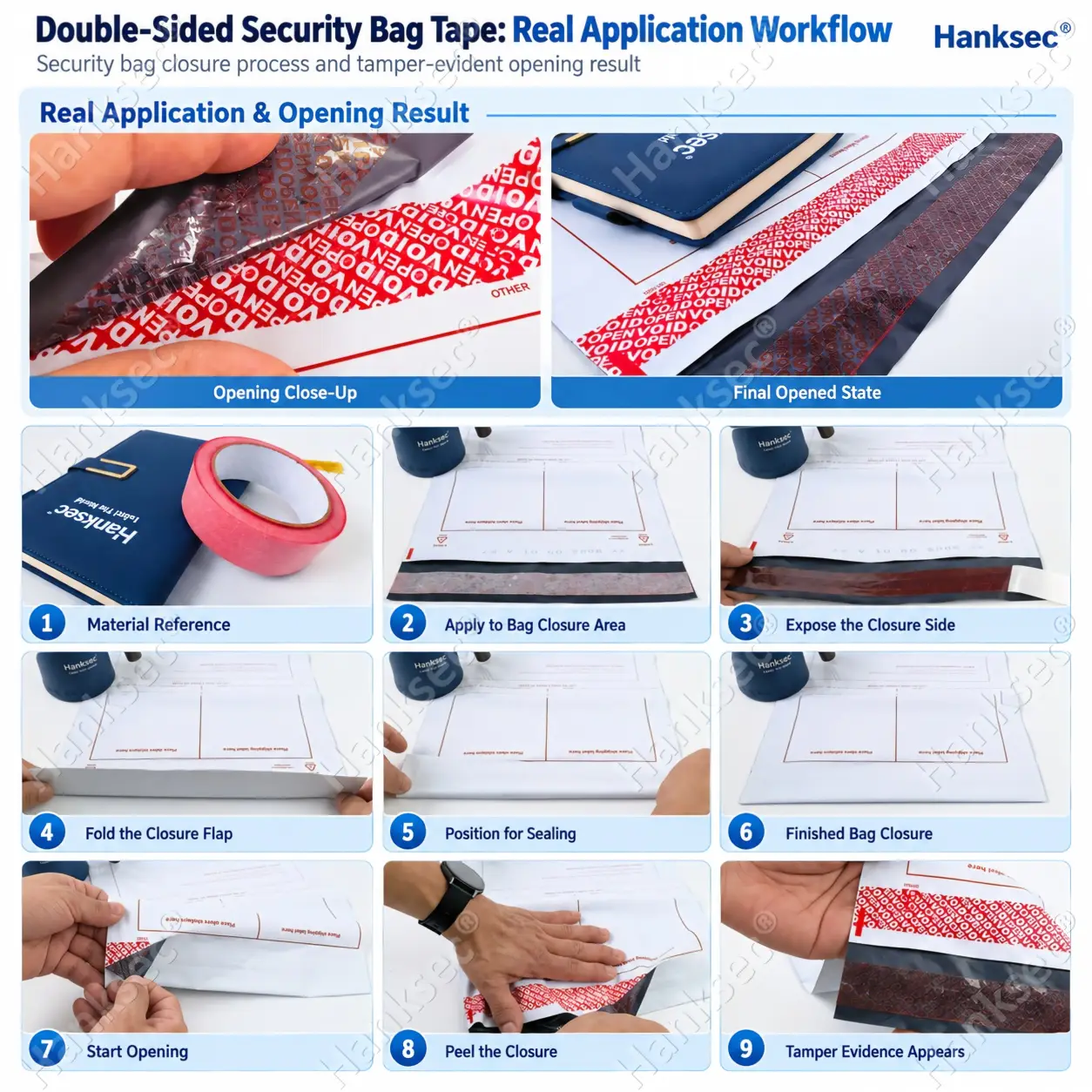
A useful qualification sequence is:
Material Roll → Convert / Slit → Integrate With Actual Bag Film → Remove Liner → Close Bag → Dwell → Opening Test → Inspect Tamper Evidence → Repeat
Important checks include:
- bonding to the actual film;
- liner release;
- alignment during production;
- material flatness;
- seal-side adhesion;
- VOID / OPENED clarity;
- residue behavior;
- and repeatability between samples.
ASTM D3330/D3330M provides standardized peel-adhesion methods for pressure-sensitive tapes, including double-coated tape and release-liner testing. These measurements can support quality control, but they should not replace testing on the actual bag film and finished closure.
For a broader converter-level testing workflow, see the Security Label Material Quality Control Guide.
Frequently Asked Questions
Is double-sided security bag tape more secure than single-sided tape?
Not automatically. Double-sided describes the closure construction, while security performance depends on the complete tamper-evident design, adhesive compatibility and finished-bag response.
Can both constructions work on PE and PP?
Both can be developed for PE- and PP-based applications, but the actual film formulation, surface treatment and production process should be tested before bulk approval.
Does double-sided mean VOID appears on both sides?
No. Double-sided refers to two functional bonding or sealing interfaces. The location of the VOID, OPENED or residue response depends on the approved security construction.
Can I replace a single-sided tape with double-sided tape without changing the bag-making process?
Not necessarily. A double-sided construction can change liner handling, tape orientation, bag-side integration and final closure requirements. The production process should be evaluated before substitution.
Which construction is better for high-speed production?
The better construction is the one qualified on the actual production line. Single-sided tape may be simpler, but a properly designed double-sided construction can also run efficiently when liner release, winding direction, alignment and material stability are matched to the equipment.
Should I test the tape roll or the finished security bag?
Both are useful, but the finished bag is the more important functional qualification. Conversion and integration can change adhesive behavior, liner performance and tamper response.
Not Sure Which Security Bag Tape Construction Fits Your Production Line?
Send Hanksec your bag film, current closure structure, tape width, liner requirement, winding direction, production process and required tamper response. We can compare security film, single-sided tape and double-sided constructions before sample approval.
COMPARE SECURITY BAG TAPE CONSTRUCTIONS →
Hanksec® | Security Bag Tape · Double-Sided VOID Material · Security Film · Slit Rolls · Jumbo Rolls · OEM/ODM