Quick Answer:
Warranty VOID labels are tamper-evident security labels used on electronics, equipment, housings, seams, screws and service-access points to show whether a protected area has been opened, removed or disturbed. The best construction depends on where the tamper evidence should appear, how much residue is acceptable, the exact application surface, the service environment, and whether the material must also support printing, serialization or converter processing.
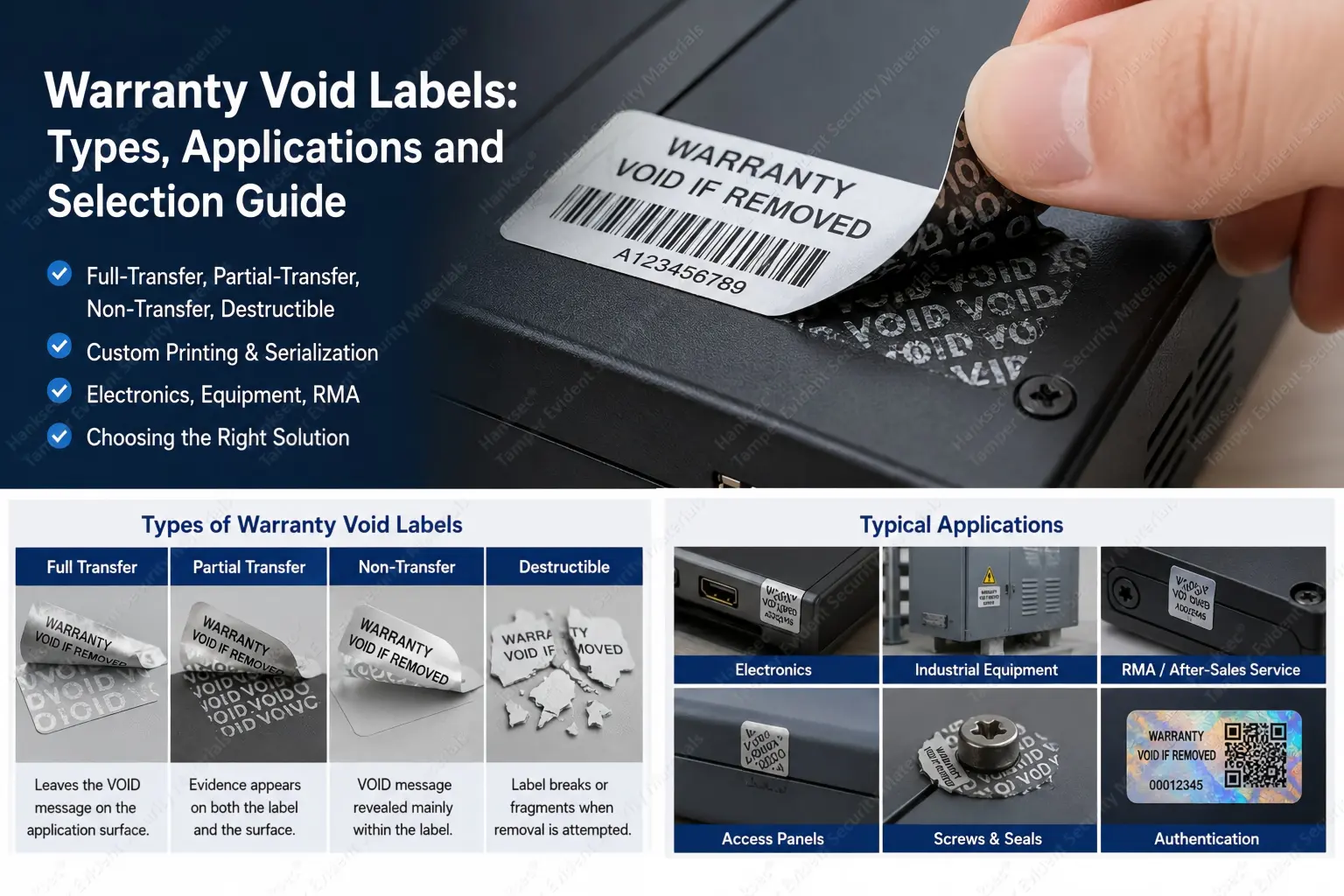
For electronics and equipment, the most common starting options are full-transfer VOID, partial-transfer VOID, non-transfer VOID and destructible security labels. Holographic and serialized features can then be added when authentication or traceability is also required.
| Warranty Label Direction | What Happens During Removal | Typical Starting Use | Main Buyer Question |
|---|---|---|---|
| Full-transfer VOID | Most or all of the hidden message remains on the product surface | Equipment housings, cabinets, panels, packaging | Is strong permanent surface evidence acceptable? |
| Partial-transfer VOID | Evidence appears on both the label and the application surface | Electronics, devices, general warranty inspection | Do you want evidence on both sides? |
| Non-transfer VOID | The hidden message appears mainly within the removed label | Electronics, glass, premium housings, reusable equipment | Should the surface remain relatively clean? |
| Destructible label | The facestock fractures, cracks or fragments during removal | Screws, narrow seams, small access points, warranty seals | Should intact label removal be difficult? |
| Holographic / serialized security label | Tamper evidence is combined with authentication or unique identification | High-value electronics, branded equipment, RMA and asset programs | Is visual authentication or traceability also required? |
Important for the U.S. market: a tamper-evident warranty label can provide physical evidence that a product or access point was opened, but the label itself should not be treated as a universal legal mechanism that automatically cancels warranty rights. The U.S. Federal Trade Commission has warned companies about certain “warranty void if removed” practices and about warranty terms that improperly condition coverage on specified parts or service providers. For consumer products sold in the United States, warranty wording and policy should be reviewed separately from the physical security function of the label.
What Are Warranty VOID Labels?
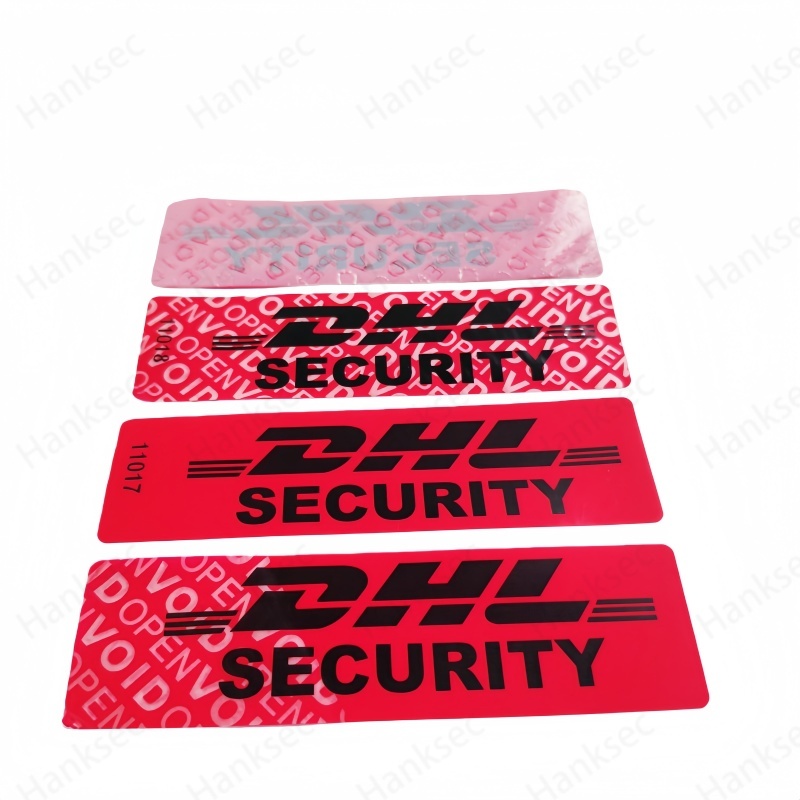
A warranty VOID label is a security label placed over a product seam, screw, enclosure, service panel, component or other controlled access point. When someone attempts to remove the label, the construction creates a visible and usually irreversible change.
The word “warranty” describes the application; it does not define one specific label material. A warranty security program may use PET VOID film, destructible material, holographic security film, a serialized construction or a hybrid system.
This distinction matters because two labels printed with the same warning text can behave very differently. One may leave a permanent VOID message on a metal housing. Another may reveal the message mainly inside the removed label. A destructible version may break into fragments before it can be removed intact.
For a broader comparison of the major tamper-evident technologies, see Hanksec’s Types of Tamper-Evident Security Labels Guide.
How Warranty VOID Labels Work
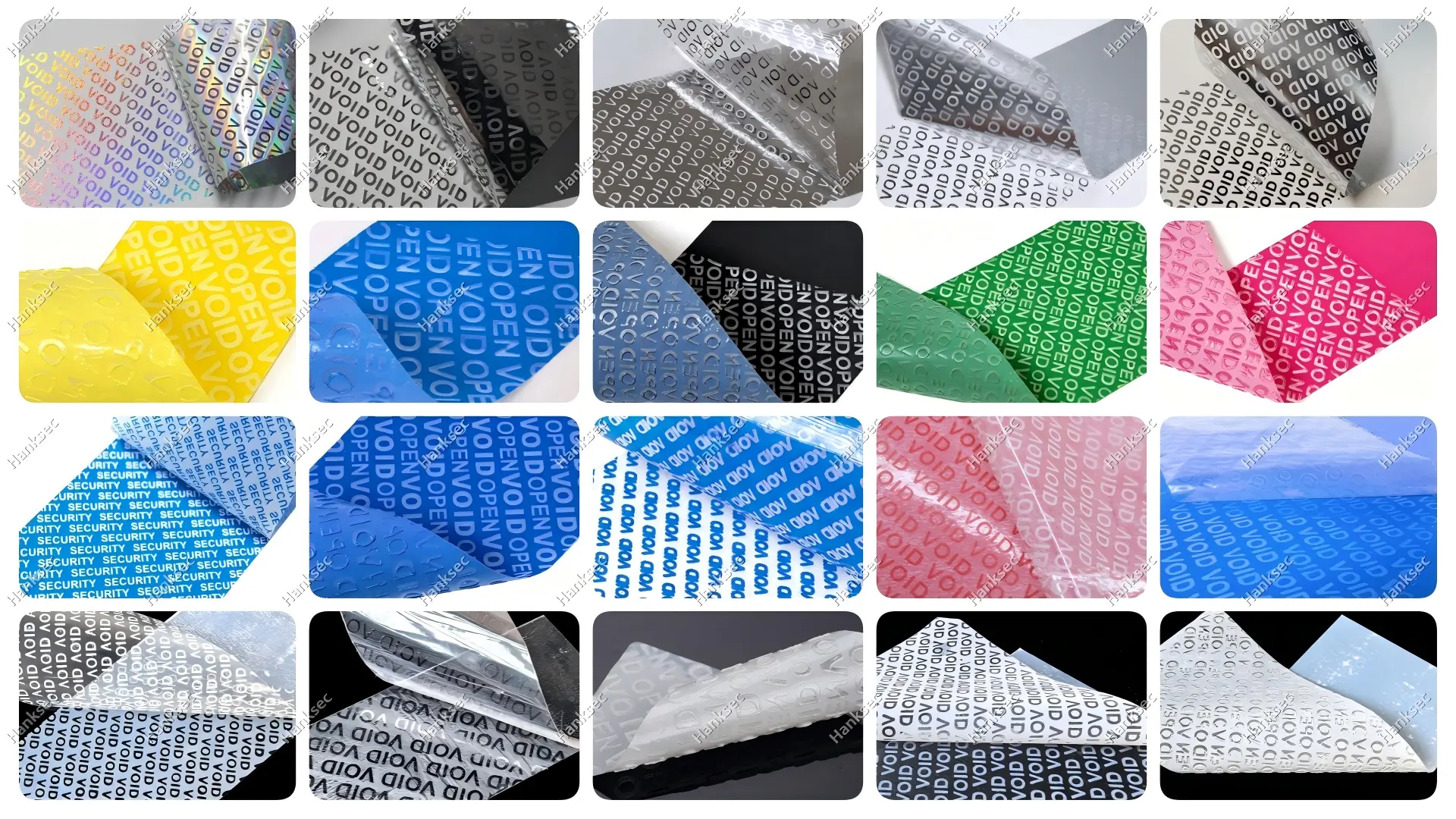
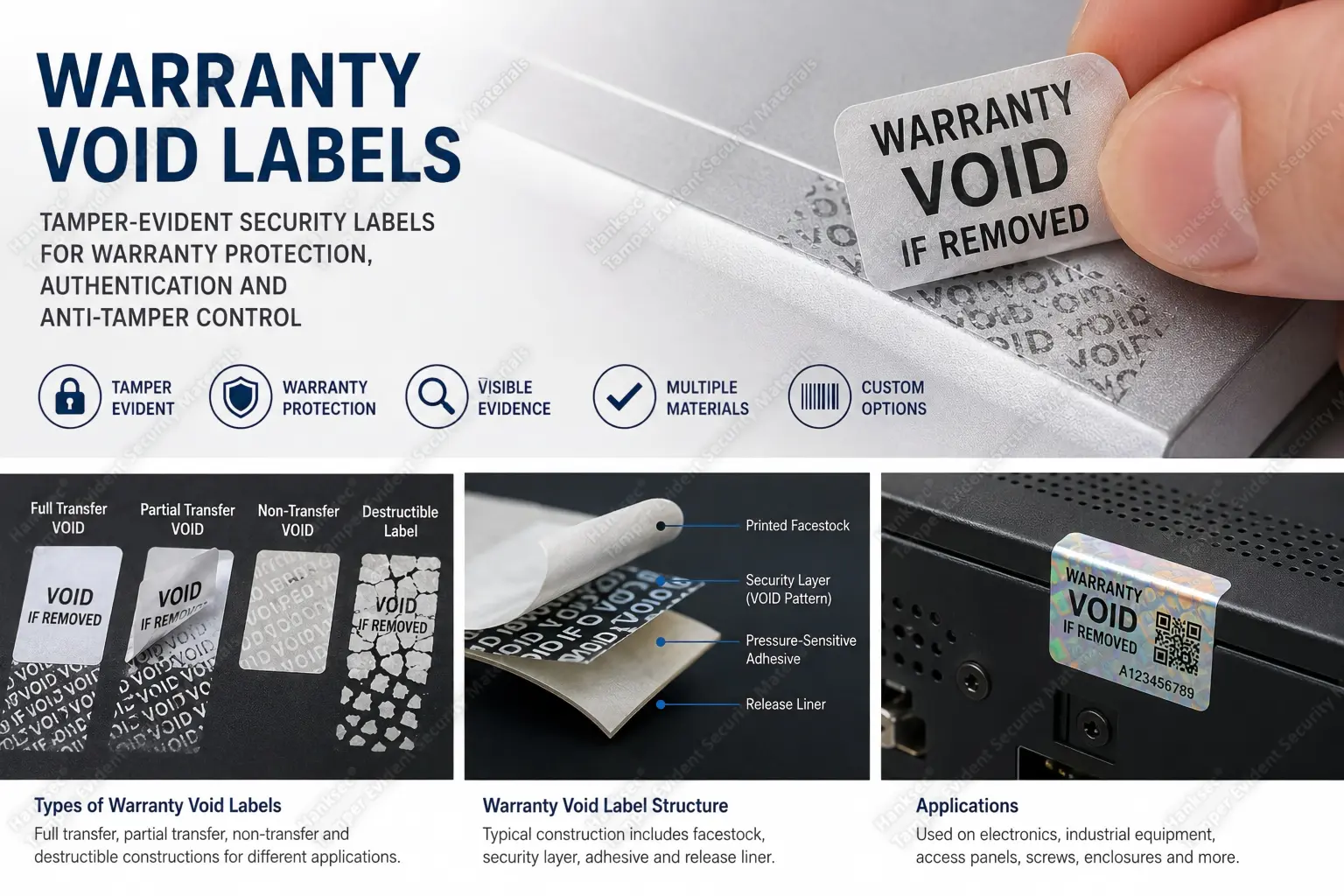
In a typical VOID construction, the material contains an engineered separation or release layer between the facestock and adhesive system. When the label is peeled, the internal structure separates in a controlled pattern and reveals a hidden word, logo or security message such as VOID, OPENED, SECURITY or a custom design.
The visible response depends on the construction:
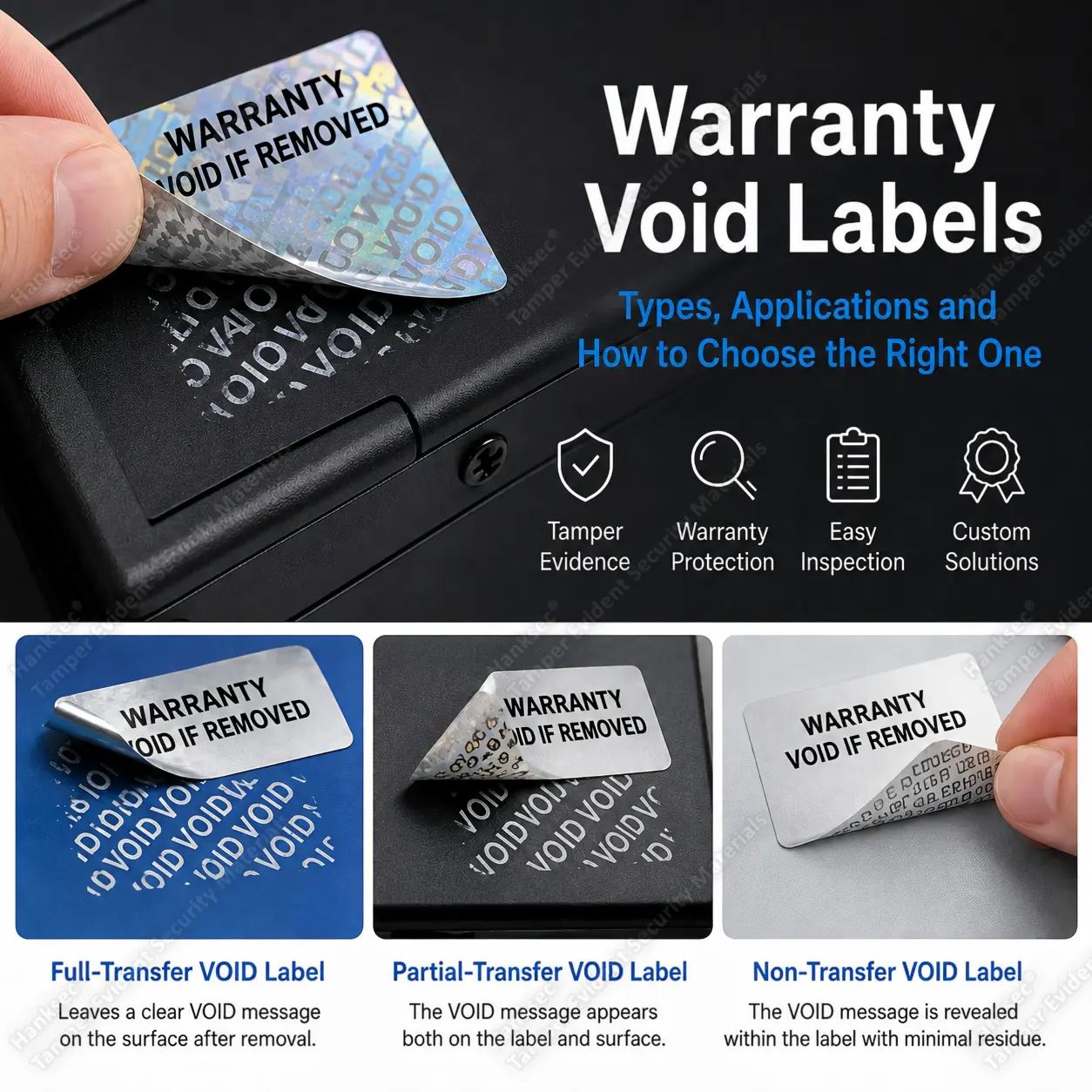
- Full transfer: the hidden pattern transfers mainly to the application surface.
- Partial transfer: the security pattern is divided between the label and the application surface.
- Non-transfer: the tamper message appears mainly within the label while heavy visible surface residue is reduced.
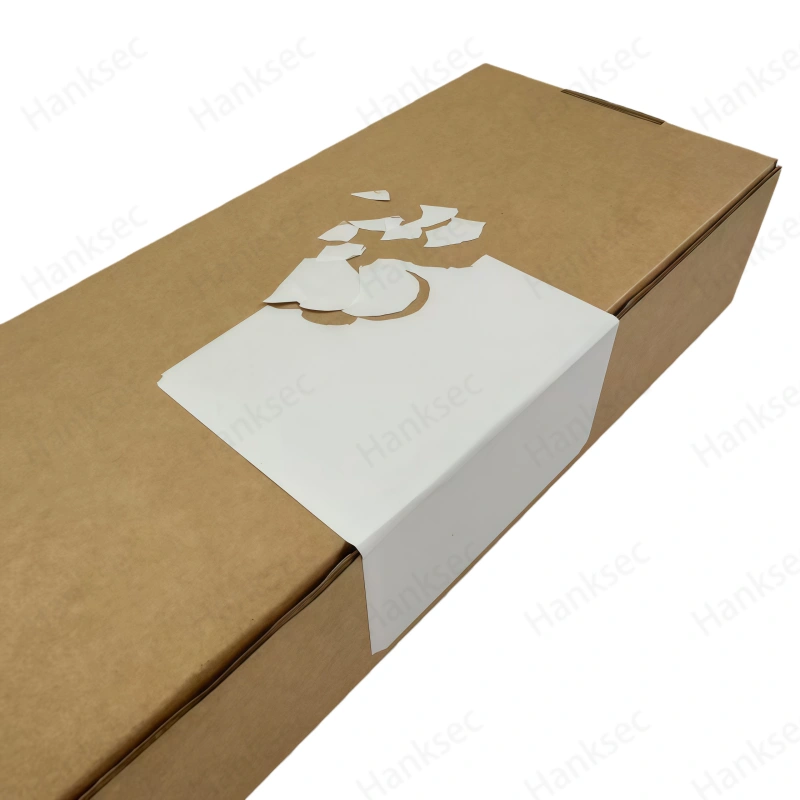
Destructible warranty labels work differently. Their facestock is engineered to fail cohesively during removal, causing the label to crack, tear or fragment before it can be lifted intact.
The final result is created by the complete system: facestock + security layer + pressure-sensitive adhesive + substrate + dwell + service conditions. The hidden VOID technology alone cannot compensate for an adhesive that does not bond correctly to the real device surface.
For a deeper explanation of the complete material stack, see How Security Label Material Systems Work.
Warranty VOID Label Types for Electronics & Equipment
Full-Transfer VOID Labels
Full-transfer warranty VOID labels are selected when the buyer wants obvious evidence to remain on the protected surface after removal. They are useful on machine housings, access panels, control cabinets, boxes and other locations where permanent surface evidence is acceptable.
They are not automatically the “highest security” option. If the product surface is decorative, reusable or sensitive to residue, a full-transfer construction may create more cosmetic impact than the application can accept.
Partial-Transfer VOID Labels
Partial-transfer VOID labels divide the tamper evidence between the removed label and the product surface. This can be useful for electronics and equipment where service personnel want to inspect both the substrate and the removed seal.
Partial transfer can also provide a more balanced appearance than a heavy full-transfer pattern, but the real result should still be tested on the actual housing material and finish.
Non-Transfer VOID Labels
Non-transfer warranty VOID labels are designed to reveal the hidden security message mainly within the label. They are especially useful when visible residue on the device should be minimized.
Typical starting applications include glass, smartphones, cameras, premium electronic housings, reusable assets and other surfaces where appearance matters after inspection.
“Non-transfer” should not be interpreted as a guarantee of absolutely zero residue on every surface. Adhesive chemistry, surface treatment, dwell, temperature and removal conditions can still affect the final result.
For a dedicated material-selection guide, see Non-Transfer VOID Label Material Buyer’s Guide.
Destructible Warranty Labels
Destructible labels create evidence by physically damaging the facestock. They are often suitable for small screw heads, narrow seams, calibration points and compact access locations where an intact film label might be easier to lift.
Destructibility must be balanced with the adhesive bond. If the adhesive is too weak for the surface, the entire label may lift instead of fragmenting. If the facestock is too fragile for the converter’s geometry, die cutting and matrix stripping may become unstable.
For fracture grades and converting considerations, see the Destructible Label Materials Guide.
Holographic and Serialized Warranty Labels
Holographic features can add visual authentication, while serial numbers, barcodes and QR codes can support identification, RMA records, internal service tracking or asset management.
These features solve a different problem from physical tamper evidence. A hologram does not automatically become tamper-evident simply because it is holographic, and a serial number does not stop label removal. For higher-value products, the strongest system often combines an authentication or identification feature with a proven VOID or destructible base construction.
Choose the Warranty Label by Surface, Not by Wording
Current commercial warranty-label pages often sell labels by size, color or printed wording. For electronics and industrial equipment, however, surface compatibility is usually more important than the words printed on the face.
| Application Surface | Useful Starting Direction | Main Risk | What to Test |
|---|---|---|---|
| ABS / PC / PC-ABS housings | Non-transfer, partial-transfer or destructible depending on residue requirement | Texture, additives, coatings, cosmetic damage | Adhesion, edge lift, residue and final VOID response |
| PP / PE / HDPE plastic | VOID or destructible construction with substrate-matched adhesive | Low surface energy and weak adhesive wet-out | Dwell, edge lift and tamper activation on the exact molded surface |
| Glass | Non-transfer or controlled-residue VOID | Visible residue, condensation and cleaning chemistry | Bond strength, residue and clean-surface appearance |
| Painted metal | PET VOID or destructible construction | Paint or coating may become the weakest layer | Coating lift, residue and tamper evidence |
| Powder-coated metal | High-contact adhesive with suitable VOID construction | Texture reduces effective contact area | Wet-out, edge lift and removal response |
| Anodized / bare metal | VOID or destructible construction according to residue requirement | Surface contamination, oils and finish variation | Cleaning method and final adhesive response |
| Coated carton / equipment packaging | Full- or partial-transfer VOID, paper or film construction | Varnish and coating interaction | Transfer clarity and coating damage |
For substrate-specific adhesive selection, see the Tamper Evident Label Adhesive Guide.
Where Warranty Security Labels Are Used
Consumer Electronics
Warranty VOID labels are commonly applied to laptops, routers, power supplies, control units, accessories, device housings and protected screws. The label should be positioned so that opening or servicing the controlled access point changes the seal in a way that can be inspected later.
Non-transfer structures are often considered where heavy residue is undesirable. Destructible labels can be useful for compact screw or seam locations. Full-transfer constructions may be appropriate where strong visible surface evidence is more important than cosmetic appearance.
Industrial Equipment and Control Panels
Machine housings, control cabinets, maintenance panels, calibration points and protected components may require a more durable construction than small consumer-electronics seals. Buyers should document expected temperature, abrasion, cleaning chemicals and service life before selecting the adhesive and facestock.
RMA and After-Sales Service
A serialized tamper-evident label can connect physical inspection with an internal service record. The label may carry a sequential number, barcode or QR code that is recorded when a product is shipped, repaired, inspected or returned.
For internationally standardized barcode structures, buyers can consult GS1 barcode standards.
Calibration, Maintenance and Controlled Access
Warranty-style tamper-evident seals are also used where the goal is not consumer warranty enforcement but controlled access. Examples include calibration points, service panels, inspection covers and components that should not be adjusted between authorized maintenance events.
In these applications, wording such as “Security Seal,” “Tamper Evident,” “Service Access Seal” or project-specific text may describe the physical function more accurately than “Warranty Void If Removed.”
Residue Requirement: Full, Partial or Cleaner Surface?
Residue is not simply a sign of “more security.” It is a design decision.
| Inspection Requirement | Starting Construction | Typical Benefit | Trade-Off |
|---|---|---|---|
| Permanent evidence must stay on the product | Full-transfer VOID | Fast visual confirmation after removal | More visible surface residue |
| Evidence should be visible on both surfaces | Partial-transfer VOID | Dual inspection points | Still leaves visible evidence on the product |
| Product surface should remain relatively clean | Non-transfer VOID | Better cosmetic appearance after inspection | Evidence is concentrated more heavily on the removed label |
| Label should not come off intact | Destructible construction | Physical fragmentation | Converter handling and small-part removal can be more difficult |
The correct direction should be confirmed with actual samples. One construction can produce different residue and bond behavior on painted metal, glass, ABS and low-surface-energy PP even when the same adhesive coat weight is used.
Printing, Serialization & Converter Requirements
Warranty labels are frequently small, highly customized and used in serialized production. That makes printability and converting performance part of the security specification.
Printing
Common requirements include logos, custom VOID messages, warning text, barcodes, QR codes, variable data, sequential numbering and UV security features. The facestock or topcoat should be qualified for the actual print process, such as UV flexographic, screen, thermal-transfer, digital or inkjet printing.
For converter-focused print guidance, see Printable Security Label Materials for Label Converters.
Die Cutting and Matrix Stripping
Small warranty labels can create converting challenges because narrow gaps, sharp corners and fragile constructions increase matrix-stripping stress. Destructible materials are particularly sensitive to the balance between final fracture behavior and convertibility.
Converters should confirm die geometry, label spacing, web tension, matrix stripping, liner strength and dispensing method before mass production.
Release Liner and Supply Format
Glassine, kraft and PET release liners can behave differently during precision die cutting, high-speed converting and automatic dispensing. The liner should be selected together with the label geometry and customer equipment.
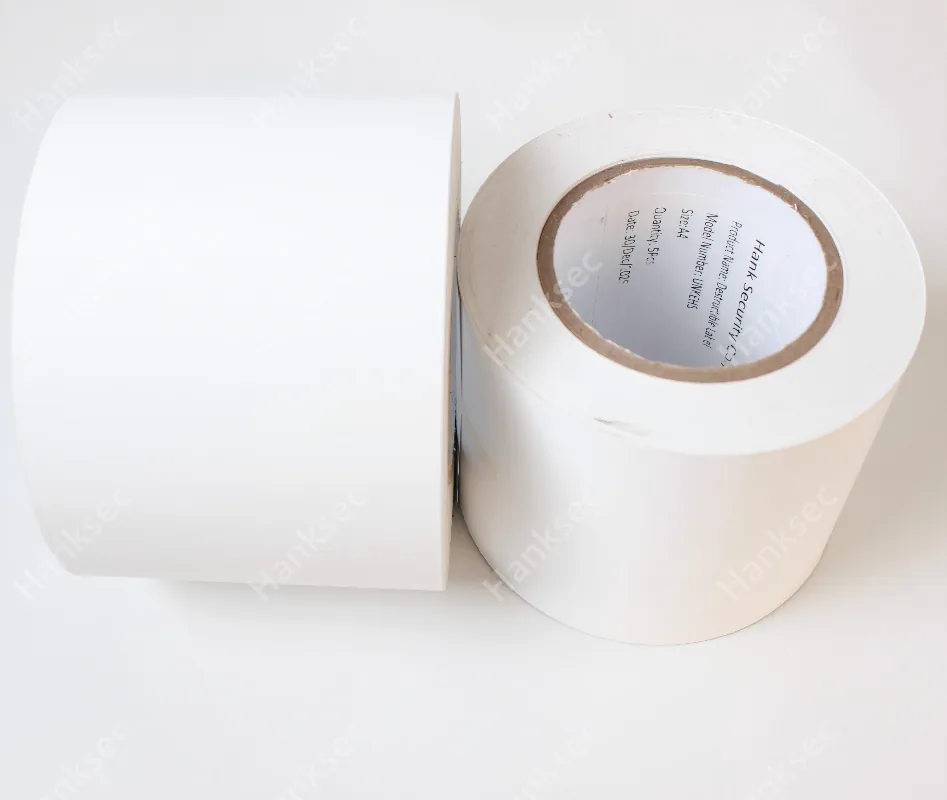
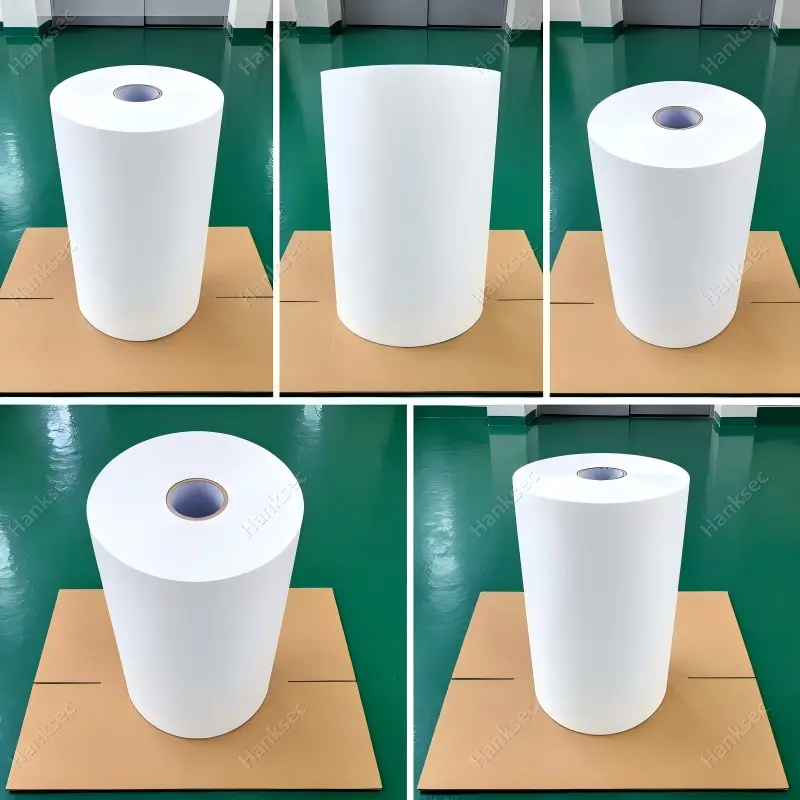
Hanksec can supply warranty security materials as jumbo rolls, slit rolls, sheets or finished labels depending on whether the buyer is a converter, security printer, OEM or end-use manufacturer.
Custom Options for Warranty VOID Labels
Common project options include:
- custom VOID, OPENED, SECURITY or logo-based hidden messages;
- full-transfer, partial-transfer and non-transfer constructions;
- destructible security facestocks;
- silver, white, transparent, colored and holographic surfaces;
- custom logos and warning text;
- barcodes, QR codes and sequential numbering;
- UV or covert features;
- custom adhesive selection for the real product substrate;
- glassine, kraft or PET release liners;
- custom label sizes, screw seals, narrow strips and die-cut shapes;
- jumbo-roll and slit-roll supply for converter processing.
For U.S. consumer products, the physical label design and the legal warranty language should be treated as separate decisions. A buyer may still need tamper evidence while choosing wording that does not imply broader warranty cancellation than applicable law allows.
How to Qualify Warranty VOID Labels Before Production
A warranty label should be qualified on the actual product or a representative production surface. Generic steel or glass panels are useful for controlled adhesive comparison, but they cannot reproduce every molded plastic, paint system, coating or texture.
- Define the protected access point. Confirm whether the label covers a screw, seam, service door, enclosure, component or package opening.
- Identify the exact substrate. Record the plastic resin, coating, metal finish, glass treatment or packaging surface whenever possible.
- Define the required tamper response. Decide whether evidence should remain on the substrate, label, both, or through physical fragmentation.
- Define acceptable residue. Cosmetic electronics and reusable assets may have different requirements from industrial cabinets.
- Apply samples consistently. Use the intended application pressure and placement geometry.
- Allow realistic dwell. Do not approve only from an immediate peel. Evaluate after the time interval relevant to the project.
- Perform actual removal tests. Confirm VOID activation, transfer clarity, fragmentation, edge lift and residue.
- Condition for the environment. Heat, cold, humidity, condensation, cleaners and abrasion should be included where relevant.
- Verify printing and converting. Check ink or ribbon anchorage, barcode readability, die cutting, matrix stripping and dispensing.
- Retain an approved reference sample. Production batches should be compared against the agreed security response and construction.
ASTM D3330/D3330M-04(2025) can support controlled peel-adhesion measurement for pressure-sensitive materials where appropriate. Peel force alone does not prove warranty-label suitability; the required tamper response on the intended substrate must also be evaluated.
For a broader incoming and production QC workflow, see the Security Label Material Quality Control Guide.
Common Warranty Label Failure Modes
- The label lifts intact: adhesive wet-out or bond may be too low for the substrate.
- The VOID pattern is weak or uneven: the application surface, dwell or construction may not be matched correctly.
- Too much residue is left on a cosmetic device: a full-transfer or high-residue direction may not match the project requirement.
- The label damages paint or coating: the coating may be weaker than the adhesive bond.
- Edges lift around a screw or curved housing: the label geometry, stiffness or adhesive may not fit the surface contour.
- A destructible label will not matrix strip cleanly: the facestock may be too fragile for the die geometry or converter settings.
- Print rubs off during handling: topcoat, ink, ribbon or curing conditions may not be compatible.
- Heat allows clean removal: the adhesive or security-release system may soften before the tamper mechanism activates. For heat-assisted removal concerns, see Hanksec’s Heat-Resistant Tamper-Evident Label Guide.
U.S. Warranty Law: What “Warranty Void If Removed” Does and Does Not Mean
For U.S. consumer products, manufacturers should separate tamper evidence from warranty eligibility.
The Federal Trade Commission’s Businessperson’s Guide to Federal Warranty Law explains that the Magnuson-Moss Warranty Act generally prohibits certain “tie-in sales” provisions. The FTC gives an example of a problematic warranty term involving a broken or removed warranty seal where repair cannot occur without affecting that seal.
In July 2024, the FTC also warned three computer-hardware companies about stickers containing “warranty void if removed” or similar wording when placed in locations that hinder routine maintenance and repairs.
This does not make tamper-evident labels useless. They can still provide valuable evidence that a protected access point was opened, assist inspection, support RMA investigation, identify unauthorized access, protect calibration points and help document service history.
The practical distinction is important:
- Physical function: the label shows that access or removal occurred.
- Warranty decision: the legal and contractual effect depends on the warranty terms, jurisdiction, cause of damage and applicable law.
Hanksec supplies tamper-evident materials and labels; it does not determine a customer’s legal warranty policy. Buyers selling consumer products in the United States should have their final warranty language reviewed for their specific use case.
How to Choose the Right Warranty VOID Label
| Buyer Requirement | Starting Direction | Next Check |
|---|---|---|
| Strong permanent evidence on housing | Full-transfer VOID | Confirm residue is acceptable |
| Evidence on label and product | Partial-transfer VOID | Test transfer clarity on actual surface |
| Cleaner electronics surface | Non-transfer VOID | Verify actual residue and bond |
| Seal over small screw / narrow seam | Destructible or small-format VOID | Check geometry, edge lift and fragmentation |
| Authentication plus tamper evidence | Holographic + VOID / destructible | Define overt and covert security features |
| RMA / service tracking | Serialized tamper-evident label | Define serial, barcode or QR workflow |
| PP / PE housing | Substrate-matched adhesive + selected security mechanism | Run low-surface-energy adhesion test |
| Heat-assisted removal risk | Heat-resistant film / adhesive / security construction | Run thermal exposure and removal test |
If the construction is still uncertain, send the real substrate, label size, access-point photo, residue requirement, operating temperature, printing method and estimated quantity. These details are more useful for sample selection than choosing a label only by color or printed warning.
Frequently Asked Questions
What is a warranty VOID label?
A warranty VOID label is a tamper-evident security label used on a product, component, screw, seam or access point to create visible evidence when removal or opening is attempted. The security mechanism may use VOID transfer, non-transfer behavior, destructible material or a hybrid construction.
What is the best warranty VOID label for electronics?
There is no universal best type. Non-transfer VOID labels are often considered when residue must be limited, while destructible labels can be useful on small screws or narrow seams. Full- or partial-transfer constructions are suitable when visible surface evidence is acceptable. The final choice should be tested on the actual device housing.
Can warranty VOID labels be used on plastic?
Yes, but plastic type matters. PP and PE have lower surface energy than many ABS, PC, PET, glass or metal surfaces. Adhesive selection and sample qualification should therefore use the real production plastic rather than a generic test panel.
What is the difference between full-transfer and non-transfer warranty labels?
Full-transfer labels leave most or all of the hidden security message on the application surface. Non-transfer labels reveal the message mainly within the removed label and are used when a cleaner product surface is preferred.
Can a warranty label include a serial number, barcode or QR code?
Yes. Depending on the printable surface and production method, tamper-evident labels can include logos, sequential numbers, barcodes, QR codes and other variable data for identification, RMA and service workflows.
Does removing a warranty VOID label automatically cancel a U.S. consumer warranty?
No universal rule should be inferred from the label alone. U.S. warranty coverage depends on the warranty terms, applicable law and circumstances. The FTC has warned companies about certain “warranty void if removed” practices and about conditioning coverage on specified parts or services. The label is best treated as physical tamper evidence, while the warranty decision is handled separately.
Can Hanksec supply warranty label material rolls instead of finished labels?
Yes. Depending on the project, Hanksec can supply converter-ready jumbo rolls, slit rolls, sheets or finished labels with project-specific VOID construction, facestock, adhesive, liner and printable treatment.
Should warranty labels be tested before bulk production?
Yes. Approval should include the actual substrate, realistic dwell, residue, final tamper response, environmental exposure, printing and converter performance where applicable.
Request Warranty VOID Label Samples & Technical Recommendation
The correct warranty security label depends on the complete application: access point, tamper response, substrate, residue requirement, adhesive, service environment, printing and converting process.
For a faster recommendation, send Hanksec the product surface, label dimensions, protected location, required VOID or destructible response, acceptable residue, operating temperature, printing method, supply format and estimated quantity.
Hanksec can recommend a starting construction and prepare samples for adhesion, printing, converting and tamper-response qualification before bulk production.
REQUEST WARRANTY VOID LABEL SAMPLES & TECHNICAL RECOMMENDATION