Quick Answer: When buyers search for “torn or tampered packaging meaning,” they are usually trying to distinguish visible physical damage from signs of possible unauthorized opening. The term can cover either condition or both, but a torn package is not automatically proof of tampering. Damage may result from transportation, handling or weak packaging materials. For buyers, the important distinction is whether the package has a defined security feature that provides visible evidence when its closure is disturbed. Proper evaluation requires inspection criteria, suitable tamper-evident materials and testing on the actual packaging surface.
A shipping carton may arrive with a torn corner, a courier bag may have a disturbed adhesive closure, or a retail package may show a broken security label. These conditions are not identical, even though customers may describe all of them as “torn or tampered packaging.”
For procurement teams, packaging suppliers and brand owners, the challenge is to distinguish ordinary distribution damage from suspicious interference—and then specify a security material that makes future inspections more reliable.
As a manufacturer of security printing materials, Hanksec supplies materials used to create visible opening evidence, including VOID security tapes, tamper-evident label materials, destructible constructions and customized security-bag sealing materials.
Torn or Tampered Packaging Meaning: How Buyers Should Interpret Damage
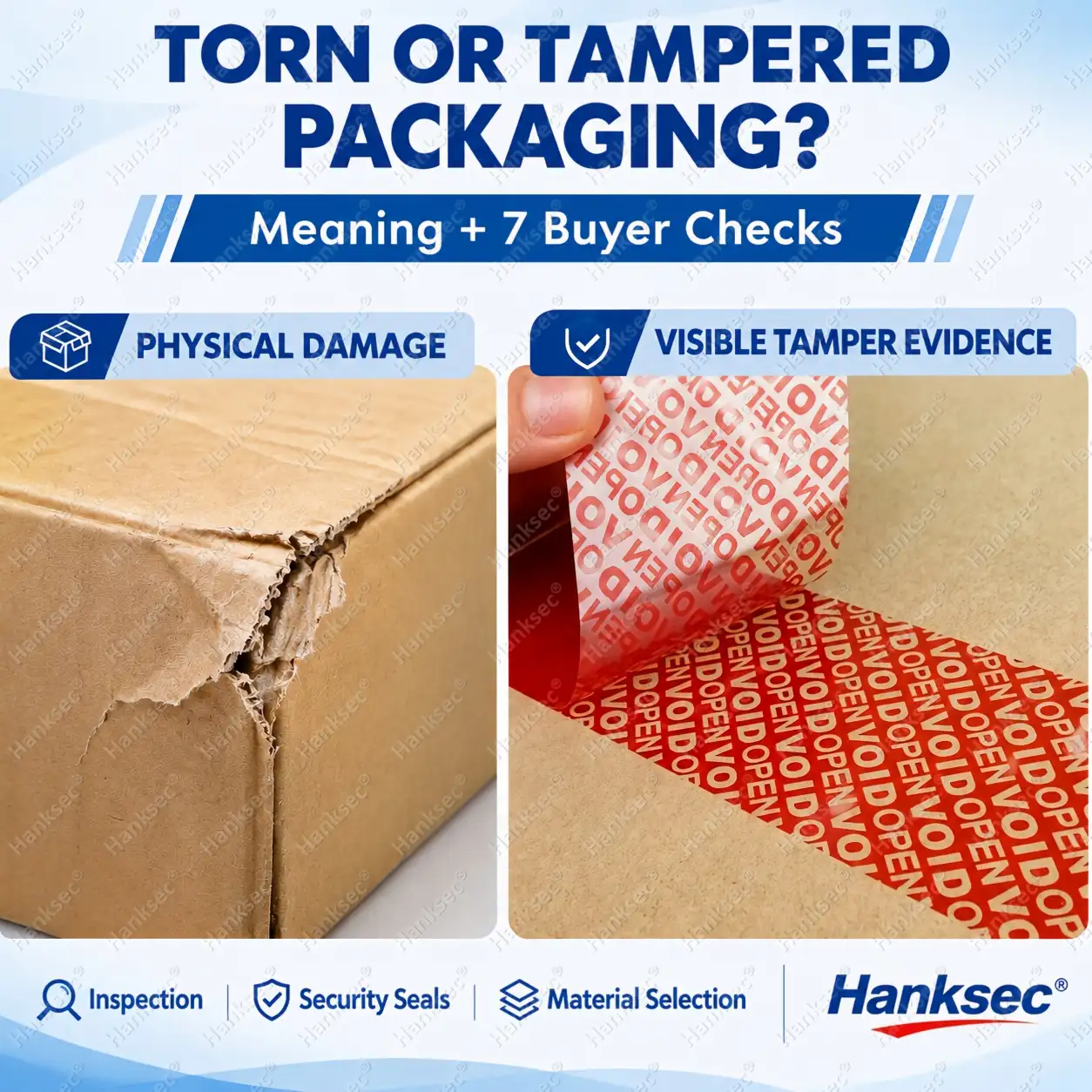
Torn packaging refers to visible physical damage such as ripped paperboard, split film, broken flaps, punctures or torn sealing areas.
Tampered packaging refers to packaging suspected of having been opened, manipulated, altered or resealed without authorization. The concern is not simply that damage exists, but whether the original package integrity or security condition has been compromised.
Sometimes the two conditions occur together. A security label may tear because somebody attempted to open a package. In other situations, cardboard may tear during normal transport while the protected closure remains intact.
| Packaging Condition | Visible Evidence | Inspection Meaning |
|---|---|---|
| Torn or Damaged | Ripped carton, crushed edges or punctured outer film. | Physical damage; cause and product impact require assessment. |
| Suspected Tampering | Disturbed closure, unusual resealing, missing seal or unexpected opening marks. | Possible interference; investigate before acceptance. |
| Activated Security Seal | VOID message, label fracture or another designed tamper-evident response. | Evidence that the security feature has been disturbed, not automatic proof of who caused it. |
| Apparently Intact | No visible damage or activated security feature. | No visible indication detected; not an absolute guarantee of integrity. |
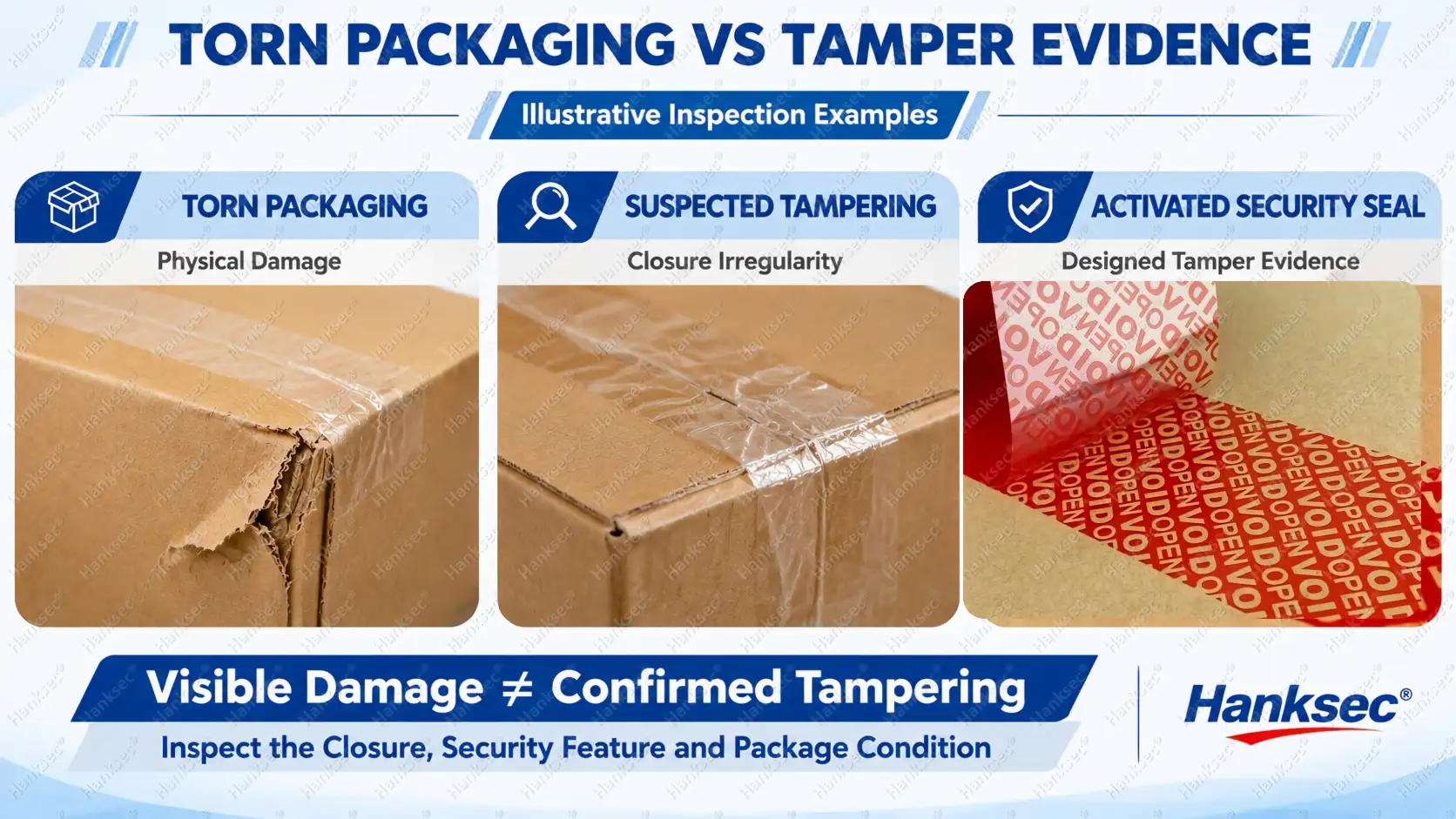
In a procurement context, the torn or tampered packaging meaning is best treated as an inspection question, not an assumption about intent: where is the damage, is the closure disturbed, and has the security feature activated? The practical assessment depends on the location of the damage, the presence of an intentional security feature and the expected opening response.
Does Torn Packaging Always Mean Someone Opened It?
No. Cartons, labels and plastic films can be damaged without deliberate interference.
Possible causes include excessive compression during shipment, handling impacts, abrasion against neighboring packages, weak paper fibers, moisture exposure, overloaded carton flaps and poorly matched sealing adhesives.
A cardboard surface can also split when ordinary packing tape is removed. This may leave obvious fiber damage but does not necessarily confirm that the package was intentionally accessed.
Conversely, a carton may appear undamaged while an unprotected closure has been opened and resealed. Visible package damage and evidence of unauthorized access should therefore be evaluated separately.
For example, if the outer corner of a shipping box is crushed but a qualified security closure remains intact, the packaging may require damage assessment without necessarily showing evidence of opening. If the security tape displays a clear VOID or OPENED pattern, the closure itself has experienced the intended activation condition and should be investigated under the applicable inspection procedure.
The buyer should define these distinctions before selecting packaging-security materials—not after receiving a customer complaint.
What Signs Should Trigger a Closer Package Inspection?
Inspection should focus on differences from the approved sealed condition rather than treating every tear or surface mark as evidence of tampering. Common reasons for a closer inspection include:
- Unexpected closure changes: A security label, tear strip or sealing tape is missing, split, lifted or replaced with a different material.
- An unusual security response: A VOID or OPENED message, transfer pattern or label fracture does not match the approved reference sample.
- Possible access points: Cuts, punctures, separated flaps or disturbed seams appear near an area that could provide access to the contents.
- Identification inconsistencies: Serial numbers, printed security marks or package identifiers are missing, damaged or inconsistent with the approved specification.
These observations should be assessed against the package design, the expected seal condition and the available inspection records. For a more detailed checklist of warning signs, see Hanksec’s Tampered Package: 7 Signs to Check Before Opening.
No single indicator proves every form of tampering. The appropriate conclusion depends on the package design, product risk, available reference condition and inspection records.
How Should Buyers Define a Receiving Inspection Standard?
A material specification should describe not only the security feature but also how its condition will be judged when the package arrives. A consistent receiving standard should define:
- Approved reference condition: Retain photographs and physical samples showing the normal unopened closure and the expected VOID, OPENED or destructible response for the approved material construction.
- Separate condition categories: Distinguish outer-package transit damage, a disturbed closure, an activated security feature and an unclear condition. Do not classify every tear as proof of tampering.
- Defined inspection points: Identify the protected seam, flap, bag mouth or label area and specify where inspectors should examine the package.
- Disposition and escalation rules: Assign responsibility for acceptance, holding, rejection or further investigation according to the product risk and the company’s procedures.
- Traceable inspection records: Record the package identification, seal or serial number where applicable, damage location, photographs, inspection result and final disposition.
For medicines, food, sterile goods or other sensitive products, a suspiciously breached package may require stricter handling under applicable procedures and regulations. A general security-label inspection does not replace product-specific safety requirements.
A defined standard helps buyers compare material samples, train receiving teams and investigate supplier or transport issues without relying only on subjective judgments.
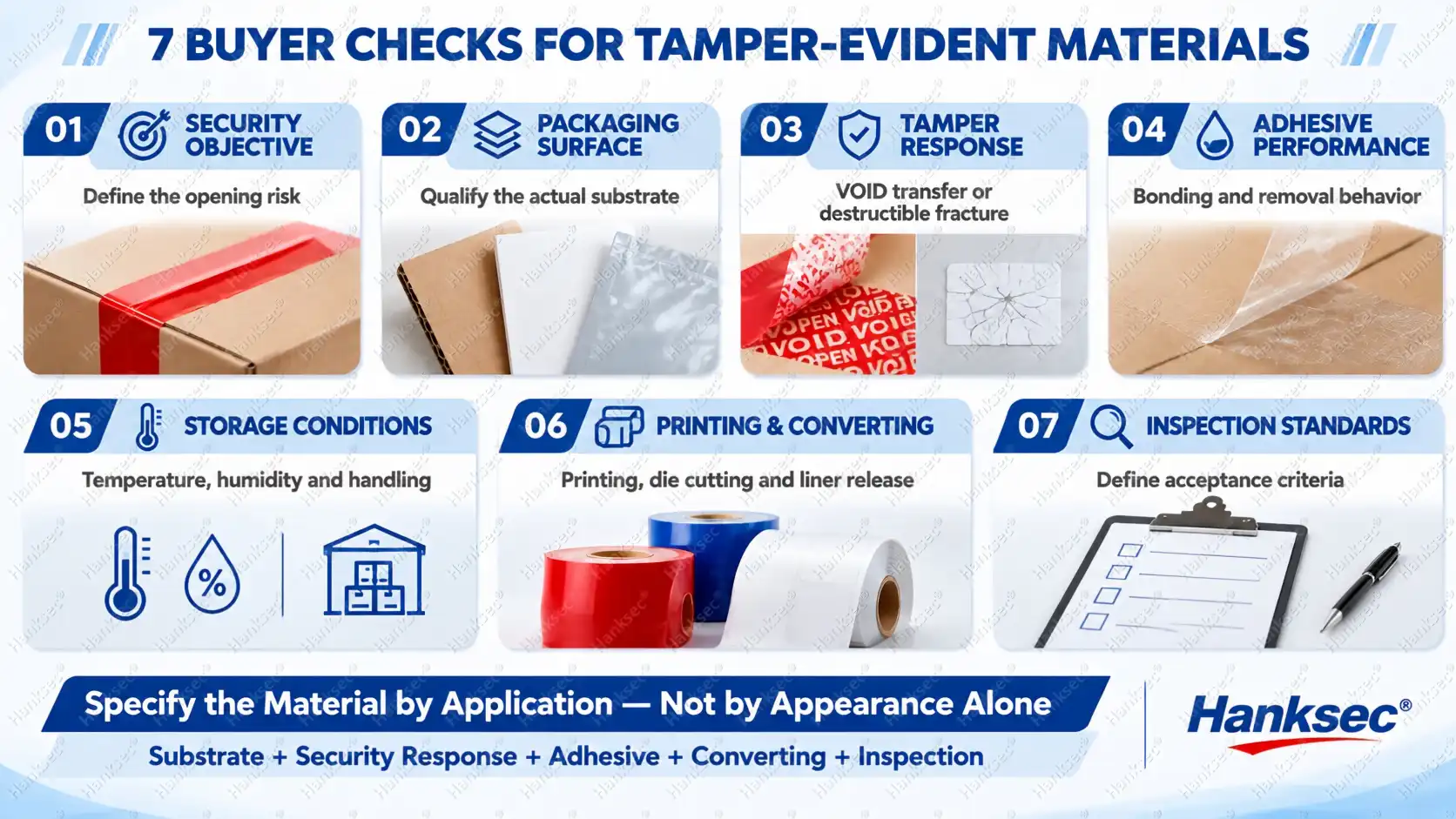
What 7 Checks Should Buyers Make Before Selecting Tamper-Evident Packaging Materials?
Once the required inspection outcome is defined, procurement teams can evaluate security tape and label materials systematically.
1. Define the Opening Risk and Required Evidence
Start with the specific problem the security material must address.
Does the buyer need to detect carton opening, security-bag access, warranty-label removal, product substitution or attempted resealing?
Different threats require different physical responses. A shipping carton may benefit from a visible VOID transfer pattern, while a small warranty label may be better served by a destructible construction that cannot be removed intact under qualified conditions.
The acceptance specification should state what inspectors must see after the defined removal attempt. Avoid requirements such as “tamper-proof” without a corresponding, testable performance description.
Buyer check: Is the desired security effect defined clearly enough that two inspectors can reach the same conclusion?
2. Identify the Actual Packaging Surface and Closure Area
The receiving surface is a major part of the material selection process.
Security materials may be applied to recycled corrugated board, coated paperboard, kraft mailers, PE or PP films, laminated cartons, plastic containers or other surfaces.
The same adhesive can develop different contact and removal behavior on these substrates. Dust, surface coatings, fiber strength and local texture may also influence whether a VOID message activates correctly.
For example, a security tape may bond strongly to a smooth reference panel but release prematurely from a dusty carton. Another construction may bond well enough to tear the carton fibers before the intended security layer separates.
Buyers sourcing carton-sealing materials can refer to Hanksec’s Security Tape for Boxes Guide for additional substrate and closure considerations.
Buyer check: Has the proposed security material been tested on the real production package rather than only a standard test panel?
3. Choose the Correct Tamper-Evident Response
Different security constructions provide different opening evidence. They should not be selected solely by tape color, thickness or the appearance of a sample roll.
| Material Option | Designed Opening Evidence | Typical Procurement Direction |
|---|---|---|
| Full-Transfer VOID | Visible security pattern remains on the receiving surface. | High-visibility evidence on qualified carton or package surfaces. |
| Partial-Transfer VOID | Security evidence appears on both removed material and substrate. | Applications requiring a controlled split transfer response. |
| Non-Transfer VOID | Hidden evidence appears mainly on the removed label or film. | Selected surfaces where visible transfer must be limited. |
| Destructible Material | Label cracks, fragments or tears during attempted removal. | Small security seals and applications resisting intact removal. |
| Security Bag Tape | A designed security response within the integrated bag closure. | Security-bag converters and controlled bag-sealing projects. |
For a detailed overview of material constructions, refer to Hanksec’s Tamper Evident Security Packaging Tapes Guide.
Buyer check: Does the material produce the required evidence on the correct surface when opening is attempted under the approved test conditions?
4. Check Adhesive Compatibility and Residue Requirements
A security label must stay attached during its intended service life while also creating the specified response during removal.
These requirements must be balanced. An adhesive that releases too easily may allow the security material to peel without activating. An excessively aggressive adhesive may tear a weak carton surface before the intended VOID interface separates.
For coated or sensitive surfaces, buyers may also need to limit residue or coating damage. However, non-transfer construction does not automatically guarantee absolutely zero residue on every substrate.
Where appropriate, ASTM D3330/D3330M provides recognized methods for pressure-sensitive tape peel-adhesion evaluation. A peel-force result alone does not establish that a functional VOID message activates correctly.
For projects requiring a distinctive VOIDOPEN sealing response, buyers can review Hanksec’s Tamper Evident VOIDOPEN Sealing Tape and request sample validation against the actual package surface.
Buyer check: Have adhesive bonding, security activation and acceptable surface condition been evaluated separately?
5. Evaluate Storage, Shipping and Handling Conditions
Packaging security materials may experience temperature changes, humidity, dust, handling pressure and mechanical stress before the end user inspects them.
These conditions can affect adhesive contact, label edges, security-layer separation or the receiving substrate.
For example, low application temperature may limit adhesive wet-out, while a rough or dusty carton can reduce effective bonding area. Warm takeaway packaging, humid warehouse cartons and flexible courier films may require different adhesive and functional constructions.
The required test conditions should reflect the actual use environment. A material that works immediately after careful room-temperature application may not provide equivalent performance throughout the complete distribution process.
Buyer check: Has the final label or tape been evaluated after representative application, storage and transportation conditions?
6. Confirm Printing, Converting and Production Compatibility
For B2B buyers, material performance is only part of the specification. The supplied security construction must also be compatible with the customer’s converting or application process.
Depending on the project, Hanksec can support material options involving printable facestock, hidden VOID or OPENED messages, custom graphics, pressure-sensitive adhesives, release liners and converter-ready roll specifications.
Important procurement parameters may include:
- Facestock and finished material construction.
- Required security message and transfer behavior.
- Printing method, ink or ribbon compatibility.
- Jumbo roll or slit-roll width, roll length and core requirements.
- Release liner, die-cutting and matrix-stripping performance.
- Serial number, barcode or QR code requirements where applicable.
- Sample approval, material identification and production-lot consistency.
A material that produces excellent VOID evidence during a manual demonstration may still be unsuitable if it activates during die cutting, strips poorly or does not release consistently from its liner.
Buyer check: Can the approved security material be manufactured, converted and applied consistently within the customer’s production process?
7. Define Inspection Criteria Before Bulk Purchasing
The final procurement check is often overlooked: who decides whether the security evidence is acceptable?
Buyers should retain approved reference samples showing the normal sealed condition and the expected opening response. Inspection instructions should explain how to identify a broken seal, incomplete VOID activation, premature edge lifting or unexpected carton damage.
Rather than requiring a vague result such as “strong tamper-proof performance,” define observable acceptance criteria for the chosen material and package.
Sampling plans, acceptable defect limits and recordkeeping should be agreed according to the product risk and procurement requirements. These values should not be invented or assumed identical for every application.
Buyer check: Can incoming inspectors and production operators evaluate the security feature using the same documented reference and decision rules?
What Should Buyers Include in a Tamper-Evident Material RFQ?
A clear request for quotation helps a material manufacturer recommend a construction that can be evaluated against the actual security objective.
Instead of requesting only “tamper-proof tape for packaging,” buyers should describe the complete application.
| RFQ Information | What to Specify |
|---|---|
| Package Type | Carton, courier bag, security bag, document envelope or finished product packaging. |
| Receiving Surface | Actual board, paper, coating or plastic-film specification; sample substrates where possible. |
| Security Objective | Detect opening, prevent intact label transfer or make unauthorized resealing visibly detectable. |
| Required Evidence | Full VOID transfer, partial transfer, non-transfer, destructible fracture or another approved response. |
| Supply Format | Material rolls, slit rolls, printed tape or finished die-cut labels. |
| Application Conditions | Application temperature, pressure, dwell, expected storage and transport environment. |
| Approval Method | Required tests, reference samples, inspection criteria and production requirements. |
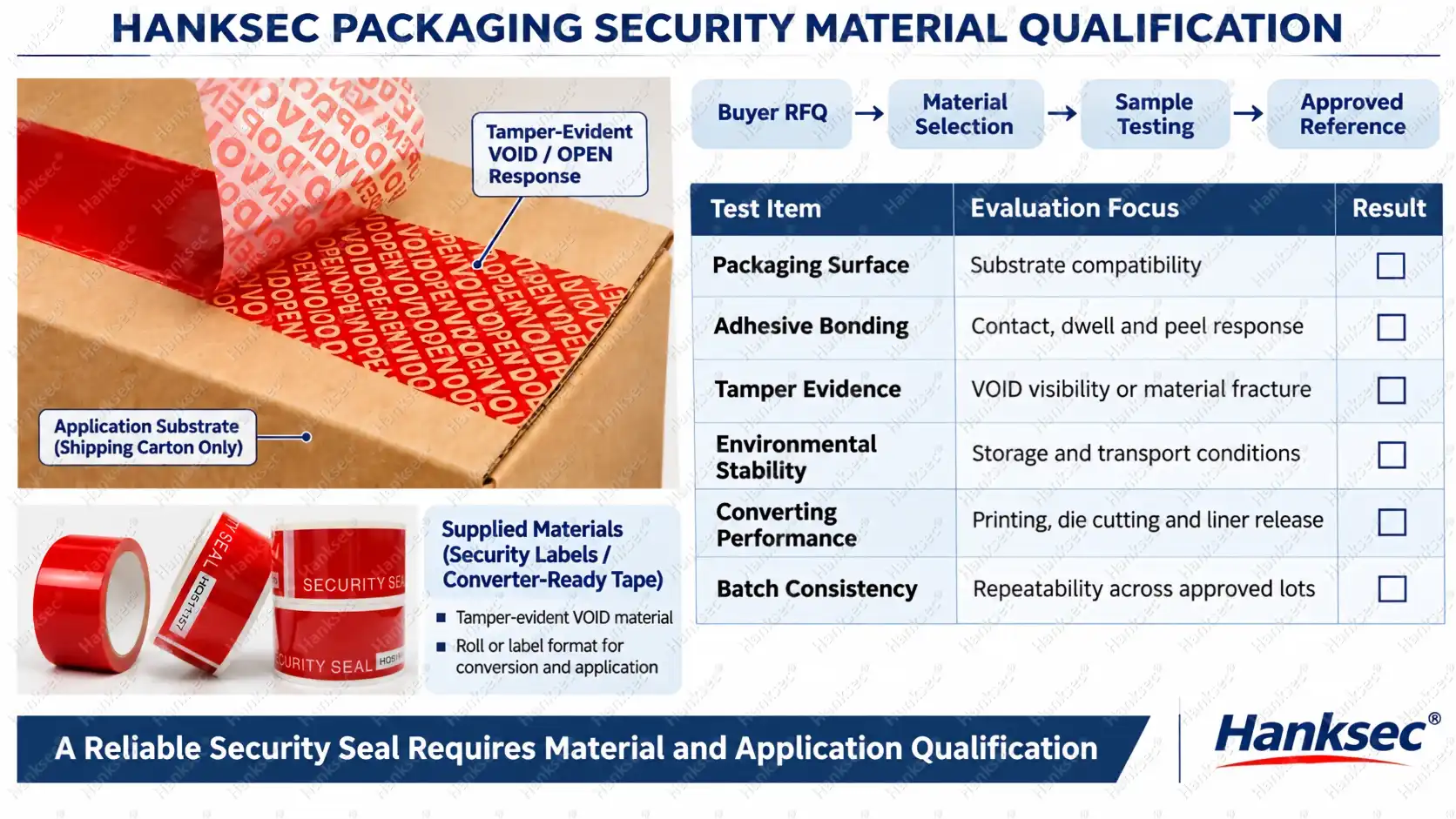
Providing representative package samples and photographs of the intended opening evidence is often more useful than specifying adhesive strength without reference to the actual application.
How Do Packaging Security Requirements Differ by Industry?
Different industries face different consequences when a package is torn, opened or suspected of being manipulated.
E-Commerce and Logistics Packaging
The main concern may be unauthorized carton access, product substitution, shipment disputes or resealing attempts during distribution.
Visible VOID or OPENED sealing tape can support inspection at warehouse handover and delivery. The selected tape must still be matched to the carton surface and sealing process.
Food Delivery and Takeaway Packaging
The main concern is whether a bag or container closure may have been opened between preparation and delivery.
A suitable label should create visible evidence when its intended closure is disturbed, while also remaining stable under representative handling, grease and moisture conditions.
For application-specific material considerations, see Hanksec’s Tamper Evident Seals for Takeaway Guide.
Pharmaceutical and Regulated Packaging
For certain regulated products, tamper-evident packaging is subject to defined legal or technical requirements rather than optional buyer preference alone.
For example, 21 CFR 211.132 addresses tamper-evident packaging requirements for specified over-the-counter human drug products in the United States.
ISO 21976:2018 provides requirements and guidance relating to tamper verification features for medicinal product packaging.
These references are application-specific. Supplying VOID tape or a security label does not automatically establish compliance with a regulated packaging system. The finished package, label design, validation and inspection process must meet the relevant requirements.
Security Bags, Confidential Documents and Controlled Shipments
For security bags and confidential shipments, buyers may require evidence of bag opening, controlled identification and consistent sealing performance.
Integrated security-bag closures differ from ordinary carton tape because the functional material must also work with the bag film and manufacturing process.
For these projects, review Hanksec’s Security Bag Tape Material Options.
Can Tamper-Evident Tape Prevent All Package Tampering?
No. Tamper-evident materials are designed to create evidence of specified interference, not to make every package impossible to access.
The effectiveness of a security closure depends on the complete package design, the location of the seal, the application process, the receiving surface and the inspection procedure.
A correctly functioning VOID tape may indicate a removal attempt at the protected closure. It does not automatically detect every possible access route through an unprotected part of the package.
For buyers, the practical goal is to make relevant opening attempts visibly detectable and to reduce ambiguity during inspection.
For broader anti-counterfeit solutions, tamper-evident packaging can serve as one physical layer alongside product identification, serialization and supply-chain controls. It should complement these measures rather than be treated as a standalone guarantee against counterfeiting.
That is why a successful purchasing decision should be based on a qualified material + package + application + inspection system rather than one impressive sample demonstration.
Frequently Asked Questions
What does torn or tampered packaging mean?
For a buyer, the torn or tampered packaging meaning depends on whether the package shows accidental physical damage, signs of possible access or an activated security feature. A tear alone does not establish that the package was opened.
Does a torn shipping box always mean the contents were tampered with?
No. Boxes can tear during normal handling or transportation. The condition should be assessed using the damage location, seal status, product risk and available inspection evidence.
What is the difference between damaged packaging and tamper-evident packaging?
Damaged packaging describes a physical condition. Tamper-evident packaging includes a designed feature intended to make specified opening or manipulation attempts visibly detectable.
What does a VOID message on packaging mean?
A VOID or OPENED message generally indicates that the designated security construction has activated during removal or separation. Its exact interpretation depends on the material design and inspection procedure.
Can ordinary packing tape show whether a package has been opened?
Ordinary tape may tear or leave incidental adhesive marks, but it normally does not contain a designed security mechanism. Tamper-evident tape provides a specified opening response that can be included in an inspection standard.
Which material is best for a carton that may be opened and resealed?
Full-transfer or partial-transfer VOID tape may be worth evaluating when visible evidence on the carton is required. The correct construction depends on surface strength, coating, adhesive contact and the expected opening conditions.
Should buyers select the strongest adhesive for tamper-evident tape?
Not automatically. Excessive adhesive strength can damage weak paper fibers before the functional security layer activates. Bonding and the intended tamper response should be qualified together.
Can Hanksec supply custom tamper-evident materials for packaging manufacturers?
Yes. Hanksec supplies security printing materials and supports OEM/ODM development for relevant VOID tapes, destructible labels and security sealing applications. Material construction, printing, release liner, adhesive and roll-format requirements should be confirmed through sampling and qualification.
If your customers cannot reliably distinguish ordinary package damage from an opening attempt, the security feature and inspection criteria may need to be reviewed.
Send Hanksec your packaging substrate, closure design, required opening evidence, application conditions and converting specifications. Our technical team can help evaluate suitable VOID security tapes, destructible label materials or customized tamper-evident sealing constructions for your project.
Hanksec® | Tamper-Evident Security Materials · VOID Tape · Destructible Labels · Custom Adhesives · OEM/ODM