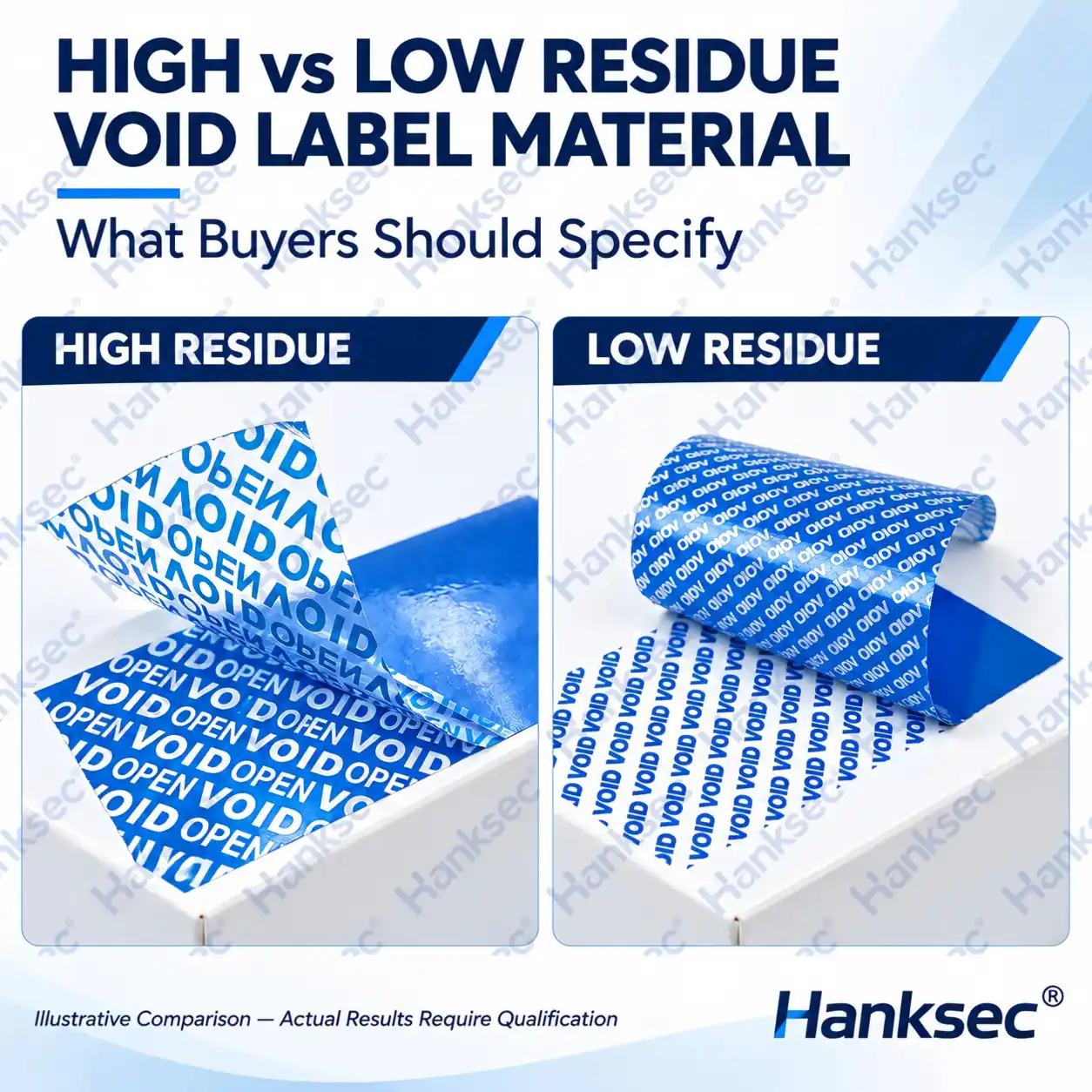
Quick Answer: High Residue VOID Label Material and Low Residue VOID Label Material are distinguished by where the VOID lettering and surrounding functional material remain after peeling. With high residue, the VOID lettering stays with the removed facestock, while the surrounding functional material transfers to and remains on the substrate. With low residue, the VOID lettering transfers to and remains on the substrate, while the surrounding functional material stays with the removed facestock. Residue level and VOID transfer type are separate specifications: Full Transfer, Partial Transfer and Non-Transfer describe where the security message appears. Buyers should specify both requirements and qualify the complete construction on the actual application surface before bulk production.
When purchasing tamper-evident security label materials, buyers often compare Full Transfer, Partial Transfer and Non-Transfer constructions. However, another important selection factor is the residue effect after removal.
For label converters, security printers and packaging manufacturers, choosing the appropriate residue level affects the visible opening evidence, surface appearance, adhesive compatibility and final inspection process. A material that creates an obvious security response on a shipping carton may not be suitable for a premium plastic enclosure or a reusable product surface.
The correct specification therefore starts with a practical question: After peeling, where should the VOID lettering and the surrounding functional material remain?
What Is High Residue VOID Label Material?
High Residue VOID Label Material refers to a construction in which the VOID lettering stays with the removed facestock, while all of the surrounding functional security material transfers to and remains on the applied substrate in the activated and peeled area.
After peeling, the VOID lettering is carried away with the removed face material. The surrounding functional material transfers to the substrate, creating the more visible residual effect. This describes the residue pattern of the specified construction; it does not by itself classify the material as Full Transfer, Partial Transfer or Non-Transfer.
Hanksec’s Total Transfer Security Label Material is designed for applications requiring visible surface-side security evidence. The required residue pattern should be specified and confirmed separately for the selected material construction and application.
High residue may be considered for:
- Shipping carton security seals.
- Export packaging and logistics closures.
- Warranty labels requiring obvious opening evidence.
- High-value product packaging.
- Applications where inspectors need to identify a disturbed closure quickly.
However, high residue should not automatically be interpreted as stronger adhesive or better security. The important requirement is whether the approved material produces the intended visible response without causing unacceptable damage to the substrate.
What Is Low Residue VOID Label Material?
Low Residue VOID Label Material refers to a construction in which the VOID lettering transfers to and remains on the applied substrate, while the surrounding functional material stays with the removed facestock. The intended security-material residue on the substrate is therefore the VOID lettering in the activated and peeled area.
This direction may be appropriate when package appearance, surface condition or subsequent handling is important.
Typical applications for evaluation include:
- Premium coated packaging.
- Selected electronics and equipment enclosures.
- Product surfaces where extensive surrounding functional-material transfer is undesirable.
- Reusable packaging or components requiring controlled surface condition.
- Security labels where the customer wants the VOID lettering to remain on the substrate without the surrounding functional material transferring with it.
For example, Hanksec’s Matt Silver Low Residue VOID Label Material is intended for projects requiring the VOID lettering to remain on the applied surface while the surrounding functional material stays with the removed facestock.
It is important to distinguish the specified low-residue pattern from zero adhesive residue. The intended security response is that the VOID lettering remains on the substrate while the surrounding functional material is carried away with the facestock. Separate adhesive traces, substrate condition and surface compatibility must still be evaluated; low residue does not guarantee completely clean removal on every surface.
High Residue vs. Low Residue VOID Label Material: Key Differences
The following comparison shows the intended location of the VOID lettering and surrounding functional material after peeling. These are construction-specific residue patterns, not universal numerical grades.
| Evaluation Item | High Residue | Low Residue |
|---|---|---|
| Residual Effect | VOID lettering stays with the removed facestock; all surrounding functional material transfers to the substrate. | VOID lettering remains on the substrate; surrounding functional material stays with the removed facestock. |
| Surface Appearance | The surrounding functional material remains visible on the activated and peeled area of the substrate. | The VOID lettering remains visible on the substrate while the surrounding functional material is removed with the facestock. |
| Inspection Priority | Confirm the surrounding functional material transfers to the substrate and the VOID lettering stays with the removed facestock. | Confirm the VOID lettering remains clear on the substrate and the surrounding functional material stays with the removed facestock. |
| Application Direction | Selected carton seals, logistics packaging and security closures. | Selected premium packaging, electronics and sensitive surfaces. |
| Key Evaluation | Location and consistency of the VOID lettering and surrounding functional material on both surfaces. | VOID message clarity, surrounding-material retention with the facestock and substrate compatibility. |
There is no universal rule that every application needs high residue or that low residue is always preferable. Buyers should compare actual reference samples on the intended packaging surface and define the acceptable appearance before production approval.
Residue Level vs. VOID Transfer Type: What Is the Difference?
No. Residue level and transfer type describe different aspects of a security label construction. Transfer type identifies where the designed security message appears. Residue level, in this comparison, identifies whether the VOID lettering or the surrounding functional material remains on the substrate after peeling.
Transfer type identifies where the designed hidden security message appears after removal. Residue level describes the distribution of the VOID lettering and surrounding functional material between the removed facestock and the applied substrate. The high-residue and low-residue patterns described here do not automatically correspond to any one transfer type.
| VOID Construction | Designed Message Location | Separate Residue Consideration |
|---|---|---|
| Full Transfer | The security message transfers primarily to the applied surface. | Define the required surface-side transfer and residual appearance. |
| Partial Transfer | The security response appears on both the removed label and the substrate. | Check the visibility and consistency of both sides. |
| Non-Transfer | The hidden security message appears mainly on the removed label. | Adhesive residue and actual surface cleanliness still require verification. |
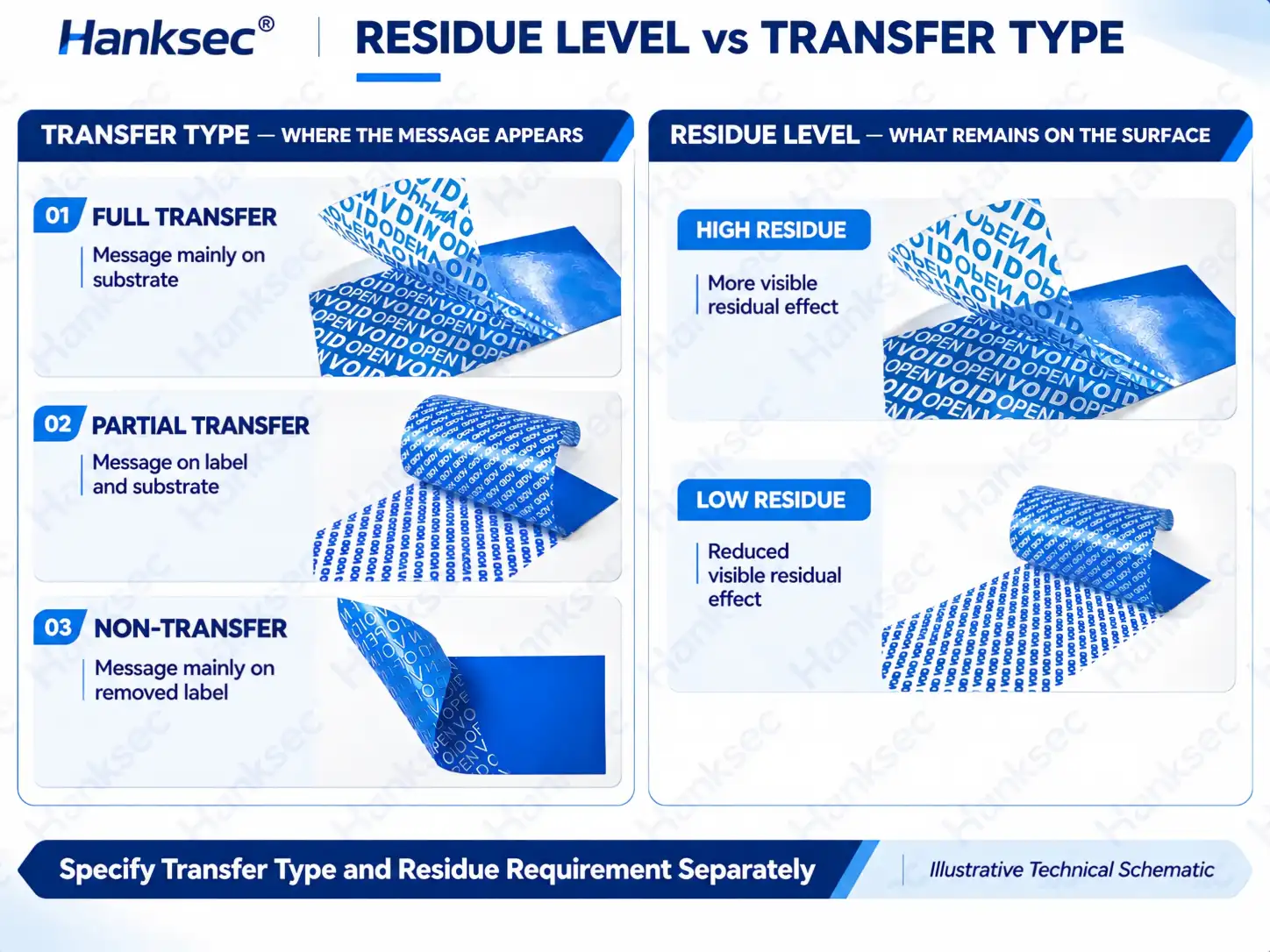
A buyer may require a particular transfer construction together with either specified residue pattern. These specifications must be confirmed independently: high residue does not automatically mean Full Transfer, and low residue does not automatically mean Partial Transfer or Non-Transfer.
For a detailed explanation of the three main constructions, read Hanksec’s Non-Transfer VOID Label Material Buyer’s Guide.
For applications involving camera stickers and sensitive device surfaces, our article Do Camera Blocking Stickers Leave Residue on Phones? 5 Tests explains why the location of the security message and adhesive residue must be evaluated separately.
What Affects VOID Label Residue After Removal?
The same security label material can produce different results on different application surfaces. The final removal behavior depends on the complete construction and the conditions under which the label is applied, stored and removed.
1. Substrate Surface and Coating
Coated cartons, kraft paper, PET, PP, PE, glass and painted metal have different surface properties. Surface energy, roughness, porosity, protective coatings and contamination can change adhesive contact and the final separation behavior.
For example, a smooth coated carton may produce a different residual effect from a rough recycled cardboard surface. Plastic surfaces may also require specific adhesive selection according to their material and surface treatment.
2. Adhesive Formulation and Coating
Pressure-sensitive acrylic and selected hot-melt adhesive systems can produce different bonding and removal characteristics. Adhesive formulation, coating weight and compatibility with the security layer all influence the final result.
Higher peel adhesion does not automatically produce the correct residue level or VOID activation. The adhesive must work together with the facestock, functional security layer and receiving surface.
For more detailed material selection guidance, see Hanksec’s Tamper Evident Label Adhesive Guide.
3. Application Pressure and Dwell Time
Application pressure affects adhesive contact, while dwell time allows the bond to develop. A label removed immediately after application may behave differently from one removed after the specified waiting period.
Buyers should therefore define the application procedure and evaluate the material at relevant inspection intervals.
4. Temperature and Humidity
Storage, application and service conditions can influence adhesive behavior and material stability. Humidity, cold surfaces and temperature changes may affect the final removal response.
Testing should reflect the actual packaging and distribution environment rather than relying exclusively on a room-temperature demonstration.
5. Peel Direction and Removal Conditions
Peel angle, speed and direction can influence the observed result. Comparisons between high-residue and low-residue samples are meaningful only when the removal procedure is controlled and repeatable.
How to Test High and Low Residue VOID Label Materials
Before approving a bulk order, buyers should evaluate the complete security label construction on the actual production substrate.
- Prepare representative surfaces: Use actual cartons, coated paperboard, plastic or metal samples with the same surface finish as the intended application.
- Apply the security label: Follow the agreed application procedure and record application pressure and temperature.
- Control dwell time: Allow the label to remain bonded for the specified period before removal.
- Perform controlled removal: Use a consistent peel direction, angle and speed.
- Inspect both surfaces: Record whether the VOID lettering remains with the removed facestock or on the substrate, where the surrounding functional material remains, and any separate adhesive traces or substrate damage.
- Compare approved samples: Evaluate high-residue and low-residue options using the same substrate and inspection conditions.
- Check repeatability: Repeat the evaluation across multiple samples and relevant production lots.
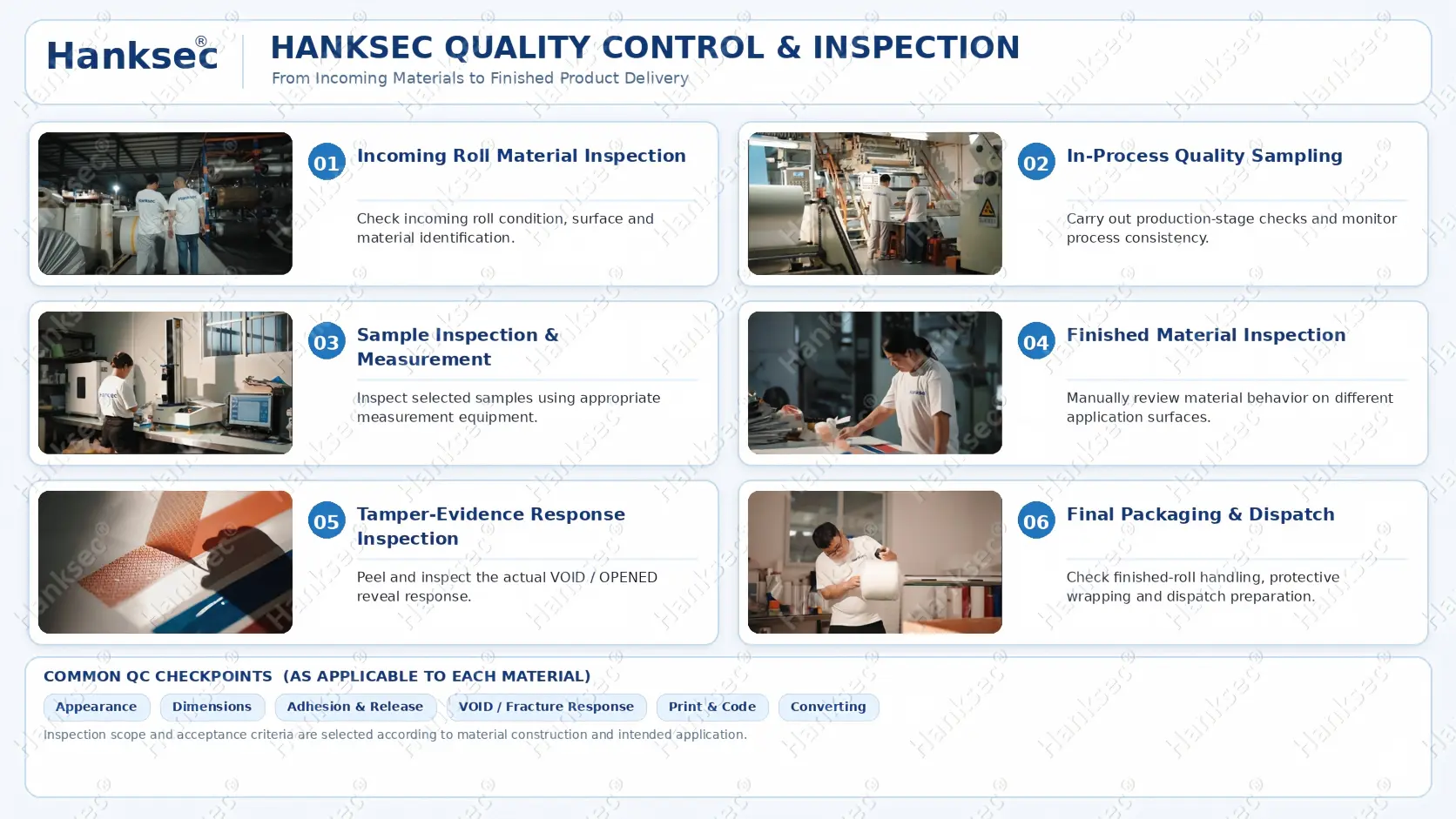
ASTM D3330/D3330M provides methods for measuring peel adhesion of pressure-sensitive tapes and evaluating adhesion uniformity. It can support adhesive performance evaluation, but it does not establish a universal high-residue or low-residue classification and does not independently verify the intended VOID security response.
The final material approval should therefore consider peel adhesion, VOID message clarity, residual appearance, substrate compatibility and the complete application conditions together.
For additional failure diagnosis, see Hanksec’s Why VOID Labels Fail: 8 Causes & Fixes.
What to Include in a VOID Label Material RFQ
A clear request for quotation helps the manufacturer recommend the appropriate material construction. Instead of requesting only a high-residue or low-residue label, buyers should define the transfer type and the exact post-removal location of the VOID lettering and surrounding functional material.
| RFQ Specification | Information to Provide |
|---|---|
| Application Surface | Kraft carton, coated paperboard, PET, PP, PE, glass or metal. |
| Transfer Type | Full Transfer, Partial Transfer or Non-Transfer. |
| Residue Requirement | High Residue: VOID lettering stays with the removed facestock while surrounding functional material transfers to the substrate. Low Residue: VOID lettering remains on the substrate while surrounding functional material stays with the removed facestock. Confirm with an approved reference sample or photograph. |
| Facestock | PET or custom material, with 25 / 36 / 50 μm or project-specific thickness. |
| Adhesive System | Pressure-sensitive acrylic, selected hot-melt or application-specific adhesive construction. |
| Security Message | VOID, VOIDOPEN, OPENED, SECURITY or customized wording. |
| Printing & Converting | UV, flexo, digital, screen, thermal transfer, die cutting and dispensing requirements. |
| Release Liner | Glassine, kraft paper or other project-specific liner. |
| Roll Dimensions | Width, length, core size, maximum roll diameter and winding direction. |
| Test Conditions | Application pressure, dwell time, temperature, humidity, peel direction, peel angle, removal speed and agreed acceptance criteria. |
Hanksec’s current Total Transfer Security Label Material specifications include PET or customized facestock, 25 / 36 / 50 μm thickness options, pressure-sensitive acrylic or selected hot-melt adhesive systems, and glassine or kraft release liners. Roll dimensions and printing requirements can be discussed according to the converter’s production process.
For converters sourcing master rolls or slit rolls, review the VOID Label Material Rolls: Jumbo & Slit Roll Selection Guide before preparing the final RFQ.
How to Choose Between High and Low Residue VOID Labels
The correct selection depends on where the VOID lettering and surrounding functional material must remain after peeling, together with the required transfer type and actual substrate.
- Choose a high-residue direction: When the required pattern is for the VOID lettering to stay with the removed facestock while all surrounding functional material transfers to the substrate.
- Choose a low-residue direction: When the required pattern is for the VOID lettering to remain on the substrate while the surrounding functional material stays with the removed facestock.
- Specify transfer type separately: Confirm Full Transfer, Partial Transfer or Non-Transfer according to where the security message appears; do not infer the transfer type from the residue pattern.
- Evaluate Non-Transfer VOID: When the primary requirement is for the hidden security message to appear mainly on the removed label rather than transfer to the substrate.
- Request both samples: When the final appearance is uncertain, compare high- and low-residue options on the same actual substrate before making a purchasing decision.
For security printers and packaging manufacturers, the most reliable specification is not simply a product name. It is an agreed combination of transfer type, residue target, substrate, adhesive system, application procedure and inspection reference.
FAQs About High and Low Residue VOID Labels
Does high residue mean stronger adhesive?
Not necessarily. High residue does not mean stronger adhesive. It describes the pattern in which the VOID lettering stays with the removed facestock while the surrounding functional material transfers to the substrate. Adhesive peel force is a separate property and should be evaluated independently.
Does low residue mean the label leaves no trace?
No. In the specified low-residue pattern, the VOID lettering remains on the substrate while the surrounding functional material stays with the removed facestock. This does not automatically guarantee zero separate adhesive residue or completely clean removal on every substrate.
Does Full Transfer automatically mean high residue?
No. Full Transfer describes where the designed security message appears after removal, while high residue describes the separate pattern in which the VOID lettering stays with the removed facestock and the surrounding functional material transfers to the substrate. The two requirements must be specified and qualified independently.
Can Non-Transfer VOID labels still leave adhesive residue?
Yes. Non-Transfer describes where the designed hidden security message appears after removal. It does not independently define the amount of adhesive residue. Surface cleanliness must be qualified separately.
Should buyers test residue on the actual packaging surface?
Yes. Coatings, surface energy, texture, contamination, application pressure and dwell time can all influence removal behavior. Testing the actual production substrate is recommended before bulk approval.
What should converters provide when requesting high or low residue samples?
Provide the application surface, required transfer type, desired residual appearance, facestock thickness, printing method, roll dimensions and expected operating conditions. Photographs or physical samples of the actual substrate can help the manufacturer recommend a suitable construction.
Hanksec manufactures tamper-evident security label materials for label converters, security printers, packaging manufacturers, material distributors and OEM/ODM projects.
Our material options include Full Transfer, Partial Transfer and Non-Transfer VOID constructions with different facestock, adhesive, residue, hidden-message and roll-format options.
Send Hanksec your actual application surface, required transfer type, desired residue effect, printing method and roll specifications. Our technical team can help evaluate suitable material options and arrange samples for pre-production testing.
Hanksec® | Tamper-Evident Security Materials · VOID Label Materials · Custom Adhesives · Jumbo & Slit Rolls · OEM/ODM