Quick Answer: UV Security Label Material is a label stock or material construction designed to support ultraviolet-responsive security printing and authentication. The UV-responsive ink or marking provides the security effect, while the facestock, printable coating, adhesive, release liner and any protective finish influence printing compatibility, application performance and final inspection. Depending on the selected formulation, a security marking may fluoresce, change appearance or become visible under a specified UV light source. Unlike UV-curable printing, which uses ultraviolet radiation to cure ink during production, UV security marking is intended for authentication and inspection. Buyers should define the expected UV response, inspection conditions, material construction and application requirements, then qualify the complete label before bulk production.
For brand owners, packaging manufacturers and security label converters, a label can do more than display a company logo, product information or warning message. It can also incorporate hidden security markings that authorized personnel can inspect using a specified ultraviolet light source.
This additional authentication feature is particularly useful when a brand wants to strengthen product verification without significantly changing the normal appearance of its packaging.
However, selecting suitable UV Security Label Material requires more than simply requesting invisible ink. The security marking, printable surface, material construction and verification conditions must work together to deliver a consistent result.
What Is UV Security Label Material?
UV Security Label Material is a specialized label stock or material construction designed to support ultraviolet-responsive security markings. These markings provide an additional authentication feature that can be inspected under specified UV illumination.
The UV-responsive effect is generally created by the selected security ink or marking system rather than by the adhesive alone. The label material must provide a suitable surface for printing while maintaining compatibility with the intended security design and subsequent converting processes.
Depending on the selected ink and security design, the marking may have different characteristics:
- Invisible or difficult to distinguish under normal lighting.
- Fluorescent and visible under a specified UV light source.
- Designed to change appearance or color under different illumination conditions.
- Customized with hidden logos, text, symbols or security patterns.
- Integrated with other printed or physical security features.
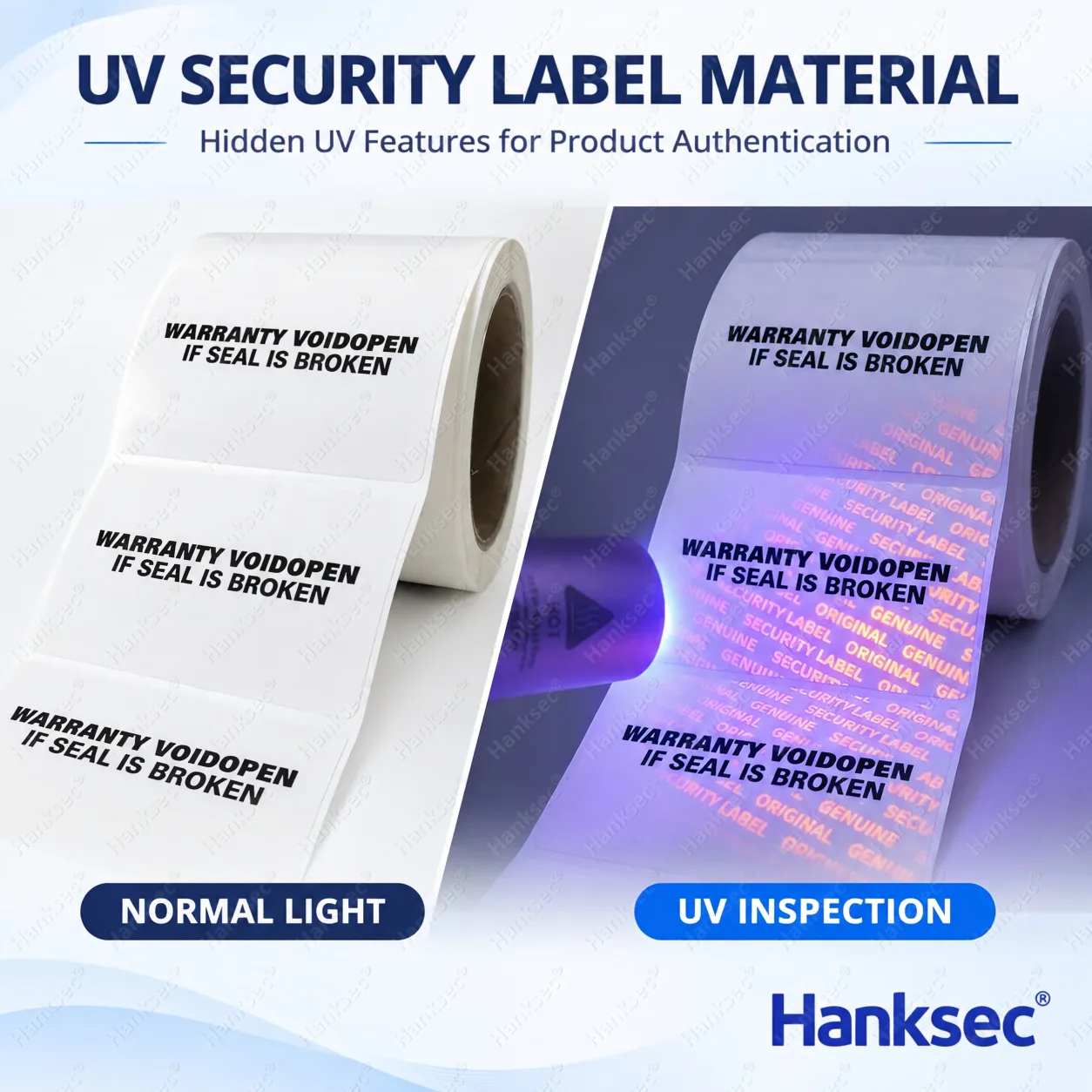
For example, a customized security label may display its normal branding, QR code and holographic elements under ordinary lighting, while additional markings such as ORIGINAL, SECURITY LABEL and GENUINE become visible during the specified UV inspection.
The exact response depends on the selected security ink, printing method and complete label construction. Some UV-responsive markings produce fluorescence, while others may exhibit a different visual response. Buyers should therefore approve an actual reference sample rather than assume that all UV security inks behave identically.
According to the EUIPO Anti-Counterfeiting and Anti-Piracy Technology Guide, UV-sensitive inks can support authentication and anti-tampering applications on products and packaging. Their performance depends on the specific ink formulation and inspection method.
For B2B buyers, the important question is not simply whether a label contains UV ink. It is whether the finished label provides a recognizable, controlled and repeatable security response under the intended inspection conditions.
For related material options, explore Hanksec’s UV Function Security Material range for customized UV-responsive security applications.
How Does a UV Security Label Work?
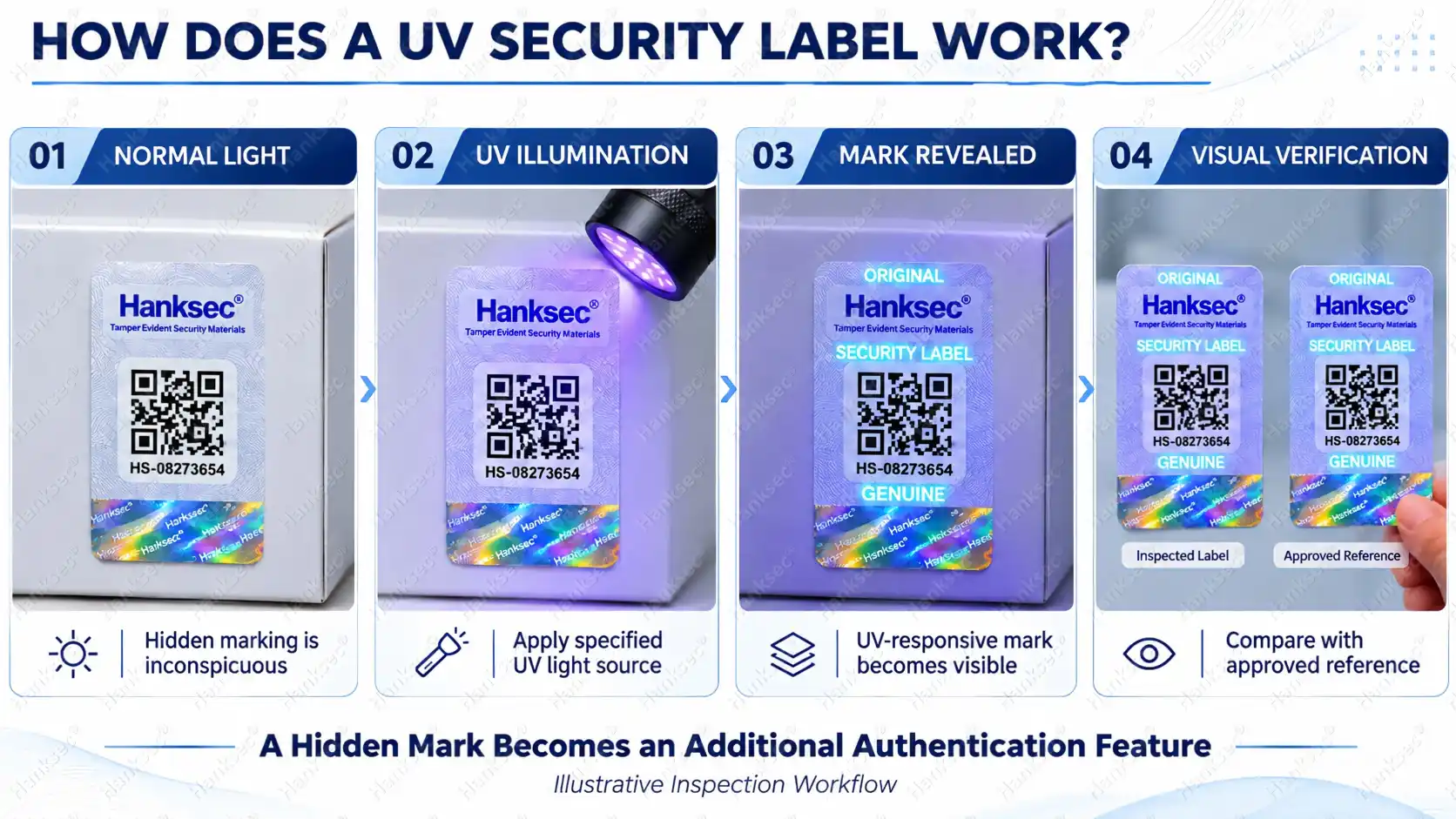
A UV security label works by incorporating a UV-responsive marking into its printing or material construction. The marking is designed to produce a specified visual response when exposed to the agreed UV light source.
A typical authentication process follows four steps:
- Normal Light: Inspect the label’s ordinary appearance. The covert marking should remain inconspicuous if this is the approved design.
- UV Illumination: Apply the specified UV light source under the agreed inspection conditions.
- Security Response: Observe the expected fluorescence, hidden text, logo, color change or other specified visual response.
- Visual Verification: Compare the observed result with an approved reference sample to confirm the marking’s appearance and position.
For example, a customized Hanksec label may show the hidden words ORIGINAL, SECURITY LABEL and GENUINE in a blue or cyan fluorescent appearance under the specified UV illumination. These markings should appear in their approved positions and match the reference design.
Importantly, the verification method should be defined before production. Different UV-responsive inks may require different illumination wavelengths, light intensity, inspection distances and viewing conditions. A general-purpose UV flashlight should not automatically be treated as an approved verification device.
UV Security Ink vs. UV-Curable Printing: What Is the Difference?
This is one of the most important distinctions when purchasing UV Security Label Material because the two technologies involve ultraviolet light but serve different purposes.
UV security ink refers to an ink or marking system with a UV-responsive characteristic used for authentication, covert identification or specialized inspection. Its intended function is to produce a specified security response under the agreed inspection conditions.
UV-curable printing refers to a printing process in which ultraviolet radiation is used to cure or harden printing ink during production. Its main purpose is to complete the printing process rather than provide a covert authentication feature.
Although both technologies involve ultraviolet light, they should not be treated as interchangeable.
| Comparison | UV Security Ink | UV-Curable Ink |
|---|---|---|
| Main Purpose | Authentication and specialized security inspection. | Ink curing during printing production. |
| UV Function | Produces a specified fluorescent, color-changing or other UV-responsive security effect. | Uses UV energy to cure or harden the printing ink. |
| Inspection | Requires the specified UV inspection method and an approved reference sample. | Normally evaluated through curing and print-quality performance. |
| Application | Security markings and product-authentication labels, including covert or UV-responsive inspection features. | General label printing and production processes. |
A material can be compatible with UV printing without containing any UV authentication feature. Likewise, a UV-responsive security ink does not automatically require the same printing and curing process as conventional UV-curable ink.
In some projects, UV-curable printing and UV-responsive security markings may be used within the same label design, provided that the selected inks, printing sequence and material construction are compatible.
For more information about printing compatibility, coatings and different printing methods, see Hanksec’s Printable Security Label Materials Guide.
Where Are UV Security Labels Used?
UV security labels are useful in applications where an additional verification feature is needed without relying entirely on visible security graphics.
1. Brand Protection and Product Authentication
Brands can incorporate hidden logos, symbols or customized security patterns into labels used on consumer products and packaging.
Authorized distributors, inspection personnel or brand representatives can use the specified UV verification procedure to check whether the expected marking is present and consistent with an approved reference sample.
2. Electronics and Warranty Labels
Electronics manufacturers may use UV-responsive markings as an additional inspection feature on warranty seals, equipment labels and product identification labels.
Depending on the design, the UV mark can help authorized personnel identify a designated security feature during repair, servicing or product inspection.
3. Pharmaceutical and Healthcare Packaging
Selected pharmaceutical and healthcare packaging projects may use covert markings as an additional authentication feature.
For these applications, buyers should evaluate the printing surface, packaging material, handling environment and inspection procedure. UV markings should not be presented as a substitute for applicable product identification, serialization or regulatory requirements.
4. Documents and Controlled Packaging
UV-responsive markings are also used in security printing for documents, certificates, controlled packaging and other products where visual inspection under a dedicated light source is practical.
The marking can be positioned in a defined area so that inspectors know exactly where and how to verify it.
Can UV Security Labels Prevent Counterfeiting on Their Own?
No. A UV security feature is an additional authentication layer, not an absolute guarantee against counterfeiting.
A basic fluorescent marking may be imitated if its appearance, location and printing characteristics are easily observed or reproduced. Its security value depends on how the feature is designed, controlled and verified.
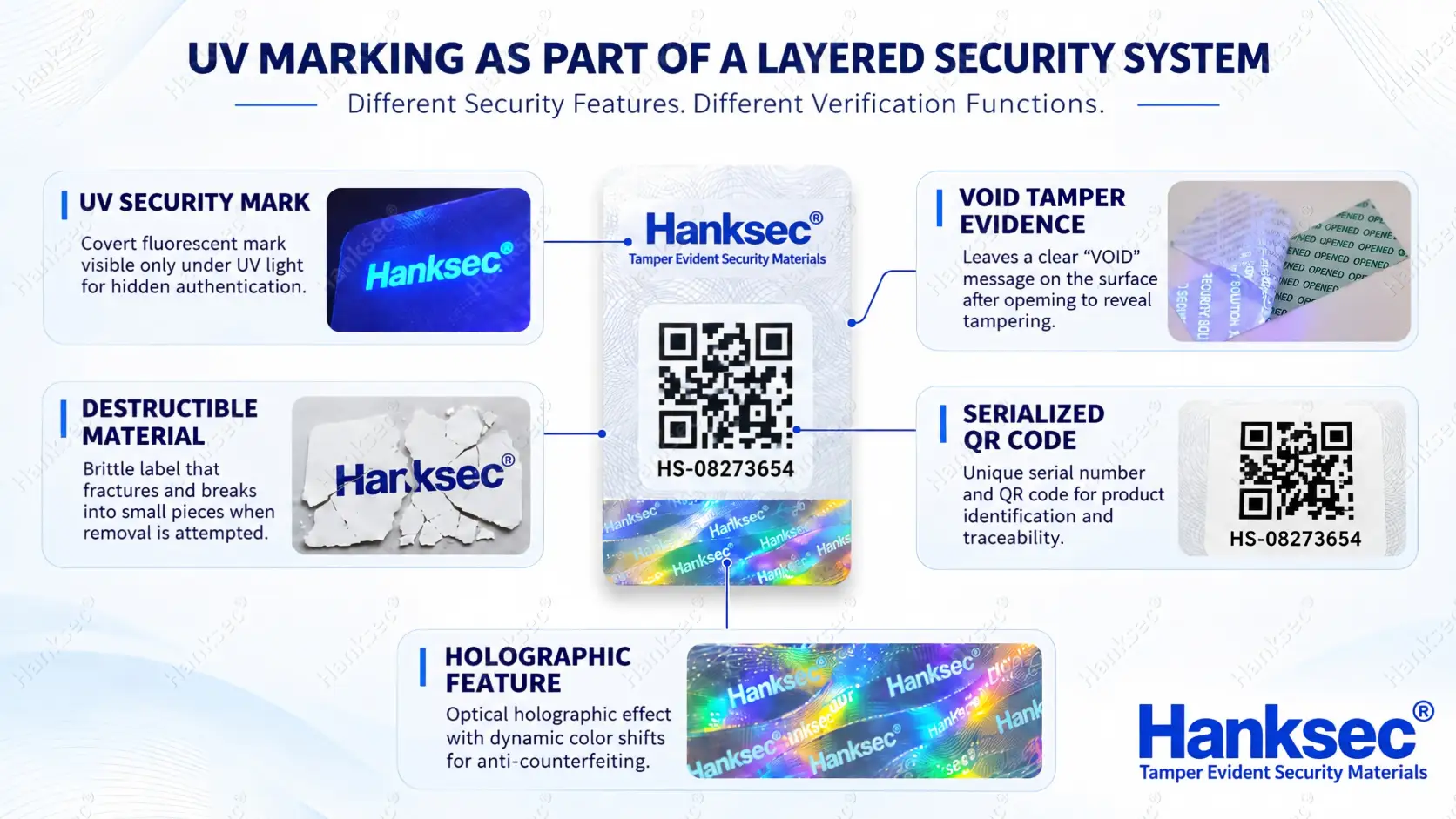
For more effective protection, UV security markings can be combined with other security technologies. Each feature should perform a clearly defined function rather than simply adding visual complexity to the label.
| Security Feature | Main Function | Verification |
|---|---|---|
| UV Marking | Covert visual authentication. | Specified UV light source and reference comparison. |
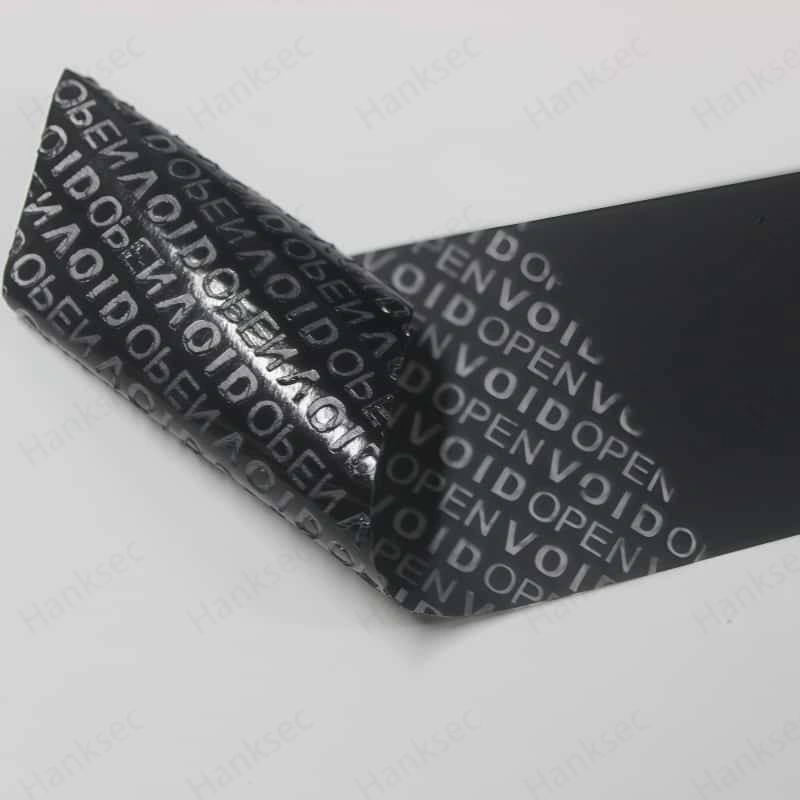
| VOID Label | Provides visible evidence when removal or opening is attempted. | Inspection of the activated VOID message or transfer pattern. |
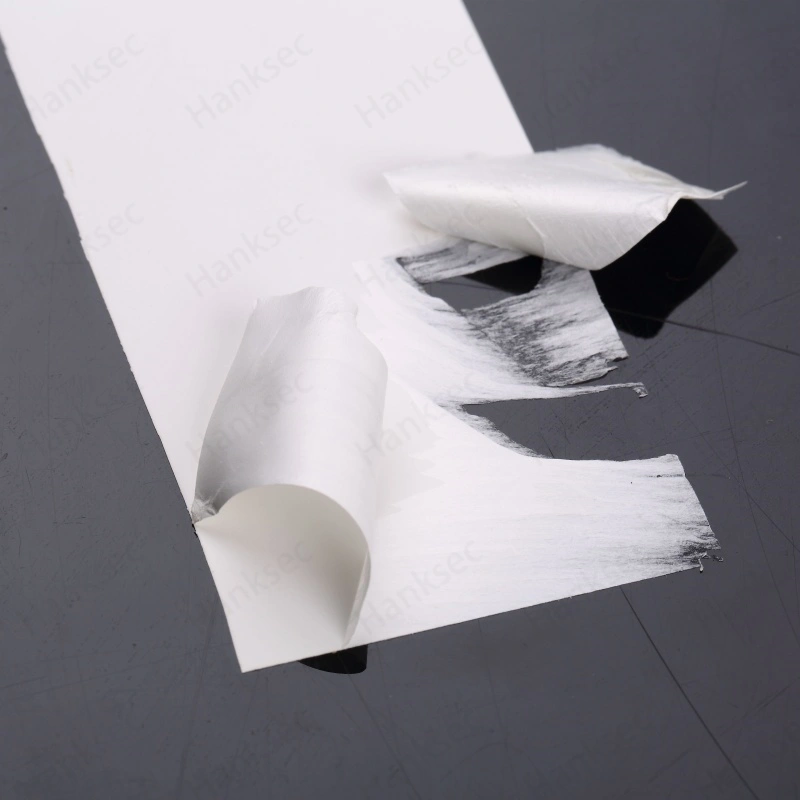
| Destructible Label | Designed to fragment during removal, making intact transfer and reuse difficult. | Inspection of material fracture and removal behavior. |
| Holographic Feature | Optical recognition and visual authentication. | Visual inspection under different viewing angles. |
| Serial Number / QR Code | Unique identification and traceability when supported by a controlled data system. | Database or platform verification. |
Each feature serves a different purpose. UV markings support covert inspection, while VOID and destructible constructions provide physical tamper evidence. Holographic elements support optical recognition, and serialized QR codes can support identification and digital verification.
For a broader brand-protection strategy, read Hanksec’s Anti-Counterfeiting Labels for Brand Protection: How to Build an Authentication System.
What Should Buyers Specify When Purchasing UV Security Label Material?
For label converters, OEM buyers and packaging manufacturers, a clear technical specification helps avoid problems during printing, converting and final inspection.
Before requesting samples or quotations, buyers should define the following requirements:
| Specification | Information to Confirm |
|---|---|
| UV Feature | Hidden logo, text, graphic, pattern or customized marking. |
| Normal Appearance | Whether the marking should be invisible, low-visibility or visible under normal lighting. |
| UV Verification | Required light source, wavelength, light intensity, inspection distance and expected visual response. |
| Facestock | PET, BOPP, paper, destructible film or another specified label-facing material. |
| Printing Method | UV security ink application and compatibility with the selected printing and production process. |
| Protective Finish | Topcoat, protective coating or overlaminate, including its compatibility with the intended UV inspection response. |
| Adhesive | Pressure-sensitive acrylic or another project-specific adhesive matched to the application surface and service conditions. |
| Security Construction | UV marking alone or combined with VOID, destructible or holographic features. |
| Supply Format | Jumbo rolls, slit rolls, sheets or finished die-cut labels. |
| Application Substrate | Actual packaging or product surface, such as coated cartons, plastic, glass or metal. |
One important distinction: the facestock is the material forming the label itself, while the application substrate is the surface to which the finished label is applied. Both should be evaluated because they affect different parts of the final construction.
Protective coatings and overlaminates also deserve attention. Depending on their optical properties and construction, they may influence the visibility or inspection of certain UV-responsive markings. A UV feature that performs correctly before finishing should therefore be checked again after the complete label construction has been assembled.
Buyers should also provide reference artwork or an approved physical sample whenever possible. The manufacturer can then evaluate the printable surface, material construction and compatibility requirements according to the intended inspection method.
How Should UV Security Label Material Be Qualified Before Bulk Production?
A UV mark that looks correct on a small printing sample may not necessarily remain consistent after printing, coating, lamination, die cutting, matrix stripping, slitting or rewinding.
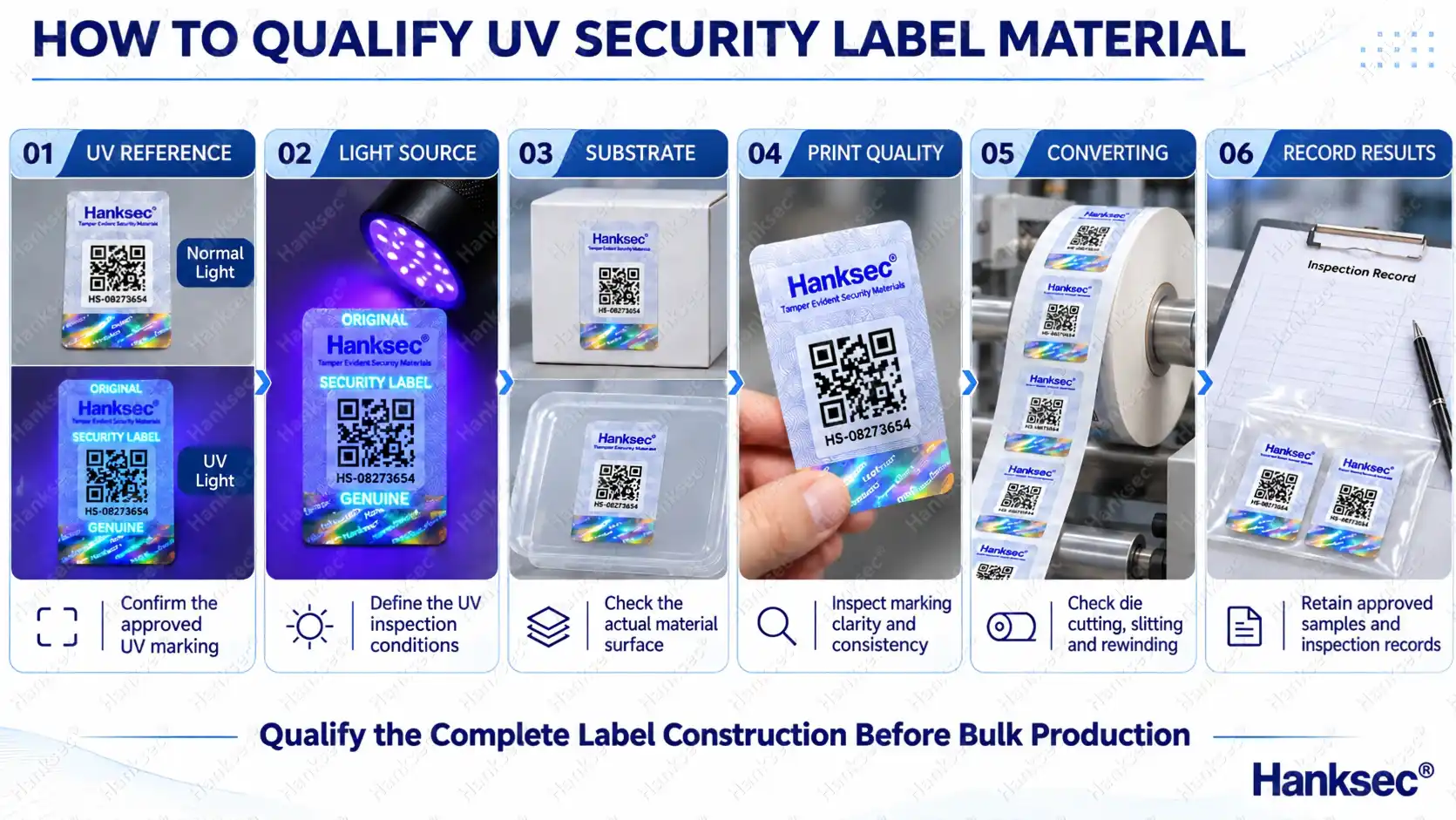
For this reason, Hanksec recommends a practical six-stage qualification process for UV security label material:
- UV Reference: Approve the intended security marking, normal-light appearance, UV response and marking position. Retain an approved reference sample as the inspection standard.
- Light Source: Define the UV inspection equipment and conditions, including the specified wavelength, light intensity, distance, angle and viewing environment. Use the same agreed conditions when comparing samples and production batches.
- Substrate: Check the actual facestock, printable surface, adhesive construction and final application substrate. Confirm that the selected materials are compatible with the intended printing and inspection requirements.
- Print Quality and Finish: Inspect marking clarity, registration, consistency, fluorescence or color response, background interference and print durability. Recheck the UV response after applying any protective coating or overlaminate.
- Converting: Evaluate die cutting, matrix stripping, slitting, rewinding and liner release where applicable. Check that the marking remains intact and recognizable after processing, and verify the finished label on the intended application surface.
- Record Results: Retain approved samples, inspection conditions and qualification records. Define acceptance criteria and use the approved reference as a comparison standard for subsequent production batches.
UV response should be checked together with the complete label construction rather than on the printing ink alone. If a protective coating, overlaminate, facestock, adhesive construction or printing process is changed, the finished material should be re-evaluated instead of assuming that the original UV response will remain unchanged.
This approach helps buyers identify compatibility issues before bulk production and establish a more consistent inspection standard between material approval, printing, converting and final application.
For broader material-layer and manufacturing information, see Hanksec’s Security Label Material Systems Guide.
Frequently Asked Questions About UV Security Labels
Are UV security labels invisible under normal light?
Not always. Some UV-responsive markings are designed to be invisible or difficult to notice under normal lighting, while others may have a visible appearance that changes under UV illumination. The intended behavior depends on the selected ink and security design. Buyers should confirm the normal-light appearance using an approved sample.
Can a normal UV flashlight verify a UV security label?
It depends on the specified ink and verification system. Buyers should confirm the required UV light source, wavelength and inspection conditions before approving the material. Not every UV-responsive ink produces the same result under every UV lamp.
Are UV security labels the same as holographic labels?
No. UV security labels use UV-responsive markings for covert or specialized inspection. Holographic labels use optical structures that create visual effects under normal lighting and different viewing angles. Both can be combined in a layered security design, but they provide different authentication functions.
Can UV security features be combined with VOID labels?
Yes, subject to material and printing compatibility. A UV-responsive marking can provide an additional authentication feature, while a VOID construction provides physical evidence when removal is attempted. The complete construction should be tested to confirm that both features remain effective after printing, converting and application.
Does UV ink alone guarantee that a product is genuine?
No. A UV mark can help authorized personnel check for a specified security feature, but its presence alone does not establish product origin. Stronger authentication should use controlled designs, approved reference samples and additional identification or tamper-evident technologies where appropriate.
Can UV security label material be supplied in rolls?
Supply format depends on the selected construction and project requirements. Buyers can discuss jumbo rolls, slit rolls, sheets and customized finished-label formats according to their printing and converting requirements.
Hanksec® specializes in tamper-evident security label materials and customized security printing materials for label converters, security printers, packaging manufacturers, distributors and OEM/ODM customers.
For UV security label projects, buyers can discuss the intended hidden marking, normal-light appearance, UV inspection requirements, facestock, adhesive, application substrate and converting process. These details help determine a suitable material construction and qualification approach.
Whether you require UV-responsive authentication features, VOID security materials, destructible constructions or a combination of independent security technologies, provide your application details and reference requirements so the appropriate solution can be evaluated.
Contact Hanksec to discuss your material requirements and arrange samples for technical evaluation before bulk production.
REQUEST UV SECURITY MATERIAL SAMPLES →
Hanksec® | Tamper Evident Security Materials · UV Function Security Materials · VOID Label Materials · Destructible Materials · OEM/ODM