Anti-counterfeit packaging for e-commerce is no longer only a container-shipping or wholesale-market issue. E-commerce has changed how genuine and counterfeit products move through global supply chains, with more individual products traveling through postal networks, courier systems, fulfillment centers and small-parcel delivery channels.
The OECD and EUIPO estimated that global trade in counterfeit and pirated goods reached approximately USD 467 billion in 2021, equivalent to 2.3% of total global imports. Their 2025 analysis also found that shipments containing fewer than ten items accounted for 79% of customs seizures in 2020–2021, highlighting the increasing importance of fragmented small-parcel distribution. OECD/EUIPO 2025 Mapping Global Trade in Fakes report
For brands selling electronics, cosmetics, spare parts, tools, accessories, pharmaceuticals, premium consumer products or other high-value goods online, this creates a packaging question that digital serialization alone cannot fully answer:
Can we identify the product — and can we also see whether the physical package has been opened, transferred, substituted or resealed?
Quick Answer
Anti-counterfeit packaging for e-commerce works best when digital identification and physical tamper evidence are treated as separate but complementary security layers.
Serialization, QR codes and unique identifiers can help identify individual products and support traceability. However, a valid serial number does not automatically prove that a carton, mailer, security label or closure remained intact throughout storage, fulfillment, transportation, delivery and returns.
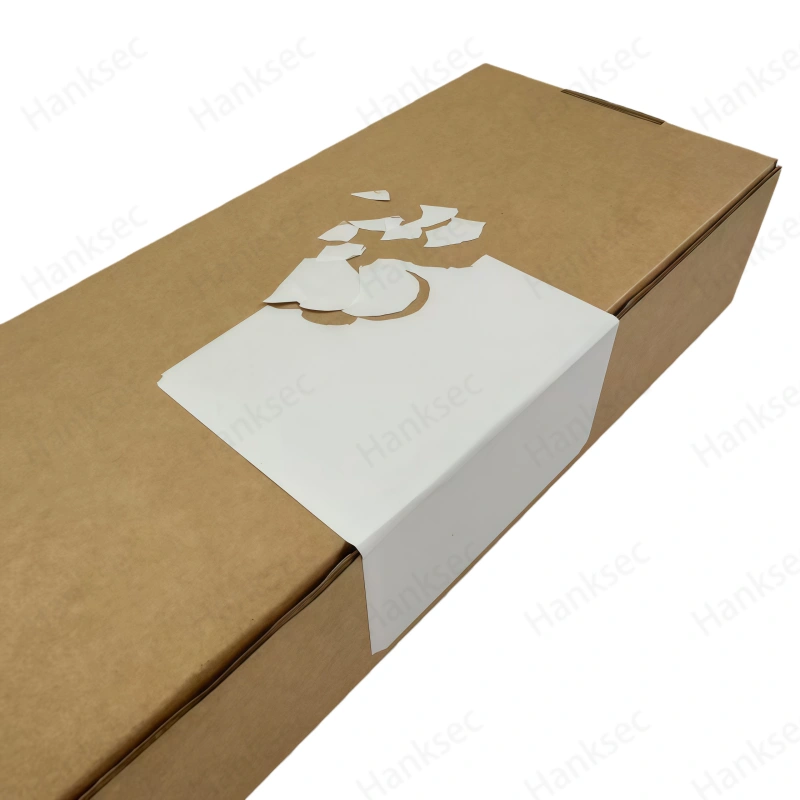
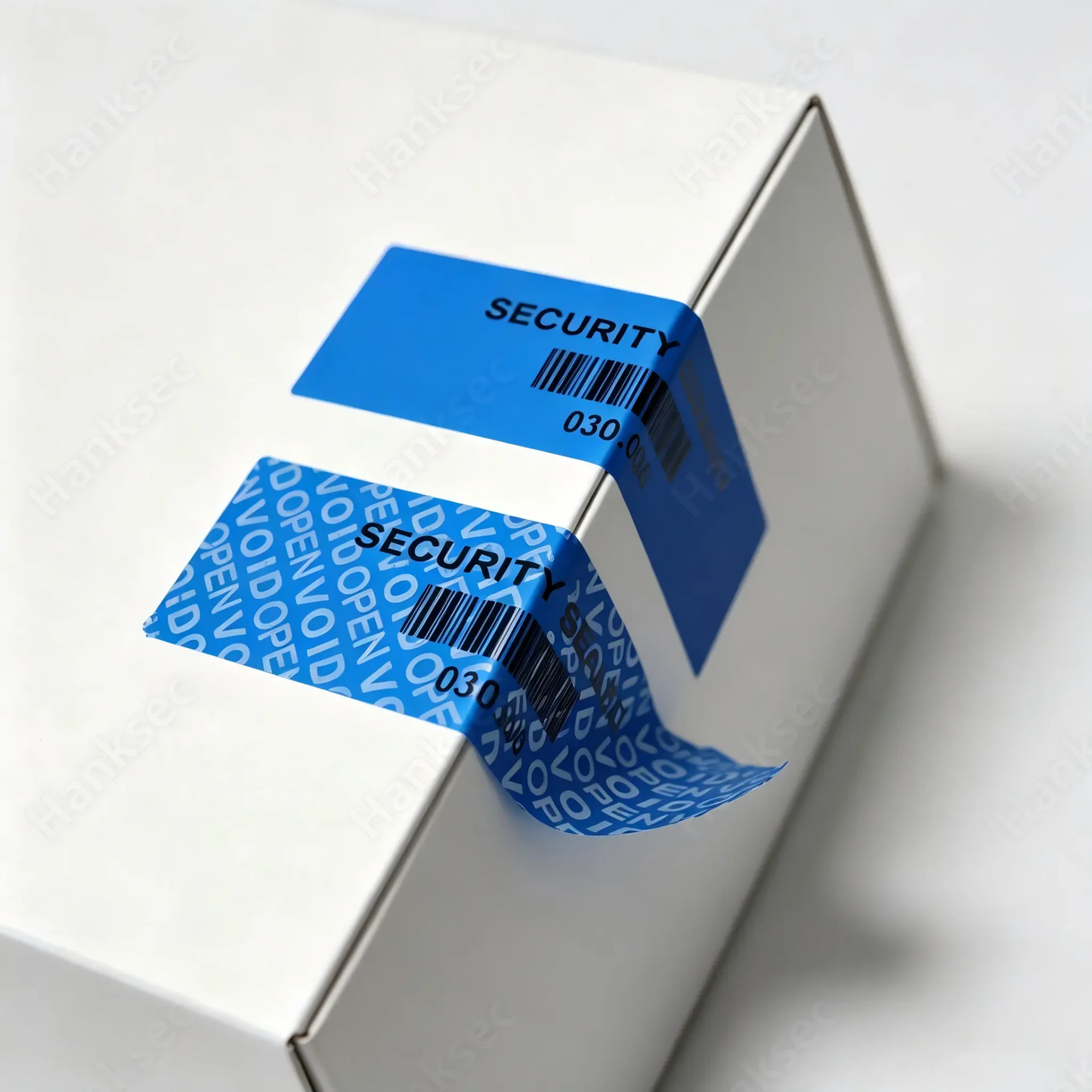
Tamper-evident e-commerce packaging can add a physical security layer through VOID security tape, destructible labels, serialized carton seals or other controlled opening indicators. When correctly matched to the package surface, these technologies help make unauthorized opening or label transfer more visible.
They do not prove product authenticity by themselves and should not be presented as a replacement for serialization, marketplace authentication systems or supply-chain traceability.
Why Anti-Counterfeit Packaging Matters in the $467 Billion Counterfeit Trade
The significance of the USD 467 billion figure is not simply its size.
The distribution pattern matters.
OECD/EUIPO research shows that counterfeiters increasingly exploit online platforms, modern logistics and small-parcel distribution. In 2020–2021, shipments containing fewer than ten items represented 79% of seizures, compared with 61% during 2017–2019. The report specifically identifies postal services and fragmented shipments as important channels that create enforcement challenges.
Earlier OECD/EUIPO research focused specifically on e-commerce found a strong relationship between online trade in counterfeit products and the use of small parcels. In the European Union case study used in that research, 91% of counterfeit detentions linked to e-commerce involved postal services.
This does not mean every small e-commerce package contains a counterfeit product. It means the modern parcel environment creates a security challenge at a much smaller physical scale than traditional freight protection.
A brand may now ship one valuable product through several separate handling points:
Warehouse picking, fulfillment, parcel consolidation, courier collection, sorting, local distribution, final-mile delivery and potentially reverse logistics.
For high-risk products, the carton or mailer becomes part of the security system.
Serialization Is Powerful — But It Solves a Different Problem
Serialization gives an individual item or logistic unit a unique identity.
The GS1 Global Traceability Standard distinguishes class-level, batch/lot-level and instance-level identification. At instance level, a product can receive a serialized identifier that distinguishes one individual physical object from every other instance of that product. GS1 also uses identifiers such as SSCC to uniquely identify logistic units such as cases, pallets and parcels.
This is extremely valuable.
A serialized system can answer questions such as:
Which product is this?
Which parcel is this?
Where was it scanned?
Which batch or serial number was involved?
Which supply-chain event was recorded?
But serialization and physical tamper evidence are not the same control.
Consider a genuine serialized product packed inside a genuine serialized carton.
If somebody opens the carton after the last legitimate scan, removes the original product and substitutes another item, the serial numbers may still be valid.
The identification system has not necessarily failed.
The physical closure has failed.
That is why high-risk e-commerce packaging may benefit from a separate tamper-evident layer.
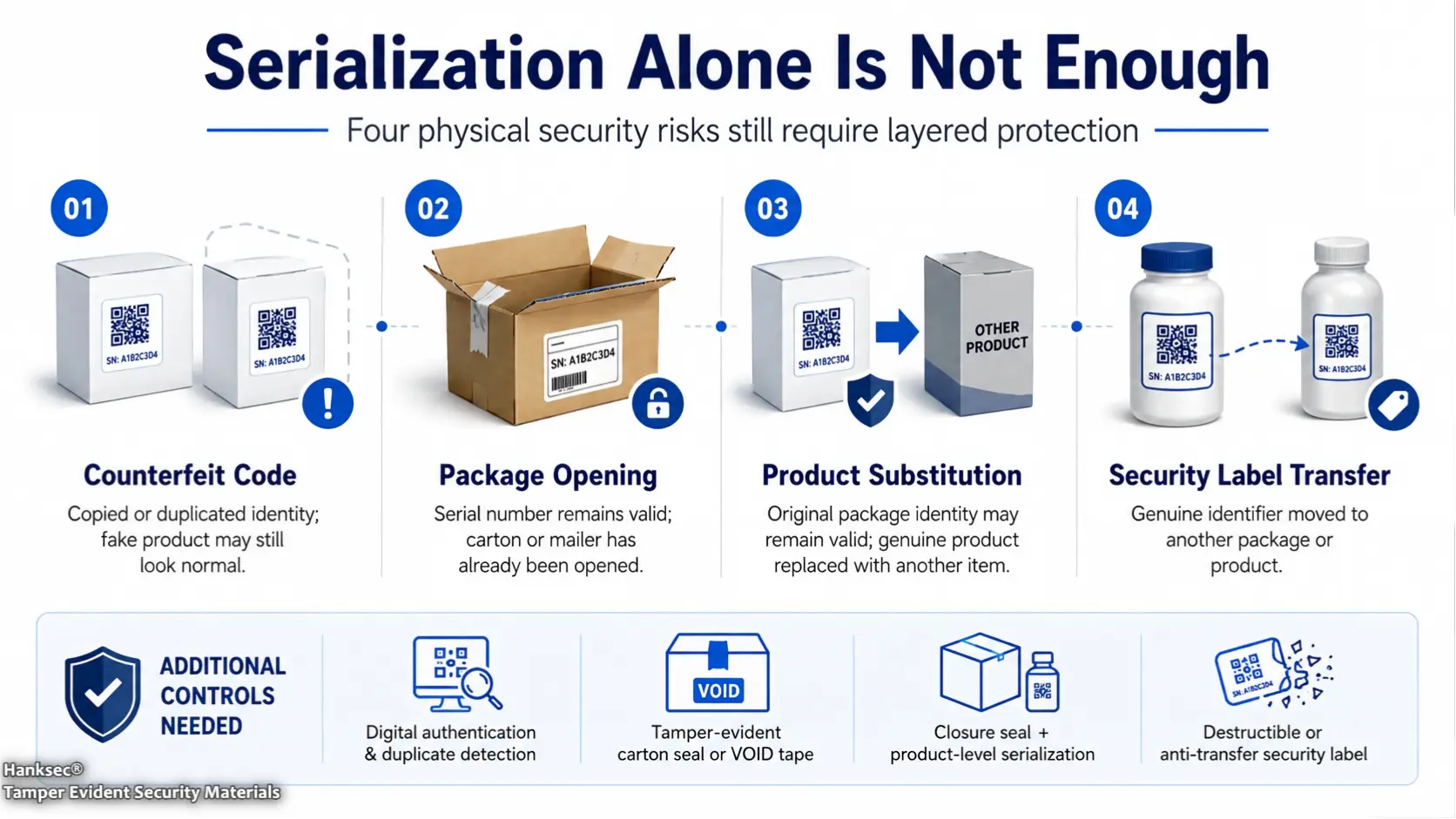
Four Security Problems That Serialization Alone Should Not Be Expected to Solve
| Security Scenario | Digital Identity Status | Physical Package Status | Main Risk | Additional Control |
|---|---|---|---|---|
| Counterfeit Code | Invalid, copied or duplicated identity | Package may appear normal | Fake product carries copied identification | Digital authentication and duplicate detection |
| Package Opening | Serial number remains valid | Carton or mailer has been opened | Pilferage or unauthorized access | Tamper-evident carton seal or VOID tape |
| Product Substitution | Original package identity may remain valid | Genuine product replaced with another item | Customer receives wrong or counterfeit contents | Closure seal plus product-level serialization |
| Security Label Transfer | Genuine identifier moved to another package or product | Physical identity association is broken | Genuine code attached to wrong object | Destructible or anti-transfer security label |
The important lesson is that anti-counterfeit packaging should not force one technology to solve every threat.
A serial number provides identity.
A VOID security tape provides opening evidence.
A destructible security label can make clean transfer difficult.
A scan history provides digital traceability.
Together, they create a more complete system.
Amazon Transparency Shows Why Serialization Is Becoming Important
Marketplace brand-protection programs increasingly use serialization.
Amazon describes Transparency as a product-serialization and anti-counterfeiting program that assigns or accepts unique serial codes so enrolled product units can be checked for authenticity throughout supported Amazon workflows. Amazon states that its system uses unique codes to verify enrolled units and help stop counterfeit or inaccurate products from being listed or shipped. Amazon Transparency
That illustrates the value of digital identity very clearly.
However, physical packaging still performs another function.
A serialized product can be genuine while its carton has been opened.
A valid code can remain valid after a parcel has been physically manipulated.
A scan can record a logistics event without proving that the closure remained untouched after that event.
This is why brands should avoid treating:
serialization = tamper evidence
They are different security controls.
For higher-risk products, the strongest architecture is often:
unique identity + physical opening evidence + inspection procedure
What Physical Tamper Evidence Adds to E-Commerce Packaging
Physical tamper evidence is designed to create an observable change when a protected closure, label or package is opened or removed.
Depending on the construction, that evidence may include:
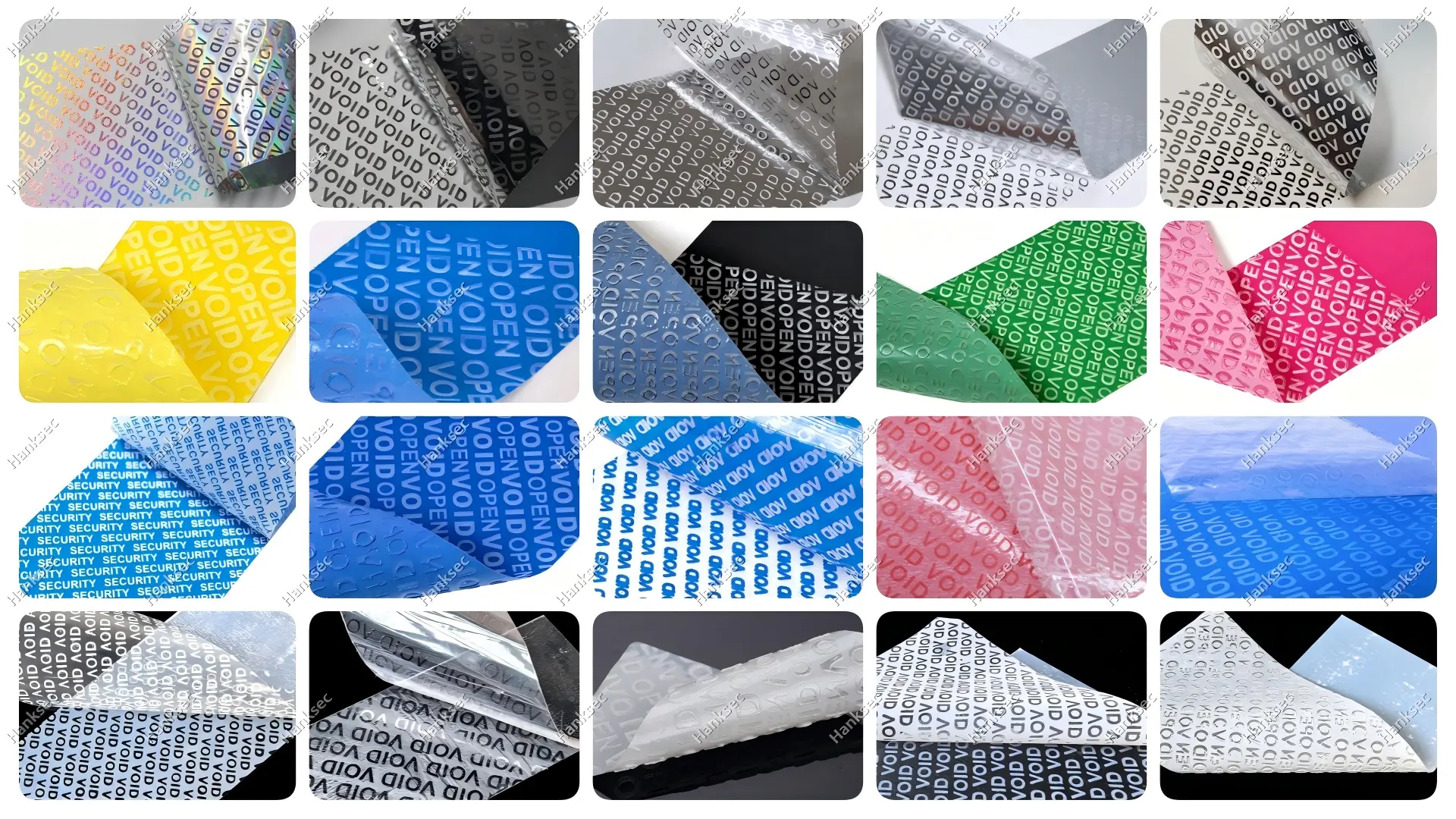
VOID or OPENED residue, a split security message, carton-fiber damage, label fracture, destructible film, broken security cuts or another irreversible change.
The objective is not necessarily to make opening physically impossible.
That would often be unrealistic for consumer packaging.
The objective is to make undetected opening and convincing resealing more difficult.
For e-commerce security labels, that distinction is important.
A properly engineered seal can help warehouse staff, delivery personnel, returns teams or customers answer:
Does this package still look like it did when the approved seal was applied?
For a deeper explanation of how facestock, security release layers, hidden VOID messages and adhesive systems create visible tamper evidence, see our What Is VOID Label Material? guide and Security Label Material Systems guide.
Which Physical Security Technologies Work for E-Commerce Packages?
| Security Technology | Opening Evidence | Typical Packaging | Main Advantage | Main Limitation |
|---|---|---|---|---|
| Full-Transfer VOID Tape | Strong message/residue remains on package | Shipping cartons, export boxes | Very visible opening evidence | Strong residue may damage presentation |
| Partial-Transfer VOID Tape | Evidence appears on both tape and package | Branded cartons, electronics boxes | Balanced evidence | Requires surface-specific tuning |
| Non-Transfer VOID Seal | Evidence appears mainly in removed seal | Premium boxes, equipment surfaces | Cleaner substrate | Less visible evidence remains on carton |
| Destructible Security Label | Label fractures during removal | Small boxes, warranty areas, components | Difficult to remove intact | Fragile material can be harder to convert |
| Serialized Security Seal | Unique number + physical seal | High-value parcels, controlled logistics | Links inspection to a specific seal | Serialization alone still needs physical tamper response |
| Tamper-Evident Security Bag | Bag closure produces visible opening evidence | Small items, documents, controlled shipments | Entire package becomes controlled enclosure | Different bag constructions suit different security levels |
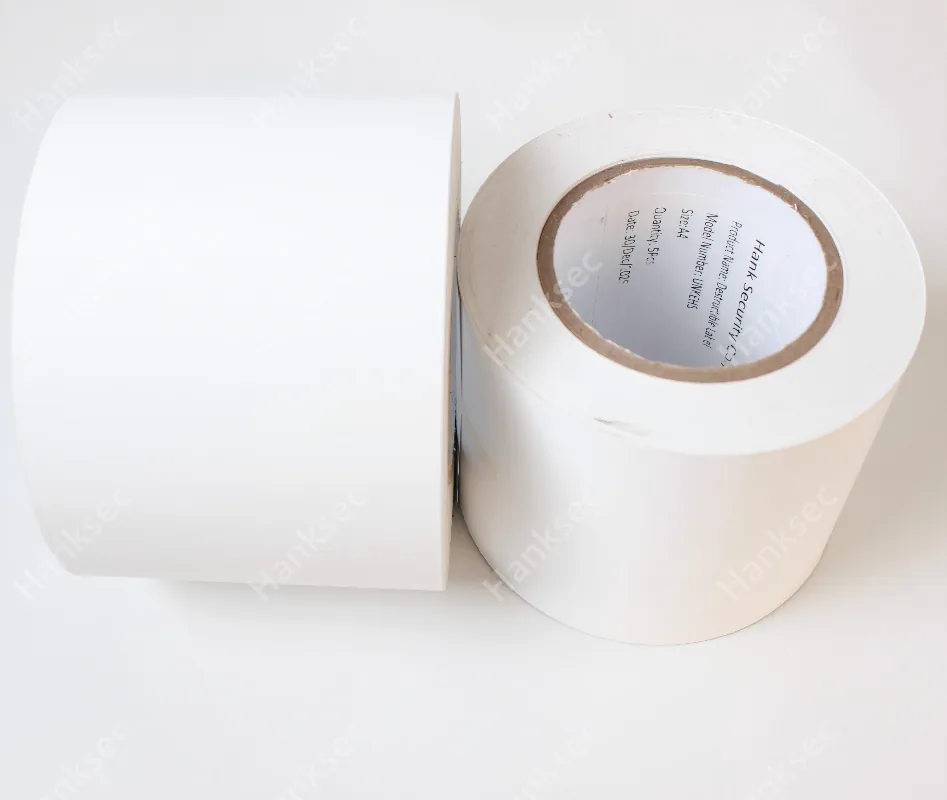
Hanksec supplies full-transfer, partial-transfer and non-transfer security tape constructions for cartons, bags, envelopes and other packaging applications. Buyers comparing tape structures can also review our tamper evident security packaging tape guide.
Full, Partial or Non-Transfer: Which VOID Tape Should E-Commerce Buyers Choose?
For most e-commerce carton applications, the first question should not be:
What color tape should we buy?
It should be:
Where do we want the evidence to appear after opening?
Full-Transfer VOID
Full-transfer constructions are useful when the shipping carton itself should retain strong visible evidence.
They can suit high-value products, export cartons, electronics and controlled shipments where permanent residue is acceptable.
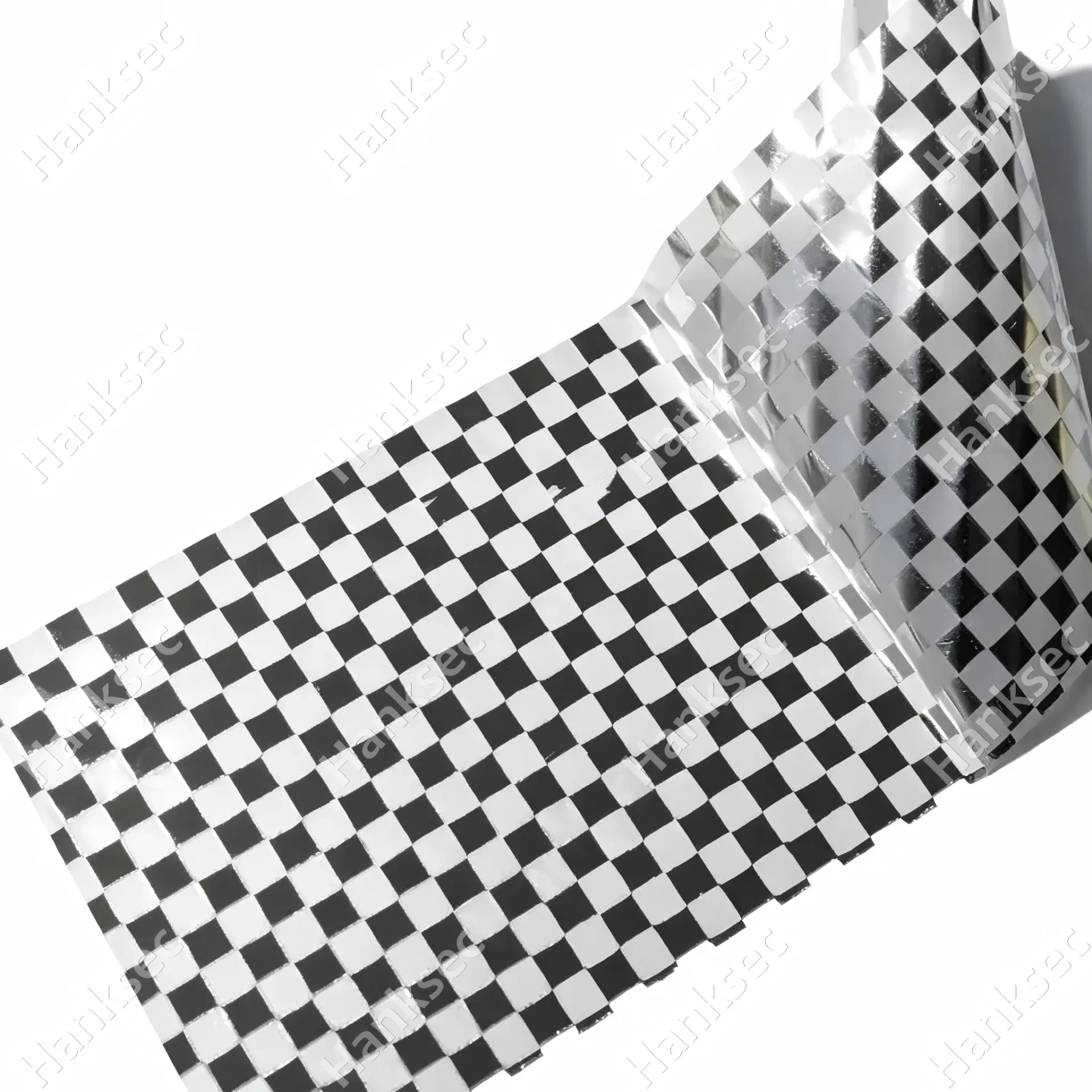
Partial-Transfer VOID
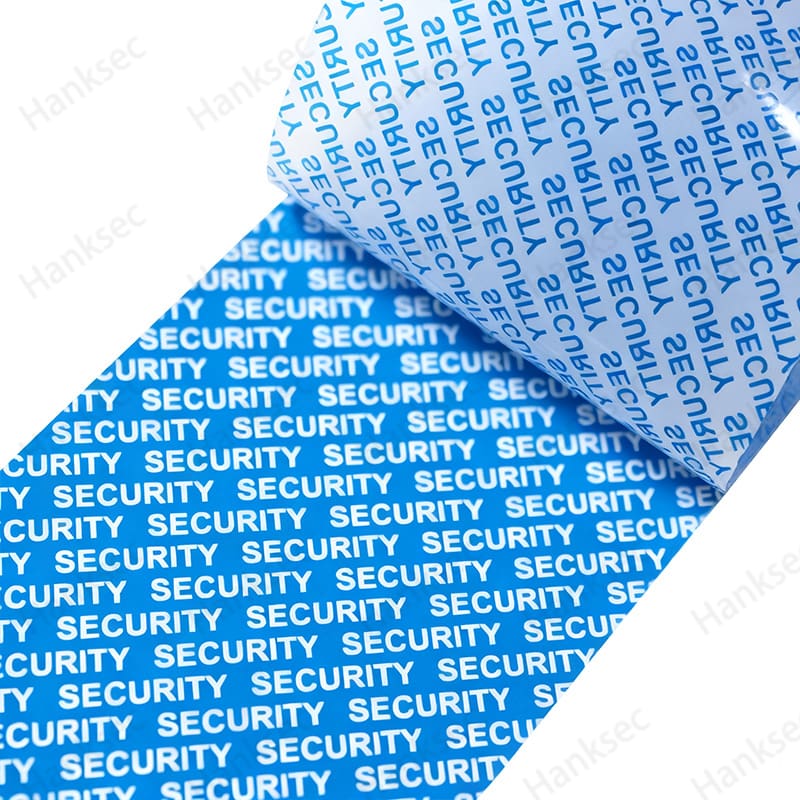
Partial-transfer construction divides the security evidence between the tape and package.
This can provide a balance between visible residue and package appearance.
Non-Transfer VOID
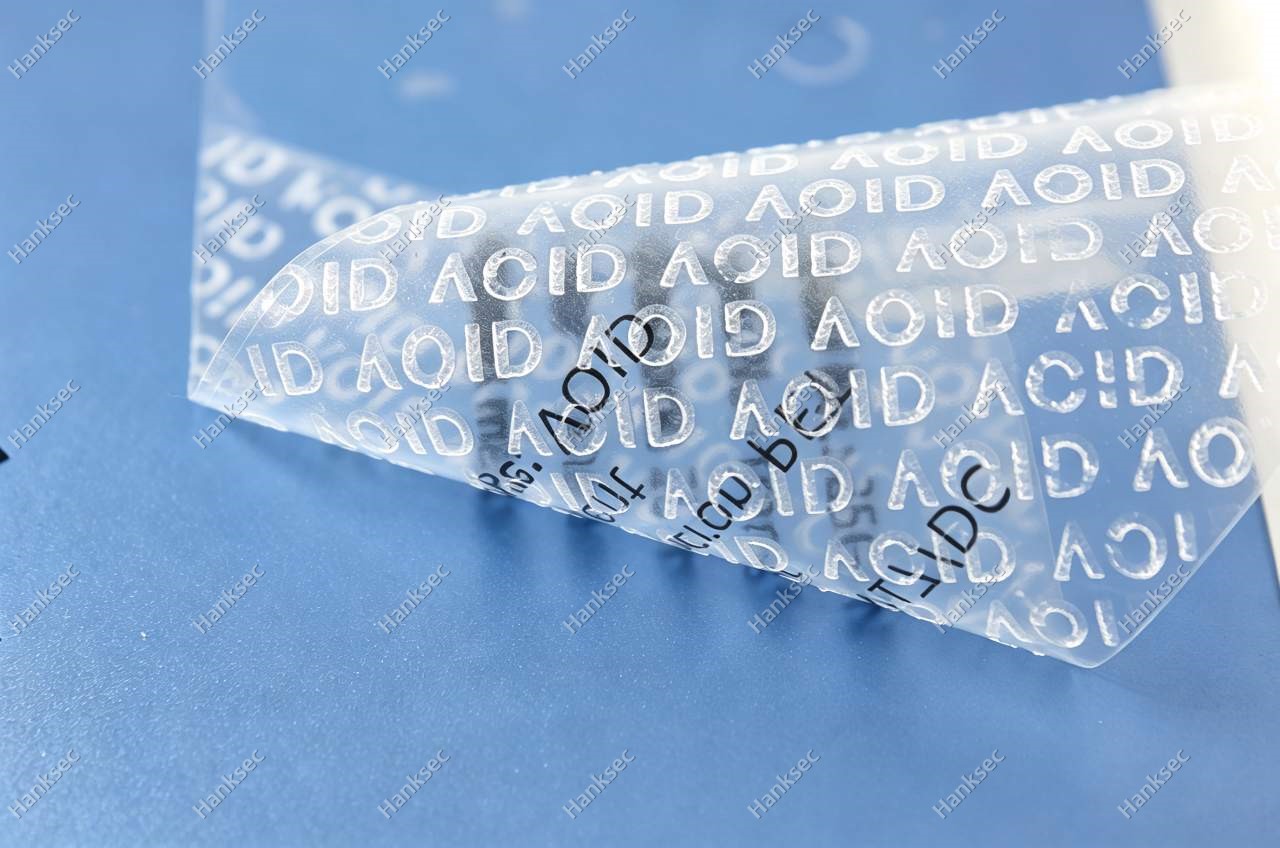
Non-transfer designs reveal the security message mainly on the label or tape itself while leaving comparatively little evidence on the protected surface.
They can be more appropriate for:
premium cartons, reusable cases, equipment surfaces or products where cosmetic damage should be minimized.
For a more detailed comparison, see our full-transfer, partial-transfer and non-transfer VOID systems guide.
Anti-Counterfeit Packaging Must Match the Actual E-Commerce Surface
A security label can have a perfect VOID effect in a laboratory and still fail on a real shipping carton.
Adhesion changes with:
surface energy, coating, dust, recycled fiber, varnish, roughness, moisture, temperature, storage time and application pressure.
That makes substrate testing essential.
| E-Commerce Surface | Typical Risk | What to Check | Typical Security Direction |
|---|---|---|---|
| Recycled Corrugated Carton | Rough fibers, dust, inconsistent surface | Edge lifting, fiber tear, initial tack | Higher-tack carton-compatible adhesive |
| Coated / Printed Carton | Varnish or coating reduces bonding | Dwell adhesion, clean peel, residue | Surface-matched VOID construction |
| PE / PP Mailer | Low surface energy | Wet-out, lifting, cold performance | LSE-compatible adhesive |
| PET / Plastic Box | Smooth but may have coatings | Residue appearance and peel behavior | Partial or non-transfer option |
| Painted / Powder-Coated Surface | Texture reduces contact area | Edge anchorage, adhesive thickness | Conformable high-bond construction |
| Paper Envelope | Fiber strength varies | Tear response and adhesive anchorage | Security label or narrow VOID seal |
The correct material should therefore be tested on the actual package, not only on a standard stainless-steel test panel.
For PE, HDPE or LDPE courier bags, a bag-specific tamper-evident sealing construction may be more appropriate than a carton-oriented security tape.
Where Should a Tamper-Evident Seal Be Applied?
Placement can be as important as material selection.
A strong seal applied to the wrong location can still leave another easy opening path.
For carton security, the closure should normally cross the opening seam or flap in a way that requires the security construction to be disturbed before the package can be opened normally.
For courier mailers, the security feature should protect the functional opening area rather than simply decorate an unrelated surface.
For boxes with several possible access points, buyers may require more than one closure seal.
For reusable shipping cases, a replaceable numbered seal may be preferable to permanently damaging the case itself.
The engineering rule is simple:
Protect the access path, not just the visible surface.
How Serialization and Physical Tamper Evidence Should Work Together
A stronger e-commerce security architecture can separate four functions.
| Security Layer | Technology Example | Main Question Answered |
|---|---|---|
| Product Identity | GTIN + serial number, QR, Data Matrix | Which product is this? |
| Parcel Identity | SSCC, parcel barcode, logistics ID | Which shipping unit is this? |
| Physical Closure | VOID tape, security seal, destructible closure | Has the package closure been visibly disturbed? |
| Event History | EPCIS, warehouse scan, courier scan, returns record | What happened to this item or parcel in the supply chain? |
The GS1 Global Traceability Standard distinguishes class-level, batch/lot-level and instance-level identification. At instance level, a product can receive a serialized identifier that distinguishes one individual physical object from other instances of the same product. GS1 also uses the SSCC to uniquely identify logistic units such as cases, pallets and parcels.
Physical tamper evidence adds a different type of information:
condition at the closure.
This combined approach is more useful than trying to make a barcode or adhesive solve every security problem.
Why Returns and Reverse Logistics Need Special Attention
E-commerce packaging does not stop being a security problem when the product reaches the customer.
Returns create a second journey.
A parcel may move:
customer → carrier → consolidation center → returns warehouse → inspection → resale, refurbishment or disposal.
During that process, the business may need to distinguish between:
an unopened genuine return, an opened but legitimate return, a substituted item, missing accessories, returned counterfeit goods or a package that was resealed after inspection.
Physical tamper evidence cannot resolve every returns dispute.
But it can provide an additional observable data point.
For example:
seal intact can indicate that the designated opening path has not visibly been disturbed.
seal broken indicates that inspection is required.
It should not automatically be treated as proof of who opened the package or when.
That distinction keeps the article technically and legally accurate.
For shipments that require the entire enclosure—not only one carton seam—to provide visible opening evidence, tamper-evident security bags may offer a more controlled package format.
Serialized Security Labels Can Make Physical Inspection More Auditable
A generic VOID seal can show that something happened.
A serialized VOID seal can additionally identify which individual seal was used.
Depending on the project, an e-commerce security label can include:
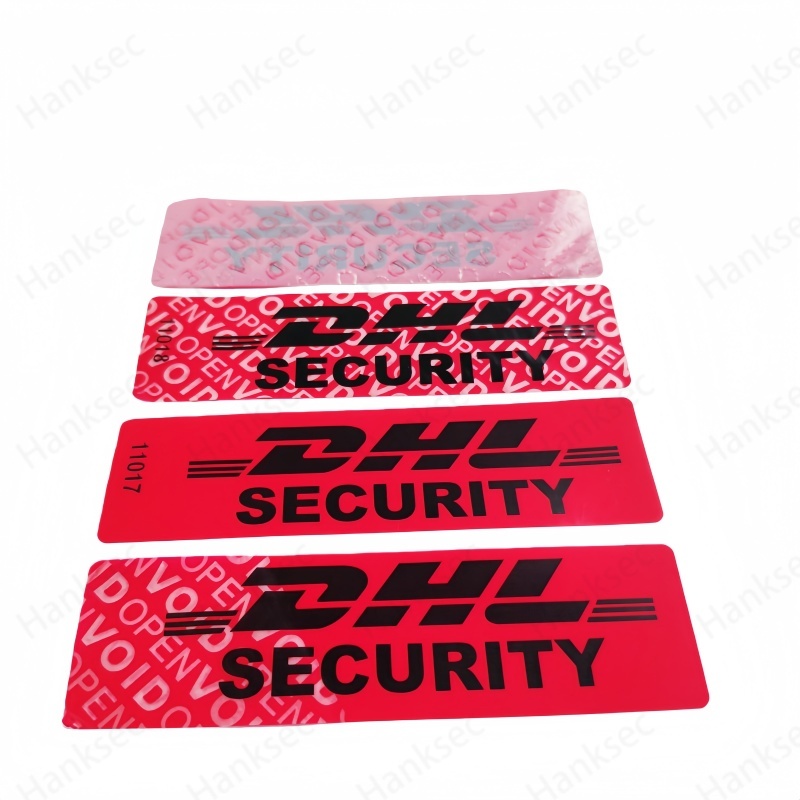
serial number, barcode, QR code, order reference, batch identification, brand logo or custom hidden message.
A warehouse procedure can then record the seal number at packing.
During an exception or return, staff can compare:
package ID, product serial number, security-seal ID and current tamper status.
This does not require every e-commerce order to use high-security labels.
It is most valuable when the product value, counterfeit risk or dispute cost justifies the additional control.
Custom Security Labels Should Be Difficult to Substitute
One overlooked problem is generic replacement.
If a business uses a common off-the-shelf red VOID sticker, a bad actor may try to replace it with another visually similar sticker after opening.
Customization can raise the substitution difficulty.
Useful options include:
custom VOID text, brand logo, unique colors, sequential numbering, barcodes, QR codes, microtext or holographic elements.
But customization should not be confused with security by itself.
A beautiful hologram on a poorly bonded label is still a weak closure.
The material, adhesive and tamper response must work first.
Artwork comes second.
Testing Tamper-Evident E-Commerce Packaging Before Bulk Production
Testing should be performed on the final package construction.
| Test Area | What to Evaluate | Failure to Watch For |
|---|---|---|
| Initial Adhesion | Bond immediately after application | Seal lifts during packing |
| Dwell Adhesion | Bond after 24–72 hours | Performance changes after storage |
| Tamper Response | Normal peel, slow peel, edge lifting | VOID message incomplete or label removes cleanly |
| Reapplication | Whether removed seal can appear original again | Weak irreversible evidence |
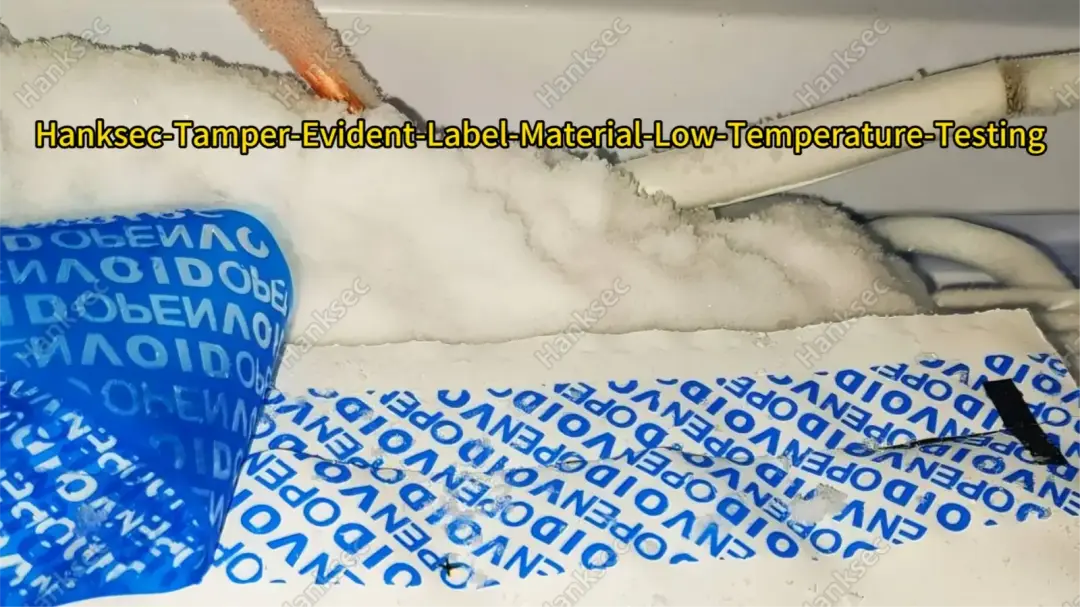
| Temperature | Hot warehouse, cold transport, seasonal exposure | Adhesive softening or lifting |
| Humidity / Condensation | Moist or tropical logistics conditions | Edge failure or weak print |
| Carton Variation | Recycled board, varnished carton, coated surface | Different results between packaging batches |
| Printing / Serialization | Barcode and serial readability | Smearing, duplicate or unreadable codes |
| Automatic Application | Dispensing and roll unwind | Misalignment, liner failure, machine stops |
Testing should reproduce the actual shipping and fulfillment environment as closely as practical.
A security tape that works on one carton supplier’s board may behave differently when the brand changes to a higher-recycled-content carton or another varnish system.
Hanksec Factory Testing Note: Final material recommendations are confirmed through application-surface testing because the same VOID construction can behave differently on recycled board, coated cartons, plastics and other packaging surfaces.

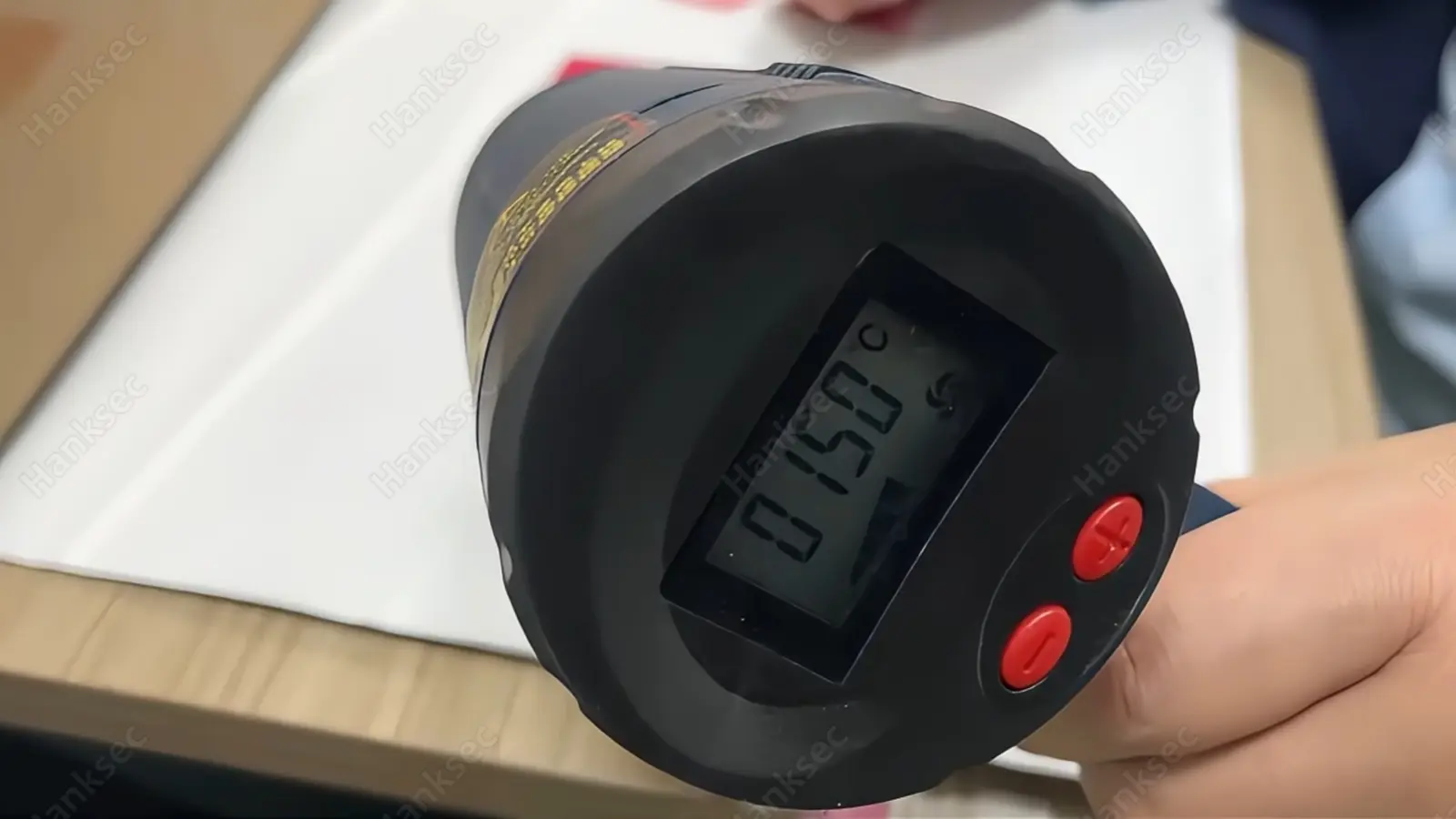
For applications where attackers may use heat to soften the adhesive or weaken the tamper response, see our guide to heat-resistant tamper-evident VOID solutions.
A Practical Approval Workflow for E-Commerce Security Labels
A strong development process can follow this sequence:
Package Surface → Security Threat → Opening Path → Required Evidence → Adhesive Selection → Label/Tape Construction → Serialization Requirement → Sample Test → Fulfillment Trial → Final Approval
This prevents a common sourcing mistake:
choosing the security tape first and explaining the application later.
For custom projects, the packaging sample should come first whenever possible.
Common Mistakes in Anti-Counterfeit E-Commerce Packaging
The most common failure is assuming that one security feature performs every function.
A serialized barcode does not automatically show physical opening.
A VOID tape does not prove that the product inside is authentic.
A hologram does not guarantee adhesion.
A strong adhesive does not prevent code cloning.
A visible warning tape does not provide tamper evidence if it can be peeled and reapplied without an irreversible change.
And a technically excellent seal does not create a useful security process if warehouse and returns staff never inspect it.
The system needs both:
technology and procedure.
What Buyers Should Provide Before Requesting a Security Packaging Quote
| Project Information | Example | Why It Matters |
|---|---|---|
| Package Type | Corrugated carton, mailer, envelope, reusable case | Determines closure structure |
| Surface | Kraft board, coated carton, PP, PE, PET, metal | Determines adhesive |
| Package Size | Small parcel, electronics box, export carton | Determines tape/label dimensions |
| Opening Path | Top flap, side seam, bag closure | Determines placement |
| Tamper Evidence | Full, partial, non-transfer, destruction | Defines security response |
| Residue Requirement | Strong evidence or clean surface | Determines transfer type |
| Serialization | None, sequential number, QR, barcode | Determines printing and traceability |
| Environment | Heat, cold, humidity, condensation | Determines material construction |
| Application | Manual or automatic | Determines roll and dispensing specification |
| Order Volume | Pilot, medium-volume, high-volume fulfillment | Determines converting and printing process |
This information allows a security-material manufacturer to recommend the physical system, not simply quote the cheapest roll of tape.
Buyers who need finished standard or customized constructions can also compare Hanksec tamper evident security tape options before requesting substrate testing.
Where a Security Material Manufacturer Adds Value
Security packaging performance depends on the interaction between film, release layer, hidden-message system, pressure-sensitive adhesive, printing layer, liner, package substrate and converting process.
Hanksec manufactures full-transfer, partial-transfer and non-transfer VOID label materials and finished security tape constructions for packaging applications. Its product architecture also includes serialized and customized security-tape solutions.
For e-commerce anti-counterfeit packaging projects, the material manufacturer’s role is therefore not simply:
“print VOID on tape.”
It is to determine:
what should happen during opening, where the evidence should appear, how strongly the tape should bond, whether residue is acceptable, whether the seal must be serialized and whether the design will run consistently through the customer’s packing operation.
Conclusion: E-Commerce Security Needs Both Identity and Evidence
The USD 467 billion global counterfeit-trade estimate shows the scale of the wider illicit-trade problem, while the growing share of small shipments in counterfeit seizures highlights why parcel-level security deserves attention.
Serialization is an important part of modern anti-counterfeit packaging.
It can uniquely identify products and logistic units, support traceability and strengthen marketplace authentication.
But a serial number does not automatically answer:
Was this physical package opened after it was packed?
That is where tamper-evident e-commerce packaging provides a different layer of evidence.
For lower-risk products, ordinary packaging plus serialization may be sufficient.
For higher-risk products, combining unique identification with VOID security tape, destructible seals, serialized closure labels or other physical tamper indicators can create a more complete anti-counterfeit packaging system.
The correct objective is not to add the maximum number of security features.
It is to make sure that identity, package integrity and supply-chain records each have a control designed for the problem they are supposed to solve.
Planning an e-commerce security packaging project?
Send Hanksec your package material, opening position, required tamper evidence, serialization requirement and expected application method. Our team can help identify a suitable VOID tape, security label or tamper-evident packaging structure for sample testing before bulk production.REQUEST A PACKAGING SECURITY SAMPLE
FAQ: Anti-Counterfeit Packaging for E-Commerce
What is anti-counterfeit packaging for e-commerce?
Anti-counterfeit packaging for e-commerce combines packaging, identification and security features intended to reduce substitution, unauthorized opening, label transfer and other forms of product or parcel manipulation. Depending on the risk level, the system may use serialization, QR codes, VOID tape, destructible labels or other security technologies.
Is serialization enough to protect an e-commerce package?
Not always. Serialization can uniquely identify a product or parcel and support traceability, but it does not automatically show whether a physical carton, bag or closure was opened after a legitimate scan or packing event.
What is the difference between serialization and tamper evidence?
Serialization answers which individual product or logistic unit is being handled. Tamper evidence is designed to show visible physical change when a protected closure, label or package is opened or removed.
What type of VOID tape is best for shipping cartons?
Full-transfer tape is useful when strong permanent residue is required. Partial-transfer tape provides evidence on both tape and carton. Non-transfer constructions are better where the underlying surface should remain relatively clean. Actual carton testing is recommended before bulk production.
Can security labels include serial numbers or QR codes?
Yes. Tamper-evident security labels and tapes can be customized with sequential numbers, QR codes, barcodes, logos and other identification features so the physical seal can also be recorded within a warehouse or inspection process.
Can tamper-evident tape prevent counterfeiting?
Tamper-evident tape should not be described as a complete anti-counterfeit solution by itself. Its primary function is to provide visible evidence of physical opening or removal. Product authentication usually requires additional digital or physical authentication controls.
Why should security tape be tested on the actual carton?
Corrugated board, recycled fibers, varnishes, coatings, dust, plastics and environmental conditions can change adhesive performance and VOID response. Testing on the real package helps verify adhesion, edge lifting and tamper evidence before mass production.
What information should buyers send before requesting samples?
Buyers should provide the package material, surface type, dimensions, opening method, residue requirement, desired tamper response, serialization requirement, environmental conditions, application method and expected order volume.
Written by Hank Security Co., LTD | Security Materials Specialist, Hanksec
Technical review: Hanksec Materials Engineering Team
Published: August 20, 2026 | Last Updated: August 20, 2026