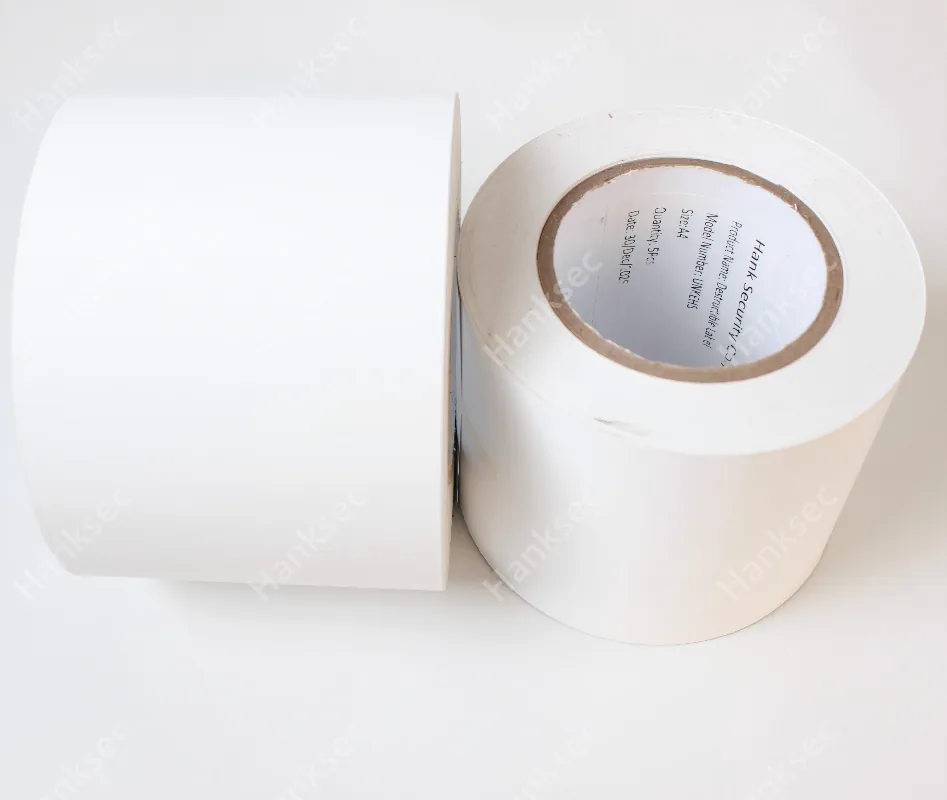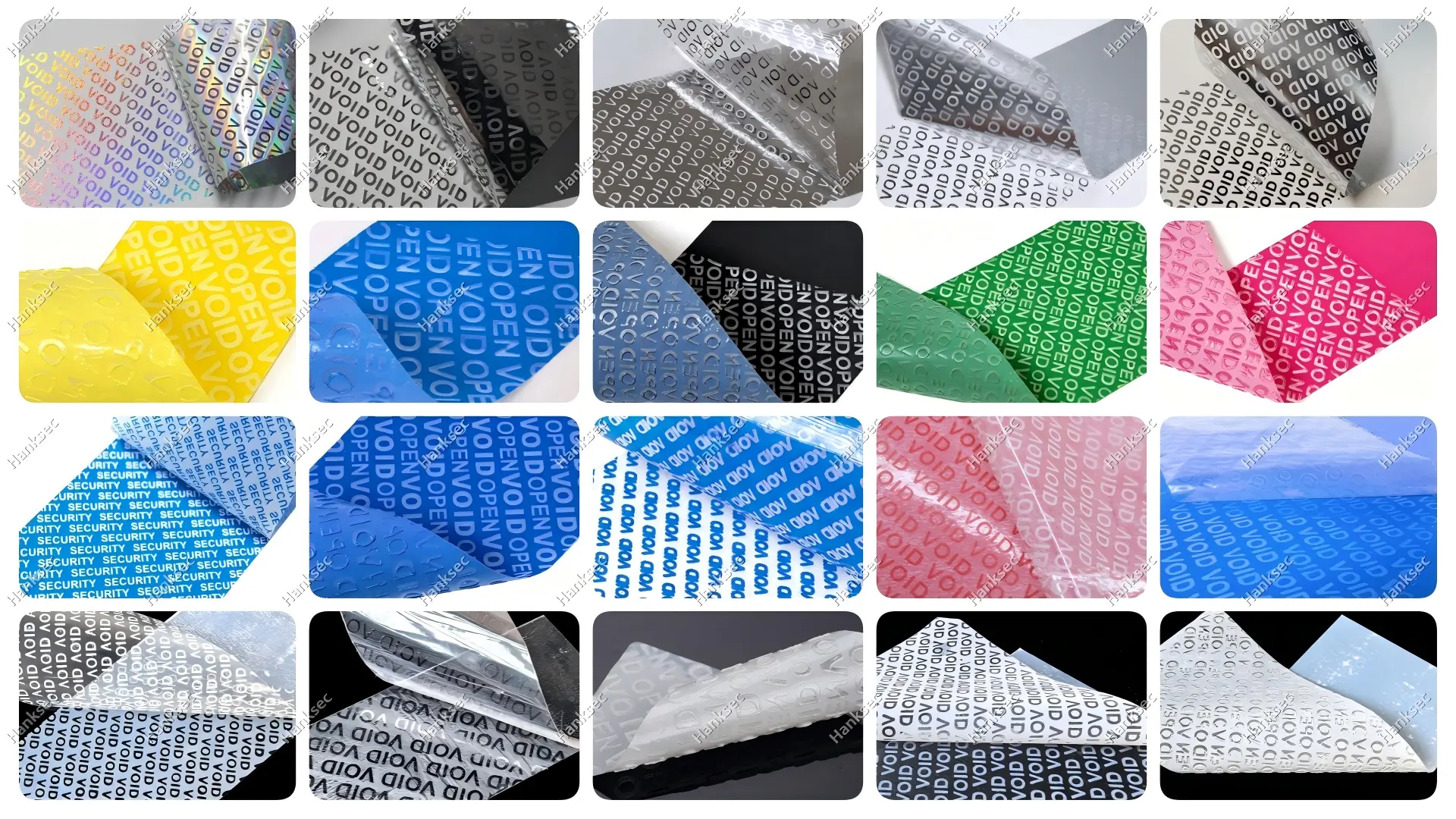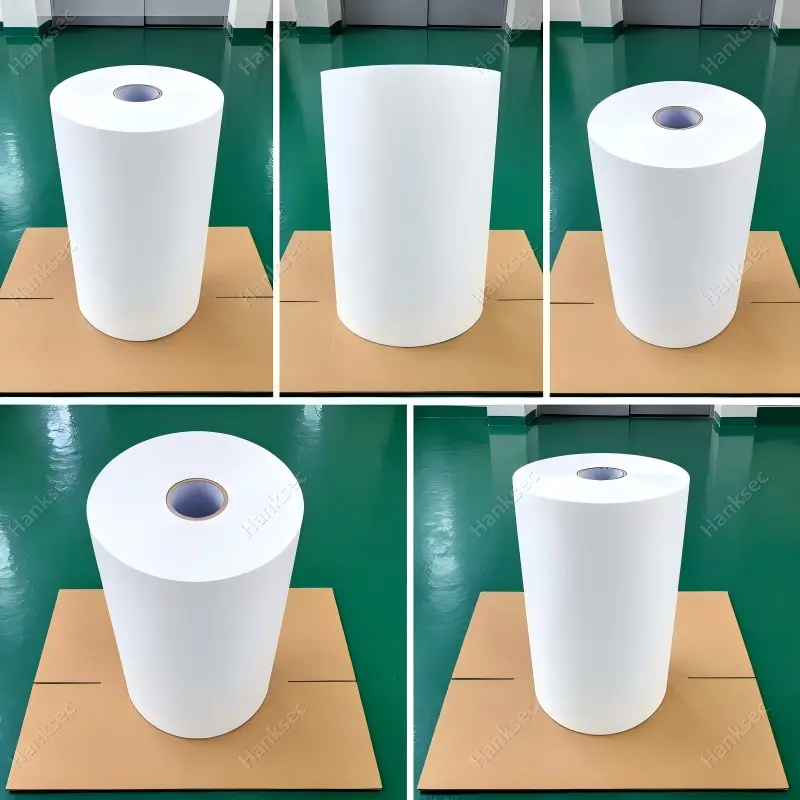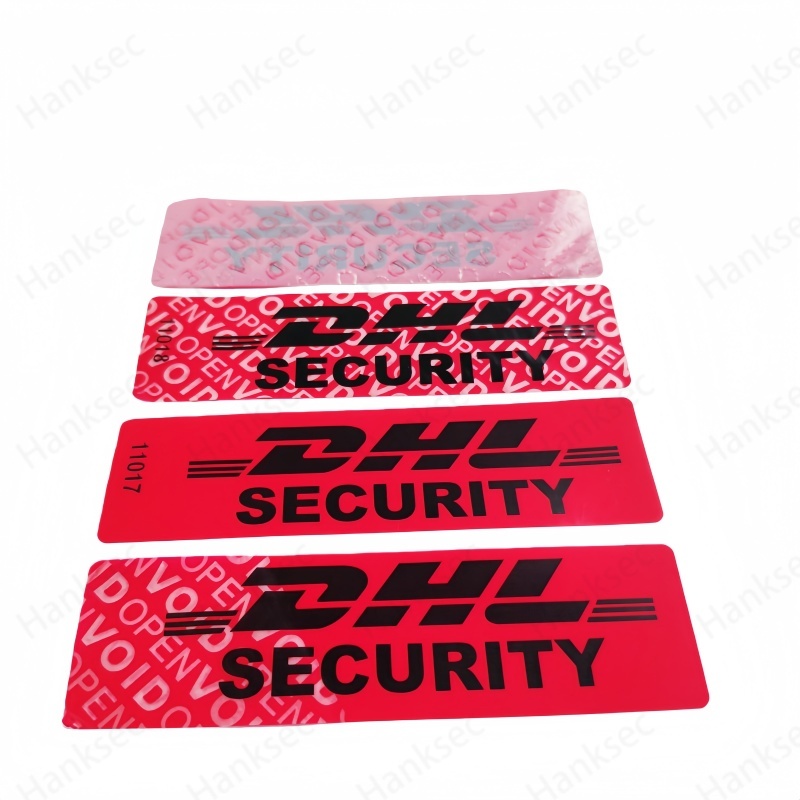
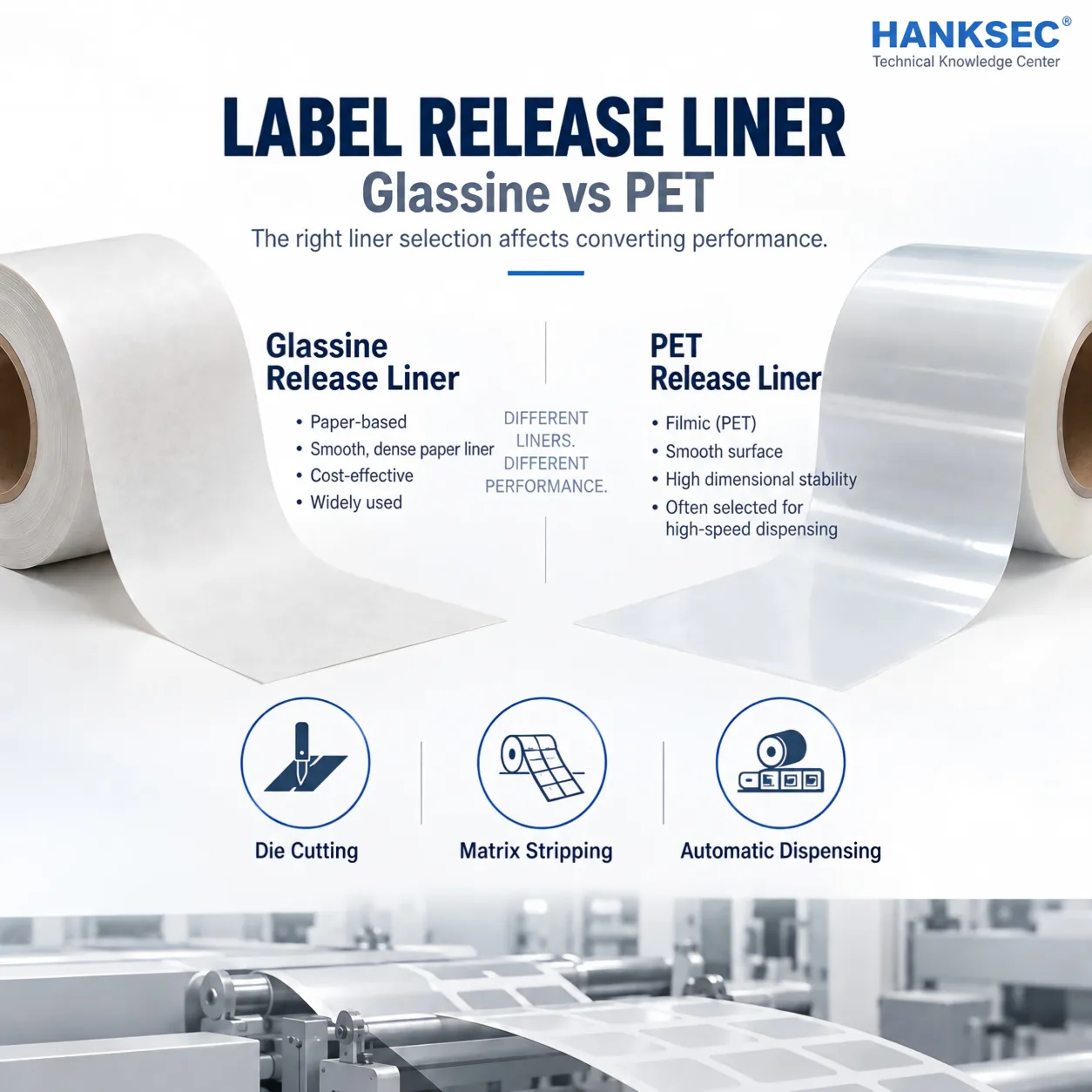
A label release liner may look like a simple backing material, but for label converters it can directly affect die cutting, matrix stripping, dispensing, web stability and production speed.
This is particularly important for tamper-evident materials.
A VOID or destructible label construction may have the correct facestock and adhesive, yet still create converting problems if the release liner, silicone release level or die-cutting setup does not match the production process.
For this reason, Hanksec does not treat the label release liner as an isolated backing material.
It is part of the complete construction:
Facestock + Security Layer + Adhesive + Release Liner + Converting Process
For a broader explanation of how facestock, adhesive, security layers and the liner work together, see Hanksec’s Security Label Material System Guide.
The practical question is therefore not simply:
Glassine or PET — which one is better?
It is:
Which release liner works correctly with the actual label material, adhesive, die-cutting process and dispensing method?
Author
Hanksec Technical Team
Hanksec specializes in tamper-evident security label materials, VOID security materials and converter-ready roll stock solutions. Our technical team supports material qualification, printing trials, converting evaluation and application testing for global label converters and OEM customers.
Expertise:
Security Label Materials | VOID Materials | Destructible Materials | Printing & Converting Evaluation
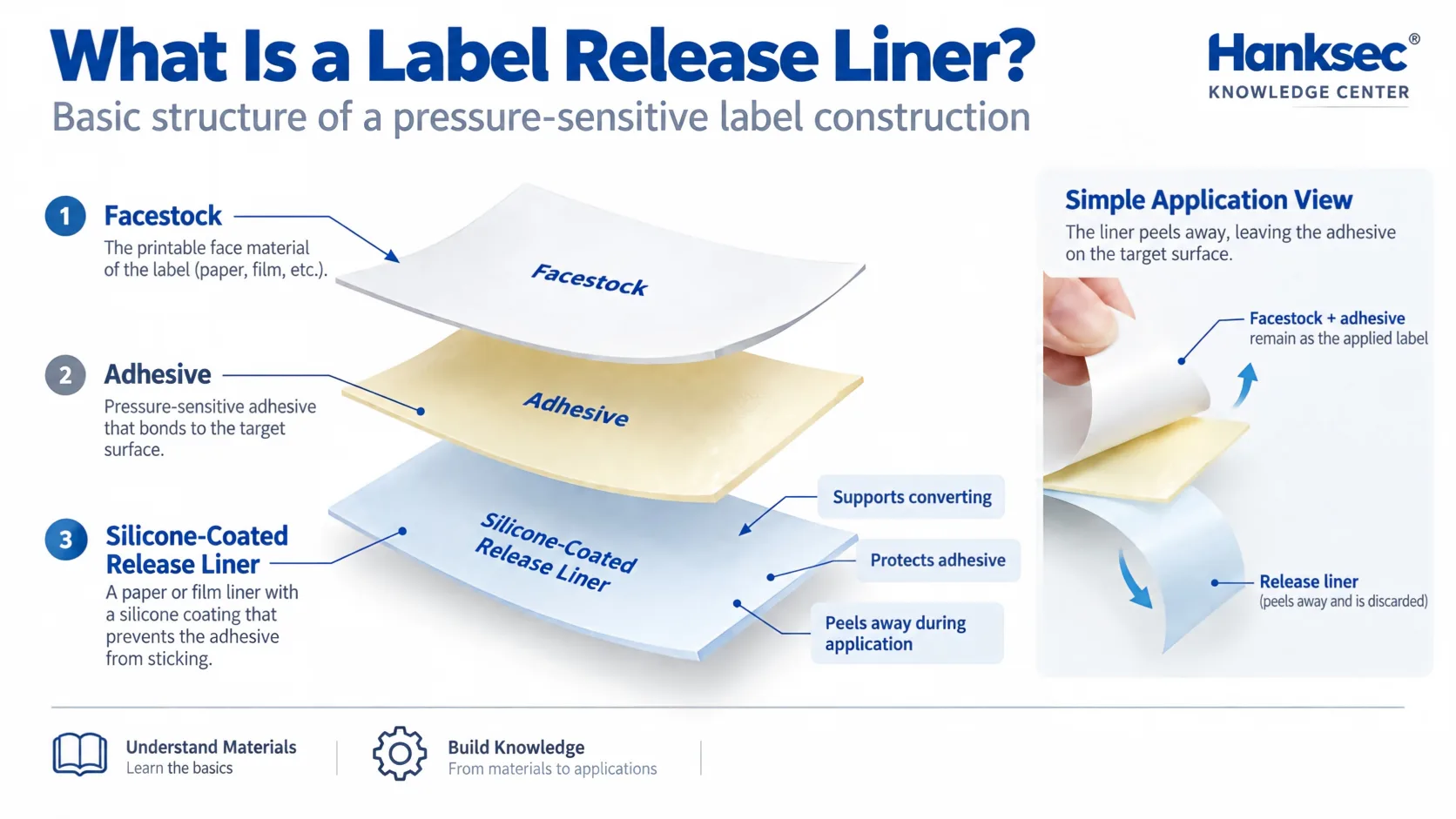
Quick Answer: What Is a Label Release Liner?
A label release liner is the silicone-coated backing that protects the pressure-sensitive adhesive before the label is applied.
During converting, the liner also acts as the carrier supporting the label through processes such as:
- printing;
- die cutting;
- matrix stripping;
- rewinding;
- dispensing;
- automatic labeling.
This is why label release liner selection affects much more than how easily a finished label can be peeled from its backing.
Hanksec’s own security-label constructions commonly use glassine liners, while selected custom constructions and destructible materials can also use PET or other liners depending on the application and converting requirement.
Glassine vs PET Release Liner: Key Differences
| Factor | Glassine Release Liner | PET Release Liner |
|---|---|---|
| Material | Supercalendered paper | Polyester film |
| Typical Character | Paper-based, smooth and compact | Thin, strong and dimensionally stable |
| Die Cutting | Widely used for rotary and flatbed converting | Requires accurate die setting |
| Matrix Stripping | Good when release force and die cut are matched | Stable web can support demanding converting |
| High-Speed Dispensing | Suitable for many standard applications | Often preferred for higher-speed systems |
| Moisture Stability | More affected by humidity than film | Strong dimensional stability |
| Transparency | Translucent / semi-transparent | Clear or translucent options possible |
| Cost | Generally more economical | Generally higher material cost |
| Typical Use | General roll labels, VOID and destructible materials | High-speed, thin-liner or special converting projects |
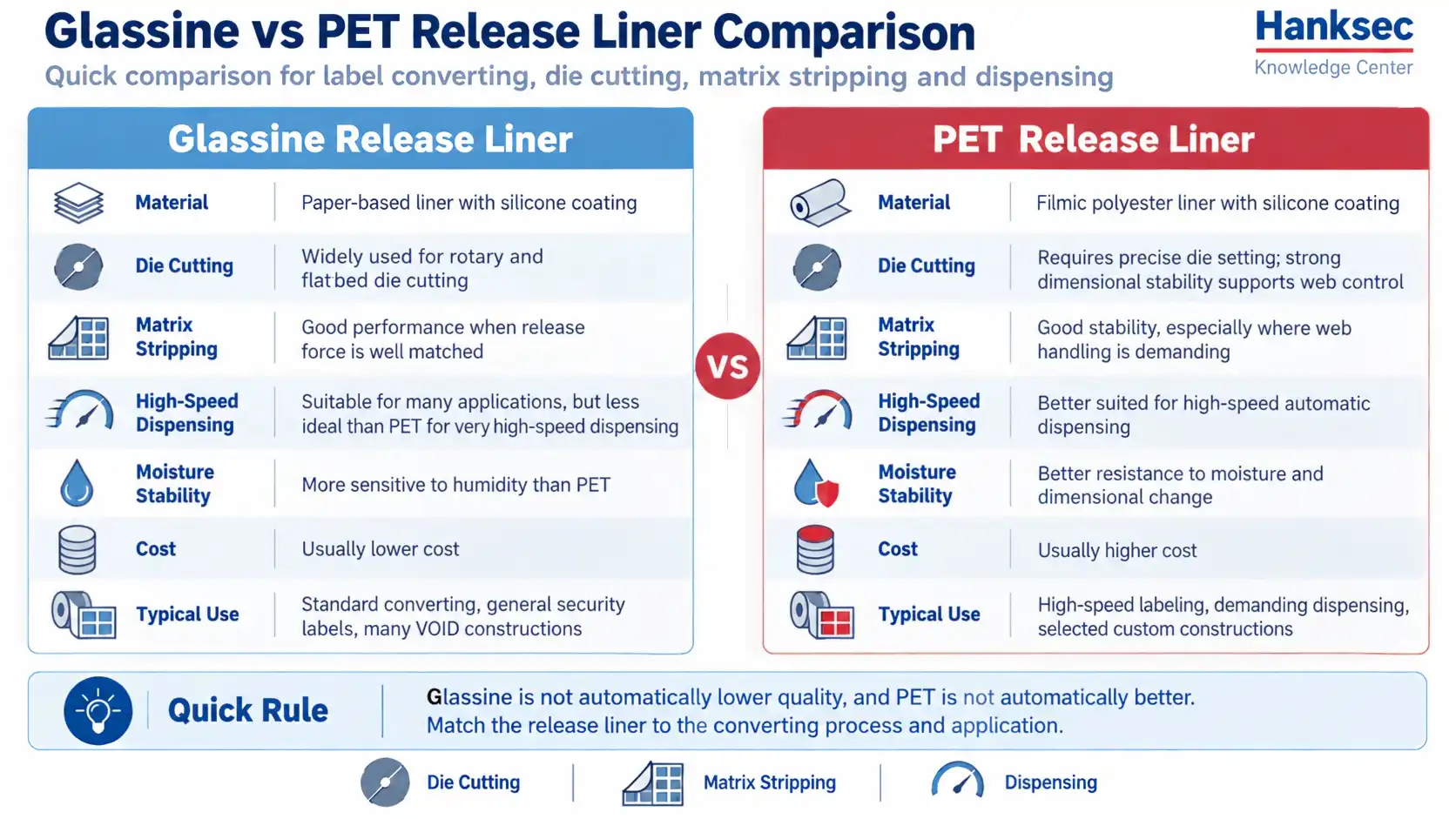
There is no universal winner.
Glassine is not automatically “lower quality,” and PET is not automatically “better.”
Avery Dennison Liner Selection Guide, for example, identifies glassine as suitable for roll-to-roll rotary and flatbed die cutting, while PET liners are highlighted for high-speed labeling because of their strength under web tension.
When Should You Choose Glassine Release Liner?
Glassine is one of the most common liner materials for pressure-sensitive labels.
For Hanksec’s standard VOID material constructions, 60/80 gsm glassine is already a common liner option.
Glassine can be a practical choice when the converter needs:
- standard roll-to-roll converting;
- rotary or flatbed die cutting;
- conventional label dispensing;
- cost-effective for volume production;
- paper-based liner construction;
- common VOID or destructible label production.
Its smooth, dense surface provides a suitable base for silicone release coating.
For many conventional security-label applications, PET is not automatically necessary simply because a film liner appears more advanced.
When Should You Choose PET Release Liner?
PET release liner may be preferred when the production process requires characteristics that paper liners may not provide as consistently.
Typical reasons to evaluate PET include:
- higher web tension;
- high-speed dispensing;
- thin liner requirements;
- better dimensional stability;
- demanding small-label converting;
- humidity-sensitive production environments;
- clear or filmic constructions.
PET has high tensile strength relative to its thickness, which can help reduce web breaks during faster dispensing.
However, PET liner also changes the converting condition.
The converter should not assume that the same die pressure used for glassine can simply be transferred to PET.
Release Liner for Die Cutting: Why the Liner Changes the Result
During label die cutting, the die must cut through:
facestock + adhesive
without damaging the liner beyond the acceptable level.
This sounds simple, but the liner is the surface against which the die is working.
With Glassine
Paper liners provide a different cutting response from film liners.
A controlled die impression may be visible, but excessive penetration can weaken the liner and create:
- web breaks;
- dispensing problems;
- liner tearing;
- unstable matrix stripping.
With PET
PET is thin and mechanically strong, but the film does not behave exactly like paper.
Die pressure must therefore be controlled accurately.
Too little cutting can leave the label edges incompletely separated.
Too much die penetration can damage the liner and affect downstream dispensing.
FINAT specifically separates die-strike testing on paper liners (FTM 23a) and clear filmic liners (FTM 23b), which shows that paper and film liners should not be evaluated as identical converting surfaces.
Label Release Liner for Matrix Stripping
Matrix stripping is one of the areas where liner problems become visible very quickly.
After die cutting, the waste matrix must separate from the finished labels without pulling the labels away from the liner.
Typical problems include:
- labels lifting with the matrix;
- small corners lifting;
- waste web breaking;
- incomplete matrix removal;
- labels shifting on the liner.
It is tempting to blame these problems entirely on the adhesive.
But matrix stripping is a system problem involving:
label shape + facestock + adhesive + die cut + release force + liner
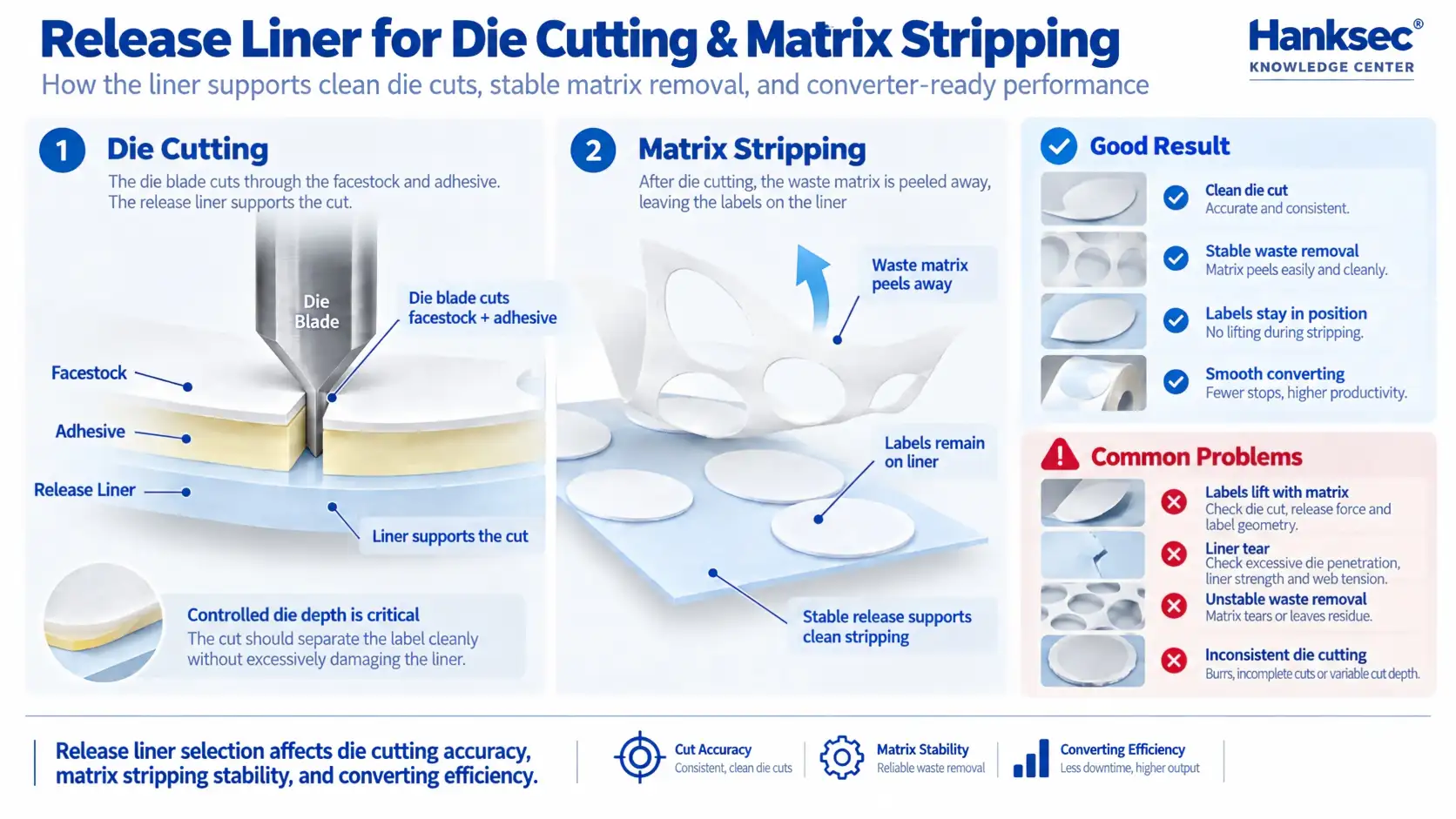
Hanksec’s existing Security Label Material Quality Control Guide already explains that release force directly affects matrix stripping and web stability.
A dedicated liner selection should therefore be made together with the converting conditions rather than independently.
Release Force: Too High and Too Low Both Create Problems
Release force describes the force required to separate the adhesive-coated label construction from the liner.
If Release Force Is Too High
Possible symptoms include:
- difficult dispensing;
- increased web tension;
- unstable matrix stripping;
- labels lifting during waste removal;
- inconsistent automatic application.
If Release Force Is Too Low
Possible symptoms include:
- premature label lifting;
- labels moving during rewinding;
- unstable roll handling;
- accidental separation during converting;
- poor web control.
The correct target is therefore not:
lowest possible release force
but:
stable release behavior for the actual converting process.
According to the FINAT Technical Handbook, FTM 3 evaluates low-speed release force, FTM 4 evaluates high-speed release force relevant to matrix stripping, and FTM 10 evaluates release behavior of silicone-coated liners for dispensing.
That distinction is important because a liner that feels easy to peel by hand may behave differently on a production line running at much higher speed.
Label Release Liner for Automatic Dispensing
Automatic dispensing places additional stress on the liner.
As the web bends around the dispensing plate, the liner must remain stable while the label separates predictably.
Important variables include:
- liner stiffness;
- liner thickness;
- tensile strength;
- release force;
- dispensing speed;
- label size and shape.
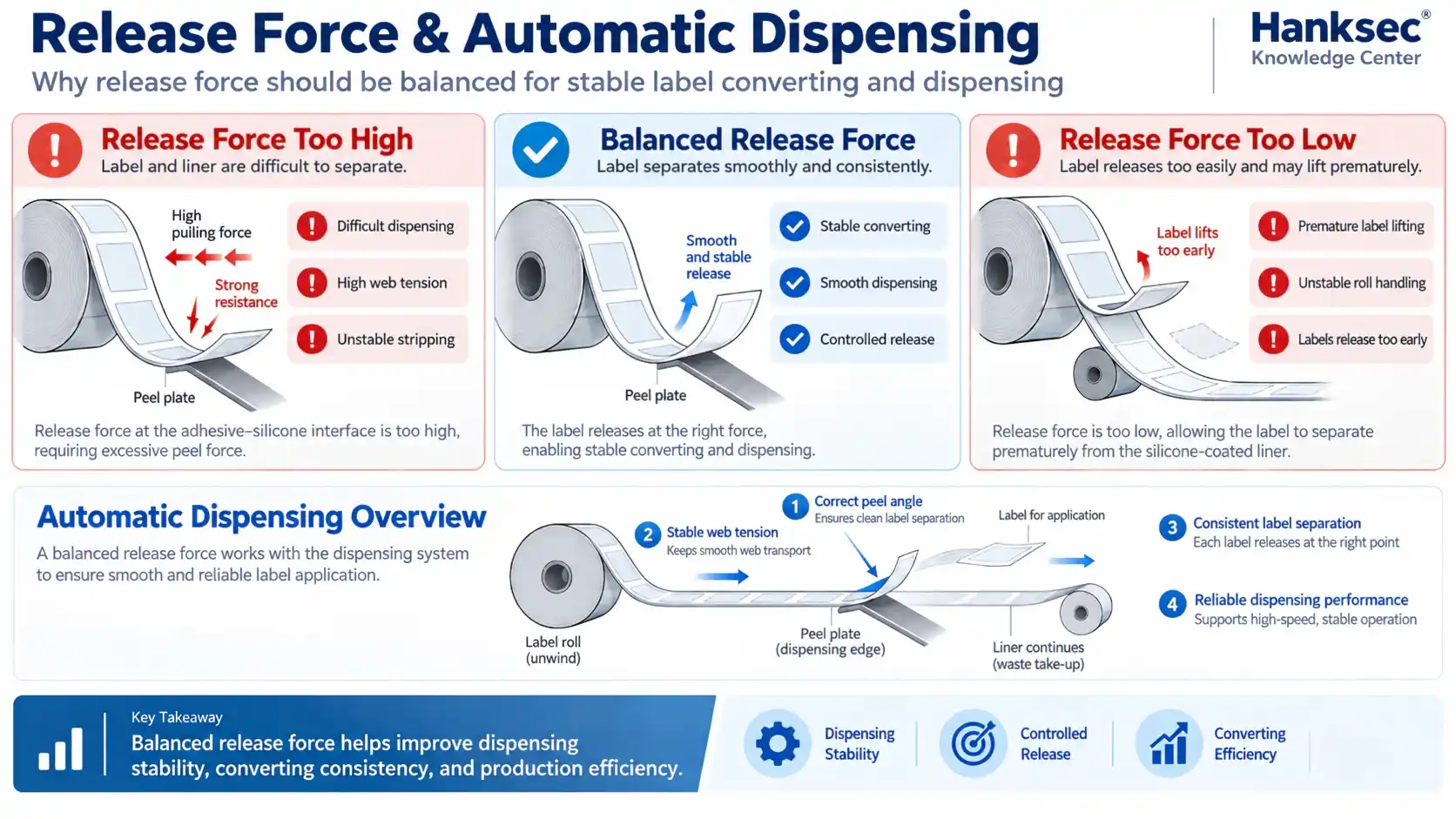
PET liners are often selected for demanding high-speed applications because their strength and dimensional stability can support higher web tension.
But this does not mean every automatic labeling application requires PET.
A properly matched glassine construction may work perfectly well at the required production speed.
The actual converting and dispensing process should drive liner selection—not the liner material name alone.
Adhesive and Release Liner Must Be Qualified Together
The adhesive and release liner cannot be treated as completely separate components.
Changing one can affect the other.
For example:
Adhesive change → different release behavior
Silicone release level change → different dispensing behavior
Liner change → different die-cutting response
This is especially important for tamper-evident materials because the adhesive also participates in the final security response.
For more detail on substrate and adhesive selection, see Hanksec’s Tamper Evident Label Adhesive Guide.
A label construction should therefore be qualified as a complete laminate rather than approving the adhesive and liner independently.
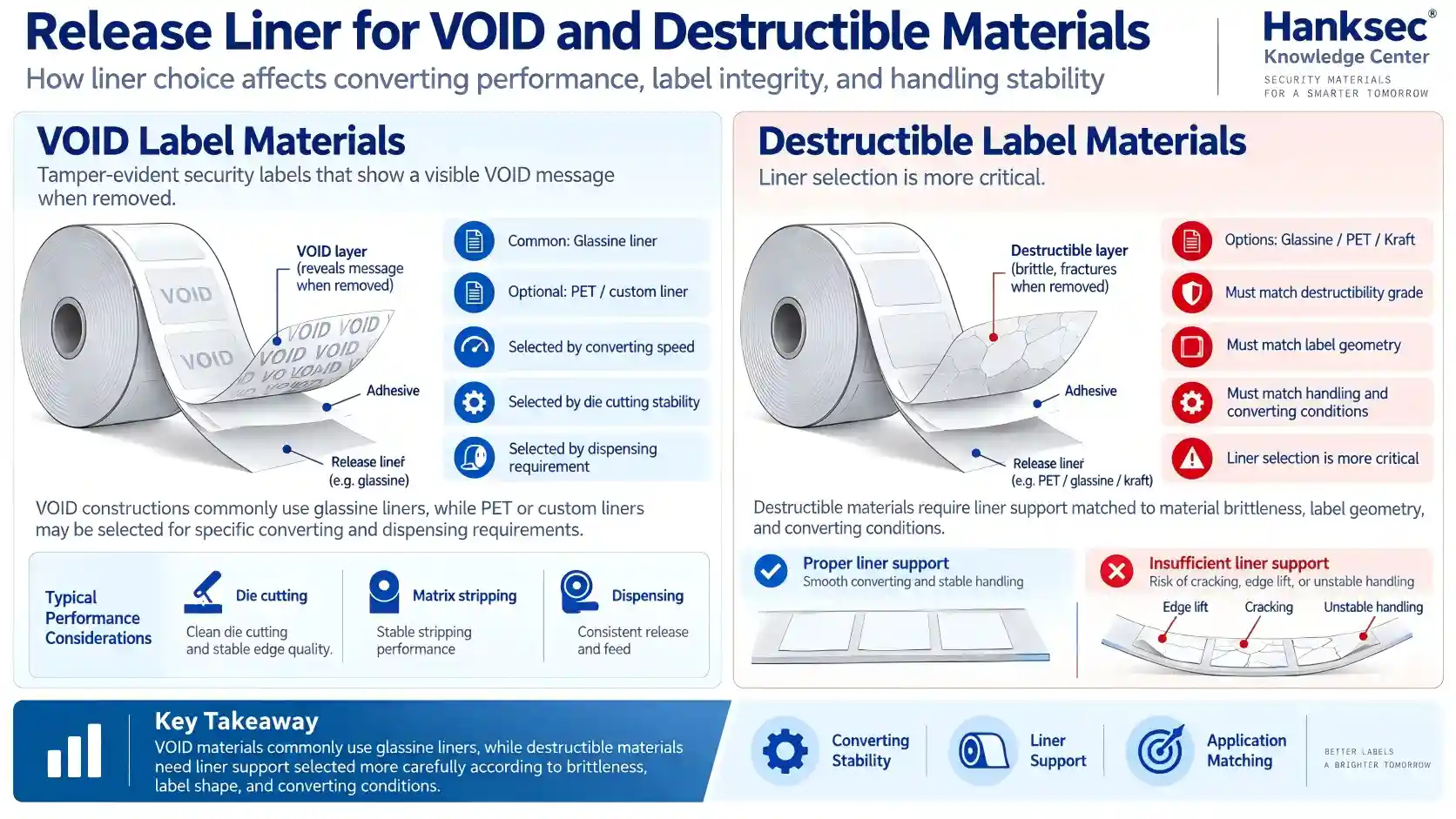
Label Release Liner for VOID Label Materials
Hanksec’s VOID label material rolls commonly use glassine liners, while liner configuration can also be adjusted according to the material and converting requirement.
For example, current Full Transfer and Non-Transfer material specifications list 60/80 gsm glassine, kraft paper or custom liner options.
Selected custom constructions can also be evaluated with PET liner where the converter’s process requires it. Hanksec’s Partial Transfer Jumbo Roll range specifically lists both glassine and PET liner among customization options.
The decision should therefore be based on:
- roll converting method;
- die-cutting setup;
- matrix stripping;
- label dimensions;
- dispensing method;
- production speed.
Not simply on whether the facestock is PET.
Label Release Liner for Destructible Label Materials
Destructible materials create another converting challenge because the facestock itself may be intentionally fragile.
The liner must provide enough support during:
- printing;
- die cutting;
- matrix removal;
- rewinding;
- handling.
If the release behavior is poorly matched, the converter may experience:
- premature fragmentation;
- label lifting;
- difficult waste removal;
- damaged finished labels.
Hanksec’s destructible label materials range currently includes glassine, PET and kraft liner options depending on the material construction.
For fragile materials, liner selection should therefore be tested together with the destructibility grade and actual label geometry.
Common Release Liner Problems and What to Check
| Production Problem | First Areas to Check |
|---|---|
| Label lifts with waste matrix | Release force, die cutting, label geometry |
| Liner tears during converting | Die penetration, liner strength, web tension |
| Label difficult to dispense | Release force, liner stiffness, dispensing angle |
| Label releases too early | Release level, web tension, rewinding |
| Small labels move on liner | Release balance, die cut, adhesive construction |
| Matrix repeatedly breaks | Die cut, facestock strength, release force |
| Performance changes after liner change | Requalify complete adhesive/liner construction |
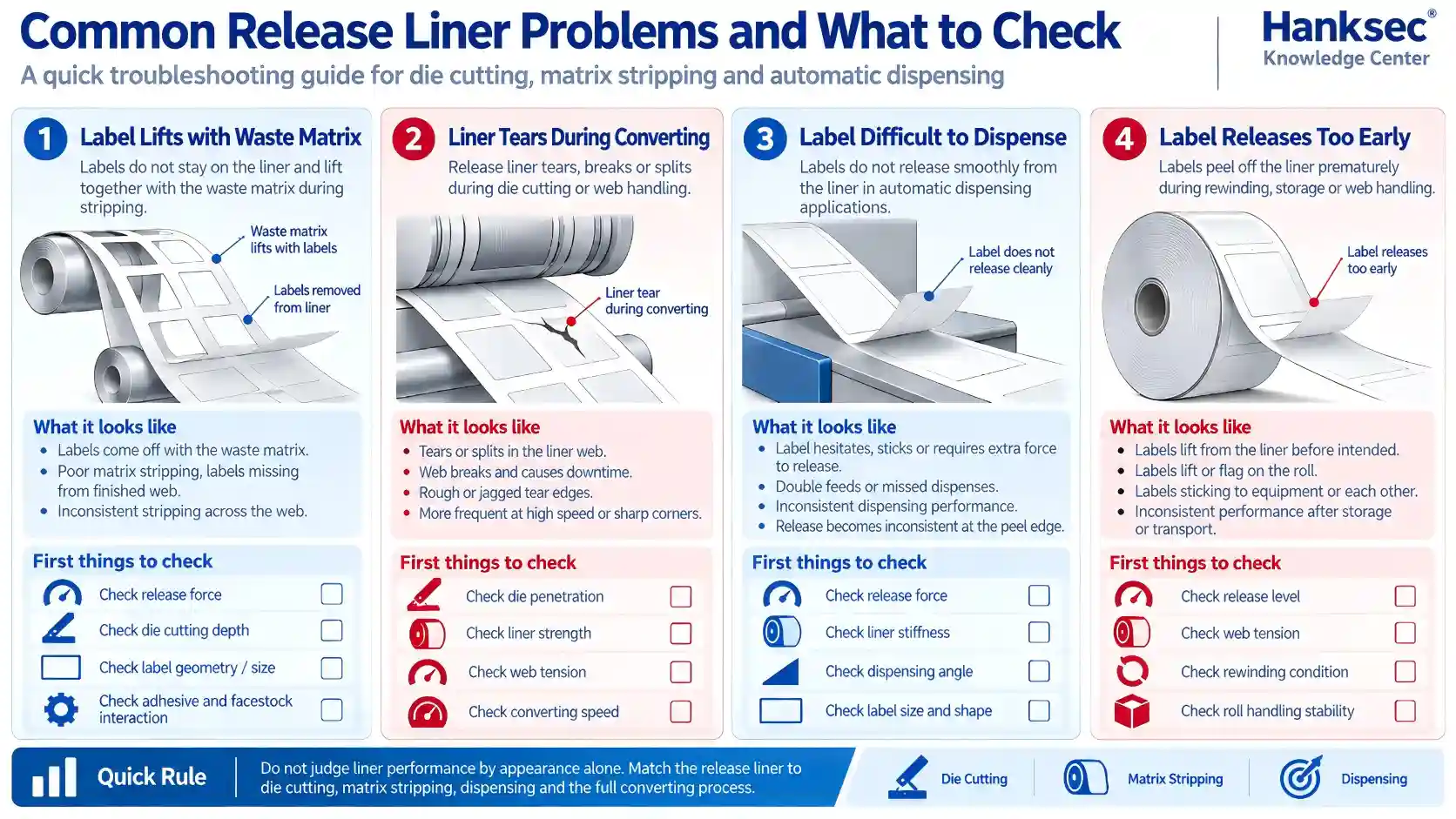
The buyer does not need to diagnose all of these parameters before contacting Hanksec.
A more useful starting point is simply to explain:
What is happening on the machine?
For example:
“The label comes off together with the matrix.”
“The backing paper keeps breaking.”
“The labels release too early.”
“The material works at low speed but becomes unstable when the machine runs faster.”
This gives the technical team much more useful information than asking the buyer to guess a release-force value.
How Hanksec Selects a Release Liner for a Converter
For a new or problematic construction, the selection normally starts with four questions:
1. What Material Is Being Converted?
VOID PET, destructible material, paper or another construction?
2. What Is the Converting Process?
Printing, die cutting, matrix stripping, slitting or automatic dispensing?
3. What Problem Is Occurring?
High release, premature release, web break, label lifting or unstable matrix stripping?
4. What Does the Actual Machine Require?
Production speed, label size, roll format and dispensing method all matter.
From there, Hanksec can evaluate the liner together with the facestock, adhesive and converting requirement.
FAQ
Is PET release liner always better than glassine?
No. PET provides excellent strength and dimensional stability, but glassine remains suitable for many rotary and flatbed die-cutting applications. The correct choice depends on the converting process.
Is glassine release liner suitable for VOID labels?
Yes. Glassine is commonly used in pressure-sensitive VOID label constructions, including Hanksec’s standard material range.
Can release liner affect matrix stripping?
Yes. Release force, liner stability and die-cut quality can all influence whether the waste matrix separates cleanly.
Why does a label lift together with the waste matrix?
Possible causes include excessive release force, incomplete die cutting, difficult label geometry, adhesive behavior or unsuitable converting conditions. The liner should be evaluated as part of the complete construction.
When should a converter consider PET liner?
PET may be worth evaluating for high-speed dispensing, demanding web tension, thin-liner requirements, small labels or applications requiring greater dimensional stability.
Conclusion: Choose the Release Liner for the Converting Process
A release liner should not be selected only by:
paper vs film + thickness + price.
Its real job is to support the complete label construction through:
die cutting + matrix stripping + rewinding + dispensing + application.
Glassine is a proven and practical liner for many pressure-sensitive label constructions.
PET offers additional strength and dimensional stability for selected demanding applications.
Neither material is automatically the correct choice.
For label converters, the better question is:
Which liner gives stable converting and controlled release on the actual machine?
Hanksec supplies security label materials with liner options matched to VOID, destructible and custom converting requirements.
When the correct construction is uncertain, send Hanksec:
material type + label size + machine process + current converting problem + required roll format.
The Hanksec Technical Team can then evaluate the liner together with the adhesive and security-label construction before bulk production.