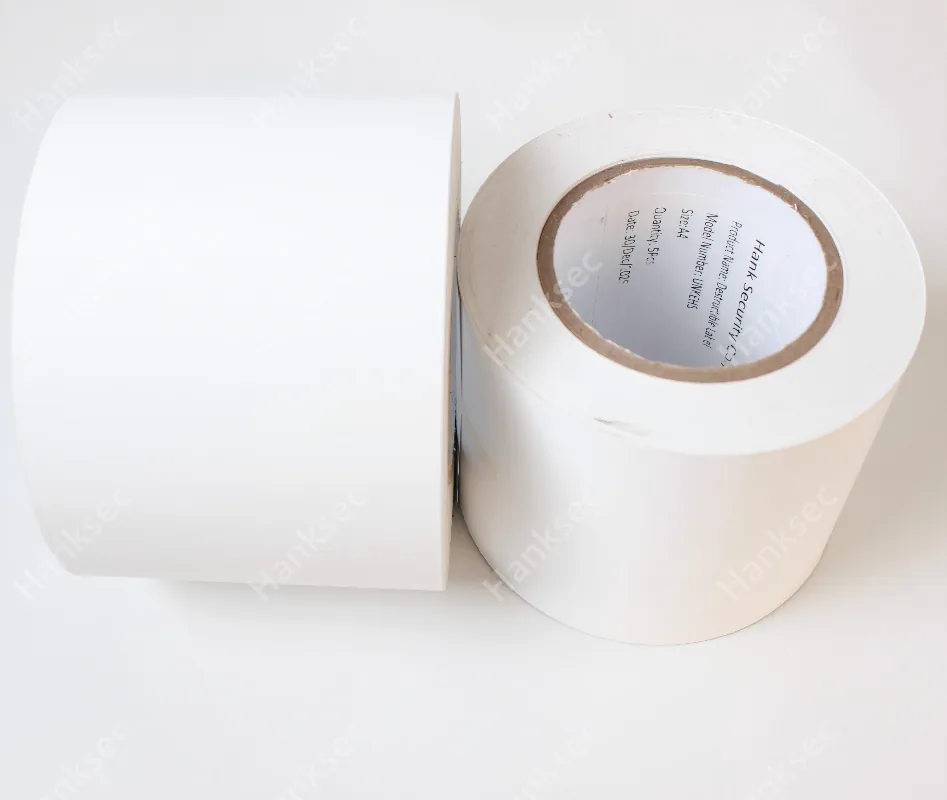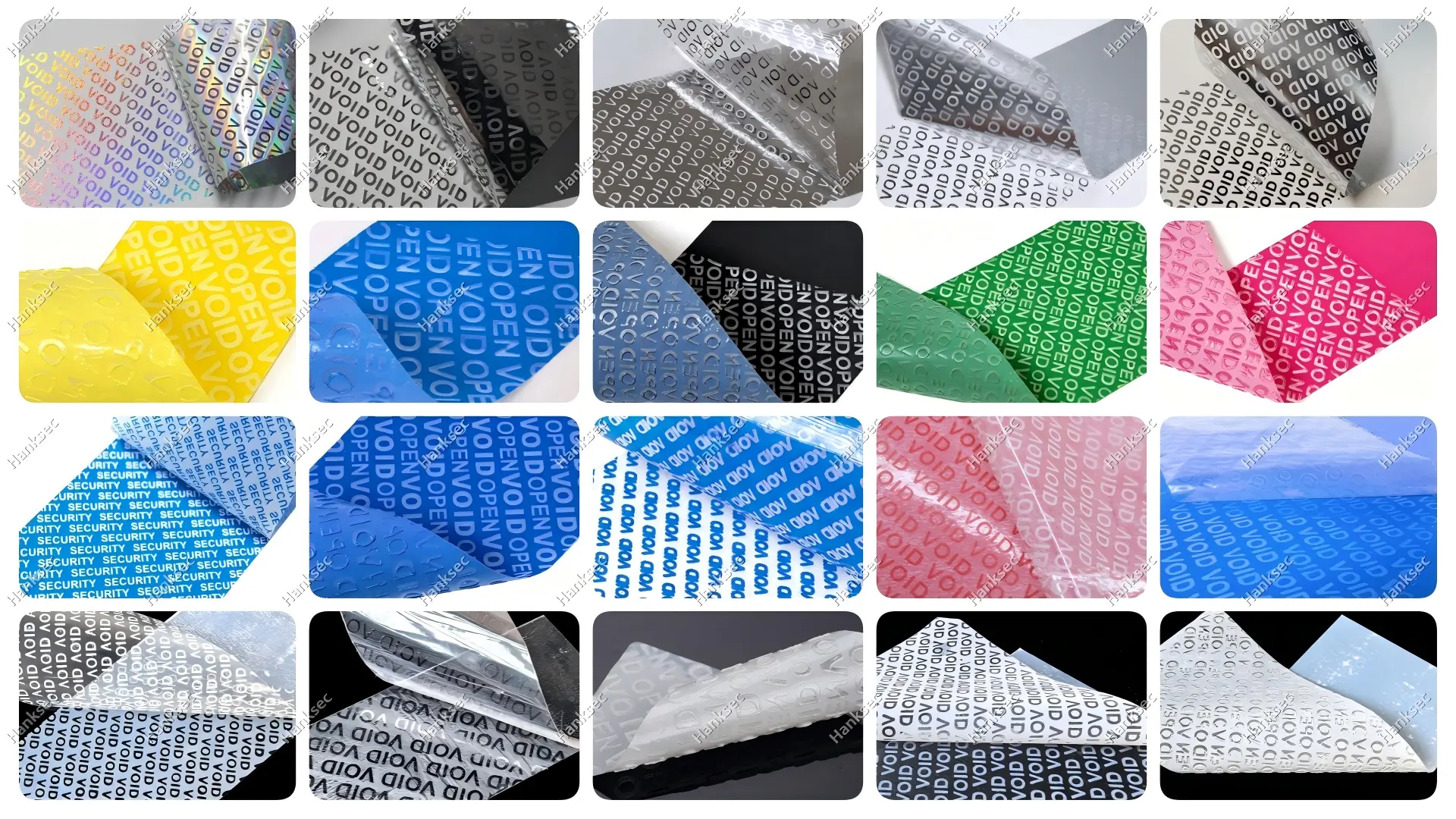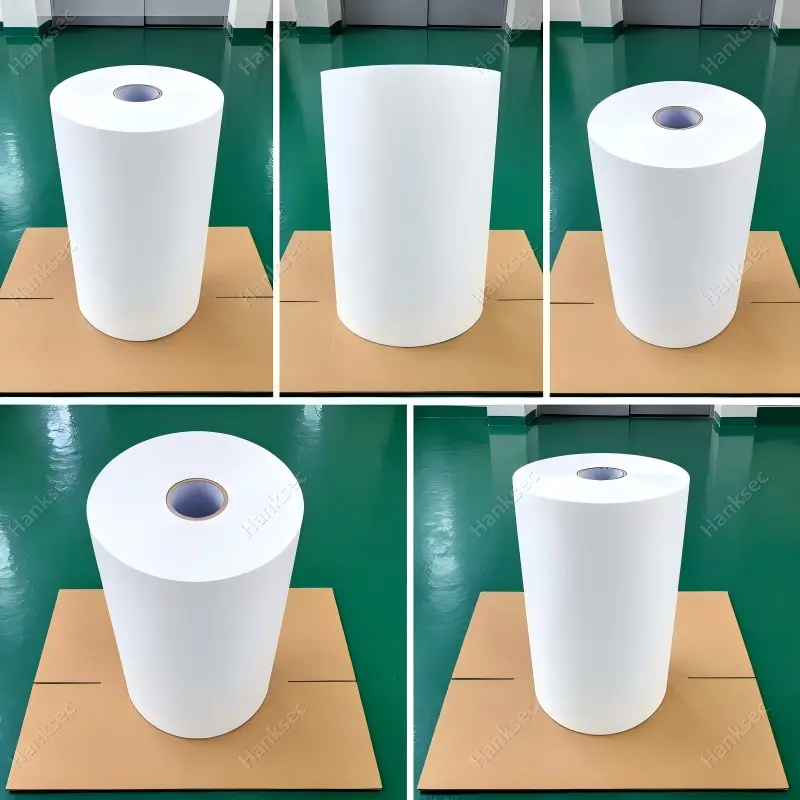
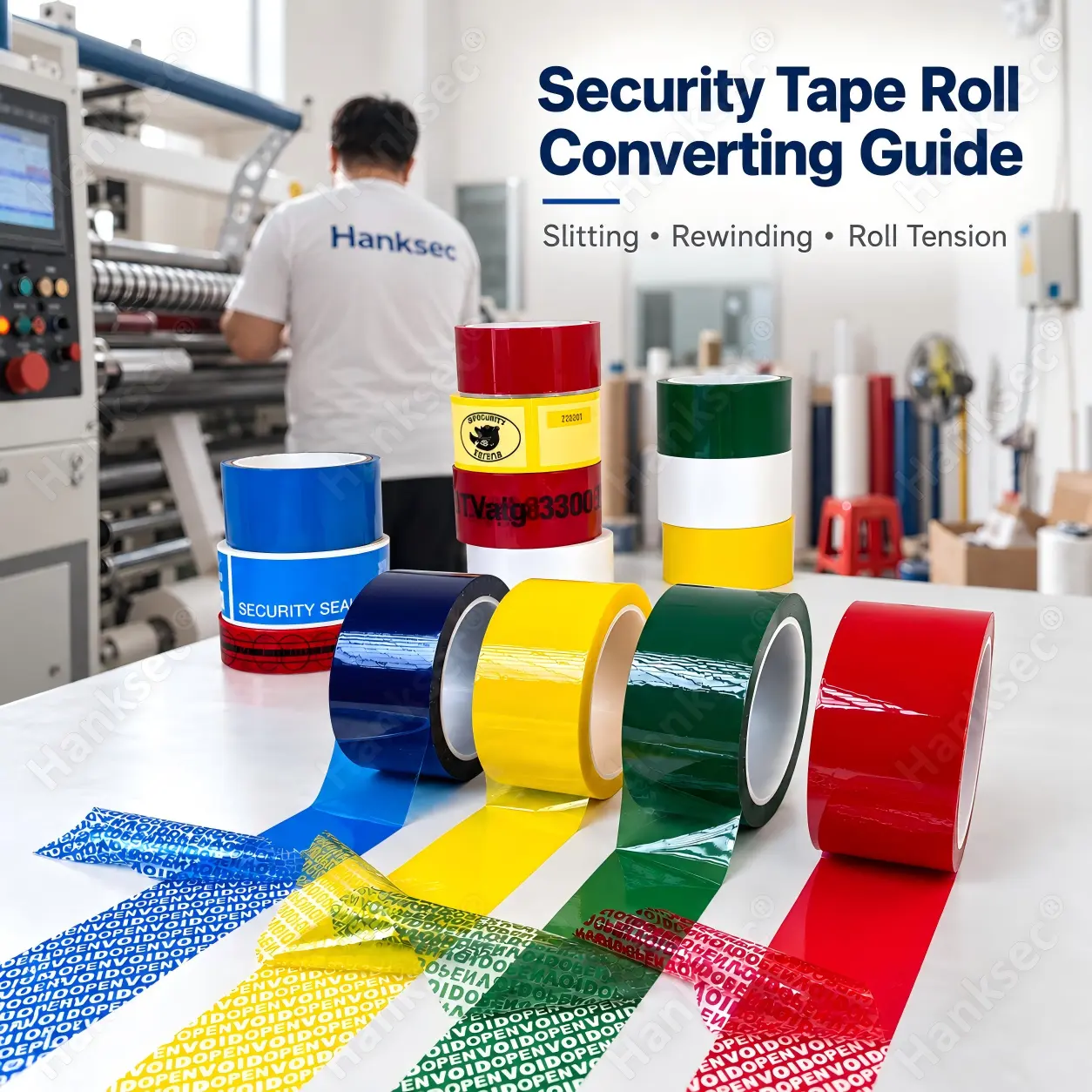
A tamper-evident security tape can perform correctly in a manual peel test and still become unstable during converting. For label converters, tape converters, security printers and packaging manufacturers, the key question is not only whether the tape produces the required VOID or OPENED indication, but whether the material can move through slitting, rewinding, dispensing and application equipment consistently.
This guide focuses specifically on security tape converting: slitting, rewinding, web tension, unwind behavior, liner release, roll build, dispensing and production troubleshooting. Material selection, transfer type and packaging-surface compatibility are covered separately in Hanksec’s Tamper Evident Security Packaging Tapes Selection Guide.
Quick answer: when a security tape works as a hand sample but fails on the production line, do not immediately conclude that the adhesive or security construction is defective. Trace the converting route step by step. The most important variables are usually web tension, slitting condition, rewind tension, roll geometry, unwind force, liner-release behavior, winding direction, machine path and line speed.
Why Security Tape Converting Requires Process Control
Tamper-evident security tape is not simply a conventional adhesive tape with a printed message. Depending on the construction, the web may combine a PET security film, tamper-indicating layer, printed or coated security layer, pressure-sensitive adhesive and release liner.
These layers have to behave as one system during converting.
A change that appears small at one stage can become a larger problem downstream. Excessive rewind tension, for example, may not be obvious immediately after rewinding but may later appear as roll hardness, curl, liner-release instability or poor dispensing. A damaged liner edge during slitting may also remain unnoticed until the finished roll reaches an automatic dispensing line.
For this reason, troubleshooting should separate two questions:
Is the problem coming from the material construction, or was the material condition changed during converting?
This distinction prevents converters from changing adhesive, liner or security-film specifications before identifying the actual failure point.
Where Security Tape Converting Problems Usually Appear
A typical converting route may include:
Incoming Roll → Printing if Required → Slitting → Rewinding → Unwinding / Dispensing → Application → Final Tamper Check
Not every project uses every step, but each operation can influence how the finished roll behaves in the next process.
| Converting Stage | Typical Problem | First Variables to Check |
|---|---|---|
| Incoming Roll | Loose roll, damaged edge, uneven roll build | Roll condition, OD, core, winding direction, storage |
| Slitting | Rough edges, liner scoring, curl, unstable narrow web | Blade condition, slit setup, web tension, liner condition |
| Rewinding | Telescoping, wrinkles, loose or excessively hard rolls | Rewind tension, alignment, roll build, finished OD |
| Unwinding | Jerking, web vibration, inconsistent feed | Unwind force, winding direction, roll geometry, speed |
| Liner Separation | Difficult release or premature liner separation | Release force, separation geometry, web path, speed |
| Dispensing | Intermittent feeding or unstable application | Winding direction, liner release, roll geometry, machine path |
| Final Application | Weak or inconsistent tamper indication | Converted roll condition, substrate, pressure, dwell time, temperature |
Hanksec’s Security Label Material Quality Control Guide explains general material-performance testing such as peel adhesion, release force, die cutting, VOID activation and print durability. This guide takes a narrower production view: where does the converting problem begin, and which variables should be recorded before the material specification is changed?
Security Tape Slitting Problems: What Should Converters Check?
Security tape is frequently supplied as a master or wider roll and then slit into customer-specific finished widths. A finished slit width can meet dimensional tolerance while the roll still performs poorly because the slit edge, liner, web tension or roll build has changed during converting.
For the first production trial, record the incoming web width, finished slit width, liner construction, roll outside diameter (OD), core inside diameter (ID), winding direction and intended dispensing method.
Common Security Tape Slitting Symptoms
- rough, feathered or uneven slit edges;
- liner scoring or partial liner cuts;
- adhesive contamination or squeeze-out at the roll edge;
- web wandering after slitting;
- curl in narrow-width rolls;
- uneven roll sidewalls;
- unstable feeding during rewinding or dispensing.
If the wide roll performs normally but the problem appears only after slitting, compare the material before and after the slitting operation before changing the adhesive or security construction.
Useful comparisons include edge condition, liner integrity, web flatness, finished width and winding direction.
Very narrow slit widths can also be more sensitive to web alignment, material balance and converting tension than a wider master roll. The workable settings therefore need to be confirmed on the actual finished width rather than assumed from the performance of the master roll.
For jumbo-roll, slit-roll, core and winding considerations, see Hanksec’s VOID Label Material Rolls: Jumbo & Slit Roll Selection Guide.
Web Tension and Rewind Tension: Why One Setting Does Not Fit Every Roll
There is no single universal web-tension value that is correct for every security tape construction.
The workable process window depends on factors including:
material construction + web width + liner stiffness + roll diameter + machine configuration + converting speed + rewind method + required finished-roll build.
Insufficient web tension may contribute to poor tracking, wrinkles, lateral movement or loose winding. Excessive web or rewind tension may contribute to overly hard rolls, distortion, curl, liner instability, adhesive squeeze-out or telescoping.
The practical production question is therefore not:
“What tension number should we use?”
It is:
“What tension window allows this material to track, slit and rewind consistently while preserving downstream release, dispensing and tamper performance?”
That distinction is important because a setting that produces a visually neat roll is not automatically the setting that gives the best downstream converting performance.
ASTM D3811/D3811M provides a standardized method for measuring the force required to unwind a roll of pressure-sensitive tape. The standard notes that low-rate unwind force is influenced by unwind rate and cautions against using the method to compare tapes intended for high-rate unwinding.
External technical reference: ASTM D3811/D3811M — Standard Test Method for Unwind Force of Pressure-Sensitive Tapes.
Afera also notes that adhesive-tape measurements contain method and sample variation. This is another reason production decisions should not be based on an isolated test value without considering the defined test conditions and the converter’s actual process.
External technical reference: Afera — Accuracy of Test Methods.
Rewinding Security Tape: Roll Build Matters
After slitting, printing or other converting operations, security tape may be rewound into smaller production rolls. A roll that looks visually clean is not necessarily production-ready.
The finished roll must remain stable during storage, handling, unwinding and automatic dispensing.
| Rewinding Symptom | Check First |
|---|---|
| Roll telescopes | Web alignment, rewind tension, roll build, core condition |
| Uneven roll sidewall | Slitting accuracy, web alignment, winding stability |
| Roll becomes excessively hard | Rewind tension, finished OD, roll pressure |
| Roll remains too loose | Tension control, winding stability, roll build |
| Wrinkles appear in the roll | Web alignment, tension distribution, material flatness |
| Curl appears after unwinding | Material balance, converting tension, winding and storage |
| Edge blocking or adhesive squeeze-out | Edge condition, rewind pressure, storage temperature |
| Finished roll dispenses poorly | Winding direction, roll geometry, unwind behavior, liner release |
If the incoming master roll runs normally but the finished slit roll does not, evaluate the slitting and rewinding stages before changing the base material specification.
When possible, retain a sample of the incoming master roll and compare it directly with the converted roll. This makes it easier to establish whether the abnormal behavior existed before converting or was introduced during production.
Why Security Tape Rolls Telescope During Rewinding
Telescoping occurs when layers of the roll shift laterally so that the roll no longer maintains a flat, stable sidewall.
For security tape converting, telescoping should be treated as a process symptom, not as a diagnosis by itself.
Possible contributors include web misalignment, unstable rewind tension, changing roll diameter, unsuitable roll hardness, core condition or uneven material tracking.
The most useful troubleshooting approach is to record when the telescoping begins:
Does it appear immediately, only as the roll diameter increases, after storage, or during subsequent unwinding?
This helps distinguish a rewind-setting issue from a broader roll-build or storage problem.
Unwind Force and Security Tape Dispensing Behavior
A pressure-sensitive tape roll requires force to unwind. In production, however, the converter is usually concerned not only with the absolute force but also with whether the unwind behavior remains stable throughout the roll and across the intended line speed.
Unstable unwind behavior may appear as:
jerking, web vibration, inconsistent feeding, registration variation, tension fluctuation or intermittent dispensing.
One of the most useful comparisons is between trial speed and normal production speed.
A roll that runs smoothly during a slow machine trial but becomes unstable at normal production speed may have a process window that is too narrow for the intended equipment conditions.
Record:
machine speed + roll OD + winding direction + unwind path + point where instability begins.
This information is substantially more useful to a material supplier than a general statement such as “the tape does not run well.”
Liner Release Problems During Converting and Dispensing
For liner-backed security tape constructions, the release liner is part of the converting system. It carries and protects the adhesive construction through operations such as slitting, rewinding, die cutting and dispensing.
Release that is too difficult can create feeding or separation problems. Release that is too easy can contribute to premature liner separation or instability along the machine path.
The observed result depends not only on the liner itself but also on the adhesive construction, separation geometry, machine path and operating conditions.
ASTM D3330/D3330M Test Method D provides a standardized procedure for measuring the adherence of a release liner to the adhesive of single- or double-coated pressure-sensitive tape.
This is useful laboratory information, but a slow hand peel should not be treated as equivalent to the behavior of a continuous web passing through a production machine.
External technical reference: ASTM D3330/D3330M — Standard Test Method for Peel Adhesion of Pressure-Sensitive Tape.
For a deeper comparison of release liners and their relationship with die cutting, matrix stripping and dispensing, see Hanksec’s Label Release Liner Guide: Glassine vs PET.
Why the Sample Works but the Production Roll Does Not
This is one of the most common situations in converting troubleshooting.
A hand-applied sample and a production roll are not operating under the same mechanical conditions.
| Manual Sample | Production Line |
|---|---|
| Short strip | Continuous web |
| Manual liner removal | Automatic separation or dispensing |
| Low speed | Normal production speed |
| Careful hand positioning | Machine-controlled web path |
| Minimal converting stress | Slitting, rewinding and dynamic tension |
| Small roll or sheet sample | Changing roll diameter during production |
The first troubleshooting question should therefore be:
At which production step does the behavior first change?
If the material performs correctly before slitting but curls after slitting, investigate the slitting conditions and web tension first.
If the slit roll looks normal but begins to telescope during rewinding, investigate alignment, rewind tension and roll build.
If the finished roll looks normal but fails during automatic dispensing, investigate unwind behavior, liner release, winding direction, roll geometry and the machine web path.
If the problem appears only after final application, then substrate condition, application pressure, dwell time, temperature and tamper-response activation also need to be considered.
Hanksec uses the same process-side versus material-side troubleshooting approach in its High-Temperature Label Matrix Stripping case study.
Security Tape Converting Troubleshooting Matrix
| What the Converter Sees | Check First | What to Record |
|---|---|---|
| Web runs sideways | Web alignment / tension / roll build | Line speed, web width, roll OD, machine path |
| Tape curls after slitting | Slitting setup / web tension / material balance | Finished width, blade setup, winding direction |
| Rough or feathered slit edge | Blade condition / slit setup / web stability | Blade type, blade condition, liner condition |
| Liner is partially cut | Slitting depth / blade setup | Blade setting, liner construction, affected position |
| Liner is difficult to remove | Release behavior / separation geometry / web path | Liner type, line speed, peel path, machine configuration |
| Liner releases too early | Release behavior / web tension / separation path | Winding direction, web path, speed, liner construction |
| Roll telescopes | Alignment / rewind tension / roll build | Finished OD, core ID, rewind condition |
| Roll becomes excessively hard | Rewind tension / roll build | Finished OD, rewind setting, roll condition |
| Roll remains too loose | Tension control / winding stability | Rewind settings, OD, roll condition |
| Tape edges block or show adhesive squeeze-out | Edge condition / rewind pressure / storage | Storage temperature, roll OD, edge photos |
| Printed image rubs off after converting | Surface treatment / ink anchorage / curing / abrasion | Printing system, curing conditions, before-and-after samples |
| Barcode becomes difficult to read | Print contrast / abrasion / web distortion | Readability before and after converting |
| VOID response changes after converting | Converted roll condition / final application variables | Failure step, substrate, pressure, dwell time, temperature |
| Works at low speed but fails at full speed | Process window / dynamic unwind / release / tension stability | Trial speed, production speed, machine settings |
| Finished roll dispenses poorly | Winding / liner release / roll geometry / web path | Dispenser model, winding direction, roll OD, machine path |
How to Run a Security Tape Converting Trial Before Bulk Production
The objective of a converting trial is not simply to confirm that the tape can pass through a machine once. The objective is to reproduce the intended production route closely enough to identify process instability before bulk approval.
1. Record the Incoming Roll Condition
Confirm the master-roll width, roll OD, core ID, winding direction, liner construction where applicable and visible roll-build condition.
Photograph the incoming roll when useful so that the original roll condition can later be compared with the finished converted roll.
2. Run the Slitting Trial
Record finished width, blade setup, slit-edge quality, liner condition and web tracking.
If multiple widths are required, do not assume that the narrowest roll will behave exactly like the wider roll.
3. Evaluate Rewinding
Check roll sidewalls, roll build, telescoping, wrinkles, curl, finished OD and winding stability.
Where possible, observe the roll at different diameters rather than inspecting only the completed roll.
4. Check Unwind and Liner Release
Run the converted roll through the intended unwind or dispensing path. Record line speed, liner-separation behavior and the exact position where feeding becomes unstable.
5. Increase to Normal Production Speed
Do not approve the material only because it runs successfully at a slow trial speed.
Confirm whether the converted roll remains stable at the intended normal production speed.
6. Confirm Printing or Barcode Performance Where Applicable
If the construction is printed during converting, inspect ink anchorage, abrasion resistance and barcode readability after slitting and rewinding.
The objective is to verify the finished converted configuration, not only the printed web before rewinding.
7. Confirm the Final Tamper Response
After converting, apply the finished tape to the intended substrate under representative application conditions.
Confirm that the specified VOID, OPENED or other tamper indication remains consistent after the complete converting process.
Do Not Change the Material Specification Before Identifying the Failure Point
When a production problem occurs, it is tempting to immediately request a stronger adhesive, easier-release liner or different film construction.
That may solve the problem in some cases, but it can also create a second problem if the original failure was caused by converting conditions.
A better troubleshooting sequence is:
Incoming roll → Slitting → Rewinding → Unwind → Liner release → Dispensing → Final application.
Compare the material condition after each relevant stage.
If the failure already exists in the incoming roll, the material construction or manufacturing condition should be investigated.
If the incoming roll performs correctly and the problem begins only after a particular converting operation, that process should be evaluated before the material specification is changed.
This approach helps both the converter and the material supplier avoid unnecessary trial-and-error changes.
What Data Should Be Recorded When a Security Tape Converting Problem Occurs?
Effective technical support depends on production data. A short description such as “the roll has a problem” rarely provides enough information to isolate the cause.
| Process Data | What to Provide |
|---|---|
| Incoming Roll Width | Master-roll width before converting |
| Finished Slit Width | Final width and required tolerance |
| Core ID | Core size used on the converting equipment |
| Incoming / Finished Roll OD | Roll diameter before and after converting |
| Winding Direction | Required unwind orientation |
| Line Speed | Slow trial speed and normal production speed |
| Slitting Setup | Blade type, blade condition and relevant machine setup |
| Rewind Condition | Tension setting or relative production setting used |
| Liner Construction | Liner type and release specification where known |
| Printing Method | Printing technology and curing conditions where applicable |
| Failure Point | Exact production stage where behavior first changes |
| Final Substrate | Carton, plastic, metal, bag film or other application surface |
| Environment | Relevant processing, storage or application temperature |
| Evidence | Close-up photographs and a short machine video showing the web path |
For an existing production failure, a short video showing the roll direction, web path, machine speed and exact failure point can often provide more useful troubleshooting information than a long written description.
Security Tape Converting and Material Quality Are a System
Converting stability should not be evaluated separately from material quality.
The security film, security coating, adhesive, liner, printing surface, roll build and converting conditions interact with each other.
For example:
Release behavior can influence dispensing.
Liner stiffness can influence handling and separation.
Rewind conditions can influence roll hardness and downstream feeding.
Slitting quality can influence the stability of a narrow finished roll.
Printing and curing can influence abrasion resistance and barcode readability.
Final application conditions determine whether the converted tape still produces the intended tamper indication on the actual substrate.
This is why production qualification should evaluate the complete material-and-process system rather than one isolated property.
How Hanksec Supports Security Tape Converting Projects
Hanksec manufactures tamper-evident security materials for label converters, security printers, packaging manufacturers and material distributors.
For converting projects, technical evaluation begins with the customer’s actual production route rather than only with a finished tape specification.
Hanksec troubleshooting logic:
incoming material condition → slitting → rewinding → unwind / liner release → dispensing → final application → tamper response.
Where practical, representative material should be evaluated under the customer’s actual or simulated production conditions before bulk approval.
This is particularly important when the project involves narrow slit widths, automatic dispensing, specific winding directions, high production speeds, specialized liners or customer-defined finished-roll dimensions.
Converters comparing available constructions can review Hanksec’s Security Packing Tapes or contact the technical team with the required roll and converting specifications.
FAQ: Security Tape Converting
Why does security tape curl after slitting?
Curl can be influenced by material balance, slit width, web tension, slitting setup, rewind conditions and storage. Compare the master roll with the slit roll and determine the first production stage where the curl becomes visible before changing the material construction.
Why does a security tape roll telescope during rewinding?
Telescoping can be associated with web alignment, rewind tension, roll build, core condition or changes that occur as the roll diameter increases. Record the rewind condition and observe whether telescoping begins immediately or only after the roll reaches a larger OD.
Why is the liner difficult to remove on the machine even though it peels easily by hand?
Hand peeling and machine separation use different web paths, speeds and separation geometries. Evaluate liner release under representative production conditions and record the machine path and point where separation becomes unstable.
Why can liner release change at higher machine speeds?
Liner-release behavior is affected by the complete adhesive-and-liner construction together with the separation path and operating conditions. A slow manual peel should therefore not automatically be treated as representative of continuous machine dispensing.
Why can a security tape roll run correctly at low speed but fail at normal production speed?
This may indicate that the converting process window is too narrow. Unwind behavior, liner separation and tension stability can behave differently when line speed and roll dynamics change. Compare the exact settings used at trial speed and normal production speed.
Why does adhesive appear at the slit edge?
Edge contamination or adhesive squeeze-out can be influenced by slit quality, rewind pressure, adhesive construction, roll build and storage temperature. Record whether the condition exists on the master roll or appears only after slitting and rewinding.
Should the master roll or the finished converted roll be approved?
The finished converted configuration should be evaluated. Slitting, rewinding, printing, liner separation and dispensing can introduce performance differences that may not be visible during incoming master-roll inspection.
Should we immediately change to a stronger adhesive when a converted roll fails?
Not necessarily. First determine whether the failure exists in the incoming material or begins after a particular converting operation. Changing adhesive before identifying the failure point can introduce new release, rewinding or application problems without solving the original cause.
What should we send Hanksec when a converting problem occurs?
Provide the master-roll width, finished slit width, core ID, roll OD, winding direction, trial and production speeds, liner information where applicable, slitting and rewind conditions, intended substrate and the exact process stage where the problem appears.
Close-up photographs and a short machine video showing the web path and failure point are also useful for technical evaluation.
Need Security Tape Converting Support?
If you are troubleshooting security tape slitting, rewinding, web tension, unwind, liner release or automatic dispensing problems, send Hanksec the production information from the affected process together with photographs or a short machine video.
Recommended information: master-roll width + finished width + core ID + roll OD + winding direction + line speed + slitting setup + rewind conditions + liner information + final substrate + exact failure point.
Providing these details allows the Hanksec technical team to distinguish between a possible material-side issue and a process-side converting issue before recommending changes to the tape construction.