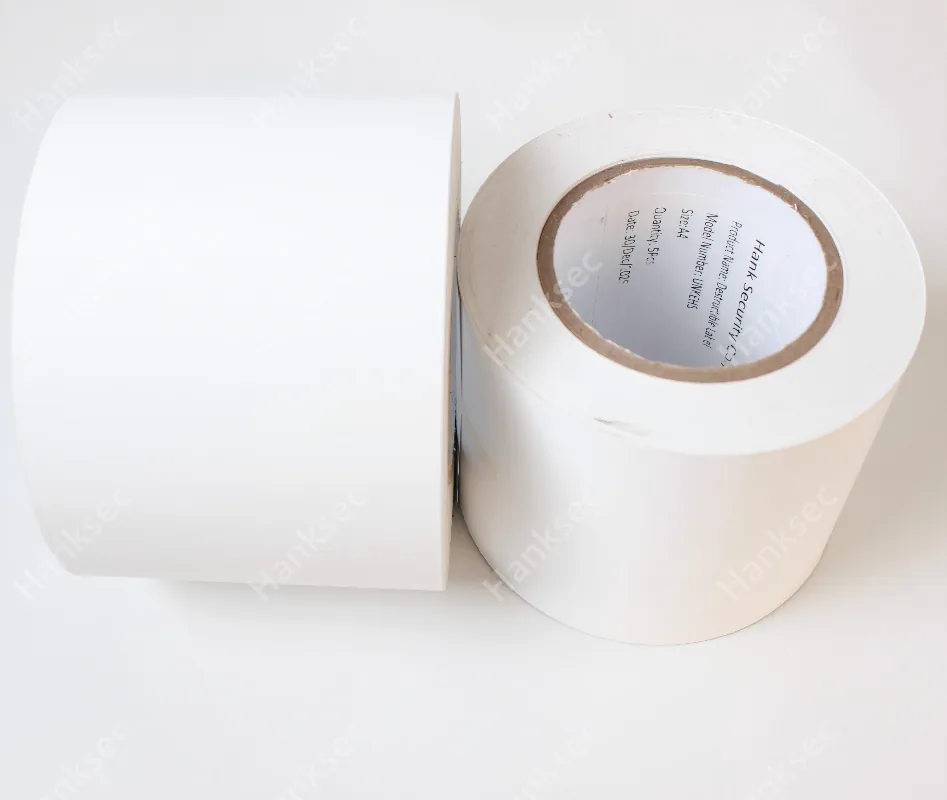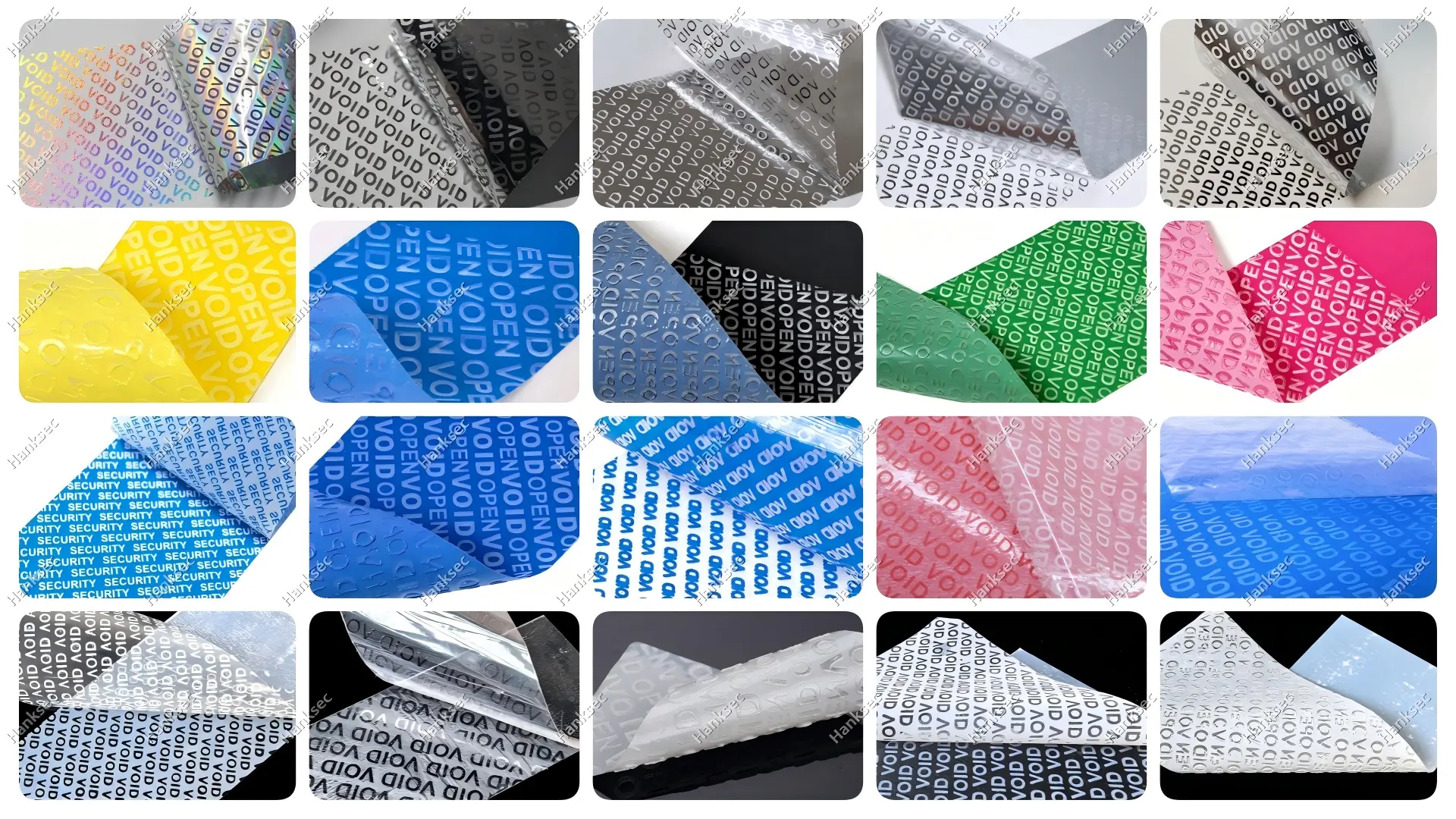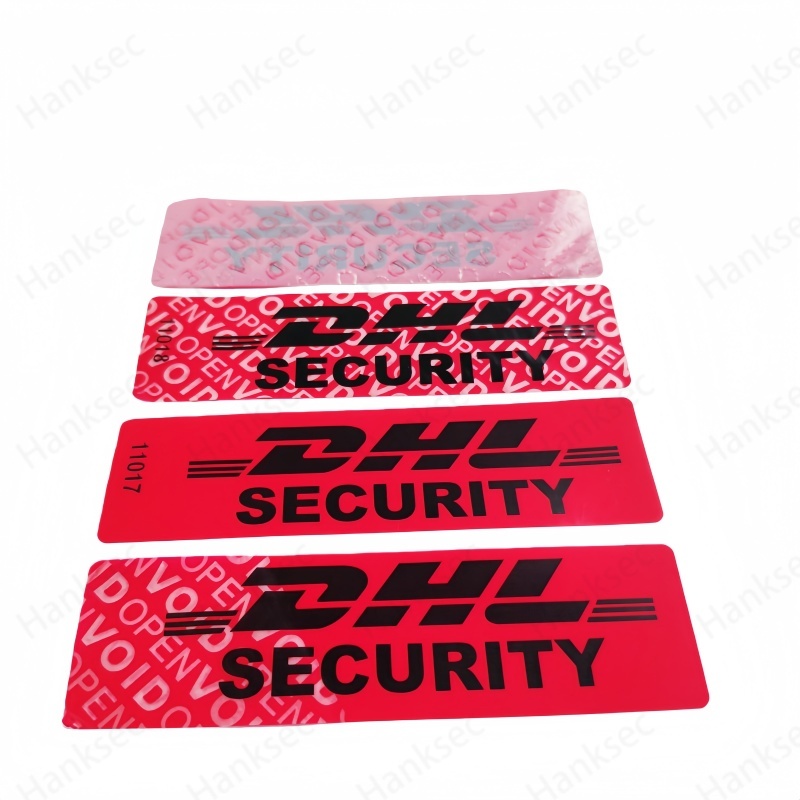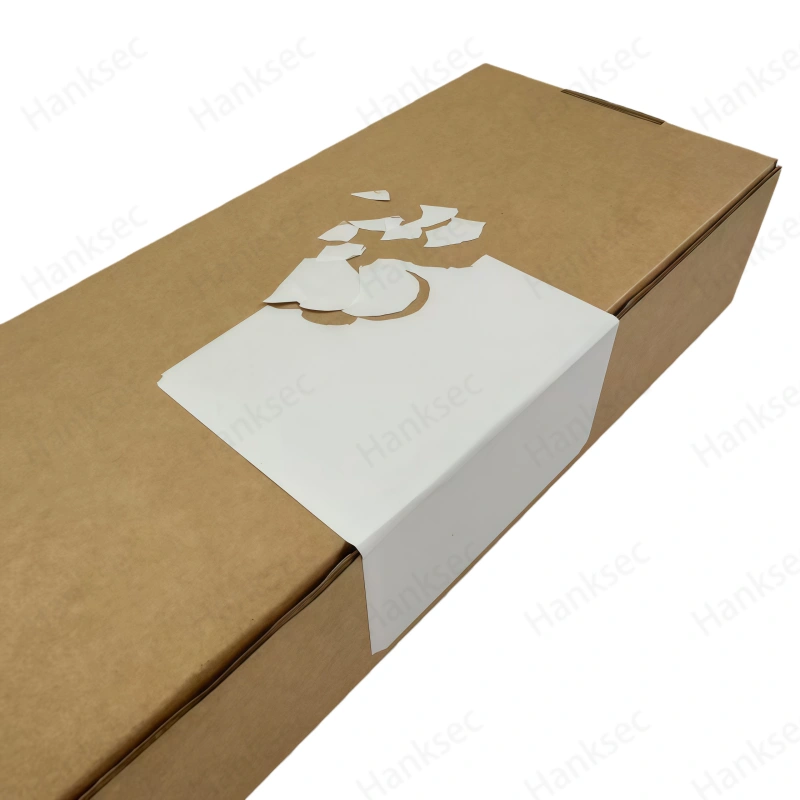
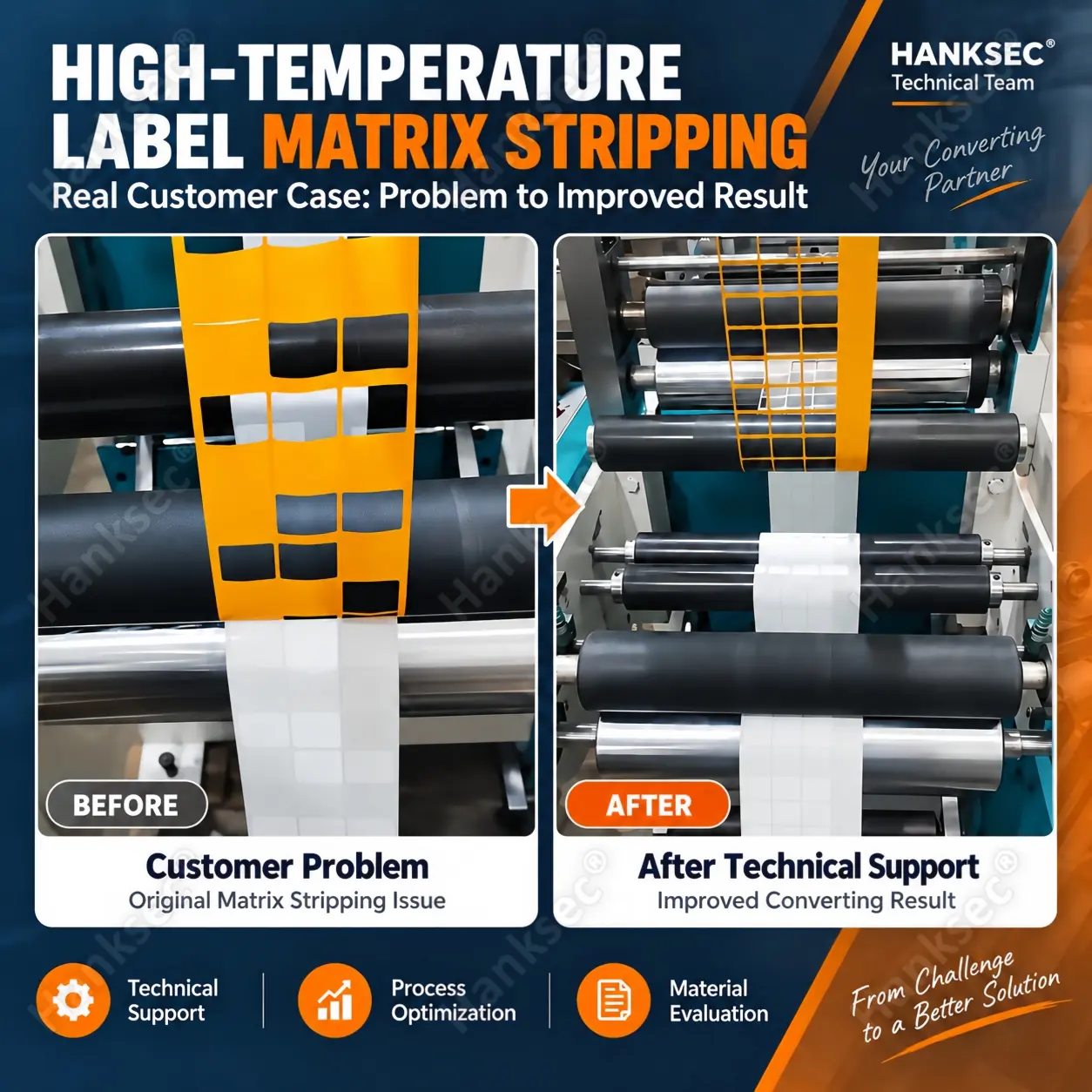
High temperature label matrix stripping can become difficult when thick facestock, a relatively heavy adhesive layer and small label dimensions are combined.
Recently, Hanksec received technical feedback from a customer in India who experienced a matrix stripping problem while converting one of our high-temperature label materials. During waste removal, some finished labels were lifted together with the surrounding matrix instead of remaining cleanly on the release liner.
At first glance, this type of converting problem can easily be interpreted as a material-quality issue. However, pressure-sensitive label converting is rarely controlled by only one factor.
After reviewing the customer’s production photos and videos, our technical team analyzed the interaction between the facestock thickness, adhesive layer, initial tack, die-cutting condition, label size, waste-stripping angle and machine configuration.
We eventually provided the customer with two possible solutions:
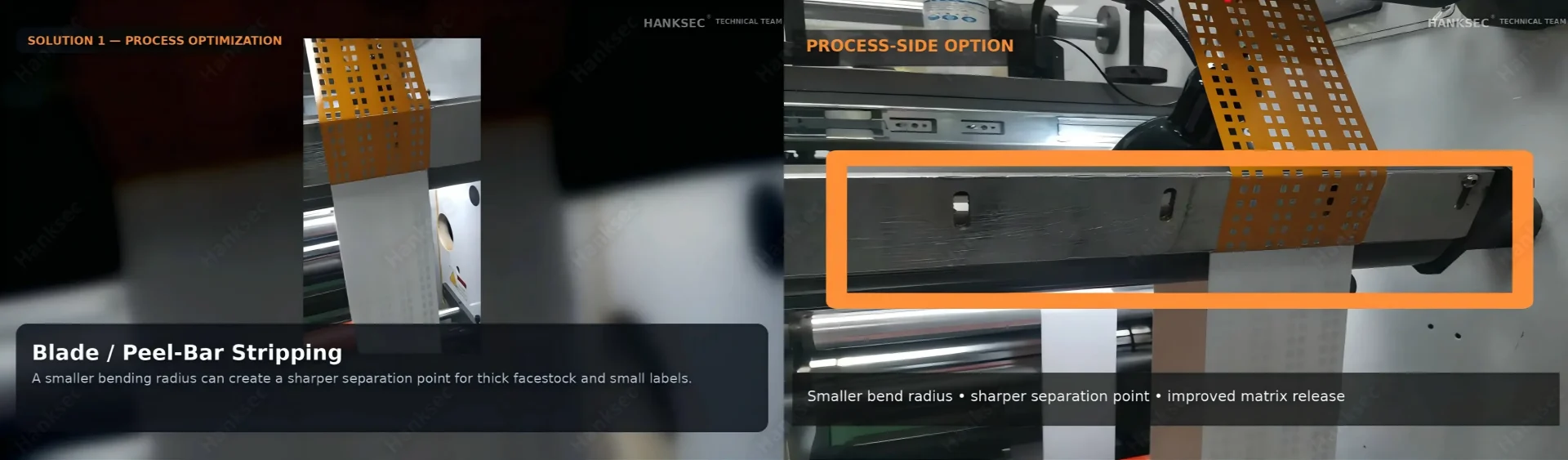
- Process-side optimization: replace the conventional roll-stripping path with a flat peel-bar / blade-shaped stripping guide to create a smaller bending radius and a more abrupt change in web direction.
- Material-side optimization: adjust the adhesive formulation and reduce the initial tack to create a wider converting window on the customer’s existing equipment.
The second solution was particularly valuable because it allowed the customer to evaluate a material-side adjustment without first changing the existing converting setup.
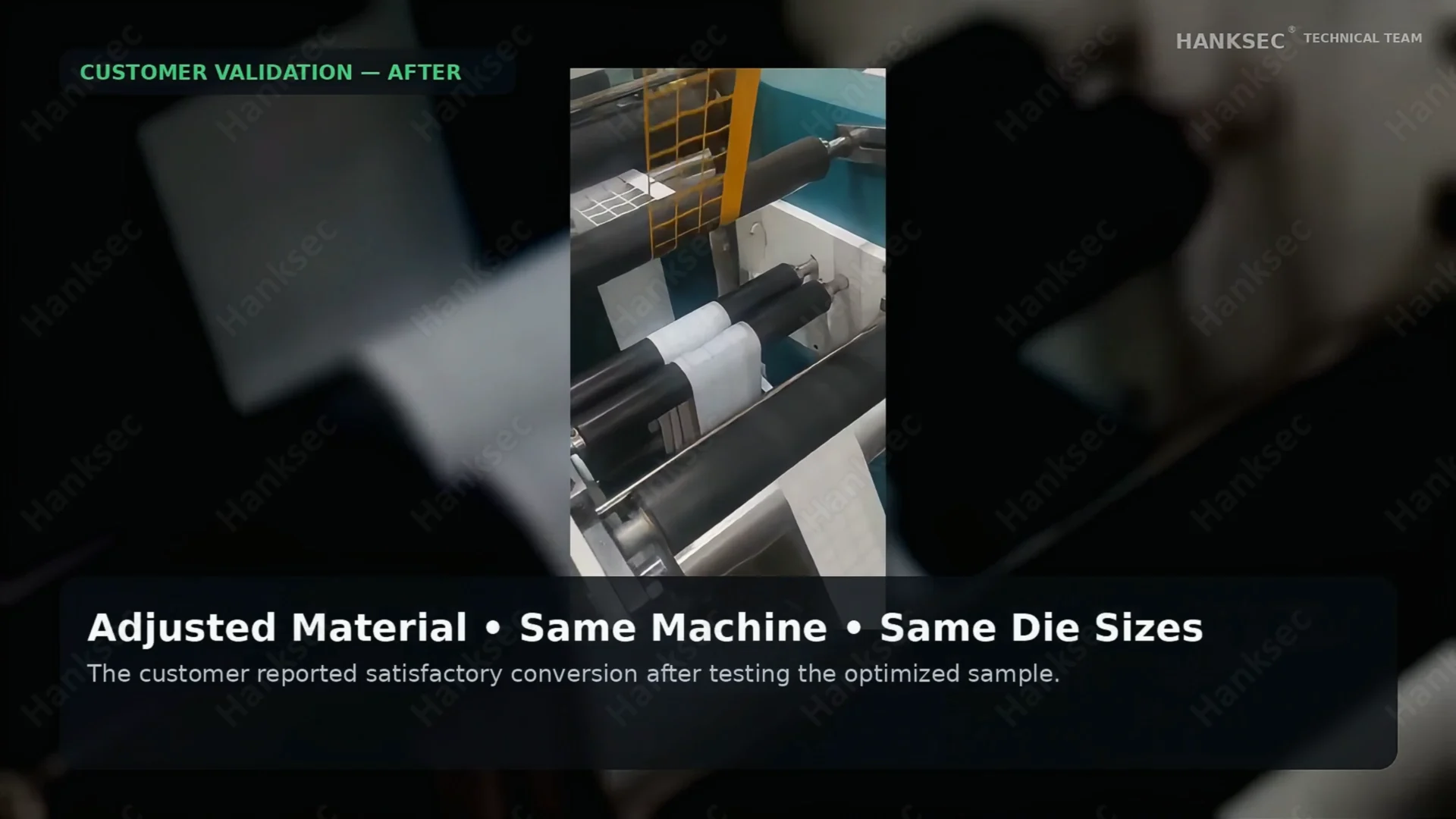
Hanksec therefore prepared a newly adjusted sample roll. The customer tested the new material using the same machine and the same die sizes and reported satisfactory conversion.
This real case demonstrates an important principle:
A matrix stripping problem is not always solved by changing the machine, and it is not always solved by changing the material. The correct solution comes from understanding how the material and the converting process interact.
A Real Customer Case: Labels Lifting During Matrix Stripping
The original problem appeared during matrix removal after die cutting.
Instead of the waste matrix separating cleanly around each finished label, some labels followed the waste web and were lifted from the release liner.
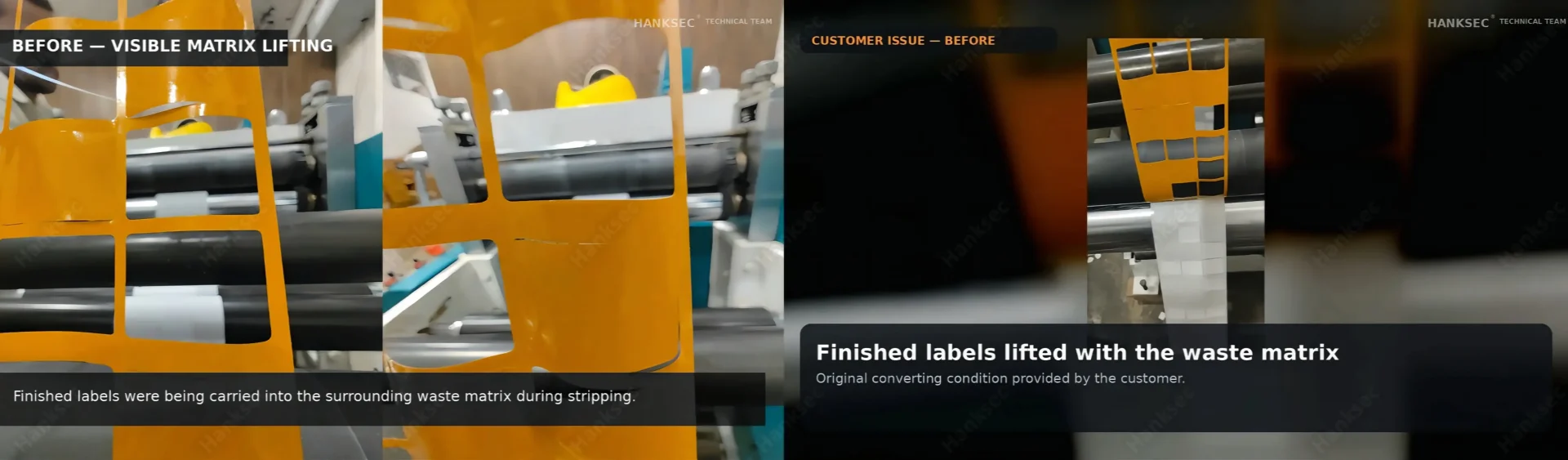
This type of failure can cause several production problems:
- finished labels being carried away with the waste matrix;
- unstable waste removal;
- matrix tearing;
- reduced converting speed;
- higher material waste;
- production interruptions;
- difficulty maintaining consistent output for small labels.
What made the case especially useful was that the issue could not be evaluated simply by looking at the final material specification.
The complete converting system had to be considered.
Why Was This High-Temperature Label Material More Difficult to Strip?
The material construction used in this project was relatively thick compared with many conventional pressure-sensitive label materials.
For converters working with heat-resistant electronic and industrial identification applications, Hanksec also supplies High Temperature Polyimide Label Material with customizable adhesive, liner, thickness and roll specifications.
- Facestock thickness: approximately 50 μm
- High-temperature adhesive thickness: approximately 25 μm
Before the release liner is even included, the facestock and adhesive together already represent approximately 75 μm of functional construction.
A thicker construction naturally creates greater demands during die cutting and matrix stripping.
However, thickness alone does not fully explain the problem.
In this case, several technical factors were interacting at the same time.
1. Thicker Facestock Creates Higher Bending Stiffness
A 50 μm facestock is more difficult to bend sharply than a thinner film.
During matrix stripping, the waste material must change direction and separate from the die-cut label edge. When the facestock has higher bending stiffness, the stripping geometry becomes more important.
If the separation angle is too gradual, the waste matrix may exert enough lifting force to pull a small finished label away from the liner.
2. A Thicker Adhesive Layer Increases the Difficulty of Clean Separation
The material also used approximately 25 μm of high-temperature adhesive.
A thicker adhesive layer means there is more adhesive present around the die-cut edge. If the cutting depth, stripping geometry and adhesive behavior are not properly balanced, the waste matrix may not release cleanly.
The adhesive can contribute additional resistance during the short moment when the matrix separates from the finished labels.
3. Initial Tack Influences Converting Behavior
Initial tack describes how quickly an adhesive develops grip after making contact with a surface.
For many industrial applications, strong initial tack is desirable because the label needs to establish reliable contact with the application surface.
However, converting performance and final application performance are not exactly the same thing.
When relatively high initial tack is combined with:
- thick facestock;
- a heavy adhesive layer;
- small label dimensions;
- tight matrix areas;
- and a relatively gradual stripping geometry;
the matrix may become more difficult to separate immediately after die cutting.
This became one of the key directions in Hanksec’s material-side optimization.
Why Die Cutting High-Temperature Labels Requires a Very Precise Process Window
Many high-temperature labels are designed for industrial applications where automatic dispensing or auto-labelling may be required.
This creates another challenge.
The die needs to cut completely through the facestock and adhesive layer, but it should avoid excessive penetration into the release liner.
If the Die-Cutting Pressure Is Too Low
Several problems may occur:
- the facestock may not be completely cut;
- the adhesive may remain partially connected around the cut edge;
- the waste matrix may pull against the finished label;
- matrix stripping becomes unstable.
If the Die-Cutting Pressure Is Too High
Different problems may occur:
- the release liner may be excessively scored;
- liner strength may be reduced;
- web breakage risk can increase;
- automatic dispensing performance may become less stable.
This means that simply increasing die pressure is not always the correct solution.
The converter must find a narrow operating window where the facestock and adhesive are completely cut while the release liner remains suitable for downstream processing.
Die cutting should also be qualified together with the complete printing and converting workflow. Converters using UV, flexographic, thermal-transfer or digital processes can review Hanksec’s Printable Security Label Materials Guide for additional printing and downstream converting considerations.
Why Small Labels Make Matrix Stripping Even More Sensitive
Label size is another important factor.
As labels become smaller, the converting tolerance becomes narrower.
During matrix stripping, the waste web must separate cleanly around every die-cut perimeter. With very small labels, even a relatively small upward force can cause the finished label to follow the matrix.
Small labels are therefore particularly sensitive to:
- die-cutting accuracy;
- adhesive behavior;
- matrix tension;
- label spacing;
- waste-bridge design;
- stripping radius;
- stripping angle.
Hanksec has previous converting experience with high-temperature labels down to approximately 3 × 4 mm.
The important lesson is not that every 3 × 4 mm label will behave identically.
Instead, successful micro-label production depends on the complete converting system:
Material + Adhesive + Die Cutting + Label Layout + Stripping Geometry + Tension
Solution 1: Optimize the Matrix Stripping Geometry
The first solution identified by our technical team was to optimize the mechanical stripping method.
Different stripping structures create different separation geometries, and this can have a major effect on thick or small labels.
Conventional Roll Waste Stripping
In a conventional roll-stripping configuration, the waste matrix is usually redirected around a roller and pulled away under tension.
The material follows the radius of the roller, which creates a relatively smooth and gradual change in direction.
This type of stripping system works very well for many conventional label products, especially when:
- the facestock is relatively thin;
- the label size is medium or large;
- the waste matrix has sufficient tensile strength;
- high-speed continuous converting is required.
Its main advantage is smooth and stable web handling.
However, when the combination includes thick facestock, relatively heavy adhesive and very small labels, the gradual stripping geometry may not create sufficiently decisive separation at the die-cut edge.
The result can be:
- label lifting;
- matrix carrying finished labels away;
- local waste tearing;
- inconsistent stripping.
Flat Peel-Bar Waste Stripping
A flat peel-bar or blade-shaped stripping guide changes the web path used during matrix removal. In this context, “blade-shaped” describes the flat geometry of the stripping tool; it is not a sharpened cutting blade and does not cut the material.
Instead of allowing the liner to follow the relatively large radius of a round stripping roller, the liner is redirected over a flatter guide with a much smaller effective bending radius.
This creates:
- a smaller bending radius;
- a more abrupt change in web direction;
- a more concentrated separation action at the matrix-removal point.
For thick and relatively stiff constructions, this geometry can make it easier for the waste matrix to separate without pulling the finished labels away from the release liner.
Flat peel-bar stripping can therefore be particularly useful for:
- thicker PET label constructions;
- PI high-temperature labels;
- relatively heavy adhesive layers;
- micro-size labels;
- difficult matrix stripping applications.
The exact stripping angle depends on the equipment design and web path, so it should not be treated as one universal fixed number.
The important principle is the smaller bending radius and more abrupt separation geometry.
Roll Stripping vs. Flat Peel-Bar Stripping
| Comparison Item | Flat Peel-Bar Stripping | Roll Waste Stripping |
|---|---|---|
| Separation Geometry | Small-radius, abrupt direction change | Smoother roller-radius separation |
| Local Separation Action | Strong and concentrated | More gradual |
| Thick Facestock | Often more suitable | Requires more careful process adjustment |
| Small Labels | Often provides a wider converting window | More sensitive to label lifting |
| Heavy Adhesive Construction | Can improve matrix separation | May become more difficult to strip |
| Conventional High-Speed Labels | Depends on machine configuration | Often highly suitable |
| Typical Application | Thick, difficult or micro-label converting | Conventional thin-label converting |
Flat peel-bar stripping should not be described as universally better than roll stripping.
For many standard label jobs, roll stripping is highly efficient.
The correct choice depends on the material construction, label geometry and converting equipment.
Solution 2: Optimize the Adhesive Initial Tack
Although changing the stripping geometry was one possible solution, modifying the customer’s existing machine was not the only option.
In real converting operations, customers may already have:
- established production machines;
- validated operating parameters;
- fixed web paths;
- existing die tooling;
- multiple products running on the same equipment.
Changing the complete stripping section for one material may therefore be inconvenient or economically inefficient.
For this reason, Hanksec also analyzed the problem from the material side.
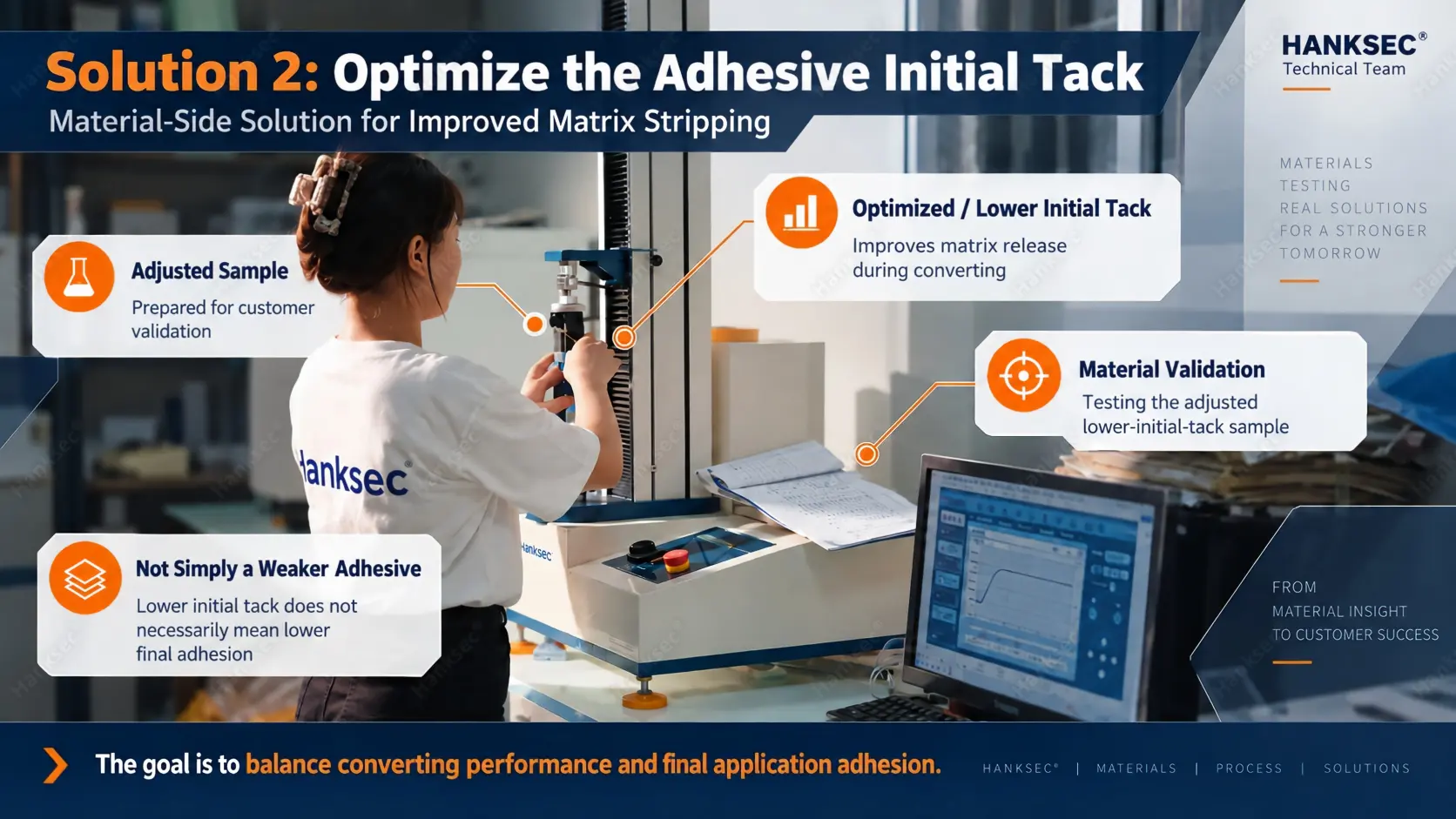
Our technical team prepared a newly adjusted sample roll using an adhesive formulation with reduced initial tack.
The purpose was not simply to make the adhesive weaker.
The objective was to create a better balance between:
converting release behavior and final application adhesion.
Why Lower Initial Tack Can Improve Matrix Stripping
During converting, the matrix is removed shortly after the label has been die cut.
If the adhesive develops very strong initial grab during this short stage, the waste matrix can be more resistant to clean separation around small die-cut labels.
By appropriately reducing the initial tack, the matrix can release more easily during stripping.
This can help reduce:
- labels lifting into the waste matrix;
- adhesive pull around the cut edge;
- unstable matrix removal;
- production interruptions.
At the same time, the adhesive formulation still needs to meet the final application requirements of the high-temperature label.
Lower Initial Tack Does Not Necessarily Mean Lower Final Adhesion
This distinction is extremely important.
Lower initial tack does not necessarily mean lower final adhesion.
Initial tack, peel adhesion, shear resistance, release behavior and temperature resistance describe different aspects of pressure-sensitive adhesive performance and should not be treated as one single property.
Industry test systems such as FINAT test methods evaluate peel adhesion, release force, shear resistance, loop tack and adhesive coat weight separately. This is important because an adhesive can be adjusted to provide a lower initial grab during converting while still maintaining the peel, shear and temperature performance required in the final application.
Adhesive selection should therefore be evaluated as part of the complete label system rather than by tack alone. For a broader explanation of substrate compatibility, adhesive behavior and pre-production qualification, see Hanksec’s Tamper Evident Label Adhesive Guide.
- Initial tack describes the adhesive’s immediate grab during initial contact.
- Peel adhesion describes resistance to peeling after bonding under specified conditions.
- Shear resistance relates to the adhesive’s ability to resist movement under sustained load.
- Temperature resistance describes how the adhesive system performs under the required thermal conditions.
A professional adhesive adjustment therefore requires balancing several properties instead of simply increasing or decreasing “stickiness.”
This is why material engineering can become an important part of solving converting problems.
The Customer Validation Test: Same Machine, Same Die Sizes, New Material
The most important part of this case was the customer’s follow-up validation test.
After receiving the newly adjusted sample roll, the customer carried out another converting trial.
The key point was that the customer continued using:
- the same machine;
- the same die sizes;
- the existing converting setup.
The customer subsequently reported satisfactory conversion and provided a production video showing the improved result.
The following feedback was received after the customer tested the adjusted lower-initial-tack sample material:
The customer’s feedback stated:
“The recent sample roll tried found satisfactory conversion on the same die sizes on the same machine.”
This comparison provided very useful technical evidence.
Because the machine and die sizes remained the same, while the optimized material produced satisfactory conversion, the result strongly indicated that the adhesive adjustment had significantly improved the converting window for this particular application.
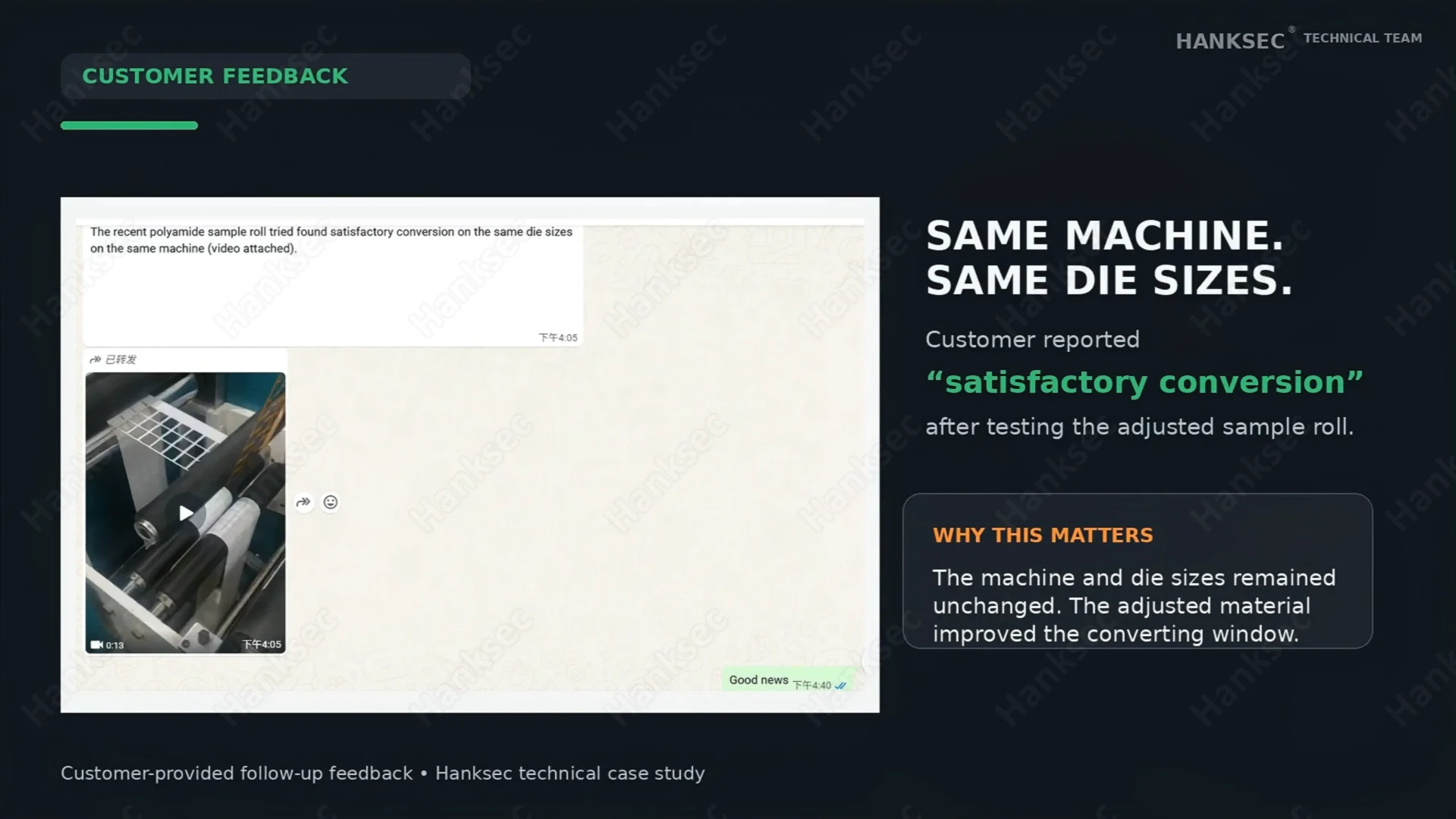
Most importantly, the customer was able to resolve the matrix stripping issue without replacing the existing converting machine.
Two Different Solutions for the Same Matrix Stripping Problem
This case demonstrates why matrix stripping problems should be approached from more than one direction.
There were two valid engineering solutions.
Option 1: Process-Side Optimization
Modify the stripping geometry by replacing the round stripping path with a flat peel-bar / blade-shaped guide that creates a smaller bending radius.
This approach focuses on increasing the effectiveness of mechanical separation between the matrix and finished labels.
Option 2: Material-Side Optimization
Adjust the adhesive formulation to reduce initial tack and improve matrix release under the customer’s existing production conditions.
This approach focuses on widening the material’s converting window without requiring major changes to the customer’s equipment.
Process-Side vs. Material-Side Optimization
| Production Situation | Process-Side Optimization | Material-Side Optimization |
|---|---|---|
| Stripping geometry can easily be changed | Recommended option | Optional |
| Existing machine is difficult to modify | May be limited | Strong option |
| Thick facestock | Flat peel-bar geometry may improve separation | Adhesive behavior can also be optimized |
| Small or micro labels | A smaller-radius, more abrupt separation geometry can help | Initial tack can be adjusted |
| High initial tack contributes to stripping difficulty | Mechanical changes may compensate | Direct material optimization |
| Customer wants to keep the same machine | May be inconvenient | Highly practical solution |
| Best engineering approach | Evaluate both the converting process and the material before deciding | |
Same Material Does Not Always Mean the Same Converting Result
One of the most important lessons in specialty label converting is that a material does not operate independently.
The final production result is influenced by the complete system:
Material + Adhesive + Die + Machine + Label Geometry + Web Path + Matrix Tension + Operator Setup
Changing only one of these variables can change the converting result.
This explains why one converting line may run smoothly while another experiences difficulty with a similar label construction.
It also explains why the solution should not automatically be:
“The customer must change the machine.”
or:
“The material must be defective.”
A more useful technical question is:
Which part of the complete material-and-converting system should be optimized?
There Is No Universal Solution for Matrix Stripping Problems
For one converter, changing the stripping geometry may be the fastest and most economical solution.
For another converter, changing the existing machine may be difficult, while adjusting the material construction may be much more practical.
This is why a professional material supplier should not respond to every converting problem with the same recommendation.
The correct diagnosis should consider:
- facestock type and thickness;
- adhesive type and coat weight;
- initial tack;
- label dimensions;
- label spacing;
- die-cutting quality;
- release liner condition;
- waste-stripping geometry;
- matrix tension;
- machine configuration;
- final label application requirements.
Only after these factors are understood should the technical team decide whether the most practical solution lies in:
the converting process, the material design, or both.
Practical Recommendations for Converters Working with Thick High-Temperature Labels
Based on this case and our converting experience, several checks are particularly useful when thick high-temperature labels show unstable matrix stripping.
1. Confirm Complete Die Cutting
Check whether the facestock and adhesive are consistently cut around the entire label perimeter.
Even a small partially connected area can significantly increase stripping resistance.
2. Avoid Excessive Liner Damage
Do not assume that continuously increasing die pressure is the best solution.
The goal is to completely cut the facestock and adhesive while avoiding excessive scoring of the release liner.
This is particularly important when the finished labels will later be automatically dispensed.
3. Check the Stripping Geometry
If conventional roll stripping repeatedly causes small labels to lift, evaluate whether the machine can use a flat peel-bar or plate-type stripping guide with a smaller bending radius.
4. Review Matrix Tension
Excessive waste-web tension can increase the upward pulling force applied to small labels.
Insufficient or unstable tension can also cause inconsistent waste handling.
The correct setting depends on the label dimensions, material stiffness, waste-web strength and stripping path.
5. Review Label Layout and Spacing
Small labels have a narrower converting tolerance than large labels.
Label spacing, matrix bridge width and overall layout can all influence waste stability.
6. Consider Adhesive Initial Tack
If mechanical parameters appear reasonable but matrix stripping remains difficult, adhesive behavior should also be considered.
For some projects, reducing initial tack while maintaining the required final adhesion can significantly improve converting performance.
7. Test on the Customer’s Actual Production Equipment
Laboratory testing and real production converting answer different questions.
For difficult or critical applications, actual testing on the customer’s machine can provide the most meaningful validation.
In this case, the successful test on the same machine and same die sizes was especially valuable because it directly demonstrated the effect of the adjusted material.
Why Material Engineering Matters in High-Temperature Label Projects
High-quality raw material is only the starting point.
Specialty label products eventually need to operate inside a real converting and application system.
For difficult projects, the material supplier may need to consider not only:
- temperature resistance;
- facestock thickness;
- adhesion;
- chemical resistance;
but also:
- die-cutting behavior;
- matrix stripping performance;
- automatic dispensing;
- customer equipment limitations;
- label dimensions.
This is where material engineering becomes especially valuable.
A standard specification may work for many customers, but a difficult converting application may require adjustments that create a better balance between production efficiency and final-use performance.
For buyers and label converters who need a broader framework for evaluating facestock, adhesive performance, temperature exposure, printing compatibility and supply formats, see Hanksec’s High Temperature Label Materials Buyer’s Guide.
For projects that cannot be solved with a standard stock construction, Hanksec can also evaluate custom label material solutions according to the required facestock, adhesive, liner, converting process and final application.
Why Technical Support Matters Beyond Material Supply
At Hanksec, we do not treat converting feedback simply as a complaint-response process.
For specialty security and high-temperature label materials, technical feedback can provide important information about how the material interacts with real production equipment.
When a customer reports a converting issue, useful diagnostic information can include:
- production videos;
- close-up photos of the matrix;
- label dimensions;
- die sizes;
- machine configuration;
- stripping method;
- application requirements.
In this case, the customer’s photos and videos helped our technical team evaluate the matrix stripping behavior.
We first identified a possible process-side solution and then developed a material-side solution that better matched the customer’s existing production setup.
The customer’s successful follow-up test completed the technical feedback loop:
Customer Problem → Technical Analysis → Process Recommendation → Material Adjustment → Same-Machine Validation → Successful Conversion
What This Real Customer Case Demonstrates
This case provides several important lessons for converters and industrial label buyers.
- A matrix stripping failure does not automatically prove that the raw material is defective.
- Machine configuration and stripping geometry can strongly influence converting performance.
- Thick facestock and small labels require a narrower and more carefully controlled process window.
- Adhesive initial tack can affect matrix stripping behavior.
- Changing the machine is not the only possible solution.
- Material formulation can sometimes be adjusted to match the customer’s existing production conditions.
- Real production validation is more useful than relying only on theoretical assumptions.
Final Conclusion
The matrix stripping problem in this real high-temperature label project was not caused by one isolated factor.
It involved the interaction between:
- approximately 50 μm facestock;
- approximately 25 μm high-temperature adhesive;
- small label dimensions;
- adhesive initial tack;
- die-cutting conditions;
- and the customer’s existing stripping configuration.
Two practical solutions were identified.
Solution 1 — Process Optimization:
Replace the round stripping path with a flat peel-bar / blade-shaped stripping guide to create a smaller bending radius and improve mechanical separation.
Solution 2 — Material Optimization:
Adjust the adhesive formulation and appropriately reduce initial tack to improve matrix release while maintaining the required final application performance.
The customer ultimately validated the material-side solution using the same machine and the same die sizes.
The adjusted sample achieved satisfactory conversion and successfully resolved the original processing difficulty.
The broader lesson is simple:
Good material is the foundation.
Correct converting makes it work.
Material engineering can make it easier to convert.
Technical support connects all three.
High-Temperature Label Matrix Stripping FAQs
Is matrix stripping failure always caused by poor label material quality?
No. Material quality is one possible factor, but matrix stripping is also strongly influenced by die-cutting depth, label dimensions, adhesive behavior, waste tension, stripping geometry and machine configuration. The complete converting system should be evaluated before determining the root cause.
Why are thick high-temperature labels more difficult to strip?
Thicker facestock has greater bending stiffness, while a relatively heavy adhesive layer can increase resistance around the die-cut edge. These factors create a narrower converting window compared with many conventional thin labels.
Why are small labels more difficult during matrix stripping?
Small labels are more sensitive to local lifting forces. Even a relatively small amount of upward force from the waste matrix can cause a micro label to follow the waste instead of remaining on the release liner.
Can flat peel-bar stripping improve matrix removal?
Yes. For many thick-facestock and micro-label applications, a flat peel-bar or plate-type stripping guide can redirect the liner over a smaller bending radius and create a more abrupt separation geometry. This can improve matrix release. However, this configuration is not universally required for every label product.
Can changing the adhesive solve a matrix stripping problem?
Yes. If adhesive behavior contributes to the stripping difficulty, adjusting the formulation and initial tack can create a wider converting window. The final adhesive system must still meet the required application performance.
Does lower initial tack mean the final label will have weak adhesion?
No. Initial tack and final adhesion are not the same property. Initial tack, peel adhesion, shear resistance and temperature resistance describe different aspects of adhesive performance. An adhesive can be engineered for lower initial tack while still providing the final adhesion required for the application.
Why did the adjusted material work on the customer’s existing machine?
The customer tested the adjusted sample roll using the same machine and the same die sizes and reported satisfactory conversion. This indicated that changing the adhesive behavior improved the converting window without requiring the customer to replace the existing machine.
Should converters change the machine or change the material first?
There is no universal answer. If the stripping geometry can easily be optimized, process adjustment may be the most efficient solution. If changing the machine is difficult, material-side optimization may be more practical. In difficult projects, both directions should be evaluated.
Can 50 μm high-temperature label materials be used for automatic labelling?
Yes, provided that the complete label construction, release liner and die-cutting quality are suitable for the actual dispensing system. The liner should not be excessively damaged during die cutting.
What information should be provided when requesting technical support for a stripping problem?
Useful information includes the material construction, label dimensions, die size, machine type, stripping method, production photos, converting videos and final application requirements. This information helps identify whether the best solution should come from process optimization, material optimization or both.
Need Help Solving a High-Temperature Label Converting Problem?
If your production team is experiencing problems such as:
- matrix stripping failure;
- finished labels lifting with the waste;
- difficult die cutting;
- micro-label converting problems;
- thick PET or PI processing difficulties;
- adhesive-related converting issues;
send Hanksec your material structure, label dimensions, die size, machine information, production photos or converting video.
Our technical team can evaluate both process-side optimization and material-side optimization to help identify a more practical solution for your production line.
REQUEST TECHNICAL SUPPORT & SAMPLE TESTING