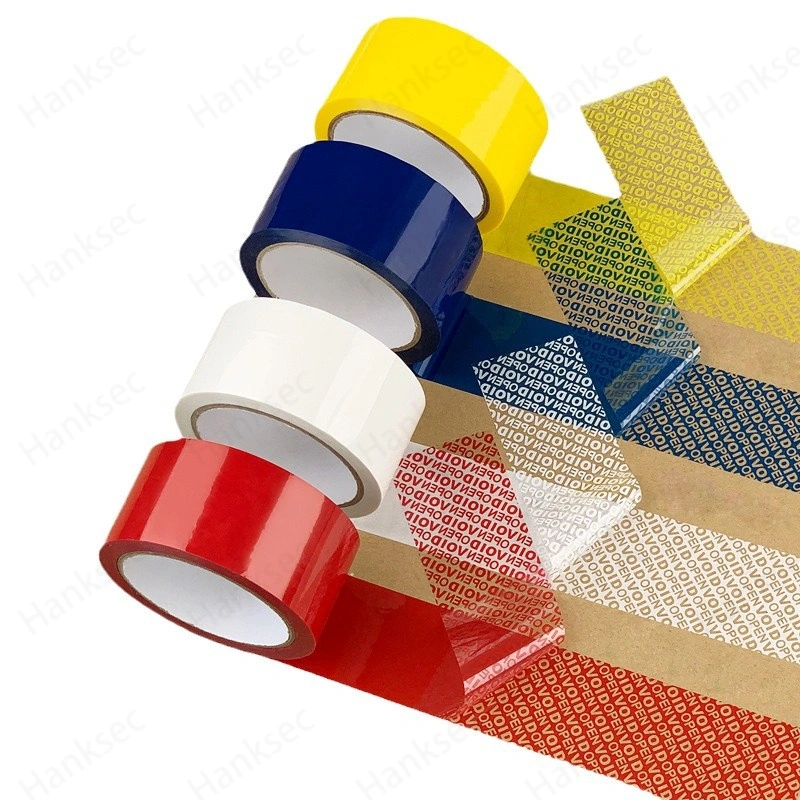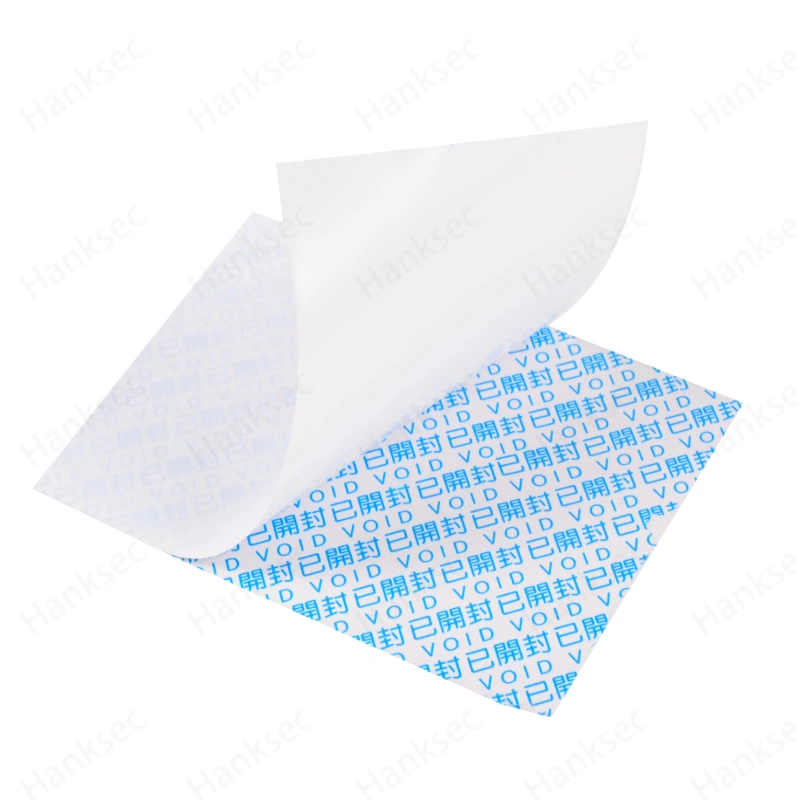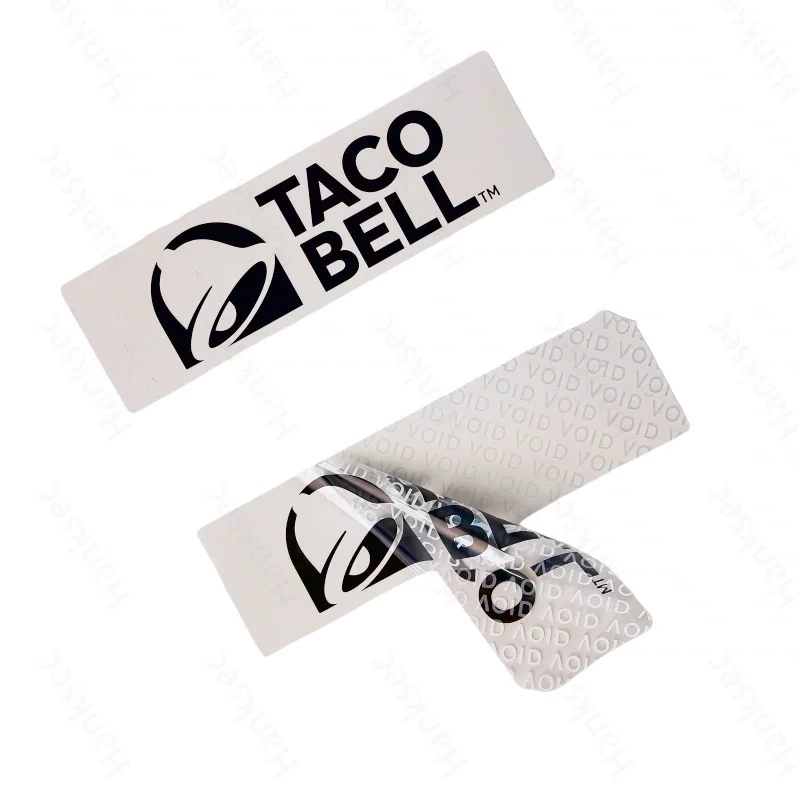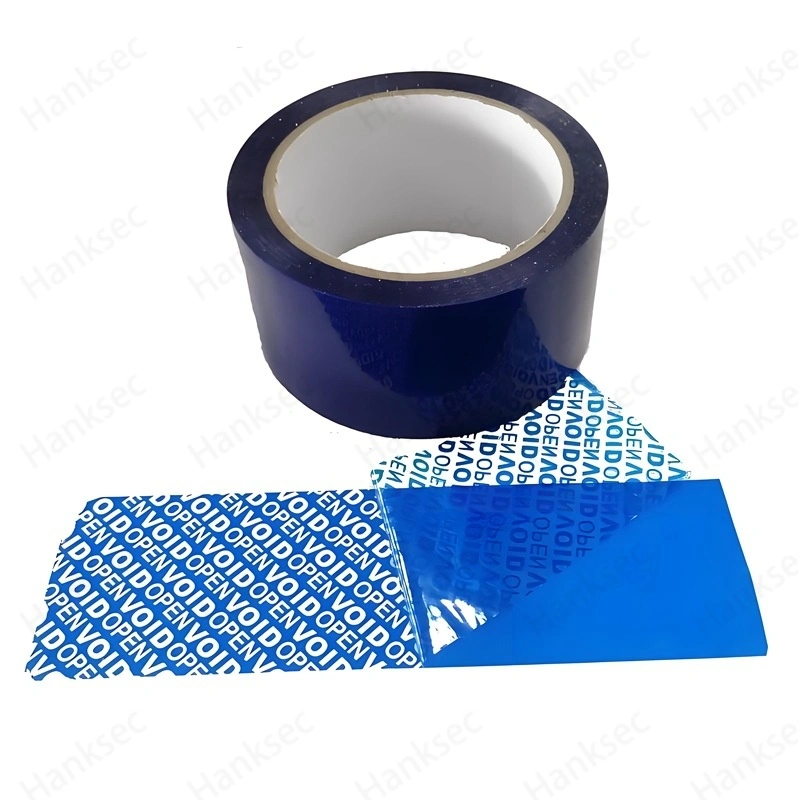
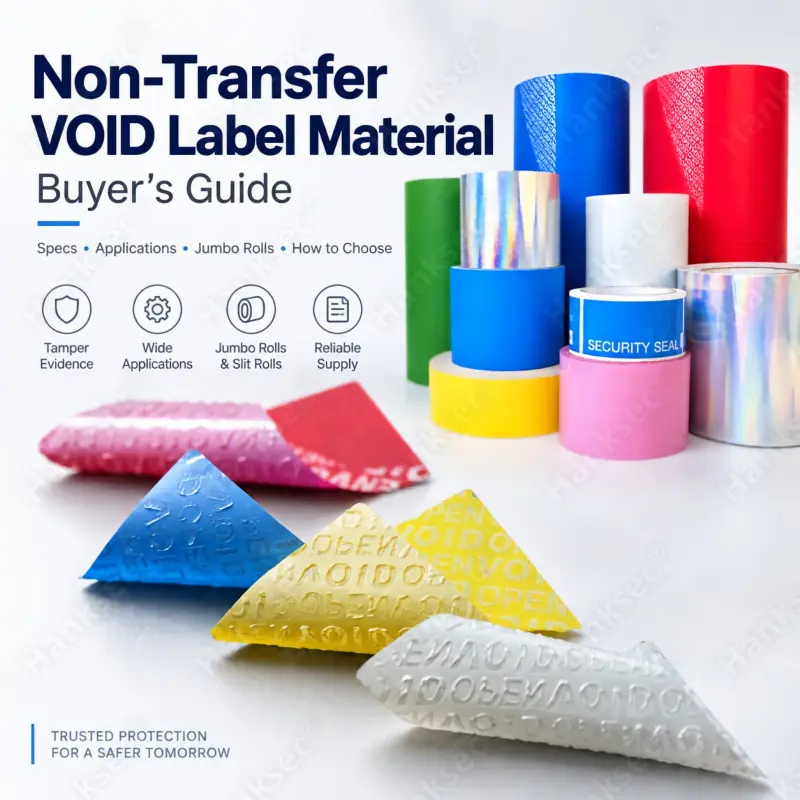
Quick Answer: Non-Transfer VOID Label Material is a tamper-evident security material designed for applications where buyers want a visible VOID / OPENED message after removal but prefer the applied surface to remain relatively clean. It is commonly selected for electronics, glass, metal, reusable assets, premium packaging and other high-value surfaces where strong permanent transferred residue is not desirable.
For B2B buyers and label converters, the main purchasing questions are practical: Which transfer type should I choose? What surface will the label be applied to? What PET thickness, adhesive, liner and roll format do I need? Can the material be printed and die cut on my equipment? Can the hidden message and color be customized?
This buyer’s guide focuses on those commercial decisions. For a deeper explanation of coating layers, controlled delamination and adhesive behavior, see Hanksec’s Security Label Material Systems technical guide.
What Is Non-Transfer VOID Label Material?
Non-transfer VOID label material is a pressure-sensitive tamper-evident material in which the hidden security message appears mainly on the removed label film when peeling is attempted, instead of transferring strongly onto the product or package surface.
Before removal, the label looks like a normal printed or blank security label. Once someone tries to peel it away, the internal security layer changes permanently and reveals a message such as VOID, OPENED, VOIDOPEN, SECURITY or a customized logo or text pattern.
This makes non-transfer material useful when the buyer needs two results at the same time:
- clear evidence that the label has been removed or disturbed;
- a cleaner product surface than a typical full-transfer VOID construction.
Hanksec supplies Non Transfer VOID Security Material in converter-ready and finished-label formats. Buyers who are still comparing all three transfer types can first review What Is VOID Label Material?.
Why Choose Non-Transfer VOID Label Material?
Non-transfer VOID material is mainly selected when surface appearance, clean removal and tamper visibility all matter.
Typical purchasing reasons include:
- Cleaner removal on valuable surfaces: suitable for projects where buyers do not want a strong permanent VOID pattern covering the product.
- Visible one-time tamper evidence: the removed label shows an irreversible security message.
- Suitable for high-value products: commonly evaluated for electronics, instruments, reusable assets and premium packaging.
- Custom security message: standard VOID / OPENED patterns can be replaced with a brand name, logo or project-specific message.
- Converter-ready supply: material can be supplied as jumbo rolls or slit rolls for printing and die cutting in-house.
- Multiple printing options: the surface can be selected or treated according to UV, flexo, thermal-transfer, digital and other printing requirements.
Important purchasing note: “non-transfer” mainly describes where the hidden security message appears. It should not automatically be interpreted as a guarantee of absolutely zero adhesive trace on every substrate. Adhesive formulation, dwell time, temperature, ageing, coatings and the actual application surface can affect residue. If a clean surface is critical, include that requirement in the sample approval specification.
Non-Transfer vs Full-Transfer vs Partial-Transfer VOID Materials
Choosing the right VOID material begins with deciding where you want the tamper evidence to remain after removal.
| VOID Material Type | What Happens After Removal | Residue / Evidence on Applied Surface | Best Purchasing Fit |
|---|---|---|---|
| Full Transfer | The hidden message transfers strongly to the applied surface. | High / obvious | Cartons, warranty seals and applications where permanent visible evidence on the substrate is required. |
| Partial Transfer | Evidence appears on both the removed label and the applied surface. | Partial | General packaging and applications that need a balance between security and surface appearance. |
| Non-Transfer | The VOID / OPENED message appears mainly on the removed label film. | Clean or low-residue target depending on construction and substrate | Electronics, glass, reusable assets, premium surfaces and other applications where cleanliness matters. |
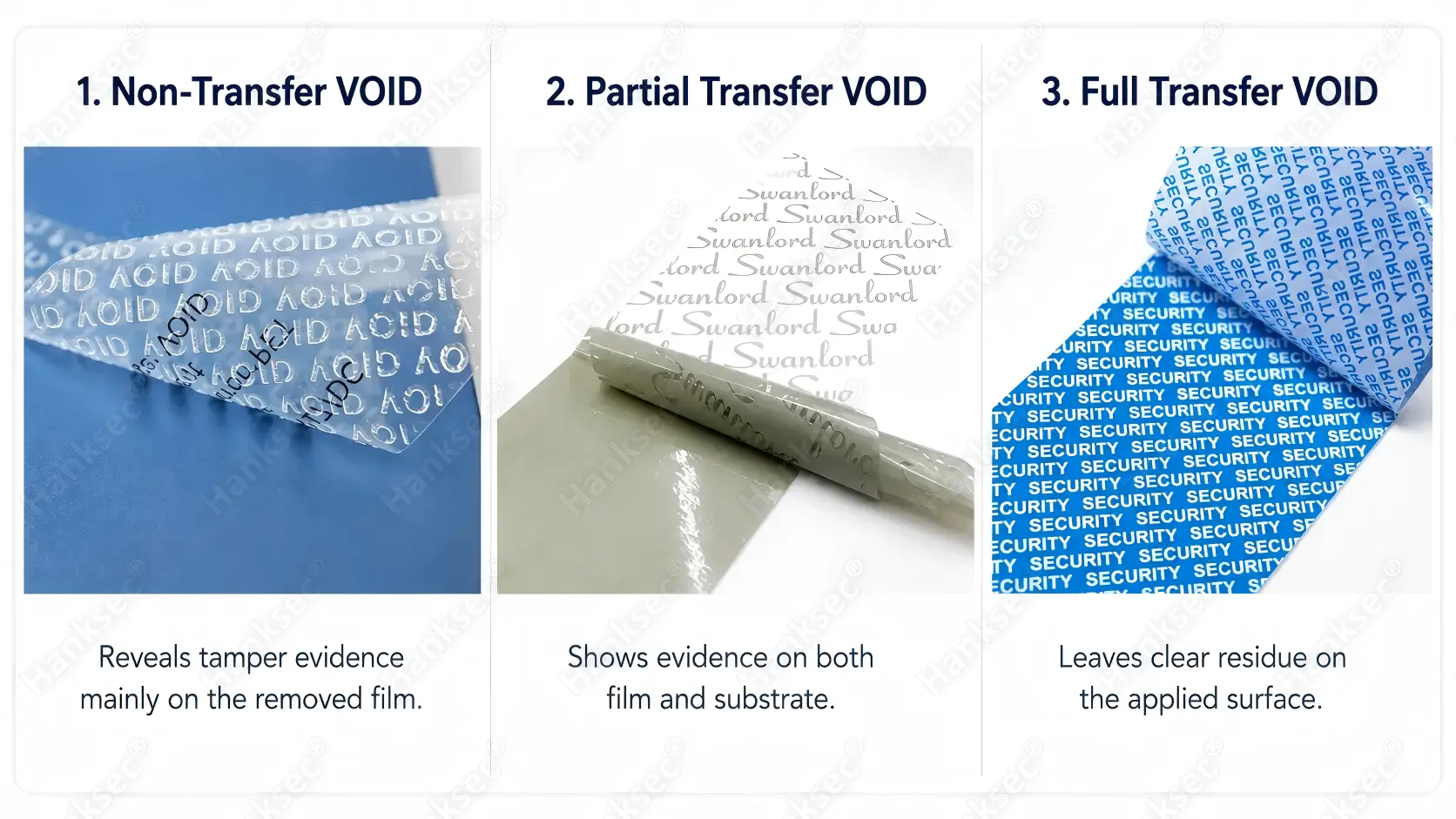
There is no single “best” transfer type. A full-transfer material may be more suitable when inspectors need a strong message left behind on the carton, while a non-transfer construction is usually more appropriate when the product itself should remain visually clean.
Label converters who need to compare transfer type together with roll width, liner and printing requirements can use Hanksec’s VOID Label Material Rolls: Jumbo & Slit Roll Selection Guide.
Non-Transfer VOID Label Material Specifications
The material should be purchased as a complete specification, not only by the phrase “non-transfer VOID.” The table below summarizes typical Hanksec options. Final specifications should be confirmed on the selected sample, quotation and technical data.
| Specification | Typical Hanksec Options | What the Buyer Should Confirm |
|---|---|---|
| Facestock | PET or custom construction | Durability, flexibility and printing requirements |
| Thickness | 25 / 36 / 50 μm or custom | Label size, stiffness, die cutting and dispensing |
| Hidden Message | VOID / VOIDOPEN / OPENED / SECURITY / custom logo or text | Required visual effect and message size |
| Color | Silver, gold, blue, red, black, white, yellow, green, transparent, orange, holographic or Pantone-matched options | Brand appearance and printing contrast |
| Adhesive | Pressure-sensitive acrylic / project-specific hot-melt options | Actual substrate, residue target and environment |
| Finish | Glossy / matte | Visual effect and printing process |
| Release Liner | 60 / 80 gsm glassine, kraft paper or custom | Die cutting, matrix stripping and dispensing |
| Roll Width | 100 / 200 / 300 / 530 / 1070 mm or custom | Printing and slitting equipment |
| Roll Length | 400 / 500 / 1000 / 2000 m or custom | Roll diameter and machine capacity |
| Core | 3 inch or custom | Unwind / rewind equipment |
| Standard Listed Temperature Range | Approx. -20°C to 80°C for standard constructions | Confirm against the actual selected adhesive and application |
| Printing | UV, flexo, screen, rotary, offset, thermal transfer, digital and selected inkjet constructions | Ink / ribbon / top-coating compatibility |
| MOQ | Stock materials may support low or no MOQ; custom constructions depend on project specifications | Color, hidden message, width and custom coating requirements |
If the material will be printed by your own factory, “printable PET” is not enough information. The top surface must match the actual ink, ribbon and curing process. See Hanksec’s Printable Security Label Materials Guide for a more detailed printing qualification checklist.
Need a quotation? Send Hanksec your application surface, required residue level, printing method, roll width, label size and estimated quantity for a faster material recommendation.
Applications & Best Surfaces for Non-Transfer VOID Labels
Non-transfer materials are most attractive where buyers need visible security evidence but do not want heavy transferred marking on the product. The final adhesive should still be matched to the real surface.
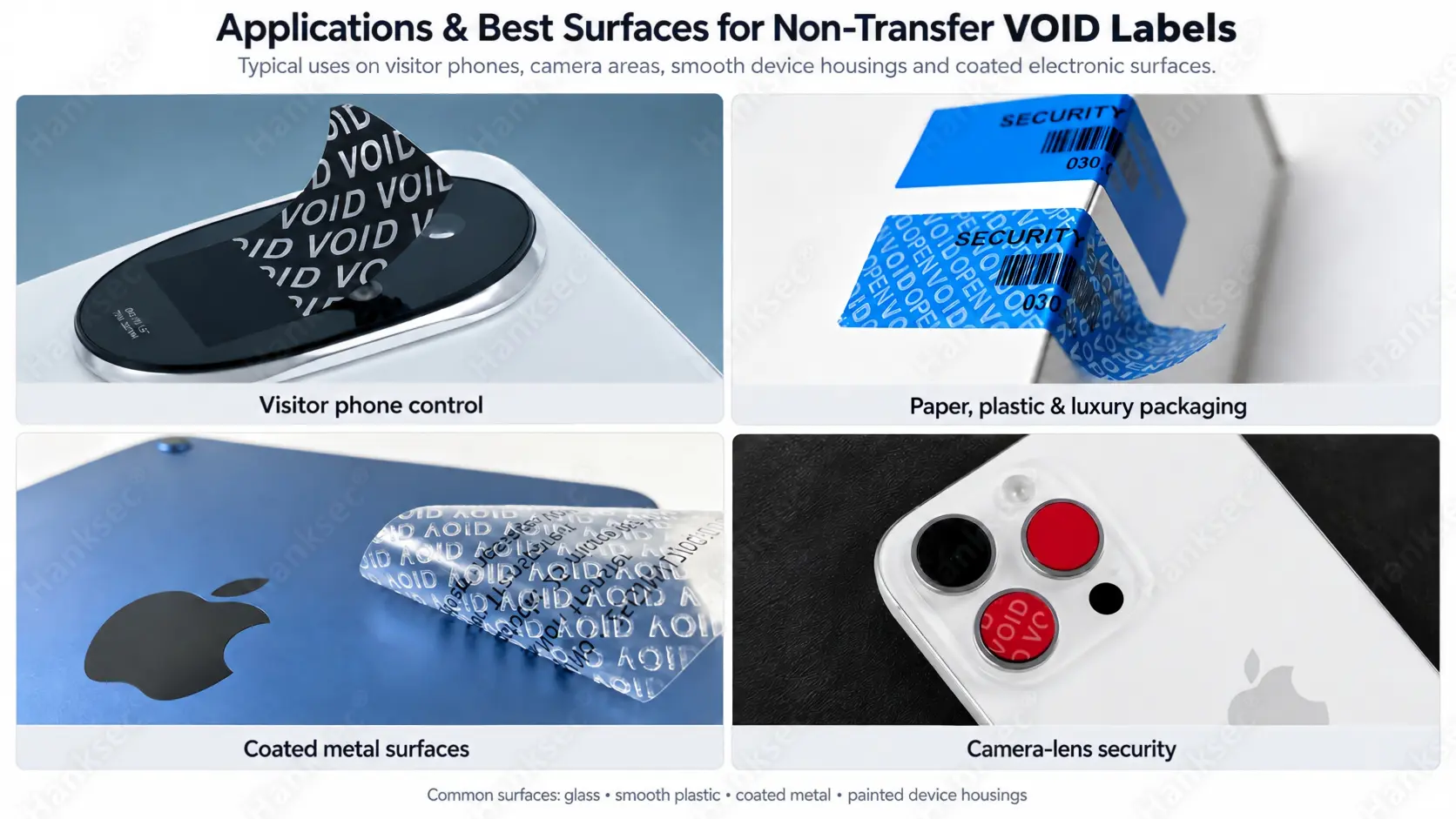
Electronics & Camera Security
Common uses include warranty labels, inspection seals, device housings, phone-camera security labels, service-access points and IT assets. These applications often require a clean-looking device after inspection or authorized label removal.
For restricted-area camera control, see Hanksec’s No Photography Phone Camera Stickers Guide, which discusses surface compatibility and sample testing on phone glass, coated plastic and metal.
Glass & Smooth Metal
Glass and smooth metal are common surfaces for non-transfer security labels because they can provide stable adhesive contact when clean. Buyers should still consider coatings, oils, fingerprints and surface treatments.
Reusable Assets & Equipment
Reusable containers, instruments, test equipment and access-control points may need evidence of unauthorized opening without permanently covering the surface with transferred VOID residue.
Premium Packaging
Luxury boxes, cosmetics, electronics packaging and high-value retail packaging can use non-transfer labels when security is needed but package appearance remains important.
PP, PE & Difficult Plastics
PP and PE frequently require additional adhesive evaluation because many grades have relatively low surface energy. Do not select an adhesive based only on the word “plastic.” Surface treatment, texture, additives and contamination can change the result.
For substrate-specific adhesive selection, review Hanksec’s Tamper Evident Label Adhesive Guide for PP, PE, PET, Glass & Carton.
Custom Non-Transfer VOID Materials & Jumbo Rolls for Label Converters
For label converters and security printers, non-transfer VOID material is often purchased as a jumbo roll or slit roll rather than as a finished label.
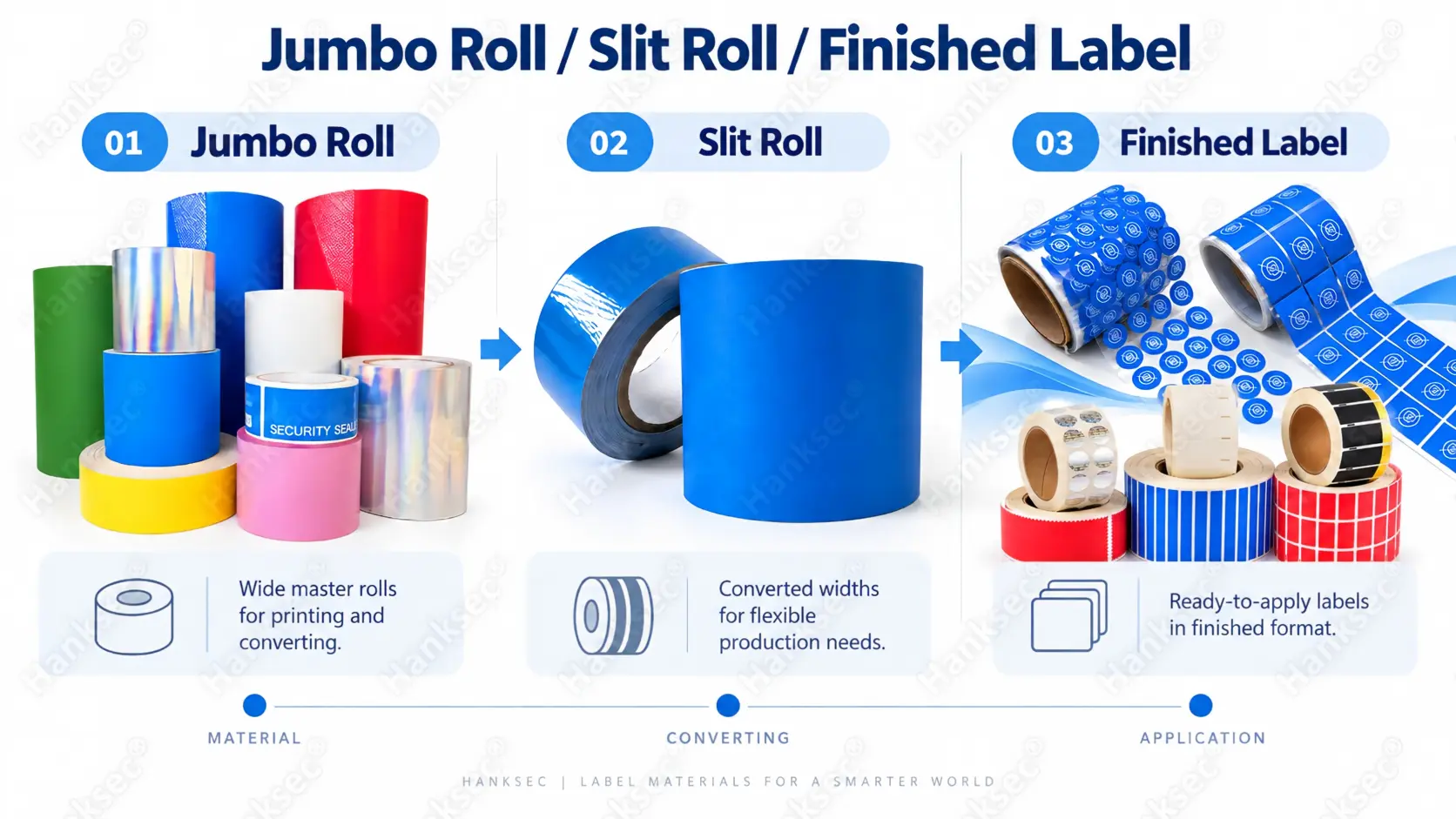
Hanksec can customize the material around the converter’s production requirements, including:
- custom hidden message: VOID, OPENED, VOIDOPEN, brand name, logo or other security pattern;
- custom colors: standard colors, holographic appearance or Pantone-matched projects;
- facestock thickness: selected according to stiffness, label size and converting requirements;
- adhesive: matched to the target substrate and desired residue level;
- release liner: selected for die cutting, matrix stripping and automatic dispensing;
- printing surface: matched to the intended printing process;
- roll width and length: master roll or slit roll according to machine requirements;
- core and winding direction: confirmed before production;
- finished labels: optional printing, serial number, barcode, QR code, custom size and shape.
For converters, the cheapest material price per square meter is not always the lowest production cost. Unstable liner release, poor ink anchorage, unsuitable tack or inconsistent coating can create waste during printing, die cutting, matrix stripping and rewinding.
This is why Hanksec recommends confirming material + printing + converting + application as one project instead of approving a sample only by hand-peeling it from a test plate.
How to Choose the Right Non-Transfer VOID Label Material
A useful purchasing process is to start from the real application rather than from a generic product photo.
- Confirm the application surface. Glass, PET, PP, PE, painted metal, powder coating and laminated cartons can require different adhesive behavior.
- Define the required removal result. Do you need no visible transferred VOID, low adhesive residue, or is some residue acceptable?
- Choose the hidden message. Standard VOID may be sufficient, or the project may require OPENED, VOIDOPEN, logo or custom text.
- Confirm label size and shape. Very small labels can have different die-cutting and matrix-stripping requirements from large labels.
- Confirm the printing method. UV flexo, digital, thermal transfer and inkjet systems do not all use the same surface requirements.
- Confirm the supply format. Jumbo roll, slit roll, sheet or finished label.
- Test the real substrate before bulk production. Evaluate tamper message clarity, residue, adhesion, printing and converting under representative conditions.
For quality-control reference, ASTM D6252/D6252M-98(2025) covers 90-degree peel adhesion testing for pressure-sensitive label stocks and allows representative application surfaces to be used in place of the standard steel panel. The FINAT Test Methods include methods for peel adhesion, high-speed release force, accelerated ageing, shear, loop tack and other properties relevant to self-adhesive label materials.
These methods can support comparative testing and quality control, but a single peel number does not by itself determine whether a non-transfer VOID material is correct for a specific security application.
Before requesting samples, send: application surface, required transfer behavior, residue target, color, label size, printing method, roll width, winding requirement, operating environment and estimated quantity. If the substrate is unusual, sending an actual piece of the product or packaging can make material selection more accurate.
Non-Transfer VOID Label Material FAQs
Does non-transfer VOID label material leave residue?
The main VOID message is designed to remain on the removed label rather than transfer strongly to the applied surface. Actual adhesive trace can still depend on the adhesive, substrate, dwell time, temperature and ageing. If clean removal is critical, approve the material on the real substrate.
What is the difference between non-transfer and no-residue VOID labels?
Non-transfer mainly describes where the security message appears. No-residue describes the desired condition of the applied surface after removal. Buyers should specify both requirements separately.
Is non-transfer VOID material suitable for electronics?
Yes. Electronics, devices and reusable equipment are common applications when visible tamper evidence is needed but strong transferred VOID residue is undesirable. Final compatibility should still be tested on the actual housing, glass or coating.
Can non-transfer VOID material be supplied in jumbo rolls?
Yes. Hanksec supplies jumbo rolls, slit rolls, sheets and finished labels. Roll width, length, core, liner and winding direction can be matched to converter equipment.
Can the VOID message be customized?
Yes. Standard VOID, OPENED, VOIDOPEN and SECURITY patterns can be replaced or combined with custom text, a logo or other project-specific hidden patterns.
Can non-transfer VOID material be printed by label converters?
Yes, when the material surface is matched to the intended printing method. Buyers should confirm ink or ribbon adhesion, curing, barcode readability and final VOID performance before bulk converting.
Which is better: non-transfer or full-transfer VOID material?
Neither is universally better. Non-transfer is more suitable when the applied surface should remain relatively clean. Full transfer is more suitable when a strong permanent message left on the substrate is part of the inspection requirement.
What information is needed for a non-transfer VOID quotation?
Provide the application surface, required residue level, material color, hidden message, thickness, printing method, label size or roll width, roll length, core, quantity and intended environment.
Need Non-Transfer VOID Material for Your Project?
Hanksec supplies non-transfer VOID security materials for label converters, security printers, distributors and brand owners. Available options include custom hidden messages, PET thicknesses, colors, adhesives, liners, printable surfaces, jumbo rolls, slit rolls and finished labels.