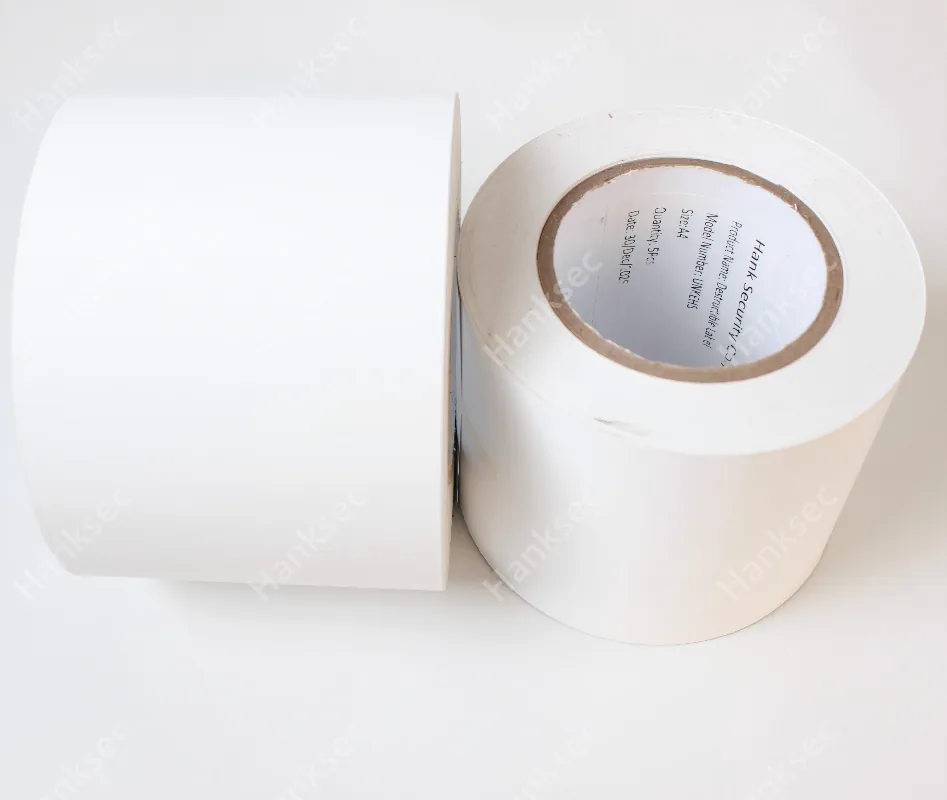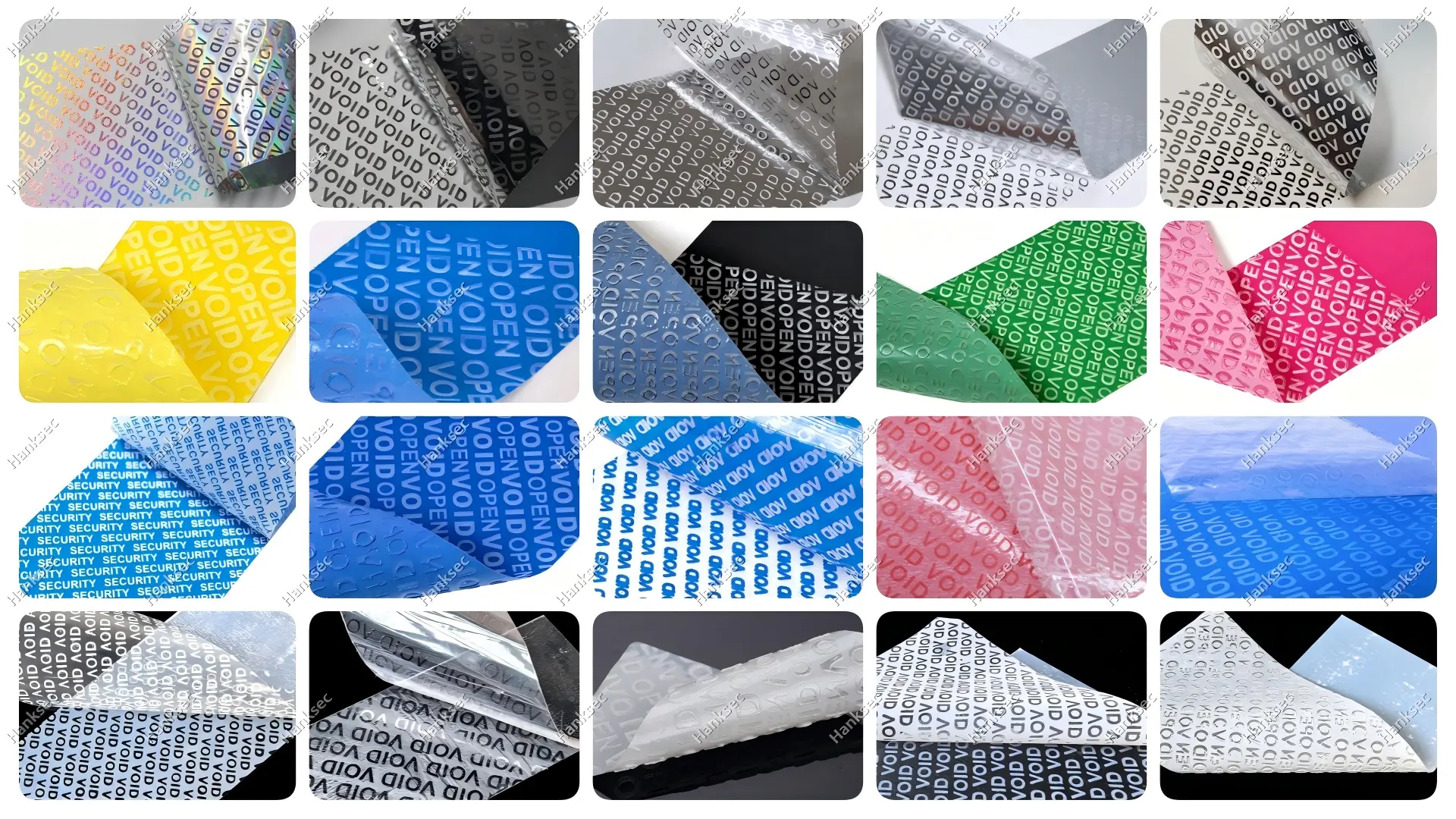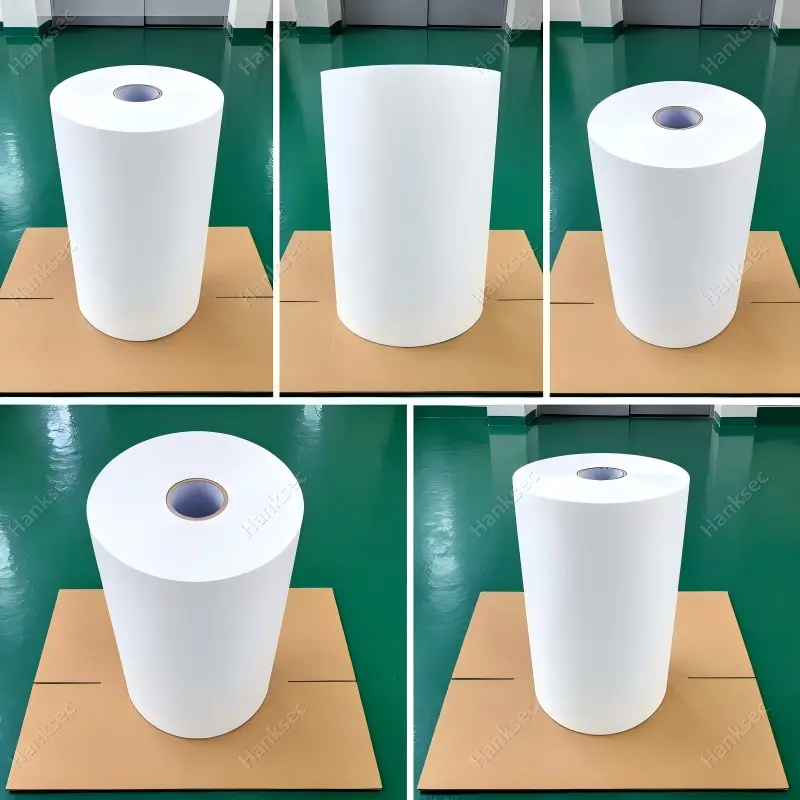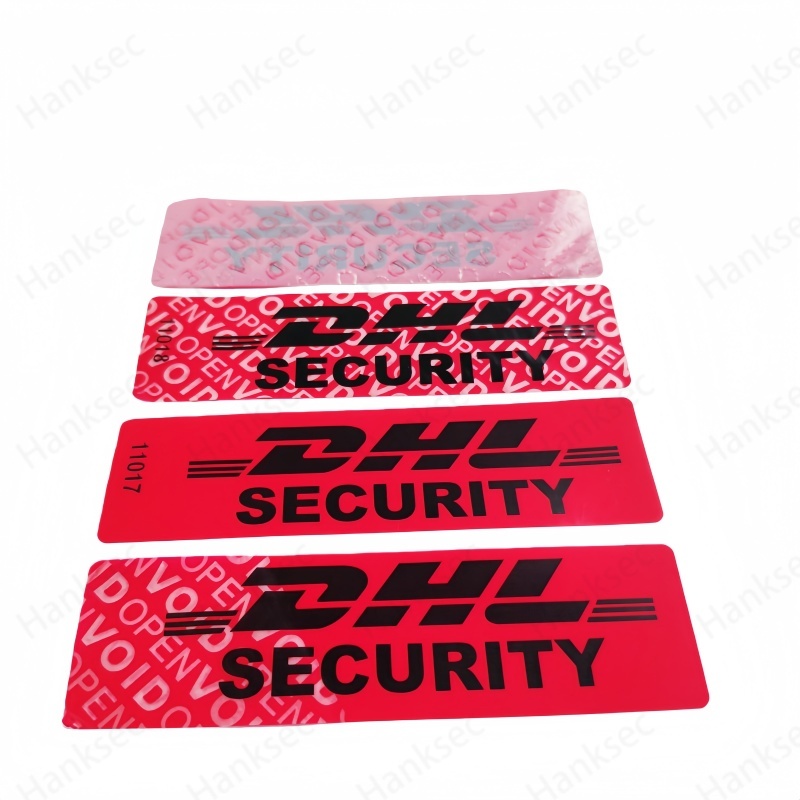
Inkjet printable label materials for security applications require more than a standard PET or destructible facestock that can simply pass through a color label printer.
For label converters purchasing unprinted security materials in rolls, the printable surface must be matched to the actual ink system before printing, die cutting and final label production.
In real production, a security material can produce a clear VOID or OPENED effect after removal and still perform poorly during printing.
The printed image may initially look acceptable, but after rubbing or handling:
- text may smear;
- pigment may scratch away;
- solid areas may lose density;
- small characters may become unclear;
- barcodes or QR codes may lose edge definition.
This is particularly important when synthetic VOID films, destructible security materials or other specialty facestocks are printed with pigment inkjet systems.
At Hanksec, we encountered exactly this problem during practical printing trials using an Epson ColorWorks pigment inkjet label printer.
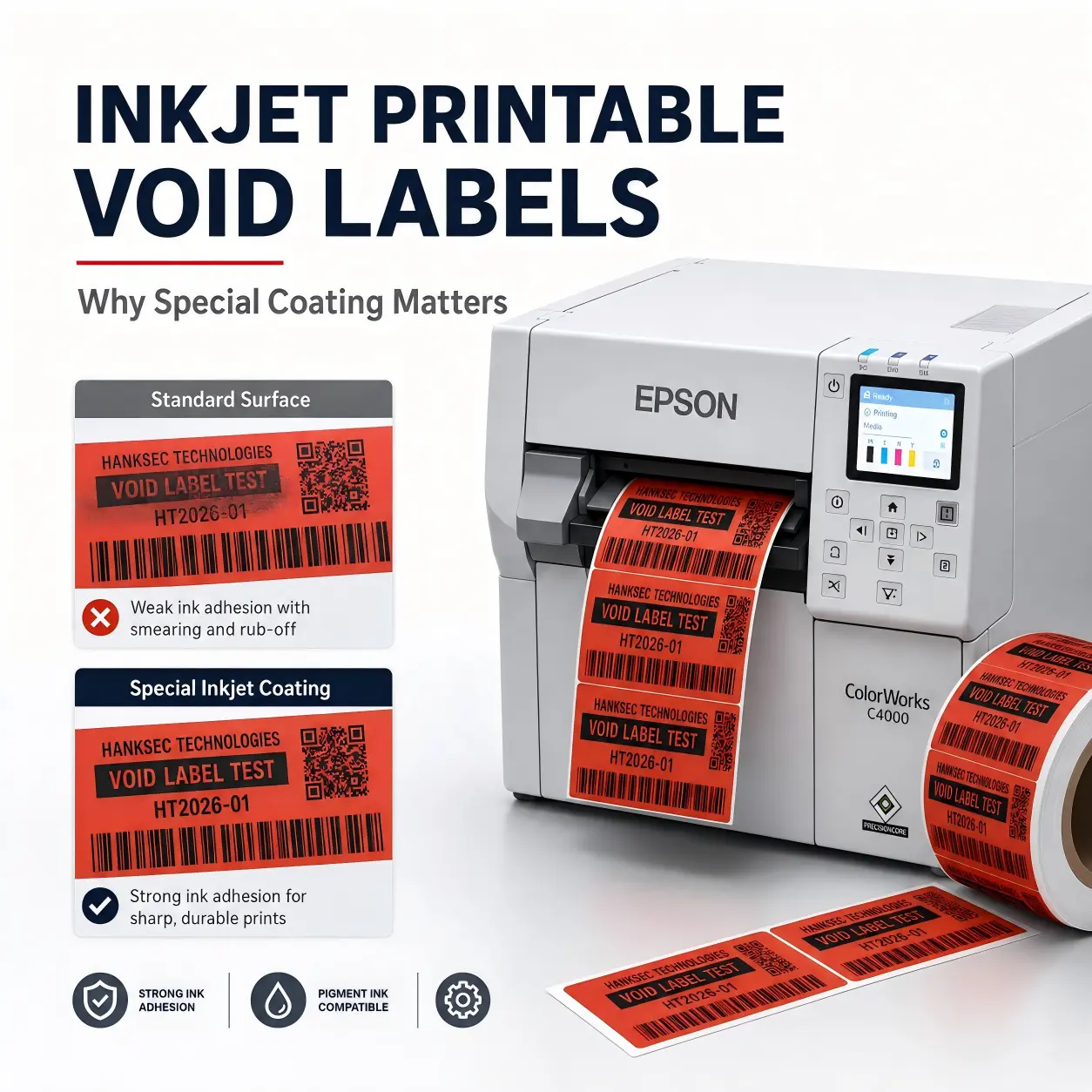
A standard security material without a dedicated inkjet-receptive coating could be printed, but the printed information did not bond strongly enough to the surface. Mechanical rubbing made part of the print easy to remove.
After changing the printable surface construction, the printing result improved significantly.
This leads to an important distinction:
A material being physically printable does not mean it is production-ready for pigment inkjet printing.
The real requirement is:
stable printing + sufficient ink adhesion + readable variable data + converting stability + reliable tamper-evident performance.
This guide explains why special coatings matter, what Hanksec observed during Epson ColorWorks testing, how VOID and destructible materials should be qualified, and what label converters should verify before ordering bulk security material.
Quick Answer: Why Do Inkjet Printable Label Materials Need a Special Coating?
Standard VOID and destructible security materials are not automatically optimized for pigment inkjet printing.
Synthetic security facestocks such as PET may have a relatively closed and non-absorbent surface. If the surface chemistry is not compatible with the ink system, pigment ink may print onto the material without developing sufficient anchorage.
The result can include:
- smearing;
- poor rub resistance;
- weak scratch resistance;
- uneven image density;
- poor fine-text definition;
- unstable barcode or QR performance.
A dedicated inkjet-receptive top coating can change how the printing surface interacts with the ink.
However, this coating must not be evaluated only for print quality.
A tamper-evident label contains several functional layers, so the final construction must still provide the required VOID, OPENED, transfer or destructible response after printing.
The correct approval process is therefore:
Print Performance + Converting Performance + Tamper-Evident Performance.
Real Epson ColorWorks Test: What Happened on Standard Security Material?
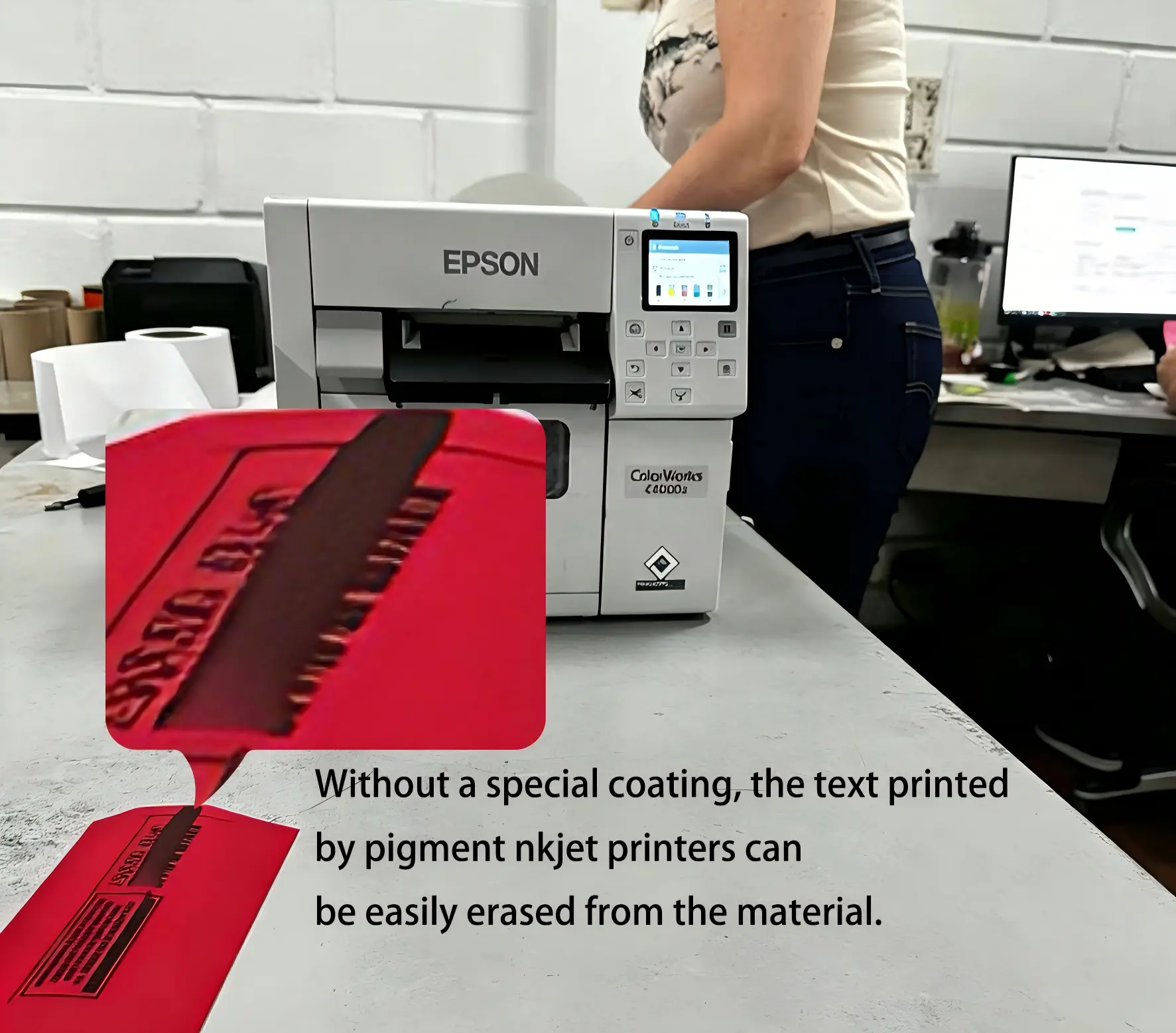
During Hanksec’s internal pigment inkjet compatibility testing, a security material without a dedicated pigment-inkjet coating was printed using an Epson ColorWorks label printer.
The printer itself was able to place the image onto the material.
At first glance, that could easily lead someone to conclude:
“The material is inkjet printable.”
But that conclusion would have been premature.
When the printed area was rubbed, part of the text could be removed relatively easily from the security-film surface.
The problem was not whether ink could reach the material.
The problem was whether the printed image had sufficient adhesion and durability for a real security-label application.
This is an important distinction for converters.
A material can pass through the printer and show a visually recognizable image while still failing the practical requirements of:
- handling;
- rewinding;
- die cutting;
- automatic dispensing;
- application;
- shipping;
- barcode scanning;
- later inspection.
That is why Hanksec does not treat “ink appears on the film” as sufficient evidence of printing compatibility.
Why This Is a Material-Compatibility Problem — Not an Epson Printer Problem
The printing failure shown in the test should not be interpreted as a defect in the Epson printer.
Epson ColorWorks is designed as an industrial color label-printing platform.
The CW-C6000 series, for example, uses pigment ink and supports applications including variable text, barcodes and two-dimensional codes.
The real issue is the interaction between:
printer + pigment ink + security-label surface.
This same principle applies throughout label printing.
Changing only the printer does not automatically solve an incompatible material surface.
Likewise, using a more aggressive ink setting does not necessarily solve poor adhesion.
If the ink-receiving surface is unsuitable, the root problem is normally at the ink/material interface.
For technical information about the printing platform used as the basis of this testing approach, converters can review the official Epson ColorWorks CW-C6000 Series specifications.
Why Ordinary PET VOID Film Is Not Automatically Inkjet Printable
PET is widely used as a facestock for tamper-evident VOID materials because it can provide:
- dimensional stability;
- good converting performance;
- clear, white, silver and colored constructions;
- controlled internal security-layer separation;
- compatibility with different adhesive systems.
But the term PET describes the base polymer—not the complete printable surface.
Two security materials can both use PET facestock while behaving very differently during pigment inkjet printing.
The difference may come from:
- surface treatment;
- top coating;
- surface energy;
- surface roughness;
- coating chemistry;
- surface contamination;
- storage condition;
- ink chemistry.
This is why a specification such as:
“50 μm PET VOID”
is not enough to determine printing compatibility.
A more useful technical specification includes:
facestock + printable surface treatment + VOID construction + adhesive + liner + printing technology.
Buyers who need a deeper explanation of the underlying functional layers can review our VOID Label Material Guide.
How Inkjet Coating and Tamper-Evident Layers Work Together
This is one of the most important points for understanding inkjet printable security materials.
A printable VOID material can be simplified as:
Pigment Ink
↓
Inkjet-Receptive Top Coating
↓
PET Face Film
↓
Security / Release Layer
↓
Hidden VOID or OPENED System
↓
Pressure-Sensitive Adhesive
↓
Release Liner
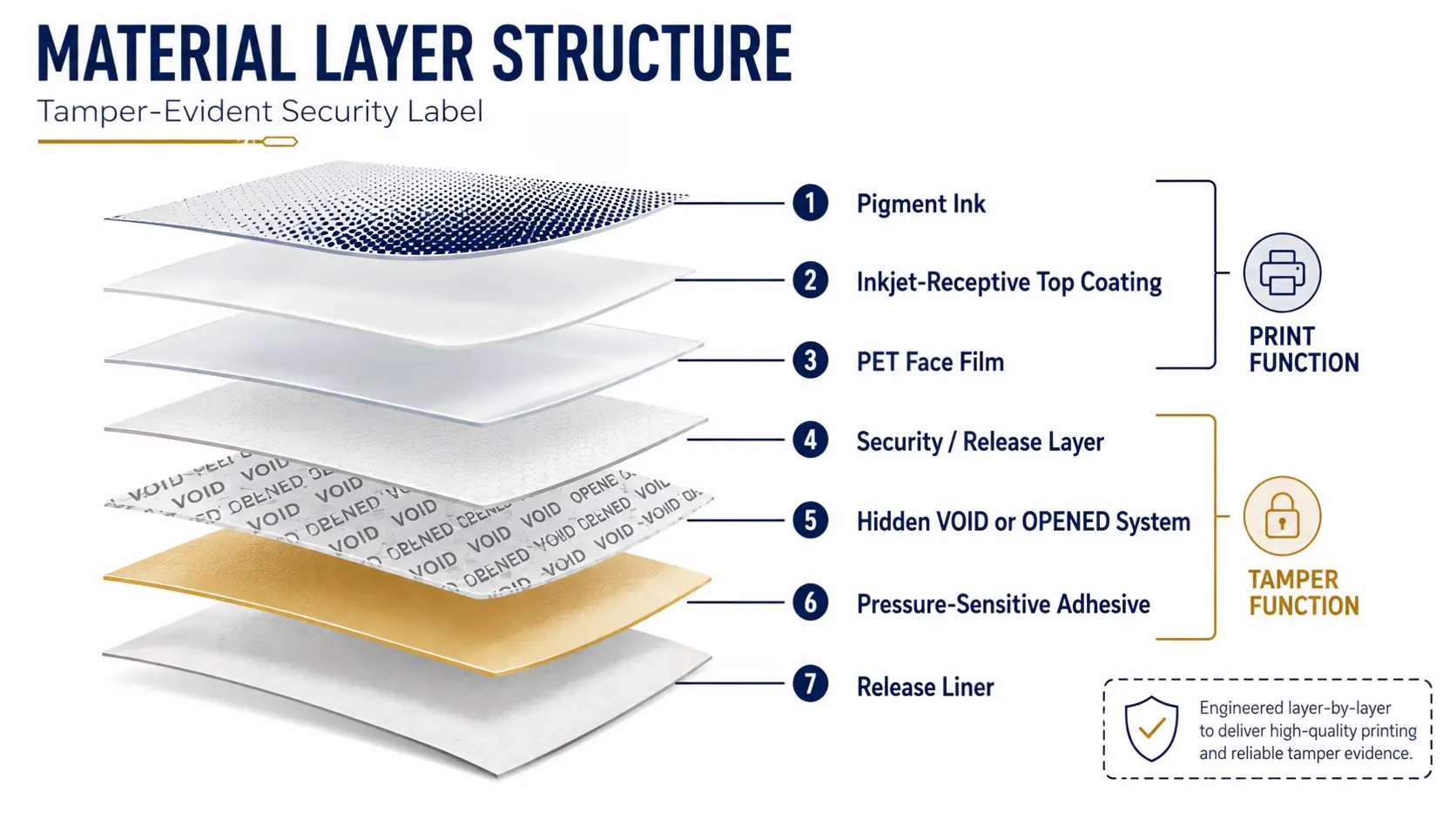
The upper coating primarily supports the printing function.
The internal release and security layers primarily control the tamper response.
The adhesive controls bonding to the final substrate.
These functions are connected, but they should not be confused.
A coating that improves ink adhesion does not automatically guarantee good VOID performance.
Likewise, a security construction that produces an excellent VOID effect does not automatically guarantee good pigment-inkjet adhesion.
This is why Hanksec treats the product as a complete security label material system rather than only a piece of printed PET.
What Does the Inkjet-Receptive Coating Do?
The purpose of a special inkjet coating is to create a more suitable interface between the security-film surface and the ink deposited by the printer.
Depending on the final coating system, it may help improve:
- ink reception;
- controlled wetting;
- surface fixation;
- pigment anchorage;
- image definition;
- rub resistance;
- scratch resistance;
- small-text clarity;
- barcode definition;
- QR code consistency.
The coating should not be described as simply “making the film absorb ink like paper.”
Synthetic security films and coated papers behave differently.
The goal is to engineer a surface that works with the intended printing chemistry while maintaining the functional properties of the multilayer security construction underneath.
What Changed After the Printable Surface Was Modified?
After the initial printing problem was identified, the material construction was changed to include a surface designed specifically for pigment inkjet printing.
The material was then tested again using the same type of printing platform.
Compared with the standard untreated or incompatible surface, the coated construction showed better practical printing behavior.
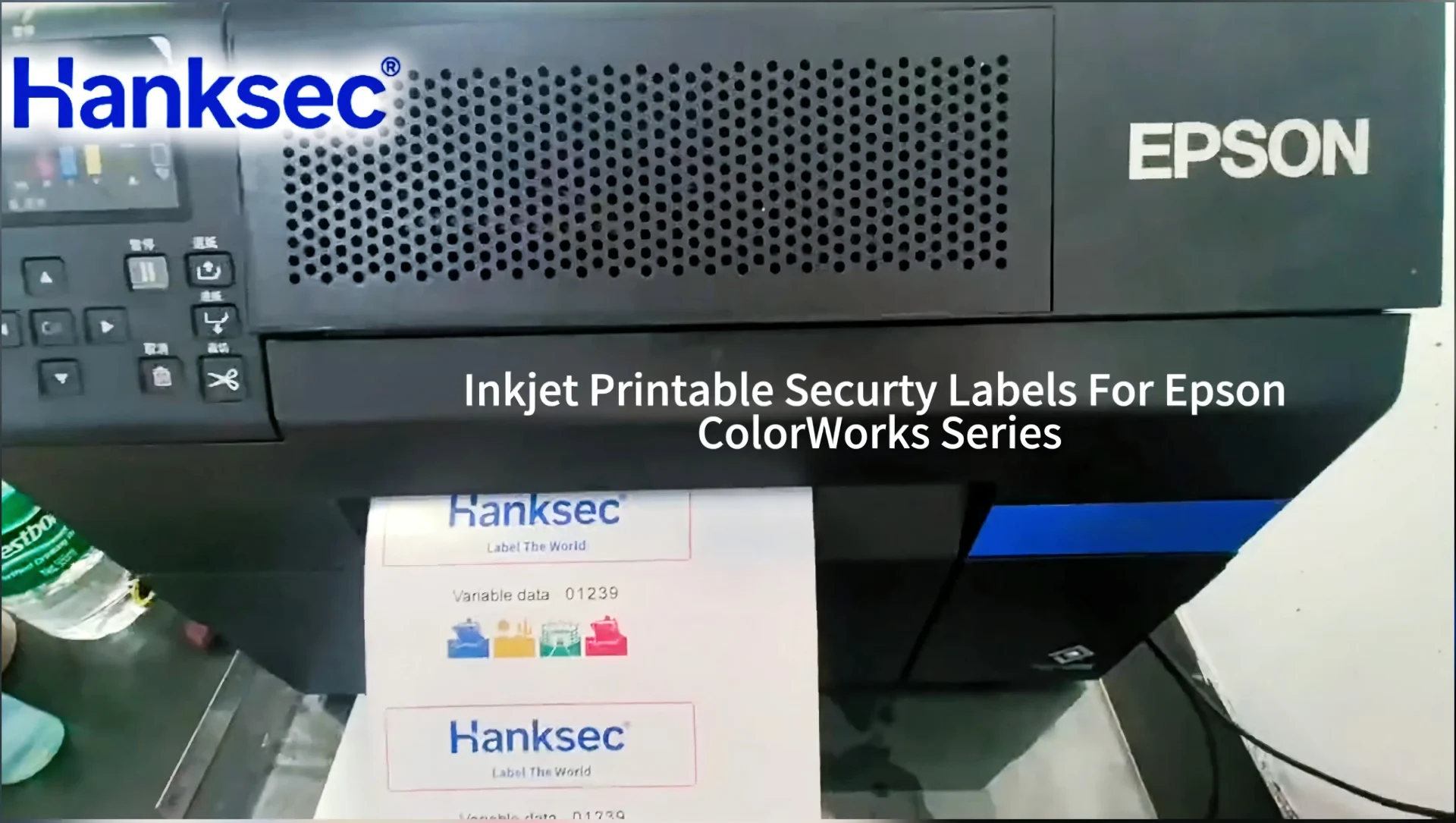
The improvements we evaluate include:
- more stable image formation;
- better text definition;
- reduced smearing during rubbing;
- improved ink anchorage;
- better scratch resistance;
- more consistent variable information.
This before-and-after pigment inkjet test was also documented in the original Hanksec VOID label inkjet printing test on LinkedIn.
However, the testing should not stop here.
After solving the printing-surface problem, the security material still needs to be converted and applied to the intended substrate.
The final question becomes:
Does the printed material still provide the correct tamper response?
Standard Security Material vs Pigment-Inkjet Coated Security Material
| Evaluation Item | Standard / Unqualified Surface | Pigment-Inkjet Coated Surface |
|---|---|---|
| Initial Printing | May appear acceptable | Designed for controlled ink reception |
| Ink Anchorage | May be weak | Improved after proper matching |
| Rub Resistance | Smearing or removal may occur | Better resistance after qualification |
| Small Text | May lose definition | More stable fine-text reproduction |
| Barcode / QR | May require additional verification | Better potential for stable edge definition |
| Scratch Resistance | May be insufficient | Can be improved with the correct coating |
| VOID Performance | Depends on security construction | Still requires independent tamper testing |
The last row is especially important.
A printable coating solves a printing-interface problem.
It does not replace the VOID or destructible security mechanism.
The Same Problem Can Occur With Destructible Security Materials
Inkjet-print compatibility is not limited to PET VOID films.
Destructible security materials can present an even more challenging converting problem.
These materials are intentionally designed to fracture or break during removal.
Depending on the construction, the facestock may therefore be:
- thin;
- brittle;
- highly destructible;
- sensitive to web handling;
- difficult to remove intact after application.
But destructibility does not automatically create a pigment-inkjet printable surface.
A standard destructible film can still experience:
- weak ink adhesion;
- smearing;
- poor scratch resistance;
- unstable variable information.
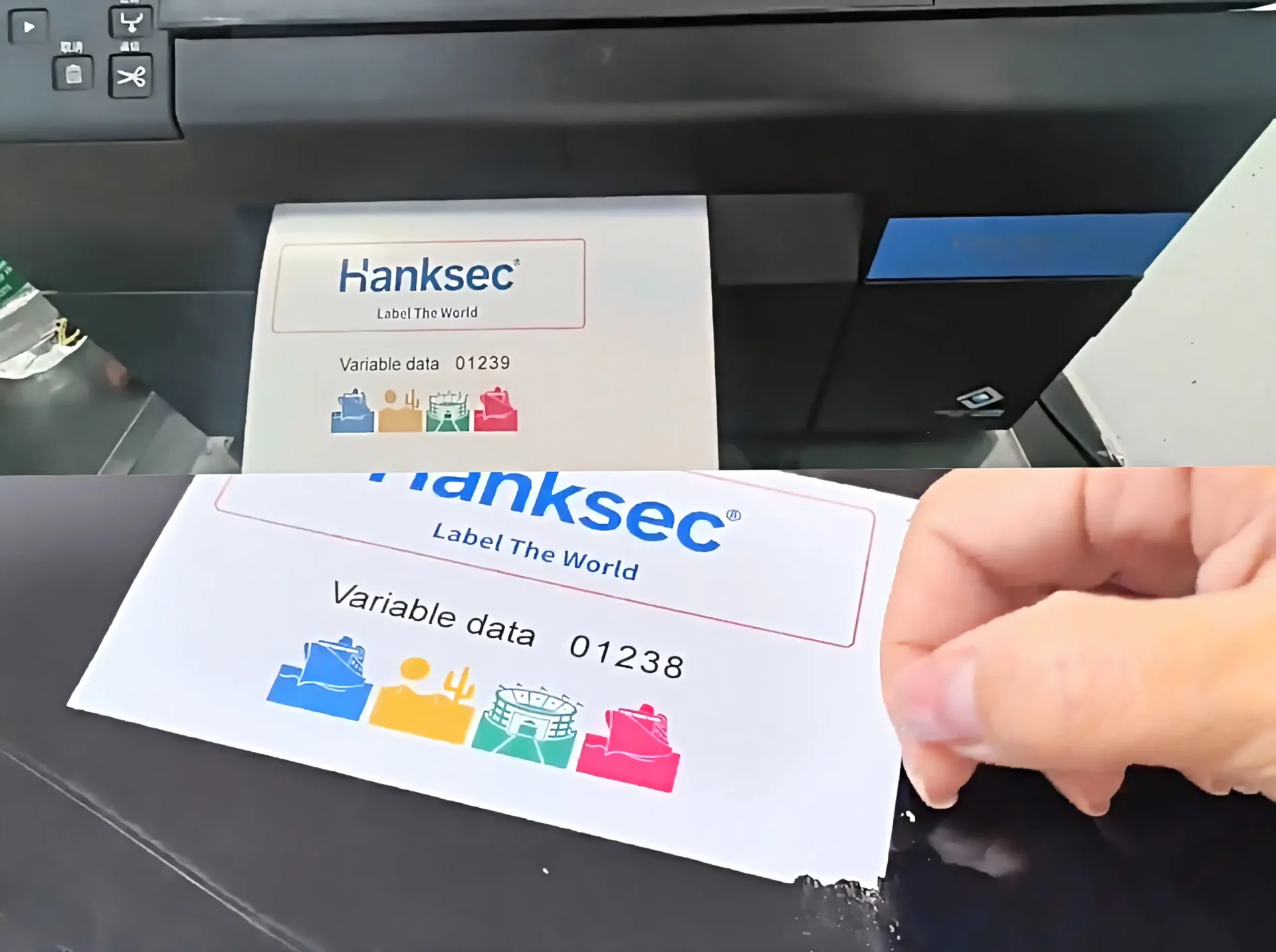
Hanksec documented the same print-surface compatibility issue in a separate destructible-material pigment inkjet test. Standard destructible security material may show weak print durability or smearing when the surface is not matched to the intended ink system. See the original Hanksec destructible-material inkjet printing test on LinkedIn.
This is why Hanksec also evaluates special printable coatings on destructible security-material constructions.
For applications involving eggshell-style, ultra-destructible or other fragile security facestocks, printability and destructibility have to be balanced together.
More information about the security mechanism itself is available in our Destructible Label Materials Guide.
Why Pigment-Inkjet Security Labels Should Be Tested After Rubbing and Handling
Visual appearance directly after printing is only the first checkpoint.
A printed security label may experience multiple mechanical contacts before it reaches the final customer.
For example:
printing → rewinding → slitting → die cutting → matrix stripping → dispensing → application → packing → transportation → handling.
If ink adhesion is marginal, these processes can reveal problems that were not visible immediately after printing.
A practical qualification should therefore include an appropriate rub or abrasion check.
The purpose is not to invent an unrealistic destructive test.
The purpose is to determine whether normal handling or the expected use environment can remove or damage critical printed information.
This is particularly important if the print contains:
- serial numbers;
- batch codes;
- barcodes;
- QR codes;
- product authentication information;
- warranty information.
Barcode and QR Code Printing on Inkjet Security Materials Requires More Than Good-Looking Artwork
A barcode or QR code should not be approved only because it looks sharp to the human eye.
Machine-readable information depends on several variables.
These include:
- contrast;
- edge definition;
- module consistency;
- quiet zones;
- surface reflectance;
- gloss;
- smearing;
- scratching;
- final substrate condition.
GS1 guidance emphasizes that barcode quality can be affected by poor contrast, excessive reflectance, substrate variation and physical defects such as smearing or scraping.
This matters especially on security materials such as:
- silver PET;
- transparent PET;
- holographic films;
- high-gloss security facestocks.
On some constructions, an opaque white background may be useful behind a barcode or QR code to improve optical contrast.
The final machine-readable code should therefore be verified on the finished security material rather than only on a white artwork proof.
This is also relevant to applications combining physical security and digital identity. For a broader explanation, see our Digital Product Passport Security Labels Guide.
Why White, Silver and Transparent VOID Films Behave Differently in Pigment Inkjet Printing
Security-material color and finish can affect the appearance of the printed image.
White VOID Film
A white face provides a relatively neutral visual background.
This can make text, graphics and machine-readable information easier to design.
Silver VOID Film
Silver surfaces can influence:
- apparent color;
- contrast;
- scanner reflectance;
- visibility of small text.
A white printed background may therefore be considered where strong barcode or brand-color contrast is required.
Transparent VOID Film
On clear labels, the final package surface becomes part of the visible artwork.
A transparent security label placed on:
black plastic,
white carton,
glass,
silver metal
will not look identical.
Artwork qualification should therefore use the real application substrate whenever possible.
Common Pigment Inkjet Printing Failures on Security Labels
| Observed Problem | Possible Cause | What to Check |
|---|---|---|
| Text rubs off | Weak ink anchorage | Printable coating and material compatibility |
| Ink smears | Poor surface fixation | Surface chemistry, ink reception and drying |
| Solid color looks uneven | Wetting inconsistency | Surface treatment and coating uniformity |
| Small text looks soft | Ink spreading | Coating, resolution and printing settings |
| Barcode scans inconsistently | Contrast or edge defects | Print definition and final verification |
| Print scratches during converting | Insufficient durability | Coating and curing / drying condition |
| Good print but poor VOID response | Security system not independently qualified | Final tamper test |
| Good VOID response but poor print | Security film not optimized for inkjet printing | Printable top surface |
These examples show why troubleshooting only the printer settings may not solve the root problem.
Strong Ink Adhesion Does Not Automatically Mean Good Tamper-Evident Performance
This point is especially important for buyers sourcing security materials.
Suppose Material A produces an extremely durable printed image.
That is good.
But if the security layer fails to activate correctly during removal, Material A may still be unsuitable as a tamper-evident label.
Now suppose Material B creates an excellent VOID message.
But the serial number can be rubbed off during normal handling.
Material B is also unsuitable for a serialized security application.
The correct target is therefore not to maximize one property in isolation.
The target is a balanced system:
Print Adhesion + Machine Readability + Converting Stability + Adhesive Performance + Tamper Response.
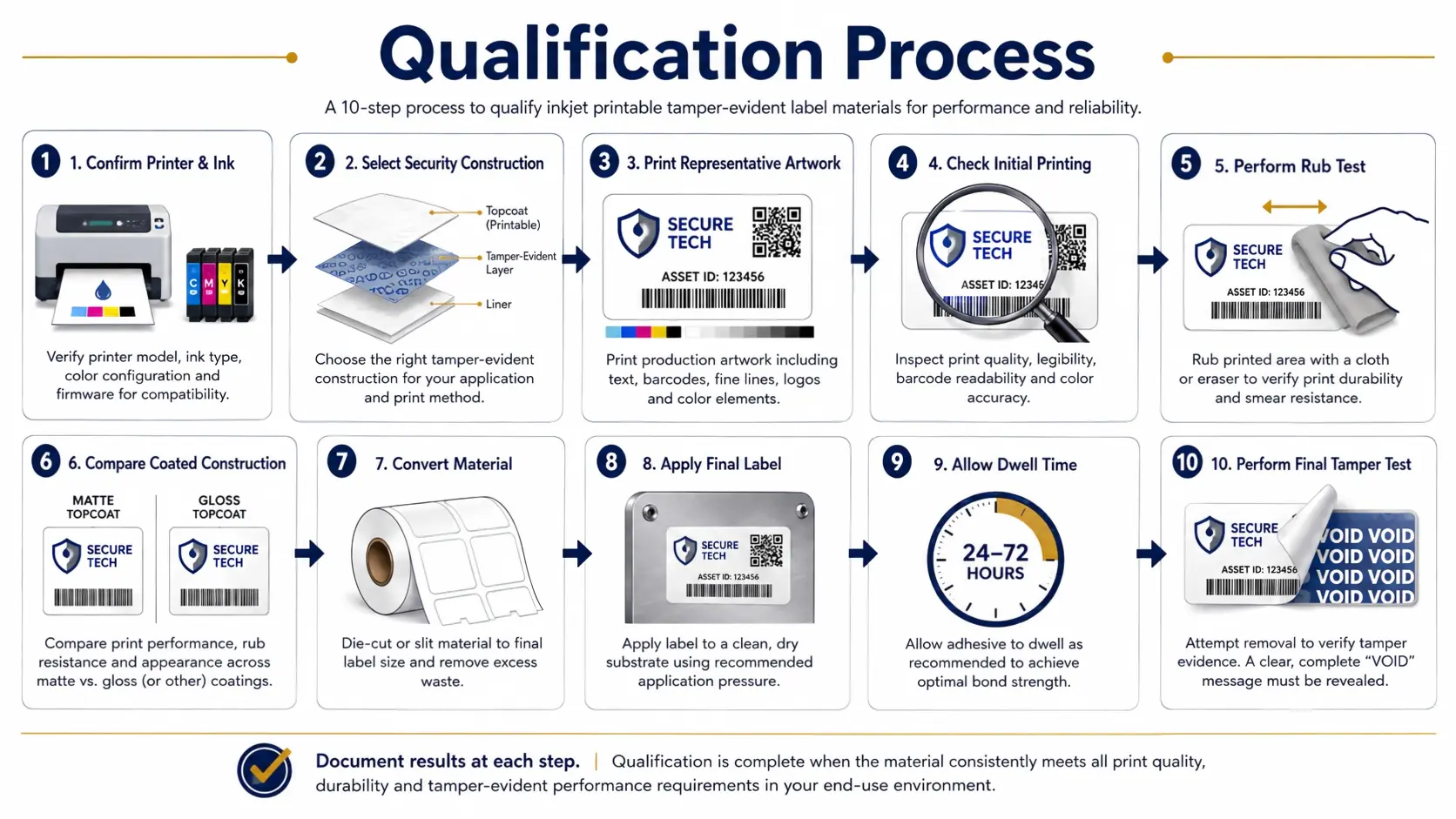
Hanksec Pigment Inkjet Security Label Qualification Process
For pigment-inkjet projects, we recommend evaluating a complete production sequence instead of approving only an unprinted sample.
Step 1 — Confirm the Printer and Ink System
Provide the exact printer family or model where possible.
For the testing discussed in this guide, Hanksec used an Epson ColorWorks pigment-inkjet platform.
Step 2 — Select the Security Construction
Define whether the project requires:
- full-transfer VOID;
- partial-transfer VOID;
- non-transfer VOID;
- destructible material;
- transparent security film;
- white or silver security film.
Buyers comparing VOID structures can review our Tamper Evident VOID Label Materials.
Step 3 — Print Representative Artwork
Do not test only one large black rectangle.
The test file should represent the real production job and may include:
- small text;
- solid color;
- fine lines;
- serial number;
- barcode;
- QR code;
- logo;
- variable information.
Step 4 — Check Initial Printing
Observe:
- wetting;
- image density;
- edge definition;
- smearing;
- surface drying.
Step 5 — Perform a Practical Rub Test
Evaluate whether important printed information remains stable under representative handling.
Step 6 — Compare the Coated Construction
When an unqualified surface fails, the modified printable construction can be printed under comparable conditions.
This allows the converter to evaluate the effect of the surface treatment rather than changing several process variables at the same time.
Step 7 — Convert the Material
Where applicable, test:
- die cutting;
- matrix stripping;
- slitting;
- rewinding;
- automatic dispensing.
Step 8 — Apply the Final Label
Use the actual application surface where possible.
Examples include:
- coated carton;
- recycled carton;
- PET;
- PP;
- glass;
- painted metal;
- electronics housing.
Step 9 — Allow Representative Dwell Time
Immediate adhesion and aged adhesion may be different.
Step 10 — Perform the Final Tamper Test
Evaluate:
- VOID or OPENED clarity;
- transfer behavior;
- film condition;
- destructible response;
- reapplication behavior;
- printed-image condition after removal.
Only after these stages should the complete material construction be approved for bulk production.
Blank Inkjet Printable Security Label Materials for Label Converters
Hanksec supplies inkjet printable label materials not only as finished security labels but also in unprinted roll formats for label converters, printing companies and security-label manufacturers that perform their own printing, die cutting and variable-data production.
Depending on the project, material can be evaluated for supply as jumbo rolls, slit rolls or other converter-ready formats. Buyers comparing roll formats, transfer types and converter specifications can also review our VOID Label Material Rolls Selection Guide.
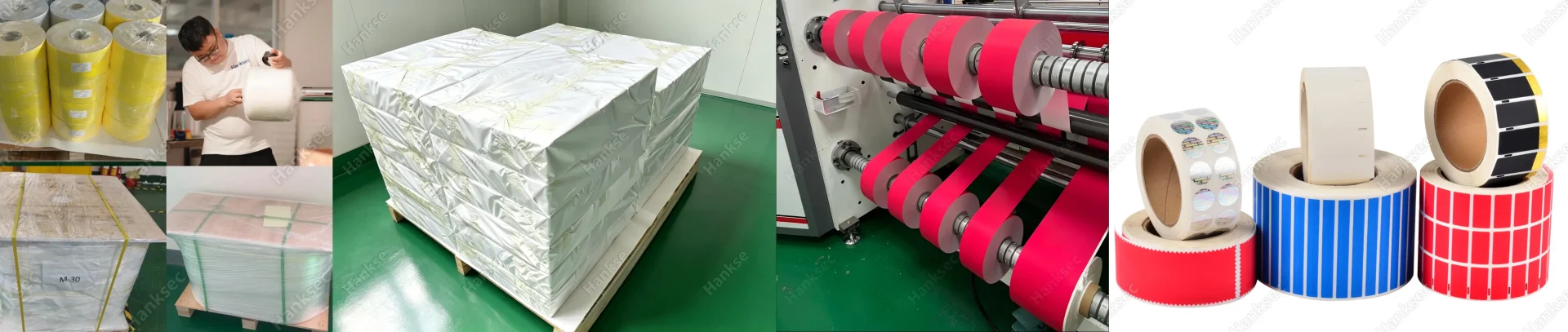
Typical material requirements may include:
- unprinted printable VOID material;
- pigment-inkjet-compatible PET security material;
- printable destructible security material;
- full-transfer, partial-transfer or non-transfer structures;
- clear, white or silver facestock;
- custom VOID or OPENED messages;
- specific adhesive and liner combinations;
- custom roll width and winding direction.
Converters sourcing fragile security facestocks can also review Hanksec’s Destructible Label Materials for available material constructions.
For a label converter, the key purchasing question is therefore not simply whether a finished blank label is available. It is whether the security label material can be printed, die-cut, rewound and converted reliably on the converter’s own production equipment.
What Should a Converter Send Before Requesting Inkjet Printable Label Materials?
A request such as:
“Send us inkjet printable VOID material.”
does not provide enough information for a precise recommendation.
| Required Information | Example |
|---|---|
| Printer Brand | Epson ColorWorks |
| Printer Model | C6000 Series or exact model |
| Ink System | Pigment Ink |
| Security Material | VOID / Destructible |
| Material Color | White / Silver / Clear / Custom |
| Transfer Requirement | Full / Partial / Non-Transfer |
| Printed Information | CMYK / Text / Barcode / QR / Serial |
| Label Size | Final converted size |
| Application Substrate | Carton / PET / PP / Glass / Metal |
| Environment | Normal / Hot / Cold / Humid |
This information helps the manufacturer recommend a realistic trial sample instead of supplying a generic security film.
Does This Pigment-Inkjet Principle Apply Only to Epson ColorWorks?
No. The Epson ColorWorks testing in this guide is a first-party example of aqueous/pigment inkjet compatibility. The same material-interface principle also applies to other aqueous or pigment inkjet platforms: the printable surface must be matched to the actual ink chemistry and production conditions.
However, UV inkjet, flexographic printing, thermal transfer, dry-toner and other digital processes use different ink, ribbon, curing or media-preparation requirements. They should be qualified separately rather than treated as extensions of the Epson pigment-inkjet test.
Converters comparing multiple printing technologies can review Hanksec’s Printable Security Label Materials Guide for UV, flexographic, thermal-transfer and broader digital-printing compatibility.
Where a Security Material Manufacturer Adds Value in Pigment-Inkjet Projects
For an ordinary commercial label, the converter may mainly focus on:
printing, die cutting and adhesion.
A tamper-evident label adds another functional system.
The finished material may contain:
printable coating + facestock + release layer + hidden security pattern + adhesive + release liner.
Each layer has a different job.
For this reason, a security-material manufacturer should be able to help answer questions such as:
- Is a special pigment-inkjet coating required?
- Does the material need Full, Partial or Non-Transfer VOID?
- Does the customer need clear, white or silver PET?
- Will the label carry barcodes or QR codes?
- Does the material need destructible behavior?
- What substrate will the final label be applied to?
- Can the construction be die-cut reliably?
- Will it run through the customer’s dispensing equipment?
- Does the printed information survive realistic handling?
- Does the security effect remain correct after printing?
Hanksec develops and tests different tamper-evident security material constructions around actual printing and application requirements.
Available project directions include:
- full-transfer VOID materials;
- partial-transfer VOID materials;
- non-transfer VOID materials;
- printable PET security films;
- destructible security materials;
- custom VOID and OPENED patterns;
- variable-data security labels;
- custom adhesive matching;
- jumbo-roll and slit-roll supply.
The objective is not to describe one film as universally compatible.
The objective is to identify the material construction that should be tested on the customer’s real printer and final application.
Conclusion: “Inkjet Printable” Is Not Enough for a Security Label
The Epson ColorWorks test demonstrates a simple but important lesson.
A printer can successfully place an image on a security film while the material still fails a practical print-durability test.
That is why security-material printability should not be judged only by the first printed sample.
Production-ready inkjet printable label materials should be evaluated for:
ink reception + ink adhesion + rub resistance + barcode quality + converting + application + tamper response.
The printable coating controls one important interface.
The VOID or destructible system controls another.
The adhesive controls the connection to the final substrate.
Good security-label engineering requires all three systems to work together.
This is the difference between:
a security film that can be printed
and
a security material that can be reliably printed, converted and used in production.
Request an Inkjet Printable Security Material Test
Using an Epson ColorWorks or another pigment inkjet label printer for tamper-evident labels?
Send Hanksec:
- printer brand and model;
- ink type;
- required VOID or destructible construction;
- material color and finish;
- barcode / QR / serial-number requirements;
- label dimensions;
- application substrate;
- expected environment;
- estimated volume.
Our team can recommend an appropriate printable security-material construction for evaluation before bulk production.
REQUEST INKJET PRINTING COMPATIBILITY SAMPLES
FAQ: Inkjet Printable Label Materials
Can inkjet printable label materials be used with Epson ColorWorks printers?
Yes. Suitable security label materials can be printed with Epson ColorWorks pigment inkjet printers when the printable surface is compatible with the ink system. Standard PET, VOID or destructible materials without an appropriate inkjet-receptive coating may show weak ink adhesion, smearing or poor rub resistance.
Why does pigment ink rub off some VOID security label materials?
Pigment ink can rub off when the surface of the VOID material is not properly matched to the ink system. The security film may still produce a correct VOID effect, but without a suitable printable coating the ink may have insufficient anchorage and can smear or be partially removed during handling.
What does an inkjet-receptive coating do on security label materials?
An inkjet-receptive coating creates a more suitable interface between the security material and the ink. A properly matched coating can improve ink reception, image definition, pigment anchorage, rub resistance, scratch resistance and the stability of printed text, barcodes and QR codes.
Does a printable coating affect the VOID or tamper-evident function?
The printable coating and the tamper-evident system perform different functions, but they are part of the same multilayer material construction. After changing or adding a printable coating, the finished material should still be tested to confirm that the required full-transfer, partial-transfer, non-transfer or other tamper response remains correct.
Can destructible security label materials be printed with pigment inkjet printers?
Yes. Destructible security label materials can be developed with pigment-inkjet-compatible printable surfaces. However, print adhesion, rub resistance, die-cutting performance and destructibility should all be evaluated because the facestock is intentionally designed to fracture during removal.
Can barcodes and QR codes be printed on inkjet printable security label materials?
Yes. Barcodes, QR codes, serial numbers and other variable information can be printed on suitable inkjet printable security label materials. The finished labels should be checked for contrast, edge definition, reflectance, smearing and scan performance, especially on silver, transparent or high-gloss security films.
Do white, silver and transparent security label materials print differently?
Yes. White materials provide a relatively neutral printing background, while silver and transparent films can affect color appearance, contrast and scanner reflectance. The final artwork and machine-readable codes should therefore be tested on the actual material and application surface.
Should inkjet printable label materials be tested before bulk production?
Yes. Before bulk production, the material should be tested with the actual printer and representative artwork, followed by checks for ink adhesion, rub resistance, barcode or QR readability, die cutting, rewinding, application and final tamper-evident performance. Approval should be based on the complete printed and converted construction rather than the unprinted material alone.